
My Mother-in-Law Called Me a Faker in Court—Then an Army Doctor Stood Up and My Husband Stopped Smiling
I walked into family court hoping to keep my seven-year-old daughter safe, but my mother-in-law pointed at me and announced that I was faking another illness while my husband laughed beside his attorney; minutes later, my knees buckled and a uniformed military doctor demanded an ambulance, turning the entire courtroom silent, yet the hospital discovery was only the first crack in their story, because my daughter had been carrying a secret in her school backpack that could expose what my husband had planned all along.
Part 1
My husband smiled when I asked the judge for a chair. It was the satisfied smirk Colin Archer wore whenever he believed he’d won. His mother, Judith, sat directly behind him in a cream cardigan, dabbing the corners of perfectly dry eyes with a folded tissue. I was standing at the witness rail, trying to explain why our seven-year-old daughter, Ruby, cried every Sunday before visiting her father’s house. The folder trembled against the rail, its metal clasp cold against my thumb.
The Dayton courthouse smelled of floor polish and burnt coffee. I’d barely slept, organizing records while my legs kept trembling. My own lawyer had withdrawn after our joint account was emptied and I couldn’t keep up with payments. No brochure had prepared me to defend myself, especially after Colin used my hospital visits to claim I was an unreliable mother.
“Mara has always exaggerated,” Colin told Judge Elena Alvarez, with easy confidence. “When things don’t go her way, she gets dizzy or needs to lie down.” Judith nodded from the first row and said loudly, “She’s doing it right now.” I’d brought Ruby’s drawing of two houses beneath a thundercloud, but the folder slipped in my trembling hands.
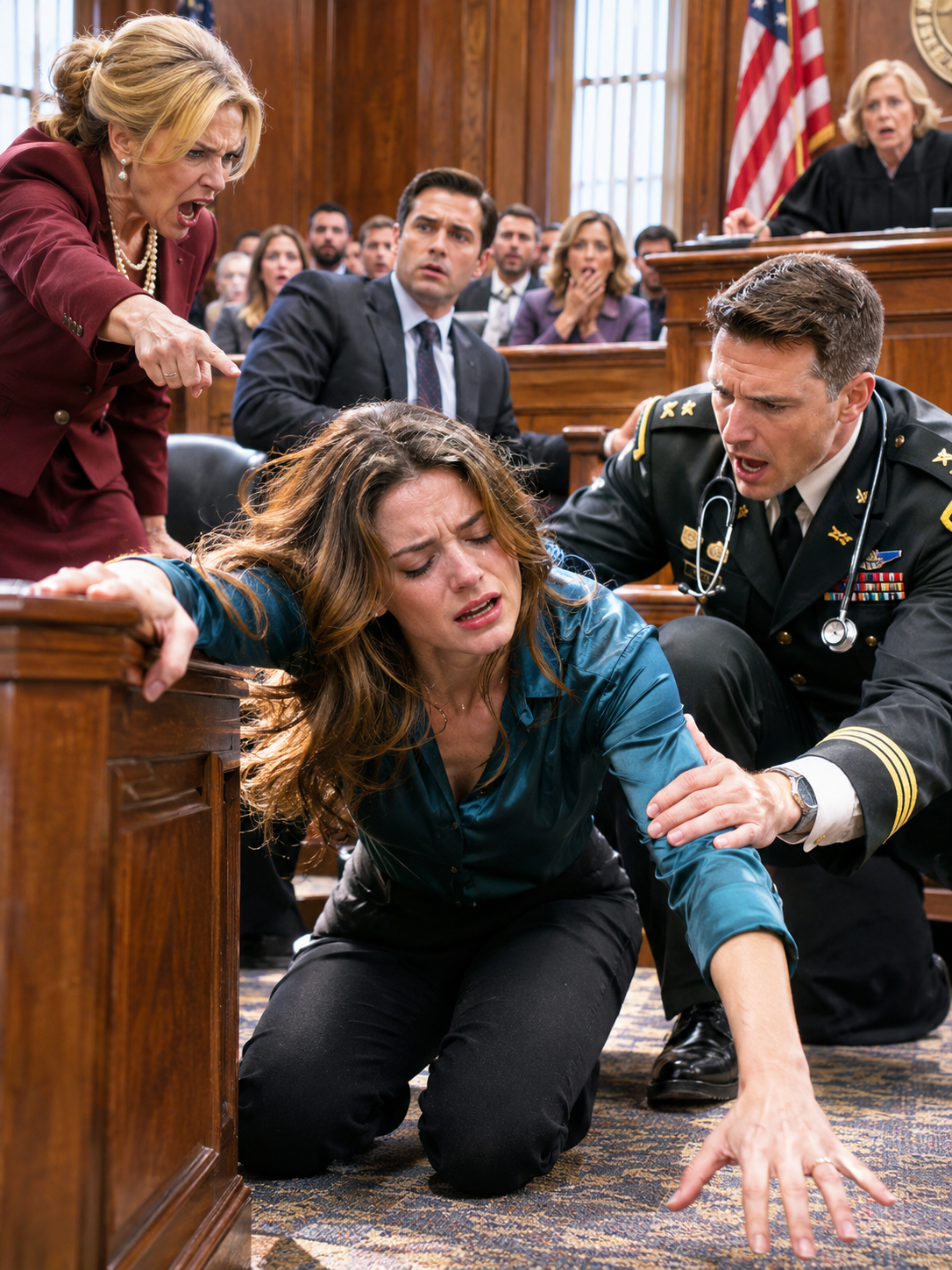
“Mrs. Archer, do you need a recess?” Judge Alvarez asked. I’d spent months expecting impatience from everyone. “Just one minute,” I managed, gripping the rail as the room shifted sideways. Colin laughed under his breath, and Judith said, “See?” The next thing I knew, the polished floor was against my cheek and somebody was shouting for people to move.
A man in an Army dress uniform came down the aisle and knelt beside me, his shoes squeaking on the tile. His name tag read BELL. “I’m Major Nathan Bell, a physician,” he said to the court, then turned back to me. “Mara, can you hear me?” When Colin insisted I did this all the time, the major didn’t even glance his way; he checked my responsiveness and told the bailiff, “Call 911. Now.”
Benches scraped aside as Judge Alvarez cleared space for the responders. Colin approached with his hands out, wearing the concerned expression he’d perfected during my previous hospital visits, but the major quietly told him to step back while the professionals worked. I remember thinking that Colin looked less worried about me than about the people watching him.
At the hospital, ceiling tiles slid past my stretcher. When I woke properly, my sister Tess was sitting beside the bed, holding Ruby’s purple hair tie in her fist. “She’s with me,” Tess said before I could ask, and something inside my chest loosened. A child advocate had arranged to postpone Ruby’s exchange with Colin pending an urgent review, though Tess still couldn’t say what the judge might decide next.
I told Tess Colin would call my collapse proof I couldn’t care for Ruby. She reached across the blanket and turned my phone facedown when a message from him lit up the screen. “You don’t have to explain being sick to me,” she said. An ambulance siren faded outside; I was defending Colin without him even being there.
That evening, Dr. Valeria Ibarra said my tests showed something more than anxiety. She asked who helped manage my daily health supplies and whether anyone besides me had access to my kitchen and bathroom. I told her Colin used to insist on organizing everything because I was, in his words, “forgetful.” Two weeks earlier, he’d collected Ruby’s jacket, leaving a cabinet open behind him.
Dr. Ibarra didn’t accuse anyone. She requested confirmation testing and involved the hospital’s safety team. Before she left, she showed me one preliminary result: an unexpected substance in my system that I had never knowingly taken. I stared at the screen until the numbers blurred, because for months I’d been asking what was wrong with me, and now I had to ask a much worse question: who had wanted me to stay that way?
Part 2
The next morning, I watched Ruby’s purple hair tie looped around my wrist. I was stabilizing, but even unopened meal trays made me uneasy. Tess sat close, holding cafeteria oatmeal whose cinnamon smell reminded me of the breakfasts I used to make before my hands started shaking. “We can find out what happened without deciding the answer today,” she said, and I held on to that.
Simone Park arrived with a gray notebook. A child specialist would speak privately with Ruby, who was building a fort at Tess’s house. “Ruby keeps asking whether you’ll be alone tonight,” Simone said. I remembered Ruby begging me to call Tess on Sundays if I felt weak.
I’d assumed Ruby dreaded visiting Colin; now I wondered if she feared leaving me. Simone asked whether Ruby had ever said anything strange about my recent illnesses, and a memory surfaced: Ruby standing beside the kitchen sink, asking why Grandma Judith always wanted to know whether I’d finished my tea. I’d brushed it off, wiping soap bubbles from Ruby’s hands while Judith watched us from the doorway. The thought of that careless answer made my stomach hurt.
I described the open cabinet, my unexplained falls, and Colin speaking for me at hospitals. She wrote carefully and promised not to interrogate Ruby or treat a child’s guesses as proven facts. Colin had spent years correcting my memories in public, even once claiming I’d forgotten an entire family dinner when I had been home sick. I didn’t want anyone doing the same to our daughter.
Major Bell visited that afternoon to discuss his court statement. In plain clothes, he stood politely by the doorway. “Thank you for believing me,” I said. He shook his head gently. “I responded to what I could see. Your symptoms needed urgent attention, regardless of anyone’s opinion.” His calm answer made me feel less ashamed, and when he stepped aside to let a nurse enter, I noticed he never once tried to answer for me.
Colin began sending messages that night. He offered a blanket, accused Tess of interfering, then threatened to use the postponed exchange against me. My phone flashed against the blanket until I silenced it; each buzz felt like the start of another argument I was too exhausted to survive. Tess saved the messages and found a legal-aid attorney, Leah Morgan.
Leah explained that the medical finding couldn’t identify a culprit without evidence. She arranged to preserve the hospital records and ask the court for temporary protections while an investigation proceeded. Finally, someone offered a plan: independent medical review, financial records, and a safe place for Ruby while the court weighed the facts. But why would Colin want me ill?
Then Tess handed over our bank statements. Colin had transferred thousands from our joint account before my attorney withdrew. I’d thought we were simply struggling through an ugly separation; now the timing looked deliberate. Leah circled the dates with a blue pen and said, “We’ll have the financial records reviewed, too.” The circles frightened me, especially one transfer dated the morning he told me to cancel a medical appointment because money was tight.
That evening Simone called with news from Ruby’s interview. Ruby had mentioned a family-history recording assignment on her purple tablet. She said she had left the device running while visiting Judith and later heard grown-ups discussing “Mommy being wobbly.” Ruby usually used that tablet to record birds outside the window, not conversations, and Simone had secured it for review without making her replay anything. I pressed the phone against my ear and asked whether the audio was clear.
“We haven’t verified everything yet,” Simone answered, “but there is a conversation we need your attorney to hear.” I touched Ruby’s purple hair tie, remembering how she’d once asked me to promise I wouldn’t sleep through her next phone call. She had been trying to understand my falls. And somewhere inside that little device was a voice I was terrified to recognize.
Part 3
Ten days later, the temporary hearing began after investigators preserved Ruby’s tablet. Leah sat beside me with her legal pad. Colin arrived in a navy suit, smiling at the clerk as if nothing had happened, while Judith wore the same cream cardigan from the day I collapsed. Judith’s hands shook as she adjusted her purse, and I wondered whether she feared the truth or merely the consequences.
Judge Alvarez clarified the hearing’s limits. The hearing concerned Ruby’s immediate safety, not criminal guilt; questions about the unexpected substance and anyone’s responsibility would be handled separately. Colin’s attorney argued illness alone couldn’t determine custody. Leah agreed that illness didn’t make me incapable, then asked the court to consider evidence that someone had deliberately used my illness to discredit me, turning my genuine need for treatment into a legal weapon.
Specialists had examined and documented the recording. Ruby’s quiet humming came first, followed by the scrape of a drawer and Judith saying, “She’s changed the locks.” Colin answered, “I still get inside when Ruby needs something.” I remembered the Sunday he’d retrieved a jacket, and the way he’d insisted I stay seated while he searched the back hallway.
Judith asked, “What if she gets worse before the judge?” Colin replied, “Then they’ll finally see what I’ve been saying about her.” He said he’d seek primary custody and a quick settlement if I appeared helpless. Judith sounded uneasy, asking whether the situation was getting out of hand. Colin’s answer was flat: “She’ll be fine once this is over. She just needs to stop fighting.”
No one spoke when the clip ended. The words didn’t explain every test, but exposed the strategy behind his accusations. Leah submitted the bank records and highlighted the pattern of access, unexplained illness, and attempts to undermine my credibility. Across the room, Colin watched the tabletop instead of looking at the judge, his thumb rubbing a pale spot where his wedding ring used to be.
For Ruby, the court ordered temporary residence with me, while Colin’s contact was restricted and reviewed under safeguards appropriate to the developing evidence. Neither could move Ruby out of Ohio without approval. Outside the courthouse, Colin caught sight of me near the elevators and said, “You’ve turned our daughter against me.” I met his eyes. “She was frightened, Colin. You were too busy building a case against me to notice.”
During the hearing, Judith had asked to speak, but Judge Alvarez directed her to consult counsel before making any statement. Through her attorney later that week, she provided information to investigators and acknowledged helping Colin portray my health crises as exaggerations. Further evidence connected them to interference with my health supplies. The investigation continued, but uncertainty was giving way to facts; I kept every report in a new folder labeled with my own name.
That evening after the hearing, Colin had messaged me saying he only wanted to keep the family together. Another message followed twenty minutes later: “You know Mom pushed everything too far.” Now he blamed her for everything. I saved the messages and watched Ruby sort colored pencils. My daughter didn’t ask about court; she asked whether I’d still be home when she woke up.
“Yes,” I told her, and she set down a purple pencil. After a long silence, she whispered, “I thought grown-ups wouldn’t believe me unless I had a recording.” I pulled her close and said she could tell me whenever something felt wrong, with or without proof, even if she wasn’t sure. She nodded, still uncertain, then asked if she could throw away the tablet because she never wanted to hear that conversation again.
The next day Leah called with one more discovery from the financial review: Colin had drafted a settlement proposal before my first collapse, outlining custody and property terms he intended to offer once I appeared unwell. I read the date twice. Whatever apology he might offer now, the paper in front of me showed this hadn’t been a single terrible argument. It had been a plan.
Part 4
Colin and Judith faced charges after the investigation. Both entered guilty pleas; I followed the proceedings through official updates. The divorce and parenting orders took longer, through interviews and exhausting assessments. When the papers finally arrived, Colin had no direct contact with us outside what the court expressly permitted, and the financial settlement addressed the money he’d diverted.
Judith wrote on perfumed stationery, claiming she’d feared losing Colin’s affection and regretted her cruelty. At the bottom she wrote, “I hope one day you’ll forgive me.” I folded the pages and put them away. Regret didn’t give her a place in my life, and I no longer confused a late confession with the kind of change that could earn trust.
Colin’s letter arrived through the lawyers a month later. He recalled vacations and teaching Ruby to ride a bicycle. Then he wrote that he wanted us to remember him as the man he had been before things went wrong. He still wanted to control which version of him I remembered, as though the man who brought me birthday flowers could somehow erase the one who laughed when I collapsed.
The most difficult part of recovery wasn’t the legal paperwork. A kettle clicking off could still send my pulse racing. Tess noticed me freeze, unplugged it without a word, and offered to make cocoa instead. Slowly, my kitchen felt like mine again, though I still preferred making breakfast with Tess nearby and the windows wide open.
Ruby returned to school with a new backpack and a counselor she trusted. Some mornings she talked; others she complained about cafeteria pizza. We kept the difficult conversations honest but age-appropriate, and I made sure she knew she hadn’t been responsible for protecting me. When she asked about her father, I said love never excused cruelty, and that grown-ups were responsible for their own choices no matter whom they claimed to love.
I found steady work and opened my own account. Tess helped me paint the kitchen a soft yellow, the color Ruby chose because it looked like sunshine on a winter morning. We hung her school drawings beside the refrigerator and replaced the old kettle with a blue one from a thrift store. I hadn’t made choices freely in years, so even deciding where to hang a crooked drawing felt like reclaiming a small piece of my ordinary life.
Major Bell stopped by once before transferring to another assignment. He gave Ruby a whistle and told her making noise could be brave. She tilted her head and said, “I already made noise.” He smiled and answered, “Yes, you did.” I thanked him; he credited the work we’d done afterward, and I appreciated that he never treated himself like the hero of a story that belonged to Ruby and me.
Almost two years after my collapse, Ruby found the family-history worksheet that had started her recordings. She’d called me brave for making breakfast despite being sick. On the back was a sentence that stopped me: “I hope Mommy learns to listen when her own body says something is wrong.” I smiled through tears. I’d learned, but I wished she hadn’t been the one to teach me while she was still so young.
For her tenth birthday, we drove past the courthouse on the way to a small diner. She asked if the building frightened me. Sometimes it did. “Then why take this road?” she asked, looking at the tall windows. I said one bad memory couldn’t own the street. She squeezed my hand, then announced that surviving the drive entitled her to extra whipped cream, and I laughed loudly enough to surprise myself.
That evening, rain streaked the yellow kitchen windows while Ruby worked on homework beneath her framed worksheet. I filled the blue kettle and set out our mugs, taking my time while the rain ticked against the glass and Ruby’s pencil scratched across her math worksheet. When she asked if I was okay, I glanced around our quiet kitchen. “I am,” I said, and for the first time, those words didn’t need anyone else’s permission to be true.
Legal Notice: This story is a work of fiction. Names, characters, businesses, events, and incidents are the product of the author’s imagination or are used fictitiously. Any resemblance to actual persons—living or dead—or to actual events is purely coincidental. Thank you! 💓


