
My Mother Banned My Kids From Grandpa’s 80th Birthday—Then Handed Me a $2,670 Restaurant Bill
Six hours before my grandfather’s eightieth birthday dinner, my mother sent me a message that made my stomach turn. “Don’t bring your children. They’ll embarrass us. And please don’t mention your pig farm.” I obeyed one part of her request and arrived alone at the most expensive restaurant in town. Halfway through dinner, the executive chef walked out and revealed something my mother desperately wanted hidden. But the real humiliation came when my father pushed a $2,670 bill toward me—and I finally did something my family never expected.
Part 1
The first thing I noticed about my mother’s message was that she hadn’t bothered to say hello. I was standing inside the refrigerated packing room of my farm, checking an order for a downtown restaurant, when my phone vibrated against the stainless-steel counter. “Caleb, don’t bring Sophie and Jackson tonight. They’ll embarrass us in front of Walter’s guests. Also, please wear something decent and avoid talking about your pig business.” I read those three sentences twice while the refrigeration fans hummed above my head.
My name is Caleb Whitaker, and I’m thirty-eight years old. I own a forty-two-acre livestock farm outside Lancaster, Pennsylvania, where my employees and I raise heritage pigs and supply fresh pork to families, butcher shops, and several restaurants. My wife, Hannah, handles our accounting, and our two children, eleven-year-old Sophie and eight-year-old Jackson, spend weekends helping with age-appropriate chores. Apparently, that made us unsuitable company for my grandfather’s eightieth birthday.
I called my mother immediately, hoping she’d explain herself differently. “Mom, Grandpa specifically asked whether the kids were coming,” I reminded her, wiping my hands on a clean towel. “Caleb, this is BellaForte, not some backyard barbecue,” she answered, sounding irritated that I’d questioned her. “There will be influential people there, and I don’t need Jackson discussing livestock while someone is eating.”
That last comment wasn’t entirely imaginary. At Thanksgiving, Jackson had cheerfully informed my sister Paige that the ham on her plate had come from a pig he’d helped feed. Paige had put down her fork, and Mom had spent fifteen minutes explaining that sophisticated families didn’t discuss where their food originated. She’d conveniently forgotten that I’d donated the entire holiday meal.
“Then I won’t bring them,” I said, feeling something settle cold and heavy in my chest. My mother immediately brightened and reminded me that dinner started at seven, adding that my father appreciated everything I did for the family. I knew exactly what that meant. Over the last several years, whenever my parents organized an expensive celebration, I somehow became the person responsible for paying.
My older sister, Paige, sold luxury real estate and spoke constantly about commissions that never seemed to arrive. My younger brother, Derek, described himself as a business consultant, although nobody could identify a business that actually consulted him. Dad had retired early, while Mom maintained a country-club membership that apparently required everyone around her to pretend we were wealthier than we were.
That evening, Hannah watched me straighten my tie in our bedroom mirror. “You’re really going without the kids?” she asked, holding a lint roller against my charcoal jacket. I showed her the message, and her expression changed from confusion to something much harder. “Your grandfather gave you half his weekends for fifteen years, and she thinks your children would embarrass him?”
She wasn’t exaggerating. Grandpa Walter had taught me to repair fences, balance a checkbook, and shake someone’s hand without checking what kind of car they drove. When I decided to start farming professionally, he helped me purchase the original acreage and later transferred his remaining adjoining land into my name. He always said he’d rather see a field producing something useful than watch another developer turn it into identical houses.
Sophie appeared in our doorway carrying a handmade birthday card decorated with tiny watercolor tractors. “Can you give Grandpa this?” she asked, carefully handing it to me. Jackson stood behind her, holding a small wooden birdhouse he’d spent three weekends building. When I explained that they wouldn’t be attending, Sophie lowered her eyes and quietly asked whether Grandma was ashamed of us.
I couldn’t bring myself to answer.
At six-thirty, I placed the card and birdhouse inside a gift bag and drove toward Lancaster. BellaForte occupied a restored stone mansion with glowing windows, valet parking, and a dining room where one appetizer could cost more than a family’s groceries for a week. My mother’s silver sedan was already parked near the entrance, and I recognized Dad’s SUV beside it.
Inside, the hostess guided me past a marble staircase toward a private dining room. My mother stood near the entrance wearing a pearl necklace and a midnight-blue dress, greeting guests like she owned the building. When she saw me alone, her smile widened with unmistakable relief.
“Oh, Caleb,” she said, straightening my collar without asking. “You look wonderful. See what happens when you make an effort?”
Then I heard Grandpa’s voice from the other end of the room.
“Where are my great-grandchildren?”
And when I looked toward him, I realized he had already set two empty chairs beside his own.
Part 2
Grandpa Walter stood behind his chair with both hands resting on its carved wooden back. At eighty, he still had the broad shoulders of a man who’d spent most of his life outdoors, although his silver hair had thinned considerably. He glanced past me toward the doorway, clearly expecting Sophie and Jackson to come running inside. When nobody appeared, the excitement in his face disappeared.
“Where’s my crew?” he asked, pointing at the two empty seats. I crossed the room, hugged him, and placed the gift bag on the table. “They’re home with Hannah,” I answered, keeping my voice low. Grandpa studied my expression before asking, “Was that their decision or someone else’s?”
Mom appeared beside us before I could respond. “Dad, we discussed this already,” she said, pulling one of the empty chairs away from the table. “Tonight is a sophisticated adult celebration, and Caleb completely understands.” Grandpa watched her rearrange the place settings, then looked at me with an expression I remembered from childhood whenever he’d caught someone stretching the truth.
“I understand exactly what happened,” I told him. Before he could ask another question, Mom announced that everyone should take their seats because our distinguished guests had arrived. She steered us toward the table with the determined efficiency of someone directing traffic around an accident. Grandpa said nothing, but he didn’t smile again.
There were eleven adults altogether, including my parents, siblings, Grandpa, and several family acquaintances. Two guests received particularly enthusiastic attention: Lawrence and Diane Bennett, a retired banking executive and his wife who belonged to the same country club as my parents. Mom had spent weeks describing them as important connections, although nobody had explained what we were supposed to connect.
As the first course arrived, Lawrence asked everyone about their work. Paige immediately launched into a lengthy explanation of luxury properties, investment clients, and a beachfront condominium she hoped to sell. Derek followed with an elaborate description of strategic partnerships and operational efficiency. I listened while examining the beautifully arranged beet salad in front of me, wondering whether anyone besides me understood what my brother actually did.
When Lawrence turned toward me, Mom answered before I could open my mouth. “Caleb works in food distribution,” she announced with a polished smile. I set down my fork and looked directly at him. “I raise heritage pigs and operate a farm-to-table meat business,” I clarified.
For a moment, Mom’s fingers tightened around her wineglass. Then Lawrence leaned forward with genuine interest and asked how much pasture each animal received. I explained our rotational grazing system, our relationships with local processors, and the importance of maintaining consistent quality. Diane asked whether customers could order directly from the farm.
Within minutes, the conversation had shifted completely. Lawrence wanted to know about soil management, feed costs, and how independent farms competed with large suppliers. Diane mentioned that her niece owned a restaurant in Philadelphia and struggled to find reliable local producers. While I answered their questions, Mom repeatedly attempted to redirect the discussion toward Paige’s real estate business.
Eventually, the main courses arrived, carried by waiters in crisp white jackets. My father had ordered a thick heritage pork chop resting on creamy mashed potatoes, while Mom selected a smaller portion with roasted vegetables. Paige photographed her plate before taking a bite, then declared it the most remarkable pork she’d ever tasted.
Dad cut another piece and nodded approvingly. “Now this,” he said, lifting his fork, “is what happens when you buy from a first-class establishment.” Mom agreed enthusiastically and began praising BellaForte’s commitment to exceptional ingredients. I quietly recognized the distinctive marbling in the meat and wondered whether the kitchen had ordered from my farm that morning.
Earlier that week, our delivery coordinator had mentioned an unusually large order from one of our restaurant accounts. I hadn’t checked the final destination because Hannah handled those invoices. The thought seemed almost too convenient, and I decided not to mention it. I simply continued eating my steak while my family complimented the very industry they considered beneath them.
Then a waiter approached my chair and bent slightly toward me. “Mr. Whitaker, Chef Luca would like to know whether you’re enjoying your meal,” he whispered. Mom glanced up immediately, her eyes narrowing with suspicion. “Why would the executive chef want to speak with Caleb?”
Before I could answer, the double doors opened.
A tall man in a spotless white chef’s jacket stepped into the dining room, looked directly at me, and broke into a huge smile.
Part 3
“Caleb Whitaker!” the chef exclaimed, crossing the room with his hand extended. I stood and shook hands with Luca Moretti, BellaForte’s executive chef, whom I’d met several times during supplier visits. He congratulated Grandpa on his milestone birthday, then turned toward the table with obvious enthusiasm. “Ladies and gentlemen, you’re enjoying pork from one of the finest independent farms in Pennsylvania.”
My mother’s smile froze. Luca placed a friendly hand on my shoulder and continued explaining that my farm supplied heritage pork for several of his signature dishes. He described the quality standards, the consistency of our deliveries, and the difference good husbandry made in the finished product. “The pork chops you’re eating tonight came directly from Caleb’s operation,” he announced.
Dad stopped chewing.
Paige looked down at her plate, then toward me, as though she’d discovered something suspicious beneath the garnish. Derek gave an awkward little laugh and asked whether Luca was certain. The chef nodded and explained that he’d personally approved our latest order that morning. He even mentioned that our farm had helped him develop a seasonal tasting menu.
Grandpa began laughing, a deep, rolling laugh that brought tears to his eyes. “Well, I’ll be,” he said, pressing his napkin against his mouth. “Marlene, you’ve spent half your life complaining about that farm, and now you’re paying good money to eat from it.” Mom lifted her chin and claimed she had always respected agricultural businesses.
I nearly let that pass. Then she added, “Of course, there’s a difference between appreciating quality food and discussing farm animals at a formal dinner.” Grandpa’s laughter stopped, and he turned toward her with a puzzled frown. “What exactly are you trying to say?”
Mom reached for her water, but I placed my phone beside Grandpa’s plate. The screen still displayed the message she’d sent six hours earlier. He adjusted his reading glasses and slowly worked through the words, his jaw becoming firmer with every sentence. Around us, the conversation died.
“Don’t bring your children. They’ll embarrass us,” Grandpa read aloud, then looked directly at his daughter. “You told Caleb my great-grandchildren weren’t welcome at my birthday dinner?” Mom tried to explain that she had simply wanted an elegant evening without distractions. Grandpa pushed his chair backward several inches and demanded to know when family had become a distraction.
For the first time all evening, my father joined the argument. “Walter, Marlene was only trying to make a good impression,” he said, glancing nervously at Lawrence. Grandpa folded his arms and asked why anyone worth impressing would object to two polite children attending their great-grandfather’s birthday. Dad looked away without answering.
Luca recognized the tension and excused himself with professional courtesy. Before leaving, he handed me his business card and mentioned that the restaurant wanted to discuss a larger supplier agreement the following week. Diane asked for my contact information as well, saying her niece would appreciate an introduction. I thanked them both while Mom studied the tablecloth.
For the next twenty minutes, conversation continued in awkward fragments. Grandpa asked about Sophie’s science project and Jackson’s new birdhouse, and I showed him photographs on my phone. His expression softened when he saw the children smiling beside our chicken coop. “They should be here,” he murmured, mostly to himself.
When dessert arrived, Mom attempted to reclaim control of the evening. She told a long story about a country-club fundraiser, praised Paige’s latest business prospects, and repeatedly complimented Lawrence’s career. I noticed Grandpa barely touched his birthday cake. His eyes kept returning to those two empty places.
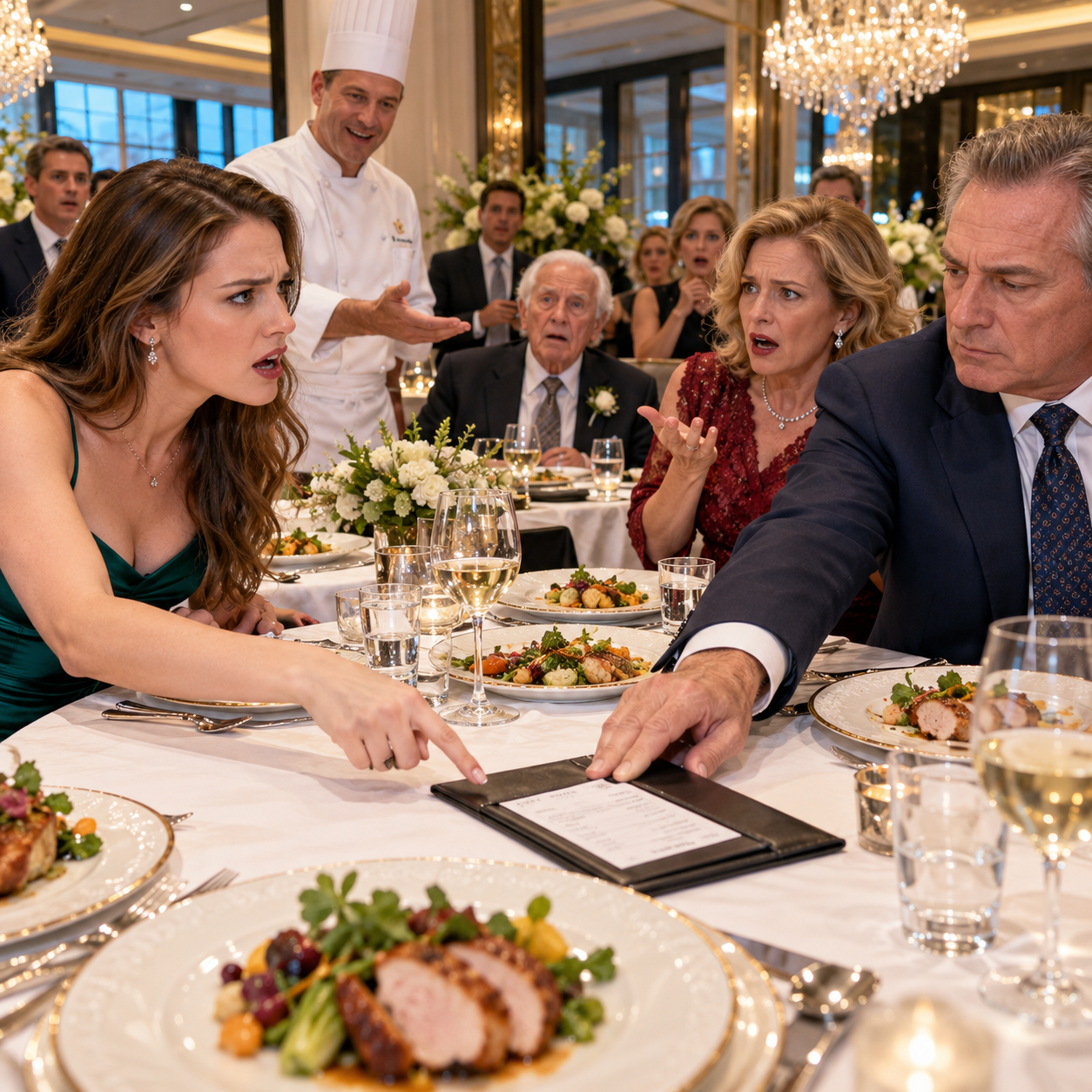
Near nine-thirty, our waiter approached carrying a black leather folder. Dad accepted it with a confident nod, opened it, and studied the contents. I watched his eyebrows lift before he quickly lowered them again. He closed the folder and rested it beside his plate.
For a few seconds, nobody spoke.
Then my father reached across the white tablecloth and pushed the folder directly toward me.
I opened it and saw the total: $2,670.
And suddenly I understood why my mother had been so determined that I attend.
Part 4
The total stared back at me beneath an elegant restaurant logo. There were expensive bottles of wine, multiple appetizers, specialty entrées, desserts, and several items I hadn’t even noticed being ordered. My father leaned back in his chair with the relaxed expression he always wore when a financial problem became somebody else’s responsibility. Across the table, Mom gave me an encouraging smile.
I remembered the previous Christmas, when I’d paid for a catered dinner because Dad said his retirement deposits were delayed. I remembered Paige’s engagement celebration, where my parents promised to reimburse me for the restaurant and never mentioned the money again. There had been birthdays, anniversaries, graduation parties, and ordinary Sunday lunches that somehow became my responsibility. Until that evening, I’d always convinced myself that paying was easier than arguing.
But the sight of Grandpa’s empty chairs changed something.
I carefully removed the itemized receipt and studied it while my parents waited. My own meal consisted of a salad, steak, sparkling water, and coffee, totaling approximately ninety-four dollars after tax and a generous gratuity. I took two fifty-dollar bills from my wallet and slipped them into the leather folder. Then I closed it and pushed it back toward Dad.
He frowned. “What’s this supposed to mean?”
“My portion is inside,” I answered, keeping my voice steady. “You can keep the extra six dollars.”
Mom stared at me as if she’d misunderstood an ordinary sentence. “Caleb, sweetheart, your father gave you the check because you always handle these things,” she said, lowering her voice. Dad opened the folder, saw the cash, and immediately pushed it toward me again. “Stop being difficult and use your card.”
I didn’t touch it.
“Why?” I asked. “You invited everyone, selected the restaurant, ordered whatever you wanted, and told my children they weren’t welcome. Why am I responsible for paying for this evening?” Mom glanced toward Lawrence and Diane, clearly horrified that money was being discussed in front of them. She whispered that we could settle the matter privately after I took care of the bill.
Grandpa set his spoon down with a sharp click. “No, Marlene,” he said, his voice carrying across the table. “We’re going to settle this right now.” He reminded her that she’d described the evening as her gift to him, something she’d arranged because she wanted his birthday to be memorable.
“It is memorable,” he continued. “You banned my great-grandchildren, insulted the work that feeds your family, and now expect Caleb to finance your performance.” Mom’s cheeks reddened, and Dad adjusted his collar. Neither seemed particularly concerned about what they’d done until Grandpa said it aloud.
Then Mom lost her temper.
“Your son makes more money than the rest of us!” she snapped, pointing toward me. “Derek’s waiting on contracts, Paige has expenses, and your father and I are retired. Caleb can afford one dinner without turning it into a moral lecture.” Her words hung between us, exposing a resentment I’d suspected for years but never heard expressed so plainly.
I looked at Derek, who suddenly became fascinated by his water glass. Paige quietly slipped her phone into her purse. Lawrence cleared his throat, and Diane looked toward the doorway. Grandpa leaned forward and asked Mom whether she’d ever considered that making money didn’t obligate someone to surrender it whenever she wanted.
My father finally spoke again, his voice noticeably softer. “Caleb, please don’t embarrass your mother.”
That was the sentence that ended it for me.
I stood, buttoned my jacket, and looked directly at him. “She embarrassed my children before dinner even started,” I said. “She embarrassed my work while eating the food I produce. The only thing embarrassing her now is that I’m not paying for it.”
Mom opened her mouth, but Grandpa raised one hand. “Let him go,” he said firmly. “He’s the only person at this table who remembered what family is supposed to mean.”
I picked up Sophie and Jackson’s gift bag and placed it beside Grandpa. Then I thanked Lawrence and Diane, shook Grandpa’s hand, and walked toward the door.
Behind me, I heard Dad whisper something about splitting the bill across three credit cards.
I thought the evening was finished.
But before I reached the parking lot, Grandpa called my name and told me there was something about the farm my parents had never told me.
Part 5
Grandpa caught up with me beneath the restaurant’s stone entrance, holding his jacket over one arm. The cool October air carried the smell of damp leaves and freshly cut grass from the landscaped gardens. He looked back through the glass doors before asking whether we could speak somewhere private. I led him toward my truck, suddenly wondering what else the evening could possibly reveal.
He leaned against the passenger door and took a folded envelope from his inside pocket. “Three months ago, your mother asked me to reconsider how the remaining family property would eventually be divided,” he said. My stomach tightened because he still owned a small residential parcel beside my farm, including the original farmhouse where he’d lived for decades. He explained that Mom wanted him to sell that parcel to a developer and distribute the money among her and my siblings.
“She said your farming operation wasn’t a suitable long-term investment,” Grandpa continued. “Told me you were wasting valuable property and that Derek had better opportunities for the money.” I stared at the envelope, remembering how often Mom had suggested I sell everything and pursue a more respectable career. Grandpa handed it to me and explained that it contained a letter from a developer who had contacted him after speaking with her.
I opened the envelope beneath the parking lot lights. The proposal was preliminary, but it identified the remaining parcel and described a possible purchase contingent on his approval. My mother’s name appeared in the correspondence as the person who’d encouraged the developer to make contact. Suddenly her obsession with appearing wealthy seemed less like ordinary vanity and more like an attempt to turn other people’s hard work into her own financial escape route.
“Nothing’s signed,” Grandpa assured me. “And the land already in your name is yours, regardless of what anyone says.” He explained that he’d contacted his attorney and decided to keep his remaining property out of any speculative arrangement. I exhaled slowly, relieved that the business Hannah and I had built wasn’t threatened by a transaction happening behind our backs. Still, the letter confirmed something painful about how my mother viewed everything I’d accomplished.
Grandpa gripped my shoulder. “I should’ve told you sooner,” he admitted. “I kept hoping she’d remember that the farm represents more than acreage and dollar signs.” He looked tired in a way I hadn’t noticed inside the restaurant. Then he asked whether Sophie and Jackson would forgive an old man for missing his own birthday cake with them.
I laughed for the first time since receiving Mom’s message. “They’ve got chocolate cupcakes waiting at home,” I told him. “And Jackson built you something that needs a proper inspection.” Grandpa smiled and said he’d come over the next morning. He refused my offer of a ride, explaining that Lawrence and Diane had agreed to take him home.
Twenty minutes later, I pulled into our gravel driveway. Warm light spilled from the kitchen windows, and I could see Hannah sitting at the table with the children. Jackson opened the door before I’d reached the porch and immediately asked whether Grandpa liked his birdhouse. I knelt beside him and promised that Grandpa would see it personally over breakfast.
Later, after the children went upstairs, I told Hannah everything. She listened without interrupting, occasionally shaking her head as I described the chef, the bill, and the developer’s letter. When I finished, she reached across the kitchen table and squeezed my hand. “You’re allowed to stop financing people who are ashamed of you,” she said quietly.
The next morning, I called our attorney and arranged a meeting with Grandpa to review the property paperwork. I also instructed our accountant to end the informal practice of charging family food orders to the farm’s promotional budget. From that point forward, anything my parents or siblings wanted from the business would require the same payment terms as every other customer. I wasn’t interested in punishing anyone, but I was finished pretending their expectations were obligations.
Mom called seventeen times over the following week. Her messages shifted from anger to accusations, then to appeals about family unity and how much she’d sacrificed for me. Dad sent one message saying I should apologize for embarrassing everyone at the restaurant. I answered once, explaining that my children, my career, and my finances were no longer subjects open for negotiation.
I never received an apology for excluding Sophie and Jackson.
Three weeks later, BellaForte signed a new annual supply agreement with my farm. Diane’s niece also became a customer, bringing us additional business during a season when independent producers often struggled. I told my employees about the new contracts over coffee in the packing room, and we celebrated by ordering lunch from a local sandwich shop.
Grandpa began visiting every Sunday. Sometimes he helped Jackson repair the birdhouse, and sometimes he sat beside Sophie while she painted landscapes of the fields. On his next birthday, we celebrated in our backyard with grilled pork chops, homemade cake, paper decorations, and a long folding table filled with people who genuinely wanted to be there.
My parents weren’t invited.
As Grandpa blew out his candles, Jackson asked whether next year’s party could include a pig-shaped cake. Everyone laughed, and Grandpa said it was the finest idea he’d heard all day. Watching my children lean against him, I realized I’d spent years purchasing acceptance from people who should have offered it freely.
My mother thought a five-star restaurant determined someone’s worth.
But I learned that evening that a person can wear expensive jewelry, eat exceptional food, and still have no understanding of what makes a family valuable.
I didn’t lose my family over a $2,670 dinner.
I simply stopped paying people to pretend they loved me.
Legal Notice: This story is a work of fiction. Names, characters, businesses, events, and incidents are the product of the author’s imagination or are used fictitiously. Any resemblance to actual persons—living or dead—or to actual events is purely coincidental. Thank you! 💓


