
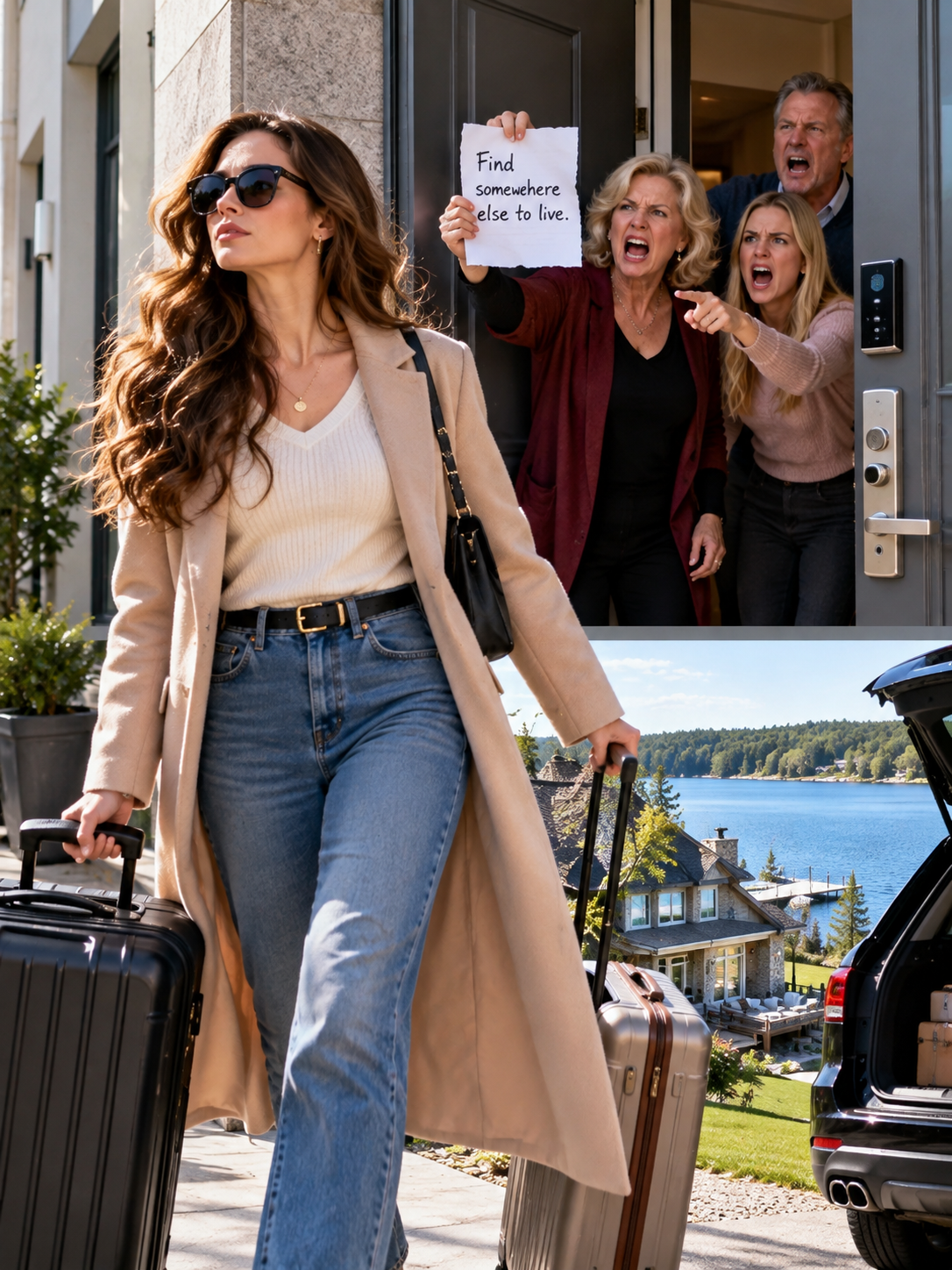
My Mom Changed the Locks on My Apartment While I Was Away—So I Moved to My Secret Lake House and Exposed Everything
“Find somewhere else to live,” my mother’s note said when I returned from a twelve-day business trip and discovered strangers’ furniture inside the apartment I owned. My brother was wearing my slippers, his pregnant wife had taken my bedroom, and my mother threatened to accuse me of assault if I called the police. I left without fighting, heading toward the lake house I’d secretly inherited years earlier. But when I arrived, the lights were already on—and my mother was waiting with a document she expected me to sign.
Part 1
My key wouldn’t turn in the lock, and for a ridiculous moment, I thought I had the wrong apartment. I’d just returned from twelve days of meetings in Chicago, and the wheels of my suitcase were still wet from the parking garage. The brass lock on my front door was new, shiny enough to reflect the hallway lights. Then I noticed a handwritten note taped above the doorbell: “Find somewhere else to live. Mom.”
I stood there reading it three times before knocking. My younger brother, Colin, opened the door wearing my gray slippers and holding a bowl of cereal. Behind him, his pregnant wife, Paige, was sitting on my cream-colored couch with her feet resting on my grandmother’s antique coffee table. “Oh, you’re back,” Colin said, sounding more inconvenienced than surprised. “Mom said you wouldn’t get here until tomorrow.”
My name is Elise Ward, I’m thirty-five, and I work as a regional operations director for a manufacturing company in Atlanta. Five years earlier, I’d bought that two-bedroom apartment with savings from almost a decade of working overtime and accepting difficult assignments. My name was the only one on the deed, and every mortgage payment came directly from my bank account. Yet my brother was standing in my doorway as though I needed his permission to enter.
“Get out of my apartment,” I told him, pushing my suitcase against the wall. Colin rolled his eyes and called for our mother, who appeared from my kitchen wearing the blue cardigan I’d bought her for Christmas. She looked at me with the disapproving expression she usually reserved for waiters who brought the wrong order. “Elise, don’t embarrass yourself,” she said. “We’ve already made arrangements, and you’re going to have to accept them.”
I tried to step inside, but Mom caught my wrist before I could reach the doorframe. “Colin and Paige need somewhere stable before the baby arrives,” she explained, tightening her grip when I pulled away. “You travel constantly, you’re unmarried, and you barely use this place.” I told her none of those things gave her the right to change my locks.
She leaned closer until I could smell the peppermint gum on her breath. “Call the police if you want,” she whispered, “but I’ll tell them you attacked me when I asked you to help your brother.” Then she dragged her fingernail across her forearm, leaving a thin red scratch. I stared at it, realizing she’d prepared an accusation before I even arrived.
Colin disappeared into my office and returned carrying a brown folder. “Mom has legal authority,” he announced, displaying a document titled Durable Power of Attorney. My name appeared above a signature that resembled mine, except for the final letter, which curved in a direction my handwriting never did. I photographed the page before he could take it away.
“I never signed that,” I said. Mom immediately raised her voice so Paige could hear. “Elise, you’ve been so forgetful lately, especially with all that stress at work.” Paige avoided my eyes, and I noticed several of my framed photographs stacked inside a cardboard box near the television. My family hadn’t simply moved into my home; they had begun erasing every sign that it belonged to me.
Then Colin said something that made my stomach drop. “The apartment’s under contract, and closing is tomorrow morning, so don’t start causing problems.” I looked from him to my mother, waiting for someone to explain how they could possibly sell property they didn’t own. Instead, Mom reached for my phone and demanded that I delete the photograph.
I backed toward the elevator, pulling my suitcase behind me. Mom followed, insisting that I’d promised to help Colin years earlier and that no respectable daughter would leave her family homeless. I remembered giving her an emergency key after she underwent surgery, trusting that she’d use it only if something happened to me. Now I understood how badly that trust had been misplaced.
Inside my car, I called Tessa Alvarez, the attorney who’d handled my grandmother’s estate. She asked me to email the document immediately and advised me not to confront anyone again until we could verify what had been filed. When she asked whether I had somewhere safe to stay, I hesitated before mentioning the property nobody in my family knew I still owned.
Six years earlier, Grandma June had left me a small lake house near Lake Oconee through a private family trust. My mother believed the property had been sold to cover Grandma’s final expenses, and I’d never corrected that assumption because Grandma had specifically asked me to keep the inheritance private. I muted my family’s calls and drove east through the darkening Georgia countryside, trying to convince myself that at least one home still belonged to me.
When I reached the gravel driveway shortly after nine, I stopped so abruptly that my seat belt locked against my chest. A warm yellow light glowed behind the kitchen curtains of a house that should have been completely empty. My porch camera was tilted toward the wall, and the front door stood slightly open. Then my phone buzzed with a message from an unknown number: “Your mother says you’re almost here.”
Part 2
I stayed in the car for several seconds, watching the kitchen light flicker behind the blinds. Tessa was still on the phone, and when I told her someone was inside the lake house, her voice became firm. “Elise, remain outside while we contact the sheriff’s office,” she said. I wanted to listen, but then my mother’s voice came through the open doorway, calling my name as though she’d been expecting me.
“Your mother’s there?” Tessa asked, her disbelief matching mine. I told her I could hear Mom talking to Colin, and she instructed me to keep the call connected while she contacted local authorities from another phone. The nearest neighboring house was barely visible across the water, and the road behind me had gone completely dark. I stepped onto the porch but stopped beside the railing, unwilling to enter while I didn’t know what they intended.
Mom appeared in the doorway holding a thick blue binder. It was Grandma June’s original trust file, the one I’d kept inside a locked drawer in my Atlanta apartment. “Well, there you are,” she said brightly, as though she’d come to surprise me with dinner. “We found something interesting while clearing out your things.”
Colin emerged behind her carrying a stack of papers and a cheap ballpoint pen. He explained that my apartment needed to be sold immediately and that the lake house could provide temporary security for a business arrangement. I asked how they’d gotten past the camera, and Mom shrugged. “You left the emergency keys where anyone could find them, sweetheart.”
That wasn’t true. The lake house keys had been inside the same locked drawer as the trust binder, nowhere near the apartment key she’d possessed. Someone had forced that drawer open, searched through documents unrelated to Colin, and driven two hours to a property I had deliberately kept private. The realization left me colder than the night air coming off the water.
“Grandma left that house to me,” I said, pointing toward the binder. Mom’s smile disappeared. “Your grandmother had no right to hide family property from us,” she snapped. “Colin has a baby coming, and you have more than enough to share.” She held up another document, this one prepared as a transfer of my interest in the lake house.
I asked why they needed the property if they were already selling my apartment. Colin glanced toward Mom before explaining that the apartment proceeds would resolve a temporary cash-flow problem with his real estate business. He claimed an investor had delayed funding and that a lender required additional collateral. When I asked how much money he owed, Mom interrupted. “The amount doesn’t concern you, Elise, because we’re handling it.”
I knew Colin had struggled financially, but he’d always described his problems as temporary inconveniences. His company renovated small commercial buildings, and Mom frequently praised him for being the only person in our family willing to take real risks. I’d declined to invest two years earlier after reviewing a proposal with numbers that didn’t make sense. Colin had called me selfish then, but this was the first indication that his debts might threaten my property.
“Come inside and sign,” Mom ordered, moving back toward the dining table. I remained on the porch and told her I wanted to see every document before agreeing to anything. She placed the papers on Grandma’s polished oak table, the same table where we’d eaten pancakes together when I was a child. Then she smiled in a way that made my skin prickle.
“If you refuse,” she said, “I’ll tell the police you broke into this house and attacked me.” Colin added that Paige would confirm whatever Mom said, since she’d already witnessed my supposedly unstable behavior at the apartment. I glanced toward my phone, which was still connected to Tessa, and carefully asked whether they were admitting that the power of attorney hadn’t been authorized.
Mom laughed. “Families make decisions for each other all the time, Elise, and we knew you’d create difficulties.” Colin warned me that the buyer expected the apartment closing to proceed the following morning, with money already committed to another transaction. For the first time, I understood that they weren’t merely trying to house my brother’s family. They were attempting to convert everything I’d earned into cash before I could stop them.
I told them I needed a moment to think and stepped farther down the porch. Inside my coat pocket, Tessa’s voice came through the phone, barely audible above the wind. “Elise, deputies are on their way, and I’ve contacted someone who can reach the title company tonight.” Before I could answer, Colin appeared at the doorway and said, “Mom wants your phone.”
Part 3
Colin came down the porch steps, his face flushed and his hands shaking. “Give me the phone, Elise,” he repeated, reaching toward my coat. I stepped backward and told him my attorney was listening to everything. His expression changed instantly, and he shouted for Mom to come outside.
Mom appeared with the trust binder pressed against her chest. “You brought a lawyer into a private family discussion?” she demanded, sounding genuinely offended. I told her that stealing keys, forging documents, and threatening false accusations weren’t private family matters. She started crying, then stopped abruptly when I asked whether she wanted Tessa to hear her explanation.
Tessa spoke through the phone, identifying herself and explaining that law enforcement had already been contacted. She instructed everyone to avoid touching the documents or leaving with anything belonging to the property. Mom insisted that she’d been invited to the house, but I reminded her that she hadn’t known it existed until she searched my locked desk. Then headlights swept across the gravel driveway.
Two sheriff’s vehicles stopped behind my car, and two deputies approached the porch. I explained that I owned the property through a trust and that my mother and brother had entered without my permission. Mom immediately displayed the scratch on her arm, claiming I’d attacked her outside my apartment earlier that evening. One deputy separated us while the other asked Colin to place the binder on the table and step away.
The next twenty minutes felt longer than my entire drive from Atlanta. I showed the deputies photographs of the altered apartment lock, the note on my door, and the questionable power of attorney. Tessa provided contact information for verifying my ownership, and I explained that the original trust records were held by her office. When Mom repeated her assault accusation, the deputy asked whether she’d received medical treatment or contacted police before arriving at the lake house.
She hadn’t. Colin attempted to describe the paperwork as a misunderstanding, but his explanation changed when the deputy asked whether I’d authorized the proposed transfer. I told them clearly that I hadn’t signed anything and didn’t intend to. The deputy looked at the documents spread across the table and said they would need further investigation to establish the extent of the suspected fraud.
I expected Mom to become frightened, but instead she turned toward me with furious confidence. “You won’t actually do this to your brother,” she said. “You’re not going to destroy his future over a little paperwork.” I looked at the man who’d thrown my suitcase into a hallway, and I realized I no longer recognized the brother who once waited for me after school.
The deputies escorted Mom and Colin away from the property while arrangements were made for further questioning. They documented the apparent unauthorized entry and secured the papers that had been presented for my signature. Tessa explained that the criminal investigation would proceed separately from the urgent steps needed to protect my apartment. I watched the vehicles disappear down the driveway, but relief wouldn’t come until the attempted sale was stopped.
Tessa spent the night preparing emergency documents while I sat in Grandma’s kitchen drinking tea that had gone cold. At seven the next morning, she called the title company directly and sent written notice disputing the power of attorney. The closing was placed on hold while the company reviewed the authorization and ownership records. By midmorning, her office had also filed for emergency court relief to prevent any transfer while the matter was investigated.
I finally felt my shoulders loosen, but Tessa warned me that stopping the closing didn’t automatically remove Colin and Paige from my apartment. We’d need to establish their lack of authority to occupy it and follow the proper process to recover possession. Meanwhile, she asked me to review old bank records for anything suggesting Mom had used my personal information before. I opened my laptop at Grandma’s dining table, where the morning sunlight reflected off the water.
That’s when I found a mortgage-related inquiry from three months earlier, attached to a company I’d never contacted. The inquiry referenced a proposed loan secured by property I owned, and the listed contact person was my mother. I forwarded it to Tessa, who called back within minutes. “Elise,” she said, “I think your family started planning this long before your business trip.”
Part 4
The following week became a blur of bank statements, legal documents, and unanswered calls from relatives. Tessa arranged a meeting with the title company’s fraud specialist, who confirmed that the disputed power of attorney had been submitted several weeks earlier. The person presenting it had claimed I was frequently unavailable because of international business travel. That explanation bothered me because Mom had spent months complaining that my career kept me away from family gatherings.
My travel schedule hadn’t been a coincidence; they’d used it to support their story. The title specialist showed us copies of the submitted documents, including a notarized signature page bearing my name. Tessa noticed that the notary’s commission information didn’t match the public record for the date listed. She referred the discrepancy to investigators, explaining that it strengthened our concerns but still required formal verification.
The apartment buyer was a small investment company connected through business records to one of Colin’s associates. The purchase price was noticeably below comparable properties in my neighborhood, and the proposed closing date left very little time for ordinary questions. I realized they’d planned to complete the transaction while I was away, expecting me to return only after the money had changed hands. My early flight home had apparently disrupted their schedule.
Colin had always been charming when he needed something, but his financial records told a different story. Investigators identified substantial overdue obligations tied to his development company, including money borrowed from private lenders. His latest project had stalled after construction costs increased, and several investors were demanding repayment. The apartment sale would have provided enough cash to satisfy the most urgent claims, while the lake house was intended to support another loan.
When Tessa explained the arrangement, I remembered a conversation from the previous Thanksgiving. Mom had asked whether I planned to sell my apartment someday and whether Grandma’s estate had left anything valuable. I’d laughed and told her I wasn’t interested in discussing my finances at dinner. She’d smiled and changed the subject, but I now understood those questions hadn’t been casual curiosity.
Paige contacted me ten days after the attempted closing. She’d moved temporarily into her parents’ home and wanted to discuss what had happened. We met with Tessa present, and Paige arrived carrying a small diaper bag despite being several months away from delivering her baby. Her eyes were swollen, and she kept twisting her wedding ring while explaining that Colin had promised the apartment was being transferred with my permission.
I asked why she’d watched Mom threaten me without speaking up. Paige stared at the table and admitted she’d known there was something wrong when Mom instructed her to describe me as emotionally unstable. “I thought they’d worked everything out with you,” she whispered. “Then your mother told me you’d agreed to sell the apartment but didn’t want anyone mentioning it.”
I believed Paige had been misled about parts of the arrangement, but she’d also remained silent when she saw me locked out of my own home. She offered to provide the messages Colin had sent her about the apartment and agreed to cooperate with investigators. I thanked her for telling the truth, then explained that I wasn’t prepared to maintain a relationship with her. Protecting her child would be her responsibility, just as protecting my home was mine.
The civil proceedings moved slowly, but the evidence was substantial. The disputed documents were withdrawn from consideration, the proposed sale collapsed, and the court’s orders prevented further attempts to transfer the property without resolving my ownership claims. Colin and Mom eventually surrendered possession of the apartment rather than continue fighting for a home they had no lawful right to control. I changed every lock, installed new security equipment, and spent an afternoon photographing the damage they’d left behind.
My desk drawer was broken, several pieces of furniture were scratched, and Grandma’s silver serving tray had disappeared. I stood in the empty living room, listening to traffic below the windows, trying to decide whether I wanted to live there again. For years, I’d considered the apartment proof that I could build a stable life without anyone’s assistance. Now every room reminded me of the moment my family decided my independence was something they could take.
That evening, Tessa called with an update from the criminal investigation. The notary involved in the transaction had agreed to cooperate, and investigators were reviewing communications suggesting Mom had personally coordinated the false authorization. Then Tessa mentioned something I hadn’t expected: the notary had provided a message in which my mother described the lake house as “the inheritance we should have received.” I realized the real betrayal wasn’t simply that Mom had wanted my property; she’d believed she was entitled to it all along.
Part 5
Six months after I discovered the changed locks, I sat on Grandma’s porch watching the sun rise over Lake Oconee. The water reflected bands of gold and pale violet, and a heron stood motionless near the reeds. My coffee was hot, the air smelled of damp wood, and nobody was calling to demand something from me. For the first time in years, silence felt comforting instead of lonely.
The criminal case had moved through hearings and negotiations that were far less dramatic than the confrontation at the lake house. Mom and Colin faced charges arising from the forged documents, the attempted property transaction, and their unauthorized entry. Both eventually entered negotiated pleas involving financial restitution and court-supervised conditions, with the sentences determined by the judge. I didn’t attend every hearing, but I provided the records and testimony requested of me.
Some relatives accused me of being cruel for allowing the prosecution to continue. An aunt called to remind me that Colin was about to become a father and that my mother was getting older. I asked whether either fact entitled them to steal from me, and she couldn’t answer. After that, I stopped trying to explain myself to people who believed family loyalty meant accepting whatever damage my relatives caused.
My mother sent a letter through her attorney shortly after the plea proceedings. It began with a lengthy explanation of Colin’s financial troubles, described the fear she’d felt about his future, and insisted that she’d never intended to hurt me. Near the end, she wrote, “I hope someday you’ll understand that everything I did came from love.” I read the sentence twice, remembering her fingernail dragging across her own skin while she threatened to accuse me of assault.
I didn’t respond. Love didn’t forge signatures, change locks, or prepare false accusations against someone who refused to surrender her belongings. Whatever Mom believed about her intentions, the consequences of her choices belonged to her. I wasn’t going to spend another year trying to make her understand a truth she’d had decades to recognize.
Colin attempted to contact me through several relatives, saying he wanted to apologize and rebuild our relationship. One message mentioned that he and Paige had separated temporarily after their daughter’s birth and that he was struggling financially. I hoped he would become a responsible father, but I didn’t offer money or emotional reassurance. His daughter deserved stability, and that responsibility rested with the adults who had brought her into the world.
The apartment was eventually restored, professionally cleaned, and rented to a young couple who had recently moved to Atlanta for work. Their first rent payment arrived on a rainy Tuesday morning while I was repairing the lake house’s old garden fence. I checked the notification, smiled, and returned to tightening a loose board. The property that my family had nearly stolen was finally supporting the peaceful life I’d chosen.
Moving permanently to the lake hadn’t been part of my original plan. I’d always imagined staying in the city, climbing the corporate ladder, and eventually purchasing a larger apartment with a view of the skyline. But after everything that happened, I realized how much of my life had been organized around proving I could succeed without help. Grandma’s little house offered something different: a place where I could work remotely most days, grow vegetables, and wake up without rushing into traffic.
Tessa visited one Saturday with her husband and brought a bottle of sparkling cider to celebrate the final resolution of the property dispute. We sat on the dock with our shoes beside us while their dog investigated the shoreline. She asked whether I regretted involving the authorities, and I considered the question carefully. “I regret giving them access to my life for so long,” I answered, “but I don’t regret protecting what belongs to me.”
Before she left, Tessa handed me a small envelope discovered among Grandma’s remaining estate papers. Inside was a handwritten letter I’d never seen, dated shortly before Grandma died. She wrote that she’d left me the lake house because I had always visited without asking for anything and because she wanted me to have a place that nobody could use to control me. At the bottom, she’d added, “Your mother may never understand that love isn’t something people owe in exchange for obedience.”
I sat alone on the porch that evening, holding the letter while the lake turned dark beneath the trees. Grandma had understood the family dynamics long before I found the courage to acknowledge them. She hadn’t left me the house to punish anyone; she’d wanted me to have a future that couldn’t be taken away by guilt or obligation. I placed her letter inside a new frame beside the kitchen window, where morning sunlight would fall across it.
A year after the night my mother changed my locks, I received an email from a distant cousin containing a photograph of Colin and Mom at a family gathering. They looked older and tired, and for a moment I felt the familiar impulse to ask whether they were doing all right. Then I remembered standing outside my apartment with my suitcase while Mom threatened to destroy my reputation. I deleted the message and went outside to finish planting flowers along the porch.
Later that afternoon, I found the original note she’d taped to my apartment door. I’d kept it inside a folder with the legal documents, thinking I might need it as evidence. The paper had yellowed slightly, but her handwriting remained unmistakable: “Find somewhere else to live.” I studied those words one last time before placing the note back in the folder and closing it.
Mom had meant them as punishment, a way to remind me that my needs would always come after Colin’s. Instead, she’d pushed me toward the one place she’d never been able to control. I owned my home, my finances were secure, and my future no longer depended on whether my family approved of my decisions. When the sun slipped beneath the trees, I carried my coffee onto the porch and listened to the water brushing against the dock.
My mother told me to find somewhere else to live. So I did, and I finally found a home where nobody could make me feel like an unwanted guest.
Legal Notice: This story is a work of fiction. Names, characters, businesses, events, and incidents are the product of the author’s imagination or are used fictitiously. Any resemblance to actual persons—living or dead—or to actual events is purely coincidental. Thank you! 💓

