My In-Laws Locked 60 Guests Inside a Birthday Banquet to Force My Daughter to Apologize—Then She Asked One Question
My seventeen-year-old daughter was ordered to apologize for accusing her uncle of forging a deed. She hadn’t accused him of anything; she’d simply refused to swear she witnessed a signature she never saw. My wife’s family decided to settle the matter at her grandfather’s eightieth birthday, with sixty guests watching and the doors blocked until she obeyed. I was seated at the back, apparently powerless. But my daughter knew why I had promised to tap my water glass twice—and why the truth depended on one date.
Part 1
The trouble began with a folded sheet of paper at my mother-in-law’s funeral luncheon. My daughter, Claire, was reaching for a ham sandwich when her uncle Ellis Carver laid a hand on the back of her chair. He spoke gently, so the people around them wouldn’t hear: “I’ll need you to sign a little confirmation about Grandma’s farm. Your name is already on the paperwork.” Claire looked toward me across the church hall, and the sandwich stayed untouched on her plate.
I’m Daniel Mercer, forty-five, and I run Mercer & Daughter Funeral Home in the little Pennsylvania town of Bellweather. The sign honors my great-aunt, who worked beside my grandfather when the business opened; it doesn’t refer to Claire, although she sometimes helps me arrange flowers. I’ve spent twenty years watching people conceal fear beneath polite expressions. I knew something was wrong when my normally precise daughter stopped checking the time on her running watch.
On our drive home, with rain tapping the windshield and my wife Joanna still helping her family at church, Claire told me what Ellis wanted. He claimed she had witnessed her grandmother Miriam sign a deed on February twentieth at the farmhouse kitchen table. “He says I sat there doing homework, Dad,” she told me, twisting the strap of her seat belt. “I was at the indoor track meet in Harrisburg that entire day.”
I remembered the meet because her relay team had placed second and she’d called me from the bus at 10:43 that night. I remembered February twentieth for another reason: Miriam had suffered a stroke three days earlier and was hospitalized. I pulled into the parking lot of a closed pharmacy and asked Claire whether she’d signed anything for Ellis. “Nothing,” she said. “He told me a second signature would just clear up a technical problem.”
The Carvers owned two lumberyards and had their surname painted on a grain elevator outside town. Their patriarch, Leonard, was nearing eighty; his sons Brent, Nolan, and Ellis ran the business while Joanna, their youngest sibling, worked as a dental hygienist. Ellis handled titles and notarizations, always with a spotless shirt and a smile that made every demand sound reasonable. Miriam had been the family’s gentle counterweight, the one who saved butterscotch candies for Claire and listened when nobody else did.
I told Claire not to sign, argue, or guess at what had happened. “If anybody asks, tell them you need to review the document with a lawyer,” I said. She wanted to know whether her uncle had committed a crime, but I couldn’t answer honestly yet. What bothered me most was not his request; it was how confidently he said her name was already there.
Over the next month, I checked the recorded property documents and met quietly with a real-estate attorney named Naomi Price. A deed filed after Miriam’s death purported to transfer her half of the family’s 170-acre orchard property to the three sons, without payment. Attached to the filing was an affidavit naming Claire as an eyewitness, dated February twentieth and notarized by Ellis. Naomi frowned at the papers and told me to preserve Claire’s track records, messages, and everything from the hospital that we could lawfully obtain.
A bank’s recent public filings also suggested the lumber business was under financial pressure, though they didn’t prove why the sons wanted the property. That Saturday, Claire laid her silver relay medal beside the hospital dates I had written down. “They keep asking me to remember something that didn’t happen,” she said. “What if Grandpa believes them forever?” I couldn’t give her a reassuring answer, and I hated that more than I hated the paperwork.
I couldn’t tell whether Leonard knew any of this. My wife insisted her brothers might simply have made an administrative mistake, and I didn’t yet show her what I’d found because Claire begged me to keep the conversation private. Then an invitation arrived for Leonard’s eightieth birthday, and Joanna’s handwritten note on the back read, “Please, let’s just get through one evening.”
Part 2
Leonard invited us to Sunday dinner three weeks before the party. Miriam’s chair sat empty beside the window, and the farmhouse smelled of roast beef, rosemary, and the polish she’d used on her maple table. Halfway through the meal, Leonard set down his fork and looked directly at Claire. “I’m hearing you’ve been saying Ellis falsified your grandmother’s papers,” he said, with the authority of a man accustomed to silence.
“I said I wasn’t there when Grandma signed them,” Claire answered. Brent leaned back and gave a humorless chuckle, while Ellis studied his potatoes. Leonard said Miriam had wanted the farm kept together and that questioning a dying woman’s wishes was cruel. “I love Grandma,” Claire said, her voice tight. “That’s why I won’t say I saw something I didn’t see.”
Joanna touched our daughter’s elbow beneath the table, a silent request to stop. I asked Leonard one question: “Have you personally seen the original document?” He admitted he’d been told its contents by Ellis, then changed the subject to the birthday guest list. Driving home, I noticed Claire hadn’t eaten her pie, and Joanna stared through the side window as if the roadside fields could give her an answer.
The next Friday, Joanna came home with her scrubs in a plastic bag and her lipstick freshly reapplied. Brent had called her at work: he wanted Claire to give a short apology during Leonard’s birthday toast. “Ellis thinks the date may just be a clerical error,” Joanna said, rubbing the bridge of her nose. “Maybe the paperwork was prepared earlier and somebody copied the wrong day.”
“Then he can correct his own paperwork,” I answered. “He doesn’t need a teenager to confirm a false memory in front of sixty people.” Joanna said her father had just buried his wife and couldn’t endure another family scandal. I understood her grief, but I asked whether she understood what it felt like for Claire to be called dishonest by the people who raised her.
That night I visited Claire in her room, where race bibs were pinned above her desk and damp running shoes dried beside the heater. “Mom wants me to say I’m sorry for upsetting Grandpa,” she said. “I might say I’m sorry he’s upset, but I’m not signing anything.” I told her she would never have to surrender her account of that day to keep my affection, and her shoulders finally lowered.
I’d already visited Riverside Pavilion, the banquet hall on Route 9, where I once arranged a memorial service for the owner’s husband. Evelyn Cross, who ran the property with sharp eyes and no tolerance for bullying, confirmed Brent had booked the main room for sixty. I told her I was worried relatives might try to intimidate Claire, and I asked her to keep staff attentive and call for help if anyone interfered with exits. She agreed, showing me the emergency procedures and the unobstructed staff corridor behind the bar.
I didn’t tell Claire to put herself at risk for a dramatic confrontation. We agreed that if she wanted to leave, we’d leave immediately, and the staff had a way to get us outside. But she wanted Leonard to hear what she’d been trying to say, not another version filtered through his sons. I suggested she ask questions instead of making accusations, because an invented story often falls apart when someone has to name the time and place.
We chose a private signal: two taps on my water glass meant I was watching, that help was nearby, and that she could speak if she still wished. On the evening of the party, Claire wore a navy dress Miriam had bought her and carried her track-meet results folded into her purse. At the hall, I found our seating cards: Joanna beside her brothers, Claire directly across from Leonard, and mine at a distant table near the bar. Ellis smiled as he passed. “Nothing personal, Daniel,” he said, though we both knew the arrangement was exactly that.
Part 3
Riverside Pavilion glowed under strings of warm lights, and the smell of roasted chicken drifted from the kitchen. I took my assigned seat near a retired teacher named Mrs. Nolan, who asked about my work and then launched into a story about her nephew’s wedding. While she talked, I took in the room: the front entrance, side doors, kitchen passage, emergency exit, and the staff corridor Evelyn had shown me. The occupancy plaque said 180, but sixty people could still be frightened in a room built to hold three times as many.
Claire sat at the family table with her hands folded beside the water pitcher. I could see her in the long mirror behind the bar even when the guests stood to greet Leonard. He came in leaning on his cane, smiled at his granddaughter, and for a few minutes looked like the grandfather who used to teach her to prune apple trees. Joanna watched them with such obvious hope that I almost wished the evening could stay ordinary.
For dinner, Brent gave a speech about the family lumberyards, Nolan told stories louder than they were funny, and Ellis raised a toast to Miriam’s memory. At eight forty-five, waiters carried out a sheet cake covered in candles. Claire joined the singing, though her voice was scarcely audible beneath the applause. I watched Ellis trade a glance with Brent as the cake was cleared.
At nine ten, Brent took the microphone again. “There’s been an ugly accusation floating around since Mom passed,” he announced, smiling as though he were proposing a harmless family game. “We’ve all waited patiently for one person to take responsibility, and tonight she can finally make this right.” He turned toward Claire, and chairs creaked as sixty guests looked in the same direction.
Claire remained seated when he invited her onto the stage. “I’d rather speak from here, Uncle Brent,” she said. Nolan called her disrespectful, while Joanna whispered something I couldn’t hear. Then Ellis moved toward the front doors, and a sudden metallic rattle cut across the soft music.
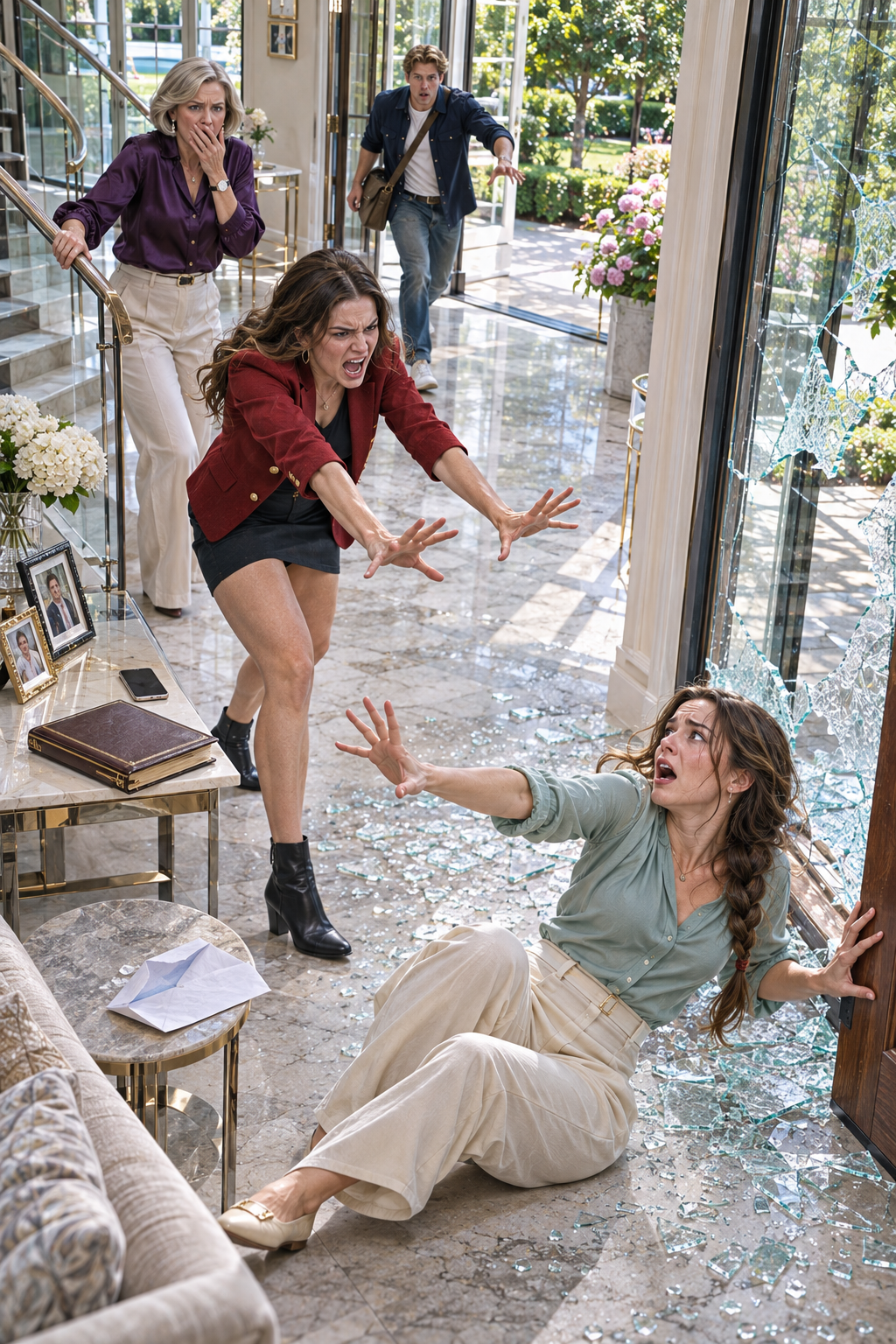
I saw him fastening a chain across the entrance as Nolan obstructed a side exit and two relatives stood beside other doors. A woman near me said, “What on earth are they doing?” Brent lifted the microphone and declared that no one would leave until Claire apologized. Several guests rose, a chair scraped the floor, and the bartender, Lydia, reached for the phone beneath the counter.
Evelyn appeared almost at once from the staff corridor and instructed the employees to keep the safe route open while emergency services were contacted. I stood and told the people nearest me that they could leave through that passage, without pushing or confronting anybody. Claire caught my eye in the mirror and gave a small shake of her head: she wanted to speak, although she could come to me at any moment. I tapped the rim of my water glass twice.
“Fine,” Claire said, rising slowly. “I want to apologize correctly, but I need Uncle Brent to remind me exactly what happened.” Brent blinked, clearly expecting a fight. She asked for the date, the location, and what she’d supposedly been doing. His expression relaxed as if she’d finally surrendered.
“February twentieth, at Grandma’s kitchen table,” he announced into the microphone. “You were doing homework, Miriam signed the deed, and Ellis notarized it while you watched.” Ellis confirmed the account from across the room. Claire asked whether anyone else remembered seeing Miriam at home that afternoon, and Brent gestured confidently toward his father.
Leonard had been listening from his chair with his cane upright between his knees. Claire turned toward him, holding the edge of the tablecloth so tightly her knuckles whitened. “Grandpa,” she asked, “was Grandma really in the kitchen on February twentieth?” His face changed before he said a word, and I knew her question had reached the one person the brothers hadn’t prepared to answer.
Part 4
Leonard looked down at his hands, then up at the three sons surrounding him. “February twentieth?” he repeated, slowly, as though he’d heard the date through a wall. Brent tried to remind him what happened at the farmhouse, but Leonard lifted a finger and silenced him. “Your mother was at Memorial Hospital,” he said. “I’d been sitting beside her since the seventeenth.”
Nobody moved. Leonard described the narrow room, its humming oxygen monitor, and the blue blanket a nurse had brought when Miriam complained of being cold. “She couldn’t hold her own cup that day,” he said, looking directly at Ellis. “She certainly wasn’t signing deeds at our kitchen table.” The microphone picked up Brent’s sharp breath as he glanced toward the blocked doors.
Ellis said it must have been a transcription error, but Claire quietly opened her purse. She held up her results from the Harrisburg meet, showing that she’d been registered and competing miles away during the alleged signing. “I wasn’t accusing anybody when I asked to see the paperwork,” she said. “I was asking why my name was on something that never happened.” A woman at the next table began to cry without making a sound.
“Who signed your mother’s name?” Leonard asked. Ellis looked toward Brent, who tried to take the microphone away from the conversation. “And who signed Claire’s?” Leonard continued, his voice stronger now. Nolan muttered that they needed to settle things privately, but an older guest reminded him he’d just helped prevent everyone from leaving. For the first time in eighteen years, I watched the Carver brothers discover that being the loudest men in a room didn’t make them right.
A county deputy named Marcus Bell, attending as one of Leonard’s friends, identified himself and told the men to stop obstructing doors. Evelyn’s staff had already called for help, and people were being guided out through the open service passage. Ellis began removing what he’d put across the main entrance while the deputy kept the crowd away from the doorway. I crossed to Claire, who stood perfectly straight until I reached her; then her lower lip began to tremble.
“Did I say it clearly?” she whispered. I took her hands and told her she’d done exactly what she needed to do, and that we were leaving. Joanna came toward us with tears on her cheeks. “I told you to apologize,” she said to Claire. “I didn’t know they’d make you stand in front of everyone, and I didn’t know the document was false.”
Claire stepped back before Joanna could hug her. “You knew where I was that day, Mom,” she said. Joanna covered her mouth, because that was the fact no explanation could repair. Leonard sat down heavily and asked Claire’s forgiveness, but she told him she wasn’t ready, not tonight. I walked our daughter through the staff passage into the damp summer air, leaving his apology unfinished.
Outside, emergency lights washed the gravel lot blue and red, and guests gathered beneath the portico while officers took statements. Evelyn assured us the hall’s cameras covered the blocked entrances and the speeches, and that footage would be preserved. Deputy Bell spoke with Claire in my presence, asking only what she’d seen and heard. Her answers were measured, with times and locations, and I was proud she didn’t try to exaggerate anything.
On the drive home, Joanna sat in the back seat beside Claire rather than beside me. She tried to explain how frightened she’d been of losing her father after Miriam died, but Claire looked out at the dark storefronts. “You were frightened of upsetting him,” she said. “I was frightened that none of you believed me.” Joanna stopped defending herself, and for once the silence felt necessary.
By morning, word had spread, though the investigation was far from finished. Naomi, our attorney, called with news from Miriam’s estate lawyer: there was an earlier, properly executed will that had not been included in the papers Ellis showed Leonard. The lawyer wanted us there Monday to review it. After everything I’d seen, I still wasn’t prepared for what Miriam had written about Claire.
Part 5
Miriam’s estate attorney kept the original will in a fireproof cabinet that smelled faintly of paper and old leather. She had signed it years earlier, with independent witnesses, leaving her share of the orchard among Joanna, Claire, and a grandson from another branch of the family. Claire was also named as the intended keeper of the farmhouse’s maple kitchen table, the one where she’d spent Sunday afternoons doing algebra while Miriam unwrapped candies. Ellis had tried to redirect property his mother had expressly chosen to share.
The deed dispute took months, not a single dramatic afternoon. The estate challenged the transfer, supported by hospital records, Claire’s competition records, document review, and the recordings from Riverside Pavilion. The court eventually set aside the fraudulent conveyance, returning Miriam’s interest to her estate for proper distribution. During that process, I learned the brothers had hoped to use the land to support financing for their troubled business.
Ellis faced criminal charges relating to the falsified documents, and the brothers were investigated for their roles in the banquet-hall confinement. They each had attorneys and chances to answer the evidence, so I refused to treat every rumor as fact. Later, guilty pleas and court findings established responsibility for the document fraud and the unlawful restraint. I attended only the hearings where Claire needed me; I had no desire to make their downfall my new occupation.
Leonard reacted in a way that surprised nearly everyone in town. He hired independent advisers, removed his sons from day-to-day control of the lumberyards while their legal problems were resolved, and began restructuring ownership with protections for longtime employees. There were lenders, contracts, and months of negotiations. But the change was real, and the men who had treated the family name as permission to do anything no longer controlled it.
Joanna had the harder work at home. She apologized without blaming her brothers for the choices she’d made, especially her refusal to believe Claire when the facts were sitting in front of her. Claire agreed to family counseling but asked her mother not to demand hugs or forgiveness as proof that things were improving. I supported that boundary, even when Joanna cried in the kitchen after our daughter went upstairs.
One afternoon, Leonard brought the maple table to the funeral home in the bed of his old pickup. Its finish was scratched, and one leg had been shortened years earlier with a folded piece of cardboard underneath. He told Claire he had believed the sons because admitting they’d betrayed him seemed unbearable. “I called you dishonest when you were telling the truth,” he said. “You don’t owe me relief from that.”
Claire let him help carry the table into our back office, but she didn’t promise everything would return to normal. Their first conversations were awkward, filled with weather reports and questions about her running times. Slowly, Leonard learned to listen without defending himself. The brothers sent cards and requests for visits, which Claire returned unopened; she told me she didn’t want them involved in her life, and I respected her decision.
A year after the banquet, Claire was studying for her final exams at Miriam’s table when Leonard arrived carrying a small birthday cake. His eighty-first celebration would consist of one candle and a few people who genuinely wanted to be together. He asked whether he could sit, waited until Claire moved her books, and told her how Miriam hid butterscotch candies in his jacket before work. Claire smiled, then asked him to tell her exactly when it happened.
That night, I locked the funeral home’s front door after everyone had gone home and checked the latch twice, an old habit from twenty years in the business. I thought of the banquet hall, the barred exits, and the daughter who’d refused to trade the truth for peace. I couldn’t erase the night her family cornered her, and I couldn’t make her forgive anyone. What I could give her was what she’d asked for from the beginning: a door she could always open and a father who would believe her when she said where she’d been.
Legal Notice: This story is a work of fiction. Names, characters, businesses, events, and incidents are the product of the author’s imagination or are used fictitiously. Any resemblance to actual persons—living or dead—or to actual events is purely coincidental. Thank you! 💓