My Husband’s Mistress Poured Wine on My 8-Month-Pregnant Belly—Then My Billionaire Father Walked In With an Envelope That Destroyed Everything
I was eight months pregnant when my husband’s mistress deliberately poured red wine over my belly in front of three hundred wealthy guests. Instead of defending me, my husband ordered me upstairs, telling everyone I was embarrassing him. I didn’t cry because I had been waiting for this exact moment. Hidden inside my pearl clutch was a recording device, and my billionaire father was already approaching the ballroom with a sealed envelope. What my husband didn’t realize was that his affair was only the beginning of what I had uncovered.
Part 1
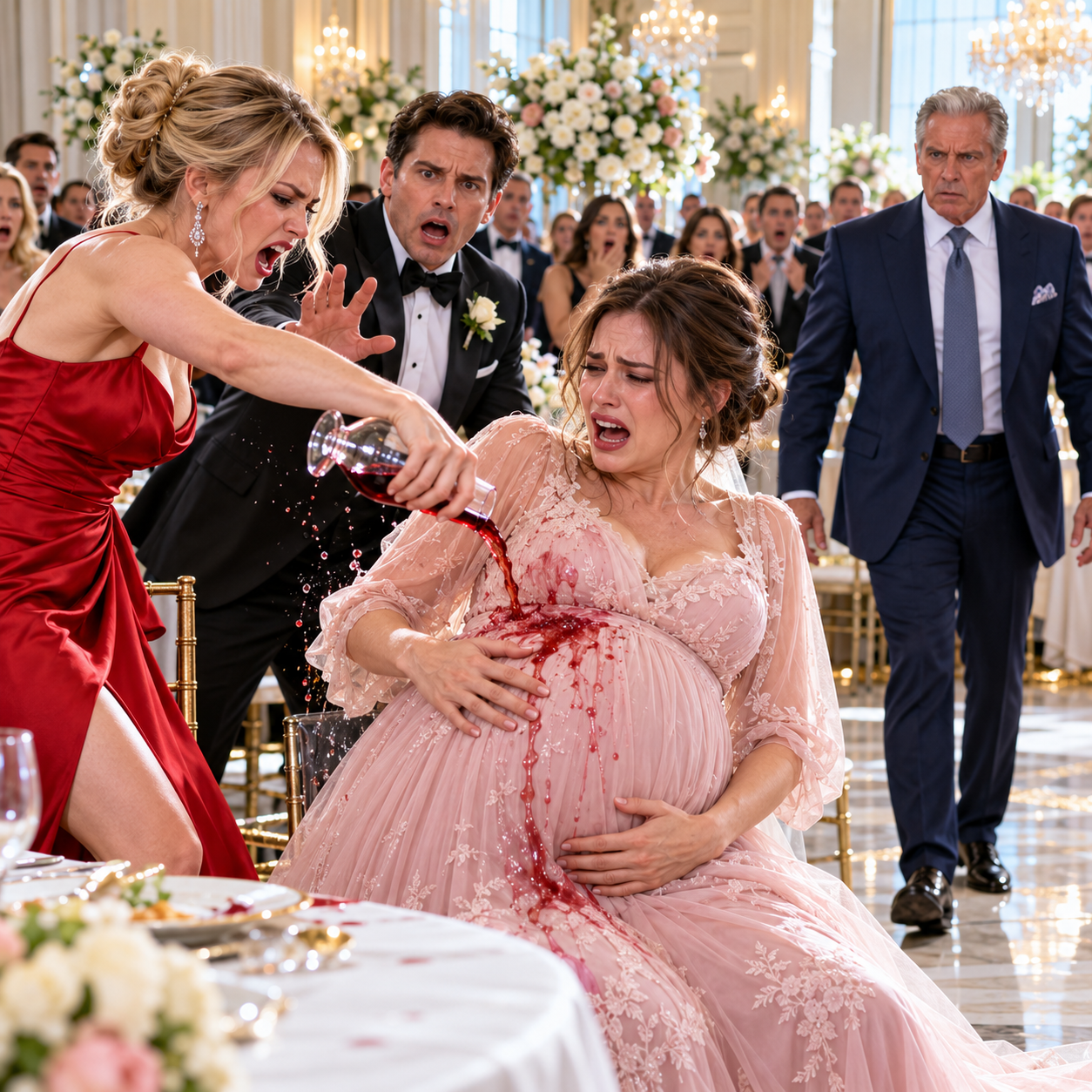
The red wine hit my stomach before I saw the glass tilt. It spread across my pale champagne-colored gown in a dark, uneven stain, cold liquid soaking through the silk while the woman standing in front of me smiled as though she’d performed a clever party trick. My eight-month-pregnant belly was impossible to hide, especially beneath the fitted dress my mother had bought before she passed away. For three seconds, I couldn’t move.
“Oops,” Celeste Price said, raising her empty glass. “Maybe pregnant women shouldn’t wear expensive dresses they didn’t earn.” Her diamond earrings caught the light from the chandeliers, and several nearby guests exchanged uncomfortable glances. Behind her, my husband, Blake Ashford, stood with one hand around her waist and the other holding his bourbon.
I looked at him, waiting for the smallest indication that he remembered I was his wife. “Blake, are you seriously going to stand there?” I asked, feeling our daughter shift beneath my palm. He glanced at the stain, then toward the gathering crowd. “Nora, go upstairs and change before you make this more embarrassing than it already is.”
The ballroom of the Fairmont Hotel fell into an awkward silence, broken only by a jazz quartet playing near the balcony. Nearly three hundred investors, executives, and their spouses had gathered for Ashford Development’s annual charity gala, an event I’d spent six weeks organizing while struggling to sleep through my third trimester. Blake had barely thanked me for securing the hospital foundation’s sponsorship. Apparently, he found thanking Celeste much easier.
His mother, Patricia Ashford, appeared beside us in a cloud of expensive perfume. “Nora, sweetheart, accidents happen,” she whispered, positioning herself between me and a photographer. “Come upstairs with me, and we’ll find something suitable.” When I asked Celeste to apologize, Patricia touched my wrist and murmured, “Please don’t turn this into a scene.”
Celeste examined her manicured nails. “I already said oops,” she replied, looking toward Blake for approval. My husband gave her a reassuring squeeze around the waist, a gesture so casual that I wondered how many times they’d touched each other in front of me when I wasn’t looking. Around us, people pretended to study their drinks, but nobody walked away.
“I watched her turn the glass,” I said, keeping my voice steady. “And you watched her do it too, Blake.” His smile disappeared, replaced by the tight expression he wore whenever an employee challenged him in meetings. “You’re emotional because you’re pregnant, Nora, and I’m not letting you sabotage tonight’s financing announcement.”
That word, “financing,” almost made me laugh. For five years, Blake had treated me like a decorative addition to his success story, telling investors he’d built everything through hard work and exceptional instincts. He rarely mentioned that my father had introduced him to his first serious lenders. He never mentioned the complicated ownership arrangements that had kept his company alive after its most expensive project nearly collapsed.
I had stopped correcting him years ago. Back then, I believed protecting his pride protected our marriage, and I convinced myself his late nights were the cost of running a growing business. When Celeste began attending his business trips eighteen months earlier, he told me she was indispensable. By the time I discovered the truth, I was already pregnant.
“Go upstairs, Nora,” Blake repeated, extending one finger toward the grand staircase. Instead, I opened my pearl clutch and pressed the small recording device I’d switched off before entering the ballroom, saving the audio it had captured. I had started recording before approaching them, hoping to document Blake’s response to a question about tonight’s announcement. I hadn’t anticipated Celeste would hand me something far more revealing.
“I won’t be coming back to your party,” I told him. Patricia gasped, and Blake leaned closer, lowering his voice to a warning. “You will do exactly what I tell you if you want to keep living in my house.” I walked away before he could see my hands trembling.
The marble corridor outside the ballroom was cooler, quieter, and smelled faintly of white roses arranged in enormous silver vases. I stopped beside a fluted column, trying to steady my breathing while our daughter gave a firm, reassuring kick. A moment later, Blake’s footsteps echoed behind me, quick and furious.
He caught my arm just above the elbow. “Do you understand how much money you’re putting at risk?” he demanded. “You have no idea what you’re interfering with tonight.” Before I could answer, another voice came from the private entrance behind us, calm enough to make Blake release me instantly.
“Take your hand off my daughter.”
I turned and saw my father, billionaire investor Grant Mercer, standing beneath the archway with two attorneys and a cream-colored envelope in his hand. Blake went pale before my father had even broken the seal.
Part 2
My father didn’t raise his voice or threaten Blake. He walked past him, removed his charcoal overcoat, and gently wrapped it around my shoulders, covering the wine-soaked silk. “Are you hurt, sweetheart?” he asked, looking at my stomach rather than my husband. I shook my head, although I was suddenly close to tears.
“Dad, I’m okay,” I whispered. “She’s moving, and I don’t feel any pain.” He nodded, then turned toward Blake with an expression I’d seen only during hostile business negotiations. “My daughter tells me you intend to make an important financial announcement tonight,” he said. Blake straightened his jacket, visibly relieved to have something besides his behavior to discuss.
“Absolutely, Grant,” Blake answered quickly. “We’re finalizing the Riverstone development financing, and your participation would mean everything.” My father glanced toward the ballroom, where investors were waiting beneath glittering chandeliers. “That’s interesting,” he replied, “because the documents in this envelope suggest there shouldn’t be an announcement at all.”
Blake’s smile faltered. He asked what documents my father meant, but Grant simply introduced the two attorneys standing behind him, Marianne Ellis and David Keene, longtime partners at his private legal firm. “We’re going to have this conversation somewhere private,” Marianne said. “And Mr. Ashford, you should understand that we’re preserving a record of everything discussed tonight.”
We moved into a small reception room overlooking the hotel’s courtyard. Patricia followed us, insisting that Blake was exhausted and that everyone was overreacting to an innocent accident. Celeste slipped in behind her, carrying a fresh glass of sparkling water as if she hadn’t just humiliated me in front of hundreds of people. I sat on a velvet sofa, my father’s coat resting over my knees.
Marianne opened the cream envelope and arranged three documents on the coffee table. The first was a property deed, the second a financing agreement, and the third a signed authorization form that immediately caught my attention. I’d seen the authorization template six weeks earlier, when Blake asked me to approve a transfer involving the Riverstone waterfront property. I’d refused to sign it.
Riverstone was the largest development Blake had ever attempted, a proposed complex of offices, apartments, restaurants, and public spaces outside Charleston. The land belonged to the Mercer Family Property Trust, established by my grandfather and now administered jointly by my father and me. Five years earlier, I’d agreed to give Ashford Development exclusive negotiating rights for a proposed project. I had never agreed to surrender ownership.
Blake had repeatedly described Riverstone as his company’s greatest asset. When I corrected him privately, he accused me of undermining his credibility and making investors uncomfortable. Eventually, I stopped attending his financial presentations because I couldn’t tolerate hearing him treat my family’s property as something he’d earned alone. That silence was one of my biggest regrets.
“Your company requested a sixty-two-million-dollar credit facility secured partly by rights in this property,” Marianne explained, tapping the documents. “The lender was told that the trust had authorized the security arrangement.” Blake leaned forward and insisted that everything had been approved through normal channels. My father asked him to identify the person who had approved it.
Blake pointed at the signature page. “Nora did,” he replied without hesitation. I stared at the familiar curve of the letter N, followed by the same distinctive underline I used when signing holiday cards. It looked remarkably like my handwriting, except for one tiny detail. My hand had never touched that document.
“I didn’t sign this,” I said, pushing the paper away. Celeste gave a short laugh and suggested that pregnancy sometimes made people forget things. My father looked at her with such quiet disapproval that she immediately stopped smiling. “You will not question my daughter’s memory to explain a document you cannot authenticate,” he said.
Marianne told Blake that the lender had halted the proposed funding while the signatures and collateral disclosures were verified. Without that financing, his expansion announcement would be meaningless, and several investors would need immediate explanations. Patricia gripped her handbag and demanded to know why I couldn’t simply cooperate for the sake of my marriage. I wondered whether she had any idea how much I already knew.
Then I noticed the date beside my supposed signature: Thursday, April 16, at 10:42 a.m. That was the exact morning I’d spent at my obstetrician’s office for an extended ultrasound appointment, with a hospital bracelet still in my purse afterward. I looked up at Blake, who had suddenly become fascinated by the carpet.
Someone had signed my name while I was listening to our daughter’s heartbeat, and my husband had just looked me in the eye and claimed I’d done it myself.
Part 3
Blake finally spoke after Marianne repeated my denial. “It’s a standard authorization, Nora, not some elaborate conspiracy,” he said, rubbing his forehead. “You told me you wanted Riverstone to succeed, and I assumed you’d support the transaction.” I reminded him that supporting a development and signing away property rights were two entirely different things.
“You assumed?” my father repeated, his voice dangerously quiet. Blake leaned back, trying to regain his usual confidence, and said complicated business decisions couldn’t always wait for family discussions. Marianne opened her laptop and requested that everyone remain available while she contacted the lender’s legal department. Suddenly, Blake wanted to leave.
I asked the hotel manager for a glass of water and a dry towel, then called my obstetrician’s office through its after-hours service. The nurse reviewed the symptoms I described and advised me what changes would require immediate evaluation. My daughter continued moving normally, and the cold sensation against my skin was fading. For now, I wanted to finish the conversation I’d been avoiding for months.
While we waited, Marianne asked when I first became suspicious of the Riverstone financing. “Six weeks ago,” I answered, remembering the day I’d found an unfamiliar folder inside Blake’s home office. It contained projected payments to consultants I’d never met, together with a proposed ownership diagram that omitted the Mercer trust. When I questioned Blake, he called me controlling and changed his computer password that evening.
I’d contacted my father afterward, not because I wanted him to rescue me, but because the land belonged to a trust we were responsible for protecting. He helped me arrange an independent review without alerting Blake. That review uncovered unexplained payments and several inconsistent statements about property ownership. Tonight’s gala was supposed to give us an opportunity to hear Blake describe the transaction publicly before confronting him.
I had activated my recorder because Blake had refused every private request to explain the financing. I expected him to repeat his ownership claims while introducing potential lenders. Celeste’s deliberate humiliation wasn’t part of my plan, and neither was the fear I felt when my husband gripped my arm. But the recording captured a side of him he’d successfully concealed from business associates for years.
Patricia interrupted my explanation with a weary sigh. “Nora, marriage involves compromise, and Blake has given you a beautiful life,” she said. I glanced at the expensive bracelet on her wrist, a Christmas gift I’d purchased after she complained her previous one was outdated. “A beautiful house isn’t much of a life when you’re treated like a guest in it,” I answered.
She accused me of exaggerating, and Blake agreed that I’d become difficult since getting pregnant. My father started to respond, but I raised my hand. “You don’t get to use our daughter as an excuse for the things you’ve done,” I told Blake. His eyes narrowed, yet for once he couldn’t order me out of the room.
Marianne’s phone rang, and she stepped into the corridor before returning with new information. The document had been submitted as a scanned signature page through Ashford Development’s executive office, not through the trust’s secure authorization process. The lender also confirmed that a secondary agreement contemplated transferring certain development rights to an outside entity after funding. I asked who controlled that entity.
Blake answered too quickly. “It’s a standard investment vehicle,” he said. My father requested its beneficial ownership disclosure, explaining that any legitimate financing partner should be able to identify the people receiving the proceeds. Blake insisted that confidential commercial information couldn’t be shared casually. Marianne reminded him that the trust’s approval was necessary before its property rights could be used.
A knock interrupted us, and the hotel manager informed Blake that several board members were asking whether the financing announcement would proceed. Blake stood and straightened his tie, clearly hoping the interruption would provide an escape. I told him he could cancel the announcement himself or explain his position in front of the independent directors. He sat down again.
David, the second attorney, connected his tablet to the room’s television and displayed the ownership disclosure Marianne had obtained from the lender. The outside entity, Cedar Key Ventures, was entitled to receive a multimillion-dollar development fee and a share of future profits. Its managing member was listed as Celeste Price. Even Patricia stopped defending her son long enough to read the screen.
Celeste’s empty glass slipped from her hand onto the carpet. Blake looked at her, then at me, and I understood that his affair wasn’t simply a betrayal of our marriage. He had been preparing to give his mistress a fortune using rights to land my family owned.
Part 4
For several seconds, nobody moved. Celeste stared at the television, her face losing its carefully maintained composure, while Blake muttered something about routine compensation for outside consultants. I asked why a woman he’d publicly described as his executive assistant needed ownership in an investment vehicle connected to my family’s land. He refused to meet my eyes.
“It’s not what you think,” Celeste said, suddenly directing her explanation toward my father. “Blake told me this was an independent investment opportunity, and that Nora had already agreed to everything.” She looked at me, perhaps expecting sympathy. I remembered her smile when the wine touched my stomach.
“Did you believe I agreed to my husband’s mistress receiving a share of my family’s property?” I asked. Celeste didn’t answer, and Patricia hurried to insist that the transaction was more complicated than it appeared. Marianne explained that the issue wasn’t Celeste’s personal relationship with Blake. The issue was whether company resources and property rights had been used without proper authorization.
At that moment, Patricia made a mistake. “The signature was already available in the documents I gave Blake,” she said, then immediately pressed her lips together. I turned toward her, feeling something inside me go perfectly still. “What documents did you give him?”
Patricia admitted she’d provided copies of paperwork from the nursery renovation, including a page containing my signature. She insisted she hadn’t known anyone would reproduce it on another authorization form. David quietly wrote down her statement, and Blake demanded that his mother stop talking. For the first time, Patricia looked frightened of the son she’d spent years defending.
Marianne asked everyone to preserve their communications and not alter any records. A handwriting comparison alone wouldn’t determine what had happened, she explained, but the source documents and submission history gave investigators specific evidence to examine. Blake accused us of treating an administrative error like a criminal investigation. My father replied that honest mistakes could survive independent scrutiny.
I asked Blake whether he’d planned to tell me about Celeste’s financial interest. “Eventually,” he said, with a shrug so dismissive that I almost laughed. “You wouldn’t understand the structure, Nora, and you would have made an emotional decision.” I had a degree in finance and had spent seven years evaluating commercial properties before our marriage. He knew that better than anyone.
Within the hour, several independent directors gathered in a hotel conference room for an emergency session. Katherine Shaw, chair of the audit committee, listened while Marianne presented the trust records, the disputed authorization, and the lender’s correspondence. I played the ballroom recording only after Katherine requested evidence of Blake’s conduct and his statements about me. The room went painfully quiet when everyone heard him order me upstairs.
Katherine closed her notebook. “Mr. Ashford, we’re not here to referee your marriage, but the documents raise serious questions about your judgment and your disclosures,” she said. Blake attempted to blame his staff, insisting he’d relied on information provided by other people. Owen Farrell, the company’s chief financial officer, confirmed he’d previously questioned the Riverstone collateral description. His concerns had been dismissed.
The lender formally suspended the proposed new financing pending verification, and the directors agreed that the expansion announcement must be canceled. Owen assured them that existing operating cash and available facilities could cover immediate payroll and essential obligations. The company’s future would require difficult decisions, but it wasn’t facing an overnight shutdown. I felt the first real relief I’d experienced all evening.
By eleven, the board had voted to suspend Blake’s executive authority while independent investigators reviewed the transactions. Katherine instructed Owen to oversee day-to-day operations temporarily, with outside supervision for material payments. The directors also authorized counsel to examine Cedar Key Ventures and the circumstances surrounding the disputed signatures. Blake’s name remained on the company stationery, but his decisions no longer controlled the room.
In the corridor afterward, Blake followed me past the same column where he’d grabbed my arm earlier. “Nora, please,” he said, sounding suddenly exhausted. “I know I’ve made mistakes, but don’t destroy our family over one terrible night.” I told him the night hadn’t destroyed our family; it had finally exposed what he’d been doing to it.
Celeste emerged behind him, clutching her purse against her chest. “You promised she’d be upstairs before the investors arrived,” she snapped at Blake, apparently forgetting I was still standing there. He ordered her to be quiet, but she’d already said enough. I turned slowly, realizing the wine hadn’t merely been an act of jealousy.
Blake had wanted me removed from the ballroom before the final investor presentation, and he’d allowed Celeste to humiliate me to accomplish it. As I looked at the man I’d once trusted with my entire future, I realized he had planned my public embarrassment as carefully as his financial deception.
Part 5
My father drove me home that night, leaving his security team to collect my belongings from the hotel. Outside the car windows, Charleston’s streets glistened beneath the streetlights, and my phone kept buzzing with calls from Blake. Dad offered to have someone handle everything, but I shook my head. “I need to make the decisions this time,” I told him.
He glanced at me across the quiet car. “Then I’ll help you make sure nobody takes that choice away.” For years, I’d confused keeping the peace with being a good wife, accepting increasingly cruel behavior because admitting the truth meant admitting my marriage had failed. Now I understood that leaving wasn’t failure. Staying silent had nearly cost me far more.
The following morning, Blake sent a fourteen-paragraph apology. He blamed work pressure, poor judgment, and Celeste’s supposed manipulation, ending with a promise that we could raise our daughter in a beautiful home if I would stop the investigation. Attached was a proposed private settlement asking me not to pursue claims involving the disputed financing. I forwarded everything to my divorce attorney without responding.
Patricia called that afternoon and left a tearful voicemail. She claimed she hadn’t realized how badly Blake treated me and insisted she’d only wanted her son to succeed. I remembered her standing beside me in the ballroom, more concerned about photographers than my humiliation. I deleted the message and instructed my lawyer to handle future communication.
Over the following weeks, investigators reconstructed the financing arrangements. Their preliminary findings showed that my signature had been reproduced from another document and placed on the disputed authorization without my permission. They also uncovered payments and proposed financial benefits involving Cedar Key Ventures that had not been properly disclosed. The board formally removed Blake as CEO after reviewing the findings and obtaining legal advice.
Celeste’s consulting arrangement ended, and the proposed payments to Cedar Key were canceled. She attempted to distance herself from Blake, claiming he’d misrepresented the investment and their relationship. I left those arguments to the investigators and attorneys. Neither her excuses nor his apologies deserved another moment of my personal attention.
Riverstone remained under the Mercer Family Property Trust, and the unauthorized financing never closed. Working with independent advisers, I began developing a revised proposal that included affordable housing, public waterfront access, and more realistic financial projections. I wanted the project to create something useful rather than become another monument to Blake’s ambition. My father supported the plan without trying to control it.
Six weeks after the gala, my daughter, Amelia Mercer Ashford, was born healthy on a quiet Thursday morning. The delivery room smelled of clean sheets, and sunlight filtered through pale curtains as a nurse placed her against my chest. She had a small button nose, dark hair, and the most determined little expression I’d ever seen. When she wrapped her fingers around mine, the last six weeks seemed very far away.
My father arrived with a modest bouquet of white roses instead of the extravagant gifts he’d usually purchased. He held Amelia carefully, his eyes filling with tears as he whispered that her grandmother would have adored her. For a moment, I wished my mother could have seen us. Then Amelia yawned, and we both laughed.
Blake learned about Amelia’s birth through our attorneys. He requested contact, and we began arranging an appropriate parenting plan with professional guidance, putting her well-being ahead of our disagreements. I wasn’t going to use my daughter to punish her father, but I wouldn’t pretend our marriage could be repaired. Those were two separate decisions.
Three months later, Blake approached me after a scheduled meeting about Amelia’s care. He looked thinner, and his expensive watch was gone. “I still love you, Nora,” he said, asking whether there was any chance we could start again. I thought about the woman in the ballroom, standing in a ruined dress while her husband ordered her to disappear.
“No, Blake,” I replied. “You had five years to love me when it mattered, and you chose something else.” He began apologizing again, but I walked toward my car without listening. His regret wasn’t an obligation I had to carry.
I moved into a comfortable house near the water, with a sunny nursery and enough room for Amelia to grow. My days were filled with feeding schedules, project meetings, and ordinary moments that finally belonged to me. Sometimes I remembered the wine spilling across my stomach beneath those chandeliers, but the memory no longer made me feel powerless. That night hadn’t been the end of my life; it was the moment I stopped allowing someone else to decide what my life was worth.
The last time I saw the pearl clutch, it was resting in my bedroom drawer beside the hospital photograph of Amelia and me. I picked it up, remembering the recording device hidden inside and the cream envelope my father had carried through the ballroom doors. Then I placed it back in the drawer and went downstairs, where my daughter was waking from her afternoon nap.
Blake had lost his position, his marriage, and the future he’d imagined controlling. I had lost the illusion that loving someone meant enduring whatever they chose to do to me. But I had gained something far more important than revenge: a peaceful home, a daughter I adored, and the freedom to build a life that was entirely my own.
Legal Notice: This story is a work of fiction. Names, characters, businesses, events, and incidents are the product of the author’s imagination or are used fictitiously. Any resemblance to actual persons—living or dead—or to actual events is purely coincidental. Thank you! 💓