
My Husband Tried to Steal My Grandmother’s House at Thanksgiving—But His Mother’s Secret Text Destroyed Their Plan
Two days before Thanksgiving, I discovered that my husband wasn’t planning a holiday surprise—he was planning to take the house my grandmother left me. His mother had already chosen the wine I was supposed to drink before signing, and someone else was waiting to move into the rooms where my daughter grew up. They expected a smiling wife, a crowded dinner table, and a quick signature. I gave them all three—except the signature—and invited one guest they never saw coming.
Part 1
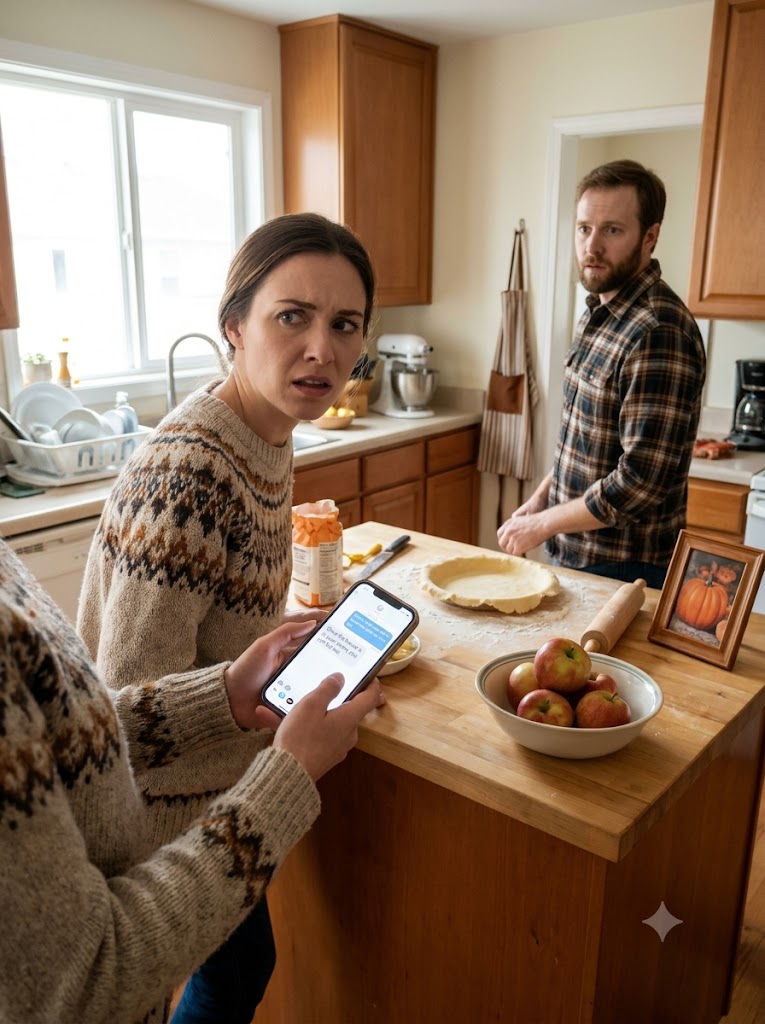
Two days before Thanksgiving, I was pressing pie dough into a glass dish when my husband’s phone flashed beside the flour canister. The message was from his mother, Elaine: “Once the house is in your name, you can tell her.” Before I could set the phone down, another appeared. “Wait until she’s had some wine. She won’t read every page.” The oven beeped, an old Motown song played on the radio, and I forgot how to breathe.
My nine-year-old daughter, Maisie, sat at the kitchen table cutting construction-paper feathers for a turkey. “Mom, why are you squeezing Dad’s phone?” she asked, looking at the flour dust on my fingers. “Just setting the timer,” I said, because that was why Blake had handed it to me in the first place. I typed in forty minutes, wiped the screen with my sleeve, and set it beside the cooling rack.
The house Elaine wanted was a modest brick ranch on the south side of Indianapolis, with squeaky boards and a cherry tree that bloomed early. My grandmother Evelyn had lived there for fifty years and left it to me four years ago. Her attorney had kept the deed in my name alone, although we were married. I used to think that was old-fashioned caution.
Three weeks earlier, Blake had asked whether we should add his name to the title. “What if something happens to you?” he’d said over takeout noodles, pointing his fork toward Maisie. “We need to make things simple for her.” I’d promised to think about it; I trusted him, but I wanted to ask a lawyer first. Since then, he’d brought it up every few days, each time sounding slightly less patient.
Now he was in the living room cheering at a football replay, unaware of what his mother had written. I stepped into the pantry and sat on a sack of potatoes between canned peaches and the extra paper towels. I kept hearing “you can tell her,” as if my life had already been decided. The smell of cinnamon from the oven made me feel sick.
When I came out, Blake had wandered into the kitchen and was stealing a cookie from the tray. “You look pale,” he said, kissing my forehead; his cologne was the one I’d bought him for his birthday. I wanted to ask what he planned to tell me, but Maisie was holding up a turkey with two mismatched wings. “That one’s perfect,” I told her, and Blake smiled as though we were still an ordinary family.
At dinner, he casually announced that his mother’s friend would come on Thanksgiving with the house paperwork. “She’s a notary,” he explained, scraping mashed potatoes from his plate. “We’ll do it before dessert so everyone can celebrate with us.” I asked why it couldn’t wait until December, and he sighed. “You’ve been putting this off forever, Nora. I thought you wanted us to be a team.”
I waited until the house went quiet, then took his phone from the nightstand. I knew his passcode because it was Maisie’s birthday, and he’d never considered changing it. In the bathroom, the exhaust fan hummed above me while I scrolled through four months of messages with Elaine. There were references to an appointment with a lender, a folder under his car seat, and a plan they called “the Thanksgiving solution.”
One message from Elaine said, “She still thinks you’re just adding yourself for Maisie’s sake?” Blake had replied, “Yes. Don’t complicate it.” I stared at the words until my reflection in the dark window looked like someone else. Then I found a short exchange from the previous Sunday, after Blake had spent the afternoon pretending to help Maisie build a science project.
“Have you decided when you’ll tell her about the separation?” Elaine had asked. Blake’s answer contained only five words: “After she signs the house.” I pressed my hand over my mouth so I wouldn’t wake anyone. He wasn’t asking to share the place where we raised our daughter; he was preparing to leave me, and somehow he believed my grandmother’s home should go with him.
Part 2
I kept scrolling because I needed to know who could plan a divorce while asking me to bake pies. An unfamiliar number appeared again and again beneath Elaine’s messages, always followed by the initials C.R. In their conversation, there were pictures of a candlelit restaurant, a hotel room with a blue quilt, and two hands linked across a table. I recognized his watch.
Her name was Celia Ross, and Blake had saved her contact as “Chris—Warehouse.” She called him “my future homeowner” and asked whether she could bring over paint samples in December. He wrote, “You can have the office once Nora and Maisie are settled somewhere else.” Grandma and I had painted that room yellow. Reading his message felt worse than seeing the hotel photographs.
I forwarded the screenshots and attachments to an account Blake couldn’t access, then carefully returned his phone. I lay beside him until morning, watching shadows crawl across the ceiling while he slept with one arm stretched toward my empty pillow, as he had done for eleven years. I wanted to wake him and demand answers. Instead, I remembered Maisie sleeping down the hall and the way Elaine had instructed him to wait until I’d been drinking.
Wednesday morning, I called in sick at the dental office where I managed patient scheduling. I drove to Mr. Adrian Bell, my grandmother’s attorney, who wore plaid bow ties and kept peppermint candies for nervous clients. His office smelled of coffee and old file folders. When I showed him the messages, he read them without interrupting, his eyebrows drawing closer with every page.
“Your grandmother asked me to protect this house from exactly this sort of pressure,” he said, pulling the recorded deed from his file. He explained that a home inherited by one spouse could have special protections, though the details needed legal review. “I won’t promise you a result before examining the facts,” he added. “But I can promise that you do not have to sign a deed because twelve people are watching.”
I showed him a photograph of the documents Blake had left in our kitchen drawer. Adrian pointed to the proposed new owner. The form listed Blake Whitcomb alone, not both of us; my name appeared only as the person giving up her interest. “This does not do what he told you,” Adrian said, and the room seemed suddenly much colder.
We discussed safe ways to document the pressure, what to tell Maisie, and whether I had somewhere to go if Thanksgiving turned ugly. I decided to remain at home, where my documents and family photographs were, but I changed my email password and copied the deed into a separate folder. Adrian referred me to a family-law colleague for the divorce petition. I signed the filing paperwork that afternoon, feeling strangely steady as the pen moved.
Before I left, Adrian asked why Elaine was so determined to obtain the property. I told him she had once co-signed a loan for Blake’s unsuccessful contracting business, a venture he claimed was fully paid off. “That may be unrelated,” he said, “but don’t assume you know the whole reason yet.” He requested permission to review any property documents presented at dinner, and I invited him to join us at three.
At home, Blake was arranging folding chairs and congratulating himself on having solved the seating problem. He asked whether I’d found my grandmother’s silver serving spoon and whether I wanted red or white wine on Thursday. I answered both questions, wondering if he could hear how different my voice sounded. Then Maisie came running in with a card with two stick figures holding a heart.
Inside, she’d written, “I’m thankful Mommy and Daddy always tell me the truth.” I carried the card upstairs before I could cry in front of her. Later that night, another message appeared on Blake’s screen while he showered, this one from Elaine: “Celia wants confirmation. Tell her the equity is ours after tomorrow.” I finally understood that my house wasn’t just part of their escape plan; it was what they meant to cash in.
Part 3
Thanksgiving morning arrived under a low gray sky, and I woke before the alarm to rain ticking against Grandma’s window. I rubbed butter into the biscuit dough while Blake polished wineglasses, humming with the radio. He kissed my cheek and said, “This is going to be such a good day.” I wondered how many lies could fit inside that familiar smile.
By noon the house smelled of turkey, sage, and the orange peels simmering on the stove. Elaine arrived first wearing pearl earrings and carrying a bottle of expensive red wine, although she knew I usually drank sparkling cider. She hugged me with both arms and said, “You’re so lucky to have a husband who thinks ahead.” I stepped aside to let her in before my face betrayed me.
Blake’s older brother, Grant, came with his wife and two children; his younger brother, Owen, brought cornbread and an aunt who loved to talk about her garden. Soon there were twelve people under Grandma’s roof, setting platters on sideboards and talking about the game. Maisie took her cousins upstairs to watch a movie until dessert. I needed her away from whatever was about to happen, but I also wanted her to enjoy the holiday I’d promised her.
At three, just as I pulled the turkey from the oven, Elaine looked at her watch and raised her eyebrows at Blake. He tapped a spoon against his glass, and everyone turned toward the dining table. “Before we eat, Nora and I have something special to do,” he announced. “We’re updating the house title so our family is protected, and Mom arranged a notary to make it official.”
Grant began to clap, then stopped when he noticed I wasn’t smiling. A woman in a navy coat appeared at the door carrying a slim briefcase and introduced herself as Marissa, Elaine’s longtime friend. She placed several sheets across Grandma’s crocheted table runner, pausing to check our identification. Elaine poured a generous glass of wine and set it beside the signature line, pushing my untouched cider to the side. “You deserve to relax, sweetheart,” she told me.
I looked at the paperwork without touching the pen. Blake shifted closer, his hand resting on the back of my chair as though to present us as a pair. “Just the formalities,” he whispered. “We talked about this.” I could hear the refrigerator motor cycling on behind the silence, and I noticed that Marissa had put a little yellow arrow beside the exact place where he wanted me to sign.
“I invited someone to review the documents,” I said. Blake’s hand lifted from my chair, and Elaine’s expression hardened. The doorbell rang before either could object. Adrian entered wearing a burgundy bow tie and carrying the same battered leather folder he’d used at his office. He greeted the room politely, then asked Marissa whether she would mind giving him a moment with the proposed deed.
Blake laughed too loudly. “Nora, this is embarrassing. My mother went to a lot of trouble.” Adrian looked at me, waiting, and I nodded for him to continue. He read the first page, then turned it toward the others without passing it around. “Your husband described this as adding his name,” he said. “The document instead proposes transferring your entire interest to him.”
Owen leaned forward, frowning, while Marissa stared at the page in disbelief. Blake insisted the wording was standard, and Elaine said attorneys always made simple things sound frightening. I pulled up a message on my phone and read it aloud: “Wait until she’s had some wine. She won’t read every page.” Grant turned to Elaine and asked, “Mom, did you seriously tell him to do that?”
Elaine’s hand stayed wrapped around the neck of the bottle. I showed Blake the next message, the one in which he promised a separation after I signed. “I know about Celia,” I told him, keeping my voice low enough that Maisie wouldn’t hear upstairs. His face drained of color, and Grant stopped looking at his mother. Then Marissa cleared her throat and said, “Elaine, you never told me this was a transfer to Blake alone.”
Part 4
Marissa pulled the deed toward herself and removed the yellow signature tabs. “I was told both spouses had agreed to the transfer,” she said calmly. “I cannot notarize a signature given under pressure or when the signer does not understand the document.” She closed her briefcase, apologized to me, and left through the front door without taking a dime of the fee Elaine had offered. The latch clicked loudly.
Blake stared at the empty chair where the notary had been. “You went through my phone,” he said, as though that were the betrayal. “Yes,” I answered, “and I found out you planned to take my home before leaving me for Celia.” He looked toward his brothers for help, but neither moved, and I realized they hadn’t been included in his mother’s plan. The turkey rested untouched on its platter, cooling under the light.
Elaine rose so quickly her chair scraped the hardwood. “Blake invested years in this house,” she said. “He deserves security.” I reminded her that the house was Grandma’s and I’d paid most costs myself. She looked at Adrian instead of me. “Tell her what he’s entitled to, then,” she snapped, expecting Adrian to side with her.
“Any financial claims can be addressed through the divorce process,” Adrian replied. “They do not justify misleading Nora about a deed.” At the word divorce, Grant turned sharply toward Blake. “You were going to leave her anyway?” he demanded. Blake mumbled that nobody understood his sacrifices, speaking as though our marriage had been punishment.
Then Owen asked why Elaine was so desperate to put the house in Blake’s name. Grant answered before she could: a bank had contacted him about the contracting business they’d once run together, and payments were several months behind. Elaine had guaranteed some of Blake’s borrowing, and collection notices were reaching her home. Blake hoped to use the house as collateral, although no lender had approved his plan.
“Celia knows about the loan?” I asked. Blake flinched, and that was answer enough. I showed him her message about repainting my grandmother’s old sewing room and moving in after Maisie and I left. “You were going to give her my memories like they were furniture you bought on clearance,” I said. Nobody in that dining room could look at him. Even Elaine stared at the table.
Adrian opened his folder and explained that my divorce petition had been filed Wednesday. He had also brought copies of the existing deed, so there could be no confusion about what I owned today. “You should each get independent advice about temporary living arrangements,” he told us, without pretending he could evict Blake. I turned to my husband, remembering how we’d carried Maisie through the front door as a sleepy toddler. “I’m not signing anything, and our marriage is over.”
For several seconds Blake just stood there, then walked upstairs and returned with two suitcases. Elaine started to follow, but Grant caught her attention with a simple question: “Did you know about Celia when you asked Nora to sign?” She admitted she had. Grant fetched her coat, and Owen opened the front door without saying another word. Blake went with her, leaving his wedding ring beside the sink.
Nobody knew whether to sit or leave. Finally Grant asked, “Would you like us to go?” I looked at the turkey and Maisie’s cranberry sauce. “No,” I said. “But we’re not going to spend this holiday talking about him.” We called the children downstairs, cut the turkey, and passed the potatoes while the rain stopped outside.
After dessert, Maisie noticed Blake’s coat was missing and quietly asked whether Daddy had gone to work. I sat beside her on the stairs, telling her that her father and I would live separately and that she had done nothing to cause it. She asked if he would still come to her school concert, and I promised we would ask him. That night, I found a lender’s letter addressed to me about an application I’d never made. Blake had apparently tried to put his debt in my name, too.
Part 5
The letter came from a lender I’d never contacted, thanking me for beginning an application with Blake as a co-borrower. It requested employment verification, so approval was still pending. On Friday, Adrian helped me contact the lender’s fraud department, and I placed freezes on my credit reports. At least this fear came with a paper trail.
The lender confirmed that an application had been started using my information but that no loan had been issued. I submitted a written dispute with supporting records while my attorney documented everything. I wrote the confirmation number on a grocery receipt because my hands were shaking. Blake sent me a message insisting it was “only a backup plan” and that I’d made things unnecessarily hostile. I didn’t answer; my name belonged to me, and no one had the right to borrow it without asking.
Elaine called repeatedly through December, crying about the business debt. She claimed she believed Blake would repay everyone. When she finally asked whether we could put it behind us for Maisie’s sake, I told her that future visits would require honesty and boundaries. “You didn’t make one mistake,” I said. “You made a plan, and you expected me not to notice.”
Blake began seeing a counselor and asked for another chance before Christmas. He called Celia a distraction and the deed an error. I listened only long enough to confirm the pickup time for Maisie’s school concert, then ended the call. His explanations no longer made me doubt myself. I could tell responsibility from a rehearsed apology.
Maisie asked hard questions over those winter months, while we rinsed dishes or folded laundry. I told her that adults sometimes made choices that meant they couldn’t stay married, but that she could love us both. Blake attended some school events and missed others; I stopped making excuses when he didn’t come. I couldn’t promise away her disappointment, but I could sit beside her, hold the wet dish towel, and let her ask again tomorrow.
My divorce attorney guided us through financial disclosures and temporary parenting arrangements. The court reviewed the inherited property, our household expenses, and the evidence surrounding the proposed transfer, not anyone’s dinner-table declaration. Blake’s creditors pursued his business obligations, and the disputed application in my name was closed without a loan. Mail still frightened me, but records told the truth. Each time I opened an envelope and found nothing hidden, the house felt a little more like my own again.
In March, Owen mentioned that Celia had ended her relationship with Blake after learning the house would not be available to them. Perhaps he expected vindication. Instead, I felt tired; two strangers had spent months imagining a future inside rooms filled with my daughter’s drawings. Their future wasn’t my business, and I asked Owen not to bring me updates again. I had a life to rebuild, not regrets to monitor.
The divorce was finalized in May. The house remained mine, and our parenting plan set Blake’s time with Maisie and our responsibilities. I didn’t celebrate publicly. I took the final paperwork home, placed it beside Grandma’s original deed, and made myself a cup of tea in the same chipped blue mug she’d used every morning.
That weekend the cherry tree opened into pale pink blossoms, scattering petals onto the grass. We spread a quilt beneath it and ate sandwiches while a breeze rattled the branches. “Will this house be mine someday?” she asked, tracing a petal on her knee. “If that’s what you want when you’re grown, we’ll make a proper plan,” I told her, because love deserved clear choices, not surprise signatures.
At Christmas, Adrian sent a card featuring his terrier in a bow tie. Inside, beneath his careful handwriting, was one sentence: “Your grandmother would be proud that you read the fine print.” I set it on the mantel beside Maisie’s paper turkey, with its mismatched wings. For years I’d mistaken keeping the peace for keeping a family; now I knew a real home was somewhere nobody needed to be tricked into staying.
Legal Notice: This story is a work of fiction. Names, characters, businesses, events, and incidents are the product of the author’s imagination or are used fictitiously. Any resemblance to actual persons—living or dead—or to actual events is purely coincidental. Thank you! 💓


