
My Husband Gave Me $150 Million to Disappear—Three Years Later, He Found Twins in My Flower Shop and Discovered the Truth He Had Buried
My husband sent me $150 million the day he asked for a divorce, certain a fortune would buy my silence. I returned every penny and left with an ultrasound picture he refused to see. Three years later, he found me running a small flower shop, with two toddlers who had his eyes. He claimed nobody had told him. Then an old email surfaced, proving the truth was uglier than abandonment—and forcing me to decide what place he deserved in our children’s lives.
Part 1
My marriage ended by banking notification outside a Cleveland fertility clinic. A transfer of $150 million had landed in my personal account, followed by a text from my husband, Julian Vale: “Consider it a generous settlement. I want a clean break.” Inside my coat pocket was an ultrasound photograph I had spent the entire morning protecting from the rain.
Seven years earlier, Julian had proposed on the roof of a hotel his company had just purchased. He promised that success would never make us strangers, and I believed him because he still remembered how I took my coffee. By our seventh anniversary, his real estate empire had swallowed our dinners, our weekends, and eventually the space between us in bed. Whenever I brought up starting a family, he called himself “careful,” although I was the one sitting through disappointing appointments.
My name is Lena Cross, and back then I mistook endurance for devotion. I worked part-time restoring old books and spent the rest of my week managing the enormous house Julian barely visited. For months, the clinic kept rescheduling appointments, citing requests from our household office. I trusted his assistant and didn’t question the changes.
That afternoon, I spotted Julian across the street with Camille Arden, the woman he’d dated before we met. She adjusted his scarf, and he leaned down to kiss her forehead beneath a red awning. I had seen Camille at two charity dinners and told myself her returning to Cleveland meant nothing. My ultrasound envelope felt fragile.
Julian was waiting at home with divorce papers arranged beside a bowl of untouched lemons. “I’ve been unhappy for a long time,” he said, without asking why I was carrying a medical envelope. When I tried to explain that something important had happened, he raised his palm. “Please don’t make this harder. The money is yours, and Camille and I are going to build a different life.”
I asked whether our years together meant anything beyond a number on a screen. He answered, “I gave you everything,” then admitted he had instructed his office to pause our fertility appointments because he didn’t want a baby complicating his doubts. I remembered crying after canceled visits while he held me and promised we’d try again next month. For the first time, I understood that some of my disappointment hadn’t been bad luck.
I signed the papers after receiving independent legal advice, and I returned every dollar through the bank. Julian looked offended. “You’ll regret leaving with nothing,” he said. I put my ring beside the lemons and answered, “I already regret staying as long as I did.”
The following week, a specialist confirmed I was carrying twins. I emailed Julian the scan, called his office, and mailed a signed letter through an attorney because I believed the children deserved a father who knew they existed. My email bounced from one address; the calls went to an assistant, and the letter came back marked undeliverable. Eventually my lawyer advised me to preserve every attempt and stop forcing open a door Julian had shut.
I moved into my aunt’s spare room and spent my savings converting a vacant Cleveland storefront into a flower shop. The first winter, condensation ran down the windows and I slept in short stretches between feeding two babies. My son, Miles, arrived with Julian’s serious eyebrows; my daughter, Hazel, had a stubborn little chin and an unexpected talent for sleeping through thunder. Neither child ever knew the marble hallways of the mansion I had left.
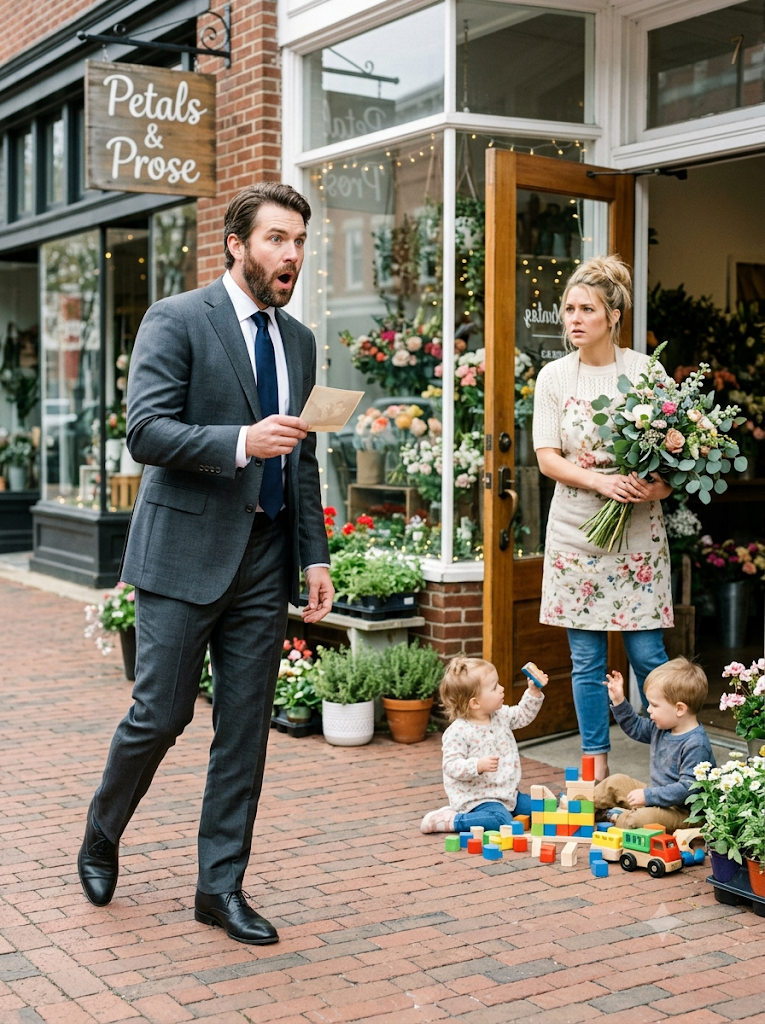
Three years later, my shop smelled of eucalyptus and wet stems, and the twins argued over who got to straighten the ribbon display. A neighborhood magazine photographed us outside beneath the green awning for a story about small businesses. I thought the photograph might bring us a few wedding orders. Instead, one Thursday morning, the bell above my shop door rang, and Julian stood there staring at the little boy holding my hand.
Part 2
Julian had silver at his temples and a new crease between his brows. Miles stood behind my leg while Hazel offered him a daisy she’d dropped on the floor. “Are you here for flowers?” she asked, and he stared at her as if she’d spoken a language he used to know. I asked my employee, Rosa, to take them upstairs to my apartment before we talked.
“Those children,” Julian began, watching the stairwell. “They’re yours?” I wiped my damp hands on my apron and told him they were my son and daughter. His gaze moved from their little rain boots to the photograph pinned near the register. “Lena, are they mine?”
I said yes, and he lowered himself onto a stool meant for customers choosing arrangements. Then he asked, “Why didn’t you tell me?” and whatever sympathy I’d felt evaporated. I retrieved a folder from below the counter, where I’d kept every record.
I showed him copies of my emails, certified-mail receipts, and the dated message explaining the twins. Julian searched the pages for some loophole that would turn silence into my fault. “My office handled everything during the divorce,” he muttered. “I wasn’t taking personal calls.” Delegating wasn’t an excuse.
He asked to see them again, but I pointed to the schedule taped beside my cash register. “You can’t meet my children because you happened to recognize their faces,” I said. “Hire a family lawyer, establish paternity properly, and we’ll discuss introductions that don’t frighten them.” He heard Hazel laugh upstairs and didn’t argue. Even with all his money, he had never understood how children depend on adults who keep promises. I wouldn’t let his panic write their first memory of him.
That evening my aunt Bernice joined us for dinner above the shop. Hazel said a tall stranger had looked sad downstairs. I told them an adult who once knew me was working out something important, and we would talk when there was more to explain. That night, I checked the bolt twice.
Two days later, his attorney contacted mine. Julian agreed to a DNA test and structured introductions. He also sent an envelope containing a cashier’s check large enough to purchase the entire building. My lawyer returned it unopened.
Rosa promised the twins hot chocolate after their test. Miles watched the nurse prepare the cheek swabs and asked whether it would tell him why Julian had the same eyebrows. I said it might. Julian stared at the dinosaur stickers.
While we waited for results, I found an unexpected visitor on the shop’s security footage from the previous month. Camille had come in wearing dark glasses, asked who owned the building, and offered to connect me with an investor who could “make moving worth my while.” She’d watched Miles chase Hazel between buckets of carnations and asked whether their father was involved. Rosa remembered her because she’d bought a single white rose and left it on the counter. I’d thrown it away after its petals browned.
I called my former clinic and requested the full history of appointment changes. The administrator said some records had been archived after a corporate billing review and would require a formal release. Julian’s old assistant, Peter, once routed medical invoices through that account. I authorized their release.
Six days after the test, the laboratory confirmed Julian was the twins’ biological father. On the phone, he asked, “Can I tell them who I am?” I said we’d plan that with a child therapist, not improvise it in the middle of my shop. He didn’t argue.
Then the clinic sent its first batch of records. The final page included Camille’s message to Peter, dated two days before the divorce: “The clinic billed an ultrasound. Don’t let Lena through to Julian until I’ve spoken with him.” I stared at the date, wondering how two people I’d trusted so little had learned my secret before the man I’d married.
Part 3
I printed Camille’s message and placed it beside the returned envelope from my lawyer. For three years, I’d wondered whether Julian’s silence meant ignorance, indifference, or something worse. Now I knew people around him had been managing what he was allowed to hear. I didn’t know whose instructions they’d followed.
My attorney, Dana Ortiz, contacted the clinic directly. During a meeting beneath unforgiving fluorescent lights, its administrator confirmed that Julian’s office had asked to suspend further fertility appointments. Staff had treated the instruction as a scheduling request, even though I hadn’t authorized it, and the clinic apologized for failing to confirm with me. My pregnancy was already underway, but the canceled visits hadn’t been an accident.
Camille’s involvement was harder to untangle. She had access to Peter’s office calendar and had seen a billing notice referencing an early ultrasound. When I contacted her through counsel, she denied interfering and described her visit to my shop as an investment inquiry. Then my landlord forwarded an unsolicited offer to purchase the building from a development company whose director was Camille. Her interest in my children’s home was no coincidence.
I met Julian in Dana’s office rather than let him return to the shop unannounced. He looked exhausted, his expensive watch hanging loose above his cuff, and asked whether he could pay for a larger apartment for the twins. “They have a home,” I replied. “What they need is consistency, and what I need is the truth.” I pushed the clinic message toward him, and he read it without looking up.
“Camille said you were trying to pull me back,” he admitted. “She told me the ultrasound could be old.” I wanted to shout that a husband who’d helped arrange medical appointments should know the difference between suspicion and checking. Instead, I asked what he’d done to find out. Julian said nothing, and Dana’s pen stopped moving across her notebook.
Peter agreed to provide relevant office records through the attorneys. He admitted routing the clinic’s messages away from Julian, following instructions that personal correspondence from me was not to interrupt work. Camille had reinforced that rule and asked him to hold the ultrasound notice. At least he’d preserved the archive.
Meanwhile I needed a plan for the shop. My landlord had no intention of selling immediately, but the offer reminded me how little security a short lease provided. Rosa introduced me to a retired florist who owned a neighboring storefront and wanted a partner rather than another tenant. We spent Saturday walking through the empty rooms, smelling old paint and imagining a classroom where children could learn to grow herbs.
Miles and Hazel began asking about Julian after their therapist helped me explain that he was their biological father. “Was he lost?” Hazel asked as she arranged crayons into a crooked rainbow. I said he had made choices that kept him away, which was true without making her carry my anger. Miles wanted to know whether Julian liked trains, and I promised they could ask him at their first planned meeting.
That meeting took place at a quiet library courtyard with Dana’s recommended family specialist nearby. Julian arrived on time, brought no expensive gifts, and listened while Miles explained how train signals worked. Hazel handed him a yellow leaf she’d found beneath a bench, and he accepted it with shaking hands. Watching them was painful, but the children were entitled to build their own relationship with him, separate from my marriage.
Afterward, Peter’s complete archive reached Dana. One email, sent the day after Julian received my pregnancy announcement, had been opened from Julian’s own account. He’d forwarded it to Camille with a single sentence: “She says she’s pregnant. Handle it. I’m not reopening this marriage.” I read those words until the room seemed to tilt, because the man asking for a second chance as a father had known there was a child to ask about all along.
Part 4
I called Julian the next morning and asked him to meet with both attorneys present. He arrived carrying a paper bag from the bakery where we’d once bought anniversary pastries, then saw the forwarded message on the conference table. He pushed the bag aside. “You knew,” I said, as my hands shook.
“I thought you were trying to stop the divorce,” he admitted. “Camille said there was no proof, and I didn’t want to get pulled into another argument.” I asked why a possible child hadn’t deserved one phone call. He looked at the window and said he’d convinced himself he could settle everything later. “Later grew up without you,” I answered.
For a moment he tried to blame Camille and Peter, but Dana reminded him that the instruction had come from his own account. Julian finally stopped defending himself and apologized for abandoning me when I needed an answer. I believed his remorse. But remorse couldn’t return three lost years.
Camille’s offer to buy my building vanished once Dana asked her to preserve every message about my family. Julian told me their relationship was over; I felt nothing. I had no interest in accepting another invitation into their drama.
The harder work concerned Miles and Hazel. We put a parenting agreement in place with a predictable schedule, clear boundaries, and financial support that couldn’t be traded for access to me. Julian agreed to respect every boundary. When he asked whether I’d ever forgive him, I said, “You can become a better father. That doesn’t require me to become your wife again.”
I signed a partnership agreement with the retired florist, Mrs. Delgado, and moved the shop into her sturdier brick building that spring. She taught me how to price large wedding orders without apologizing, and I showed her how to manage online bookings. We painted the front door green and installed a small table where the twins could work on puzzles after preschool. The business was ours.
A year later, Miles started kindergarten with a backpack bigger than his torso, and Hazel insisted on wearing mismatched socks for her class photograph. Our shop hosted a children’s planting workshop, and the room smelled of soil, orange peels, and raincoats drying beside the heater. At closing time, I found an envelope slipped under the door from Julian. Inside was a handwritten apology and an invitation to dinner, just the two of us.
I returned the invitation through Dana and kept the apology in the legal folder, where it belonged. Once, his tenderness might have swayed me. That evening, I wondered only whether the florist across the street would trade me extra ribbon for the bunches of lavender I’d overordered. I liked the freedom of having such ordinary problems.
That summer the twins helped me hang a new photograph above the shop counter. In it, Miles was holding an enormous sunflower, Hazel was laughing so hard her eyes had closed, and I stood behind them with dirt on my apron. No mansion appeared in the background, no settlement check waited on a table, and nobody was being asked to disappear. We belonged there.
Julian still appeared in their calendar, as a father learning to show up, not as a husband I’d been persuaded to take back. I never forgave the choice he’d made when he read my message, or the years he’d let me believe I was unheard. I no longer needed his understanding. The life I’d built was already answering that question.
On the anniversary of the day he sent me $150 million, I bought the twins ice cream and closed early to walk along the lake. Hazel took my left hand, Miles took my right, and the wind smelled of water and newly cut grass. Once, Julian had offered a fortune to make me leave his life; today, I had everything I wanted without accepting a dollar of that offer. When the twins pulled me toward the shoreline, I went with them, leaving nothing worth keeping behind.
Legal Notice: This story is a work of fiction. Names, characters, businesses, events, and incidents are the product of the author’s imagination or are used fictitiously. Any resemblance to actual persons—living or dead—or to actual events is purely coincidental. Thank you! 💓


