
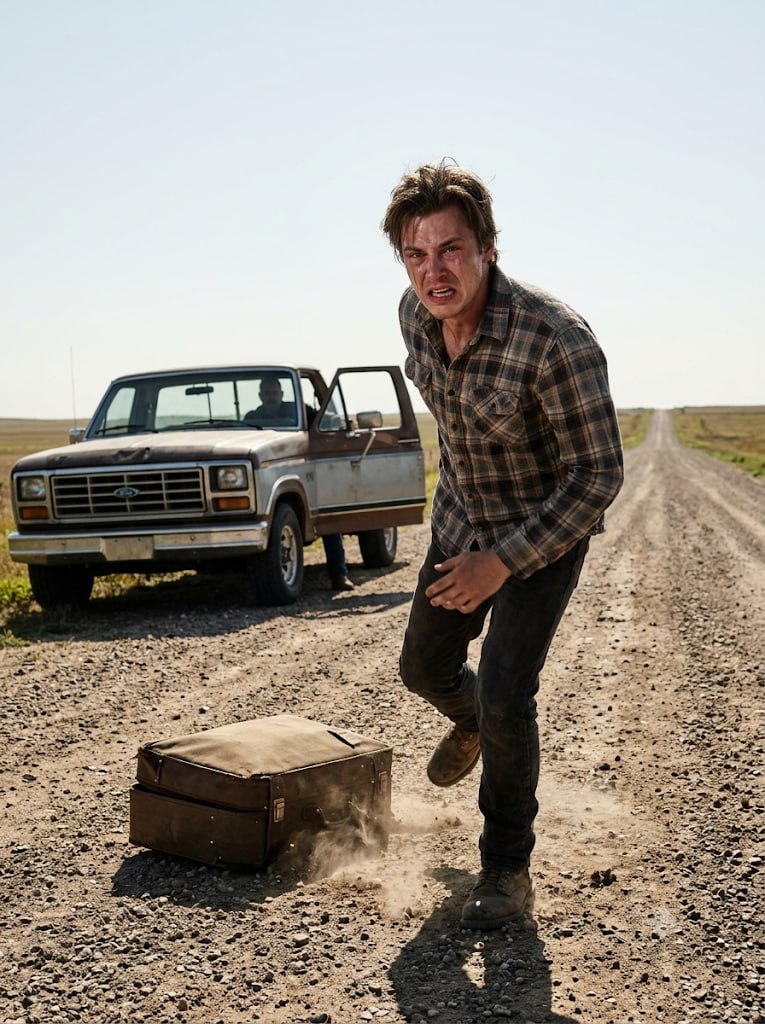
My Father Left Me on a Dirt Road at Thirteen. Eighteen Years Later, a Wedding Invitation Exposed His Secret.
At thirteen, I watched my father drive away after ordering me out of his truck on a deserted road. For eighteen years, he told everyone I had run away, and I built a life without him. Then a wedding invitation arrived from the half-sister I had never met, with a handwritten warning tucked inside. What I discovered wasn’t an apology or an explanation for his cruelty. It was evidence that the day he abandoned me had been planned down to the week.
Part 1
“Get out, Evan.” My father kept his truck in drive, one boot pressed against the brake while heat shimmered above the gravel road. I was thirteen, holding a blue duffel containing two T-shirts, a paperback, and the baseball glove my mother had bought before she died. “Walk home,” he said, pushing the door open. “Maybe it’ll make a man out of you.”
I waited beside a soybean field until the dust from his tires disappeared, then waited longer because I couldn’t imagine he wouldn’t return. By the time I reached a gas station, my socks were damp and the duffel strap had rubbed my shoulder raw. The cashier let me use the counter phone, and my mother’s sister, Aunt Nora, arrived forty minutes later with a bottle of cold water. She didn’t demand an explanation; she just put my bag in her car and said, “You’re coming home with me.”
My mother, Caroline, had died when I was eight, and afterward Dad seemed to resent every reminder of her, especially me. He married Melissa two years later, and their house became a place where I learned to eat quietly and keep my opinions to myself. Nora petitioned for custody after the roadside incident, and Dad signed without appearing at the hearing. I found out years later that he told our relatives I had run away because I couldn’t stand rules.
I’m thirty-one now, and I own an HVAC company outside Lansing, Michigan, with twelve employees and a dispatcher named Rosa who runs my calendar better than I do. Nora helped me buy my first service van; I repaid every dollar and still bring her groceries on Sundays. Most days, the past stays where I put it, behind the shop invoices and the smell of solder. Then an ivory envelope appeared in my mailbox, addressed in handwriting I didn’t recognize.
It invited me to the October wedding of my half-sister, Paige, and her fiancé, Lucas, at a lakeside pavilion. I’d seen Paige in photographs but had never spoken to her, and I was about to put the card in the recycling when a smaller envelope slipped out. On its front, someone had written, “Read this before deciding whether to come.” Inside was a letter in my mother’s unmistakable slanted handwriting, dated a few months before she died.
“If anything happens to me, don’t let Grant handle Evan’s trust alone,” it said. “He asked what the monthly payments would be before he asked how long I had left.” My stomach tightened as I read about an account established by my grandparents for my care, with Nora named as the person my mother trusted. A separate note from Paige said she’d found the letter in Dad’s desk, hidden with old bank records. “He told me you ran away,” she wrote. “I think he lied about more than that.”
I called Nora, who was washing dishes; I could hear plates knocking against her kitchen sink. She said she’d never received the letter, but Dad had told her my mother’s last instructions were burned with some hospital paperwork. Then she mentioned something I hadn’t known: Dad had hired a crew to build Paige’s wedding pavilion on Nora’s three acres of lakefront land. “I told him no twice,” she said, “but he says the property is his now.”
The next morning, I drove to the county records office instead of my first appointment. The clerk handed me a copy of a quitclaim deed transferring Nora’s lakeside lot to Grant Mercer, filed six months earlier, with a notary stamp from a town Nora had never visited. Her signature looked close enough to fool someone who didn’t know her, but I had watched her sign school forms for years. When I showed her the document, she gripped the kitchen table and whispered, “Evan, I never signed that.”
Outside her window, a truck rolled down the driveway carrying fresh lumber toward the lake. I could hear hammers beginning where Nora’s peonies used to grow. My father hadn’t just come back into my life through a wedding invitation; he was already taking something from the person who had saved it.
Part 2
Nora’s attorney, Martin Bell, worked in an office smelling of lemon polish. He compared Nora’s signature with the deed under a lamp. “I can seek an emergency order to stop construction while we challenge the transfer,” he said, “but first we need to establish who witnessed this signature.” Nora told him she had spent the date Grant claimed she signed in a hospital bed with pneumonia.
While Martin requested records, I visited the bank in my mother’s letter. A trust officer confirmed that my grandparents had deposited $140,000 into an account benefiting me, with an allowance of $650 a month authorized for my guardian. He couldn’t release transactions there, but confirmed Dad received the payments. “There were changes after your custody moved,” he said cautiously, “and your lawyer should request those files.”
At Mercer Roofing, a forklift beeped between stacks of shingles. Dad sat behind a metal desk, older and heavier than I remembered, with the same habit of scratching his neck before he lied. I placed the deed on his blotter and asked why Nora’s name appeared on property she had never sold. He glanced at it and smiled. “Your aunt’s getting confused, Evan. You’ve been gone a long time.”
“Nora knows what she owns,” I said, but Dad had already opened the office door and waved his crew over. He announced that his runaway son had returned to steal his sister’s wedding venue, and the workers stared. I kept my voice level, said the property belonged to Nora, and left rather than give him the shouting match he wanted. Near my van, an older roofer named Pete caught my elbow and murmured, “Ask him about the blue notebook he keeps with the bank papers.”
Paige called that evening and asked to meet at a diner where neither of us knew the waitresses. She arrived in jeans and a wrinkled cardigan, twisting her engagement ring as she slid an envelope between the ketchup bottles. Inside were $650 checks payable to Dad, dated long after Nora took custody. “He says you took the money yourself,” she whispered. “I thought you deserved to see what he signed.”
I stared at the endorsements while the grill hissed behind the counter. One signature looked like Dad’s; another had the wrong slant, as though somebody had practiced copying it. Paige watched my face and said she’d grown up hearing I was unreliable, selfish, impossible to find. “I wanted to invite my brother to my wedding,” she said, “but when I found that letter, I realized I didn’t know who my brother was.”
Melissa confronted us in the parking lot. She told me I had a business and a good life, so there was no reason to embarrass my father over an old family disagreement. “Wait until after October,” she insisted, gripping her purse strap. “Give Paige one perfect day.” When I asked whether she knew the land deed was false, her expression changed, and she said, “Some questions don’t improve anything.”
Martin filed the challenge the next morning, and Dad answered with a sworn claim that I’d threatened his roofing crew. A deputy delivered a temporary order keeping me away from the lake property until a hearing, though I had witnesses and work records contradicting Dad’s account. Nora stood behind the boundary tape on her own driveway, looking smaller than I had ever seen her. I promised her we would fight it, but I couldn’t even cross the line to repair her loose porch step.
The following day, Martin called me into his office and laid an old bank notice beside the forged deed. The notice required my father to bring me to the bank for an in-person identity check beginning on my fourteenth birthday. My birthday had been three weeks away when he left me on that road, and suddenly the timing felt far too precise to be an accident.
Part 3
Martin spread the bank records across his conference table. Certified copies showed Dad collected payments years after Nora gained custody. Tucked behind them was a statement he had signed claiming I had disappeared voluntarily and that he remained responsible for my expenses. “He didn’t merely fail to look for you,” Martin said. “He reported you missing while continuing to collect money meant for your care.”
I wanted to drive straight to the roofing yard, but Martin stopped me before I reached the door. “We need documents, not another argument he can turn into a police report.” Instead I visited Nora, who was clipping coupons at her kitchen table. Her breathing sounded shallow, and she admitted she’d canceled a heart specialist’s appointment because she didn’t want to leave the lake unguarded. I rescheduled it and made her promise to go.
That evening Paige met me behind my shop with a blue spiral notebook wrapped in a grocery bag. She’d taken it after hearing Dad mention the bank’s questions. Each page contained dates, check numbers, and transfers, some marked “care expenses” and others simply “roofing.” One line showed $38,400 shifted into his business account; beside it, in his handwriting, he’d written, “Evan funds—temporary.”
I remembered the identical loan Nora had co-signed for my first van. I’d spent fourteen months paying that loan back while Dad treated money left for me as his emergency cash drawer. Paige looked at the pages and whispered, “He used you to keep the company going.” Then she unfolded a bank letter she’d found beneath the notebook: an old internal exception had allowed the checks to continue after Dad claimed I could not be located. My invented disappearance had exempted him from bringing me to the bank.
For the first time, I understood why he had chosen that empty road, why he hadn’t contested custody, and why he told everyone I had run away. He needed me gone before an employee could ask where I lived, who cared for me, or whether I had ever received a dollar. I leaned against the loading dock’s cool brick until I could breathe. Paige followed but didn’t touch me. “I’m sorry,” she said, and I told her, “You didn’t do this.”
Dad asked Nora and me to dinner two nights before the hearing, claiming he wanted peace. He offered Nora $20,000 in installments to ratify the deed and host the wedding. Nora turned to the final page, saw the blank signature line, and asked when she had supposedly signed the original. “November fourteenth, at your kitchen table,” Dad answered confidently, describing the sweater she wore and the meal they ate.
“That was the day I was admitted to the hospital,” Nora said, sliding the folder back. Dad hesitated, then claimed he’d confused the years, and I watched the easy confidence leave his face. “You could end this tonight,” he snapped at me. “After all I’ve done for you, you owe this family something.” Nora stood and took my arm. “You owe Evan the truth, Grant,” she said, “and you can’t afford it.”
Thursday, Martin presented hospital records and an expert opinion that Nora’s signature was traced. My service records also contradicted Dad’s allegation about threatening the crew, and the judge dissolved the temporary restriction against me. She ordered construction stopped while the property case proceeded, and directed the disputed records to be preserved. Dad looked toward Paige, seated in the back row, expecting her to lower her eyes.
Instead, Paige stood when the hearing ended and handed Martin another envelope. Inside was a loan application listing Nora’s lake property as collateral for a substantial debt connected to Mercer Roofing, with closing scheduled the following week. The wedding pavilion wasn’t the reason Dad needed that land after all. It was the story he’d used to get his hands on it.
Part 4
Monday, the lender was scheduled to finance Dad’s failing company using Nora’s land as collateral. Martin sent its lawyers the judge’s order and Nora’s sworn statement. The closing was suspended pending proof of ownership. Dad couldn’t provide any that didn’t begin with a signature Nora said she’d never written.
Dad called six times that night before I answered on speakerphone beside Nora. “You’re going to put forty men out of work over a piece of grass?” he demanded, though his company employed fewer than twenty. I told him his debts were his problem and his workers deserved the truth, not another story about what I’d supposedly done to him. His voice softened into that old, practiced disappointment: “I’m your father, Evan.” “You were my ride,” I answered, feeling Nora’s hand settle over mine, “and there’s a difference.”
An examiner then reviewed the deed and notary records. The journal had no appointment for Nora, and her signature had been carefully copied. Martin submitted the trust records for investigation, including the handwritten ledger that showed how casually my father had converted child-support money into business cash. Dad’s lawyer offered a quiet settlement, but Nora refused anything that left the fraudulent deed intact or required us to keep the matter secret.
Paige came to my shop one Friday carrying a cardboard box of unused wedding decorations. She and Lucas had moved their ceremony to a lakeside restaurant. “Dad said I was choosing you over him,” she told me as she pulled a tangled string of white lights from the box. “I told him I was choosing the person who didn’t make me lie.” She offered Nora and me new invitations.
I said yes, provided she wanted us there for ourselves rather than as evidence that the family had healed. She smiled for the first time since we’d met and promised no speeches, no forced photographs, and no surprise reconciliation. Nora helped her untangle the lights, offering advice about centerpieces as if they’d known each other for years. Paige wasn’t responsible for the childhood Dad had stolen. I could make room for a sister without reopening a door for him.
The property case took months, not days, but the records held up. A court judgment set aside the forged transfer, confirming Nora’s ownership, and the lender abandoned its proposed loan against her land. Dad later admitted misusing trust funds and filing false statements, agreeing to supervised restitution funded partly by asset sales. His roofing business closed, and former employees found other jobs. None of those consequences required me to invent a story about him.
Melissa wrote blaming me and begging for a wedding invitation. I left it unanswered, just as I left Dad’s eventual apology unopened on my kitchen counter, where it sat for a week before I dropped it in the shredder. Martin offered to arrange a meeting; I declined. The money would be accounted for, and Nora’s property was safe; I didn’t need to sit across from my father to make either fact true.
Paige married Lucas beneath strings of warm lights on a crisp Saturday. Nora cried during the vows and then complained that the cake slices were too small. I danced once with my sister, badly, and we both laughed when I stepped on her shoe. Nothing about the evening erased what Dad had done, but it belonged to the people who had actually shown up.
That spring, I fixed Nora’s porch step and planted peonies where the pavilion had stood. She brought lemonade outside and watched me tamp soil around the roots, while a breeze carried the familiar smell of lake water and freshly cut grass. “You know,” she said, “you never did need him to tell you where home was.” I looked at the water, then at the woman who’d driven to a gas station for a frightened thirteen-year-old boy. My father had told me to walk home, and in the end, I had—just not to him.
Legal Notice: This story is a work of fiction. Names, characters, businesses, events, and incidents are the product of the author’s imagination or are used fictitiously. Any resemblance to actual persons—living or dead—or to actual events is purely coincidental. Thank you! 💓