
My Family Skipped My Wedding for My Sister’s Engagement Party—So I Stopped Paying Their Bills, and Everything Fell Apart
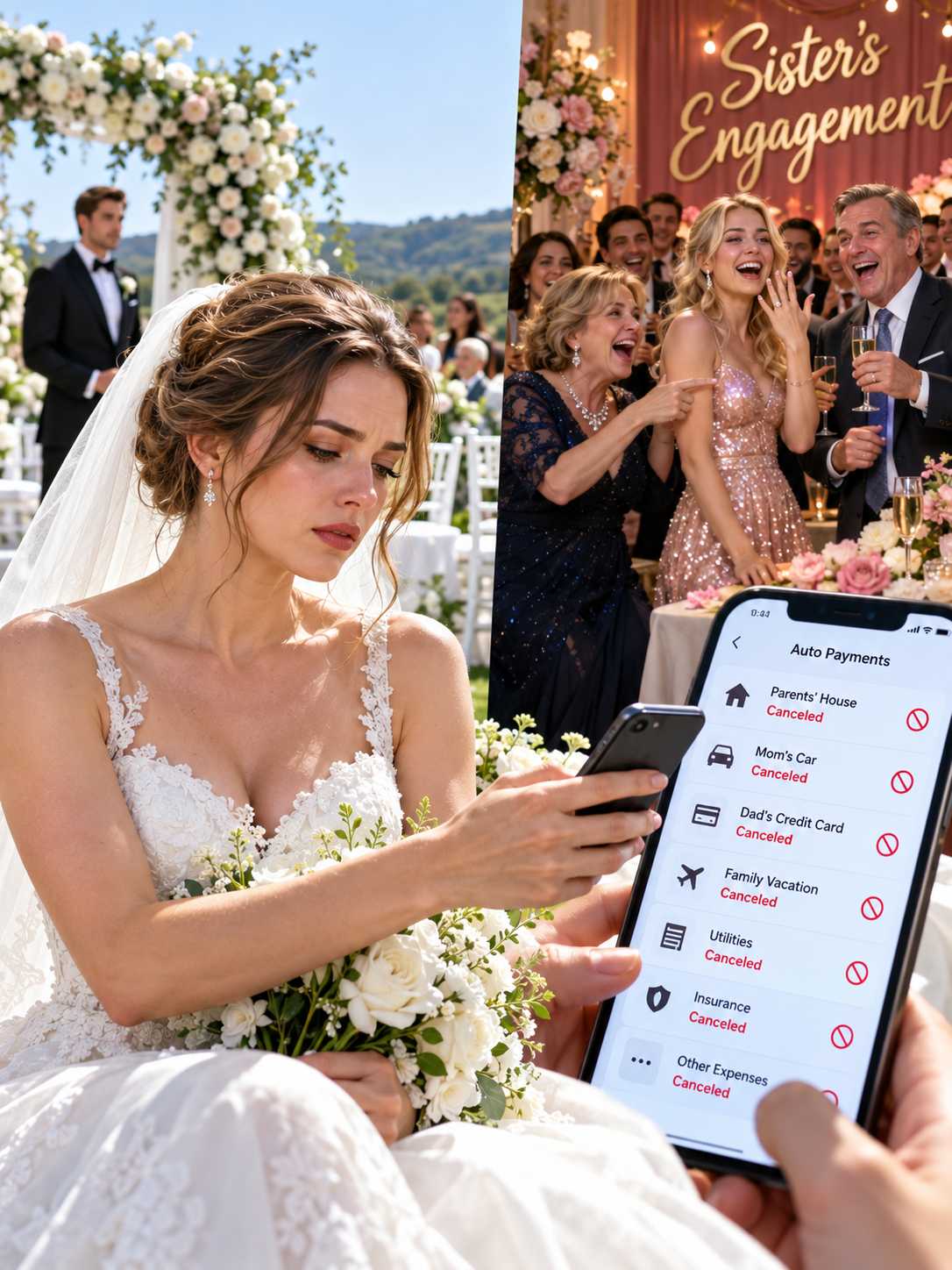
Fourteen minutes before my wedding, my mother texted, “Your sister needs us more today. You’ll be fine without us.” My parents, my sister, and nearly every relative on my side had chosen her engagement party over my marriage. I stood in my wedding gown, canceled the payments I’d been making for my family for years, and walked down the aisle without them. They thought I would apologize when I calmed down. But when the bills started arriving, my father made a desperate phone call that exposed another betrayal.
Part 1: Fourteen Minutes Before I Said “I Do”
Fourteen minutes before I was supposed to walk down the aisle, my mother sent me a message that ended thirty-one years of trying to earn her approval. I was standing in the bridal suite at Meadowbrook Orchard outside Charlottesville, Virginia, while my best friend adjusted the delicate lace along my sleeves. Through the open window came the smell of apple trees and freshly cut grass, and somewhere outside, a violinist was practicing the song I’d chosen for my entrance.
“Sweetheart, we’ve decided to stay for Brielle’s engagement celebration. You know how emotional she gets, and leaving early would upset her terribly. You’ve always been our strong girl, so I know you’ll understand. Have a beautiful wedding. We love you.”
I read it three times before my maid of honor, Hannah, noticed that I’d stopped breathing normally. She took one look at the screen and said something unrepeatable under her breath. I should have cried, but instead I looked at the six empty chairs visible through the window, each decorated with white ribbon for the family members who were supposed to sit closest to me.
My name is Evelyn Mercer, and I was marrying Jonah Hayes, a man who had spent two years helping me plan a wedding that felt like us. We’d chosen an old Virginia farmhouse surrounded by oak trees, a simple outdoor ceremony, and a reception where people could eat good food without worrying about which fork belonged to which course. We’d mailed our invitations eight months earlier, and my parents had confirmed their attendance before we’d even finalized the menu.
My younger sister, Brielle, announced her engagement to Spencer Cole the following March. She was twenty-eight, effortlessly charming, and accustomed to having entire rooms rearrange themselves around her feelings. Three weeks after her engagement, she announced that her official engagement dinner would take place on the same Saturday as my wedding.
I initially assumed she’d forgotten our date, but Mom assured me that Brielle had already discussed it with everyone. The party would be held at an upscale restaurant in Richmond, almost two hours from our venue, beginning just as my ceremony was scheduled to start. When I asked why they couldn’t choose another evening, Mom explained that Spencer’s parents had limited availability.
“Surely you can move your ceremony earlier,” she suggested. I reminded her that we’d signed contracts, invited eighty-six guests, and paid deposits that weren’t refundable. She sighed and said, “Evelyn, not everything can revolve around your wedding.”
That sentence would have been almost funny if she hadn’t spent my entire childhood arranging everything around Brielle.
When Brielle wanted horseback riding lessons, my parents found the money, although I was told to keep wearing my old running shoes. When she changed colleges after freshman year, they paid the additional tuition without complaint. When I graduated and started working in healthcare technology, I became the daughter everyone called whenever something broke or a bill became overdue.
Three years earlier, Dad had asked me to help with the payments on a new SUV after Mom’s knee surgery. He said they needed reliable transportation and promised that the arrangement would last only six months. I agreed to send $875 monthly toward the vehicle loan, assuming he’d take over once his finances improved.
Six months became a year, then two, then nearly three. I also covered their grocery delivery membership, two streaming services, and occasional utility bills whenever Mom called about an unexpected expense. By the time Jonah and I got engaged, I was sending my parents over a thousand dollars most months while they told friends they’d finally become financially comfortable.
Jonah never told me how to spend my money, but he did ask why I was paying for people who rarely seemed interested in my life. I always answered that they were my parents and needed help. He would nod, then quietly remind me that being dependable wasn’t the same thing as being obligated.
Three weeks before the wedding, after Mom announced she couldn’t promise anyone would attend, Jonah and I had a long conversation at our kitchen table. We agreed the wedding would happen regardless, and I decided that if my family abandoned me, I would end the voluntary financial support I’d been providing. I scheduled the cancellations in advance but left them unconfirmed, hoping I’d never need to follow through.
Now, standing in my wedding dress, I opened my banking application and canceled the future transfers supporting my parents’ SUV payments. The loan was in their names, not mine, and I had no legal obligation to continue paying it. I also ended the subscriptions and delivery memberships they had been using through my accounts.
Then I sent one message to our family group chat. “Since you’ve chosen not to attend my wedding, I’m ending the financial assistance I’ve provided for the past three years. Please make your own payment arrangements from now on. I’m going to marry someone who actually shows up for me.”
My phone immediately began vibrating, but I turned it off and handed it to Hannah. Jonah was waiting beneath the oak trees, and I refused to make him wait another minute for people who had already decided I wasn’t worth their time.
As Hannah opened the bridal suite door, she glanced at my phone one last time. “Evelyn, your father just sent something,” she said, her expression changing. “He says you can’t cancel the car payments because there’s something about that SUV you don’t know.”
I looked toward the ceremony lawn, where my future husband was already waiting.
Whatever my father had been hiding would have to wait until after I married the man who had never asked me to earn his love.
Part 2: The Wedding They Thought I Would Cancel
The wedding coordinator met me at the entrance to the orchard, where eighty-six guests were already standing. My parents’ reserved seats were empty, as were those assigned to Brielle and several relatives who had chosen her dinner. Hannah squeezed my hand and whispered, “Look at the people who came.”
Jonah stood beneath the largest oak tree in a dark blue suit, his eyes fixed on me as the music began. When I reached him, he took both my hands and said, “You look beautiful.” I finally cried, not because my family was missing, but because he looked genuinely happy that I was there.
Our officiant, a longtime friend named Rebecca, spoke about choosing someone in ordinary moments, not merely celebrating them when life was convenient. I watched Jonah’s expression as he promised to stand beside me through whatever came next. When I made the same promise, I felt the tightness in my chest begin to loosen.
During the reception, Jonah’s aunt quietly moved several guests into the empty family section. His college roommate raised a toast about how lucky everyone was to know us, while Hannah made the entire room laugh describing our disastrous first date. By the time dinner arrived, the empty chairs had become an unpleasant memory rather than the center of the celebration.
I eventually checked my phone in a quiet corner near the dessert table. There were seventeen missed calls, six voicemails, and a stream of messages in the family group chat. Brielle had written, “I cannot believe you would try to ruin my engagement party with some dramatic announcement.”
Mom’s response was worse. “After everything we’ve sacrificed for you, this is how you repay us? Your father is humiliated, and you’ve embarrassed your sister in front of Spencer’s family.” Not once did she ask how my ceremony had gone.
Dad had left three voicemails. In the first, he sounded furious about the canceled payment; in the second, he warned that my decision could damage their credit. His third message was quieter: “Evelyn, please call me before Monday. We refinanced the SUV earlier this year, and there are things we need to explain.”
I stared at the screen, remembering how carefully Dad had insisted the car payments were temporary. If he’d refinanced the loan, why hadn’t he told the person making the payments? I almost called him, but Jonah appeared carrying two slices of wedding cake.
“Whatever it is, it can survive until tomorrow,” he said, handing me a plate. I showed him the messages anyway, and his expression hardened when he read the one from Mom. He asked whether I’d like him to handle any communication, but I told him this was something I needed to do myself.
Later, Uncle Martin, my father’s younger brother, approached with a small envelope. He’d driven three hours to attend our wedding alone, and he looked uncomfortable as he asked whether my parents had really chosen Brielle’s party. When I confirmed it, he shook his head.
“Your mother told everyone you’d understand because you were having a small, informal ceremony,” he said. “She made it sound like the reception was mostly for Jonah’s friends.” I looked around at the flowers, the dance floor, and the eighty people celebrating with us.
Martin explained that several relatives had been told I’d encouraged the family to prioritize Brielle. I felt anger returning, sharper than before, because my mother hadn’t merely abandoned my wedding. She had apparently invented an explanation that made my absence from the family celebration look voluntary.
“Did you know we sent invitations eight months ago?” I asked. Martin nodded and admitted he’d questioned the conflicting stories but hadn’t pressed hard enough. He apologized, then handed me the envelope containing a generous wedding gift and a handwritten note.
After our last dance, Jonah and I climbed into the waiting car while our guests waved sparklers along the driveway. My dress was wrinkled, my feet hurt, and I was happier than I’d expected to be when the day began. Then Martin sent me a photograph from Brielle’s engagement dinner.
My parents stood beside Brielle beneath an enormous arrangement of white roses, smiling proudly for the camera. Behind them was a decorated backdrop with a familiar gold-and-ivory floral design.
It was almost identical to the wedding backdrop I’d shown Mom six months earlier, when she’d complained that we were spending too much money on something nobody would remember.
Part 3: The Money Behind My Sister’s Perfect Party
We left for our honeymoon the following morning, driving east toward a rented cottage on the Outer Banks. The October sky was pale blue, and Jonah played our wedding playlist while I rested my feet on the dashboard. I had promised myself a week without family drama, but by Monday afternoon, my father had called eleven more times.
I finally answered while Jonah was making coffee in the cottage kitchen. Dad didn’t congratulate us or ask whether we’d arrived safely. Instead, he opened with, “Evelyn, the car payment is due, and your mother is having a nervous breakdown.”
I reminded him that the loan was his responsibility and that I’d sent written notice ending my voluntary contributions. He insisted that the arrangement had become permanent because I’d never previously objected. When I asked what he’d meant about refinancing, his voice changed.
He explained that he’d refinanced the SUV eight months earlier and taken cash out against its remaining value. The new loan had covered the old balance and provided an additional twenty-three thousand dollars. He described it as a temporary financial adjustment intended to help the family manage unexpected expenses.
“What expenses?” I asked, though I was beginning to suspect the answer. Dad hesitated long enough for me to hear the ticking kitchen clock through the phone. Then he admitted that fourteen thousand dollars had helped pay for Brielle’s engagement celebration.
The remaining money had gone toward jewelry, a hotel deposit, and other costs associated with her upcoming marriage. Dad claimed Spencer’s parents expected a certain standard and that Brielle would have been humiliated if our family couldn’t contribute. Apparently, humiliating me had been an acceptable alternative.
I sat down at the cottage dining table. “You borrowed against the car I was helping you pay for so you could finance the party you attended instead of my wedding?” Dad protested that I was deliberately making the situation sound worse than it was.
He said he’d assumed my payments would continue until the new loan was cleared. I asked whether he’d consulted me before increasing the balance, and he admitted he hadn’t. “You’ve always been the one we could count on,” he said, as though that explained everything.
Jonah placed a coffee cup beside me and remained in the kitchen, giving me privacy. I told Dad that he had taken on a new debt without my agreement and that I would not be responsible for it. He warned that they might lose the SUV, but I reminded him they could sell it, refinance on different terms, or reduce their expenses.
His voice became bitter. “Easy for you to say when you have a good job and a husband with money.” I looked toward Jonah, who was rinsing the coffee pot in the sink. He was a public school administrator, not a millionaire, and we’d saved carefully for our wedding without asking my parents for a dollar.
After Dad hung up, I sat for several minutes staring at the Atlantic through the screened porch. For years, I’d believed I was helping my parents recover from a difficult financial period. Now I understood that my assistance had allowed them to spend money elsewhere while presenting themselves as generous parents.
That evening, Brielle sent a long message accusing me of embarrassing her in front of Spencer’s family. Apparently, someone had asked why I’d withdrawn financial support, and she’d discovered that our parents had borrowed money for her party. She claimed she hadn’t known about the refinancing and insisted that the celebration had been arranged by our mother.
I wanted to believe her, but I remembered how she had announced the date months after receiving my wedding invitation. When I asked why she’d chosen that Saturday, she replied, “Because Spencer’s parents could come then. I didn’t think you’d make everyone choose.”
I read that sentence twice. She had known there was a conflict, known I’d already booked my venue, and expected me to accept being the person who mattered less. Her surprise wasn’t that our family had hurt me; it was that I had finally stopped absorbing the consequences.
Just before bed, Uncle Martin forwarded me a screenshot from an old family conversation. Brielle had written to Mom shortly after announcing her engagement date: “If everyone goes to Evelyn’s wedding, my dinner will feel like an afterthought. You have to promise you’ll be there for me.”
Mom’s reply was only six words.
“Don’t worry. Evelyn always understands eventually.”
Part 4: The Family Meeting I Didn’t Ask For
I spent the remaining days of our honeymoon walking beaches, eating seafood, and learning how pleasant ordinary mornings could feel without a family crisis to manage. Jonah and I talked about buying a house, adopting a dog, and eventually having children. For the first time, those conversations weren’t interrupted by somebody asking me to solve a problem I’d never created.
When we returned home, a bouquet of yellow roses sat on our porch beside a card from Mom. It read, “Families make mistakes. Let’s put this behind us before the holidays.” There was no mention of our wedding, the missed ceremony, or the thousands of dollars borrowed for Brielle.
I put the flowers in the kitchen and sent one reply. “I’m not discussing reconciliation while you continue pretending this was an accident. Please don’t come to our house without arranging it first.” Mom responded with a photograph of herself crying, followed by a message asking whether I enjoyed hurting her.
Two days later, my parents appeared at our door anyway. Dad carried a folder of bank statements, and Mom wore the same blue dress she’d worn to Brielle’s engagement party. Jonah answered the door and told them they could speak with me for fifteen minutes if they respected my boundaries.
Dad immediately spread the documents across our dining table. The refinanced loan balance was almost thirty-eight thousand dollars, and he wanted me to continue paying for six more months while he investigated alternatives. He suggested that since I’d helped for nearly three years, stopping without further discussion was unfair.
“You didn’t discuss borrowing another twenty-three thousand dollars with me,” I replied. Dad insisted the money had supported a family celebration, but I reminded him that I’d been excluded from that celebration because it directly conflicted with my wedding. His expression tightened when I mentioned that Brielle had known the dates overlapped.
Mom interrupted, saying Brielle was sensitive and needed reassurance that her engagement mattered. I asked whether she’d ever considered that I might need my parents at my wedding. She started crying again, but I waited until she had finished before asking her to answer the question.
“You always seemed so capable,” she finally said. “Brielle would have fallen apart if we weren’t there.” I told her that being capable didn’t mean I couldn’t be hurt. Her silence was the closest she’d come to acknowledging what she’d done.
Then Dad made another request. Brielle’s wedding was planned for the following summer, and he wanted me to contribute to the venue deposit because the refinancing had exhausted their savings. I stared at him, wondering whether he’d heard anything I’d said.
“No,” I answered. He accused me of punishing my sister for something our parents had decided, but I reminded him that Brielle had deliberately booked her party on my wedding date. She was twenty-eight years old and capable of arranging a celebration she could afford.
Mom stood abruptly, gathering her handbag. “You’ve changed since meeting Jonah,” she said. Jonah stepped forward, but I answered before he could speak. “No, Mom. I’ve stopped paying to keep everyone comfortable, and you don’t recognize me without that responsibility.”
They left without hugging me. Later that evening, Brielle called and demanded to know why I’d refused to help with her wedding. When I explained that my husband and I were saving for our own future, she accused Jonah of turning me against the family.
I asked whether she would have attended my wedding if our situations had been reversed. She hesitated, then answered that I was being unfair because everyone knew how important her engagement had been. I ended the conversation, realizing she still believed her happiness should automatically outrank mine.
Three weeks later, Spencer contacted me privately. He apologized for missing our ceremony and explained that he’d believed my parents when they said I had encouraged everyone to attend his engagement dinner. Then he asked a question that explained why Brielle had suddenly become desperate for money.
“Did your parents really borrow against their car to pay for our party? Brielle told me her grandparents left her a wedding fund.”
I looked at the message and understood that my sister’s expensive celebration had been built on a story even her future husband didn’t know was false.
Part 5: The Life I Built Without Their Permission
I told Spencer the truth without adding anything I couldn’t verify. My parents had refinanced their SUV, used part of the money for Brielle’s engagement celebration, and continued expecting me to cover the monthly payments. I also explained that I had never agreed to contribute to their wedding.
Spencer thanked me and said he needed to speak with Brielle. A week later, Uncle Martin told me they’d postponed their wedding after arguing about finances. Apparently, Brielle had promised Spencer that a substantial family fund existed and had already discussed paying for a house down payment with money she didn’t actually have.
I didn’t celebrate their problems. Spencer deserved to understand the financial situation before marrying her, just as I had deserved to know what I was financing. Whatever happened between them was their responsibility, and I had no interest in becoming the person who fixed it.
By January, Dad had fallen behind on the SUV payments. He called once more, asking for enough money to avoid further penalties, but I told him the arrangement was finished. He could sell the vehicle and buy something affordable, even if that meant accepting a loss.
Eventually, my parents sold the SUV and replaced it with a used sedan. Mom took a part-time administrative job, and Dad began reducing expenses he’d previously considered essential. Through Martin, I learned they were managing, although neither enjoyed adjusting to a lifestyle they could no longer finance through my bank account.
The grocery delivery membership disappeared, the streaming subscriptions ended, and family dinners became considerably less elaborate. Nothing catastrophic happened when I stopped paying their bills. They simply had to make choices with their own money, something I’d been doing since I was twenty-two.
In February, Dad sent me a handwritten letter. For once, he didn’t begin by discussing money. He admitted that he’d spent years treating my reliability as permission to demand more, and that missing my wedding had been something he couldn’t justify.
“I thought you would always understand because you always had before,” he wrote. “I didn’t realize how much I was asking you to swallow until you finally stopped.” I read the letter twice, then placed it in a drawer without responding.
I appreciated that he’d finally recognized the harm he’d caused. But I didn’t want a relationship built around waiting for my parents to become people who cared about my feelings. Their apologies belonged to them, just as my decision to maintain distance belonged to me.
Mom never offered the same acknowledgment. Her occasional messages described how lonely the holidays had become and how much she missed having everyone together. She continued referring to my wedding as “that unfortunate misunderstanding,” so I stopped opening her messages.
Brielle’s engagement ended in March. According to Martin, Spencer decided he couldn’t marry someone who repeatedly concealed financial problems and expected other people to resolve them. Brielle blamed me, although I’d done nothing more than answer a direct question truthfully.
I didn’t respond when she accused me of ruining her future. She’d spent years receiving help without considering its cost to anyone else, and I wasn’t willing to absorb her anger simply because the arrangement had finally stopped working. I wished her well privately, but I didn’t invite her back into my life.
Jonah and I bought our first house in May, a modest two-story place with white shutters and a backyard that needed considerable work. We spent weekends painting walls, assembling furniture, and arguing cheerfully about whether the kitchen should be green or blue. For once, our savings were going toward a future we’d chosen together.
Uncle Martin visited that summer and brought an enormous tomato plant as a housewarming gift. We sat on the porch drinking lemonade while he told stories about my grandmother’s stubbornness and my father’s childhood. He never pressured me to reconcile, which made his company feel safe in a way I hadn’t expected.
On our first wedding anniversary, Jonah and I returned to Meadowbrook Orchard. We walked beneath the oak tree where we’d exchanged vows, then had dinner with Hannah and several friends who had filled the empty seats that day. Looking at the photographs afterward, I noticed how many people were smiling directly at us.
I also noticed that the pictures no longer made me think first about who was missing. They reminded me of Jonah holding my hands, Hannah straightening my veil, and our guests standing together beneath the autumn trees. Those were the people who had chosen to celebrate our marriage.
That evening, Jonah asked whether I regretted ending the payments on our wedding day. I thought about the years I’d spent making excuses for my family, the money I’d given without gratitude, and the apologies that arrived only after their financial comfort disappeared.
“No,” I answered. “I regret thinking that if I gave them enough, they’d eventually treat me like I mattered.”
Jonah kissed my forehead and returned to the kitchen, where he was making soup with vegetables from our little garden. The house smelled of garlic and rosemary, and rain tapped gently against the windows. I stood in the doorway watching him stir the pot, feeling an ordinary happiness that hadn’t cost me my dignity.
My parents had told me I’d be fine without them because I was the strong one. They’d been right about one thing, although not in the way they’d intended.
I was fine without them.
But I wasn’t fine because I had never needed love, support, or family. I was fine because I’d finally stopped confusing sacrifice with belonging, and I’d built a life with people who understood that love wasn’t something I had to purchase.
My family chose my sister’s engagement party over my wedding. I chose to stop financing people who couldn’t be bothered to show up for me.
And a year later, the only thing I wished I’d done differently was make that choice sooner.
Legal Notice: This story is a work of fiction. Names, characters, businesses, events, and incidents are the product of the author’s imagination or are used fictitiously. Any resemblance to actual persons—living or dead—or to actual events is purely coincidental. Thank you! 💓

