My Daughter-in-Law Tore My Six-Week Painting in Half—Then a Gallery Called About the Artist Who Claimed It Was Hers
My daughter-in-law tore my favorite watercolor in half and told me I should be grateful she was trying to make money from my “little hobby.” My son watched me pick up the pieces and said I could always paint another. At seventy-one, I thought that was the deepest betrayal waiting for me in my own kitchen. Then my gallery representative called about six paintings being offered for an exhibition, and I learned somebody had been preparing to erase my name from my life’s work.
Part 1
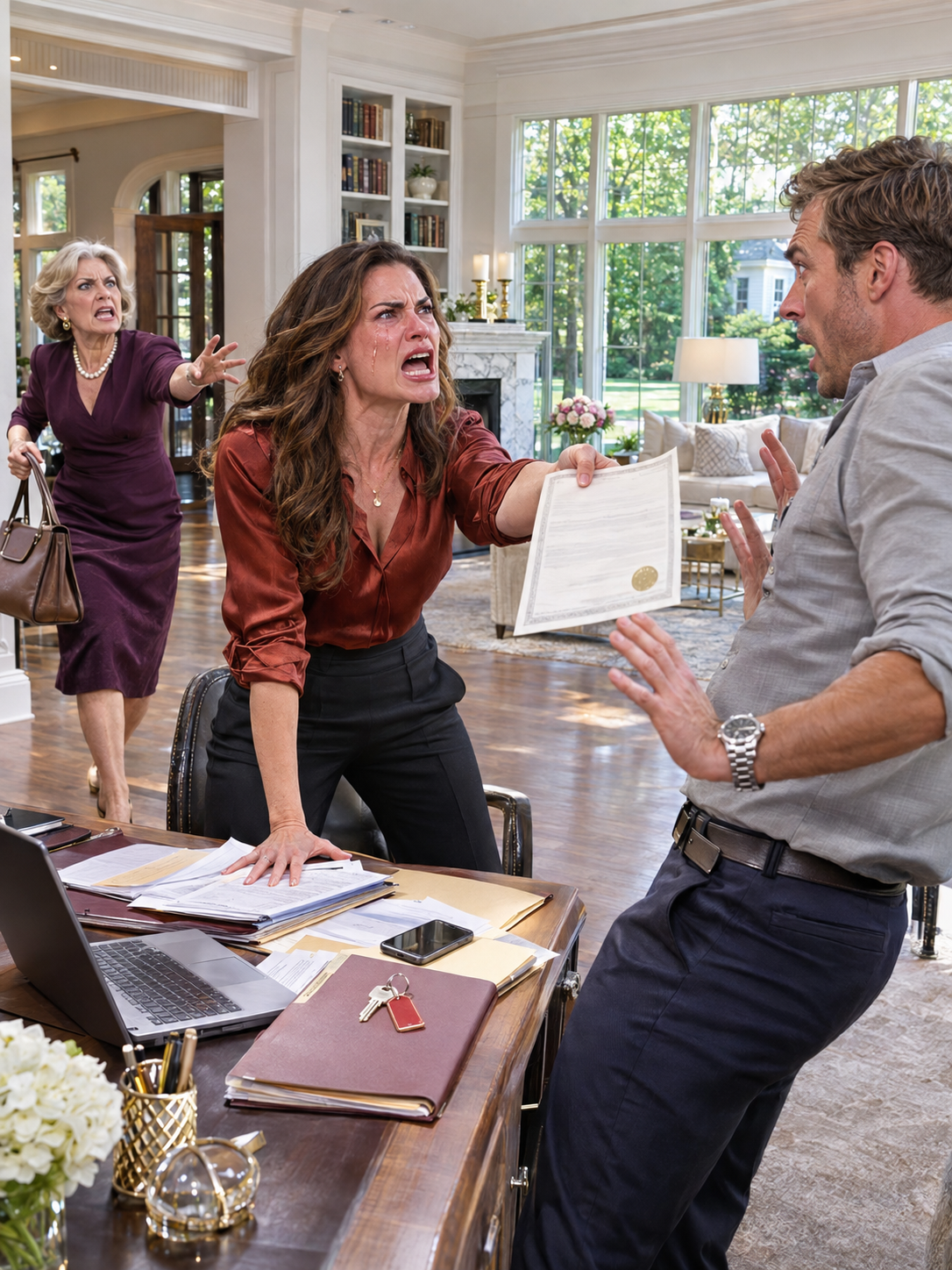
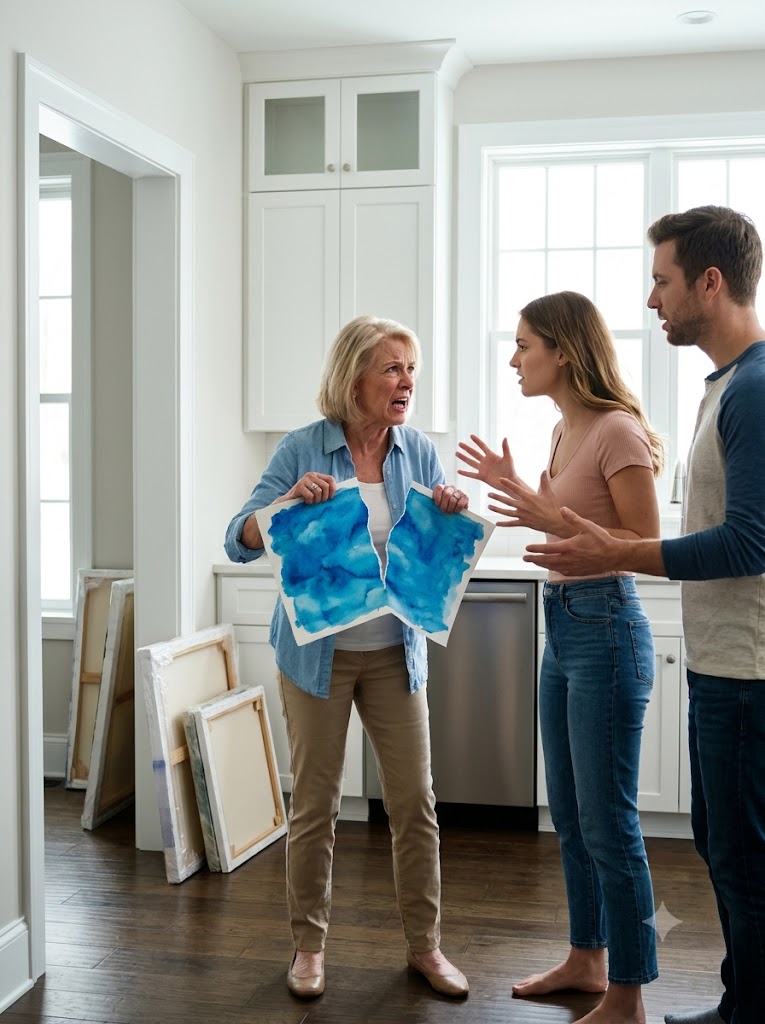
The paper made a sound like a shirt ripping along a seam. One moment my watercolor of the boathouse at Alder Lake was whole in my daughter-in-law’s hands; the next, a crooked white tear ran through the sunrise I’d spent six weeks trying to get right. Brooke held a piece in each hand, breathing hard, while three more of my paintings sat wrapped in brown paper beside the kitchen door.
“Give those to me,” I said, reaching for the pieces. Brooke dropped them onto the table, next to my grocery list and a bowl of peaches, and folded her arms as if I were the unreasonable one. “You act like I broke a priceless antique, Helen,” she said. “It’s watercolor paper.” I laid the pieces flat, afraid to speak.
My son, Graham, appeared from the hallway, still wearing his work badge. “What’s all the yelling?” he asked, and Brooke immediately said she had been trying to help me get professional photographs taken. He rubbed his forehead and said, “Mom, you can paint another one.”
At seventy-one, I felt like a scolded child. “That one took me six weeks,” I said. “Your father and I went to that lake every spring for twenty-six years.” Graham glanced at the broken sky and muttered that he wasn’t taking sides; he just wanted us to keep things in perspective.
I had painted the boathouse from a photograph taken the morning Elliot taught me to row. The roof sagged toward the water, and the sun came up behind a line of cottonwoods, washing the lake gold and pale pink. He’d been gone five years, and I’d finally found the courage to paint that morning without crying through it.
After his funeral, our house felt unbearably loud in its silence. A neighbor invited me to a watercolor class at the community center, and I went because I had nothing better planned. I began with crooked tulips and eventually painted the streets, porches, and quiet places Elliot and I had loved.
Last year, Marianne Bell at Larkspur Gallery asked to display a few pieces. Seven sold, and I used the money to repair my porch steps and buy better brushes. I never told anyone the sales made me rich; I told them they made me proud. Brooke had shown little interest until she heard someone paid four hundred dollars for my winter orchard.
After that, she wanted photographs, prices, and details about Marianne’s commission. “People your age don’t know how to market themselves,” she said one Sunday, hovering over my shoulder while I painted. I declined her offer to create an online portfolio. Looking at the three paintings by the door now, I wondered how often she’d ignored that request.
“Those aren’t leaving,” I said, guarding the door. One was my mother’s blue pitcher with pears; another showed a red farmhouse after a storm; the third was a path along Alder Lake. Brooke tried to lift the portfolio anyway, and I put my palm on its handle. “I said no,” I told her, louder than I’d intended.
Graham caught my elbow. “Please don’t turn this into a family war,” he said. I moved away from his hand and asked whether he would say the same thing if I’d walked into his office and ripped up six weeks of his work. Brooke snapped that I was throwing away an opportunity.
“What opportunity?” I asked. Brooke’s jaw worked, but before she could answer, my phone rang on the counter. Marianne’s name lit up the screen, and I answered with a shaky hello. “Helen,” she said, unusually formal, “have you authorized someone else to represent your work?”
I looked from the torn paper to the packed paintings. “No,” I said. Marianne hesitated, then told me a larger gallery across town had received a portfolio with photographs of six of my paintings. I knew every one she described, down to the dent in the blue pitcher, but I couldn’t understand why she sounded frightened. Then she said, “Helen, there’s something wrong with the name on the portfolio.”
Part 2
I put Marianne on speaker, so Graham could hear. She said the portfolio had reached Celeste Harrow, owner of a gallery whose exhibitions sometimes drew collectors from Chicago and New York. Six photographs appeared under the title Quiet Inheritance. The biography was not mine.
“Whose biography?” I asked, watching Brooke reach toward the phone, her face pale. “I want to check the documents before I identify anyone,” Marianne said, adding that Celeste wanted to examine the originals before proceeding with an exhibition. Whoever had submitted the portfolio promised to deliver them that evening. I stared at the packages by the door.
Graham asked whether this was the photography appointment Brooke had mentioned, and she said yes, claiming I was making everything difficult. Marianne invited me to meet Celeste at her gallery the next morning. I agreed, and Brooke warned I’d embarrass myself if I went.
I ended the call and told them to leave. Graham asked for ten minutes to talk, but I held the front door open and said I’d heard enough for one evening. Brooke made another grab for the brown-paper package, then let go when I stood in her way. After they left, I slipped the torn painting between clean sheets of paper.
I couldn’t sleep, so I sat in Elliot’s old armchair and tried to make sense of the last few months. Twice I’d let Brooke photograph paintings by my dining-room window. Later, she asked whether my signature on the back was “legally important” or only a habit. I’d laughed and said the paintings were mine whether my name appeared on them or not.
A week before the argument, she had visited while I was out buying groceries. Graham let her into my studio to collect “the samples,” according to a message I’d found on my phone afterward. Now I remembered discovering a pencil had been moved and several backing boards were facing the wrong direction.
The next morning smelled of wet pavement and coffee when I arrived at Larkspur Gallery. Marianne greeted me and said she’d informed Celeste. Inside, the gallery was quiet except for the soft whirring of a ceiling fan. Six glossy photographs lay on a table beneath a glass paperweight, and seeing them together felt strangely like walking into my own home through somebody else’s front door.
There were the hydrangeas Elliot planted by our kitchen steps, the red farmhouse, the winter orchard, the porch on Sycamore Street, the lake path, and my mother’s pitcher. I could explain the pale streak in each hydrangea petal and the chipped handle I’d deliberately left on the pitcher. A stranger could copy those details from a photograph, but she couldn’t know why I’d painted them.
Celeste arrived carrying a dark-blue folder. Her silver-rimmed glasses sat low on her nose. “I apologize for the confusion,” she said. “The submission claimed these were original works available for consignment, but we hadn’t accepted or exhibited anything.” I was grateful for the distinction, even though it didn’t ease the knot in my stomach.
“Did you speak to the person?” I asked. Celeste nodded and said she’d received a video call, several emails, and a proposed delivery schedule. She called me an elderly relative who provided “inspiration.” Celeste slid a page toward me and asked if I recognized the writing in the artist’s statement.
I read about “reclaiming forgotten women’s stories” and “an intimate collection of inherited landscapes.” Some sentences sounded suspiciously like things I’d said when Brooke interviewed me for what she called a family scrapbook. A photo showed a woman beside my studio easel. The face was cropped out, but I recognized the bracelet on the wrist holding my favorite brush.
Celeste turned one final page. It contained a tentative agreement, pending verification and delivery, with a name written in neat, looping letters at the bottom. I knew those letters from the labels on Christmas gifts and the notes stuck to my refrigerator. The person preparing to sell my paintings had called herself their creator, and the name she’d signed was Brooke Calder.
Part 3
I read the signature again, hoping that seeing it twice would make it mean something less ugly. Celeste waited while Marianne brought me a paper cup of water, and I realized I was squeezing it so tightly the rim had bent. “She isn’t my assistant,” I said. “She’s my daughter-in-law.”
Celeste explained that Brooke had claimed all six works belonged to a series she painted herself, using family memories for inspiration. There had been no sale, and the gallery had not paid her or announced the exhibition; the proposed agreement was conditional. Still, Brooke had answered detailed questions about technique and promised to bring in the originals before closing.
“Can you preserve everything?” I asked. Celeste agreed to retain the emails and submission records, and Marianne offered to gather my earlier exhibition materials and sales receipts. I had dated photographs, sketches, workshop notes, and a studio full of unfinished studies. My history hadn’t disappeared simply because someone else put her name on a form.
Before I left, Celeste showed me a message Brooke had sent late the previous night. It said the artist had encountered a family emergency and might need to postpone delivery. Underneath was another sentence: “Please don’t contact the older woman directly; she’s confused by commercial arrangements.” My age had become the excuse they could use whenever I objected.
I drove home with copies of the papers in a sealed envelope. At a red light, cut grass drifted through the window, and I remembered Elliot saying age didn’t make me invisible. I pulled into my driveway and found Graham sitting on the porch steps. He held two takeaway coffees as though it were an ordinary visit.
“Brooke says she got carried away trying to open doors for you,” he began. I put the envelope on the porch railing and told him the gallery had received her signature under my paintings. His eyes dropped to the papers, and he admitted Brooke had shown him a presentation a month earlier. “I thought she was building you an audience,” he said. “I didn’t know she was claiming to be the artist.”
I wanted to believe that. Yet he had watched his wife tear the boathouse in half and treated it like a spilled drink. “Even without the gallery,” I told him, “you saw what happened and decided my hurt was inconvenient.” He sat down hard on the step and whispered that he didn’t know how to fix it. I said I could no longer trust either of them with my house key.
Brooke arrived twenty minutes later, slamming her car door before she’d reached the path. “You’ve destroyed my chance to get into Harrow,” she said, not bothering with hello. I asked if she meant her chance to present my work as hers, and she laughed sharply. “You were selling pieces for a few hundred dollars. I could have turned that into something people actually notice.”
She said the new audience needed a younger artist with a coherent image and that she would have given me a share of whatever sold. “You can’t give me a share of what already belongs to me,” I told her. She pointed at my porch and said Graham and she had real expenses, while I had my pension and a paid-off house. She regarded my grief and my work as resources she could claim.
Graham stepped between us and told Brooke to stop. She accused him of being weak, and he said, “I didn’t agree to you signing your name.” Her face changed, just for a moment, from outrage to calculation. “You told me the money could help us make the down payment,” she answered, and the air seemed to leave his lungs.
I turned to my son. He admitted they’d been discussing buying a house, but insisted he had only expected Brooke to manage online sales for me. Brooke opened her handbag and pulled out a folded sheet, waving it in front of me. “Your own son said you wouldn’t object,” she said, “and he put it in writing.”
Part 4
The paper was a letter addressed to Celeste Harrow’s gallery, introducing Brooke as the person authorized to discuss my artwork. At the bottom, beneath a line about my “full family support,” was Graham’s signature as a witness. My own signature wasn’t there, but the wording made it sound as though I’d approved the arrangement.
“I signed a page she asked me to look at,” he said. Brooke interrupted to insist that he knew the whole plan, but he shook his head and said she’d told him it would help with marketing. Either way, he’d signed a statement about my consent without once bothering to ask me.
I folded the letter carefully and said I’d be keeping a copy. Brooke took a step toward me, then stopped when Graham told her not to come any closer. She demanded I give them a chance to straighten things out privately, promising to remove her name if I stopped talking to the galleries. I said offering my art under false pretenses was hardly private.
That afternoon I called an attorney named Elaine Porter, whose number Marianne had given me. I showed her the submitted portfolio, the letter, my original sketches, and photographs of the torn boathouse. She explained that we could formally assert my authorship, demand withdrawal of the false claims, and address any misuse of my artwork through appropriate channels.
Elaine sent a letter requesting that Brooke stop representing or offering my paintings and confirm in writing where every image had been submitted. Celeste immediately suspended the proposed arrangement and provided a written acknowledgment that no works would be accepted from Brooke. Marianne helped me inventory every piece in my studio, including the three that had been sitting beside the door. We photographed each piece and its backing.
Two days later, Brooke replied through her own lawyer, admitting the portfolio submission but claiming she had acted with a mistaken understanding of permission. Her account insisted the photographs had been intended to promote my work, an explanation that did not square with the name she’d signed. Elaine advised me not to argue by text and said we would focus on securing corrections and written assurances.
Graham called that evening. He said he and Brooke were fighting constantly, and that he had moved into the spare room while they decided what to do. When he asked if he could come over for supper, I told him I wasn’t ready for that. “Mom, I apologized,” he said, and I answered, “An apology doesn’t make me comfortable having you in this room yet.”
He fell silent, then asked whether I wanted him to leave his wife. I told him his marriage was his decision and I would not become a weapon in it. What mattered to me was the choice he had already made when I stood holding two halves of my painting. He’d asked me to be reasonable because challenging Brooke would have made his own life harder.
The following week, Brooke’s lawyer provided the list of accounts and contacts used to circulate the portfolio, together with confirmation that her submissions had been withdrawn. Elaine checked the responses, and the galleries that had received the images were notified of my authorship. There was no dramatic courtroom confrontation, just pages of correspondence and a great deal of patience. Each correction returned a piece of my name.
Then Marianne phoned with an invitation. Celeste wanted to feature my work in a fall group exhibition, this time after reviewing the originals and speaking to me directly. I nearly refused; the last thing I wanted was to become known for a family dispute. Marianne said, “They aren’t inviting you because of Brooke. They’re inviting you because the paintings are good.”
I looked at the boathouse pieces resting safely in an acid-free folder. The tear was still there, crossing the water where Elliot’s old rowboat should have been. I could have spent the rest of my life protecting every painting behind a locked door, but that would make the loss bigger than it already was. I called Marianne back and said yes, provided my work was displayed under my own name.
Part 5
The exhibition opened on a crisp Thursday evening in October. I wore a dark-green dress I hadn’t taken out since Elliot was alive, and Marianne fastened a small silver pin at my shoulder because my hands wouldn’t stop trembling. Inside, visitors studied my winter orchard and farmhouse. Nobody mentioned Brooke.
Celeste introduced me to a retired teacher who recognized the porch on Sycamore Street. She’d lived nearby as a child and remembered the squeak of the screen door, though it had been replaced years ago. She smiled at a place she thought she’d forgotten. That conversation meant more than any sale I could have made that evening.
Two of my paintings found buyers, and another visitor asked whether I taught classes. Marianne suggested I lead a community-center workshop. I went home with flowers and ideas for new paintings. For the first time in months, I felt excited about tomorrow rather than afraid of what somebody might take from me.
Graham hadn’t attended. He sent a message saying he was proud of me. I replied, “Thank you,” but didn’t invite him over. A week later, he asked if we could have coffee in a public place. I agreed because I wanted to hear what he had to say without having him in my studio.
We met at a diner where the booths smelled faintly of maple syrup and fresh coffee. He looked tired and said he and Brooke were living apart. “I should have defended you that day,” he said. “Instead, I made your pain sound small because I didn’t want a fight.” I let him finish without reassuring him.
He said he had finally read the entire portfolio submission and the letter bearing his signature. He admitted wanting a house had made him accept Brooke’s claims without checking. “I used to tell myself she was better at the business side,” he said, stirring his coffee until the spoon clicked against the cup. “I never asked whether you wanted a business partner.”
I told him I believed he understood more now, but that understanding was not the same as earning back trust. “You can’t undo what happened by being sorry after someone else exposed it,” I said. He nodded, and for once he didn’t ask what it would take to make me change my mind. We paid separately and left.
Brooke sent one handwritten note near Thanksgiving. She said she regretted the way things had unfolded and hoped we might put the misunderstanding behind us. She never mentioned the torn painting or the false signature. I gave the note to Elaine for the file and did not respond.
I had the boathouse watercolor assessed by a paper conservator, who explained the repair options and warned me not to press the torn fibers together with ordinary tape. I decided to preserve the two halves in a protective mount rather than pretend the damage had never happened. Back home, I sketched the same lake on fresh paper. This time, I painted the boathouse from memory, not from the photograph.
The second version wasn’t identical. I made the clouds a little wider, left the dock crooked, and painted a pair of empty chairs beneath the cottonwoods. I wanted to paint that place without hearing Brooke’s voice. When the first wash of sunrise dried, I knew the answer.
By winter, I was teaching eight people on Tuesday mornings, including a man who’d never held a paintbrush and a woman newly retired from nursing. We debated shades of blue and wrapped our work in newspaper. My house smelled of tea and paper again, and the quiet after everyone left no longer frightened me. It belonged to me.
I still loved my son, and perhaps one day we’d share more than a careful coffee. But I didn’t forgive him simply because he finally understood what he’d helped destroy, and I had no wish to rebuild a relationship with Brooke. Above my desk hung the new sunrise; beside it, in a closed portfolio, rested the damaged original. Both were mine, and nobody else would decide what either one was worth.
Legal Notice: This story is a work of fiction. Names, characters, businesses, events, and incidents are the product of the author’s imagination or are used fictitiously. Any resemblance to actual persons—living or dead—or to actual events is purely coincidental. Thank you! 💓