
My Brother Threw a Party in the House I Secretly Bought—Then the Police Asked One Question
“You can’t throw us out. This is our daughter’s birthday!” my sister-in-law screamed from the porch of the house I’d owned for three days. Strangers ate cake on my kitchen counters while my brother raised a glass to a future he thought belonged to him. I had worked seventy-hour weeks for six years to buy that place, yet somebody had given him a key. When the police asked who actually lived there, I discovered the party was only the beginning.
Part 1
The first thing I noticed was the banner. “WELCOME HOME” hung crooked across my porch while a stranger carried a casserole through my front door. I stopped beside Mr. Price’s hedge and checked the address, although I knew it. Number 416 was mine, including the cracked walkway I planned to fix.
Inside, my brother Gavin tapped a fork against a wineglass. I watched through the security app I’d installed the night before. “Here’s to us,” he announced, swinging an arm around his wife, Mallory. “Finally moving up in the world.” Guests cheered.
I stood there holding my phone until my fingers hurt. Three days earlier, I’d signed the closing documents in a little conference room outside Cleveland, beneath harsh fluorescent lights. I’d nearly cried when the title agent handed me the keys. At thirty-four, I finally owned a three-bedroom ranch near Lake Erie, with a porch, maple trees, and room for a proper dining table.
The down payment was $78,400. I’d earned it scheduling freight shipments during the week and waiting tables at a roadside diner on Saturdays and Sundays, with aching hands. I sold my Honda, bought a rusted compact, packed lunches, and skipped vacations. Every sacrifice had a shape in that house: the windows that faced the water, the kitchen cabinets, and a bedroom whose door I could shut.
I hadn’t told my family because good news had never stayed mine for long. When Gavin wrecked his credit at twenty-two, Mom convinced me to hand over the $4,000 savings bond Grandma had left for college. “Your brother needs a fresh start,” she said, and I believed it until Christmas passed without the promised repayment. Years later, I sent him $3,000 for a leaking roof, then saw his expensive new fishing equipment while his ceiling still leaked.
Mom called me “the capable one” whenever she needed money. Dad generally studied his plate, and Gavin acted grateful just long enough to collect whatever I’d brought. I worked more hours to replace what vanished. Even my old savings account still had Mom listed as a joint owner, something she’d arranged when I was nineteen “in case of emergencies.”
The Sunday before closing, Mom had called to ask whether I could co-sign a replacement truck for Gavin. When I said no, she reminded me that he had a child and I had “only myself to worry about.” I stared at a stack of takeout menus on my apartment counter, wondering when having fewer dependents had become permission to claim everything I earned. That evening I deleted a half-written family announcement about the house and went back to packing alone.
Friday afternoon, Mr. Price, the elderly neighbor I’d met during my inspection, called while I was leaving the diner. “Nora, there’s a whole crowd at your place,” he whispered, as though the people inside might hear him through the telephone. He described balloons and parked cars. I thanked him, parked two blocks away, and opened the camera feed.
What stopped me from marching inside was a small girl in a yellow cardigan. My niece Evie stood beside a sheet cake on the quartz island, clapping. I enlarged the picture and saw a pink candle shaped like a seven. They had chosen Evie’s birthday to announce that my home belonged to them.
I saved the recording, called the police, and waited beside the hedge with a blue folder containing my deed and closing statement. Mr. Price came out and offered to stay. “Please,” I said, startled by how small my voice sounded. Two patrol cars arrived without sirens, tires crunching along the curb.
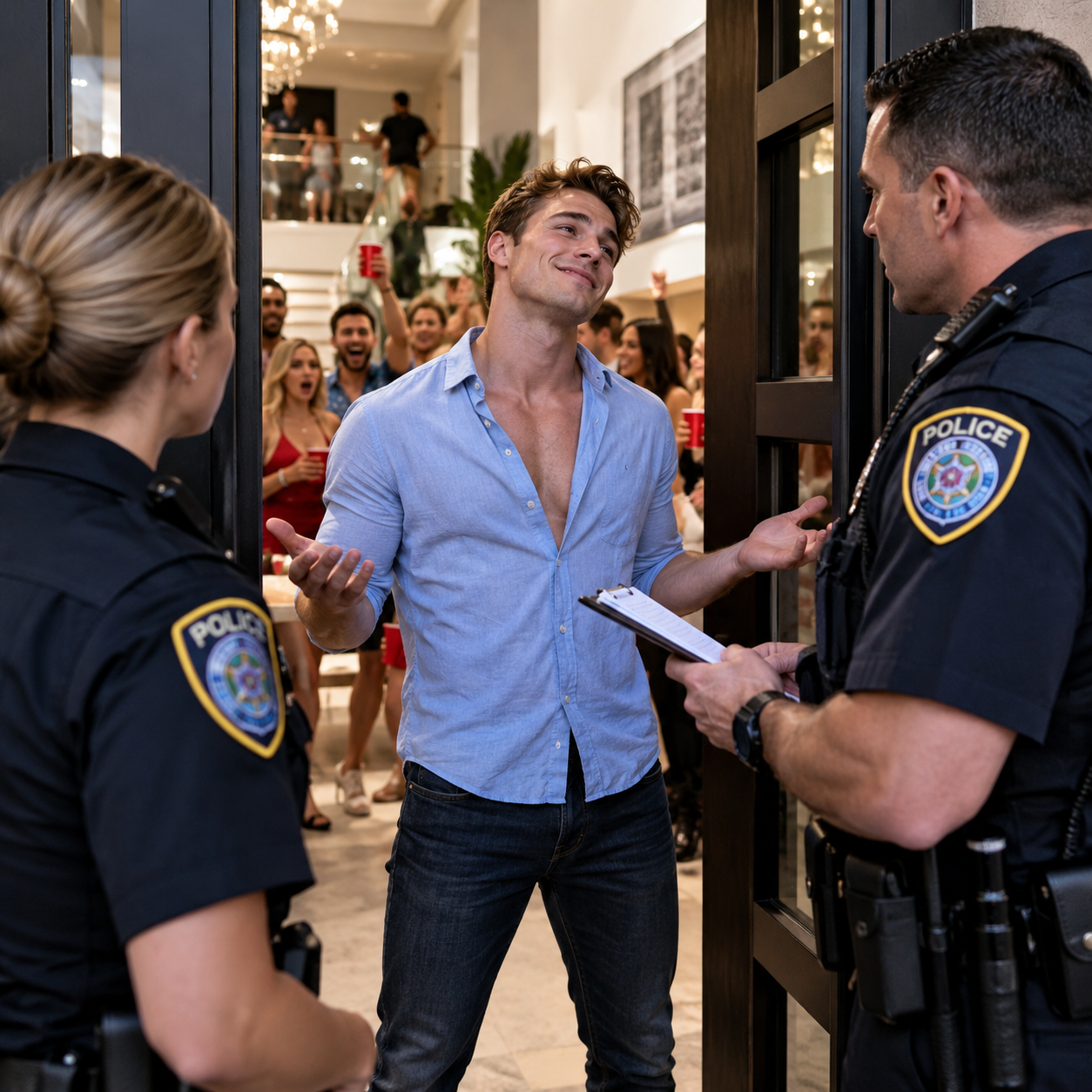
Officer Ruiz walked up the porch steps and knocked. Gavin opened the door with the broad smile he used whenever he expected people to agree with him, while laughter and the smell of buttercream drifted past his shoulder. “Is this your residence, sir?” the officer asked. “Family property,” Gavin replied easily. “We’ve been here for years.” I stepped out from the hedge, and the smile drained from his face before I said a word.
Part 2
“Hi, Gavin,” I said, climbing the first porch step clutching my folder. Mallory appeared behind him, holding wine and scowling. “Oh, please,” she said loudly. “Nora’s jealous because we finally have something nice.” Officer Ruiz glanced from her to me and asked everyone to lower their voices.
I handed him my deed, identification, and closing disclosure; he checked the address while his partner questioned Mr. Price. “Ms. Bennett is the recorded owner,” Officer Ruiz said at last, looking at Gavin. “Do you have a lease, permission from her, or any document establishing a right to occupy this property?” Gavin’s hand slipped from the doorframe.
“Our mother handled it,” he said. “Nora was surprising us.” I felt my stomach drop, because the explanation sounded exactly like Mom. She’d long treated my wages as family resources; now she’d claimed my address. “I didn’t invite you,” I said. “I didn’t invite any of these people.”
Mallory stepped toward me, and Officer Ruiz moved between us. “You’re going to kick a little girl out on her birthday?” she demanded, pointing toward Evie, standing inside with frosting on her chin. “She already told all her friends she’s moving here.” I looked at my niece, who was squeezing a paper napkin in both hands, and hated how they used her. “Evie hasn’t done anything wrong,” I said. “You two need to stop speaking for her.”
Officer Ruiz asked how they had obtained a key. Gavin reached into his pocket, turning a brass key until Mallory snapped, “Just tell them.” He said Mom had seen a wire transfer notification from our joint account, then searched county property records. A closing packet containing an extra key had then been delivered to Mom’s address, my outdated mailing address.
“She made a copy before bringing you the envelope,” Gavin admitted. “She said you wanted Evie in this school district and didn’t know how to tell us.” I remembered Mom dropping off a sealed-looking packet on Wednesday, insisting she was just helping with my mail. The flap had been attached with a strip of clear tape I barely noticed. I went cold.
“Get her on the phone,” I told him. On speaker, Mom answered, “Is everything set up for the birthday?” When I asked why she’d taken my key, I heard her television during the silence. “Nora, honey, don’t make this ugly,” she finally said. “You have three bedrooms and no children. Gavin’s family needs the space more than you do.”
I waited for an apology that never came. She called it a family misunderstanding and accused the officer of upsetting a birthday party. He explained that family relationships didn’t grant access to someone’s property and instructed Gavin to end the gathering and leave. My mother hung up while he was still speaking.
Officer Ruiz asked Gavin whether he’d ever received mail there or stayed overnight. “Not yet,” Gavin said, before Mallory hissed his name, and the officer asked the party guests to make their way out. Through the window I could see two unopened suitcases beside the coat closet, positioned for what must have been their grand reveal. What frightened me most wasn’t how loudly they lied, but how calmly they’d arranged to turn that lie into a permanent address.
Guests collected coats, avoiding my eyes, while Mallory bagged gifts and Gavin carried the cake as though it had been wronged. Evie paused beside me, holding a paper crown with a bent point. “Aunt Nora, are you mad at me?” she asked, and I crouched so we were eye level. “No, sweetheart. Adults made a mistake, and it’s their job to fix it.”
Gavin heard us and scoffed. “You’ve ruined her birthday. Mom won’t forgive you.” I accepted the key and said, “She doesn’t have to.” Afterward, I gathered plates in rooms smelling of frosting and perfume. Beneath a stack of napkins on the kitchen island lay a photocopied document headed “FAMILY OCCUPANCY AGREEMENT,” with my name signed at the bottom in handwriting that wasn’t mine.
Part 3
I took photographs before touching the paper. It granted Gavin and Mallory twelve months of occupancy, and called their rent “family contribution, amount to be determined.” Under my forged signature was a sentence stating that I would continue paying the mortgage and utilities. Someone had prepared to keep my brother there.
I called the police nonemergency number to add it to my report. The dispatcher arranged a follow-up. I stayed awake until sunrise, watching the feeds and fearing headlights in the driveway. At seven, a locksmith replaced the exterior cylinders and handed me fresh keys.
In the morning light, I found sticky footprints in the hallway and a soda ring on the sill of my future office. I scrubbed until the finish looked dull, then stopped because cleaning couldn’t erase what had happened. I’d imagined my first weekend here smelling of coffee, not disinfectant and somebody else’s leftovers.
By nine, I was sitting across from a banker named Mrs. Caldwell at a new branch. She explained that Mom, as joint owner, could withdraw money without my approval. The remaining balance was $6,260, my emergency cushion. I moved the money to a new bank and redirected both paychecks.
When Mrs. Caldwell printed the transaction history, another detail bothered me. Mom had attempted to initiate a transfer to Gavin two days before the party, but it had failed for insufficient funds. She’d been eyeing my money while delivering my mail. I folded the statement into my blue folder, bulging against its elastic.
My friend June recommended attorney Marisol Grant. Marisol studied the supposed occupancy agreement, my deed, the camera recordings, and the police incident number silently. “Don’t negotiate through relatives,” she said. “We’ll put your position in writing, notify Gavin and Mallory, and document the forgery allegation. If they try to establish residence, we’ll deal with that properly rather than risking a confrontation.”
She sent formal notices to Gavin and Mallory stating that I had never consented to their entry or occupancy. She also contacted the title office about the misdelivered closing packet, requesting delivery records. The manager confirmed the courier had delivered an envelope to the outdated address on file and began a review. “That mistake opened the door,” Marisol told me, “but it didn’t give your mother permission to walk through it.”
After Marisol’s meeting, cousins I hadn’t spoken to in months began messaging me. They’d heard I’d given Gavin a house, then “changed my mind” in front of his daughter. One sent a photograph of Evie crying beside the cake, cropped to hide the police on my porch. I saved the messages; correcting every lie would only invite another argument.
On Monday evening, Mom summoned me to the diner where we celebrated birthdays. I went only to hear her out without making promises. The place smelled of coffee and fried onions; Dad twisted his placemat. Gavin was already in the booth, beside Mallory, avoiding my eyes.
“We can work out a payment,” Mom announced before I’d taken off my coat. “Gavin will contribute what he can, and you can keep your name on everything.” I asked what would happen if he couldn’t pay, and she lifted her hands in disbelief. “You’re his sister. Isn’t that what family means?” Beside her, Dad stared at the sugar packets.
I placed the forged agreement on the table. “Who wrote this?” Gavin said it was only a temporary arrangement, Mallory claimed she’d never read it, and Mom reached for the page before stopping herself. “You signed my name,” I said, watching her tremble. “Not for an emergency. To give away the house I bought.”
Dad finally spoke above the coffee grinder. “Elaine told them they could enroll Evie using that address.” My chair creaked as I leaned back, picturing Evie announcing her imaginary move. Then Mallory pulled out her phone to show me the district registration confirmation, and I saw the attachment they’d submitted as proof of residence: a letter supposedly written by me, bearing another forged signature.
Part 4
I asked Mallory to forward the school document to Marisol. She refused until Officer Ruiz called the next morning about the additional evidence I’d submitted, and then the attachment arrived without a message. It claimed Gavin’s family lived at my house and I was their landlord. The signature was a clumsy version of mine, with a wrong final loop, but it had been good enough to start an enrollment review.
Marisol helped me notify the school district that the address claim was unauthorized, and I supplied proof of ownership along with the incident number. The district opened a review; no one blamed Evie. Her parents seemed less concerned. They had turned a little girl’s school year into leverage and called it love.
Two days later, Mr. Price sent a photograph that revealed what Gavin had been hiding: a moving truck parked in my driveway, its ramp lowered. When I arrived, Gavin was arguing with the driver, waving the fake agreement as Mallory stood beside a tower of boxes. “We paid a deposit,” the driver told me, clearly wishing he’d taken a different job. “He said the homeowner was expecting us.”
I showed him my identification and Marisol’s notice, then called the police rather than arguing in my yard. Gavin jabbed a finger toward the front windows. “We already told our landlord we’re leaving,” he said, finally sounding frightened instead of superior. “Our lease ends this month.” I understood then why the party had been scheduled before they’d even spoken to me: they needed their friends to believe the move was settled, and they needed me to feel too embarrassed to stop it.
“You gave notice on your rental before asking me?” I asked. Gavin looked away, and Mallory began crying into her sleeve. Their current landlord had offered a renewal, she said, but Gavin insisted the lake house was certain. They had spent money on decorations and a moving deposit instead of arranging another place to live. I felt the familiar tug to solve it for them, followed by an unfamiliar anger at how efficiently they’d trained me to feel that tug.
Officer Ruiz arrived, reviewed the situation, and told them not to enter the property without authorization. The moving crew loaded the boxes back onto the truck and left; I photographed every vehicle before the driveway emptied. Gavin lingered by the curb and said, “You’re really going to let your niece be homeless?” I asked why he’d rejected a lease renewal for a house that wasn’t his. For once, he had no answer.
That evening Dad called me privately, his voice rough with shame. He admitted he’d watched Mom search the property records after noticing the transfer alert, and he’d seen her open the envelope containing my spare key. “I told myself she’d talk to you first,” he said, while I listened to the rattling fan over my kitchen stove. “I knew she wouldn’t. I just didn’t stop her.”
I asked whether he’d also known about the fake agreement. He said yes, then confessed Mom had promised Gavin he could stay rent-free until his finances improved, because I was supposedly capable of covering two households. “She said you always come around,” Dad murmured. I thought about my college fund, the leaky roof, every check written to purchase a little peace. “That’s what she counted on,” I told him, and ended the call.
The next morning, Marisol forwarded a message from the title office. Their delivery review showed Mom had called pretending to be me, requested that the envelope be left without a signature, and later asked whether a second owner could be added after closing. The office had refused that request, but Mom had continued asking about forms and fees. I sat at my kitchen island reading those words twice, realizing that giving Gavin the keys might have been only her first move.
Part 5
Marisol and I took the title office’s findings to the detective assigned to review the forged documents. I gave him copies of the camera footage, the occupancy agreement, the school letter, and the delivery records, keeping the originals safe. He explained investigators must establish who created each document. I wanted facts, not an arrest that magically erased the damage.
I checked every account tied to the house. The mortgage and insurance were mine alone; utilities were unchanged, although Mom had questioned the electric company about switching them. I added security notes and installed a doorbell camera. Each step replaced her assumptions with boundaries I could prove.
Mom responded to Marisol’s formal letter with a handwritten note at work. She called the house “an opportunity for the family” and accused me of valuing a building more than blood. She offered to stop contacting the title company if Gavin could stay until Christmas. She was bargaining with something she never owned.
I wrote one reply through Marisol: no access, no occupancy, no use of my address, and contact only through counsel. I didn’t debate what a daughter owed. Every family request began with somebody else’s problem and ended with my surrender. I would not forgive them just to make Thanksgiving comfortable. This time the pattern stopped at my front door.
Gavin’s family eventually rented a townhouse in their existing school district after negotiating a short extension with their landlord. Dad told me. They’d rejected that option for an impressive address. Evie would finish the year with her friends, without pretending I’d gifted her a house.
Six weeks after the party, Marisol called with an update. Investigators had interviewed Mom and Gavin; the district had closed the false-address application. The title office had changed its key-delivery procedures and reimbursed my locksmith bill. The investigation remained open; consequences didn’t obey a tidy schedule.
I gathered old bank statements, including Mom’s failed transfer, and added up what I’d given them since college. The number topped $24,000 without groceries or other emergencies. I didn’t expect repayment, but the total proved the house hadn’t been their first claim. Seeing it on paper made me stop calling those payments favors.
Dad came by one Sunday with an apology and a small cardboard box of belongings I’d left at his house years ago. He waited on the porch instead of trying the handle. “Your mother thinks you’ll get over this,” he said. “I told her you shouldn’t have to.” I thanked him for returning my things but didn’t invite him inside; his honesty couldn’t erase years of silence.
“Can I come back sometime?” he asked. I looked past him toward the street remembering the times he’d stayed silent, and I told him I wasn’t ready to decide. His eyes watered, but he nodded and left without asking me to make him feel better. That felt like the first truthful conversation we’d had in a decade.
That Saturday I painted the smallest bedroom soft green, a color Mom had always called impractical. There was no guest bed, no rug, nobody insisting I spend less so Gavin could have the difference. Lake air moved through the paint smell, and I enjoyed work that belonged entirely to me. I ate dinner on the floor without feeling lonely.
A few days later, Mr. Price knocked with two tomato plants in chipped clay pots. “Your porch gets better morning light than mine,” he said, eyeing the clean windows and the new brass deadbolt. I invited him in for coffee, and we sat at the kitchen island where strangers had once cut a birthday cake. He warned me where rainwater pooled; I planned lavender near the steps.
That night I hung a photograph of Lake Erie above the couch. Then I removed the last scrap of silver ribbon I’d missed behind the refrigerator and carried it to the trash. I needed no family approval to call this place home. I had bought the door, changed the locks, and, at last, learned that I was allowed to keep the key.
Legal Notice: This story is a work of fiction. Names, characters, businesses, events, and incidents are the product of the author’s imagination or are used fictitiously. Any resemblance to actual persons—living or dead—or to actual events is purely coincidental. Thank you! 💓

