
I Paid $2,100 a Month for Dad’s Nursing Home for Three Years—Then I Discovered Where My Sister Had Been Sending His $26,000 Farm Rent
For three years, I quietly drained my retirement savings to keep my father in a nursing home while my older sister insisted his money was gone. I believed her because she was family, and because I never imagined someone who had once protected me could deliberately ruin my future. Then a forgotten tax document exposed a payment nobody had mentioned. I drove Dad back to his 200-acre farm, where one innocent question uncovered a betrayal far worse than missing money.
Part 1
The first thing I noticed was the number. Twenty-six thousand dollars, printed neatly beside the word “Rent” on a tax document that wasn’t supposed to exist, at least according to my sister. I sat in my Buick behind a small accounting office in southern Kentucky, staring at that figure while rain tapped against my windshield. For several minutes, I couldn’t make myself turn the page.
My name is Evelyn Harper, and I’m sixty years old. I retired after thirty-one years with the United States Postal Service, where I learned that when money disappeared, there was usually a paper trail explaining where it went. My husband, Paul, spent most of his working life maintaining county roads, and neither of us ever earned enough to treat money carelessly. We had planned our retirement down to the last dollar, or so we thought.
Three years earlier, my father, Walter Merritt, had broken his hip outside the cattle barn on his farm. He was eighty-one then, stubborn enough to argue with the ambulance crew and embarrassed that somebody had to carry him out of his own driveway. Surgery saved his ability to sit and move around, but he never recovered enough strength to live independently. Eventually, we moved him into a nursing home near Scottsville.
The place cost $7,400 every month, more than Paul and I had ever paid on a mortgage. Dad’s Social Security and long-term care insurance covered $5,300, leaving a $2,100 shortage that somebody had to pay. My older sister, Denise Caldwell, told me Dad’s savings had disappeared into hospital bills and rehabilitation expenses. She also insisted his farmland wasn’t producing anything worth mentioning.
“Earl stopped planting most of it,” she’d explained in the nursing home hallway. “He just keeps cattle there in exchange for maintaining the fences.” Denise had Dad’s financial power of attorney because she lived twelve miles away while I lived forty-five. She carried folders, remembered deadlines, and always knew which government office to call. I trusted her with the paperwork because she’d been managing family business since our mother died.
That evening, Paul and I sat at our kitchen table with a yellow legal pad between us. He studied our retirement budget, rubbed his thumb along his wedding ring, and finally said, “Your dad spent his whole life making sure his girls had something. We’re not leaving him without proper care.” I called our financial adviser the following morning. The automatic withdrawals began that month.
Thirty-six payments later, we had contributed $75,600. That number didn’t include the extra income taxes on our retirement withdrawals or the interest our savings would have earned if we’d left the money alone. I knew because Paul kept a spreadsheet showing every deduction. Whenever I saw the figures, I reminded myself that Dad was comfortable, safe, and getting the care he deserved.
What bothered me wasn’t helping him. It was the roof we couldn’t afford to replace, the damp stain spreading across our bedroom ceiling, and the mountain vacation Paul had been promising me since our twentieth anniversary. During heavy storms, we arranged cooking pots beneath the leaks and listened for the first drops. Then we’d laugh about someday owning a house where rain stayed outside.
That morning, Denise had asked me to deliver Dad’s tax folder because her husband, Martin, had a cardiology appointment. I noticed the rental document while checking that everything was in order. Beneath it lay copies of Dad’s bank statements, and I searched each page for deposits matching the reported income. There weren’t any, not even one.
I knew Earl Benton, the farmer who leased Dad’s land. He was dependable, drove the same battered pickup for years, and once returned forty dollars Dad had accidentally overpaid him for hauling gravel. Earl wasn’t the sort of man to invent rental income on a federal tax form. Somebody had received that money, and the bank statements suggested it wasn’t my father.
I took photographs of the documents before handing the folder to the accountant. Then I sat behind the wheel, holding my phone with Denise’s contact open on the screen. I could have called and demanded an explanation, but I knew my sister too well. She could make an unreasonable situation sound perfectly sensible before you realized she’d changed the subject.
Instead, I drove home and placed the photographs in front of Paul. He read them without speaking, then opened his spreadsheet and added another column. “That’s seventy-eight thousand dollars over three years if the rent stayed the same,” he said. “Evie, where did it go?”
“I don’t know,” I answered, watching rainwater slide down the kitchen window. “But Dad should be the one asking.” Paul looked at me carefully and asked whether I thought Dad could handle the answer. I remembered how my father still followed grain prices, argued about baseball statistics, and corrected nurses who mispronounced local road names.
His legs had failed him, but his mind hadn’t. Whatever Denise had done, she’d apparently counted on nobody giving him the information he needed. I drove to the nursing home the next morning, carrying a copy of the tax form in my purse. Before I even explained what I’d found, Dad told me something that made the entire situation worse: “Denise says my farm rent has been paying this place all along.”
Part 2
Dad was sitting by the window wearing his favorite green cardigan when he said it. The sweater had been knitted by my mother during her last winter, and one sleeve was stretched where he habitually pulled it over his hand. I sat opposite him and asked him to repeat what Denise had told him. He frowned, annoyed that I seemed to be questioning something obvious.
“She said the rent goes toward my room, and my insurance covers most of the rest,” he explained. “I asked her about it last Christmas.” I swallowed hard and told him I’d been sending $2,100 every month from my retirement savings. For the first time that morning, he stopped rocking his chair.
Dad had always hated being treated like a burden. When I showed him the document, he studied it through his scratched reading glasses, running one thick finger beneath the figures. Then he asked how much money I’d contributed altogether. I told him the truth, and his eyes moved toward the parking lot, where two employees were helping a resident into a van.
“Seventy-five thousand dollars,” he repeated quietly. “And your sister told me I was paying my own way.” He removed his glasses and polished them with the edge of his cardigan. I expected anger, perhaps a demand that I immediately telephone Denise. Instead, he asked whether Earl was still farming the bottom fields.
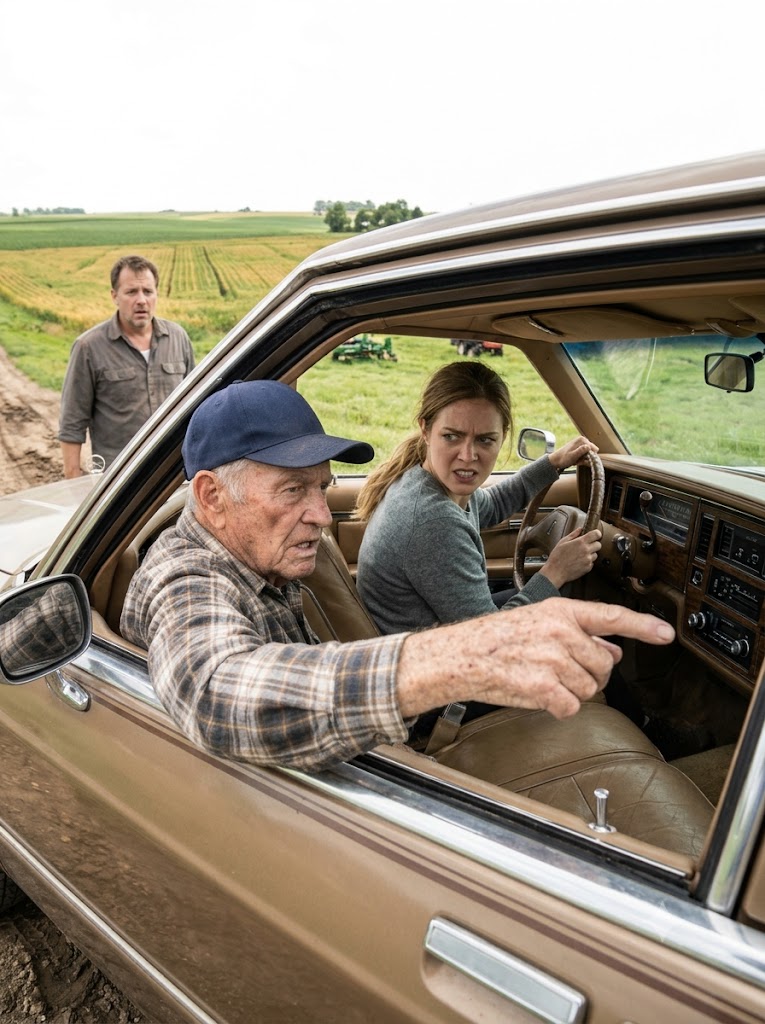
“I believe so,” I said. Dad nodded and reached for the cane leaning beside his recliner, although he couldn’t walk far enough to use it safely. “Then we’re going out there,” he announced. “I want to hear from the man who’s been working my land.”
An aide named Melissa helped us transfer Dad into my car. He wore his brown felt hat and the quilted jacket he’d owned for nearly twenty years, and he complained that everyone was fussing over him. Once we reached the highway, he became unusually quiet. The only sounds were the heater fan and the occasional rattle of his cane against the door.
We passed the Methodist church where Mom was buried and the old feed store that had become a hardware warehouse. Dad watched familiar buildings through the passenger window, occasionally shaking his head at how much the town had changed. Then we turned onto the gravel lane leading to his property. He straightened in his seat so suddenly I thought something had hurt him.
“Look at those soybeans,” he said. “Earl got a good crop out of the bottom this year.” Beyond the fence, golden stubble stretched toward the creek, and black cattle moved slowly through autumn grass. Dad pointed out fields by the names he’d used since childhood. For a few minutes, he sounded like the farmer I’d grown up with rather than a nursing home resident.
I parked beside an old cedar fence post near the north pasture. Getting his wheelchair across the loose gravel took effort, but Dad insisted I push him close enough to touch the weathered wood. He rested his palm against it and smiled. “Your granddaddy and I set this post when I was nineteen,” he said.
I remembered the story, though I hadn’t heard it in years. Grandpa believed a fence was only as dependable as its corner posts, because every other section relied on them staying straight. Dad traced a crack in the cedar with his thumb. “Funny how something can stand here sixty years while everything around it changes,” he murmured.
A tractor engine shut off across the pasture, and Earl Benton appeared beside the cattle gate. He was sixty-two, broad through the shoulders, with a gray beard and a faded blue work jacket. When he saw Dad, his face brightened, and he hurried toward us. They shook hands like men who hadn’t seen each other in years but had never stopped being friends.
For several minutes, they discussed rainfall, cattle prices, and the condition of the old barn. Dad asked about the soybean harvest, and Earl proudly described his best yield in five seasons. Then Earl mentioned that his next rental check would be ready in November. I felt Dad’s wheelchair shift beneath my hands.
“Earl, tell me something,” Dad said. “Where have you been sending my rent?” Earl blinked and glanced between us, clearly confused by the question. “To Denise’s house, just like she requested after your accident,” he answered. “She showed me the power-of-attorney papers, and I figured you knew.”
Dad asked whether the checks had been made payable to him. Earl hesitated before explaining that Denise had instructed him to write them to her as the person managing Dad’s financial affairs. His wife kept copies of every payment, and he offered to bring them over that afternoon. Dad listened without interrupting, but I watched the color drain from his face.
“Did my daughter ever tell you I was running short of money?” Dad finally asked. Earl shook his head and said Denise had assured him everything was being handled properly. When Dad explained what Paul and I had been paying, Earl took off his cap and stared at the ground. He looked genuinely sick.
“I didn’t know, Walter,” he whispered. Dad reached out, squeezed Earl’s forearm, and told him he wasn’t responsible for trusting someone with legal authority. Then he gave Earl instructions to make all future rent payments directly to him, subject to the paperwork being corrected. As we prepared to leave, Earl mentioned something unexpected: Denise had recently asked him whether he would consider paying the next two years of rent in advance.
Part 3
I stopped halfway through folding Dad’s wheelchair. Earl noticed my expression and quickly explained that Denise had approached him two weeks earlier about a possible advance. She’d said there were urgent family expenses and that Dad had approved the arrangement. Earl hadn’t agreed because he wanted to discuss the terms with his accountant first.
Dad sat motionless in the passenger seat while Earl spoke. Then he said, “I haven’t approved anything, and I don’t want you paying anybody early.” Earl promised he wouldn’t, and I wrote down the date of their conversation. On the drive back to town, Dad held his hat in both hands and watched the fields disappear behind us.
When we reached the nursing home, he asked me to call Denise and arrange a meeting the following morning. I offered to speak with her privately first, but he refused. “She lied to both of us,” he said. “I’m not having three different conversations about one set of facts.”
Denise answered on the second ring, cheerful and distracted. I could hear a television playing behind her while she asked whether the accountant had received Dad’s documents. I told her everything had been delivered and that Dad wanted both of us in his room at ten. She asked why, and I said we’d visited the farm.
Her voice changed immediately. “You took him all the way out there?” she asked. “Evelyn, he’s eighty-four years old.” I explained that he was fine and had enjoyed seeing his cattle. When I added that we’d spoken with Earl, the television seemed suddenly louder because Denise had stopped talking.
That night, Paul couldn’t sleep. At two in the morning, I found him in the kitchen surrounded by retirement statements and a calculator, wearing the old flannel shirt he used for winter chores. He’d calculated our additional taxes and estimated our total financial loss at about $85,000. I stood behind him, looking at the figures, and realized our retirement had been funding two completely different households.
Denise arrived at the nursing home five minutes before ten, wearing a navy church coat despite the warm weather. Her eyes were swollen, and she carried her purse against her stomach like armor. Dad was freshly shaved, sitting upright with his glasses and a notebook on the table beside him. He told her to sit down.
“I saw Earl yesterday,” Dad began. “He told me where my rent has been going.” Denise looked at me with an expression I recognized from childhood, the one she’d used when something went wrong and she wanted me to help explain it. I didn’t move, and Dad asked her directly what she’d done with the money.
She began crying before she answered. Three years earlier, her husband, Martin, had suffered a serious heart attack while working at a lumber supplier. He’d undergone surgery, experienced complications, and spent weeks recovering while medical bills accumulated. Their insurance had covered much of the treatment, but uncovered expenses and reduced income had left them facing more than $60,000 in obligations.
“I was terrified we’d lose the house,” Denise said, gripping a tissue. “Collectors kept calling, Martin couldn’t work, and everybody wanted money we didn’t have.” Then Earl’s first $13,000 rental check arrived, and she deposited it into her own account. She told herself she’d borrowed the money temporarily and would repay it when Martin recovered.
Dad listened with his hands folded across his lap. When Denise explained that she’d kept taking the rent because she couldn’t figure out how to replace it, he asked why she’d never come to him. “You know I would have helped Martin,” he said. “He’s been part of this family for thirty years.”
“I didn’t want you worrying,” she whispered. Dad shook his head, and his voice became harder than I’d ever heard it. “You didn’t protect me, Denise. You took away my right to decide what happened to my own property.”
She pulled a small spiral notebook from her purse. Every rental payment was recorded in her familiar handwriting, along with expenses she claimed the money had covered. Dad handed it to me, and I began reading the entries while Denise described her fear, her guilt, and the impossible pressure she’d felt. Some entries supported her explanation, but the later pages told a different story.
The medical debts had been settled nearly eleven months earlier. Afterward, the rent had helped pay their mortgage, repair their kitchen, and cover several ordinary household expenses. Denise had allowed Paul and me to continue sacrificing our retirement even after the emergency she described had ended.
I looked up at her and asked whether she intended to tell us when the medical bills were paid. She wiped her cheeks but couldn’t answer. Then I turned another page and found a notation beside Earl’s proposed advance payment, followed by two words in Denise’s handwriting: “Evelyn continues.”
Part 4
I placed the notebook on Dad’s table and pointed to the notation. Denise reached toward it, but Dad moved it out of her grasp and asked what those words meant. She stared at the page for so long that I thought she might refuse to answer. Finally, she admitted that she’d assumed I would keep paying the nursing home regardless of what happened to Martin’s finances.
“You never complained,” she said weakly. I felt something inside me go completely still, because I’d spent three years making sure nobody knew how difficult those payments had become. “I didn’t complain because I thought my father needed help,” I answered. “You knew exactly why I was paying.”
Denise began explaining again, this time talking about rising grocery prices, property taxes, Martin’s reduced hours, and the cost of maintaining their house. She mentioned how difficult it had been to watch friends enjoy their retirement while she worried about money. I remembered the photographs of her new kitchen, the granite countertops, and the family dinner she’d hosted after the remodeling was finished.
Last Christmas, I’d stood in that kitchen admiring the cabinets while rainwater was still collecting in pans beside my own bedroom wall. Denise had offered me coffee from an expensive machine and complained that the contractor had charged more than expected. I’d told her the room looked beautiful. Now I wondered how many of those cabinets had been paid for with money that should have relieved Dad’s expenses.
Dad didn’t raise his voice. He asked Denise for the account records, the copies of Earl’s checks, and every document she’d signed using his power of attorney. Then he asked me to arrange an appointment with an attorney who specialized in elder financial matters. Denise protested that involving a lawyer would make everything look worse than it was.
“It is worse than I thought,” Dad replied. “Your sister and Paul have spent their retirement because you let them believe I couldn’t pay my own bills.” He paused, then added, “Your husband was sick, and I understand why you were frightened. What I don’t understand is why you kept lying after he got better.”
Denise cried harder and told him she was sorry. Dad said he could still love his daughter without trusting her to manage his money. He wanted the financial authority revoked and a new arrangement established with independent oversight. His attorney would review the statements and determine how the family could recover the money without putting his future care at risk.
Then Dad turned toward me. “Evelyn, you’re finished paying my nursing home bills,” he said. “Not another dollar.” I reminded him that the annual rent was paid in two installments rather than monthly, and that the facility still needed reliable monthly payments. He told me we’d work out a cash-flow arrangement with the bank and nursing home office.
Denise asked whether Dad expected her to repay every dollar. He said the money taken from his farm needed to be accounted for, but he wasn’t going to demand that I accept whatever repayment arrangement she found convenient. “Evelyn and Paul are the ones whose savings disappeared,” he said. “You will deal fairly with them, through the lawyer, and you won’t ask them to pretend this never happened.”
For a moment, Denise seemed relieved that Dad wasn’t threatening to cut her off completely. Then she turned toward me, holding out both hands. “Evie, I know I hurt you, but we’re sisters,” she said. “You know I never meant for things to go this far.”
I remembered Denise walking me to school when I was seven and holding my hand after Mom died. Those memories were real, and so was the woman sitting in front of me, asking for forgiveness before she’d made anything right. “I know what we used to be,” I said. “But you watched me drain my retirement while you spent Dad’s money, and being my sister didn’t stop you.”
I refused her outstretched hands. I told her our financial conversations would go through the attorney and that I needed distance from her personally. Dad looked tired, but he didn’t argue or insist that I reconcile. He simply said, “You don’t have to settle your feelings today, Evelyn.”
Over the next two weeks, the attorney reviewed Dad’s records and contacted Earl to confirm the rental payments. Dad signed the necessary documents to revoke Denise’s financial authority and establish a supervised account arrangement, with monthly statements available for review. The attorney also began preparing a written repayment agreement based on the losses the records could substantiate. Meanwhile, Denise stopped calling me and started sending her explanations to the lawyer instead.
Martin eventually learned what had happened, and he came to our house alone. He looked thinner than I remembered, and he sat at our table without touching the coffee Paul poured for him. “I knew we were struggling,” he said, “but I had no idea Denise was using Walter’s money.” Then he explained that he wanted to help repay us, even if it meant selling some of their possessions.
I believed Martin hadn’t known the full truth, but I couldn’t absolve him of everything without seeing the records. Paul told him the attorney would explain the options and that promises weren’t enough anymore. After he left, I noticed our kitchen ceiling had developed another damp patch. That evening, the nursing home business office called to confirm Dad’s account had been updated, and for the first time in three years, my name was no longer listed as the person covering his monthly shortage.
Part 5
The first rent check arrived at Dad’s nursing home in November, inside an envelope addressed in Earl’s wife’s careful handwriting. It was for $13,000, and Dad held it beneath the window light as though he were inspecting a prized harvest. His right hand trembled when he picked up a pen. I offered to help with the deposit paperwork, but he insisted on signing his own name.
“These are my fields,” he told me. “I’ve earned the right to sign for what they produce.” We had already arranged for his rent to enter a dedicated account that would cover the monthly care shortage alongside his existing income. An accountant helped us plan for farm expenses, taxes, and the timing of the spring and fall payments. Dad approved every step.
I sat beside him as he signed the banking authorization. His handwriting wandered upward across the paper, just as it had on every school permission slip he’d signed when I was little. Then he set down the pen and asked me to take a copy to the nursing home business office. “Tell them I want my own statements,” he said.
The office manager, Patricia, had been sending bills to our house for three years. She reviewed the updated account information, printed a confirmation, and showed me the new payment arrangement. Under the billing contact information was Dad’s name, followed by the contact details authorized under his new financial plan. Mine was there for notifications, but not as the person expected to supply the money.
I carried the paper back to his room. Dad looked at it for a while before folding it carefully and placing it inside his bedside drawer. Then he reached across the table and squeezed my hand. “I should’ve been asking more questions,” he said.
“All of us should have,” I admitted. We’d let Denise control the information because she was organized and confident, and because nobody wanted to make family relationships uncomfortable. Dad looked toward the window and said that getting old hadn’t made him stop caring about the farm or the people who depended on it. “Next time, ask me,” he said. “Even if the answer might be unpleasant.”
The repayment agreement took longer. Denise and Martin agreed to a documented obligation based on our nursing home contributions and associated tax costs, subject to the attorney’s final accounting. They began with monthly payments they could realistically afford and agreed to provide annual financial updates. The arrangement would take years, and I knew there was no guarantee every lost opportunity could be recovered.
Their first payment arrived in December. It came with a brief letter from Denise saying she was sorry and hoped we could eventually spend Christmas together again. I deposited the money and placed the letter in a folder with the legal documents. I didn’t answer.
Some people might think that was cruel. They might point out that Denise had been frightened when Martin became ill, or that she’d eventually admitted what she’d done. I understood both of those things, but understanding someone’s reasons doesn’t automatically restore trust. She’d continued taking the rent after her original crisis was resolved, and she’d known exactly what our family was giving up.
Martin came by again in January, bringing copies of the first repayments and thanking Paul for treating him decently. He mentioned that Denise was having a difficult time with our separation and asked whether I might consider calling her. Paul remained silent, leaving the decision to me. I told Martin I wished him good health, but Denise’s loneliness was no longer something I intended to fix.
By spring, Paul and I had enough room in our budget to replace the roof. The contractor installed dark green metal panels, and I spent an entire afternoon watching workers carry the old shingles away. When the first thunderstorm arrived in April, I lay awake beside Paul listening to rain strike the new metal. Not a single drop came through the ceiling.
Paul rolled toward me and whispered, “Remember that cabin in the Smokies?” I laughed, because for three years we’d stopped mentioning the trip as though wanting something for ourselves were selfish. We booked a week in October, choosing a small cabin with a wooden porch overlooking a wooded valley. For once, the money came from savings we’d planned to spend on ourselves.
Before our trip, I took Dad back to the farm. Earl had repaired part of the north pasture fence, but he’d left the old cedar corner post exactly where it stood. Dad touched its weathered surface and told me again how his father had helped set it decades earlier. “A corner post holds the whole line,” he said, smiling.
I looked at the post, then at the fields where cattle grazed beneath the autumn sun. Dad wasn’t just remembering his younger days; he was reminding himself that his decisions still mattered. He had lost much of his independence physically, but he hadn’t lost the right to make choices about his own life. That mattered more to him than any check.
Denise continued making payments, and Dad continued seeing her occasionally. I didn’t try to prevent their relationship, and Dad never pressured me to rebuild mine with her. When he needed family help, I came because I loved him, not because I felt obligated to repair everything Denise had broken. Our visits became quieter, simpler, and far more honest.
That October, Paul and I finally sat together on a cabin porch while morning mist lifted above the Smoky Mountains. I held a warm cup of coffee between my hands and watched sunlight reach the treetops. My phone buzzed with a message from Denise saying she missed her little sister and hoped someday I’d understand. I read it, put the phone away, and took Paul’s hand.
I didn’t hate Denise, and I didn’t need her to suffer. I wanted the money repaid, my father protected, and the freedom to live the retirement we’d worked decades to earn. Those things were finally happening, and I wasn’t going to surrender them for the comfort of pretending nothing had changed. My sister could be sorry for the rest of her life, but she could no longer make her choices my responsibility.
Every month, I still visit Dad and review his statements with him. Twice a year, we find the farm rent recorded among his deposits, and he rests his finger on the line for a moment before smiling at me. “That’s my money,” he says, as though he still needs to hear the words out loud. I always answer the same way: “Yes, Daddy. And nobody gets to decide what happens to it without you ever again.”
Legal Notice: This story is a work of fiction. Names, characters, businesses, events, and incidents are the product of the author’s imagination or are used fictitiously. Any resemblance to actual persons—living or dead—or to actual events is purely coincidental. Thank you! 💓


