
I Came Home Two Weeks Early and Found My 8-Year-Old Cooking for Another Man’s Kids—Then I Read 26 Messages He Couldn’t Send
I spent fourteen days on an oil rig believing my eight-year-old son was safe at home with his mother. When a storm sent me back two weeks early, I found him standing on a kitchen chair at ten at night, cooking for another man’s children with duct tape wrapped around his injured arm. He begged me not to get angry because he might have to sleep in our backyard shed. What I discovered afterward exposed something far worse than an affair.
Part 1
The first thing I noticed when I pulled into my driveway was the black pickup truck parked where mine belonged. It was 9:58 on a Thursday night, and rainwater was dripping from the oak trees onto the windshield. I’d been awake since four that morning, when a tropical storm forced our offshore platform to evacuate. But the thought of surprising my eight-year-old son, Noah, had kept me going through the helicopter ride and three-hour drive home.
My name is Owen Kessler, and I’ve worked offshore in the Gulf of Mexico for eleven years. Twenty-eight days working, twenty-eight days home, with enough overtime to pay for a three-bedroom house outside Lafayette, Louisiana. My wife, Maren, handled the household finances while I was away, and I trusted her completely. At least, I had until that night.
The front door was unlocked, which immediately bothered me because Maren knew how particular I was about security. Inside, the living room smelled of stale beer, greasy takeout, and a cologne I didn’t recognize. Two unfamiliar boys sat on my couch watching football while a large man slept in my leather recliner, his muddy boots resting on the coffee table. My son’s blue dinosaur blanket had been pushed onto the floor beneath an empty pizza box.
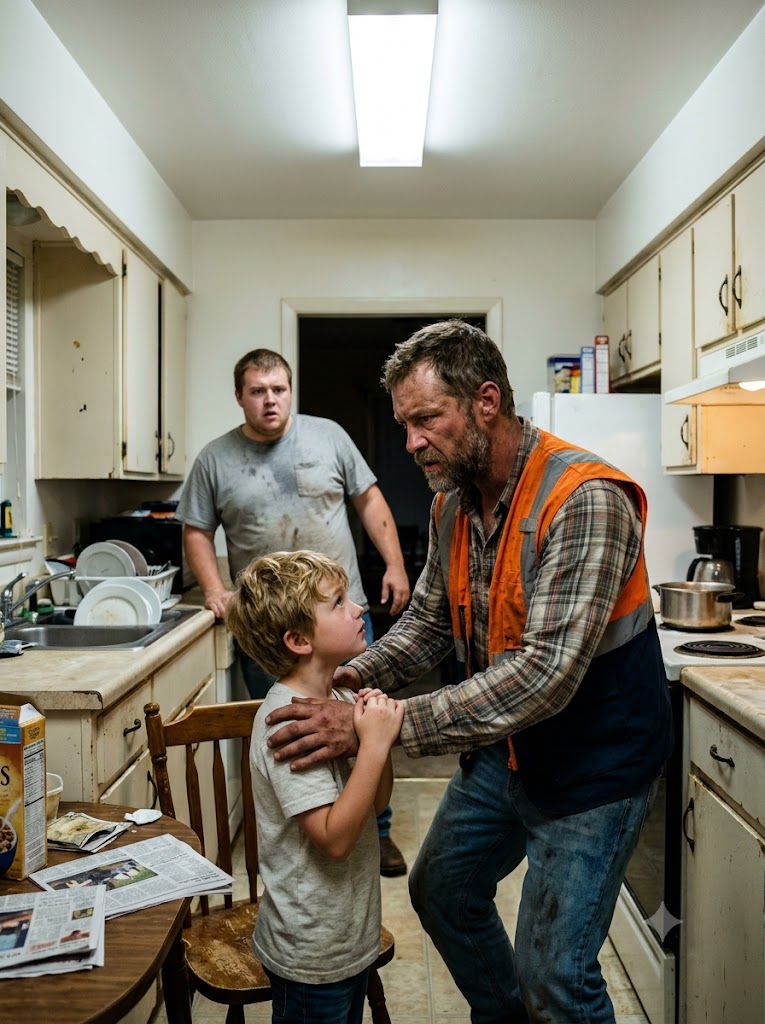
I heard metal scraping against a pot in the kitchen, followed by a small, frightened voice saying, “Please don’t boil over.” I walked around the corner and stopped so suddenly my duffel bag slipped from my shoulder. Noah stood on a wooden chair in front of the stove, stirring macaroni with both hands, his school shirt stained and his bare feet curled around the chair’s edge. His left forearm was wrapped in silver duct tape.
“Noah?” I whispered, and he turned so quickly the chair rocked beneath him. His eyes lit up for half a second before fear swallowed the excitement. “Dad, you’re not supposed to be home yet,” he said, backing away from the stove as though I’d caught him doing something wrong. I switched off the burner, lifted him down, and felt how much lighter he seemed than when I’d left.
“Buddy, what happened to your arm?” I asked, looking at the tape running from his wrist toward his elbow. He pulled his sleeve down and glanced toward the living room before answering. “I got burned, but I fixed it myself because nobody wanted to take me to the doctor.” When I asked who had been watching him, his entire body stiffened.
“Please don’t be mad, Dad,” he whispered into my shoulder. “Blake says if dinner isn’t ready, I have to sleep in the shed again.” My eyes moved toward the backyard, where the little windowless storage shed sat beside the fence. I’d built it for the lawnmower, not for a child.
The man in my recliner woke up when one of the boys shouted that someone was home. He entered the kitchen wearing basketball shorts and an irritated expression, then stopped when he saw me holding Noah. “You must be Owen,” he said, scratching his jaw. “I’m Blake Rusk, a friend of Maren’s.”
“Where’s my wife?” I asked, keeping Noah behind me. Blake shrugged and explained that Maren had gone to a casino with friends, leaving him to supervise the children. When I asked why my son was making dinner at ten at night, Blake laughed and said Noah needed to learn responsibility. “Kids are too soft these days,” he added, looking directly at me.
One of the boys appeared in the doorway and announced that Noah had slept outside on Tuesday because he’d forgotten to wash the dishes. Blake didn’t deny it; he simply told the boy to return to the television. I wanted to shout, but Noah’s fingers were gripping my shirt so tightly I could feel them through the fabric. I asked Blake to take his children and leave, then reached for my phone.
He argued that I was overreacting, but I told him medical help was already on the way. The confidence drained from his face when he realized I wasn’t negotiating. Minutes later, with Blake’s truck disappearing down the driveway, I wrapped Noah in his favorite blanket and waited for the ambulance and sheriff’s deputies. Noah finally looked up at me and whispered, “Dad, Tuesday wasn’t the first time.”
That was when I understood my son hadn’t simply been left with the wrong babysitter. Something had been happening in my house for weeks, and everyone who should have protected him had kept it from me.
Part 2
The paramedic who examined Noah was a woman named Teresa, and I still remember how carefully she spoke to him. She crouched beside the ambulance instead of towering over him and asked whether she could look at his arm. Noah hesitated until I promised I would stay right beside him. When Teresa gently loosened the tape, her expression changed, but she kept her voice calm and told him the hospital could help.
At the emergency department, a doctor examined the burn and arranged treatment for the irritated skin beneath the makeshift bandage. Noah barely complained, even when the nurses cleaned his arm and replaced the tape with a proper dressing. He apologized twice for making everyone work so late. The second time, the nurse stopped what she was doing and said, “Honey, you’re a child, and taking care of you is our job.”
A deputy named Sergeant Vincent Landry arrived around midnight with a woman from the hospital’s child protection team. They asked me to step outside while a trained interviewer spoke gently with Noah about what had happened. Standing in the hallway beneath fluorescent lights, I could hear a vending machine humming and someone’s television playing behind a curtain. I’d spent years working around heavy machinery and dangerous weather, but I’d never felt as helpless as I did outside that hospital room.
When Landry came back, he explained that Noah had described being made to cook, clean, and supervise Blake’s two older boys. He’d also described spending several nights inside the backyard shed when Blake decided he hadn’t finished his chores. The injury on his arm required further investigation, and the deputy was arranging to locate Blake for questioning. I asked whether Noah would have to return to his mother, and Landry said the immediate priority was establishing a safe place for him.
Maren called at 1:07 a.m., furious that I’d supposedly thrown her friends out of our house. I told her Noah was in the emergency department, and for several seconds she said nothing. Then she asked, “Why would you take him there without asking me?” I looked through the hospital window at our son sleeping beneath a thin white blanket and wondered when she’d started thinking she needed permission to protect him.
She arrived wearing a cream blouse and expensive perfume, her casino wristband still fastened around one wrist. When I showed her the medical paperwork, she said Noah had accidentally touched a hot pan and was exaggerating because he disliked Blake. I asked about the shed, and she folded her arms. “Blake believes in consequences, Owen, and you’re never around to help me with discipline.”
“He’s eight years old,” I answered, too stunned to raise my voice. Maren began talking about how lonely she’d been during my offshore rotations and how Blake understood the pressure she was under. She never asked Noah whether he was frightened, or whether his arm hurt. When Landry approached us, she stopped speaking and asked whether she needed an attorney.
By four that morning, Noah had been discharged into my care under a temporary safety arrangement while the authorities continued investigating. I checked us into a hotel near the hospital rather than bring him back to the house while Maren and Blake still had access. Noah fell asleep holding my hand, and I sat beside him listening to the air conditioner rattle. Every few minutes, I looked at the dressing around his arm and wondered how many signs I’d missed during our nightly video calls.
At seven, I called an attorney recommended by a coworker and explained everything. She told me to preserve messages, bank records, and documents without confronting Maren or interfering with the investigation. I also contacted my employer, who granted me emergency family leave while I arranged care for Noah. For the first time in eleven years, I had no intention of checking when the next helicopter would take me offshore.
Later that morning, I returned to the house with a deputy present to collect Noah’s clothes and school supplies. His bedroom looked strangely empty, with several toys missing and his favorite lizard’s terrarium sitting open on the dresser. While searching the office closet for his old backpack, I found an outdated smartphone tucked inside one of my work boots. The phone had no active service, but when I touched the screen, it lit up.
I’d given Noah that phone to play games and practice typing, never imagining he’d use it for anything serious. A note-taking app was open, displaying a folder titled “FOR DAD” with twenty-six numbered entries. The first began, “Hi Dad, I’m writing because sometimes I can’t tell you things when we talk.” I scrolled toward the bottom and saw that the newest entry had been written just two nights before I came home.
The final message began with seven words that made my knees weak: “Dad, I need you to believe me.”
Part 3
I sat on the closet floor with Noah’s old phone in my hands, listening to rainwater drip from the gutters outside. The message was dated Tuesday, two nights before I returned from the rig. “Dad, Blake pushed my arm against the hot pan because the noodles got stuck. A man came to the door with a paper about our house, and Mom started crying. Blake said the bank is taking it because you don’t send enough money.”
The message continued, “Mom said I can’t tell you because then you’ll find out where the money went. I don’t know what that means, Dad. I tried to be good, but my arm hurts and I’m scared to sleep in the shed again. Please come home because I’m not okay.” I read those sentences until the words stopped looking real. My son had been asking for help through a phone that couldn’t send a single message.
The earlier entries were scattered across my two most recent offshore rotations, beginning shortly after Blake started visiting. In entry nine, Noah wrote that Blake’s boys had taken his pet lizard, Pepper, and laughed when he cried. In entry fourteen, he described counting to one thousand in the darkness of the shed, hoping somebody would come outside. Entry twenty-two said, “I put your work hoodie on my pillow because it still smells like you.”
I remembered our video calls, especially the evenings Maren claimed Noah was tired or already asleep. Sometimes I’d seen him sitting quietly behind her, his expression empty, while she told me he’d had another wonderful day. I’d accepted her explanations because she was his mother and I’d never imagined she’d allow anyone to treat him this way. The guilt was unbearable, but I knew Noah needed me focused on helping him rather than punishing myself.
I photographed the messages, preserved the phone, and called Sergeant Landry before touching anything else. He arranged for the appropriate investigators to review the device while keeping Noah from having to repeat his experience unnecessarily. Then I contacted my attorney and told her about the message mentioning the bank. She advised me to obtain our mortgage records immediately, because financial problems could affect where Noah and I would live.
The mortgage website showed four missed payments and a balance that had grown with fees. I’d transferred money to our household account every month, enough for the mortgage, utilities, groceries, and emergency savings. Maren had repeatedly assured me everything was paid, usually while criticizing me for worrying about numbers. Now the account statements showed large withdrawals, repeated gambling-related transactions, and transfers I had never authorized or understood.
Inside a drawer in our bedroom, I found a thick envelope containing overdue notices, casino-related debt records totaling approximately thirty-one thousand dollars, and a copy of an eight-thousand-dollar cashier’s check payable to Blake Rusk. The check’s memo read “truck payment.” I recognized the lifted black pickup from my driveway and felt sick. The money I’d earned through sleepless nights offshore had helped finance the man who frightened my son.
There were also unopened envelopes addressed to me from the mortgage lender, their corners creased as though Maren had repeatedly moved them without opening them. I called the lender’s hardship department, verified my identity, and requested a written accounting of the delinquency and available options. The representative explained that no foreclosure sale had been scheduled, but the situation needed immediate attention. For the first time that morning, I felt a small measure of control returning.
My next call was to Maren’s mother, Judith, who lived in Tulsa and had always treated Noah with genuine affection. She started crying when I described his injury and the nights in the shed. Then she told me Maren had borrowed money from her twice that summer, claiming I’d lost my offshore job and was too proud to ask for help. Judith had sent five thousand dollars, believing she was keeping her grandson’s home secure.
I sat beneath the kitchen window, where Noah’s height had been marked on the doorframe every birthday, and stared at the figure Judith had texted me. Maren hadn’t simply spent our mortgage payments; she’d lied to her own mother and hidden the consequences from our son. My attorney called back with an urgent warning about protecting our accounts before more money disappeared. As I gathered the statements, I realized the missing payments were only part of the damage, and that the next battle would be keeping Noah safe while everything around him changed.
Part 4
Judith arrived the following afternoon in a dusty silver sedan, having driven from Tulsa with barely a stop. Noah ran into her arms outside the hotel, then immediately apologized because he couldn’t hug her properly with his bandaged arm. She held him carefully and said there was nothing to apologize for. When he asked whether she was angry with his mother, Judith answered, “I’m worried about what happened to you, sweetheart, and that’s what matters right now.”
While Judith stayed with Noah, I met my attorney, Rebecca Sloan, in her downtown office. She reviewed the hospital documentation, the preserved messages, and the financial statements before explaining the next steps toward emergency temporary custody. A child protective services investigation was already underway, and Rebecca wanted to establish clear restrictions on unsupervised contact while the facts were reviewed. I signed the paperwork with a hand that still trembled whenever I thought about the shed.
Blake was located and taken into custody after investigators reviewed Noah’s medical findings and statements. Authorities also arranged to check on his own children, who had spent weeks watching their father mistreat an eight-year-old boy. I felt no satisfaction when Sergeant Landry called with the news. I wanted Blake far away from Noah, but no arrest could erase what my son had experienced.
Maren began calling repeatedly, first demanding that I bring Noah home, then accusing me of trying to steal him from her. In one voicemail, she claimed Blake had made every decision while she was away and insisted she’d never approved the shed punishment. That evening, Rebecca asked me to review the dated messages from Noah’s phone again. One described Maren standing on the back porch while Blake locked the shed, then walking inside after telling Noah to stop crying.
I didn’t call Maren back. Rebecca advised that communication should go through the attorneys while the investigation continued. When Maren sent a photograph of our wedding day with the message “Remember what we promised,” I saved it and put the phone away. I remembered those promises perfectly, but I also remembered what Noah had written when nobody was listening.
At the emergency custody hearing, the judge considered the medical records, investigators’ reports, and the evidence Rebecca had organized. Maren’s attorney argued that my offshore schedule made me an unsuitable primary caregiver, even though I was now on family leave and had arranged dependable support. The judge granted me temporary primary custody, restricted Maren’s contact pending further assessment, and directed both parents to cooperate with the investigation. Walking out of the courthouse, I felt relief for the first time, followed immediately by the frightening realization that rebuilding Noah’s life would take more than one ruling.
Noah and I returned to the house after the necessary safety arrangements were made. I changed the locks through proper channels, installed security cameras, and had someone remove the shed from the backyard. Noah watched from the kitchen window while the empty structure was dismantled and hauled away. When the truck disappeared, he asked whether anybody could make him sleep outside again, and I promised that I’d do everything in my power to keep him safe.
I worked with the lender to reinstate the mortgage, using part of my savings to cover the overdue payments and fees. My attorney helped me separate future income from the disputed household finances while the divorce proceedings began. The house was still financially vulnerable, but the immediate danger of losing it had passed. I stood in the backyard afterward, staring at the grass where the shed had stood, and realized I wanted to keep the home only if Noah could feel safe inside it.
The hardest conversation came with my offshore supervisor. I explained that I couldn’t keep leaving my son for four weeks at a time, even though the job had supported us comfortably for years. He understood and connected me with a maintenance manager at a refinery twenty minutes from home. The offer meant a substantial pay cut, but it came with a regular day shift and evenings with Noah.
That night, I told Noah I was considering the new position while we ate chicken and rice at our kitchen table. He listened, then asked the question he’d apparently been holding inside for days: “If you work near home, does that mean I won’t have to tell Mom what to say when you call?” I put down my fork because I hadn’t known he’d been coached during our video conversations. Then he added, “Sometimes she told me to smile before she let me see you.”
Part 5
I didn’t sleep much after Noah told me about the rehearsed video calls. I kept remembering the way he’d smiled at the camera while Maren stood beside him, and how often I’d mistaken obedience for happiness. The following morning, I asked his therapist how to help without making him relive everything. She told me to build predictable routines, listen without pressing for details, and never make promises I couldn’t keep.
So we started with breakfast. Every morning I made eggs or pancakes, checked Noah’s schoolbag, and drove him to school before heading to the refinery. Some days he talked nonstop about dinosaurs and baseball cards; other days he barely spoke. Whenever he grew quiet, I reminded myself that healing didn’t have a deadline.
Judith stayed for several weeks, helping with meals and appointments while Noah settled into his new routine. She also provided investigators with records of the money Maren had borrowed and the false claims about my employment. Watching her choose Noah’s well-being over protecting her daughter was painful in a way I hadn’t expected. She told me, “I love Maren, but loving someone doesn’t mean pretending they haven’t hurt people.”
As the months passed, the investigations moved forward. Blake eventually pleaded guilty to charges arising from his treatment of Noah and received a prison sentence, while Maren faced consequences for neglecting her responsibility to protect him. The family court granted me primary physical custody under the final custody arrangement, with any contact between Noah and Maren subject to court-ordered safeguards. I followed the orders, but I made it clear that protecting Noah did not mean rebuilding my marriage.
The divorce was completed after months of financial negotiations. I kept the house through a settlement and refinancing arrangement, while Maren’s disputed spending became part of the accounting handled by our attorneys. It cost me money I’d planned to save for retirement, but Noah could keep his bedroom, his school, and the backyard where I’d taught him to ride a bicycle. For the first time, I cared more about stability than the size of my bank balance.
Maren sent me a long message shortly after the divorce became final. She said she was lonely, ashamed, and desperate to repair the family, then asked whether we could try again someday. I read it at the kitchen table while Noah colored beside me. My reply was simple: “I will cooperate with every lawful arrangement involving Noah, but our marriage is over. I can’t trust you with the life we built.”
I didn’t hate her, and I wasn’t interested in spending the rest of my life punishing her. I simply couldn’t forget that she’d watched our son suffer while protecting her own secrets. Whatever regret she felt now belonged to her, not to me. I had no intention of teaching Noah that someone deserved forgiveness merely because they eventually regretted what they’d done.
Noah’s arm healed, leaving a small curved scar he sometimes called his shark bite. He gradually stopped asking whether he was allowed to eat something from the refrigerator, and he no longer flinched when a pot rattled against the stove. With his therapist’s help, he began talking about the shed without blaming himself. Eventually, he even asked whether we could get another lizard.
We visited a reptile rescue and adopted a small bearded dragon that Noah named Rig. He spent an entire Saturday arranging its enclosure, explaining everything he knew about basking lamps and vegetables. That evening, he climbed onto the couch beside me with the old phone, which had been returned after the necessary evidence was preserved. “Can I keep writing messages to you?” he asked.
I told him he could, but he didn’t have to write because I was right there. He thought about that for a moment, then said, “I know, Dad. I just like telling you about my day.” I put my arm around him and said he could write as much as he wanted, and that I’d always make time to read it. He smiled and went back to typing, his small fingers moving carefully across the screen.
Last Sunday, I woke to sunlight across the kitchen floor, made pancakes, and found the phone charging beside the cereal box. Noah had written another entry before bed, complete with a drawing of Rig wearing a tiny construction helmet. Underneath, he had typed, “Day 302. Dad made pancakes. Rig is getting bigger. I don’t have to be scared when someone comes home anymore. I’m okay. For real this time.”
I read it twice before Noah came downstairs, asking whether we had enough syrup. Outside, the swing set creaked gently in the morning breeze, and the place where the shed once stood was covered with new grass. I handed him a plate, pulled out his chair, and listened while he told me about his plans for the day. I’d spent years believing providing for my son meant earning enough money to give him everything he needed, but it took almost losing him to understand that what he needed most was someone who would notice when he wasn’t okay—and stay long enough to help.
Legal Notice: This story is a work of fiction. Names, characters, businesses, events, and incidents are the product of the author’s imagination or are used fictitiously. Any resemblance to actual persons—living or dead—or to actual events is purely coincidental. Thank you! 💓


