
I Came Home From Deployment With Lilies. Someone Had Tried to Erase My Wife.
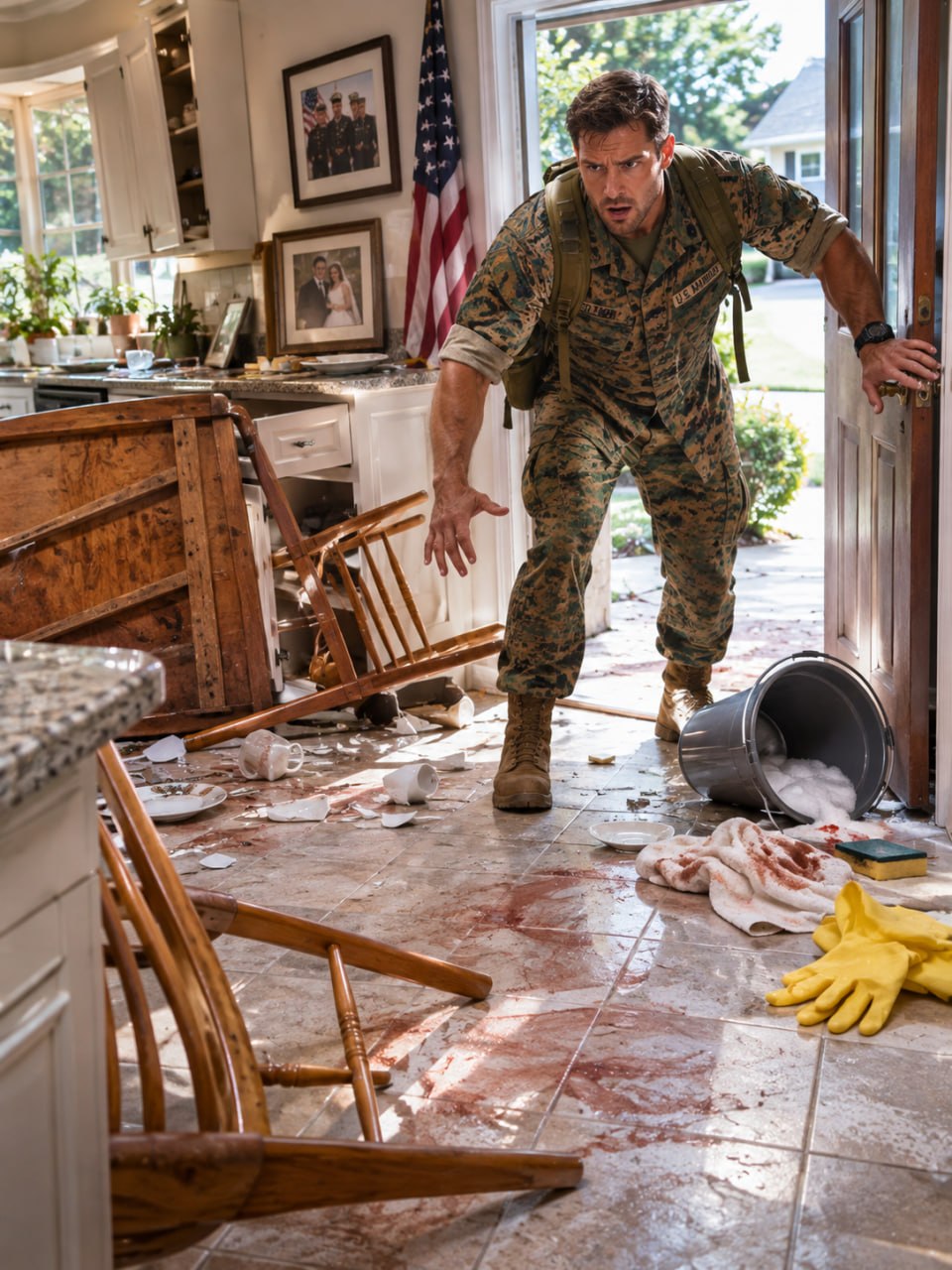
I came home from seven months overseas two days early, carrying white lilies and imagining my wife’s smile. Instead, our furniture was smashed, our kitchen smelled of bleach, and she was unconscious in a hospital bed. Her father insisted a stranger had attacked her in an alley. Then a man nobody wanted to listen to told me she had never been there. I thought I was searching for an unknown attacker, until I realized someone had been carefully rewriting the truth—and knew I was home.
Part 1
The lilies were still wrapped in grocery-store paper when I unlocked our front door. After seven months deployed with the Marines, I had pictured Mara dropping whatever she was holding and running toward me. Instead, the house was silent except for the refrigerator humming. A sour chemical smell hit me before I had even put down my duffel bag.
Our coffee table lay sideways against the couch, and one leg of a dining chair had snapped clean off. There were scrape marks along the hallway. I called Mara’s name, checked the bedroom, then called again louder. In the kitchen, beneath the harsh morning light, I noticed dark marks caught between the floor tiles despite the sharp smell of bleach.
I dialed her cell phone twice, getting voicemail both times, before calling her father, Victor Hale. He answered with his usual brisk, irritated “Hello,” but when I said I was standing in our house, he went quiet. “You’re home already?” he asked, as though my return were the problem. When I demanded to know where Mara was, he finally said, “Hillcrest Memorial. There was an incident.”
On the drive there, Victor told me Mara had been attacked three nights earlier in an alley near the old warehouse district. He said she had gone out alone, and that police believed the attacker was a stranger. I asked why nobody had contacted me through the emergency number Mara kept on our refrigerator. Victor said he had been told I couldn’t be reached.
The intensive care unit smelled like disinfectant and stale coffee, and the floor shone under lights too bright for the hour. A doctor explained that Mara had several fractures, an injured wrist, and significant trauma, but that the medical team was monitoring her closely. When I asked who had supplied the alley story, he checked the chart and said Victor had given the initial account. He also said staff had been told not to expect contact from me while I was overseas.
That made no sense. Mara had called me almost every weekend, sometimes just to show me the tomato plants she was growing in coffee cans on the back porch. Even during deployment, we had a procedure for family emergencies. Victor knew it because I had handed him the numbers myself. I looked through the glass at my wife, pale against a white pillow, and felt the first flicker of something colder than fear.
A man in a frayed denim jacket was watching me from the far end of the corridor. When he approached, I noticed his scuffed boots and the careful way he held a battered canvas backpack against his chest. “Are you Caleb Rowan?” he whispered. I nodded, wondering how a stranger knew my name, and he said, “Mara used to bring me sandwiches when I slept behind the empty house next door.”
He called himself Gus, and he kept glancing toward the elevators as though expecting someone to appear. He said he had seen Mara the night she was hurt, and when I asked where, he pulled a sealed plastic pouch from his backpack. Inside was the silver bracelet I had given her on our fifth anniversary. I recognized the bent link near the clasp, the one we had kept meaning to repair.
“I found it by your back steps,” Gus said, his voice unsteady. “That night, I heard her shouting from inside your house.” I thought of the broken chair and the marks on the kitchen floor, then asked why Victor had described an alley. Gus swallowed. “Because somebody wanted the police looking somewhere else.”
The elevator chimed behind us. Victor stepped out wearing a crisp gray coat, took one look at the bracelet, and stopped so suddenly that the man behind him nearly walked into his back. He didn’t ask about Mara or why I was home. His eyes stayed fixed on Gus, and I saw a flash of fear cross a face I had known for eight years. Whatever had happened in our kitchen, my father-in-law already knew this man could unravel it.
Part 2
Victor recovered quickly. “Who is this?” he asked, looking at Gus. I stepped between them and asked who had actually found Mara. “Police discovered her near a warehouse,” Victor replied, but when I mentioned our kitchen floor, his jaw tightened. “You just got back from a war zone, Caleb. Don’t mistake exhaustion for evidence.”
Shouting would help Victor more than me. I told him to stay away from our house, then walked Gus toward a quiet stairwell. Victor followed us with his eyes but didn’t come closer. As the elevator doors shut behind him, Gus whispered, “He saw me that night. He knows I tried to call for help.”
Rain had been hitting the tin roof of the abandoned garage when Gus heard Mara yelling at someone in our kitchen. She kept repeating, “Those papers aren’t yours,” before something crashed hard enough to carry across the yard. Gus had run toward the back fence and seen two men through the lit doorway. One wore Victor’s familiar camel-colored coat; the other was younger, carrying a black duffel bag.
“I couldn’t see the younger man’s face,” Gus told me, rubbing his palms together. “But I heard your wife again, and I called 911.” He showed me his phone: one emergency call that night, then three calls over the following days. He said an officer took his name, yet nobody had followed up. Victor had told arriving paramedics that Mara had been injured elsewhere and brought home before help was called.
I asked why Gus had stayed near the hospital instead of leaving town after Victor threatened him with trespassing charges. He looked at the bracelet and said Mara had brought him hot soup throughout the winter, even when neighbors complained about him sleeping nearby. “She always asked what I needed, not what I’d done wrong,” he said. “I wasn’t going to let somebody turn her into an alley story.”
I called the police from the hospital lobby and asked for a supervisor, describing the conflicting location reports and Gus’s emergency call without making accusations I couldn’t prove. Detective Elena Moreno arrived that afternoon, her notebook balanced on one knee, and listened to Gus without interrupting. She took possession of the bracelet after documenting how he found it. Then she asked me whether anyone besides Mara and me had keys to the house, and I gave her Victor’s name.
By midnight, Moreno had requested the first incident report and emergency dispatch records. She said the earlier investigation had relied heavily on Victor’s account, but the police needed to verify what the responders actually knew. I stayed at Mara’s bedside while a monitor ticked softly beside her pillow, describing our plans for our first weekend together. Her fingers shifted once against mine; the nurse said it was encouraging, but not proof she could hear me.
The next afternoon, I met Moreno and two technicians at our house after agreeing to let them examine it. The lilies I had abandoned on the counter were gone, and someone had set an unfamiliar dining chair where the broken one had been. I hadn’t given anybody permission to enter. When I told Moreno, she photographed the clean stretch of counter.
Mara’s laptop was missing from her office, along with the external drive she used to back up family photographs. A small walnut box containing her late mother’s letters had vanished from the living-room shelf. Yet inside her desk, tucked beneath a stack of birthday cards, a thin green notebook remained. Moreno photographed the pages before touching anything, and I recognized the crooked stars Mara drew beside reminders she considered urgent.
One page contained dates, transfers, and a company name I knew from Victor’s business cards: Hale Ridge Construction. The figures were large enough to make me check them twice, and several entries had question marks beside signatures. At the bottom, Mara had written, “Mom’s trust. Ask Dad why the account is empty.” Until that moment, I had been afraid someone wanted to hurt my wife. Now I wondered what she had found that somebody wanted removed.
Part 3
By morning, Moreno had an explanation for the notebook’s numbers. Mara’s mother, Evelyn Hale, had died four years earlier, leaving a trust for Mara. Victor had handled its administration while Mara grieved, and I’d never questioned the arrangement because Mara trusted him. But bank records showed that hundreds of thousands of dollars had been moved toward Hale Ridge Construction, a company struggling to pay its creditors.
“Six hundred and twelve thousand dollars,” Moreno said, tracing the total with her pen. “That’s what your wife appears to have been trying to account for.” Several authorization forms carried Mara’s name, though Mara had questioned those signatures weeks earlier. I remembered that call now: how she wanted to speak to Victor before accusing anyone. I had told her to be careful, then gone back to work.
Investigators located traffic-camera footage showing a black SUV entering our street shortly before Gus called 911 and leaving half an hour later. The vehicle belonged to Nolan Voss, Victor’s operations manager. Gus’s description of the younger man fit Nolan, but Moreno warned me that being present was not proof of assault. She had something more revealing to show me: several seconds of video Gus had taken while trying to see who was inside.
The footage was shaky, rain streaking the lens, and most of the picture showed our porch light reflecting against wet siding. I could make out Victor by the back door, with another man passing behind him carrying a dark bag. Then Mara’s voice came through, strained but unmistakable: “Dad, please. Put it back.” Victor’s answer was quieter, but I recognized it immediately. “You should’ve left those papers alone.”
I pushed back from Moreno’s desk so fast the chair scraped the floor. I wanted to storm Victor’s office and force an explanation. Moreno stood and said, “Caleb, I need you here, not in a holding cell.” I stared at the frozen image until I could unclench my hands. Anger had finally given me a target, but charging at it would only make Mara’s fight harder.
Nolan had already been interviewed through his attorney. He admitted visiting the house that night, claiming Victor had ordered him to collect confidential business files after a family argument. He claimed Mara was injured before he arrived. Moreno didn’t treat his account as fact, but it fit the timing of Gus’s call and raised a question: why was Victor alone with Mara before anyone summoned help?
That evening, I returned to the ICU and found Mara’s eyelids moving as I pulled up my chair. I spoke her name, and after a long moment she opened her eyes enough to focus on my face. “Caleb?” she whispered, her voice thin and rough. I pressed the nurse’s call button, then held her uninjured hand while she looked at me with astonishment.
A doctor assessed her before we talked again, and he warned us to keep the visit short. Mara stared at the ceiling, then turned toward me and said, “He took Mom’s money.” I told her the detective had found her notebook, and she started crying, with tears slipping into her hair. “I asked him to give it back,” she whispered. “Dad said I was destroying the family. Then he hurt me.”
Speaking clearly hurt her, so I didn’t press. I told her I believed her, that she was safe, and that she didn’t have to explain everything to me. When her breathing settled, she caught my sleeve and whispered, “He said you weren’t coming home.” I kissed her forehead and stayed until she fell asleep, furious that Victor had used my absence as one more weapon.
After her doctors approved a short interview, Mara gave Moreno her own account of the confrontation. She said she’d discovered transfers she never approved and demanded the original trust records; Victor lost control, then ordered Nolan to remove her files. Moreno called with one final detail: Victor had asked hospital staff that morning to alert him the instant Mara could speak. He wasn’t asking whether she was improving. He was asking how much she remembered.
Part 4
Moreno moved quickly after Mara’s statement. Victor was arrested two days later, after police found Mara’s laptop and document box in Nolan’s storage unit. Messages on Nolan’s phone showed Victor ordering him to remove the records and wipe down the kitchen before officers returned. Another message instructed him to keep repeating the alley account. Victor had even told the hospital nobody could reach me.
The financial investigation took longer. Auditors traced the missing $612,000 into company accounts and uncovered forged authorizations. Nolan eventually agreed to cooperate and pleaded guilty to offenses involving the concealment of evidence. He admitted he had followed Victor’s orders to keep his job. Mara listened to that explanation once, then said, “He was afraid of losing a paycheck. I nearly lost my life.”
For weeks, I measured time by therapy appointments and short walks. The first time she held a coffee mug with her injured hand, we both cried over a ridiculous little achievement. Other afternoons were harder; scraping chairs could silence her. I learned to ask what she wanted before rushing to fix things, because she had already spent too long with someone else deciding for her.
Gus came to visit when Mara felt ready. He arrived with his hair neatly combed and a paper packet of lily bulbs. Mara held his hand and thanked him for calling 911, and he tried to apologize for not doing more. “You came back and told the truth,” she said. “My own father wouldn’t even do that.” Gus looked away, wiping his eyes with his sleeve.
With Mara’s permission, I helped Gus contact a housing organization, whose caseworker found him supported housing. He refused money but accepted rides and invited us over. The room had one window, a narrow bed, and a chipped yellow mug on the sill. “Nobody can tell me to move along here,” he said, smiling.
Victor’s attorneys initially claimed Mara had misunderstood the trust accounts. Confronted with the records, Victor changed his story and called the confrontation a tragic argument that had gotten out of hand. The prosecutor rejected that elaborate cover-up. Months later, Victor entered a guilty plea to serious assault and financial offenses, sparing Mara the ordeal of a lengthy trial.
At sentencing, she walked to the podium without asking me for support. “My mother left that money so I would have choices,” she told the judge. “My father took the money, then tried to take away my chance to tell anyone.” Victor sat with his head lowered while Mara described what recovery had cost her: sleep, ordinary confidence, and the certainty that home meant safety.
The judge imposed a lengthy prison sentence and restitution obligations, although only part of the trust was recoverable. As deputies led him away, he finally looked at Mara and said, “I’m sorry. Please don’t let this be the end of us.” She stood with her hand in mine and answered, “You had years to be my father. You chose to protect yourself instead.” Then she turned toward the doors.
We sold the old house. She chose a smaller place with a bright kitchen, a fenced garden, and no one holding an emergency key except us. I took extended leave to help her settle in, then returned to duty knowing that staying close meant listening, not controlling. For the first time, closing a door behind us felt ordinary instead of frightening. Difficult nights remained, but they no longer controlled our plans.
One spring afternoon, nearly a year later, I found Mara kneeling beside the lilies Gus had helped us plant. She laughed after planting a bulb upside down, her repaired bracelet catching sunlight. I sat beside her with lemonade as the leaves rustled. Victor would never enter our lives again. But Mara was here, the garden was growing, and when she reached for me, neither of us had to look over our shoulders.
Legal Notice: This story is a work of fiction. Names, characters, businesses, events, and incidents are the product of the author’s imagination or are used fictitiously. Any resemblance to actual persons—living or dead—or to actual events is purely coincidental. Thank you! 💓