
At My Husband’s 40th Birthday Party, I Heard Him Say “I Love You” to Our Neighbor—So I Lit Every Candle Anyway
I was carrying a cake into my husband’s fortieth birthday party when I heard him whisper that he loved someone else. She was two houses down, married, and standing in my backyard beside her own husband while our children played together. I could have thrown the cake or screamed in front of forty guests. Instead, I lit every candle, smiled for the pictures, and started paying attention. By the following Thursday, two marriages were heading toward a hotel room neither cheater expected us to find.
Part 1
The buttercream was sliding toward one side of the cake, and I was looking for a spatula when my husband stepped into the garage to take a call. It was a warm Saturday evening in our quiet Ohio suburb. Beyond the kitchen window, forty guests crowded beneath the string lights I had hung that afternoon. Our daughter, Lily, was guarding the gifts from her little brother, Ben, who kept trying to guess what was inside.
Daniel had turned forty that morning, and I wanted the evening to feel special. He had worked late for weeks at his insurance office, coming home with tired eyes and an apology ready. I’d spent Friday baking chocolate cake and Saturday setting out food and patio furniture. The only thing left was to bring out the cake when Lily gave the signal.
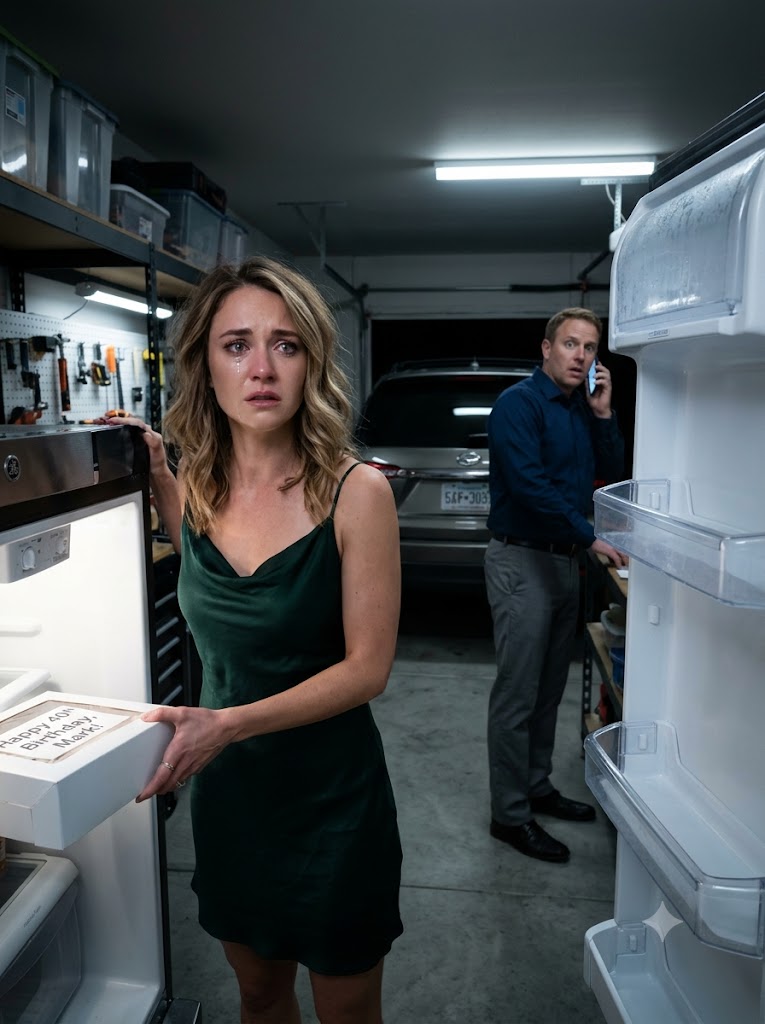
I opened the garage door and stopped at his voice. Daniel stood near his pickup in the dark, one hand resting on the hood, his phone pressed to his ear. “After tonight, I’m telling her,” he said. “Please, Claire, just let me get through the party.”
Claire Benton lived two houses down, and her kids shared our school bus stop. Owen, her husband, coached Ben’s soccer team; Claire and I traded babysitting favors. For a second I tried to invent another Claire, some client whose paperwork Daniel had forgotten. Then I glanced through the small window above his workbench and saw Claire by our side gate, phone to her ear, her pale blue dress unmistakable beneath the porch light.
“I know,” Daniel murmured. “I hate pretending too. One more night.” His voice had the softness he once used when our babies slept against his chest, and I suddenly couldn’t feel my fingers. Claire turned away from the yard. “I love you,” he said. “Go back before Owen notices.”
The garage smelled of motor oil and damp cardboard. I backed into the kitchen before Daniel turned, catching the counter so the metal mixing bowl wouldn’t fall. In the backyard, someone shouted for another bag of ice, and our neighbor’s dog barked at the music. I stood there wondering how the world could sound exactly the same when mine had just come apart.
Then Lily pushed through the screen door, cheeks flushed. “Mom, he’s coming back! Did you get the candles?” I looked at my daughter, who’d painted HAPPY 40, DAD on poster board. Whatever happened next would become part of her childhood, and I couldn’t bear to make this moment the one she remembered. “I’ve got them,” I told her, amazed that my voice worked.
I lit forty candles and carried the cake outside. Everyone sang badly, Ben drummed on the table, and Daniel pulled Lily close as if he were the luckiest father alive. He blew out the candles, kissed my cheek, and announced, “Best wife in the world.” Near the fence, Claire raised her plastic wineglass toward me and smiled like we shared a harmless secret.
I smiled back because my children were looking at me, but the cake tasted like chalk. Daniel held my waist for photographs, while Claire avoided posing beside Owen. At one point she disappeared into the house, and Daniel checked his phone immediately afterward. Small things I’d dismissed for months suddenly lined up like footprints in wet cement.
After everyone left, I scraped frosting from paper plates. Daniel offered to help, but his phone buzzed, and he said he needed to answer something from work. Upstairs, I tucked Ben’s soccer blanket around him and listened to Lily tell me that Dad’s birthday had been perfect. “I’m glad,” I whispered, and meant it for her.
By midnight Daniel slept beside me, his promised confession forgotten. I lay awake watching headlights crawl across the bedroom ceiling, thinking about all the Thursdays he’d spent at the gym. When he rolled toward me, I moved to the edge of the mattress and waited for morning. I had heard enough to know he was lying, but I needed to learn how long he’d been doing it—and what else he’d taken from our life.
Part 2
On Sunday morning Daniel made pancakes and asked whether I was feeling okay. I said the party had given me a headache, which was true. He kissed my forehead and left to help a coworker move. The smell of maple syrup lingered after the kids went to their grandparents, and I opened the laptop he kept in the downstairs study.
I hated snooping, but needed more than a garage whisper. Daniel used the laptop for our household bills; a message notification appeared. “Same room Thursday?” it read, followed by a heart. The sender was saved as C. Benton, a name I’d seen on school pickup lists for years.
Their earliest messages discussed soccer, rain, and kitchen renovations. Then, fourteen months earlier, the tone had changed after a neighborhood cookout. Daniel wrote that he kept thinking about standing beside her at the grill; Claire replied that she felt the same and was terrified. Within weeks they were arranging Thursday evenings, each using the same excuse at home.
A folder marked TRAVEL held Marriott receipts from near the airport. Some dates matched evenings when Daniel claimed he’d stayed late at the office, including our wedding anniversary last fall. I stared at one charge until the numbers blurred, remembering the flowers he brought me the following morning. I’d thanked him for those flowers and apologized for complaining.
The worst discovery was a photograph taken in a hotel mirror. Daniel was smiling with an ease I hadn’t seen in months, and Claire wore the silver necklace I’d helped Owen choose for their anniversary. I shut the screen as the refrigerator compressor started. Instead of smashing something, I needed to document what I’d found and protect myself.
I saved the relevant shared-account receipts and dates, wrote down what I’d seen, and called a family-law attorney whose office offered Monday consultations. She advised me to stay within shared accounts and avoid impulsive decisions about the children. Then I gathered the household financial records I already had access to. I discovered that a credit card we’d agreed to reserve for emergencies carried a balance I hadn’t recognized.
In the printer tray, I found a receipt for a restaurant I’d suggested for our anniversary. Daniel had told me it was too expensive, yet he’d paid for dinner there on a Thursday with two desserts and a generous tip. It was a smaller betrayal than the hotel photographs, but somehow it made me angrier.
Daniel came home describing the furniture he’d carried upstairs. He asked what I wanted for dinner, and for one insane moment I nearly told him the whole thing. Instead, I asked about his new gym membership. “Every Thursday,” he said without blinking, and offered to show me the app if I didn’t believe him.
I wondered what Claire was telling Owen. That night I sat on the back steps with my phone and watched the Bentons’ porch light turn on two houses away. Our kids traded Halloween costumes and filled each other’s kitchens with muddy shoes. I wasn’t only afraid of losing my marriage; I was afraid of what the truth would do to four children who had never asked for any of this.
On Monday, after Lily and Ben boarded the bus, I walked to Owen’s front porch with a slim folder under my arm. He opened the door holding cinnamon-scented coffee. “Natalie? Everything okay?” he asked, stepping aside so I could come in. I saw a family photo on the wall and nearly turned around.
“I need to show you something,” I said. “I’m sorry.” At their kitchen table, I showed him the messages, receipts, and dates. He read them slowly, occasionally scrolling back as if he’d misunderstood the words. When he reached the anniversary receipt, his thumb stopped moving.
“She told me book club,” he said at last, staring toward the street. “Every Thursday, for over a year.” I told him Daniel’s gym story, and we sat without speaking while the wall clock clicked above us. Then Owen set his untouched coffee down and asked, “What happens now?” For the first time since Saturday, I wasn’t the only person carrying the truth.
Part 3
I expected Owen to yell, but he asked for paper. An engineer, he still moved carefully through his shock. We listed facts, suspicions, and ways to protect our children. “I want them to say it to our faces,” I told him. “At the same time, so neither can rewrite what happened.”
Owen glanced at the children’s camping drawings on his refrigerator. “No kids,” he said. “No neighbors standing around with cameras.” We agreed against public accusations and consulted our attorneys. Planning felt practical and sad, nothing like revenge.
Before I left, Owen showed me a message Claire had sent a friend, asking her to cover if anyone questioned book club. He just wanted to understand what was true. “I kept saying I trusted her,” he admitted. I had said the same thing about Daniel.
On Tuesday Daniel brought home a bouquet from the grocery store, sunflowers wrapped in brown paper. He asked whether I was worrying about money. I thought of the emergency credit card as he studied me. “I’m tired,” I said, and he put the flowers in a vase himself, something he hadn’t done in years.
That night I asked if there was anything important he needed to tell me. Daniel dried a dinner plate, smiled, and said, “Only that I love you.” Water dripped from his towel; ‘love’ had become his way to end conversations. Then Lily arrived with homework, and he cheerfully explained the moon’s phases.
Wednesday brought a text from Claire asking whether I’d recovered from the party. She included a photo of the cake and wrote, “You two are such a great team!” I stared at her exclamation point. I replied, “Thanks for coming,” unwilling to warn her. It was the last friendly message I would ever send her.
Owen and I met briefly in a coffee shop across town after our separate attorney consultations. Our lawyers had emphasized parental responsibilities, documentation, and custody planning. The hotel couldn’t solve those problems. We wanted one undeniable moment to replace the fog of excuses we’d been living in.
Owen had also found Thursday’s reservation confirmation in their shared family email, something Claire had apparently overlooked. There it was: one room, two adults, at the same hotel listed on Daniel’s receipts. I wrote down the room number, though I knew I’d remember it.
By Thursday afternoon I felt as if I were moving underwater. My mother agreed to keep the kids overnight after soccer practice. Daniel reminded Ben to stretch before Saturday’s game. I watched Ben wave and wondered how many evenings had hidden lies.
At seven, Daniel grabbed his gym bag. “Don’t wait up,” he said, and smiled as though it were a kindness. Five minutes later Owen texted me a single word: “Left.” Claire had left for book club under a clear sky. I locked my front door, took a long breath, and drove to meet Owen near the airport.
We parked at eight fifteen beneath the hotel’s blue sign. In the lobby, a suitcase rattled across tile beneath a muted television. Owen showed me a reservation confirmation Claire had shared to a family email account, with room 412 clearly visible. We asked for no key and walked to the elevator.
On the ride up, Owen watched the changing floor numbers while I stared at our reflections in the brushed-steel doors. He wore his coaching polo; I wore Daniel’s Christmas-gift cardigan. We looked dressed for errands, not a confrontation. “We leave together,” Owen said softly. I nodded.
The corridor smelled of detergent and stale coffee. We stopped outside 412, hearing music beneath the door. I could hear a woman laugh, followed by a man’s low voice answering her. Owen knocked twice, firmly enough to be heard but not enough to wake the whole floor.
The latch clicked, and the door opened. Claire stood there in a white hotel robe, holding two glasses, her face already arranged into a playful smile. Then she saw Owen, and the smile vanished. Behind her, Daniel said my name before I had even stepped into view.
Part 4
One glass tipped against the other, and both fell onto the carpet with a muffled clatter. Claire gripped the doorframe while Daniel rose from the edge of the bed, still wearing his gym T-shirt. His shoes and overnight bag sat beneath a familiar cologne bottle. That small ordinary bottle hurt worse than I expected, because I’d given it to him last Christmas.
“Natalie,” he said, moving toward me. “This isn’t what you think.” I held up my hand, and he stopped halfway across the room. Owen watched the champagne flutes roll apart. “It is exactly what we think,” he said. “We know it’s been fourteen months.”
Claire began to cry and reached for her husband’s arm, but Owen stepped back into the hallway. “Please,” she said. “I was going to tell you.” He looked at her for a long time before answering, “When? After another book club?” She shook her head, and for once she had nothing prepared to say.
Daniel tried to explain that he’d been unhappy, that our lives had become schedules and bills, that he hadn’t wanted to hurt the kids. I remembered him asking me to buy balloons for his party while he sent Claire a message from our kitchen. “You didn’t want to face the consequences,” I told him. “That’s different from not wanting to hurt anyone.” The room fell silent except for the air conditioner rattling beside the window.
“You said you’d tell me after your birthday,” I continued. “I heard you in the garage while our friends were outside singing.” His eyes widened with childish panic. “You heard that?” he whispered. “Every word,” I said. “And then I lit all forty candles.”
Claire pressed a tissue against her face. “Natalie, our friendship was real,” she said, and I felt my stomach turn. I remembered listening to her marriage complaints while preparing our children’s snacks. “You don’t get to call it friendship because I didn’t know what you were doing,” I answered. She lowered her eyes.
Owen asked whether they planned to stay together. Daniel looked at Claire, waiting for her to answer, and Claire looked at the floor. That was the first time I saw uncertainty pass between them, a crack in the certainty they’d borrowed from secrecy. “You don’t have to decide for us,” Owen said. “Our marriages are not yours to put on hold until you figure it out.”
Daniel followed me as I turned toward the elevator. “We can fix this,” he pleaded, his bare feet slapping against the hallway carpet. I faced him once, keeping my voice level because a door had opened farther down the corridor. “You had fourteen months to stop,” I said. “Don’t ask me to do the work of forgiving you before you’ve even told the truth.”
In the elevator, Owen leaned his head against the wall and covered his eyes. Neither of us spoke until we reached the parking lot, where rain had begun to fall in thin silver lines beneath the lamps. “I don’t know what I’m going to tell my kids,” he said. “The truth they can carry,” I answered, “not the details that belong to us.” We stood grieving the lives we thought we’d had.
My mother met me at her front door with a blanket and no questions. When Lily and Ben were asleep, I told her what had happened, then called my attorney to arrange the next steps. Daniel sent twenty-three messages that night, changing from apologies to explanations to accusations that I’d humiliated him. I read none of them until morning, when I needed to discuss our children’s schedule rather than his feelings.
At sunrise I returned home with my mother beside me to collect school clothes and the children’s favorite books. Daniel was sitting at the kitchen table beneath the HAPPY 40, DAD banner he’d forgotten to take down. He looked up, eyes red, and said, “I made a mistake.” I glanced at the fourteenth-month timeline printed in my folder and understood how much that one word was trying to erase.
Part 5
“A mistake is leaving the garage door open,” I told Daniel. “This was a decision you made again and again.” He started crying, but I picked up Ben’s sneakers from beside the table and went upstairs. My mother stayed in the kitchen while I gathered what the children needed for school. For the first time, I stopped trying to make Daniel feel better about the things he’d done.
The following months were thoroughly unglamorous. We divided accounts, set parenting schedules, and moved school projects between houses. Daniel moved into an apartment twenty minutes away, and Claire rented a place across town. We documented the emergency-card charges instead of arguing before the kids.
Lily asked whether the divorce happened because she’d been difficult at bedtime, and I felt the air leave my chest. I sat beside her and said, “Nothing you did caused this. Adults made these decisions.” Ben wanted to know whether he could still play soccer with Owen, and I promised he could. We kept those promises.
Some church friends encouraged reconciliation. Others offered casseroles in exchange for gossip. I learned to say, “We’re separating, and I won’t discuss private details,” without apologizing. A quiet friend took the kids to the library every Tuesday; that kindness mattered.
Daniel asked me to try counseling together, promising he’d changed and that the affair meant nothing now. I supported counseling for his parenting, not for rebuilding our marriage. He accused me of throwing away fifteen years; I disagreed. Valuing my past didn’t require surrendering my future.
I reclaimed Saturdays from the chores Daniel had assigned me. I fixed the broken latch on our garden gate, signed up for a pottery class, and painted the kitchen a soft green Lily chose. Each small change made the house feel like mine again.
Owen and I coordinated pickups and soccer uniforms. We didn’t turn into a couple, despite the hopeful looks some neighbors gave us when we arrived at practice together. We were grieving separately, and I wanted to rediscover myself. Pain wasn’t a promise of romance.
Daniel and Claire tried living together after their separations, but the arrangement ended within four months. I heard during a parenting-schedule conversation. Daniel said the excitement vanished amid groceries and bills. I didn’t ask for details; I had already spent more than enough time inside their story.
By fall, I no longer pictured Daniel hiding in the garage. I pictured Ben learning to ride his bike in the driveway and Lily making chalk stars on the concrete. The building hadn’t changed. What I let it mean to me had.
Both divorces were final within a year. Daniel remained their father, and I encouraged him to show up for them without pretending he was still my partner. Outside a school concert, he apologized again. “I hope you become someone you respect,” I said. Then I walked inside to find my seat, leaving his forgiveness where it belonged: with him, not me.
On Thursdays after soccer practice, Owen and I still took all four kids for pizza at a place with sticky booths and a jukebox that never worked properly. The kids argued over pepperoni and planned sleepovers. Owen and I talked or listened. There was no secret romance waiting to be revealed, only the relief of friendship without deception.
Last month, for my birthday, Lily and Ben baked a cake in my mother’s kitchen. It leaned to the left, the frosting was too thick, and Ben had written MOM in crooked blue letters. They carried it in, singing off-key and shielding the candles from the fan. I laughed so hard I nearly cried, for happier reasons.
Before I blew out the candles, Ben caught my sleeve. “Make a good wish this time, Mom,” he said, suddenly serious. I looked at my children and the friends who hadn’t demanded forgiveness. Then I closed my eyes and wished for exactly what we were building: a home where nobody had to pretend to be loved. I blew out the candles, and this time the darkness afterward didn’t frighten me.
Legal Notice: This story is a work of fiction. Names, characters, businesses, events, and incidents are the product of the author’s imagination or are used fictitiously. Any resemblance to actual persons—living or dead—or to actual events is purely coincidental. Thank you! 💓


