
Chapter 2
The following morning, I called my best friend, Kesha Lindgren, a consumer protection attorney with an office downtown. We had met during our freshman year at Ohio State after getting locked out of our dorm room in matching bathrobes, and she had remained the one person who could tell me an uncomfortable truth without making me feel small.
She listened while I explained the loan, then set down her coffee.
“First, freeze your credit with all three bureaus. Second, get the entire loan file from the bank. Third, file the affidavit of forgery and make a police report. Don’t wait for your family to calm down.”
I had already frozen my credit, but I hadn’t obtained the documents.
“Once you file a report,” she continued, “this becomes an investigation, not a private family argument. Your parents may pressure you to withdraw it. Your sister may cry, apologize, or accuse you of ruining her life. You need to decide whether you’re prepared to follow this through.”
I thought about the coffee can beneath my childhood bed.
When I was twelve, I had babysat for nearly every family on our street. I saved $340 in an old coffee can for a school trip to Washington, D.C. I had been so proud of that money that I kept the permission slip on the refrigerator for two months.
Then Josie qualified for a regional dance competition. Her costume and travel expenses came to almost exactly $340, and one afternoon I returned from school to discover my savings gone. Mom was sewing sequins onto Josie’s blue costume at the kitchen table.
“We’ll pay you back, bird,” Dad told me that evening. “I promise.”
He called me Bird because I hummed while doing my homework. I never received the money, and I stayed home while my classmates traveled to Washington.
That was how things worked in our family. When Josie needed something, I was expected to understand. When I needed something, I was expected to be strong enough to go without it.
When I graduated from Ohio State, my parents missed the ceremony because Josie had a cheerleading competition in Cincinnati. Dad called from the parking lot afterward and told me to keep the peace.
“Your sister needs us more right now,” he said. “You’ve always been the strong one.”
I loved my father. He had driven two hours through a snowstorm when my car broke down during college, and he had spent countless Sunday afternoons teaching me how to maintain an engine. But whenever the choice came down to me or Josie, he chose whichever option made the house quiet fastest.
Kesha listened without interrupting.
“Wendy, being the reliable one doesn’t mean you’re the family emergency fund.”
I swallowed hard.
“I know. I’m filing the report.”
On Thursday, I visited the bank branch with my driver’s license, passport, tax records, and examples of my signature going back ten years. The bank’s fraud investigator, Garrett, met me in a small conference room and helped me complete the affidavit.
He was in his fifties, wore reading glasses on a cord, and spoke with the steady calm of someone who had heard every possible excuse.
“I’ll request the entire loan file,” he said. “The application, the guarantee, the supporting documents, and the notarization. Give me about a week.”
From there, I drove to the police station and met Detective Hunter in the financial crimes unit. He typed while I explained what had happened, then handed me a report number.
“Family identity fraud is more common than people think,” he said. “Relatives already have access to personal information. They know where you keep documents, and they assume you’ll forgive them.”
I drove back to the hospital with the report number tucked into my wallet.
By Thursday evening, my family had begun telling its own version of events. Josie posted a message on social media about how people with perfect lives were always the first to kick someone when they were down. Several cousins offered heart emojis and prayers, but nobody asked why she was in trouble.
Mom sent long messages about everything she had sacrificed to raise me. Dad sent one sentence.
Your mother is very upset. Call her.
I stared at the screen for a long time before typing a question.
Dad, did you know Josie had used my name?
The little dots appeared, disappeared, and appeared again.
He never answered.
Sunday was Dad’s sixty-fourth birthday, and I almost skipped the family dinner. Sam told me he would support whatever I decided, but I had bought Dad a hand-painted fishing lure from a shop in Port Clinton two months earlier. I wanted to give it to him and remember the man who had once taught me how to tie a fishing line.
I told myself I wasn’t going to let Josie take his birthday from me, too.
When we arrived at my parents’ house in Hilliard, the first thing I noticed was the empty space beside the garage. For twelve years, Dad’s fishing boat had sat beneath a blue tarp, and he had spent nearly every spring and summer weekend taking it out on the lake.
“Where’s the boat?” I asked.
“Sold it,” he replied, avoiding my eyes. “Wasn’t using it enough.”
I knew that wasn’t true, but I didn’t press him.
Dinner was pot roast, mashed potatoes, and green beans. Josie sat across from me with swollen eyes and barely acknowledged my presence. Mom served everyone, then placed a folded piece of paper beside my plate.
At the top, in bold letters, were the words REQUEST TO WITHDRAW COMPLAINT.
Beneath them was a paragraph claiming I had misunderstood the situation and wished to drop all charges against my sister. A line had been provided for my signature, with my name already typed beneath it.
“Sign it, and we’ll eat,” Mom said.
“That’s not how a police report works.”
“Then call the detective and tell him you made a mistake.”
“I didn’t make a mistake. Josie did.”
Josie slammed her fork against the plate.
“I’m sitting right here, Wendy!”
“I know. That’s why I’m saying it to your face.”
Dad rubbed his forehead.
“Bird, it’s my birthday. Can’t we have one peaceful meal?”
I looked at the document. Once again, my family had placed a piece of paper in front of me with my name already printed on it, expecting me to sign away something that belonged to me.
I picked up my pen.
Mom smiled.
Then I turned the paper over and wrote one word across the back in large, neat letters.
NO.
I folded it, placed it beneath my water glass, and continued eating. Sam made a noise that sounded suspiciously like a laugh, while Josie pushed back her chair and stormed upstairs.
Mom accused me of ruining Dad’s birthday. I set his gift beside his plate and told him I loved him, but he kept staring at the pot roast as though it might provide an answer.
On the drive home, Sam rested one hand on my knee.
“Your dad sold that boat for a reason,” he said.
I looked out at the darkening highway.
“The shop closed in June. He’s retired. Mom’s paycheck can’t cover everything. He must have needed the money.”
I thought about the empty driveway and the tarp marks still visible on the concrete.
But I wasn’t prepared for the reason I would discover a few days later.
Chapter 3
Garrett called the following Wednesday afternoon and asked me to come to the bank. He had obtained the complete loan file and wanted me to review it in person.
The envelope he handed me contained forty-one pages. I took it home, set it on my kitchen table, and waited until Sam left for an evening workshop before spreading the documents out beneath the overhead light.
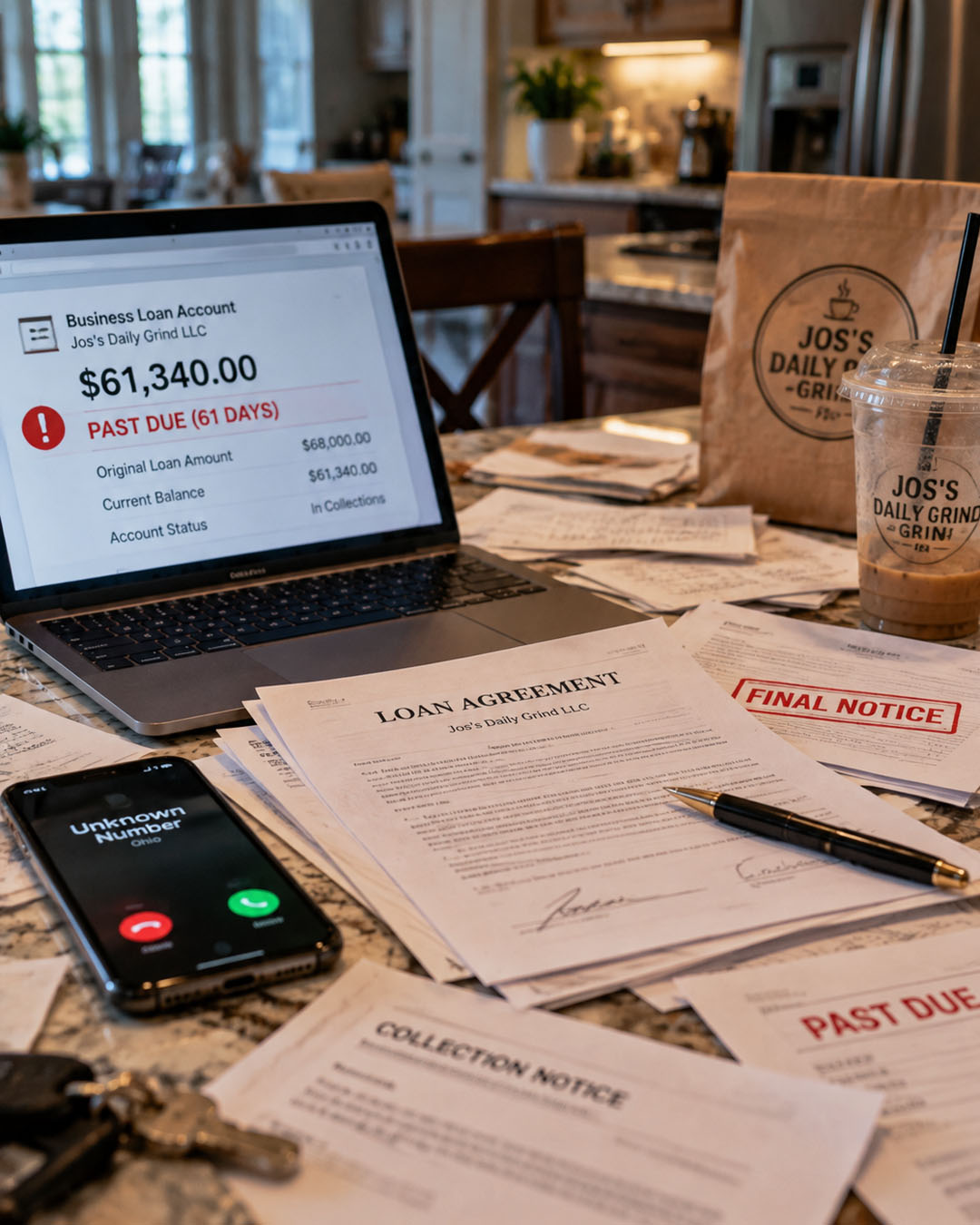
The first pages contained Josie’s business plan, projected revenue, equipment estimates, and lease agreement. Her first-year sales were projected at $210,000, a figure that seemed wildly optimistic for a small coffee shop in a strip mall.
Then I found my own documents.
A copy of my driver’s license. A recent bank statement. A tax form from two years earlier. My Social Security number, income, and employment information.
These weren’t convincing imitations. They were real documents I recognized immediately.
I knew where they had come from.
In March of the previous year, a pipe burst in Josie’s apartment, and she stayed with me for two weeks while the damage was repaired. I gave her a spare key and let her sleep in the guest room, where I kept a filing cabinet containing my personal records.
I remembered coming home one evening and finding her sitting on the bed, scrolling through her phone. She had smiled and asked what we were having for dinner.
I had never thought twice about it.
Now I sat at my kitchen table with my palm pressed against the wood, realizing that my sister had gone through my belongings while living beneath my roof.
I kept reading.
Page three contained the personal guarantee. My name appeared on the signature line, written in blue ink.
It wasn’t my handwriting.
I make my capital W with two sharp points, a habit I had developed in seventh grade. The signature on the document had rounded loops that belonged to Josie, who had been writing her W that way since childhood.
I turned to page four, then five, then six.
When I reached page seven, I stopped breathing for a moment.
The document was the notarization of my signature. It stated that I had personally appeared before the notary, presented identification, and signed the guarantee in that person’s presence.
Beneath the statement was an embossed seal and a name.
Arlene M. Washington.
My mother.
For twenty-two years, Mom had worked at a title company. She notarized documents as part of her daily job, and she knew exactly what she was certifying when she stamped that page.
She had sworn that I stood in front of her and proved my identity on a day I had never visited her office.
I read the page again, then sat down on the kitchen floor with the document shaking in my hand. It wasn’t simply that my sister had forged my signature. My mother had helped make that forgery look legitimate.
When Sam came home an hour later, he found me sitting against the cabinets with the file pressed to my chest.
“Wendy, what happened?”
I handed him page seven.
He read it, his expression tightening, and sat down beside me without removing his coat.
“I need you to trust me for a few days,” I said. “I need to understand how far this goes.”
He looked at me for a long moment.
“Okay. I’ll be right here.”
The next morning, I scanned all forty-one pages and sent them to Detective Hunter, Garrett, and Kesha. My hands didn’t shake this time. I had moved beyond confusion and into something much clearer.
I needed the entire truth.
Detective Hunter contacted Josie at the salon where she had been working since the coffee shop closed. He asked her to come in for an interview the following Monday.
Ten minutes later, my phone began buzzing.
Josie’s voicemail was mostly shouting. She accused me of sending police officers to her workplace and humiliating her in front of her manager.
Mom sent a shorter message than usual.
Your father is coming to see you Saturday morning. You will listen to him.
That evening, I placed the loan file in a plain manila folder. I marked page three with a yellow sticky note and placed another on page seven.
Sam asked if I wanted him to stay home Saturday.
“I want you in the backyard,” I said. “Close enough to hear me if I need you, but far enough away that Dad doesn’t feel cornered.”
He nodded.
“You’re still trying to protect him.”
“I’m giving him a chance to tell me the truth.”
At 8:40 Saturday morning, Dad’s truck pulled into my driveway so quickly that it bumped the curb. He knocked three times and walked straight past me when I opened the door.
He looked exhausted. His flannel shirt was buttoned incorrectly, and his face was unshaven. A part of me still wanted to reach out and straighten his collar the way I had when I was little.
Instead, I asked whether he wanted coffee.
“I’m not here for coffee,” he said. “Josie has to meet with a detective on Monday.”
“I know.”
“She’s your sister, Wendy.”
“She was my sister when she went through my filing cabinet, too.”
He began pacing between the refrigerator and the kitchen table.
“Your mother hasn’t slept in a week. Josie says she’s thinking about leaving Ohio. You’ve turned this family upside down over money.”
“Over $68,000 borrowed in my name.”
“She made a mistake!”
“She used my tax records, my identification, and my signature. That’s a decision, Dad.”
He slapped his palm against the table hard enough to make my coffee jump in its mug.
“Withdraw that report today, or you are no daughter of mine.”
The words hurt more than I wanted to admit. This was the man who had driven through a snowstorm to rescue me and taught me to change my own oil. He was threatening to erase me from his life because I refused to cover up something his other daughter had done.
I let the silence stretch between us.
Then I opened the manila folder and slid it toward him.
“Sit down, Dad. Start with page three.”
He stared at me before slowly pulling out a chair. He picked up the first document and examined the signature.
“That’s not your W,” he murmured.
“No. You taught me to write it differently when I was a kid.”
He rubbed his eyes.
“Josie was desperate. She thought she’d pay it back before anybody found out.”
“Now read page seven.”
He turned the pages until he reached the second sticky note. His eyes moved across the notarization, then stopped at the name beneath the seal.
Arlene M. Washington.
His face went gray.
He covered the seal with his palm, as though hiding it might somehow make it disappear. Then he stood, took his phone from his shirt pocket, and walked into my hallway.
My house was a modest brick ranch. The hallway was barely eight feet from the kitchen, and there was nowhere to hide his conversation.
“Arlene,” he whispered urgently. “Listen to me. She has the application. She saw your stamp.”
He paused, listening.
Then he said the words that made my stomach turn.
“She found out about the other loan.”
Chapter 4
I remained seated at the kitchen table, listening as Dad lowered his voice. I could hear Mom speaking frantically through his phone, but I couldn’t make out her words.
“What other loan, Dad?” I asked.
He turned around sharply.
“There’s no other loan. I meant the first one. I got confused.”
“That’s not what you said.”
“Wendy, Bird, please don’t do this.”
I raised my hand.
“Sit down. We are going to finish this conversation.”
To my surprise, he obeyed. He returned to the kitchen and sat in the chair he had refused earlier, staring at his hands.
“The first loan isn’t the only one, is it?” I asked.
He remained silent for so long that I thought he might refuse to answer. Finally, he took a breath and began speaking.
“Last January, the coffee shop was losing money. Josie said she needed working capital to get through the winter. She found an online lender called Bright Path Capital. Forty thousand dollars.”
I felt the room grow strangely quiet.
“And whose name is on that loan?”
“Mine,” he said. “I’m a guarantor. My signature is real, and your mother notarized it.”
He looked at me.
“I knew about the loan. I didn’t know what she did with your signature on the first one until later.”
I did the math automatically.
“That’s $108,000 in loans connected to Josie’s business, and I never agreed to either one.”
Dad nodded.
“Your mother and I have been paying the Bright Path loan since June. Nine hundred and ten dollars a month. We couldn’t let that one default because I’m legally responsible for it.”
“How have you been paying it? You’re retired.”
He looked away.
“The boat. And some money from my retirement account.”
I closed my eyes.
Twelve years of Saturdays on the lake. The fishing trips he had talked about all winter. The boat beneath the blue tarp that had been part of his life for as long as I could remember.
He had sold it to cover a loan he had knowingly guaranteed.
“Why didn’t you tell me?”
“We thought we could handle it. Your mother said that if you made the payments on the first loan, the bank would stop calling. Nobody would look at the paperwork, and nobody would see her stamp.”
There it was.
The reason Mom had already known the monthly payment. The reason she had insisted that I pay the bank rather than report the fraud. She wasn’t simply trying to save Josie’s business or protect her from embarrassment.
She was trying to protect herself.
She wanted me to spend years paying more than a thousand dollars every month so no one would examine the document she had falsely notarized.
The back door opened quietly. Sam stood at the entrance from the backyard, watching without interrupting. I gave him a small nod to let him know I was all right.
Twenty minutes later, Mom’s car pulled in behind Dad’s truck. Josie was in the passenger seat.
Mom entered wearing her work blazer, her chin lifted as though she were arriving at a business meeting.
“Lloyd, don’t say another word,” she told Dad.
“He’s already said plenty,” I replied. “Sit down, Mom.”
She remained standing.
“I don’t know what your father has told you.”
“He told me about Bright Path. Forty thousand dollars in January. You notarized my name twice, once for each loan, even though I never stood in front of you.”
Mom’s expression hardened.
“I did it for this family. Josie needed one chance.”
“She had a chance,” I said. “She had a business, and she had options. She didn’t have permission to use my identity.”
Josie stepped forward.
“You have a house, Wendy. You have Sam. You have a good job and an excellent credit score. You wouldn’t even have felt the payments.”
“I would have felt every dollar.”
Mom rolled her eyes.
“Oh, please. Is this still about that coffee can from when you were twelve?”
“Three hundred and forty dollars,” I said. “Twenty-two years ago. I still remember the exact amount.”
For once, my mother had no immediate answer.
I took Garrett’s business card from my wallet and called him. When he answered, I put the phone on speaker and set it beside the sugar bowl.
“Garrett, this is Wendy Washington. I’ve discovered a second loan connected to Josie’s Daily Grind. Forty thousand dollars from January, through Bright Path Capital. My mother notarized the guarantee, and my father is listed as the other guarantor.”
“Can you identify the lender and the date?”
Dad looked across the table at me. I waited, giving him the opportunity to tell the truth himself.
“Bright Path Capital,” he said clearly. “January ninth. Josie Washington’s business. I’m the second guarantor, and my signature is real. My daughter’s isn’t.”
Mom reached toward the phone, but I moved it out of reach.
Dad continued, his voice shaking.
“Arlene, it’s over. I’m sixty-four years old, and this morning I told my daughter she wasn’t mine anymore because of something you helped do. I’m not doing that again.”
There was a long silence on the line.
Then Garrett spoke.
“Thank you, Mr. Washington. That’s important information. Mrs. Washington, if you’re listening, do not alter, conceal, or destroy your notary journal. Preserve all records. Any attempt to interfere with the investigation could create additional legal problems.”
Mom stared at the phone as though it had betrayed her.
I thanked Garrett and ended the call.
Then I stood.
“I want everyone to leave my house. The bank has the documents, the detective has the report, and my attorney has copies of everything. I’m not withdrawing the complaint.”
Mom’s eyes filled with tears.
“If you do this, you’ll lose your whole family.”
“You keep saying that as if it’s a threat. Dad already told me I wasn’t his daughter this morning. I’m still standing.”
Josie lingered in the doorway, her mascara smudged and her face pale.
“I’m your sister,” she whispered.
“Then you should have asked me.”
I closed the door.
Through the front window, I watched Dad walk toward his truck alone. Mom and Josie got into their car, but neither vehicle moved for nearly a minute.
Then Mom backed out of the driveway, and Dad lowered his head over the steering wheel.
Sam came to stand beside me and wrapped his arm around my waist. I finally let myself cry, not because I regretted what I had done, but because I had spent my entire life believing that if I were patient enough, useful enough, and forgiving enough, my family would eventually treat me fairly.
I had been wrong.
Chapter 5
The investigation took four months, and none of what happened afterward was accidental. Every consequence came from documents, dates, signatures, and decisions my family had made long before I discovered the loans.
Garrett requested Mom’s notary journal through her employer. Ohio notaries are required to maintain records of their notarizations, including the date, the method used to verify identity, and the relevant details of the transaction.
Mom had recorded both supposed appearances by me.
The first entry was dated April eleventh of the previous year at 2:15 in the afternoon. The second was January ninth at 11:30 in the morning. Both entries stated that I had presented my Ohio driver’s license in person.
There was just one problem.
On April eleventh, my hospital badge showed that I was inside the administration building, attending a quarterly audit meeting with eleven other employees. Three of those employees were external auditors who had documented the attendees.
On January ninth, I was in the same building running the first payroll of the new year. The hospital’s electronic records confirmed the time, and my work badge recorded my presence.
I sent the documentation to Detective Hunter.
Kesha reviewed it over my shoulder and shook her head.
“Wendy, this is devastating evidence. Your mother didn’t just make a mistake on a document. She certified that you appeared before her when you were somewhere else entirely.”
Mom’s employer terminated her employment after reviewing the journal. The state revoked her notary commission, and she was charged with two counts of falsely notarizing signatures. In February, she pleaded guilty and received probation and a fine.
After twenty-two years in a profession built on trust, she could no longer serve as a notary.
Josie’s case proceeded separately. During her interview with Detective Hunter, she claimed I had given her permission to use my information. When the detective showed her the records proving where I had been when the documents were notarized, her story changed.
She then claimed Mom had told her it was acceptable.
That statement became part of the investigation, too.
Josie was charged with two felony counts of forgery and one count of identity fraud. In March, she accepted a plea agreement that included five years of probation, a felony record, and restitution obligations connected to the fraudulent loans.
The court process was difficult, and I won’t pretend that seeing my sister face those consequences made me happy. But I also couldn’t pretend that she was a helpless victim of circumstances. She had taken my personal documents, forged my signature, and relied on the belief that I would eventually surrender rather than risk upsetting the family.
That belief had protected her for years.
Now it no longer did.
By November, the bank had released me from the $68,000 personal guarantee. Bright Path Capital followed in December. Both lenders sent written confirmation that I bore no liability for the debts connected to Josie’s Daily Grind.
I read each letter at my kitchen table.
This time, I didn’t end up sitting on the floor.
My father, however, was legally responsible for the Bright Path loan because his signature had been genuine. With Mom out of work and Josie making restitution payments on a call center salary, the family finances could no longer sustain the obligations.
In January, my parents listed their house in Hilliard.
It sold in eleven days.
They moved into a two-bedroom apartment off Fishinger Road, and Josie moved into the second bedroom because she could no longer find anyone willing to co-sign a lease for her.
I drove past my childhood home once on a gray Sunday afternoon. A young couple was carrying a crib through the front door, and the driveway where Dad’s fishing boat had sat for twelve years was empty.
I thought I would feel triumphant.
Instead, I felt the sadness of realizing that a place could hold so many good memories and still be part of a painful story. The house had not done anything wrong, and neither had the little girl who had saved $340 in a coffee can because she wanted to see Washington, D.C.
I went home to Sam, and he made grilled cheese sandwiches while I told him what I had seen.
That was enough.
In late March, Dad came to visit me.
He sat in his truck at the curb for nearly twenty minutes before I finally walked outside in my socks and tapped on the window. He looked thinner, and his flannel shirt was buttoned correctly this time.
“I didn’t know if I was allowed to come to the door,” he admitted.
“You’re allowed to come to the door, Dad.”
We sat on my front steps because neither of us knew how to begin. The air smelled of rain and fresh-cut grass, and for a while, we watched cars pass along the street.
Then he handed me a thick envelope.
Inside was $340 in cash, mostly twenties with a few smaller bills. A note in his careful block lettering lay on top.
I’m sorry it took me twenty-two years.
I stared at the money until the words blurred.
Dad rubbed his hands together.
“I knew about the January loan. I knew what your mother had done, and I signed my own name beside it. I told myself it was all right because we’d pay it off before anybody found out.”
He looked down at his shoes.
“I sold my boat to keep you from discovering what we’d done, instead of selling it to make things right. Then I came into your house and told you that you weren’t my daughter.”
His voice broke.
“You were always the one who did things the right way, Bird. I punished you for it because you were the one I knew could take it. I kept telling myself you were strong enough to handle being disappointed.”
I held the envelope with both hands.
“I accept your apology, Dad. I mean that. But I need more than one envelope and one evening on the steps. I need to see you choose differently when it matters.”
He nodded slowly.
“That’s fair. More than fair.”
Then he asked about Mom.
“She still thinks you did this to her,” he said. “I don’t think she’s going to change her mind.”
He was right.
A month later, Mom sent me a four-page handwritten letter explaining that I had destroyed the family over paperwork. She insisted she had done what any mother would do to help a struggling child and suggested that I would understand when I had children of my own.
I read the first page, folded the letter, and placed all four pages in the recycling bin.
I didn’t respond.
Josie and I haven’t spoken since the morning she stood on my front step and told me she was my sister. Perhaps one day that will change, but I’m no longer willing to rebuild a relationship by pretending the damage never happened.
Before Dad left that evening, he paused beside his truck.
“Am I still allowed to call you Bird?”
I thought about the question honestly.
“Not yet,” I said. “Ask me again sometime.”
He nodded, and a small, sad smile crossed his face. I think he understood that my answer was not a rejection, but it wasn’t permission to return to the way things had always been, either.
I kept the $340.
People have asked why I would keep old money I no longer needed. The answer is simple. I kept it for the twelve-year-old girl who had saved every dollar, believed a promise, and waited twenty-two years for someone to acknowledge that what happened to her had mattered.
Sam and I were married in May at the Franklin County Courthouse, with Kesha serving as our witness. She brought a framed photograph of us in our freshman-year bathrobes and made the clerk laugh so hard that we had to pause the ceremony.
Afterward, the three of us went out for burgers and milkshakes. Garrett and Detective Hunter sent congratulatory cards, which still makes me smile whenever I think about it.
I sent Dad one photograph from the wedding: Sam and me standing together on the courthouse steps.
His reply contained four words.
You look so happy.
I did. I was.
My family had spent thirty-four years treating me like collateral, something reliable they could borrow against whenever somebody else needed a soft landing. They had mistaken my patience for permission, my loyalty for an obligation, and my ability to recover for proof that I couldn’t be hurt.
The day I stopped letting them sign my name was the day I finally understood that love and accountability were not enemies.
I could love my father and still require him to earn my trust again. I could care about my sister without paying for her choices. I could acknowledge my mother’s fear without allowing her to use that fear as an excuse for dishonesty.
And I could say no without being responsible for what happened afterward.
Sometimes, protecting yourself means filing the report, preserving the documents, and allowing the truth to reach the people who need to see it. Sometimes, it means closing the door on someone you love because leaving it open has taught them that your boundaries don’t matter.
I don’t know whether my family will ever fully understand what they did to me. I no longer need their agreement to know that I was right to protect my name, my future, and the life Sam and I are building together.
For the first time, my signature belongs only to me.
THE END.
⚠️ All characters and events are fictional. Do not imitate or apply them in real life. 😌😌😌


