
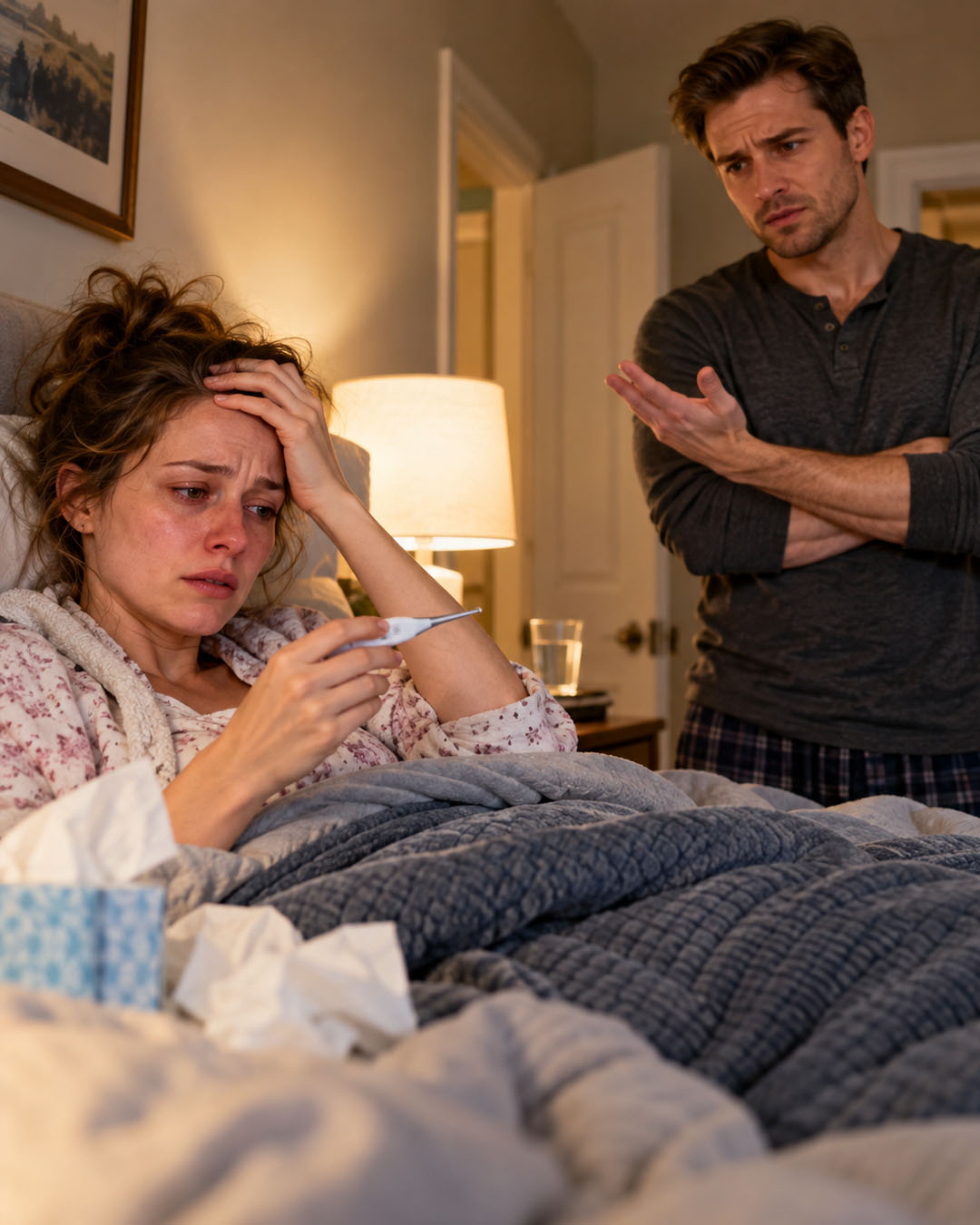
Chapter 2
Garrett arrived at 7:15.
His hair was damp from the shower.
That detail bothered me more than it should have.
I had left our house barely able to walk while he stayed in bed. Yet he had found time to shower before coming to the hospital.
He rushed toward me.
“Oh, God. Nora.”
I watched him put concern onto his face as naturally as another person might put on a coat.
“I should’ve taken you last night.”
Not last night, I thought.
Four days ago.
But I was too tired to fight.
Doctors had started IV medication while samples were rushed to the lab. The fever was still high. Nurses moved in and out, checking my blood pressure, marking the edge of the redness on my leg to see whether it spread.
A security officer asked Garrett to wait outside when two police detectives arrived.
One was a woman named Detective Vasquez. Her partner, Detective Hanley, carried a small notebook.
They asked about Roberta.
Not whether I liked her.
Not whether we had “issues.”
Facts.
When did she arrive?
How long did she stay?
Did she bring the jar with her?
Did anyone else touch it?
Where might it be now?
I answered as carefully as I could.
Roberta Wells was sixty-three and lived about twenty minutes away. A retired school administrator. Divorced. Garrett’s father had left when Garrett was eleven, and Roberta had raised him alone.
For years, Garrett had explained nearly everything about his mother with that fact.
She worries because she had to do everything herself.
She’s protective because Dad left.
She has trouble letting go.
Every explanation asked me to absorb the consequences.
Roberta had never screamed at me.
She didn’t need to.
Her weapon was suggestion.
When she visited our house, she would glance around and say, “Garrett always preferred warmer rooms.”
Or she would ask, “Are you still doing that nonprofit work?” although she knew exactly where I worked.
Money interested her most.
Before marrying Garrett, I had bought a condo in Portland’s Pearl District. It was modest by neighborhood standards, but it was mine. I had also spent years building savings.
Roberta seemed to know the details.
Two years earlier, she had asked Garrett for $8,000 for a roof repair.
I requested a contractor estimate.
The request reached Roberta before the end of the evening.
She called Garrett, upset.
Afterward, he came into the kitchen.
“Mom feels like you’re interrogating her.”
“I asked for an estimate before giving someone eight thousand dollars.”
“You know how she gets.”
“Yes. I do.”
We gave her the money.
I never saw an estimate.
Detective Vasquez listened without reacting.
“Any other financial disputes?”
“Nothing major.”
She wrote something down.
The detective’s definition of major, I would soon learn, was very different from mine.
Around noon, a nurse told me the medication appeared to be slowing the spread.
My mother arrived from Eugene two hours later.
Carol Mitchell was sixty-eight, widowed, practical, and usually incapable of entering a room without asking whether anyone needed food.
That day she came in carrying a thermos and said almost nothing.
She kissed my forehead.
Then she sat beside me.
“How bad?” I asked.
Her eyes filled.
“The doctor says they caught it.”
“That isn’t what I asked.”
She looked at my leg beneath the blankets.
“Bad enough.”
Garrett stayed near the window.
Mom barely acknowledged him.
Sometime that afternoon, Detective Vasquez returned.
“We located the jar.”
My heart thudded.
“Where?”
“In Mrs. Wells’s home.”
Garrett stepped forward.
“You searched my mother’s house?”
“We obtained consent.”
“What was in it?”
“We’re waiting for confirmation.”
His voice sharpened.
“My mother uses all kinds of natural products. She probably didn’t know what was in it.”
Detective Vasquez looked at him calmly.
“We haven’t said she did.”
Garrett’s mouth closed.
That evening, Dr. Harding came in with preliminary lab findings.
“The substance wasn’t a normal skin treatment,” she said. “There appears to be an industrial irritant in the base. Applied to damaged skin, especially with an existing infection, it could significantly worsen inflammation and tissue injury.”
My mother’s hand found mine.
I stared at the doctor.
“Someone made that?”
“We can’t tell you who prepared it.”
“Could it have happened accidentally?”
Dr. Harding paused.
“The formulation is unusual enough that law enforcement needs to determine that.”
Garrett shook his head.
“No. Mom wouldn’t intentionally hurt Nora.”
Nobody answered him.
He repeated it.
“She wouldn’t.”
I looked at my husband.
“Then why was it in her bathroom?”
“She kept the jar. That doesn’t prove anything.”
“No. It doesn’t.”
He exhaled in relief, as if I had agreed with him.
“But you know what bothers me?” I asked.
He said nothing.
“You’re already defending her.”
“I’m trying to be rational.”
“I’ve been sick for eight days. I’m lying in a hospital because someone put something on an open wound, and your first instinct is still to make sure your mother doesn’t feel accused.”
“That’s not fair.”
There were those words again.
Fair.
I had spent years negotiating with Garrett’s idea of fairness.
It usually meant everyone received compassion except the person asking him to take a side.
Before he could answer, Detective Vasquez appeared in the doorway.
She glanced at her phone, then at her partner.
“Douglas Crane.”
The name meant nothing to me.
But something happened to Garrett’s face.
Only for a second.
I saw it.
“Who is Douglas Crane?” I asked.
Garrett looked away.
And I knew my husband had been keeping something else from me.
Chapter 3
Garrett waited until the detectives left before explaining.
His mother had mentioned Douglas Crane months earlier.
“Some kind of investment adviser,” he said.
“You knew she was investing with him?”
“She said she was.”
“How much?”
“I don’t know.”
“Garrett.”
“Maybe twenty thousand. Maybe more.”
I closed my eyes.
“When were you going to mention this?”
“It was her money.”
“Apparently my finances came into it too.”
“We don’t know that.”
My mother finally spoke from beside the bed.
“You seem very committed to not knowing things.”
Garrett looked at her.
“Carol, please.”
“No.”
My mother’s voice was calm.
“My daughter asked you to take her to a hospital. You kept asking her to wait. Now the police are investigating something your mother rubbed into her skin, and you’re still explaining why nobody could possibly have known anything.”
Garrett stared at the floor.
Mom opened her thermos.
“I’m done helping you make ignorance sound innocent.”
I had never loved her more.
The next piece of the story came from somewhere I did not expect.
Serena Hall.
Serena worked with me at the nonprofit.
She was thirty-two, smart, capable, and someone I considered a friend. We had eaten lunch together several times a week. We walked on Saturday mornings. When I was promoted to oversee regional projects, I had fought for a salary adjustment for her because her responsibilities increased too.
She cried when I told her.
“You didn’t have to do that.”
“You earned it.”
Now detectives were asking about her.
Douglas Crane had loaned Serena money.
Not once.
Repeatedly.
At first, the requests he made in return had seemed harmless.
Where was I traveling?
Which projects did I control?
Who signed contracts?
Did I own property?
Did I have savings?
Serena had answered.
She later told investigators she thought Crane was looking for business connections.
But the questions became more specific.
And by then, she owed him enough money to be afraid of what happened if she stopped cooperating.
He had found Roberta through another route.
Her “investment” had begun as a real-estate opportunity.
For several months, she received impressive returns.
Then the returns stopped.
The excuses began.
Then came debts, penalties, and pressure.
Crane knew she had a son.
He knew her son was married.
He knew the daughter-in-law owned a condo and had substantial savings.
He also knew I was managing a major grant-funded project at work.
The detectives reconstructed the rest from messages.
Crane had suggested that if I became temporarily ill, several things might happen at once.
My work could be disrupted.
A project deadline might be missed.
Serena might gain access to documents she otherwise could not control.
And Garrett, frightened and distracted, might become easier to persuade that my savings should be used to help his mother through her “investment emergency.”
The plan was not supposed to send me to intensive treatment.
That fact gave me no comfort.
Crane had reportedly described the jar as something that would cause inflammation and a few days of illness.
Roberta claimed she believed him.
The investigators were less convinced after finding her messages.
In one exchange, she had written:
How sick?
Crane replied:
Enough to keep her home and off balance.
Roberta:
No hospital.
Crane:
Not if you use very little.
I was reading a printed copy when Garrett came into my hospital room.
He saw the pages in my hand.
His face collapsed.
“Nora.”
I held up one sheet.
“Did you know?”
“No.”
“Did you know she needed money?”
“Yes.”
“How much?”
He sat down.
“More than she told you.”
“How much?”
“Almost fifty thousand.”
I stared at him.
“You knew your mother was in a fifty-thousand-dollar hole?”
“She made me promise not to tell you.”
I laughed once.
It came out ugly and tired.
“Of course she did.”
“I thought she could work it out.”
“Did she ask you for money?”
“Yes.”
“How much?”
He looked at his hands.
“Twenty-five thousand.”
“And what did you tell her?”
“That we didn’t have that kind of cash available.”
“We?”
He looked up.
My voice had gone very quiet.
“We didn’t?”
“Nora—”
“My condo is mine. My savings are mostly mine. You knew that.”
“Yes.”
“Did you tell her about them?”
“No.”
“Garrett.”
His eyes closed.
“I may have told her we had options.”
The room seemed to tilt even though I was lying still.
“You told her my money was an option.”
“I didn’t mean it like that.”
“How did you mean it?”
“I was trying to calm her down.”
There it was.
Again.
Garrett’s lifelong solution.
Calm the person making the most noise.
Let somebody quieter pay the bill.
I looked at the swollen leg beneath my blanket.
“How many times did I ask you to take me to the hospital?”
He began crying.
I had seen Garrett cry only twice in six years.
Once when Huck had surgery.
Once at our wedding.
“I’m sorry.”
“How many?”
“Several.”
“Four times?”
He nodded.
“And each time, you decided waiting was easier.”
“I didn’t think—”
“I know.”
My voice broke.
“That is the whole problem. You didn’t think about what waiting cost me because you weren’t the one paying for it.”
Garrett covered his face.
“I love you.”
I believed him.
That was the terrible part.
Love was not the missing ingredient.
Courage was.
Responsibility was.
The willingness to be uncomfortable for someone else was.
Detectives arrested Douglas Crane the following Tuesday.
Serena gave them a folder of messages and a USB drive she had secretly kept as protection. Those records reportedly connected Crane to other financial schemes across three states.
Roberta was charged as well.
She changed her story twice.
At first, she said she believed the jar contained an herbal remedy.
Then investigators showed her the messages.
After that, she claimed she thought the substance would only make me mildly uncomfortable.
I never asked which version was true.
Some questions stop mattering once every possible answer is bad.
Chapter 4
I stayed in the hospital eleven days.
The infection responded to treatment, but slowly.
Doctors warned me early that the damaged area on my shin would leave a scar about the size of my palm.
“That’s all right,” I told Dr. Harding.
She looked at me.
“Most people don’t say that.”
“I want something to remember.”
Her eyebrows lifted.
“I don’t mean the illness.”
I looked toward the window.
“I mean the part where I finally listened to myself.”
My mother spent most days beside me.
She brought coffee she complained was better than the hospital coffee and crossword puzzles she rarely finished. We talked about ordinary things because ordinary things felt precious.
One rainy afternoon, Garrett visited.
He sat in the chair Mom normally used and kept rubbing his wedding ring.
“The police showed me more of Mom’s messages.”
I waited.
“She knew it wasn’t normal ointment.”
I said nothing.
“She says she didn’t know how dangerous it was.”
“Maybe she didn’t.”
He looked startled.
“You believe her?”
“No. I’m saying it doesn’t change anything.”
He stared out at the rain.
“I don’t know how to ask you to forgive me.”
“Then don’t.”
His eyes filled.
“I should’ve protected you.”
I shook my head.
“That makes me sound helpless.”
“I didn’t mean—”
“I didn’t need you to protect me from the whole world, Garrett. I needed you to believe me when I said something was wrong.”
He lowered his head.
“I did believe you.”
“No. You believed me eventually. There’s a difference.”
“I was scared of overreacting.”
“You were scared of inconvenience.”
His face tightened.
“That’s harsh.”
“I had a 104-degree fever.”
He looked away.
I continued.
“You didn’t want urgent care because it was late. You didn’t want the hospital because you had dinner. You wanted me to wait at four in the morning because the ER might be crowded. Every decision made your life easier.”
“I didn’t realize it.”
“I know.”
I let the silence stay.
For years, I had rushed to soften silence.
Not anymore.
After a while, he whispered, “Is this over?”
“I don’t know.”
It was the truth.
He nodded and left.
My mother appeared a few minutes later with two cups of coffee.
“You heard?”
“Some.”
She sat down.
“I always thought Garrett was a good man who occasionally made a bad choice.”
I waited.
“Now I think he made the same bad choice so many times it became part of who he is.”
I stared at the rain crawling down the window.
“What choice?”
“To let other people carry discomfort for him.”
She handed me a cup.
“You don’t have to decide anything today.”
“I know.”
“But when you do decide, make sure it’s what you want. Not what keeps everybody else comfortable.”
I smiled faintly.
“Did you rehearse that?”
“For about four years.”
That made me laugh.
The laugh hurt my ribs.
I kept laughing anyway.
Serena was fired from the nonprofit after the investigation confirmed she had shared confidential information.
She sent me a letter.
I read it once.
She wrote that she had not known what Crane planned to do with the information. She said every request had seemed small when he made it. She had convinced herself she was only crossing tiny lines.
I believed part of that.
Tiny lines are dangerous because crossing them rarely feels like becoming a different person.
You become that person by inches.
That didn’t excuse her.
But I understood it.
I had crossed lines by inches too.
Every time I said “fine” when something wasn’t fine.
Every time I accepted Garrett’s silence as neutrality.
Every time I told myself Roberta’s contempt was simply difficult-family behavior.
Every time I distrusted my own discomfort because acknowledging it would require a decision.
Serena’s choices had harmed me.
My choices had silenced me.
They were not equal.
But both taught me the same thing.
A boundary ignored repeatedly stops looking like a boundary.
It starts looking like permission.
Chapter 5
Garrett and I separated in November.
There was no dramatic final fight.
No shattered dishes.
No screaming in the driveway.
He sat across from me at our kitchen table while rain tapped the windows, and I told him I was moving back to my condo.
“Do you still love me?” he asked.
“Yes.”
That answer hurt him more than no would have.
“Then why are you leaving?”
“Because loving you has become the reason I keep explaining away things I shouldn’t have to live with.”
He looked down.
“I can change.”
“I hope you do.”
“For us?”
I thought carefully before answering.
“For yourself.”
He nodded.
I packed over the next week.
Mom came from Eugene to help.
My condo in the Pearl District looked nearly the way I had left it years earlier. Neutral walls. Hardwood floors. Tall windows overlooking wet streets and glowing restaurant signs.
When we carried in the final box, I stood in the empty living room.
Mom inhaled dramatically.
“Smells like a fresh start.”
I sniffed.
“It smells like the neighbors cooking onions.”
She laughed.
I laughed too.
Nothing about it felt forced.
That surprised me.
For so long, every room had required calculation.
Was Roberta offended?
Was Garrett uncomfortable?
Had I sounded too cold?
Too independent?
Too controlling?
Had I asked for too much?
My own living room asked nothing from me.
Douglas Crane’s case expanded after investigators examined Serena’s records. Detectives told me other people had been pressured through debts and fake investments. What happened to me helped them connect pieces that had previously seemed unrelated.
I had complicated feelings about that.
People sometimes want suffering to become meaningful because meaning feels like compensation.
I didn’t see it that way.
I would have preferred that none of it happened.
But because it did, I was grateful that the truth reached beyond my hospital room.
Roberta’s case moved more slowly.
Garrett visited her once after her arrest and then stopped.
He told me this during one of our final conversations.
“She keeps saying she never meant for you to get that sick.”
“What do you say?”
“That intention doesn’t erase consequence.”
I looked at him.
“That sounds new.”
“It is.”
For the first time, I saw a version of Garrett who might someday understand what had happened.
That did not mean I needed to stay married long enough to meet him.
By December, I returned to work.
My colleagues were careful around me for the first week.
Too careful.
They lowered their voices when I walked into rooms and offered to carry things I could carry perfectly well.
Finally, during a staff meeting, I said, “I had an infection. I did not become porcelain.”
Someone laughed.
Then everyone laughed.
The tension broke.
I began rebuilding my routines.
Saturday walks.
Coffee near the park.
Long conversations with Mom.
Evenings reading beside my own windows while October rain became December rain and then, eventually, spring.
The scar on my shin faded.
At first it was dark and obvious.
Then pink.
By April, it had become a pale seam, visible mostly when the light hit it from the side.
I never covered it deliberately.
Sometimes people noticed and asked what happened.
I usually said, “An infection.”
That was true.
But incomplete.
The deeper wound had nothing to do with bacteria.
It came from years of learning that other people’s certainty should matter more than my own discomfort.
The lesson that changed me arrived in an emergency room at 4:30 in the morning.
I had spent eight days waiting for someone else to confirm what my body already knew.
Something was wrong.
Not only with my leg.
With the way I lived.
With the marriage in which my pain became negotiable if acknowledging it disrupted someone else’s schedule.
With the mother-in-law whose resentment I kept renaming as personality.
With the friend whose strange questions I dismissed because suspicion felt unkind.
With my own habit of confusing endurance with maturity.
Months after the hospital, I found an old photograph from my wedding.
Garrett and I were standing beneath tall trees in the Columbia River Gorge.
He was looking at me.
I was laughing.
For a moment, grief hit me so sharply that I had to sit down.
I did not hate the woman in that picture.
I did not think she had been foolish.
She had loved someone.
She had trusted people.
Those were not sins.
Her mistake was believing trust required her to ignore herself.
I placed the photograph in a drawer rather than throwing it away.
Some parts of life deserve to be remembered without being returned to.
That evening, I took Huck for a walk.
The rain had finally stopped. The air smelled like wet pavement and new leaves, and the city was glowing in that soft spring light Portland gets before sunset.
Huck stopped at every tree.
I let him.
There was nowhere I needed to hurry.
At the corner, my phone buzzed.
Garrett.
I almost let it ring out.
Then I answered.
“Hi.”
“Hi.”
He sounded nervous.
“I wanted to tell you Mom’s attorney reached an agreement with the prosecutor.”
“Okay.”
“And I started therapy.”
I looked across the street.
A woman was watering flowers outside a bookstore.
“That’s good, Garrett.”
“I’m learning some things.”
“I’m glad.”
He was quiet.
Then he said, “I think I spent my whole life believing that if I didn’t choose a side, nobody could blame me.”
I closed my eyes.
“And?”
“And not choosing was a choice.”
There it was.
The sentence I had needed from him for years.
Once, hearing it would have made me run home.
Now it simply made me sad.
“I think you’re right.”
“I’m sorry it took this much.”
“So am I.”
Another silence.
This one wasn’t uncomfortable.
It was honest.
“Take care of yourself, Nora.”
“You too.”
I ended the call.
Huck tugged gently at the leash.
I looked down at the faint scar on my shin.
For a long time, I had thought strength meant staying calm, staying reasonable, giving people another chance, waiting one more night.
Sometimes it does.
But sometimes strength is calling the car.
Opening the door.
Leaving without permission.
And trusting yourself enough to go where someone will finally take your pain seriously.
THE END.
⚠️ All characters and events are fictional. Do not imitate or apply them in real life. 😌😌😌


