Chapter 2
I called my father from the bedroom while I packed. He reacted exactly as I feared.
“What about the deposits?”
“Dad.”
“You paid so much already. Can Adrian fix this before the twentieth?”
I stared at the suit bag hanging in his spare room in my imagination, freshly cleaned for the wedding.
“Ask about me,” I said.
There was silence.
I hung up before either of us could make it worse.
My coworker Margo answered on her drive home. She had known me through six years of deadlines, office relocations, computer crashes, and family emergencies.
“Do you want company,” she asked, “or somewhere to sleep?”
“Both.”
“My guest room is full of laundry. Give me an hour.”
That answer nearly broke me because it contained no argument. No explanation. No request that I defend myself.
Just a place to go.
Before I left, my father called back.
“I asked the wrong thing first,” he said.
I started crying.
He waited.
“Are you somewhere safe?”
“Margo’s.”
“Are you hurt?”
“Yes,” I whispered. “Not physically.”
“I should’ve asked.”
That was all I needed.
The next morning Naomi confirmed that I had formally withdrawn from the June twentieth wedding, though Adrian still controlled the venue contract.
At lunch, I called my photographer. She had received Adrian’s request to add another couple but had not changed anything without my approval.
Under my contract, canceling that day meant losing the six-hundred-dollar deposit but nothing more.
I cried after I hung up.
Six hundred dollars was groceries. Part of a security deposit. Several months of careful saving. But it was also a closed door, and I suddenly valued closed doors.
That evening Adrian called.
“Why did you cancel the photographer? Kelsey could’ve used the date.”
“She can book her.”
“The money is already gone.”
“My contract is not a wedding gift.”
He sighed like I was being unreasonable.
The next day, Kelsey asked if the four of us could meet at a coffee shop. I almost refused until I saw the budget she attached.
My money was listed in it.
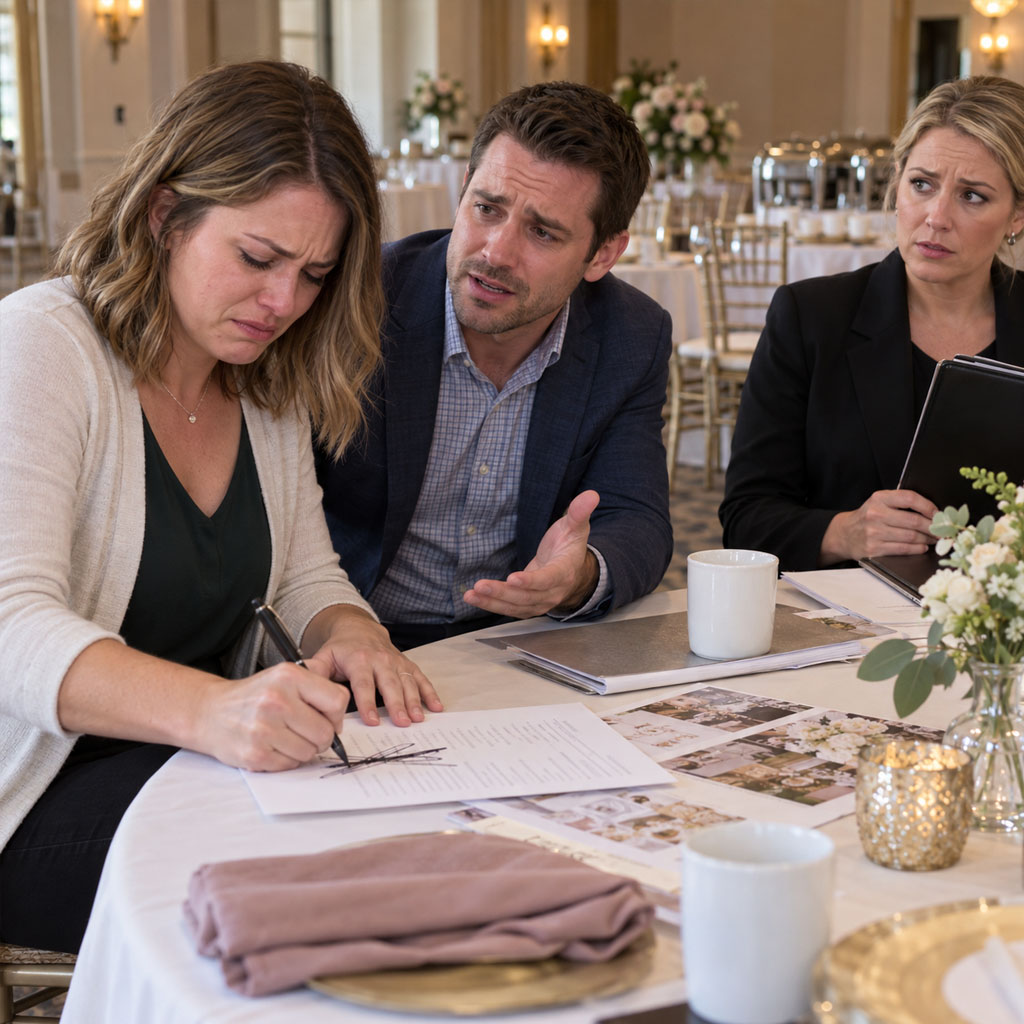
We met Thursday evening. Kelsey placed a printed spreadsheet on the table.
“Our July venue is gone,” she began. “They booked somebody else.”
“I’m sorry.”
“We lost the reservation fee.”
“I’m sorry about that too.”
“Adrian told us Cedar Mill was settled.”
I opened the old group chat and placed my phone on the table. My refusal was still there in plain English.
Wes studied it.
“You replied to that message,” I reminded him.
He nodded. “Adrian said you two were still discussing it.”
I looked at Adrian. “And then you submitted the changes without telling me.”
“We’ve covered this.”
“No, you keep describing it. That isn’t the same as answering for it.”
Kelsey slid the budget toward me. Their plan was simple: since the hall, food, and decorations had already been partially paid for, they would use what existed. Their forty guests would join the event. They would contribute what they could afterward.
Then I saw the line marked PAID.
Fourteen hundred dollars.
My fourteen hundred dollars.
“When do I get this back?”
Wes hesitated. “After the wedding.”
“With what money?”
“We expect cash gifts,” Kelsey said. “My grandparents usually give money.”
I stared at her.
They wanted to finance their wedding with my canceled wedding deposit and reimburse me if their guests were generous enough.
“No.”
Adrian leaned forward. “We’re talking about a few weeks.”
“You’re asking me for a loan.”
“You’re going to lose some money if the hall cancels anyway.”
“I would rather lose a defined amount than spend months begging you three to pay me back.”
Kelsey’s eyes filled. “We already told everyone to change their travel plans.”
“I’m sorry. Truly. But I didn’t make those plans for them.”
Outside, Adrian followed me to the parking meter.
“You made them feel like they were stealing from you.”
“I didn’t call them thieves.”
“You know what I mean.”
“Yes,” I said. “I do.”
For four years I had helped Adrian repair promises he made too quickly. I reminded him about birthdays he volunteered to organize, dinners he offered to host, favors he agreed to before checking his calendar.
He liked being the man who said yes.
I had simply never realized how often somebody else paid for it.
Friday morning Naomi laid out the numbers. Canceling Cedar Mill would cost four thousand dollars total. Twenty-eight hundred had already been paid—fourteen hundred from Adrian, fourteen hundred from me. Another twelve hundred would close the contract.
Adrian and I agreed in writing to split the cancellation evenly. I sent him another six hundred dollars.
At 2:40 that afternoon, his confirmation arrived.
The hall was canceled.
There would be no wedding on June twentieth.
No shared reception.
No credit transferred to Kelsey and Wes.
Nothing.
That evening Adrian called, sounding exhausted.
“We can start over,” he said. “Somewhere smaller. Just us this time.”
For one dangerous moment I pictured our townhouse. My side of the bed. My mug beside his. His shoes near the back door. The life we had built before one terrible month.
Then he started talking about possible dates.
“Adrian.”
He stopped.
“We’re not postponing.”
“I was never going to marry Kelsey.”
“I know.”
“Then why are you throwing us away?”
I closed my eyes.
“Because I gave you an answer you didn’t like, and instead of respecting it, you built enough pressure around me that you thought I’d eventually stop resisting.”
He was quiet.
“I thought if you saw the whole plan—”
“I know.”
“Do you still love me?”
That was the cruelest question because the answer was simple.
“Yes.”
His breath caught.
“But I still can’t marry you.”
Chapter 3
My father arrived Sunday morning with a borrowed pickup and a box of donuts. Margo came too, and together we packed what remained of four years.
Adrian had wrapped my cereal bowl in a dish towel.
That nearly undid me.
Not the jewelry. Not the photographs. A cheap bowl I had eaten breakfast from hundreds of mornings while Adrian made coffee two feet away.
The townhouse had belonged to him before we met, so there was no property battle. We calculated utilities and shared expenses, settled the balance, and put everything in writing.
At the end, I took my key off the ring and placed it in his hand.
He closed his fingers around it.
“Thank you for packing the bowl,” I said.
He nodded.
Those were our final words inside the house.
The week of June twentieth moved slowly. I canceled flowers. Picked up my finished wedding dress. Returned gifts. Called relatives. Explained only what I needed to explain.
Some people told me I was brave.
Others suggested I had overreacted.
Adrian’s mother, Lorraine, called and said, “He was trying to do something generous.”
“With plans that involved me.”
“It was only one day.”
“One day when I was supposed to make one of the biggest promises of my life.”
She sighed. “If it had been anyone besides Kelsey, would you feel this strongly?”
That question told me she still did not understand.
“Kelsey is marrying Wes. I was never worried Adrian wanted her back.”
“Then what is this really about?”
“He decided my no was temporary.”
Lorraine suggested Adrian and I go through with the ceremony and repair our disagreements afterward.
“I’m not getting married,” I said.
For once, I ended the conversation without needing the other person to agree.
On June twentieth, I woke at 6:12 a.m.
I knew the date before I touched my phone.
By then I should have been preparing for hair and makeup. My father should have been asking where to stand. Somewhere there should have been flowers waiting in water and eighty place settings lined across banquet tables.
Instead I moved my wedding dress from behind Margo’s guest-room door to the closet, decided it would wrinkle there, and moved it back.
Eventually I drove to my father’s house.
He was peeling potatoes.
I washed my hands and picked up another knife.
We worked side by side until he said, “Lorraine thinks you and Adrian might still work things out.”
“Please don’t bring me messages from him.”
“All right.”
No lecture followed.
After lunch I looked at the clock.
“We would’ve been getting ready to leave about now.”
Dad sat down again.
“We can stay right here.”
“I was excited about it,” I said.
“I know.”
“I wasn’t looking for a reason to leave him.”
“I know that too.”
I told him what I missed. Adrian’s hand against my back when he passed me in the kitchen. Sending him photographs of ridiculous road signs. Knowing which side of the grocery cart he would push from.
My father listened without trying to make grief prove my decision wrong.
Eventually he asked, “Remember that woodworking class you showed me?”
Months earlier I had found a beginner course where each student built a bench.
“You told me it would collapse.”
“I said start with something less likely to collapse under me.”
I laughed, which surprised both of us.
I checked the course. It began in late July.
“I need to know what my rent is going to be first.”
“Fair enough. Send me a picture of the bench.”
“Why?”
“So I can judge its chances.”
That evening, while grocery shopping with Margo, I reached automatically for Adrian’s cereal.
Then I put the box back.
It hurt.
But not buying it was the beginning of understanding that a life can change through a thousand ordinary choices.
By mid-July, every wedding gift had been returned or settled. I found a small upstairs apartment close to work. The kitchen barely had enough counter space, but the windows opened and the rent left me room to save.
My father helped move the furniture. Margo brought the little plant one friend had insisted I keep.
We ate sandwiches sitting on the floor.
A week later I sold my wedding dress to a woman planning a small ceremony she was paying for herself. She could not afford even half what I had spent.
I took her offer anyway.
After she left carrying the white garment bag, I vacuumed tiny loose threads from the carpet and stood in the quiet bedroom.
The dress was gone.
The wedding was gone.
The relationship was gone.
But the room still belonged to me.
That night, I enrolled in woodworking.
Chapter 4
At my first class, I nearly cut the wrong side of a board.
I worked with measurements for a living, so I had arrived with a certain confidence. On paper, lines stayed where I put them. Wood had other opinions.
The instructor stopped me before I made the cut.
“Measure again,” he said.
I turned the board over.
The mistake was obvious.
For reasons I could not explain, that embarrassed me more than it should have.
By August, my apartment had a secondhand table, two mismatched chairs, and curtains that were too long. I was sitting with one of those curtains across my lap when Adrian called.
We had handled our remaining practical matters calmly, so I answered.
He asked about work. I asked about his mother. We sounded like strangers trying to be polite at a waiting room.
Then he said, “Kelsey and Wes got married.”
I stopped pinning the curtain.
“They did?”
“Last weekend. About twenty people. Dinner in the back room of a restaurant. Her sister took pictures.”
“Were you there?”
“Yes.”
“And they paid for it themselves?”
“Of course.”
I almost laughed at that word.
“They figured it out,” I said.
“They had to cut a lot.”
“I’m sure they did.”
There was another silence.
Then Adrian said, “Kelsey’s married now. I thought maybe that would make a difference.”
I looked around my unfinished apartment.
“I knew she was marrying Wes when I left you.”
“I mean there’s nothing between us. There never was.”
“I never left because I thought you wanted Kelsey.”
He struggled for a moment.
“I know I handled things badly. I should’ve explained more. I should’ve included you earlier.”
“Earlier wouldn’t have changed my answer.”
Silence.
“You needed to let me say no,” I continued. “Even if Kelsey got upset. Even if Wes got angry. Even if it made you look bad because you promised something before asking me.”
“So there’s nothing I can do?”
My eyes fell to the crooked hem of the curtain.
There had been a time when that question would have thrilled me. Adrian wanting to fight for us. Adrian unwilling to let me go.
Now I heard what was underneath it.
He was still waiting for the right argument to produce a different answer.
“I’m not coming back,” I said. “And I need you to stop calling me about us.”
“Do you want no contact at all?”
“Yes.”
He said he understood.
After we hung up, I discovered I had pinned the curtain the wrong way and had to start over.
I cried while removing the pins.
Then I started over anyway.
Autumn came quietly.
At woodworking class, one side of my bench came out uneven. I tried sanding away the problem until the instructor stopped me.
“You’re making it thinner,” he said, “but you’re not making it square.”
We found the bad measurement, removed the piece, and replaced it.
I stared at the discarded wood.
For months I had been telling myself that ending my engagement meant I had thrown away four years.
But maybe those years were not waste.
Maybe they were simply something I had measured incorrectly.
Loving someone did not make every decision with that person correct. Time invested did not require more time. A promise did not become sacred simply because keeping it would be expensive.
By October, my bench was finished.
It had two seats, a plain wooden back, and one small dent near the bottom where I had dropped a clamp. I filled and sanded it, but I could still find the mark if I knew where to look.
I liked that.
On October seventeenth, Dad borrowed the pickup again. Margo met us at my apartment, and the three of us guided the bench around the narrow turn in the stairs.
Near the window, Dad asked, “Here?”
I checked the distance from the table.
“Here.”
We lowered it into place.
Margo went to make coffee. Dad ran his palm along the wooden back, then bent to look underneath, where I had signed my name in pencil before applying the finish.
“Well,” he said.
“What?”
“You made a bench.”
I laughed. “That was the assignment.”
“I know.”
He eyed it suspiciously.
“Can I sit on it?”
“Yes, Dad. It’s finished.”
He lowered himself carefully, then shifted his full weight onto the seat.
I waited.
Nothing creaked.
Nothing cracked.
Nothing collapsed.
Dad smiled.
Margo brought three mugs and pulled one of my mismatched kitchen chairs close. The October air coming through the open window was cold enough that I got up and closed it.
Then I sat beside my father on the bench I had built.
For years, I had imagined security as a wedding, a house, shared groceries, familiar routines, and one person beside me forever. Losing those things had felt like watching the walls of my future fall outward.
But sitting there, I understood something quieter.
A safe life was not one where nothing changed.
It was one where my voice still belonged to me when it did.
The bench beneath us had one repaired piece, a hidden dent, and measurements I had checked more than once.
It was not perfect.
It was mine.
And it held.
THE END.
⚠️ All characters and events are fictional. Do not imitate or apply them in real life. 😌😌😌