
Chapter 2
Reed didn’t confront Leslie.
He went home, set his alarm for two in the afternoon, and lay beside his sleeping wife.
She smelled faintly of lake water and unfamiliar soap.
He could have woken her. He could have demanded an explanation. But he had four months of law school left to finance, two boys to raise, and a promise he’d made at their kitchen table.
He wasn’t going to sabotage her education.
He was, however, finished being careless.
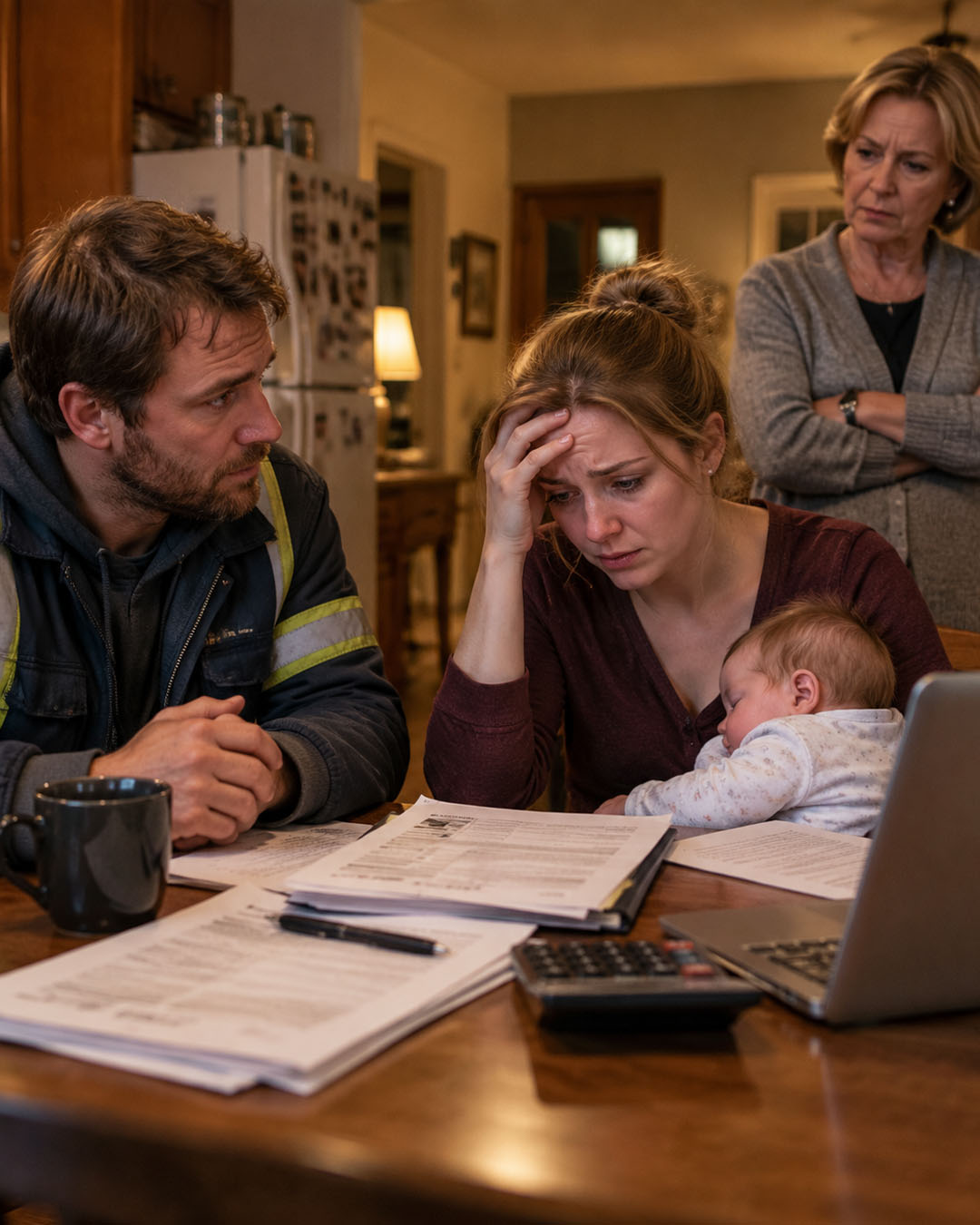
The following afternoon, he sat down with the household paperwork.
For six years, Reed had transferred tuition money from his earnings into their joint account. Leslie would log into the university portal, see that the balance was paid, and attend class.
She had never asked what he earned.
He had never volunteered.
He’d considered it unnecessary to turn his sacrifice into a number.
The pay stubs told the story clearly enough.
Between overtime, the night differential, and the hazardous-material premium, Reed had earned $101,448 the previous year.
He sat staring at the figure.
Then he looked at Leslie’s financial paperwork, which she’d left in a folder.
There was no way to know exactly what she had told Brett Linden, but Reed began to suspect that the income statement he’d seen that morning was not an innocent mistake.
On the Tuesday her bar exam results were due, Reed worked his regular shift.
At 5:45 in the morning, while standing on the loading apron at the Ridley yard, his phone buzzed.
A message from Leslie.
I passed!!! Come home!
He stood beside the fuel hose, smiling.
For a moment, he was simply a proud husband.
He remembered the first time she’d told him she wanted to become a lawyer. He remembered the kitchen table, the loan papers, the sleeping baby, and her promise that he would never have to drive nights again.
He stopped at the grocery store on the way home and bought a cake with blue icing.
He wanted to celebrate.
He wanted to believe the woman waiting at home was still the woman who had once squeezed his hand across that kitchen table.
Instead, he found Paula and a folder.
He found a divorce petition.
And he found a sworn financial statement that described him as a low-income laborer while presenting Leslie as a six-figure professional.
He signed because he didn’t yet understand what was behind those numbers.
By Thursday morning, the locks on his house had been changed.
He arrived at 6:10 after his shift, with the sun coming up behind the neighboring farmhouse.
His key wouldn’t turn.
Then he noticed the garbage bags lined along the porch.
His work boots were visible through the plastic of one.
The front door opened a few inches.
Paula stood behind the security chain.
“You’ve been served with an order,” she said. “Leslie has exclusive temporary possession of the residence. Everything is explained in the packet.”
Reed stared at her.
“My sons are inside.”
“They’re with their mother.”
“I’d like to see them for sixty seconds. Then I’ll leave.”
Before Paula could answer, Dallas appeared at the bottom of the stairs in a dinosaur shirt.
“Dad?”
Reed felt something tighten in his chest.
Paula turned sharply and said something to the boy. Dallas stopped moving.
Reed understood the situation immediately.
If he pushed past her, the police could be called. If he raised his voice, it could become part of a report. If he tried to force his way inside, Leslie’s attorney would have exactly the story he wanted.
So Reed looked at his youngest son.
“Go back to bed, buddy. I’ll see you soon. I love you.”
He picked up the bags and carried them to his truck.
He didn’t sleep in the cab.
He had spent six years sleeping in trucks.
The widow next door, Colleen Booker, watched from her porch with a mug of coffee in her hands.
She’d known Reed for nine years.
“You’re taking the spare room,” she announced. “Don’t argue. Harold’s old bed is made.”
Reed tried to refuse.
She wouldn’t hear it.
A few days later, he found an attorney named Allison Turner.
She was fifty-eight, with iron-gray hair, bifocals hanging from a chain, and a desk covered in accordion folders.
She practiced traffic law and small claims cases, but she had handled enough family disputes to recognize trouble when she saw it.
She read Leslie’s petition.
Then she read the financial statement.
Finally, she removed her glasses.
“Mr. Warner, have you ever appeared before Judge Gerald Quimby?”
“Only for a speeding ticket. Different judge.”
Allison tapped the sworn income statement.
“Judge Quimby has been on the bench for twenty-two years. Before that, he taught contracts at the law school. There are two things he cannot stand. A lawyer who treats an oath as a suggestion, and somebody who gives him a number he has to check.”
She leaned forward.
“How much did you actually make last year?”
Reed told her.
She wrote it down and underlined it twice.
“And you had no idea your wife was putting thirty-one thousand on this document?”
“I didn’t know she’d put anything on it.”
Allison studied the papers.
“What about the $112,000 she’s claiming?”
“That’s what she says she’ll earn.”
“Do you believe her?”
Reed thought about it.
“I believe she believes it.”
Allison gave him a long look.
“Here’s what I need. Your tax returns, pay stubs, employment records, and the names of people who have seen you with your children. I also want the actual offer letter from Linden Family Law.”
“Why?”
“Because if they’re promising your wife $112,000, there should be a document proving it.”
Reed shook his head.
“I don’t know if I can get that.”
“Then we’ll find somebody who can.”
She explained that the firm might refuse to release its payroll records. But the outside company processing those records could be subpoenaed.
“I need the vendor’s name.”
Reed thought about his nights on the road.
He thought about the silver Camry, the lake house, and the man in the bathrobe.
“I might know where to start.”
Allison gave him a small smile.
“Good. And one more thing. At the hearing, don’t tell the judge how badly you’ve been hurt. Don’t tell him what your wife did. You tell him what you do, how you do it, and your sons’ names. Anything else goes on paper.”
“What kind of paper?”
“The shortest kind possible.”
She closed the folder.
“One line, if we can manage it.”
The hearing was scheduled for November 12.
Reed had nineteen days.
And for the first time in six years, he had a reason to use the daylight.
Chapter 3
Before searching for the payroll company, Reed made another decision.
He went to Ridley Fuel and asked Walt Pruitt, the day manager, for a transfer.
“I want off nights. Completely.”
Walt looked up from his desk.
“You’ve been on that route for years.”
“I know.”
“Day dispatch is available, but you’re going to lose the night differential and most of your overtime.”
“I understand.”
“That’s about a thirty-five-percent cut.”
Reed nodded.
Walt leaned back.
“Something going on at home?”
Reed looked at the employment report Leslie had filed. It described him as unavailable during the hours his children most needed supervision.
For years, he’d worked nights so his wife could attend law school.
Now that same schedule was being used to argue that he wasn’t a suitable father.
“I want to be home when my boys go to bed,” Reed said.
Walt studied him for a moment.
“All right. I’ll make it happen.”
That Tuesday afternoon, Reed drove to the Lamplighter Diner.
It was a chrome-sided restaurant near the old state highway, with a neon coffee cup in the window and a gravel lot large enough for several tractor-trailers.
He’d eaten there at two in the morning for years.
The cook, Archie, had a habit of sliding a plate of eggs onto the counter without turning around.
He also had a habit of knowing when something was wrong.
Reed took his usual booth.
Archie brought coffee.
“Pie today, Warner?”
“Maybe later.”
Archie nodded.
“That bad, huh?”
Reed was halfway through his coffee when a woman in a green parka slid into the opposite seat.
She put a set of keys on the table.
“You’re Leslie Warner’s husband.”
Reed looked at her.
“Which husband?”
She didn’t smile.
“Mandy Ramirez. I managed the Marrow Bend office for Linden Family Law for five years. Until September, when Brett Linden decided I had a bad attitude.”
She was in her early forties, with a blunt dark haircut and ink stains along the side of her right hand.
“How did you find me?” Reed asked.
“I’ve been sitting in this parking lot for three afternoons. Your propane deliveries go to my mother’s farm. She says you’re the only driver who always remembers to latch the gate.”
Reed glanced toward the kitchen.
Archie was pretending not to listen.
Mandy leaned forward.
“I came because I know what Brett does to the women he hires. And I know what he did to your wife.”
Reed put down his cup.
“What do you know?”
Mandy reached into her parka and placed a paper napkin on the table.
Three words were written in blue ink.
Tri-River Payroll Services.
“That’s the company that processes Linden’s payroll,” she explained. “They’re in Kansas City. Brett doesn’t handle the books himself. He doesn’t trust spreadsheets, and he certainly doesn’t trust his own office staff with everything.”
“Why does that matter?”
“Because every employment offer and payroll record is kept by Tri-River. Your lawyer can subpoena them.”
Reed looked at the napkin.
“Why are you helping me?”
Mandy turned her coffee cup slightly.
“Because I asked why the associates’ W-2s didn’t match the promises Brett made. I was fired by email.”
She paused.
“And because I ran your wife’s numbers before I left.”
Mandy explained that Brett had developed a hiring strategy that was particularly effective with young attorneys who were trying to rebuild their lives.
He recruited three or four newly licensed associates every year, often women who were recently divorced or experiencing problems in their marriages.
He invited them to dinner, spoke about their potential, and promised that they would be earning six figures within a year.
He talked about partnership opportunities, professional independence, and the importance of leaving behind people who couldn’t keep up.
His favorite phrase was “upgrade.”
It appeared on his advertisements, his radio commercials, and the slides he used during professional seminars.
But the written employment offers were different.
The standard starting salary was $38,500.
There was no guaranteed bonus.
The additional compensation depended on collections and a vague arrangement that most new associates didn’t understand until they had already signed.
“Did Leslie know?” Reed asked.
Mandy looked down.
“I can’t answer that. I can tell you what she signed.”
“Why would she claim she was making $112,000?”
“Because that’s the number Brett gives everybody. He tells them they’re worth it. He tells them they’ll earn it. Then, when they get divorced, he helps prepare their financial statements.”
Reed sat back.
Mandy continued.
“He coaches them on what to put in the affidavits. The husband gets described as an ordinary laborer. The wife becomes a rising professional with a six-figure income. The judge sees two numbers and assumes they’re accurate.”
“And Brett?”
“He keeps his own name off the sworn statements. When the numbers fall apart, the person who signed them has to answer.”
Reed looked at her.
“How many?”
“That I know about? Seven.”
She paused.
“I signed one myself years ago, for a different attorney. I know what it’s like to hear a number that sounds wonderful and decide you want to believe it.”
Mandy didn’t pretend Leslie was innocent.
But she made one thing clear.
“Brett has been doing this for years. He’s very good at making people believe that the person they used to be is holding them back.”
Reed looked at the napkin.
“Do you think my wife knows the offer is only thirty-eight thousand?”
“I think she knows what she signed. Whether she believes Brett’s promises is another question.”
Mandy stood.
“There’s something else. Brett hired a young videographer from the community college to film Leslie outside the courthouse on the morning of your hearing.”
Reed looked up.
“Why?”
“For a radio commercial and a website banner. He’s calling it ‘From Night Shift to Council Table.'”
Reed stared at her.
“He built a commercial out of me.”
“He builds everything out of somebody.”
Before leaving, Mandy gave him one final instruction.
“Tell your lawyer to request the certified offer letter and the first payroll register. Tri-River will send the records directly to the court clerk.”
“Have you seen the letter?”
“I have.”
“What’s it say?”
She gave him a tired smile.
“Don’t open the envelope before the hearing. Just make sure it gets there.”
She walked out.
Archie brought Reed a slice of pecan pie.
He didn’t ask a question.
Reed ate slowly, looking at the napkin until the afternoon light faded.
Allison issued the subpoena that evening.
Four days later, a courier delivered a small white business envelope to the Delmar County courthouse.
It was sealed with red tape and accompanied by a certification from Tri-River’s records custodian.
The clerk logged it and called Allison.
Allison called Reed.
“It came,” she said.
“Have you read it?”
“I have.”
“Is it bad?”
“For us? No.”
She paused.
“Mr. Warner, in all my years practicing law, I’ve never wanted to sit in a courtroom more than I do right now.”
Chapter 4
Reed’s time with the boys was limited to two hours every Saturday.
The exchange took place in the parking lot of a Methodist church on Third Street.
Leslie’s mother drove them in her white Buick, usually keeping the engine running while the boys climbed out.
Reed waited near the fence.
Dallas, at eight years old, still ran with his whole body. His arms would swing wide, and he would come charging across the parking lot as if he’d been saving all his energy for that moment.
Kyle, twelve, walked more slowly.
He had become quieter since the separation. He watched the adults carefully and rarely asked questions.
During their second visit, Reed took the boys to Ridley’s yard.
Walt let them climb into the cab of a parked fuel truck.
Dallas made siren noises and pretended to steer.
Kyle held the wheel with both hands.
“How can you see anything when you’re driving at night?” he asked.
“You get used to it,” Reed replied. “After a while, you start noticing what’s out there.”
Kyle looked at the dashboard.
“Mom says you only drove nights because you liked being away from home.”
Reed didn’t answer immediately.
Then Kyle said something that made his father turn toward the windshield.
“I knew you did it for school. I used to hear you come home around six. You smelled like the truck. I thought that was the smell of Mom getting to be a lawyer.”
Reed swallowed.
“That’s exactly what it was, son.”
For a moment, neither spoke.
Dallas continued making siren noises.
Reed looked at his older boy and realized that Kyle had understood far more than either parent had given him credit for.
The following Saturday, a black Mercedes pulled into the church parking lot.
Brett Linden stepped out wearing a camel-colored coat and carrying a leather folder.
He walked toward Reed with his hand extended.
“Mr. Warner. I believe we’ve met.”
“At the school picnic.”
“That’s right. Good memory.”
Brett smiled.
“Can we talk privately? Man to man. No lawyers. I don’t think either of us wants this situation to become ugly.”
Reed sent the boys toward the swings.
Brett opened his folder.
“I’d like to make a proposal.”
He suggested an agreed custody order. Leslie would have primary custody, while Reed would receive every other weekend and one dinner during the week.
Child support would be calculated using the financial figures already submitted.
In exchange, Leslie would waive certain property claims.
But there was another condition.
Brett wanted Reed to waive any claim to the future earning capacity of Leslie’s law degree.
“You paid for her education,” Brett said gently. “I understand that. It was a noble thing to do. But a degree isn’t marital property. A mind can’t be divided.”
“Six years,” Reed said.
“Yes. Six years of love. But unfortunately, courts can’t put a price on that.”
Brett leaned forward.
“Men in your position sometimes believe the truth is a kind of leverage. In my experience, the truth is more like weather. It happens to everyone and wins for no one.”
Reed looked at the folder.
He thought about the small white envelope.
“I’ll think about it.”
“Good. The offer stands until Friday.”
Brett closed the folder and smiled.
“Leslie is nervous about the hearing. She’s afraid you’ll say something unkind. I told her you’re a gentleman.”
“I’m a driver,” Reed replied. “I say what’s on the route card.”
Brett laughed as though Reed had told a wonderful joke.
He returned to his Mercedes.
A moment later, Leslie approached from the Buick.
She wore a charcoal skirt suit and looked thinner than she had a month earlier.
Her hands were shaking.
“You quit nights.”
Reed nodded.
“Three weeks ago.”
“Why?”
“I wanted to be home when the boys were home.”
“That’s a thirty-five-percent pay cut.”
“Yes.”
She stared at him.
“That was your argument. Brett said you’d use the overnight schedule to fight for more custody. Why would you give it up?”
“The hours were an argument. So I took the argument away.”
She looked at him as if she were trying to calculate something.
“Thirty-five percent of what?”
Reed almost smiled.
“I’d tell you, but you’ve already signed a statement saying you know.”
Her mouth opened.
Before she could answer, Paula honked from the Buick.
“Leslie! Counselor, it’s time.”
Leslie straightened her jacket and walked back toward the car.
As Reed crouched to tie Dallas’s shoe, Kyle leaned close.
“Grandma and Mom were talking at the kitchen table last night.”
Reed kept his attention on the shoelace.
“What about?”
“Grandma said when you see the number, you’ll fold. She said it three times.”
Reed finished the knot.
“Thanks for telling me, buddy.”
On Friday, Brett’s offer expired.
On Monday, he filed a motion asking the court to exclude unauthenticated financial records. He also requested that the hearing be closed to the public, citing the children’s privacy.
Judge Quimby denied the request to close the courtroom and reserved judgment on the financial records.
Meanwhile, Brett’s videographer prepared for Wednesday morning.
The courthouse in Marrow Bend was an old yellow-brick building with a clock tower that ran six minutes slow.
At 8:45, the young cameraman stood outside with a microphone and a small tripod.
Leslie wore her navy blazer.
Brett stood beside her, one hand resting lightly at her back.
Paula waited two steps below them.
The cameraman raised his hand.
“Action.”
Brett began speaking.
“Six years ago, Leslie Warner was a mother of two with a dream. Today, she walks into this courtroom as one of the most promising young attorneys in the state. This is what it means to upgrade.”
Reed arrived with Allison.
He walked past the camera without looking at it.
Behind him, he heard the cameraman hesitate.
“Mr. Linden, do we keep going?”
Chapter 5
Courtroom Three was small, warm, and smelled faintly of floor wax.
The wooden benches had been polished by generations of visitors. A painted tin ceiling hung overhead, and the judge’s nameplate sat on a raised platform.
The Honorable Gerald R. Quimby entered at nine o’clock.
He was sixty-eight, broad-shouldered, and known for having very little patience for unnecessary speeches.
He looked over his glasses.
“Be seated. Let’s not waste anybody’s time.”
Brett stood.
“Your Honor, Brett Linden, representing the petitioner, Leslie Warner. Ms. Warner is also present as co-counsel.”
“Hmm,” said Judge Quimby.
It wasn’t clear whether he approved.
Brett began his presentation.
He spoke for twenty minutes without notes.
He described Leslie as a hardworking mother who had overcome significant obstacles to build a professional career. He spoke about her future earning potential, her dedication to the children, and the need for a household that reflected her new position in life.
Then he turned to Reed.
He described him as a decent man, but one with limited earning capacity whose overnight work schedule made him unavailable when his sons needed him most.
He cited the sworn financial statement.
One hundred twelve thousand dollars against thirty-one thousand two hundred.
He used the word “upgrade” several times.
When he finished, Paula began applauding from the back bench.
She smiled warmly at her daughter.
Judge Quimby didn’t look up from his papers.
“Madam, if I hear that again, you’ll be applauding from the hallway.”
The room fell silent.
He turned toward Reed.
“Mr. Warner, you appear with counsel?”
“Allison Turner, Your Honor.”
Allison stood.
She didn’t give a long opening statement.
She explained that Reed had driven for Ridley Fuel and Propane for years, had voluntarily transferred to day work three weeks earlier, and had paid every dollar of his wife’s law school tuition from his earnings.
Then she mentioned the financial statement.
“The respondent disputes both figures, Your Honor. He has one exhibit to submit, produced by a third party under subpoena and held in the court’s custody since November eighth.”
Judge Quimby looked at Reed.
“Mr. Warner, come forward.”
Reed walked to the front.
His boots sounded unusually loud against the old wooden floor.
He swore on the Bible and took his seat.
Allison asked him two questions.
“What kind of work do you do?”
“I drive a fuel truck for Ridley Fuel and Propane. I worked nights until three weeks ago. I’m on day dispatch now.”
“And your sons’ names?”
“Kyle. He’s twelve. Dallas. He’s eight.”
“Thank you. That’s all.”
The judge nodded toward the clerk.
She approached carrying a small white envelope with red tape across the flap.
“I have it, Your Honor.”
Judge Quimby raised one hand.
“Mr. Warner will hand it to me himself. I want to know whose it is.”
Reed took the envelope and walked the last few feet to the bench.
It weighed almost nothing.
Yet he’d carried heavy fuel hoses up icy ramps, driven loaded tankers through winter storms, and worked through six years of exhaustion.
This little envelope felt heavier than all of it.
He placed it on the judge’s desk.
Then he looked at Leslie.
She was staring at the envelope.
Her face had gone pale.
Judge Quimby broke the red tape with his thumbnail.
Inside was a single printed letter on the letterhead of Linden Family Law, accompanied by the payroll company’s certification.
The judge adjusted his glasses and began reading.
His lips moved slightly.
For several seconds, nothing happened.
Then his expression changed.
The corners of his mouth twitched.
A flush crept up his neck and spread across his cheeks.
He removed his glasses and placed them on the bench.
He pressed two fingers against the bridge of his nose.
Then he made a strange sound.
It began as a snort.
He tried to speak, failed, and covered his mouth.
A second later, Judge Gerald Quimby began laughing.
Not a polite chuckle.
Not a restrained courtroom smile.
He laughed so hard that his shoulders shook.
Tears gathered in the lines beside his eyes. He tried to regain control, but every time he looked at the paper, another burst escaped him.
The court reporter stopped typing.
The bailiff stared at the ceiling.
Brett Linden stood motionless.
The courtroom remained completely silent.
Finally, the judge managed to speak.
“I’m sorry. I am very sorry.”
He wiped his eyes.
“Madam Clerk, would you please read this into the record? I can’t seem to manage it.”
The clerk took the paper.
She cleared her throat.
“Linden Family Law, PLLC. Offer of Employment. Associate Attorney, Leslie Warner. Annual base salary: $38,500. No guaranteed bonus.”
Nobody moved.
Judge Quimby took a breath.
“Thirty-eight thousand five hundred.”
He started laughing again.
“Oh, my.”
He wiped his face.
“I haven’t laughed this hard since a contracts examination in 1994, when a young man wrote that a handshake was a binding contract and offered to demonstrate in the margin.”
Even Allison had to lower her head.
The judge took several minutes to compose himself.
When he finally put his glasses back on, his expression had changed completely.
“Mr. Linden.”
Brett stood.
“Yes, Your Honor.”
“Did you review your associate’s sworn income statement before it was filed?”
Brett adjusted his tie.
“Your Honor, the figure represented projected earning potential. It’s a standard professional compensation benchmark.”
Judge Quimby looked down at the document.
“It says gross annual income. Effective upon admission. One hundred twelve thousand dollars.”
“Yes, Your Honor, but—”
“I also have a W-2 from Ridley Fuel and Propane.”
He turned a page.
“The respondent earned $101,448. That means the man you spent twenty minutes describing as a limited earner made approximately two and a half times what your associate actually earns.”
Brett opened his mouth.
The judge continued.
“And nearly three times what your own sworn paperwork says he makes.”
Brett remained standing.
Judge Quimby turned toward Leslie.
“Ms. Warner, please stand.”
She rose slowly.
“Your Honor, I was told the figure was—”
“By whom?”
Leslie looked at Brett.
Brett looked toward the ceiling.
The judge waited.
Then his voice softened.
“Ms. Warner, I want you to understand something about the document you’ve signed.”
He lifted the first page.
“In this state, a notary does not certify that the statements on a document are true. A notary certifies that the person signing appeared before them and proved their identity.”
He examined the seal.
“I see this document was notarized by Paula Ford. Is that your mother?”
Paula rose.
“Yes, Your Honor.”
“Did your daughter appear before you when she signed?”
“She did.”
“Then your stamp is accurate.”
He placed the paper down.
“Everything else on this page is for me to worry about.”
He folded his hands.
“The petitioner’s sworn financial statement is, in my judgment, materially false. I am referring the matter to the Office of Chief Disciplinary Counsel and to the appropriate prosecuting authority for review.”
He looked toward Leslie.
“The temporary custody request is denied. The matter will proceed to a full evidentiary hearing in December.”
Then he turned to Brett.
“And Mr. Linden, you’ll remain at counsel table. I have several questions about how a law firm with your number of associates came to produce this many sworn financial statements.”
The hearing ended with a recess.
But the story didn’t end there.
By Friday, word of the courtroom incident had reached nearly every break room in Delmar County.
By Monday, people in Kansas City were talking about it.
Tri-River Payroll Services, having been placed in an unusual position as a witness, sent a notice to every associate at Linden Family Law.
Anyone who wanted a copy of their employment offer could request one.
Seven women did.
By the following Thursday, all seven were sitting around a table at the Lamplighter Diner.
Mandy Ramirez had saved them a booth.
They compared offer letters, pay records, and the promises they’d been given.
The pattern was unmistakable.
Brett had recruited them with the same assurances, encouraged them to believe they were worth six figures, and helped prepare financial statements that treated projected earnings as actual income.
A disciplinary investigation opened.
A state auditor began reviewing the firm’s records.
Allison Turner helped prepare a collective complaint without charging the women for her time.
The bus-bench advertisements came down in January.
The radio commercial about Leslie’s rise from night-shift marriage to professional success never aired.
The young videographer sold his courthouse footage to a regional news station, which ran the story for two weeks.
At the full hearing in December, Brett Linden didn’t appear.
His attorney did.
The court examined the false income statement, the notary certification, the employment offer, and the circumstances surrounding Leslie’s relationship with Brett.
The lake house on Larkin Cove was no longer something anyone could conveniently ignore.
The final court order ran nine pages.
Judge Quimby found that Reed had paid the entire cost of Leslie’s legal education over several years. He awarded him reimbursement of that financial support in monthly installments, with interest.
He also found that Leslie’s sworn income statement was materially false.
Paula’s notarization had been technically valid, but the judge found that her personal interest in the outcome raised serious concerns. Her notary commission was referred for review.
On custody, the judge ordered joint legal custody of the boys, with Reed receiving primary physical custody.
Leslie would have parenting time under a schedule designed around her work and the children’s needs. Exchanges would take place in daylight at the church parking lot.
The arrangement was strict but fair.
In the final paragraph, Judge Quimby made an unusual observation.
He wrote that Reed had behaved throughout the proceedings like a man who had nothing to hide and nothing to gain by hurting anyone.
It wasn’t a formal finding of fact.
But it meant something.
Leslie’s law license was suspended for one year, with the suspension stayed under probationary conditions. She received a public reprimand that would remain on her professional record.
Linden Family Law fired her the day after the first hearing.
She later told Allison that the termination email was what finally woke her up.
In January, Leslie moved out of the lake house and stayed with a cousin in Columbia.
By spring, she was working at a legal aid office in Jefferson City, answering phones and drafting leases for tenants.
Her salary was $34,000.
She didn’t lie about it.
Chapter 6
In February, Reed received a letter.
It was two pages long and written in Leslie’s handwriting.
She didn’t ask for money or forgiveness.
She wrote that she’d been wrong, although she admitted the word didn’t begin to describe what she’d done.
She said she’d believed Brett’s promises because she wanted so badly to become someone important that she’d stopped questioning the people telling her what she wanted to hear.
She acknowledged that she’d allowed her mother to look down on Reed and had eventually started doing the same herself.
She wrote that she’d forgotten who had paid for the books, the tuition, the gas, and the quiet hours that had made her education possible.
She also wrote that she knew an apology couldn’t undo the damage.
Reed read the letter at the kitchen table in the house on Maple Street.
The front door lock had been changed back. His key finally turned.
He folded the letter and placed it in a drawer.
He didn’t answer.
Not because he wanted to punish her.
He had learned that forgiving someone and being finished with what happened were two different things.
He wasn’t finished yet.
Paula surrendered her notary commission in March.
Nobody applauded.
On a Saturday in April, Leslie arrived at the church parking lot at the appointed time.
She wore jeans and a simple sweater.
For the first time since that morning in the kitchen, she looked like the young woman Reed had met at the university library with a paper cup of terrible coffee.
Kyle walked toward her slowly.
Dallas ran.
Reed stood beside the fence and watched.
He didn’t approach or interrupt. He simply waited while the boys greeted their mother.
Leslie eventually looked up.
Their eyes met.
Reed gave her a small nod.
It was the same nod he’d given farmers at the end of a delivery.
It meant the work was done.
It meant she could go on.
She nodded back.
Reed stayed on the day shift.
The pay was lower, but he was home when the boys returned from school. He learned their homework schedules, attended parent-teacher meetings, and discovered that making dinner at four in the afternoon was not nearly as difficult as he’d imagined.
Ridley offered him his old night route again that spring.
Walt Pruitt asked whether he wanted it back.
Reed thanked him.
Then he said no.
One evening near the end of the month, Reed drove his pickup to a bridge along Hollis Pike.
Kyle sat in the passenger seat.
They parked at the overlook and turned off the engine.
The countryside stretched out beneath a sky slowly filling with stars.
For a while, neither spoke.
Then Kyle asked, “Do you miss driving at night?”
“The dark?”
“Yeah.”
Reed looked through the windshield.
“Sometimes.”
“Why’d you really quit?”
Reed thought about the courtroom. The envelope. The judge laughing. The six years of driving through winter nights while his wife studied beneath fluorescent lights.
Then he thought about his sons sitting in the truck cab, Dallas making siren noises and Kyle asking how anybody could see in the dark.
“Because somebody told the court I couldn’t be in two places at once,” he said. “And he was right. I had to pick.”
Kyle looked at him.
“You picked us.”
Reed smiled.
“I picked a seat at the table. Turns out that’s the same thing.”
They sat there a little longer.
On the refrigerator at home, a yellow plastic lemon magnet held the grocery lists, school reminders, and notes that Reed had gradually learned to keep track of.
One evening, he found a new card beneath it.
The handwriting was Kyle’s, in pencil.
Dad, soup in the blue pot. Love you.
Reed stood in front of the refrigerator for a long time.
It wasn’t an expensive gift.
It wasn’t a court order or a financial award.
It was a small reminder that his boys noticed him, that they knew he was there, and that the sacrifices he’d made hadn’t gone entirely unseen.
For six years, he’d driven through the darkness so his wife could build a future.
He had never used his earnings to boast, never reminded her of every tuition payment, and never asked for applause.
He’d simply kept his promise.
And when the time came to prove what he had contributed, the most powerful thing he possessed wasn’t a speech, a lawyer, or a clever argument.
It was a piece of paper.
A single line that told the truth.
The judge had laughed because the lie was so enormous that it had become almost absurd. But Reed understood that the real tragedy wasn’t the difference between $112,000 and $38,500.
It was how easily people could be persuaded to believe a number when it told them what they wanted to hear.
Leslie had wanted to believe she was worth more than the people who had helped her.
Brett had known how to turn that desire into a business.
Paula had mistaken a notary stamp for a guarantee that her daughter was right.
And Reed had spent years believing that if he worked hard enough, loved faithfully enough, and gave enough of himself, he would never have to ask his own family to recognize his worth.
He was wrong about that.
But he was no longer confused about what mattered.
A few days later, Kyle came into the kitchen while Reed was preparing dinner.
“Hey, Dad?”
“Yeah?”
“Are you going to drive the night route again someday?”
Reed turned off the stove.
“No, I don’t think so.”
“Why not?”
He looked toward the dining table.
Two plates were already set out. Dallas was upstairs looking for his homework, and a school permission slip was waiting beside the salt shaker.
Reed smiled.
“Because I’ve spent enough time delivering things to other people’s houses.”
Kyle laughed.
Reed put the soup on the table.
“Now I want to be here when my own boys come home.”
And that was where he intended to stay.
THE END.\
⚠️ All characters and events are fictional. Do not imitate or apply them in real life. 😌😌😌


