
Chapter 2
Three weeks later, I returned home from Washington a day earlier than expected. I had spent two days consulting with a senior government official about security arrangements for an international summit, and I had planned to surprise Rod with tickets to a Washington Nationals game.
Veronica had told me she would be visiting her sister in North Carolina, and Rod was supposed to be attending wrestling camp. I expected an empty house, a quiet evening, and a chance to spend time with my son before the next round of work began.
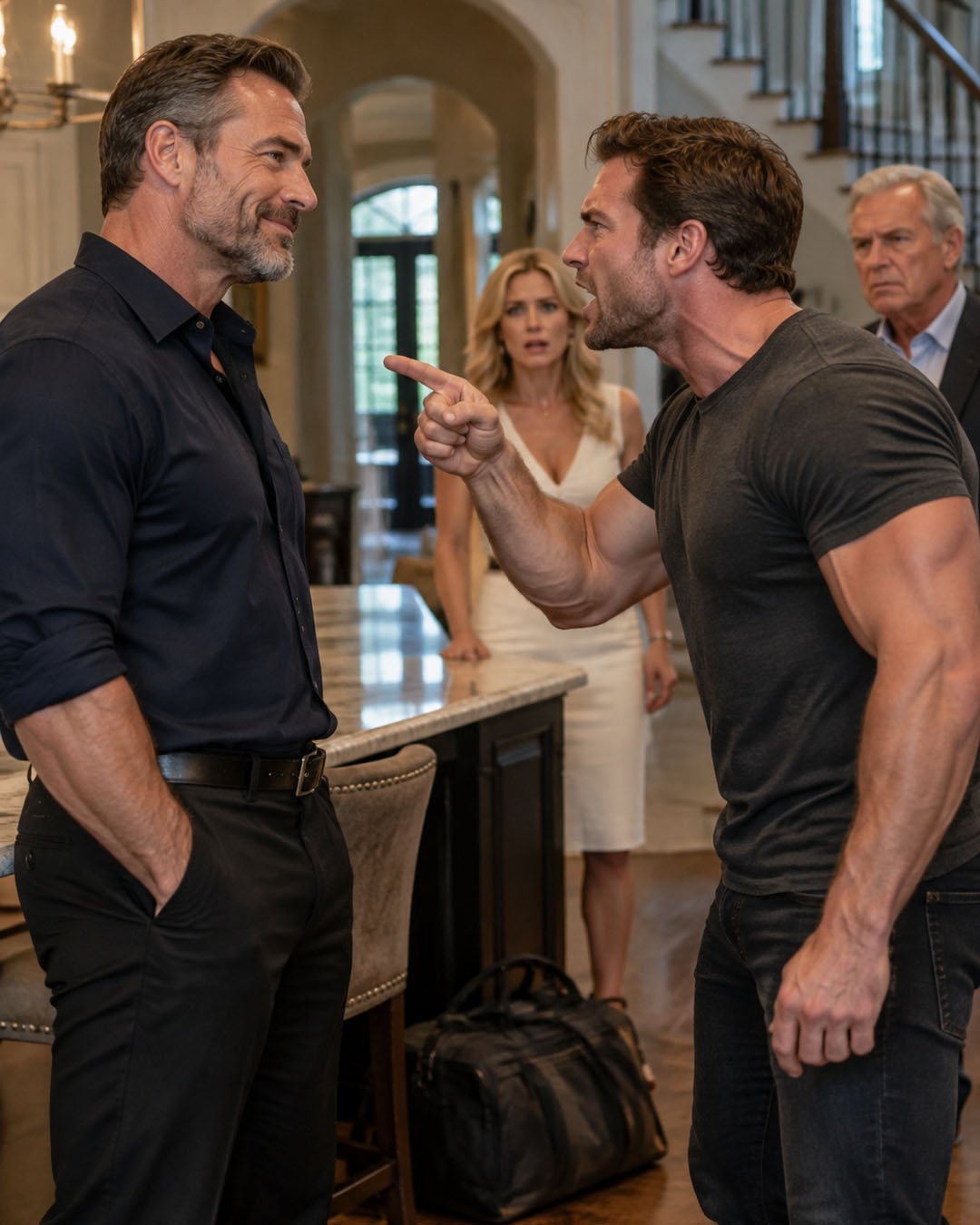
Instead, I found Austin Bradshaw in my kitchen, making coffee with the expensive machine I had bought Veronica for Christmas.
He was wearing a pair of shorts and looked entirely comfortable in a house that wasn’t his. A half-empty bottle of my father’s old scotch sat on the counter beside him, and two coffee cups stood near the sink.
Austin froze when he saw me.
“Ben,” he said, attempting a smile that didn’t quite form. “I thought you were out of town.”
“I was.”
He glanced toward the staircase.
“Veronica said you’d be gone until tomorrow.”
“Where is she?”
“Upstairs.”
I set my travel bag on the floor.
“Then I suggest you explain why you’re in my house.”
Before he could answer, Veronica appeared at the top of the stairs wearing one of my bathrobes. She stopped when she saw us, her face losing color before she managed to compose herself.
“Benjamin, we need to talk.”
“You’re right,” I said. “We do. But not while another man is standing in my kitchen pretending this is normal.”
Austin put down his cup.
“Look, man, I care about your wife. We didn’t plan for things to happen this way.”
“You didn’t plan for me to come home early. That’s different.”
His expression tightened.
Veronica descended the stairs, drawing the robe more closely around herself.
“I want a divorce,” she announced.
The words should have hurt more than they did. Instead, I felt an odd sense of clarity, as though a question I had been avoiding for months had finally been answered.
“All right,” I said. “Then we’ll handle it properly, through our attorneys, with our son’s welfare and the law taking priority.”
Veronica seemed surprised by my response.
“That’s it?”
“What were you expecting?”
“I expected you to make this difficult.”
I looked at Austin, then back at my wife.
“You’ve already made it difficult. My job now is to make sure it doesn’t become destructive.”
Austin laughed nervously.
“Veronica and I love each other. We’re going to be together, with or without your permission.”
I studied him for a moment.
“Then you should be prepared to build a life together without using my money.”
His smile disappeared.
“That’s not how this works.”
“Actually, it is. The accounts are being reviewed, and any access you have to funds that aren’t yours will be addressed. You’ll also need to leave this property.”
Veronica crossed her arms.
“You can’t throw him out like that.”
“I own the house, and he doesn’t live here. If there are any legal questions, our attorneys can resolve them.”
Austin stepped closer, trying to recover the confidence that had brought him into my home in the first place.
“You’re not going to intimidate me, Rhodes. You can’t control everyone forever.”
I smiled faintly.
“Control isn’t what I’m after, Austin. Accountability is.”
He left soon afterward, but not before making certain I understood that he intended to remain in Veronica’s life. My wife followed him to the door, then turned back to tell me that she had never been happy with me.
I didn’t argue.
I spent the following days documenting the financial transfers, working with counsel to separate legitimate household obligations from questionable expenses, and arranging an independent review of the accounts. I also made certain that Rod’s education, health care, and wrestling commitments would remain protected regardless of what happened to the marriage.
I wanted the divorce to proceed fairly.
I wanted my son to have stability.
And I wanted to believe that, despite her choices, Veronica would still put Rod’s welfare ahead of her relationship with Austin.
That hope ended at 3:47 on a Friday morning.
My phone rang with the emergency tone I had assigned to family contacts. I was awake before the second vibration.
“Dad?” Rod’s voice came through, strained and unsteady.
I sat up immediately.
“Where are you?”
“St. Mary’s Hospital. I’m in the emergency department.”
I was already reaching for my clothes.
“What happened?”
There was a long pause.
“Austin hit me.”
For a moment, the room seemed to tilt around me. Then the training that had carried me through years of emergencies took over, and I began asking the questions that mattered.
“Are you safe? Is someone with you?”
“I’m safe. I’m alone.”
“I’m on my way. Don’t leave until I get there.”
I drove to the hospital in twenty minutes.
Rod was sitting on a bed in a curtained examination area, with a bandage above his left eyebrow and his right hand wrapped in gauze. His face was swollen, and he looked exhausted in a way that had nothing to do with the hour.
I pulled a chair beside him.
“Tell me what happened, son.”
He took a breath and began explaining.
He had returned from wrestling camp a day early because one of his teammates needed a ride home for a family emergency. Rather than call us, Rod decided to surprise everyone and grab something to eat before unpacking.
He entered through the garage and found Veronica and Austin in the living room.
They had been discussing the divorce, the house, and what they planned to do about Rod.
“What did they say?” I asked.
Rod looked down at his hands.
“Austin called me a problem they needed to solve. He said Mom deserved a fresh start and that I was old enough to understand that adults sometimes had to make difficult choices.”
I felt my jaw tighten, but I let him continue.
“I asked Mom what was going on. She started crying and saying everything was complicated. Then Austin told me you were controlling and that I was too young to understand what you were really like.”
“What did you say?”
“I told him he didn’t know anything about you. I told him to stop talking about my dad like that.”
Rod swallowed.
“He grabbed my shirt. I told him to let go, and he shoved me into the coffee table. When I got back up, he punched me.”
I kept my voice steady.
“Did you try to defend yourself?”
“He came at me again. I used the takedown Coach taught us, and he fell against the entertainment center. Then Mom started yelling.”
Rod’s eyes filled with tears, but he didn’t look away from me.
“She went to Austin first, Dad. She checked whether he was okay before she even looked at me.”
I reached across the small space between us and held his uninjured hand.
“What happened after that?”
“She told me I had brought it on myself. She said I needed to learn respect.”
For several seconds, I couldn’t speak.
I had spent years believing that whatever problems existed between Veronica and me, our son would remain the one thing we both protected. I could accept that a marriage might end. I could accept that my wife had fallen in love with someone else. What I could not accept was an adult striking my child and the child’s own mother responding by blaming him.
“Did you call the police?” I asked.
“No. I thought maybe I should, but I didn’t want Mom to get in trouble.”
“You did the right thing by getting medical attention. The adults are responsible for their own actions, Rod. You don’t have to protect anyone from the consequences of hurting you.”
He nodded slowly.
A doctor entered a few minutes later, examined his injuries, and explained the follow-up care Rod would need. Fortunately, there was no indication of a serious head injury, but the doctor wanted him monitored carefully and instructed us to seek further evaluation if any concerning symptoms developed.
While we were discussing the discharge instructions, the curtain moved aside.
Veronica stood there with her father, Dick Finley, a retired union foreman who had never approved of my career or my military service. Dick believed that real men worked with their hands, and he had always treated my success as something suspicious.
“Rod, honey,” Veronica said, moving toward the bed. “Are you all right?”
Rod turned his face away.
I stood.
“Where is Austin?”
“That’s not what we need to discuss,” Dick replied. “We need to calm everyone down before this gets out of hand.”
I looked at him.
“A grown man struck my sixteen-year-old son in our home. What exactly do you think needs calming down?”
“Rod provoked him,” Veronica said quickly. “He came home and started shouting. Austin was trying to protect himself.”
I pointed toward the hospital bed.
“Look at your son.”
She glanced at Rod, then looked away.
“Benjamin, you always make everything sound worse than it is.”
“No. I’m describing what happened. There’s a difference.”
Dick stepped forward.
“Take the boy home and let things settle. Veronica will come with me, and we’ll sort this out like adults tomorrow.”
I studied him, then looked at my wife.
She could not meet my eyes.
“All right,” I said. “We’ll sort it out.”
Dick appeared satisfied, and Veronica seemed to believe the argument was over. Neither of them understood what I meant.
As Rod and I walked toward the parking garage, my phone vibrated with a message from an unfamiliar number.
“You’re not going anywhere, Rhodes. You can’t control everyone forever.”
I showed it to my son.
He read it, then looked up at me.
“What are you going to do, Dad?”
I put an arm around his shoulders and guided him toward the car.
“I’m going to make sure the truth comes out, and I’m going to make sure nobody gets another chance to hurt you.”
Chapter 3
Over the next three days, I worked from my study while Rod recovered at home. I canceled nonessential appointments, arranged for a trusted colleague to cover my immediate business responsibilities, and made sure my son had the space he needed to process what had happened.
I also hired an independent investigator through my attorney.
Blake Cheney, a former Army sergeant who now worked with Rhodes Protection Services, had known me for nearly fifteen years. He understood that I expected evidence, not rumors, and that any investigation involving my family had to be conducted lawfully and with particular care for Rod’s privacy.
When Blake arrived Friday afternoon, he carried a thick folder and an expression that told me the situation was more serious than I had expected.
“Your instincts were right,” he said, sitting across from my desk. “Austin Bradshaw isn’t the name he was born with.”
He opened the folder.
Austin was actually Angel Gray, a man from Dallas who had changed his name after a series of financial disputes and legal troubles. He had been married twice, and both relationships had ended amid allegations that he had taken money from his partners. His fitness certification had expired, his rent was overdue, and he owed substantial sums to several creditors.
The pattern was unmistakable.
He targeted women with money, studied their insecurities, and presented himself as the answer to problems they hadn’t known how to articulate. He promised adventure to women who felt trapped, admiration to women who felt overlooked, and a new beginning to anyone willing to believe that the right person could erase the disappointments of the past.
“He’s been doing this for years,” Blake explained. “We’ve identified several former partners who describe remarkably similar experiences. He promised them a future, persuaded them to provide money, and moved on when the financial support dried up.”
I looked through the photographs and financial summaries.
“What about Veronica?”
“She’s been transferring money into accounts he controls. Some of the transfers appear to have been made without proper documentation. He’s also been using credit facilities connected to her information, and she may not understand how much liability she’s taking on.”
I leaned back in my chair.
For a moment, I felt something that resembled pity for my wife. Austin had clearly manipulated her, exploiting her dissatisfaction and promising her a life he could never provide. But whatever he had done to her did not erase the choices she had made, particularly the choice to defend him after he hurt our son.
“There’s something else,” Blake continued. “Two former partners reported that Angel had been aggressive toward their children. Those complaints weren’t resolved in court, so we can’t treat them as established facts. But they’re consistent enough that I think we should take the risk seriously.”
I closed the folder.
“Then we proceed carefully. Everything goes through counsel and law enforcement where appropriate. No one approaches him, no one threatens him, and nobody takes matters into their own hands.”
Blake studied me for a moment.
“I was wondering whether you’d say that.”
“I’m not going to let my anger become another problem my son has to live with.”
I instructed Blake to preserve the evidence, verify the financial records, and identify any additional witnesses who might be willing to speak with investigators. My attorney would handle the divorce and the disputed transactions, while the police would determine what charges, if any, were supported by the evidence concerning Rod’s injuries.
I expected the legal process to be difficult.
I did not expect my wife’s family to make it worse.
The next morning, Dick began contacting attorneys, telling anyone who would listen that I had intimidated Veronica and was trying to destroy her life. He also hired a private investigator to examine my business, hoping to find something that could undermine my credibility in the divorce proceedings.
Veronica, meanwhile, contacted Rod’s school and requested meetings with counselors, claiming that she was worried about his emotional state and wanted to discuss his living arrangements.
There was nothing wrong with a mother seeking counseling for her son. The problem was that she was using those concerns to build a case against the father who had taken him to the hospital after her boyfriend hurt him.
My attorney advised me to keep every communication, avoid direct arguments, and allow the family court to evaluate any custody dispute on the facts.
I followed that advice.
Then, on Monday afternoon, Blake called with an update.
“Angel has been telling people that you’re threatening him,” he said. “He’s claiming the hospital incident was a misunderstanding, and he’s trying to convince Veronica that she needs to act before you get full custody.”
“What does acting mean?”
“He’s been asking questions about Rod’s schedule. We’ve also found messages suggesting that they want to arrange a confrontation that could be recorded and used against you.”
I felt a familiar tension settle into my shoulders.
“Have they made any direct threats against Rod?”
“Nothing specific enough to establish an immediate plan. But given what happened at the house, I’d rather not take chances.”
“Neither would I.”
We arranged for Rod to travel to school and wrestling practice with trusted adults until the situation was resolved. I notified the school through my attorney, shared the relevant concerns with the appropriate administrators, and asked them to follow their standard visitor procedures.
For the first time since returning from the hospital, I felt that we had a practical plan.
Then Austin appeared in the school parking lot.
It happened on Friday afternoon, while Rod was finishing wrestling practice. One of the coaches noticed an unfamiliar man asking parents about Rod’s schedule and contacted the school administrator. The administrator immediately called me.
I arrived to find Austin standing near the gym entrance, holding his phone.
When he saw me, he looked startled.
“Benjamin. I was just hoping to speak with Rod.”
“You can communicate through the appropriate adults. You don’t approach my son at school.”
“I’m trying to apologize.”
“Then you can put that apology in writing and send it through your attorney.”
He glanced toward the gym.
“You’re making this impossible. Veronica says you’re trying to keep her from her own child.”
“That’s a matter for the court to decide. You have no parental rights here, and you have no reason to be approaching a minor at school after what happened.”
Austin’s expression hardened.
“You’re not going anywhere, Rhodes. Veronica and I aren’t going to disappear just because you have money and a lawyer.”
I smiled.
Not because I was amused, and certainly not because I thought the situation was harmless. I smiled because he had finally said aloud what I had suspected all along: he believed that the person with the most confidence could control the story, regardless of the evidence.
He had mistaken my restraint for weakness.
“You’re right about one thing, Austin,” I said. “I’m not going anywhere. This is my home, my son’s school, and my responsibility as his father. If you want to challenge me, do it through the courts.”
The school administrator approached, accompanied by a security officer. Austin was asked to leave the property, and he did so after a brief argument. No physical confrontation occurred, and the incident was documented by the school.
When Rod emerged from the gym, he saw me waiting beside the car.
“Was he here?” he asked.
“Yes.”
“Did he try to talk to me?”
“He wanted to. The school handled it appropriately, and he left.”
Rod stared at the pavement.
“Why won’t he just leave us alone?”
“Because some people believe that admitting they’re wrong is worse than making things worse.”
He considered that for a moment.
“Do you think Mom believes him?”
I opened the passenger door.
“I think your mother has made some very poor decisions. I don’t know what she believes right now, and I won’t pretend I can read her mind. What I do know is that you deserve to be safe, and we’re going to keep doing what we need to do to protect that.”
As we drove home, I received a message from Blake confirming that the school had provided a written account of the incident. The documentation would be added to the existing file, and our attorney would determine the appropriate next steps.
It was a small victory, but it mattered.
We were no longer arguing over competing stories in a kitchen or a hospital room. We were building a record that could be examined by people whose job was to determine what had actually happened.
I had spent years protecting other people’s reputations, businesses, and families.
Now I had to protect my own son without becoming the kind of man who believed that fear was the only way to command respect.
That evening, Blake arrived with another folder.
He placed it on my desk and said, “There’s one more thing you need to know about Dick.”
I opened the folder.
Inside were financial records showing that Veronica’s father had helped Austin arrange meetings with several people who might lend him money. There were also messages suggesting that Dick had known about the transfers from our joint accounts and had encouraged Veronica to keep the money moving while she prepared to leave me.
My father-in-law hadn’t merely supported the affair.
He had helped Austin build the financial arrangement that was supposed to fund my wife’s new life.
And in one message, Dick had written that Rod would be easier to manage once Benjamin was out of the picture.
I read the sentence again.
Then I closed the folder and picked up the phone.
“Blake, I want every document preserved. I want our attorney to see all of it, and I want the police to receive the evidence relevant to the assault and any financial misconduct.”
“Understood.”
“From this point forward, nobody on my team contacts these people except through lawful, documented channels. No intimidation, no games, no exceptions.”
There was a pause.
“Benjamin, you know they’ll keep pushing.”
“Then we’ll keep documenting.”
I looked through the glass wall toward the hallway, where Rod was sitting at the kitchen table doing homework. He had returned to his ordinary routine as best he could, but I could see the strain in his face whenever his phone buzzed.
The adults in his life had spent months making decisions about him without considering what he needed.
I would not make that mistake.
Chapter 4
The next week brought the most frightening discovery of all.
At 3:17 on Wednesday morning, Blake called to tell me that investigators had found messages suggesting Austin, Veronica, and Dick were discussing taking Rod away from my care before the custody proceedings could move forward. They had been consulting someone named Raymond Rollins, a former soldier with a history of misconduct who was now offering private services to people who wanted problems handled outside ordinary legal channels.
The messages did not establish that an abduction was already underway, but they raised serious concerns about what the group might attempt next.
I sat upright in bed.
“Where is Rod?”
“At home. He’s safe. We have no indication that anyone is on the property, but I recommend we notify law enforcement immediately.”
“Do it.”
Within minutes, I had contacted the local police, our attorney, and the school. Rod remained at home with me while officers reviewed the information and advised us on additional precautions. I arranged for a trusted colleague to stay nearby, and we agreed that Rod would not travel alone until the authorities had assessed the situation.
By sunrise, the matter was no longer simply a bitter divorce.
It was a potential threat to a minor, supported by communications that required immediate investigation.
My first instinct was to take control of every moving part, just as I had learned to do during my military service. But I knew that this was not a battlefield, and the people involved were not enemy combatants. They were civilians whose actions had to be addressed through evidence, law, and proportionate measures.
I had built my company around protecting people, not punishing them.
If I abandoned that principle now, I would teach Rod that a man could justify anything as long as he claimed to be defending his family.
That was not the lesson I wanted him to learn.
Over the next several days, investigators interviewed witnesses, examined the messages, and reviewed the financial records. Blake and his team provided the documentation they had gathered, while my attorney coordinated with the authorities and the family court.
The evidence revealed that Austin had been planning to use the custody dispute to secure money from Veronica. He had encouraged her to believe that if she could establish that I was unstable or controlling, she would have a better chance of obtaining a favorable settlement.
Dick had supported the plan because he believed I had always exercised too much influence over his daughter. He had convinced himself that helping Veronica leave me justified almost anything she did along the way.
Veronica’s position was more complicated.
She had been manipulated by Austin, but she had also made deliberate choices. She had transferred money, concealed information, and defended a grown man after he hurt her son. Her vulnerability did not erase her responsibility.
When investigators contacted her, she initially insisted that the messages had been taken out of context. Later, confronted with the records, she admitted that she had discussed taking Rod to stay with relatives while the divorce proceeded.
She claimed she had never intended to endanger him.
Perhaps she believed that.
But she had been willing to make decisions about her son without his father’s knowledge, at the urging of a man who had already assaulted him.
That was enough to require serious scrutiny.
On Friday afternoon, I received a call from Harrison Whitmore, the attorney Veronica had retained.
“Mr. Rhodes, my client would like to arrange a conversation about custody and the financial issues.”
“She can communicate through counsel. I’m willing to discuss a fair resolution, but Rod’s safety is not negotiable.”
“She says she wants to see her son.”
“Then she needs to demonstrate that she can put his welfare ahead of her relationship with Austin. Any visitation should be arranged through the appropriate legal process, with whatever safeguards the court considers necessary.”
Harrison paused.
“She may not like that answer.”
“I understand. It doesn’t make it less necessary.”
The conversation ended politely, but I knew the conflict was far from over.
That evening, Rod came into my study carrying two mugs of hot chocolate. He placed one beside me and sat in the chair across from my desk.
“Can I ask you something?”
“Anything.”
“Do you think Mom really wanted me gone?”
The question hurt more than anything Austin had said.
I took a moment before answering.
“I think your mother made choices without thinking carefully enough about what they would do to you. I think she wanted a different life and allowed herself to believe that the people helping her were telling the truth. But I don’t know exactly what she intended, and I won’t make up an answer just because it would be easier.”
Rod stared at his mug.
“She told me I deserved what happened.”
“I know.”
“How can someone say that to their own kid?”
I moved my chair closer.
“Sometimes people become so determined to defend their choices that they stop seeing the people they’re hurting. That doesn’t excuse what she said, and it doesn’t mean you have to pretend it didn’t happen.”
“Do I have to forgive her?”
“No.”
He looked up at me.
“You don’t?”
“Forgiveness isn’t something anyone should demand from you. You can decide what kind of relationship you want with your mother when you’re ready. For now, you can focus on getting better, finishing school, and figuring out what you want your future to look like.”
Rod nodded slowly.
Then he asked the question I had been dreading.
“Are we safe?”
I looked at my son, at the intelligence in his eyes and the uncertainty he was trying so hard to hide.
“We’re taking the situation seriously,” I said. “The police know what has been reported, your school knows what to watch for, and our attorney is making sure the court has the information it needs. You don’t have to handle any of this yourself.”
He leaned back and let out a breath.
For the first time in days, he looked a little less frightened.
The following Monday, investigators located Raymond Rollins at a motel outside town. He was taken into custody for questioning after authorities established that he had been communicating with Austin about the proposed plan involving Rod. The investigation continued, and additional evidence was collected concerning the group’s intentions.
The news reached me through my attorney.
I felt relief, but I did not celebrate.
The possibility that someone might have tried to take my son had left a mark on both of us, and the fact that the authorities were now involved did not instantly erase it.
Two days later, Dick was questioned about the messages and the financial arrangements. He denied knowing anything about a plan to take Rod, but the documents contradicted several of his statements. Investigators also uncovered evidence concerning the money transferred through accounts associated with Austin.
The case against Angel Gray grew stronger with each interview.
Veronica eventually agreed to cooperate with the financial investigation. She provided records of the transfers and acknowledged that Austin had promised to repay her after their divorce plans were completed. She had believed they would begin a new life together, but the documents showed that he had been using her money to cover his debts and maintain his lifestyle.
When she finally spoke to me through our attorneys, she asked whether I could help her recover what she had lost.
“I can make sure the records are available to the people handling the case,” I replied. “But I can’t promise what will be recovered or how long it will take.”
“Benjamin, I never meant for any of this to happen.”
I closed my eyes briefly.
“Veronica, you may not have intended every consequence. But you chose to lie to me, you chose to use our money without proper agreement, and you chose to defend Austin after he hurt Rod. Those are things you need to take responsibility for.”
She began to cry.
“I know.”
I wanted to believe her.
But I had learned that remorse was not the same thing as change, and promises were not the same thing as proof.
Chapter 5
The legal consequences arrived over the following months, one case at a time.
Austin, whose real name was Angel Gray, was charged after investigators gathered evidence concerning the assault on Rod and the financial misconduct associated with the relationship. The authorities also examined his communications with Raymond Rollins and the messages concerning the proposed plan involving my son.
His attorney attempted to portray the situation as a private family dispute that had spiraled out of control. But the case no longer depended on my word against his. There were medical records, financial documents, witness statements, and communications that had been preserved through proper channels.
The evidence spoke for itself.
Dick faced questions about his role in the financial arrangements and the messages he had exchanged with Austin. He continued insisting that he had only wanted to protect his daughter, but investigators were interested in what he had known and when he had known it.
Veronica’s situation was different.
She had been deceived by Austin, and some of the financial evidence suggested that she had been manipulated. But she had also participated in decisions that affected our marriage and our son. The court would have to consider those facts separately, rather than treating her as either entirely innocent or entirely responsible for everything that had happened.
Our divorce proceeded through the family court.
I did not ask for revenge, and I did not attempt to control the outcome through threats or pressure. I asked for a fair division of the marital assets, accountability for the disputed transfers, and a custody arrangement that protected Rod’s physical and emotional well-being.
The court appointed the appropriate professionals to assess his needs, and Rod was given the opportunity to express his concerns in a protected setting. His injuries healed, but the emotional damage took longer to address. He began speaking with a counselor who specialized in helping teenagers cope with family conflict, and I attended sessions when appropriate so that I could support him without trying to dictate how he felt.
Some days were easier than others.
He returned to wrestling, worked hard in school, and slowly began talking about college again. But every so often, he would ask whether his mother had contacted the court or whether Austin might be released and allowed to approach him.
Each time, I answered honestly.
I never promised that life would be free of uncertainty. I promised that we would face the uncertainty with care, evidence, and the help of people whose responsibility was to protect him.
That distinction became the foundation of our recovery.
The financial investigation revealed the full extent of Austin’s scheme. Several former partners agreed to provide statements describing how he had promised them a future, gained access to their money, and left them with debts they had not expected. Their accounts, together with the records from Veronica’s accounts, helped establish a pattern that went well beyond a single affair.
Austin’s carefully cultivated image began to collapse.
The man who had presented himself as a successful trainer with a bright future was exposed as someone who had relied on other people’s trust to finance a life he could not afford. The women he had manipulated were no longer isolated, each wondering whether they had somehow caused their own misfortune.
They had evidence, and they had one another.
The legal process took time, but it moved forward.
Raymond Rollins faced separate proceedings related to his role in the proposed plan involving Rod. Dick’s involvement remained under investigation, and the authorities evaluated the evidence against him according to the law. Veronica was required to account for the financial decisions she had made, while the divorce court considered the impact of her conduct on the custody arrangements.
No single hearing solved everything.
There were motions, interviews, negotiations, and long stretches when it seemed that nothing was changing. I learned to measure progress in small developments: a document accepted into the record, a witness willing to testify, a court order clarifying boundaries, or a week in which Rod could attend practice without worrying about who might be waiting outside.
Those ordinary moments became victories.
One afternoon, several months after the hospital incident, Veronica asked to speak with Rod through the counselor who was helping him navigate the situation. Rod considered the request for several days before agreeing to a brief meeting in a supervised setting.
I did not pressure him either way.
When he returned home, he was quiet for a long time. I waited until he was ready to talk.
“How did it go?” I finally asked.
He sat beside me on the couch.
“She cried a lot. She said she missed me and that she wished everything had happened differently.”
“How did you feel?”
“I don’t know. Part of me wanted to hug her, and part of me wanted to leave.”
“Both feelings can be true.”
He nodded.
“She said she didn’t realize how much Austin had lied to her.”
“That may be true. It doesn’t change what happened to you.”
“I know.”
He looked down at his hands.
“She apologized for saying I deserved it. She said she was scared and didn’t know what to do.”
I listened carefully, allowing him to work through the emotions without interrupting.
“Do you think you can forgive her?” I asked.
“Maybe someday. But I don’t want to pretend we’re okay when we’re not.”
“Then don’t pretend. You can take your time.”
He leaned back against the couch, looking exhausted but relieved.
For the first time since the assault, he seemed to understand that he didn’t have to choose between loving his mother and acknowledging what she had done. He could care about her, feel angry with her, and still insist on boundaries that protected him.
That was a lesson I had needed much longer to learn.
The final custody arrangement gave me primary responsibility for Rod’s care while allowing contact with Veronica under conditions designed to protect his welfare. Any expansion of that contact would depend on his needs and the court’s assessment, not on promises made during an emotional conversation.
Veronica eventually moved into a smaller apartment and began rebuilding her finances. The expensive lifestyle she had once considered essential was no longer sustainable, and she had to make difficult decisions about what she could afford. She also began working with a financial adviser who had no personal connection to our family and no incentive to hide the truth from her.
Dick, forced to confront the consequences of his involvement, stopped contacting me directly. His relationship with Veronica became strained, particularly after she learned how much he had encouraged her to trust Austin despite the warning signs.
The family that had once treated my patience as an unlimited resource was finally being required to stand on its own.
As for me, I returned to running Rhodes Protection Services, but I changed the way I approached my work. I still provided security consulting for demanding clients, and I still valued the discipline and judgment I had learned in the military. But I began placing greater emphasis on prevention, lawful intervention, and the importance of keeping personal anger from becoming a professional decision.
I had seen what happened when people convinced themselves that the ends justified the means.
I had come close to making that mistake myself.
There had been moments when I wanted to frighten Austin into leaving, expose every private detail of Veronica’s life, or use my resources to make Dick regret every word he had spoken about me. The temptation was understandable, but it was not a path I wanted to follow.
If I had allowed anger to dictate my actions, I might have damaged the very things I was trying to protect.
My son’s future mattered more than my pride.
That realization became especially clear six months after the assault, when Rod competed in the state wrestling championship. He had worked through his injuries, kept up with his classes, and returned to the mat with a determination that made me proud. The stands were crowded with parents and coaches, and the air smelled of floor polish, popcorn, and the nervous energy of families waiting for their children to compete.
I sat near the front, watching him prepare.
When the match began, Rod moved with the patience and discipline his coaches had worked so hard to teach him. He didn’t rush, didn’t lose his temper when his opponent gained an early advantage, and didn’t let the crowd’s noise distract him from the work in front of him.
He won the match in the final period.
The crowd rose to applaud, and I found myself standing with them, my hands clapping before I realized how tightly I had been holding my breath.
Rod looked toward the stands.
When he saw me, he smiled.
It was not the triumphant smile of a boy who had defeated an enemy. It was the relieved smile of a young man who had come through a difficult season and discovered that he could still look forward to his future.
After the ceremony, he walked over carrying his medal.
“Coach says I might have a real shot at the next level,” he said.
“You’ve always had a shot, son. You’ve just had to work for it.”
He laughed.
Then his expression grew serious.
“Thanks for not letting everything that happened ruin wrestling for me.”
I put a hand on his shoulder.
“You did the hard part. I just made sure you had room to do it.”
A few months later, Rod received his appointment to West Point. He had earned it through his academic record, athletic performance, leadership, and determination, not because his father had connections or because anyone had tried to secure him an easy path.
When the letter arrived, he brought it straight to my study.
I read it twice before handing it back.
“Well,” I said, “looks like you’ll be giving me orders soon enough.”
He laughed so hard that he had to sit down.
That evening, we celebrated with dinner at his favorite restaurant. We talked about the academy, the challenges ahead, and the kind of man he wanted to become. For the first time in months, our conversation was about the future rather than the people who had tried to take it away from him.
Before we left the restaurant, Rod asked me something I had not expected.
“Dad, when Austin told you that you weren’t going anywhere, why did you smile?”
I considered the question.
“I smiled because he thought he understood the situation. He believed that if he spoke loudly enough and acted confidently enough, he could decide what happened to everyone around him.”
“And you knew he was wrong?”
“I knew he didn’t get to decide who I was. He didn’t get to decide what kind of father I would be, and he didn’t get to decide whether I would abandon my principles just because he had abandoned his.”
Rod was quiet for a moment.
“Did you ever want to hurt him?”
I didn’t pretend otherwise.
“Yes. I was angry, and I wanted him to feel the consequences of what he had done. But wanting something and choosing to do it are different things. My job was to protect you, not to let him turn me into someone I wouldn’t respect.”
Rod nodded thoughtfully.
“I think I understand.”
I hoped he did.
Because the most important thing I could give my son was not a perfect home, a famous name, or a guarantee that nobody would ever hurt him. I could not control every person who entered his life, and I could not prevent every disappointment he would face.
What I could do was show him that strength meant more than winning an argument or making someone afraid.
It meant keeping your promises.
It meant standing beside someone who was hurting, even when doing so was difficult.
And it meant refusing to let another person’s cruelty decide what kind of person you became.
My marriage ended. My trust in Veronica changed forever, and the family I had imagined raising Rod in was gone. There were still painful conversations ahead, and there would always be questions we could not answer completely.
But Rod was safe, his future was opening before him, and the people who had tried to manipulate our lives were being held accountable through the proper channels.
That was enough.
On the evening before he left for West Point, we sat together on the back porch of our Virginia home. The sun was setting behind the hills, and the air carried the first hint of autumn. Rod had packed most of his belongings, leaving only a few books and his wrestling bag beside the stairs.
“Are you going to be all right here by yourself?” he asked.
I smiled.
“I’ve survived three deployments, a business startup, and a divorce. I think I can manage a quiet house.”
He grinned, then grew serious.
“I know things didn’t turn out the way you wanted. But I’m glad you were my dad through all of it.”
I felt a tightness in my throat that no difficult business negotiation had ever produced.
“I’m glad I was, too.”
He leaned back in his chair and looked out at the hills.
For a while, neither of us spoke.
Then he said, “I used to think being strong meant never letting anyone see you were hurt.”
“What do you think now?”
He considered the question.
“I think it means knowing what matters enough to stand up for it. And knowing when not to let anger make your decisions.”
I looked at him, recognizing the young man he was becoming.
“That’s a pretty good place to start.”
The following morning, I drove him to the airport, helped him unload his bags, and watched him walk toward the security checkpoint. He turned once to wave, then disappeared into the crowd of travelers moving toward their own uncertain futures.
I stood there for another minute before heading back to the car.
My life was not the one I had planned, but it was still mine. I had learned that loyalty without boundaries could become a burden, that love without accountability could become an excuse, and that protecting someone did not require destroying yourself in the process.
I had also learned that the most important victories rarely looked the way we imagined them.
Sometimes, victory was a son who could sleep without fear.
Sometimes, it was a young man stepping toward a future he had earned.
And sometimes, it was a father standing in a quiet house, finally understanding that he had done everything he could to protect the person who mattered most.
Austin had once told me I wasn’t going anywhere.
He was right.
I wasn’t going anywhere.
I was staying right where I belonged, beside my son, committed to the truth, and determined to build a future that no one else had the power to take from us.
THE END.\
⚠️ All characters and events are fictional. Do not imitate or apply them in real life. 😌😌😌


