
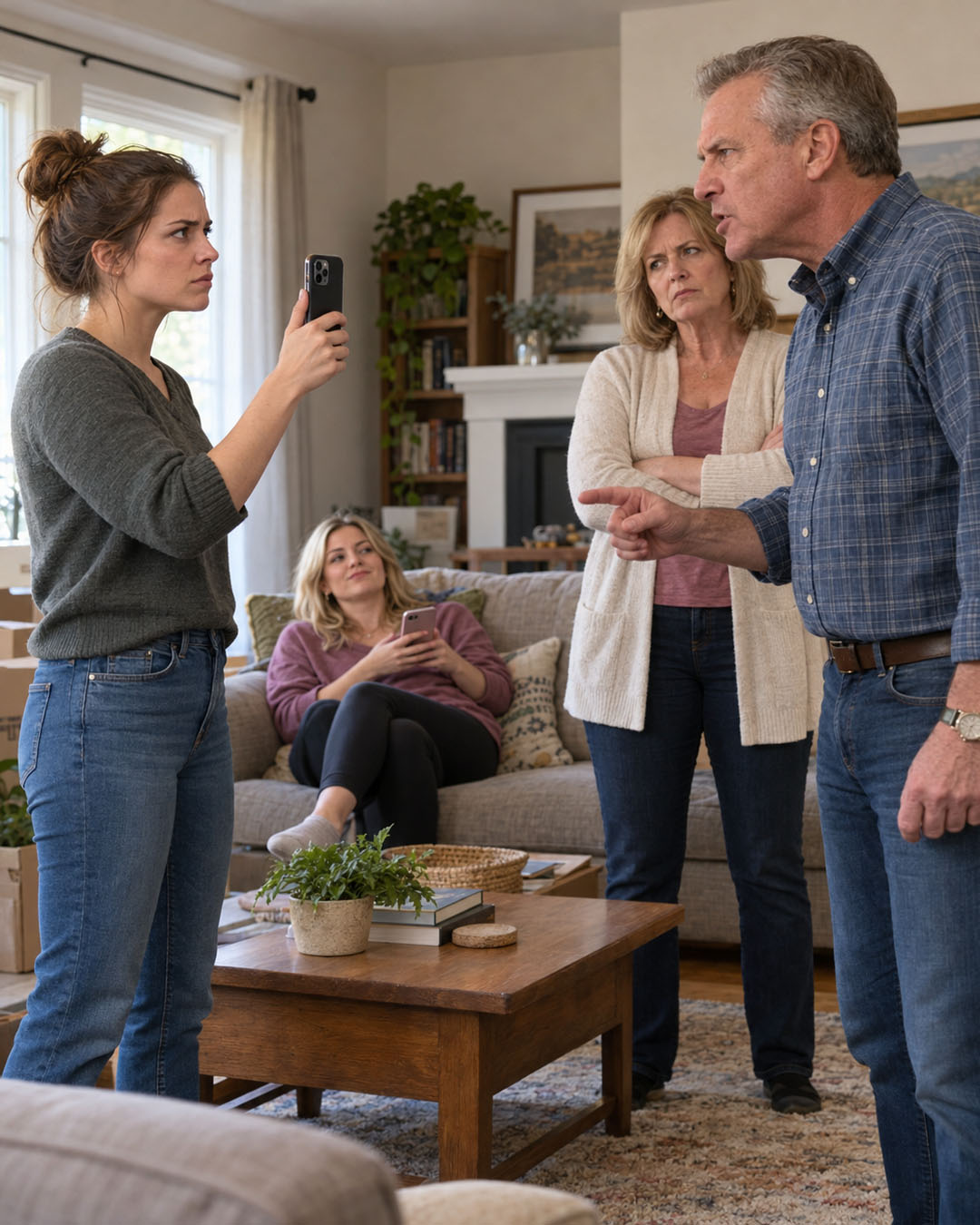
Chapter 2
By the following Monday, my sister had created an entire online fantasy about becoming a homeowner.
She posted kitchen designs, furniture selections, and photographs of spacious bedrooms. Friends she’d known since high school congratulated her on finally becoming independent.
One woman asked when she could visit.
Joanna replied, “Hopefully before Christmas! Just waiting for a few boring legal details.”
I sat at my desk staring at the screen.
My parents weren’t simply trying to win a lawsuit. They’d already promised Joanna my house, and she was announcing her victory before anyone had heard the case.
When I showed Claire the posts, she asked me to save dated screenshots.
“Don’t argue with her online,” she advised. “Don’t give them an opportunity to turn this into a public shouting match. Preserve what they’re saying and let me handle the legal issues.”
That became my routine.
Each evening, after work, I organized documents into folders. Mortgage payments, bank statements, property taxes, insurance records, emails from my real estate agent, and receipts for repairs I’d paid for myself.
I found the invoice for the new water heater I’d installed six months after moving in. I found canceled checks for the roof inspection and photographs showing the repairs completed before closing.
Every expense had come from my accounts.
Meanwhile, my parents had contributed one casserole, two visits, and an afternoon when Dad helped hang curtain rods.
Apparently, they believed that made them property investors.
Claire requested documentation supporting their alleged ownership interest.
Their attorney, Gerald Whitman, responded with a vague list of family contributions but no canceled checks, bank transfers, loan records, or signed agreements.
Then the calls began.
Mom left messages saying I’d broken her heart. Dad warned that everyone in the family would discover what an ungrateful daughter I was.
An aunt called to remind me that parents deserved respect. A cousin insisted Joanna was emotionally fragile and shouldn’t be forced to struggle.
Even our family’s longtime pastor contacted me after Mom asked him to intervene.
I listened politely while he talked about forgiveness.
“Reverend,” I finally said, “would you give someone your house because they demanded it?”
He hesitated.
“That’s a complicated question.”
“It becomes less complicated when the house belongs to you.”
After that conversation, I stopped explaining myself to distant relatives.
My family had apparently decided that telling enough people I was selfish would somehow make the lawsuit legitimate.
Then things became frightening.
My mother appeared in the lobby of my office building one Tuesday morning. She told the receptionist there was a family emergency and demanded to see me.
When security asked her to leave, she began shouting.
“That girl wouldn’t have anything if it weren’t for us! And now she’s trying to destroy her sister!”
My coworker Jessica witnessed the scene.
She later told me that Joanna had accompanied Mom and stood nearby crying while my mother accused me of abandoning my family.
“I’ve never seen anything like it,” Jessica said. “The security guards were perfectly professional, but your mother kept saying you owed her.”
I wanted to disappear.
For years, I’d kept family problems private. Now people at work knew that my parents were suing me for my house.
My manager called me into his office the next day.
I expected an uncomfortable lecture.
Instead, he closed the door and said, “Teresa, your private family problems don’t change the quality of your work. We simply need to keep everyone safe. Let us know if they come back.”
I nearly cried.
A man who wasn’t related to me had shown more concern for my well-being in two minutes than my parents had shown in months.
Claire helped me document the workplace incidents and repeated unwanted contact. After reviewing the evidence, the court granted temporary protective relief restricting my parents from coming to my home or workplace while the dispute continued.
I hoped the order would finally make them stop.
It didn’t.
Two evenings later, my doorbell camera captured Dad walking up the front steps. He taped an envelope to my door and drove away.
Inside was a six-page handwritten letter from Mom.
She accused me of humiliating them, breaking family traditions, and forcing Joanna into an uncertain future. Near the end, she threatened to tell everyone I had stolen money from them unless I dropped the lawsuit defense and agreed to the transfer.
I photographed the letter and sent it to Claire.
Her reply arrived within minutes.
“Do not contact them. Preserve the camera footage and the letter. We’ll address the violation through the court.”
I reported the incident as instructed.
But the worst discovery came three days later.
Katherine called during my lunch break.
“Teresa, please tell me you’ve seen Joanna’s new pictures.”
“What pictures?”
“She’s inside your house.”
I felt the blood drain from my face.
Katherine sent me a photograph showing Joanna standing in my living room, holding two paint samples against the wall.
Behind her were my bookshelf, my grandmother’s old rocking chair, and the blue vase I’d bought on my first trip to San Francisco.
The caption read, “Choosing colors for my fresh start. Sometimes blessings arrive exactly when you need them.”
I was at work.
Nobody had permission to be in my house.
I opened my home security application with trembling fingers.
The backyard camera showed Mom, Dad, and Joanna entering through the rear door that morning.
I’d changed the front locks after receiving the lawsuit, but I’d forgotten that my parents still possessed an old emergency key for the back entrance.
They had used it.
The interior cameras showed all three walking from room to room.
Joanna opened closets and examined furniture. Mom pointed toward the kitchen cabinets, apparently discussing future renovations.
Dad wandered into the garage.
They stayed for forty-three minutes.
I sat motionless at my desk while the footage played.
These weren’t confused people who had accidentally misunderstood a family agreement.
They had entered my home without permission, despite the pending case and the court’s restrictions, and behaved as though the property already belonged to them.
I called Claire.
She listened without interrupting.
Then she said, “Teresa, I want you to contact the police about the entry. I’ll prepare the necessary court filings.”
“Are they going to take my house?” I whispered.
“No evidence you’ve shown me supports their ownership claim. But we still have to follow the process carefully.”
That evening, a locksmith changed every lock, including the rear door. I checked each window twice before going to bed.
For the first time since moving in, my house didn’t feel safe.
A hearing was scheduled to address the violations.
My parents arrived with Gerald, their attorney, looking offended rather than embarrassed.
Judge Margaret Ellis, a woman in her sixties with silver hair and a calm, authoritative voice, reviewed the footage.
“Mr. and Mrs. Bennett,” she said, “you were ordered to stay away from this property. Why did you enter it?”
Dad stood.
“We’re her parents. We had a key.”
“Having a key does not necessarily grant continuing permission to enter someone’s home.”
Mom began crying.
“We were just trying to help Joanna plan for her future.”
The judge looked directly at her.
“Your daughter Teresa is presently the recorded owner. A pending lawsuit does not give you permission to enter her property.”
She found that my parents had violated the court’s order and imposed sanctions totaling $5,000. The restrictions remained in effect, and she warned that additional violations could result in more serious consequences.
Joanna suddenly stood.
“But it’s supposed to be my house!”
Judge Ellis turned toward her.
“Ms. Bennett, sit down. You are not a party with any established ownership interest in this property.”
Joanna sat.
For once, nobody rushed to soothe her.
After the hearing, Gerald requested a settlement conference.
He proposed that my parents withdraw their ownership claim if I agreed to abandon my requests for fees and other relief arising from their conduct.
Claire advised me to consider the costs and risks of continuing.
I thought about that carefully.
I didn’t want to spend another year in court, but I also couldn’t accept a settlement that ignored the damage they’d caused.
At the meeting, Mom reached across the conference table.
“Teresa, please. We’re still your parents.”
I looked at her hand without taking it.
“Then why are you trying to take my home?”
“We only wanted to give Joanna a chance.”
“You could help her find an apartment. You could encourage her to work. You could help her save.”
“She isn’t like you,” Dad said impatiently. “She’s not good with money.”
“And that means she gets mine?”
Neither answered.
I looked at Claire.
“We’re not accepting this offer.”
Mom began to cry again.
But this time, I didn’t feel responsible for drying her tears.
Chapter 3
The trial began on a cold December morning.
I arrived at the courthouse carrying a box of carefully organized documents and wearing the navy suit I’d bought for my first major promotion.
Katherine came with me, along with Jessica from work and my mortgage broker, Daniel Foster.
Across the courtroom, Mom sat beside Dad, dabbing her eyes with a tissue. Joanna occupied the front row behind them, surrounded by two aunts and a cousin who had come to support her.
I looked at them and felt an old familiar ache.
When I’d graduated from college, none of those relatives had attended. Mom said everyone was busy.
Now they’d traveled across the city to support a lawsuit designed to take away the house I’d bought with the degree I’d worked so hard to earn.
Judge Ellis entered, and everyone stood.
After opening formalities, my parents’ attorney presented their case.
He spoke about sacrifice, family loyalty, and the financial burdens of raising children. He described my parents as generous people who had helped me establish my career and reasonably expected to share in my success.
Listening to him, I almost admired how skillfully he turned a lifetime of favoritism into a story about devoted parents.
Then Claire stood.
“Your Honor, this case concerns a straightforward question. Did the plaintiffs acquire a legally enforceable interest in Teresa Bennett’s property?”
She placed a copy of the deed on the display.
“The title names Teresa Bennett alone. The mortgage identifies her as the sole borrower. The down payment came from her personal savings, and the plaintiffs have provided no reliable evidence of an agreement giving them ownership.”
Claire paused.
“The plaintiffs are asking this court to convert ordinary parental responsibilities and occasional family favors into a property right. The evidence does not support that request.”
My father testified first.
He described working long hours when Joanna and I were children. He talked about grocery bills, school clothes, and family vacations.
Then Gerald asked whether he’d helped me financially as an adult.
“Of course,” Dad said. “We gave Teresa thousands over the years.”
My stomach tightened.
Claire rose for cross-examination.
“Mr. Bennett, do you have bank statements, canceled checks, or other records showing those payments?”
“We helped her with cash.”
“Approximately how much?”
“Several thousand dollars.”
“When?”
“Over the years. I don’t remember every date.”
Claire approached the evidence display.
“Do you recognize this transfer?”
Dad leaned forward.
It showed $5,000 sent from my account to his, accompanied by the note, “Loan for car repairs.”
“Yes,” he said.
“And this $2,000 transfer?”
Dad shifted.
“Yes.”
“And this $800 payment for your electricity bill?”
“I suppose so.”
Claire turned toward the judge.
“These are documented transfers totaling $7,800 from Teresa to her parents. Can you identify any comparable records showing money moving from you to her?”
Dad’s face darkened.
“Families don’t keep receipts for everything.”
“That’s understandable. But you are asking this court to recognize a financial ownership interest. Do you have any independent evidence of the funds you claim to have provided?”
He looked at his lawyer.
“No.”
Mom testified next.
She described bringing meals when I moved in and Dad helping with small household tasks. She claimed they’d supported me emotionally and advised me throughout the purchase.
Claire displayed an email Mom had sent the morning after my closing.
“Mrs. Bennett, did you write this?”
Mom read it.
“Yes.”
Claire quoted the relevant sentence.
“‘We’re so proud you managed to buy your home completely on your own.’ Was that your statement?”
Mom looked uncomfortable.
“Yes, but I was just being nice.”
“So at the time, you acknowledged Teresa bought the home on her own?”
“In a manner of speaking.”
“Did you co-sign her mortgage?”
“No.”
“Did you provide any portion of the down payment?”
“No.”
“Did you have a signed agreement promising you ownership?”
“No.”
Claire nodded.
“Thank you.”
Gerald then called Joanna.
She approached the witness stand wearing a cream-colored dress and looking unusually serious.
Under questioning, she described our relationship as loving and close.
“Teresa always said family should stick together,” she told the court. “I thought she wanted to help me get started.”
Gerald asked whether I’d promised her a place in the house.
Joanna hesitated.
“She said there would always be room for family.”
I stared at her.
I’d never made such a promise.
Claire began her cross-examination.
“Joanna, when did your sister tell you that?”
“I don’t remember exactly.”
“Before or after she bought the house?”
“Before, I think.”
“Where were you?”
“Maybe at Mom’s.”
Claire glanced at her notes.
“Do you have any messages, emails, or witnesses confirming such a promise?”
“No.”
“Did you contribute money toward purchasing the house?”
“No.”
“Have you ever paid the mortgage?”
“No.”
“Property taxes? Insurance? Repairs?”
Joanna shook her head.
“No.”
Claire displayed the social media posts.
“Is this your account?”
“Yes.”
“And these photographs show you inside Teresa’s home?”
“Yes.”
“Did Teresa invite you there?”
Joanna looked toward Mom.
“No, but my parents had a key.”
“Did you know Teresa had asked your family not to enter without permission?”
“I thought it would be mine soon.”
The courtroom became very still.
Claire waited.
“So you believed your parents’ lawsuit would result in Teresa losing ownership?”
Joanna’s face turned red.
“Yes.”
“And that’s why you publicly announced that the house was already yours?”
“I was excited.”
“Despite not having purchased it, paid for it, or obtained permission from its owner?”
Joanna stared at the floor.
“Yes.”
Claire returned to her table.
“No further questions.”
I wanted to feel triumphant.
Instead, I felt exhausted.
Joanna had spent her life being told she deserved whatever made her happy. Perhaps she genuinely couldn’t understand why wanting something didn’t entitle her to possess it.
But confusion didn’t excuse what she’d done.
The following morning, I took the witness stand.
Claire began by asking about my career.
I described working through college, taking out student loans, and graduating while holding two part-time jobs. After becoming a software engineer, I lived frugally and saved consistently.
I explained how I’d researched mortgages, found the house, completed inspections, and made the down payment.
Claire displayed years of bank records showing the growth of my savings account.
Then she presented the closing statement.
“Teresa, whose funds paid the down payment?”
“Mine.”
“Who qualified for the loan?”
“I did.”
“Who has made every monthly mortgage payment?”
“I have.”
“Did your parents contribute financially to the purchase?”
“No.”
“Did you ever promise to transfer any ownership interest to them or Joanna?”
“Never.”
Gerald tried to challenge my account.
He suggested my parents had supported me indirectly by raising me and encouraging my education.
“I appreciate the care they provided when I was young,” I answered. “But that doesn’t mean they own my home.”
He asked whether I’d ever helped my family financially.
“Yes,” I said. “I’ve lent my parents money several times.”
“And now you’re refusing to help your sister?”
“I’m refusing to give away property I purchased.”
“Even though she needs a home?”
“Needing something doesn’t make it yours.”
Judge Ellis looked up briefly from her notes.
Gerald continued, questioning why I required a three-bedroom house when I lived alone.
I answered calmly.
“One room is my bedroom. One is my home office. The third is a guest room. But I don’t believe my floor plan determines who owns the property.”
A quiet murmur moved through the courtroom before the judge called for order.
When my testimony ended, Claire presented the remaining evidence.
Daniel, my mortgage broker, confirmed that my parents had not been involved in the financing. Katherine described my years of careful saving and testified about conversations she’d witnessed when my parents borrowed money.
Jessica explained the incidents at my workplace.
Then came the security footage.
The courtroom watched my parents and Joanna enter through the back door. Everyone saw Joanna posing with paint samples while Mom rearranged items on my shelves.
The recording showed Dad opening storage cabinets in the garage.
For forty-three minutes, they wandered through my home as though I were a temporary occupant.
When the footage ended, Judge Ellis looked toward my parents.
“Was this incident after the court imposed restrictions on entry?”
“Yes, Your Honor,” Claire answered.
The judge made a note.
I couldn’t tell what she was thinking.
But for the first time, the truth was visible in a room where my parents couldn’t interrupt, reinterpret, or shout it away.
Chapter 4
Closing arguments took place late that afternoon.
Gerald spoke first. He acknowledged that my parents lacked conventional ownership documents but argued that years of family assistance and an alleged verbal understanding justified equitable relief.
He urged the judge to consider the relationship between parents and children rather than focusing entirely on paperwork.
Claire waited until he finished.
Then she stood and placed her hands lightly on the lectern.
“Family relationships matter,” she began. “But family relationships do not erase property rights.”
She explained that my parents hadn’t established a legally enforceable ownership interest. Their testimony about substantial financial contributions was unsupported and contradicted by the available records.
She also addressed their conduct after filing the lawsuit.
“The plaintiffs did not merely request a court ruling,” she said. “They repeatedly disregarded their daughter’s boundaries, entered her home without permission, and involved her workplace in this dispute.”
Claire looked toward the judge.
“My client spent years building financial independence. Her parents now ask the court to transfer part of that achievement to another daughter, not because of a valid contract or contribution, but because they believe she ought to share it.”
She paused.
“That is not a legal basis for ownership.”
Judge Ellis reserved judgment until the following morning.
I barely slept.
I spent the night walking from room to room, touching the familiar furniture and looking at the small things I’d chosen for myself.
The bookshelf I’d assembled on a rainy Sunday. The curtains I’d sewn with Katherine’s help. The framed photograph of my grandmother, who’d encouraged me to become an engineer because she believed girls should know how to build their own futures.
I stopped beside her picture.
“Well, Grandma,” I whispered, “I hope I made you proud.”
The next morning, the courtroom was almost silent when Judge Ellis began delivering her ruling.
She reviewed the central facts carefully.
The recorded deed listed me as sole owner. The mortgage and purchase records showed no contribution from my parents. There was no reliable evidence of a legally enforceable agreement granting them an interest in the property.
“The plaintiffs have not established a basis for the relief they seek,” she said.
My fingers tightened around Katherine’s hand.
“Their claims are dismissed with prejudice.”
I closed my eyes.
Those words meant my parents couldn’t simply bring the same claims again.
The judge continued.
She addressed their violations of court restrictions, their unauthorized entry, and the litigation expenses I’d incurred defending myself.
After considering the applicable claims, the submitted evidence, and the sanctions issues, she entered a monetary judgment totaling $72,000, including $47,000 in recoverable legal fees and costs and $25,000 in damages and additional sanctions supported by the court’s findings.
She also entered continuing protective restrictions against further harassment and unauthorized contact, subject to the terms of the court’s order.
My father rose halfway from his chair.
“Seventy-two thousand dollars? We can’t pay that!”
Judge Ellis looked at him.
“Mr. Bennett, you had the opportunity to resolve this matter through lawful means. Instead, your conduct resulted in substantial additional proceedings.”
Dad sank back into his seat.
Mom was crying openly now.
Joanna stared at the judge as though someone had explained for the first time that the world wasn’t obligated to give her what she wanted.
The judge warned my parents that further violations of court orders could lead to additional penalties and that any suspected criminal conduct would be handled through the appropriate legal process.
Then she adjourned.
For several seconds, I couldn’t move.
Katherine hugged me.
“You kept your house,” she whispered.
I looked down at my hands.
They were trembling.
Claire turned toward me.
“Teresa, the ruling is strongly in your favor. There are still administrative matters, collection issues, and potential post-trial motions, but the ownership question has been resolved.”
I nodded.
“Thank you.”
She smiled.
“You did the difficult part. You kept your records, told the truth, and stood your ground.”
As we approached the courtroom doors, Mom called my name.
“Teresa, please.”
I stopped but didn’t turn around.
“We can’t afford this,” she said. “You’re ruining us.”
For thirty-five years, those words would have worked.
I would have rushed back to comfort her, promised to help, and somehow found a way to make the consequences of her choices disappear.
But not that morning.
I turned toward her.
“Mom, I didn’t file this lawsuit.”
She wiped her face.
“We’re your parents.”
“I know. And I wish you’d acted like it.”
Dad shook his head.
“After everything we did for you, this is how you repay us?”
I looked at him for a long moment.
“You raised me to survive without your help. I did. And when I finally built something for myself, you tried to give it away.”
He opened his mouth, but I continued.
“I hope someday you understand that I wasn’t trying to punish you. I was protecting my home.”
Then I walked out.
Outside, the December air was sharp and cold.
Katherine offered to drive me home, but I wanted to be alone for a little while.
I sat in my car, hands resting on the steering wheel, and cried harder than I had throughout the entire trial.
Not because I’d lost.
Because winning didn’t change the fact that my parents had been willing to take everything I’d worked for.
And because I finally understood that I couldn’t make them love me fairly, no matter how much I accomplished.
Chapter 5
Six months later, I was sitting on my back porch drinking iced tea when Katherine asked whether my parents had paid anything toward the judgment.
“They’re making monthly payments,” I told her. “Claire helped arrange a collection process, and the judgment has been recorded against their property.”
Katherine shook her head.
“After everything they put you through, I still can’t believe they thought they’d win.”
“Neither can I.”
Spring had transformed my little backyard.
Tomato plants grew along the fence, and a row of lavender attracted bees near the porch steps. I’d repainted the guest bedroom, replaced the kitchen backsplash, and finally repaired the garage door.
None of the improvements was extravagant.
But I enjoyed choosing them without wondering whether someone else would announce that my home belonged to Joanna.
My parents had suffered significant financial consequences.
The judgment was difficult for them to pay, especially while covering their own legal expenses. Dad took additional work, and Mom sold several expensive pieces of furniture.
Some relatives initially criticized me for not forgiving the debt.
But after seeing the court’s findings and learning about the unauthorized entries, several stopped defending my parents.
Aunt Susan even called to apologize.
“I believed what your mother told me,” she admitted. “I should have asked for your side.”
I thanked her, but I didn’t immediately resume our old relationship.
I was learning that apologies could be accepted without restoring the access people once had to my life.
Joanna moved back into our parents’ house after another unsuccessful attempt at living independently.
Her social media posts became quieter.
The photographs of my house disappeared. So did the elaborate announcements about fresh starts and wonderful new opportunities.
Sometimes she posted vague messages about betrayal and the importance of family loyalty.
I stopped looking.
The ongoing court restrictions meant my parents weren’t supposed to contact or approach me in prohibited ways. They mostly complied, although Mom later sent an accusation-filled letter to my employer, falsely claiming I’d taken money from the family.
My supervisor gave me the letter immediately.
Claire handled the violation, and the matter returned to court for review. I didn’t respond personally.
That was another lesson I’d learned.
Not every accusation deserves an argument. Sometimes the healthiest response is to let established boundaries do their work.
Meanwhile, my own life continued moving forward.
I received a promotion at work and began supervising a larger engineering team. For the first time, I could enjoy professional success without expecting my parents to ask how it might benefit Joanna.
I also joined a weekend hiking group.
That’s where I met Lauren, a school counselor with kind brown eyes and a laugh that made strangers feel welcome.
We began dating slowly.
One evening, while helping me carry groceries inside, Lauren noticed the framed photograph of my grandmother near the bookshelf.
“She looks like someone who didn’t take nonsense from anybody,” Lauren said.
I laughed.
“She didn’t.”
“Were you close?”
“Very.”
I told Lauren about Grandma’s encouragement, her practical advice, and her belief that a woman should always be able to support herself.
Then I told her about the lawsuit.
Lauren listened without interrupting.
When I finished, she took my hand.
“You must have felt terribly alone.”
That simple observation touched something deep inside me.
For so long, people had focused on the money, the house, and the courtroom victory.
Few had asked how it felt to discover that my parents valued my possessions more than my peace of mind.
“I did,” I admitted.
Lauren squeezed my hand.
“You don’t have to feel that way anymore.”
I knew she couldn’t promise that life would never be difficult. Nobody could.
But there was comfort in being with someone who didn’t treat love as an excuse to demand sacrifice.
As summer approached, Katherine and I spent more evenings on the porch, sometimes joined by Lauren and a few friends.
We cooked dinner, talked about work, and laughed about ordinary things.
Nobody asked me for money.
Nobody reminded me what I owed them.
And nobody behaved as though the home I’d purchased belonged to someone else.
One evening, after everyone left, I stayed outside watching fireflies flicker near the garden.
I thought about the day my parents had entered my living room carrying legal papers.
I remembered Joanna lounging on my couch, already choosing paint colors. I remembered Mom insisting I had a duty to share everything I’d earned because she’d raised me.
And I remembered how frightened I’d been when the lawsuit arrived.
Back then, I believed standing up for myself might mean losing my entire family.
In a way, it had.
But the family I’d been desperately trying to preserve had never given me the same protection I offered them.
I’d spent my childhood learning to need less so Joanna could have more.
I’d spent my twenties believing independence would finally earn my parents’ respect.
And I’d nearly spent my thirties surrendering the home I’d sacrificed so much to purchase.
The lawsuit forced me to understand something I’d avoided for years.
My parents’ disappointment wasn’t proof that I’d done anything wrong.
Their anger wasn’t a debt I had to repay.
And their decision to favor my sister didn’t mean I was less deserving of happiness.
Inside, my phone vibrated.
It was a message from Katherine.
“Almost forgot to tell you. Your tomatoes are looking better than mine. I’m officially jealous.”
I smiled and typed back.
“That’s because I follow Grandma’s gardening advice. Plenty of sunshine, good soil, and don’t let the weeds take over.”
After sending the message, I looked at the little garden again.
Grandma had been talking about vegetables when she gave me that advice.
But somewhere along the way, I’d realized it applied to people, too.
A good life needed care, patience, and boundaries.
It needed room for relationships that helped you grow instead of draining everything you had.
I went inside and turned on the kitchen light.
The house was peaceful.
My favorite books lined the shelves. A photograph of Lauren and me hiking along the Columbia River Gorge stood beside my grandmother’s picture.
On the refrigerator hung a small calendar filled with ordinary plans: a dentist appointment, a work meeting, dinner with Katherine, and a weekend trip to the coast.
Nothing about that evening was dramatic.
Nobody was shouting.
Nobody was threatening to sue me.
Nobody expected me to give away something I’d worked for simply because another person wanted it.
And that ordinary peace felt more valuable than anything the court had awarded.
My parents had tried to take my house and hand it to my sister.
Instead, they lost the lawsuit, faced the financial consequences of their decisions, and destroyed much of the trust that once connected us.
I couldn’t change their choices.
I couldn’t make Joanna become responsible.
I couldn’t reclaim the childhood I’d spent trying to earn affection that should never have depended on achievement.
But I could decide what happened next.
I could protect my home.
I could choose the people I allowed into my life.
And I could finally stop confusing guilt with love.
As I locked the front door that night, I glanced around the living room and smiled.
For years, I’d wanted my parents to be proud of the house I’d bought.
Now I understood that I didn’t need their approval to be proud of myself.
They had tried to take the home I’d built with my own money.
But what I gained by defending it was something no deed could ever measure.
The freedom to live a life that truly belonged to me.
THE END. ⚠️ All characters and events are fictional. Do not imitate or apply them in real life. 😌😌😌


