
Chapter 2
The desk arrangement became a problem almost immediately.
I was taking honors algebra, biology, English, history, and Spanish, which meant that most evenings I had a textbook open, a notebook beside it, and at least one assignment that needed my full attention. My desk had been large enough for everything, with drawers for supplies and a lamp positioned over the spot where I usually worked.
Now I had to stack books on the floor whenever I needed more than one open at a time.
Trevor, meanwhile, was perfectly happy with his new territory. He colored, hummed, tapped his feet, and asked questions every thirty seconds because he was six and the world was full of things he didn’t understand yet.
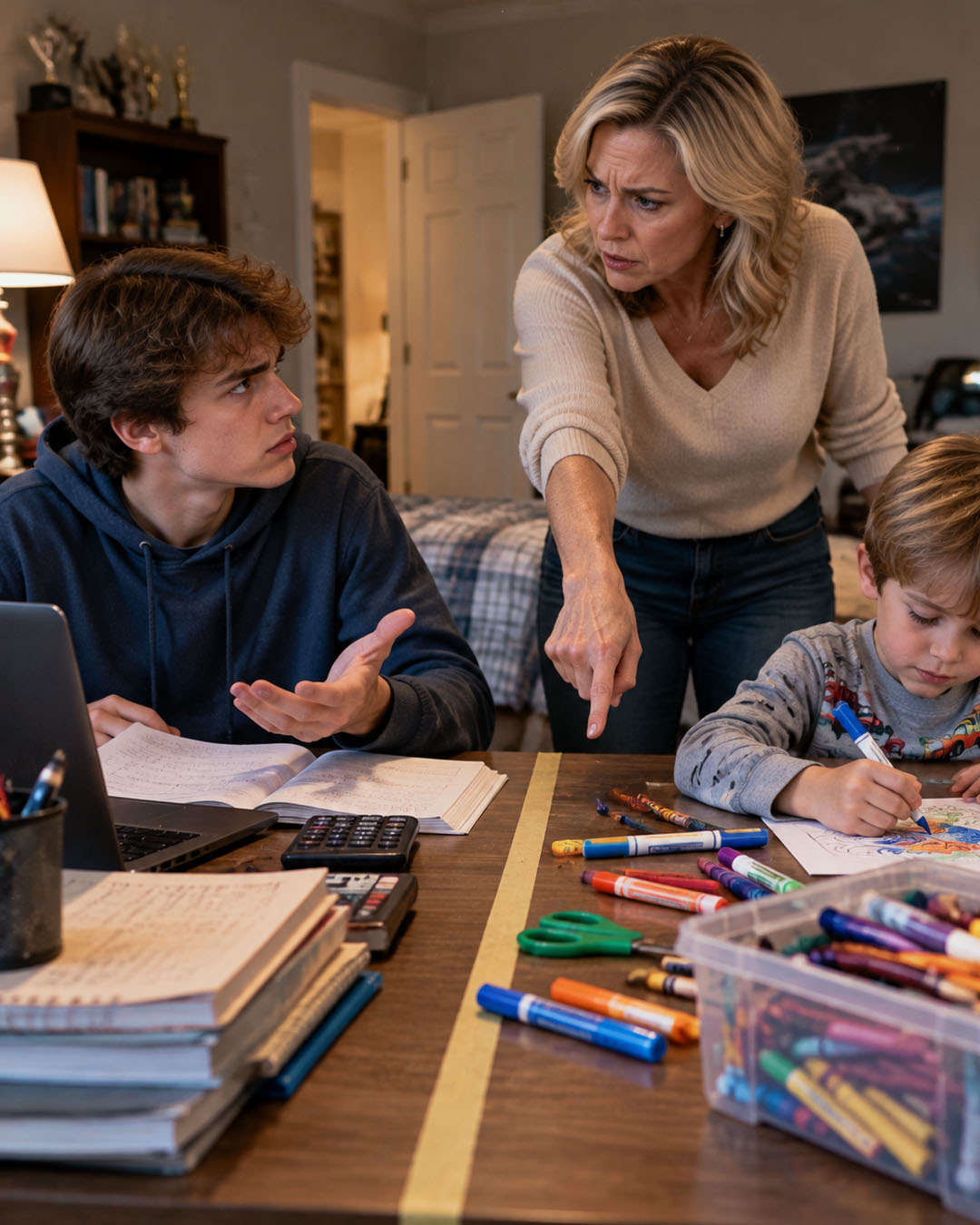
One evening, while I was working through an algebra assignment, he knocked over a cup of markers. A blue one rolled across my worksheet, leaving a thick line through two equations.
“Trevor, could you please color somewhere else?” I asked, trying to keep my voice calm.
His face fell, and before I could reassure him, Linda appeared in the doorway.
“What did you say to him?”
“I asked him to color somewhere else. I’m trying to study.”
“This is his desk, too.”
“It’s my bedroom.”
“He has a designated space here, and you’re being very selfish about it.”
I looked at the masking tape dividing my desk into two unequal piles of clutter.
“Maybe a six-year-old doesn’t need half the study desk of someone in high school.”
Linda’s face hardened. “You’re not more important because you’re older.”
“I didn’t say I was.”
“You implied it.”
Dad appeared behind her after hearing the raised voices. I asked whether I could use the dining room table for homework instead, hoping that would solve the problem without another argument.
Linda answered before he could speak.
“If you get the dining room, Trevor gets equal access. Everyone deserves the same amount of space.”
“There’s only one dining room table. I’m not asking to own it. I just need somewhere to study.”
“You already have a desk. Half of it is plenty.”
Dad gave me that familiar, exhausted look.
“Can we please not turn this into a huge fight?”
I returned to my room and tried to finish my assignment.
Over the following weeks, my grades began slipping. It wasn’t because Trevor was deliberately trying to distract me. He was just a little boy who wanted to color and talk, and Linda had given him permission to treat my bedroom like a shared playroom.
If I studied in my room, Trevor came in because his art supplies were there. If I moved to the dining room, Linda reminded me that I couldn’t spread my books across the table because everyone needed equal access. The living room was no better, with the television playing and people moving in and out.
I started doing homework on my bed, then on the floor. Sometimes I stayed at school late to finish assignments in the library. Even then, I missed a few deadlines because I couldn’t keep track of everything while constantly shifting between places.
I failed an algebra test, then a biology quiz.
By the time my algebra grade dropped to a D, Dad finally noticed.
“What is going on with school?” he asked at dinner.
Linda looked up from her plate. “I’ve been wondering the same thing. Maybe she’s spending too much time on her phone.”
I nearly dropped my fork.
“I’ve been having trouble finding somewhere quiet to work.”
Dad frowned. “You’ve never had this problem before.”
I looked at Linda, expecting her to acknowledge the desk arrangement. Instead, she took a sip of water.
“Sometimes teenagers need to learn better time management.”
That was when something clicked.
For eight months, I had tried to convince Linda that her rule was unfair. Every time I pointed out a problem, she found another explanation. Trevor was younger. Trevor felt excluded. Trevor needed to feel like part of the family. Kyle and I were older and therefore expected to be generous.
I had been arguing about whether her rule was reasonable, while she had been treating the rule itself as unquestionable.
So I decided to stop arguing.
I would follow it.
Exactly.
The opportunity came that Friday at dinner. Trevor brought home a permission slip for a school field trip to the aquarium. The trip cost forty-seven dollars, and Linda reminded Dad that the payment was due the following week.
“Of course,” Dad said, reaching for his wallet.
I looked up from my plate.
“Wait. Is Kyle going on a field trip, too?”
Linda frowned. “No. He’s in a different grade.”
“But if Trevor gets forty-seven dollars for a school trip, shouldn’t Kyle get forty-seven dollars, too?”
The kitchen went quiet.
Linda stared at me as if I had asked whether the family car should be divided into three equal pieces.
“That’s different.”
“How?”
“Trevor needs the money for his school trip.”
I nodded thoughtfully. “And I needed my birthday present. You said it didn’t matter why someone got something, because nobody should feel left out.”
Kyle slowly put down his fork. I could see him beginning to understand where I was going.
“So if Trevor gets forty-seven dollars,” he said, “I should get forty-seven dollars, too.”
Linda turned toward him. “Don’t encourage this.”
“I’m just following the rule,” Kyle replied.
Dad stopped reaching for his wallet.
I continued as calmly as I could. “And I should get forty-seven dollars, too. Otherwise, Trevor gets something that we don’t, and that isn’t equal.”
“You are not going on a field trip,” Linda snapped.
“Neither is Kyle. But you’re giving him money for fairness, right?”
“That’s not the same thing!”
“Why not?”
Linda’s cheeks reddened. “Because you’re deliberately twisting my words.”
“No,” I said. “I’m using them.”
For a few seconds, nobody spoke. Dad looked at Linda, then at me, then down at the wallet in his hand.
Finally, he said, “She has a point.”
Linda turned toward him in disbelief.
“David!”
“You did split her birthday gift card. You made Kyle share his game. You said the rule was that nobody should get more than anyone else.”
“That was different!”
I leaned forward slightly. “You’ve said that about every single thing we’ve brought up.”
Linda pushed her chair back so sharply that its legs scraped against the floor.
“This is ridiculous. You’re old enough to understand that some situations are different.”
“And you’re old enough to explain why,” I replied.
She walked out of the kitchen without another word.
Dad sat there looking uncomfortable, but he eventually handed Trevor the forty-seven dollars for the aquarium trip. Then he gave Kyle forty-seven dollars, followed by another forty-seven to me.
I thanked him and put the money in my pocket.
It wasn’t the money I cared about. I didn’t need forty-seven dollars, and I didn’t want to take anything away from Trevor. I simply wanted Linda to hear her own reasoning without the usual excuses.
For the next three days, she barely spoke to me.
I assumed the issue would fade away, but the rule had become too much a part of her identity to disappear overnight. Instead, she began inventing exceptions.
A week later, she bought Trevor a pair of expensive sneakers he had been begging for. He came downstairs to show us, grinning from ear to ear.
Kyle looked at the shoes, then at Linda.
“So, what days are mine?”
Trevor laughed, thinking Kyle was joking. Linda did not.
“What are you talking about?”
“The shoes. If Trevor gets new sneakers, do I get to wear them on certain days?”
“Of course not. Shoes are personal.”
Kyle nodded slowly. “Good to know.”
I looked up from my book. “So personal things don’t have to be shared?”
Linda crossed her arms. “Obviously.”
“Like birthday gift cards?”
“Enough.”
“We’re just trying to understand,” I said.
“You understand perfectly.”
She walked away again.
We did understand, and that was the problem. We were beginning to see exactly how her rule worked, and the more clearly we saw it, the harder it became for her to defend.
A few days later, Trevor received twenty dollars from his grandmother. Linda handed him the money and told him to put it somewhere safe.
I asked, “Do we divide family gifts or not?”
She closed her eyes as though she were summoning patience from the heavens.
“That money came from his grandmother.”
“Dad gave me my Barnes & Noble card.”
“Your gifts are yours,” she said quickly.
Kyle looked at me.
I looked at him.
For the first time, Linda had said something that directly contradicted the rule she had enforced for months.
I smiled.
“Can we get that in writing?”
She stormed out of the room.
But I wasn’t finished. The next Saturday, while Trevor was visiting a friend, I carried my algebra book, laptop, and notebooks into his bedroom. He had a small plastic activity table near the window, with plenty of room for his crayons on one side.
I moved his art supplies neatly to the left and arranged my books on the right.
Linda found me there ten minutes later.
“What on earth are you doing?”
“Studying.”
“In Trevor’s room?”
“I’m using half of his table. I need a place to work, and he doesn’t need the whole thing while he’s gone.”
She stared at me.
“You don’t have a half. You have your own desk.”
I looked at her, waiting.
Then I asked the question that stopped her cold.
“If bedrooms are private, why isn’t mine?”
Chapter 3
Linda’s mouth opened, but no answer came out.
I pointed toward the little table.
“Trevor has a place to keep his things. I need a place to keep mine. You said everything should be shared equally, so I’m using half of his table.”
“That’s completely different.”
“How?”
“You have your own desk!”
“Half a desk.”
“Stop being difficult.”
“I’m following your rule.”
“No, you’re trying to make a point.”
“Yes,” I admitted. “I am.”
Dad came home in the middle of the argument. Linda met him in the hallway and explained that I had invaded Trevor’s bedroom and was refusing to leave.
Dad looked through the doorway at my books, then at me.
“What are you doing in here?”
“Studying.”
“You have a desk.”
I stared at him for a moment.
“Do I?”
Something in his expression changed.
I led him into my bedroom, where the masking tape was still running down the middle of my desk. Trevor’s side was covered with crayons, coloring books, stickers, construction paper, and two plastic dinosaurs. My side held a laptop, three textbooks stacked on top of each other, a calculator, and a notebook hanging halfway over the edge.
I opened the drawers. One was filled with art supplies that Linda had moved there because Trevor’s side of the desk had run out of room.
Dad stood in the doorway without speaking.
“This is where I’ve been trying to do my homework,” I said. “And this is why my grades have been falling.”
Linda appeared behind him.
“She has plenty of room. She’s just upset because she doesn’t want to share.”
Dad looked at the desk again.
Then he walked forward, bent down, and began pulling up the masking tape.
Linda’s expression changed instantly.
“David, what are you doing?”
“Giving her desk back.”
“But Trevor needs an art area!”
“Then we’ll find him an art area.”
“You’re making her needs more important than his.”
Dad straightened and looked at her. “She has homework. She’s failing algebra. Trevor needs somewhere to color, and we can provide that without taking away her study space.”
I watched him, hardly believing what I was hearing.
For months, I had asked him to intervene, and he had always told me to keep the peace. Now, with the evidence right in front of him, he seemed to understand how badly things had gone.
Linda folded her arms.
“So now she’s more important because she’s older?”
“No,” I said. “That’s not the problem.”
They both turned toward me.
“The problem is that every time Trevor wants something, you take it from us and call it fairness. When we need something, suddenly we’re selfish for asking.”
Linda’s expression hardened.
“I am trying to teach you children to share.”
“No. You’re teaching us that anything we have can become Trevor’s if he wants it, while everything he has stays his.”
Kyle appeared in the doorway, drawn by the argument.
“She’s right,” he said. “I don’t mind letting Trevor use my stuff when I want him to. But I hate being told I have to give him things that he doesn’t even want.”
Dad rubbed his forehead.
For once, he didn’t tell us to stop arguing.
He carried Trevor’s bin downstairs and set it on the dining room table. Linda complained that it was inconvenient, but Dad insisted that Trevor could color there whenever he wanted, and that my bedroom was going to remain my private space.
I got my desk back.
My grades didn’t recover overnight, but I could finally concentrate. Within a month, my algebra grade had climbed from a D to a C, and then to a B-minus. My biology grade improved, too.
Dad noticed. Linda noticed.
Neither mentioned the desk again.
I thought we had finally reached some sort of understanding, but Trevor’s seventh birthday brought the issue back in a way none of us expected.
The house was full of balloons, wrapping paper, and relatives. Trevor’s grandparents arrived with a giant building set, his aunt brought clothes and gift cards, and Dad’s sister gave him a basketball hoop for the driveway.
Trevor was thrilled with everything.
Then his grandparents handed him a new handheld gaming console.
He let out a delighted shout and tore open the box. Kyle looked at me across the living room, and I knew exactly what he was thinking.
I gave him a warning look.
Don’t.
He lasted about thirty seconds.
“So, what’s the schedule?”
The room went quiet.
Linda turned toward him. “What schedule?”
“For the game. Am I getting Monday, Wednesday, and Friday again? Trevor gets the other days, right?”
My face grew warm. I had told Kyle not to do this, especially at Trevor’s birthday party, but he had apparently decided that his patience had run out.
Linda’s cheeks turned bright red.
“This is Trevor’s birthday present!”
Kyle nodded. “Right. So birthday presents belong to the person whose birthday it is.”
Dad stopped moving a stack of plates. Grandma looked from Kyle to Linda.
“What happened with the game?” she asked.
Nobody answered quickly enough, so Kyle explained how Linda had taken his birthday game and created a schedule that gave Trevor half the week, even though Trevor had barely played it.
Grandma looked genuinely surprised.
“Linda, is that true?”
“We were encouraging the boys to bond,” Linda said. “There is nothing wrong with teaching children to share.”
Trevor was still holding his new console. He looked confused by all the attention and finally said, “I didn’t even like Kyle’s game.”
I bit the inside of my cheek to keep from laughing, because the poor kid had no idea that his innocent comment had just made the whole argument even harder to defend.
Grandma looked at me.
“Did she do this with your things, too?”
Linda interrupted before I could answer. “This is not the time. It’s Trevor’s birthday, and I don’t want anyone ruining it.”
For once, I agreed with her.
“Can we not do this right now?” I asked Kyle.
He looked at me, then at Trevor.
“Fine.”
I was relieved, but only for a moment.
Trevor’s grandmother handed him a birthday card containing a hundred dollars. Linda took it, smiling, and said she’d put it somewhere safe for him.
I couldn’t help asking, “So birthday money is personal now?”
Linda froze.
“I didn’t ask for any of his money,” I added. “I just want to know which rule applies next time somebody gives me a gift.”
She stared at me, realizing that the room was full of adults who had never seen this side of her. Dad’s sister had heard about the desk. Grandma had just learned about Kyle’s game. Trevor’s grandparents were now watching Linda struggle to explain why the rule she had enforced for months suddenly didn’t apply to their grandson’s belongings.
“You’ve been waiting all day to do this,” Linda accused.
“No,” I said. “I actually told Kyle to stop because I didn’t want to spoil Trevor’s birthday. I don’t want his money, and I don’t want his game. I just want the same rule when it’s my birthday.”
Dad finally put down the plates.
“She’s right.”
Linda turned toward him.
“David!”
He shook his head.
“No. We shouldn’t have taken her gift card. We shouldn’t have made Kyle share Grandma’s game on a schedule. And we shouldn’t have divided her desk without considering what she needed it for.”
Grandma nodded firmly.
“No, you shouldn’t have.”
It was the first time somebody outside our immediate household had directly challenged Linda. She looked embarrassed and angry, but for once, she couldn’t simply send us to our rooms and declare the matter settled.
She walked into the kitchen.
Nobody followed her.
Trevor looked up at me, clutching his new game.
“Do I have to share this?”
“No,” I said gently. “It’s your birthday present. It’s yours.”
His shoulders relaxed.
Kyle smiled at him. “You can let me try it sometime if you want, though.”
Trevor brightened immediately.
“Really?”
“Sure. If you want me to.”
That small exchange mattered more than any argument we had ever won against Linda. It was the first time in months that sharing had been offered freely instead of demanded as proof of loyalty.
After the guests left, Dad called Kyle and me into the kitchen. Linda was sitting at the table, her arms crossed, while Trevor played upstairs with his new console.
Dad looked at us.
“I want to settle this properly. Tell me what you think the problem is.”
Linda started to speak, but Dad raised his hand.
“I asked them.”
I took a breath.
“I don’t think the problem is equality. I think the problem is that Linda decides when equality matters and when it doesn’t.”
Linda rolled her eyes, but I continued.
“When Dad gave me a birthday card, Trevor got half. When Grandma gave Kyle a game, Trevor got half the playing time. When I needed my desk, Trevor got half the space. But when Trevor gets money from his grandparents, it stays his. When he gets shoes, they’re personal. When he gets a birthday present, nobody suggests dividing it.”
Kyle nodded.
“And when I wanted to use his game, that was suddenly a terrible idea. But when he didn’t even want to play mine, I still had to give up my days.”
Linda’s face reddened.
“That’s not what happened.”
“It is,” I said. “You didn’t make Trevor equal to us. You made everything ours partly his, while everything his stayed completely his.”
Nobody spoke for a moment.
Then Kyle added, “And Trevor doesn’t even ask for most of this. You give him our things, and then you tell us we’re selfish if we don’t like it.”
Linda looked toward the stairs.
For the first time, her anger seemed to give way to something else.
Chapter 4
“You don’t understand,” Linda said quietly.
Her voice had changed. She was no longer speaking like a woman who believed she had won every argument simply by being the parent. She sounded like someone trying to explain a fear she had carried for a long time.
“Trevor came into this family where you already had everything,” she continued. “You had years with your father before I came along. You had your rooms, your traditions, your grandparents, your photographs, your inside jokes. Everybody already knew you and loved you.”
She looked toward the staircase again.
“He was the new kid. He walked into a house where you and Kyle had belonged since the day you were born. I didn’t want him to feel like he mattered less.”
For the first time, I understood what she thought she was doing.
It didn’t excuse what she had done, but it helped me understand why she had clung so fiercely to her rule. Linda had been afraid that Trevor would always be the outsider, the child who had to fit himself into a family that existed long before he arrived.
She had mistaken identical treatment for equal love.
“I understand that,” I told her. “But taking half of my birthday present doesn’t make Trevor my brother. It just makes me angry about my birthday present.”
Linda looked at me.
“If you want Trevor to feel included, make traditions with him. Spend time with him. Let him build his own relationship with Dad. Let Kyle and me get to know him without turning everything into a competition.”
Kyle leaned forward.
“Trevor doesn’t ask for half my stuff. You give it to him. Then you make me feel bad for not wanting to share.”
Linda’s eyes filled with tears, though she tried to hide it by looking down at the table.
Dad sat back in his chair and rubbed both hands over his face.
“I should have stopped this a long time ago,” he said.
Linda turned toward him.
“You agreed with me.”
“I know.”
“You told me I was doing the right thing.”
“I wanted everyone to get along. Every time the kids complained, I told them to keep the peace because it was easier than arguing.” He looked at Kyle and me. “I thought the problem would go away if I gave it enough time. I was wrong.”
That apology meant more to me than I expected. Dad had not been the one taking our belongings, but his silence had allowed Linda to continue. He had made us responsible for maintaining a peace that was only peaceful for the person getting her way.
“I should have listened,” he added. “I’m sorry.”
I nodded, unable to find the right words.
Dad then laid out a set of new household rules. Birthday gifts belonged to the person who received them. Money given by relatives belonged to the person named in the card. Personal belongings remained personal unless the owner chose to share them.
Bedrooms were private spaces, and nobody was entitled to someone else’s desk or storage simply because they needed more room. Shared household items would be available to everyone, while chores would be assigned according to age and ability rather than divided into identical amounts.
Linda looked unhappy about nearly every sentence.
But Dad didn’t back down.
“You can encourage the kids to spend time together,” he told her. “You can ask them to be considerate and generous. What you can’t do is take something that belongs to one child and give it to another without asking.”
Linda looked at the table for a long time.
Finally, she nodded.
The next morning, Trevor colored at the dining room table while I worked at my restored desk. He didn’t ask where his half had gone, and he didn’t complain about losing access to my bedroom. He seemed perfectly content with the arrangement.
That was when I realized something that had bothered me for months.
Trevor had never needed Linda’s rule.
She had needed it.
She had been so afraid of him feeling left out that she had turned ordinary childhood differences into a moral crisis. If Kyle had something Trevor didn’t have, she felt compelled to correct the imbalance. If I received a gift, she believed Trevor was somehow being denied something he deserved.
She had tried to eliminate every possible feeling of unfairness by making sure nobody could own anything without her permission.
In the process, she had made us resent the very brother she wanted us to love.
Things gradually became quieter after that evening. Linda still had habits she struggled to break, and there were occasional moments when her old rule nearly resurfaced.
One afternoon, she saw me eating a candy bar and opened her mouth.
“Did you get one for Trevor?”
I looked at her.
She stopped herself.
“Never mind.”
Another time, Dad bought Kyle a new baseball glove because his old one had torn. Linda glanced toward Trevor, then closed her mouth without saying a word.
Trevor asked if he could see the glove, and Kyle handed it to him. Trevor tried it on, admired the stitching, and returned it without any fuss.
Nobody needed a schedule.
Nobody needed a lecture.
It was just sharing.
The following spring, my fifteenth birthday arrived. I had been looking forward to it more than I wanted to admit, not because I expected anything expensive, but because I wanted to see whether anything had really changed.
At dinner, Dad handed me a card.
“Happy birthday,” he said. “Thought we could try this again.”
Inside was a fifty-dollar Barnes & Noble gift card.
Exactly the same amount as the one he had given me the year before.
I smiled, genuinely touched that he remembered.
“Thanks, Dad.”
Linda sat across from me, watching the card. For a moment, the entire table seemed to hold its breath.
Then Kyle ruined the silence.
“Aren’t we splitting it?”
Dad nearly choked on his water.
Trevor looked interested, and Linda stared at Kyle as though she might reach across the table and confiscate his fork.
“No,” she said firmly.
Kyle blinked innocently. “No? But I thought everything had to be equal.”
“It’s her birthday present.”
He nodded slowly. “Oh. Right.”
I looked at Linda.
“Good. Just checking.”
She gave me a look that wasn’t exactly angry. It was more like the look of someone who knew she had earned a joke at her expense and had decided to endure it.
Trevor leaned forward.
“What books are you getting?”
I told him I had my eye on a mystery novel and a collection of short stories. He listened with genuine interest, then asked if he could come to the bookstore with me.
I was surprised.
“Sure,” I said. “Why not?”
That Saturday, Trevor came along. He brought his own money, bought another Captain Underpants book, and spent twenty minutes explaining why the illustrations were funny. I bought three books because, for the first time in a long while, I had the whole gift card to myself.
On the drive home, Trevor sat in the back seat reading his new book. Kyle was beside him, pretending not to notice that Trevor occasionally read a sentence aloud.
I watched them in the rearview mirror and realized I didn’t resent Trevor at all.
I had spent months thinking I did. I had associated him with the stolen gift cards, the ruined study sessions, and the endless arguments over things that should never have been a source of conflict.
But Trevor had never created those problems.
He was simply a little boy who had been placed in the middle of them.
Once Linda stopped using him as the reason we couldn’t have boundaries, he became what he had been all along: an occasionally annoying, curious, funny little brother who asked too many questions and liked to be included.
Kyle eventually started letting Trevor watch him play PlayStation. Sometimes he handed him the controller and showed him how to get through a difficult level. Other times, Trevor simply sat nearby with his own toys.
There were no alternating days.
There was no schedule taped to the wall.
There was no demand that Kyle give up something he loved to prove that he loved Trevor.
And because sharing was no longer forced, it happened more naturally than Linda could ever have planned.
Chapter 5
Linda and I never had a dramatic reconciliation.
She never sat me down and confessed that I had been right about everything. Every now and then, she still described the first year of our blended family as a difficult adjustment period, as though the trouble had been a misunderstanding rather than a series of choices she had made.
Once, when Dad was telling a friend about how we’d worked through our differences, I called it “the dictatorship of fairness.”
Dad laughed so hard he had to put down his coffee.
Linda didn’t laugh, but she didn’t argue with the name, either.
What mattered was that her behavior changed.
She never took another birthday gift from me. She stopped dividing our money, and she never gave Trevor one of our belongings without asking first. When somebody received something special, she learned to let that person enjoy it without treating the moment as a threat to the family’s unity.
The change was not perfect, but it was real.
About a year later, Trevor came home with another field trip permission slip. He dropped it on the kitchen counter while Linda was preparing dinner.
“Mom, I need thirty-two dollars for the science museum.”
Linda reached into her purse.
Kyle was sitting beside me at the table, working on a history assignment. He glanced at me, and I glanced back at him.
Neither of us said anything.
Linda noticed immediately.
She slowly turned toward us.
“No.”
Kyle looked up. “No what?”
“You were going to say something about equality.”
“I wasn’t.”
“You absolutely were.”
I tried to keep a straight face. “We’ve grown, Linda.”
She narrowed her eyes at us, suspicious of our sudden maturity.
Then Trevor asked, “Why are they smiling?”
Linda handed him the money.
“Long story.”
Kyle leaned back in his chair.
“It’s about equality.”
Linda pointed at him.
“Not one word.”
Dad started laughing into his coffee, and this time, even Linda’s mouth twitched before she could stop it.
It was probably the moment I knew the lesson had finally stuck.
Her rule had lasted as long as it did because the cost always landed on someone else. My birthday money, Kyle’s game, my desk, our privacy, and our time had all been sacrificed in the name of making Trevor feel included.
The moment the same logic threatened to apply to Trevor’s own belongings or required Linda to explain her decisions in front of other adults, exceptions appeared everywhere.
School expenses were different.
Shoes were personal.
Birthday presents belonged to the birthday child.
Bedrooms were private.
Money from relatives belonged to whoever received it.
In the end, Linda had spent months inventing the exact boundaries Kyle and I had been asking for all along. She simply hadn’t realized that was what she was doing.
I never had to convince her that her rule was unfair.
I only had to follow it faithfully enough that she could finally see what it looked like when it applied to everyone.
And that taught me something I have carried into adulthood.
Fairness does not mean everybody gets the same thing. It means everybody’s needs, feelings, and rights matter, even when those needs are different. A six-year-old doesn’t need the same privileges as a fourteen-year-old, and a teenager shouldn’t have to surrender a birthday present to prove that she loves her little brother.
Love isn’t measured by how much of yourself you’re willing to give away under pressure.
Real generosity has room for choice. It allows someone to say yes because they want to, not because refusing would make them a bad person.
Trevor didn’t need half of my gift card to feel like family. He needed people who welcomed him, time with his new siblings, and the freedom to enjoy the things that belonged to him without being used as a reason to take things away from us.
Kyle didn’t need to be forced to share his game. He needed the chance to decide when and how to include his little brother.
And I didn’t need to prove I was a good daughter or a good sister by quietly accepting every unfair decision an adult made.
I needed someone to listen.
Dad eventually understood that keeping the peace was not the same as doing the right thing. Sometimes peace is simply the silence of the person who has been told, over and over, that speaking up will make everything worse.
He had mistaken our silence for acceptance.
Linda had mistaken our generosity for an unlimited resource.
Both of them had to learn that a family could not be built by making one child smaller so another could feel bigger.
Years later, I still remember that first birthday dinner, when Linda reached across the table and took my gift card as though she had every right to decide what belonged to me.
At the time, I thought the most important thing was getting the money back. Then I thought it was proving her wrong. Eventually, I realized that neither of those things was the real victory.
The real victory was learning that I could set a boundary without being selfish, love my brother without giving up everything I owned, and disagree with an adult without becoming a bad person.
Linda had wanted to create a household where no one ever felt left out.
What she had to learn was that belonging doesn’t require identical possessions, identical privileges, or identical treatment. It requires respect, consistency, and the willingness to recognize that every person in a family is an individual.
Some things are meant to be shared. Other things are meant to be treasured by the person who received them.
The trick is knowing the difference.
And sometimes, the best way to teach someone that difference is to let them live by their own rules until they finally understand what those rules are really worth.
THE END.
⚠️ All characters and events are fictional. Do not imitate or apply them in real life. 😌😌😌


