
Chapter 2
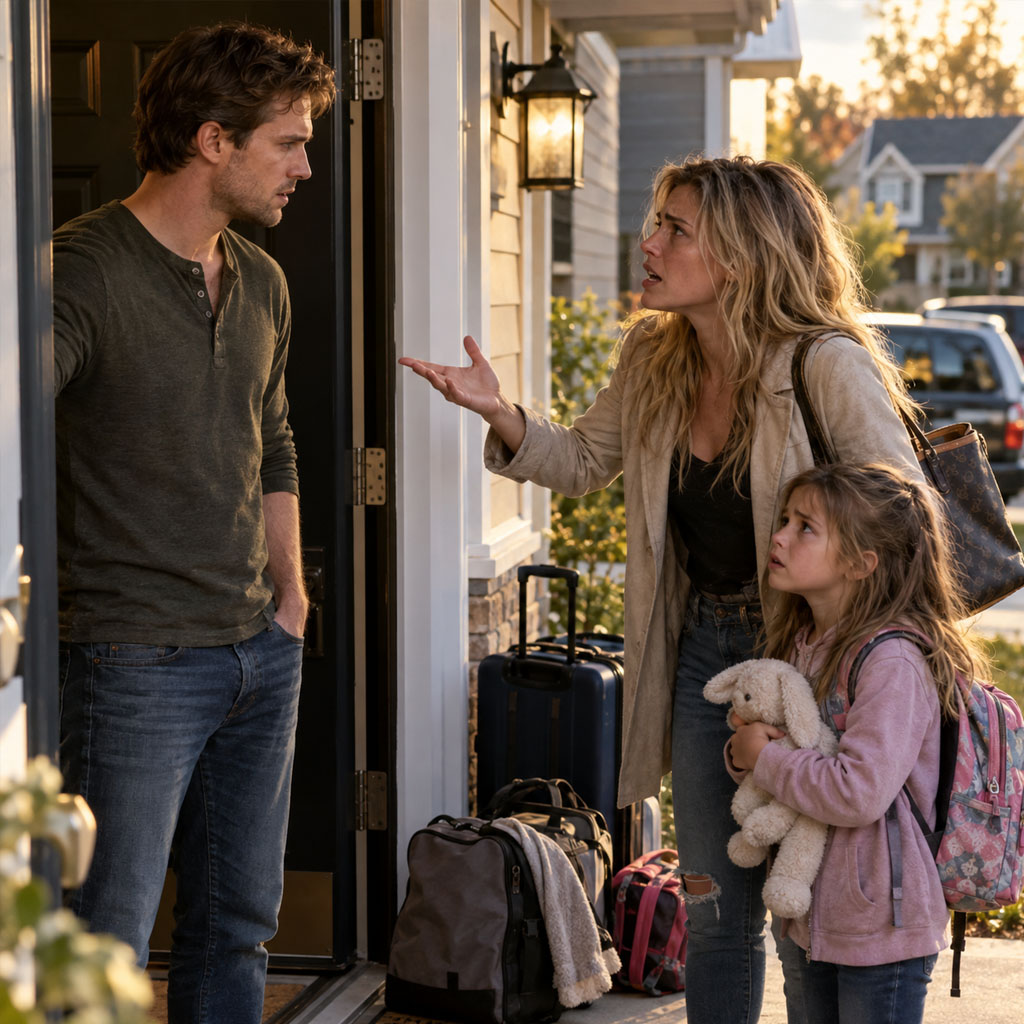
Four days later, I was mowing my front lawn when Vanessa’s SUV turned into my driveway.
Another SUV followed.
Then Richard’s pickup appeared, pulling a small utility trailer stacked with boxes.
I shut off the mower.
Vanessa climbed out wearing sunglasses and waved as if she had arrived for a cookout.
“Perfect timing.”
Two cousins began unloading storage bins. My aunt carried grocery bags toward the porch. Three children spilled from the vehicles, confused and restless.
I walked toward Vanessa.
“What is this?”
“We’re moving in.”
She said it casually.
I genuinely thought I had misunderstood.
“No, you’re not.”
She removed her sunglasses.
“Everybody talked about it.”
“Everybody except the person who owns the house?”
One cousin froze with a box in his hands.
Vanessa sighed.
“Don’t start.”
“Start what?”
“Being difficult.”
I turned toward Richard.
“Did you tell them I changed my mind?”
His face reddened.
“Not exactly.”
My cousin slowly lowered the box.
“What does ‘not exactly’ mean?”
Vanessa stepped between us.
“We figured once we got here, Nathan would stop making this into some big principle.”
That was when I understood the plan.
This was not a misunderstanding.
It was an ambush.
She believed I would be too embarrassed to say no in front of relatives and children. Once the furniture crossed my doorway, the argument would become about whether I could force a struggling mother and three kids back out.
She had spent her entire life learning which pressure points made people surrender.
She thought she knew mine too.
I walked past everyone, entered the house, and locked the door.
Thirty seconds later, my phone rang.
Vanessa.
“Open the door.”
“No.”
“The kids are standing outside.”
“You brought them here.”
“You’re really doing this?”
“Yes.”
She hung up.
Knocking started almost immediately.
Then Richard called through the door.
“Nathan, can we talk?”
I opened the door just far enough to step outside, then closed it behind me.
Richard looked exhausted.
“Son—”
“Don’t call me son while you’re helping somebody move into my house after I said no.”
His face changed.
“I didn’t think it would go this far.”
“You brought a trailer.”
He glanced toward it.
“Vanessa said you’d reconsider.”
“I said no three times.”
My aunt looked at Vanessa.
“Wait. You told us he was being stubborn, but I thought there had been another conversation.”
“There was,” Vanessa said quickly.
“No, there wasn’t.”
I pulled out my phone.
I had kept my mother’s messages.
Mom: Please reconsider. The kids are having a hard time.
Me: I’m sorry they’re struggling, but Vanessa cannot move into my house.
Mom: What if it’s only temporary?
Me: No.
Mom: Richard thinks you may feel differently after a few days.
Me: I will not.
I handed the phone to my aunt.
She read silently.
Then she gave Vanessa a long look.
“You knew he said no.”
“He’s making this sound worse than it was.”
“How?”
Nobody answered.
I turned toward the rest of the family.
“Did anyone ask how much rent Vanessa planned to pay?”
Silence.
“Utilities?”
Nothing.
“How long she planned to live here?”
My cousin looked embarrassed.
“A few months, I thought.”
I looked at Vanessa.
“How long?”
She crossed her arms.
“Until I’m stable.”
“What does that mean?”
“I don’t know.”
“Six months?”
She looked away.
“A year?”
No answer.
“Two years?”
“Stop interrogating me.”
That was enough.
The cousin holding a storage bin carried it back to the trailer.
“I’m staying out of this.”
Another cousin followed him.
Vanessa’s face tightened.
“Are you serious?”
My aunt put the grocery bags back into her vehicle.
“You told us Nathan had basically agreed.”
“I said he would come around.”
“That is not the same thing.”
Vanessa looked around at the people who had arrived as her audience and realized they were becoming witnesses instead.
Her voice rose.
“You’re all abandoning me!”
Richard stepped forward.
“Vanessa—”
“No! You said you were going to handle him.”
Handle me.
The words hung in the air.
Richard closed his eyes.
Then, for perhaps the first time in my life, he raised his voice at his daughter.
“Enough.”
Everyone stopped.
Even the children became quiet.
Richard looked at Vanessa.
“He told us no. I should have respected it. We’re leaving.”
Vanessa stared at him.
“You’re choosing him?”
Richard’s shoulders dropped.
“I’m choosing what’s right.”
Something changed in that driveway.
For decades, Richard had believed keeping peace meant convincing the more reasonable person to give way.
That person had usually been me.
If Vanessa was angry, somebody else adjusted.
If Vanessa complained, somebody else compromised.
If Vanessa wanted something badly enough, everyone learned that resisting her cost more energy than surrendering.
But now Richard finally saw what that lesson had created.
Vanessa pointed at me.
“You’ve been waiting for this.”
“For what?”
“To get revenge because I never treated you like a brother.”
I almost laughed.
Instead, I stepped closer.
“You’re right about one thing. You never treated me like a brother.”
She stopped.
“For twenty-two years, you corrected anyone who called us family. You told your friends I wasn’t related to you. You taught your children not to call me Uncle Nathan.”
Her face reddened.
“But now that you need something, suddenly I’m your brother. So which is it, Vanessa?”
She opened her mouth.
Nothing came out.
Then I asked the question no one had apparently considered.
“If I’m selfish for refusing to give Vanessa my house, why doesn’t one of you give her yours?”
The driveway became very quiet.
Chapter 3
My aunt spoke first.
“Our condo only has two bedrooms.”
I nodded.
“That sounds reasonable.”
One cousin rubbed the back of his neck.
“My landlord doesn’t allow extra occupants.”
“Also reasonable.”
Another cousin explained that his own family already had four children at home.
I looked around.
“Every one of you has a valid reason for not moving Vanessa into your home. Somehow, I’m the only one whose reason isn’t allowed to count.”
Nobody challenged me.
Vanessa began crying.
For a moment, I felt genuine sympathy. Her marriage had fallen apart, her financial security had vanished, and her children were caught in circumstances they did not create.
I did not blame them for any of it.
Then Vanessa pointed at me.
“If you acted like family, none of this would be happening.”
The sympathy disappeared.
“No. If Kyle hadn’t left, if you had cut expenses when the business started failing, if you had looked for work three months ago, or if you had accepted my answer the first time, none of this would be happening in my driveway.”
She shook her head furiously.
“You always thought you were better than me.”
“No. I learned that I was responsible for myself.”
“You got lucky.”
I looked at my house.
I remembered seventeen-year-old me stocking shelves on Friday nights. I remembered college shifts that ended after midnight. I remembered choosing savings over vacations and spending weekends rebuilding walls instead of relaxing.
“Luck helped,” I said. “But this house wasn’t handed to me.”
My mother’s car pulled up before Vanessa could respond.
Mom stepped out carrying grocery bags, took one look at the trailer, the relatives, and the boxes being reloaded, and immediately understood that something had happened.
She walked toward me.
“Are you okay?”
“I’m fine.”
Then I looked at her carefully.
“But this can never happen again.”
She nodded.
Vanessa rushed toward her.
“Mom, tell him!”
Mom surprised everyone.
“No.”
Vanessa stopped.
Mom put her purse down on the hood of her car and faced the relatives.
“Nathan never agreed to this.”
Vanessa stared at her.
Mom continued.
“I asked him several times. Richard asked him. Nathan said no every time.”
My oldest cousin looked at Vanessa.
“You told us he agreed.”
“I said he’d change his mind.”
“No,” my cousin said. “You said we were helping you move.”
Vanessa’s face crumpled.
Mom looked at me.
“I’m sorry. I kept giving Vanessa hope because I didn’t want to disappoint her. That wasn’t fair to you.”
Those words mattered more than she probably realized.
For years, my mother had explained Vanessa’s behavior instead of confronting it.
She was adjusting.
She was stressed.
She was emotional.
She was going through something.
Every excuse had sounded compassionate by itself. Together, they had taught Vanessa that discomfort erased responsibility.
Now my mother was finally refusing to translate “no” into “maybe.”
Within ten minutes, every box was back in the vehicles.
The relatives left one by one.
Some apologized.
Some avoided eye contact.
Nobody called me selfish anymore.
Soon only Mom, Richard, Vanessa, the children, and I remained.
Vanessa stood beside her SUV looking furious and humiliated.
Richard approached her.
“We’re going home.”
“I’m not going anywhere with you.”
“Then where are you going?”
She had no answer.
That was the tragedy beneath all her anger. Vanessa had spent so much energy trying to force someone else to solve her problem that she had not developed an actual plan.
One of her children, an eleven-year-old boy named Mason, quietly asked, “Mom, are we sleeping here?”
Vanessa looked at him.
“No, honey.”
He looked toward me.
I hated that he was in the middle of this.
I crouched slightly so I wasn’t towering over him.
“None of this is because of you, okay?”
Vanessa snapped, “Don’t talk to my son.”
I stood again.
“Fine.”
That evening, after everybody finally left, I sat alone on my rebuilt deck.
The yard was quiet.
For the first time all day, I could hear birds.
I expected to feel victorious.
Instead, I felt tired.
Boundaries sound simple when people discuss them from a distance. Say no. Stand your ground. Don’t let people use you.
Nobody talks as much about what happens afterward, when people you love are hurt, children are involved, and part of you wonders whether surrender would have been easier.
Maybe it would have.
But easier is not always better.
Chapter 4
The next afternoon, Richard returned alone.
He did not bring Vanessa.
He did not ask to come inside.
He stood on my porch and said, “I owe you an apology.”
I waited.
“I should have accepted your answer the first time.”
“Yes.”
He nodded as if he expected nothing less.
Then he looked toward the driveway where the trailer had been.
“I’ve been doing this her whole life.”
“Doing what?”
“Giving in.”
He sat on the porch step.
“When Vanessa was little, after her mother and I divorced, I felt guilty. I only saw her part of the week. I told myself she had already lost enough, so I didn’t want to be the parent always saying no.”
He rubbed his hands together.
“Then she got older, and arguing with her became exhausting. So I started asking everyone else to compromise.”
I sat beside him.
“You asked the person least likely to cause trouble to absorb the trouble.”
He looked at me.
“That’s exactly what I did.”
For several seconds, neither of us spoke.
“I thought I was keeping the family together,” he said.
“You were teaching her pressure works.”
“I know that now.”
That acknowledgment did not erase the past, but it changed something.
Richard apologized for the years when I had been expected to tolerate Vanessa because confronting her would upset the household. He apologized for allowing her to say I was not family without meaningful consequences.
I told him the truth.
“One conversation doesn’t fix twenty years.”
“I know.”
“If we’re going to have a relationship, I’m not going to be the automatic compromise anymore.”
“You shouldn’t be.”
It was the first time I could remember him saying that.
My relationship with Mom changed too.
She stopped calling me to report every crisis in Vanessa’s life. She stopped suggesting I “be the bigger person,” a phrase I had learned usually meant the person behaving badly got to continue while everyone else proved their maturity by tolerating it.
Most importantly, my parents stopped rescuing Vanessa from every consequence.
Richard gave her a deadline.
She needed to find work, apply for child support, make a budget, and begin saving for housing.
Vanessa was furious.
For several weeks, she accused everyone of abandoning her.
Nobody did.
They simply stopped solving problems she could solve herself.
Eventually, a former coworker of Richard’s helped her get an office position at a construction supply company. It was not glamorous, but it had health insurance and steady hours.
She finally filed for child support.
She sold the luxury SUV she could no longer afford and bought a used Honda.
Several months later, she rented a small townhouse with two bedrooms. The boys shared one room, and her daughter slept in the other while Vanessa used a pullout couch in the living room for a while.
It was not the life she had imagined.
But it was hers.
My mother told me Vanessa cried the day she received the keys.
Not because she hated the place.
Because it was the first thing in months that made her feel as though she had some control again.
I was glad for her.
I did not call.
She did not call me.
Some relationships are not repaired simply because the crisis ends.
Sometimes distance is the healthiest form of peace available.
Chapter 5
About six months after the driveway incident, Mom came over for dinner.
She brought a casserole, as mothers from Ohio seem constitutionally required to do when emotions are involved.
After we ate, she stood in the kitchen looking at the cabinets I had installed years earlier.
“I owe you something too,” she said.
“You already apologized.”
“Not for everything.”
I leaned against the counter.
She folded the dish towel twice.
“I spent years telling you to understand Vanessa because understanding her was easier than correcting her.”
I said nothing.
“I thought you were stronger.”
“I was.”
“I know. That’s why I leaned on you.”
That sentence landed harder than I expected.
She looked at me with tears in her eyes.
“I thought because you could handle unfairness, asking you to handle a little more was harmless.”
I nodded slowly.
“That’s what people do to the dependable person.”
“I’m sorry.”
I hugged her.
Not because the past disappeared.
Because she finally understood it.
There was one more change I made after that summer.
I replaced the locks.
I added security cameras.
And I asked Mom to return the spare key I had once given her.
She looked hurt for a moment.
Then she reached into her purse and handed it over.
“Fair enough.”
It was not punishment.
It was a boundary.
A boundary is not a weapon. It is simply a clear statement about where one person’s authority ends and another person’s life begins.
My relatives eventually stopped discussing the incident. A few even admitted privately that they had been embarrassed by how quickly they believed Vanessa’s version without calling me.
One cousin told me, “When she said the kids were basically homeless, I pictured you refusing to let them stay for a weekend.”
“That’s what she wanted you to picture.”
“I should’ve asked.”
“Yes.”
He nodded.
No argument.
That was enough.
Vanessa and I still do not speak.
I occasionally hear about her through Mom. She has kept her job, moved into a slightly larger rental, and apparently become far more careful with money.
Her children are doing well.
That matters to me, even if their mother and I never rebuild anything.
People sometimes ask whether I regret not letting her stay because children were involved.
I don’t.
I would have helped the children in reasonable ways. I would have paid for groceries during an emergency, helped find an apartment, repaired a car, or watched them for an afternoon if Vanessa had asked respectfully.
But that was not what she wanted.
She wanted ownership without owning anything.
She wanted authority over a house she had not purchased.
She wanted my years of sacrifice converted into her emergency solution because she believed my life required less space than hers.
And when I refused, she tried shame.
When shame failed, she tried relatives.
When relatives failed, she showed up with a trailer.
That was never a request for help.
It was an attempt to remove my right to say no.
A year later, Richard and I were repairing a section of fence in my backyard when he stopped hammering and looked toward the house.
“Remember when Vanessa said this place was too big for you?”
I laughed.
“Unfortunately.”
He smiled.
“She always wanted what looked easy.”
“This wasn’t easy.”
“I know.”
That meant something coming from him.
We finished the fence around sunset.
Before leaving, Richard stood beside his truck and said, “I’m proud of you.”
I raised an eyebrow.
“For the fence?”
“For not becoming bitter.”
I thought about that.
Maybe part of me had been bitter.
But bitterness and boundaries are not the same thing.
I did not need Vanessa to lose for me to win. I did not need her children to suffer or my relatives to choose sides. I simply needed everyone to understand that compassion was not permission to take from someone who said no.
My house is still mine.
The office is still an office. One bedroom is for guests. The other contains an old exercise bike I use less often than I claim.
Maybe Vanessa was technically correct that I do not “need” every square foot.
That was never the point.
People do not earn a claim on what belongs to you simply because they can imagine using it better.
And family does not mean surrendering every boundary until resentment is the only thing left.
Looking back, I realize Vanessa’s attempt to move in was not really about a house.
It was the final version of the same question I had been asked since childhood.
Would I give in because Vanessa was louder?
Would I sacrifice my comfort because she was angry?
Would I make myself smaller so everybody else could avoid an unpleasant conversation?
For years, the answer had been yes.
That Saturday, standing in my driveway while relatives unloaded boxes I had never agreed to accept, something finally changed.
I stopped trying to prove I was good by allowing people to treat me unfairly.
I stopped confusing peace with surrender.
And I understood that sometimes the kindest word you can say—to yourself and even to the person demanding too much—is the one word nobody in my family had taught Vanessa how to accept.
No.
THE END.
⚠️ All characters and events are fictional. Do not imitate or apply them in real life. 😌😌😌


