
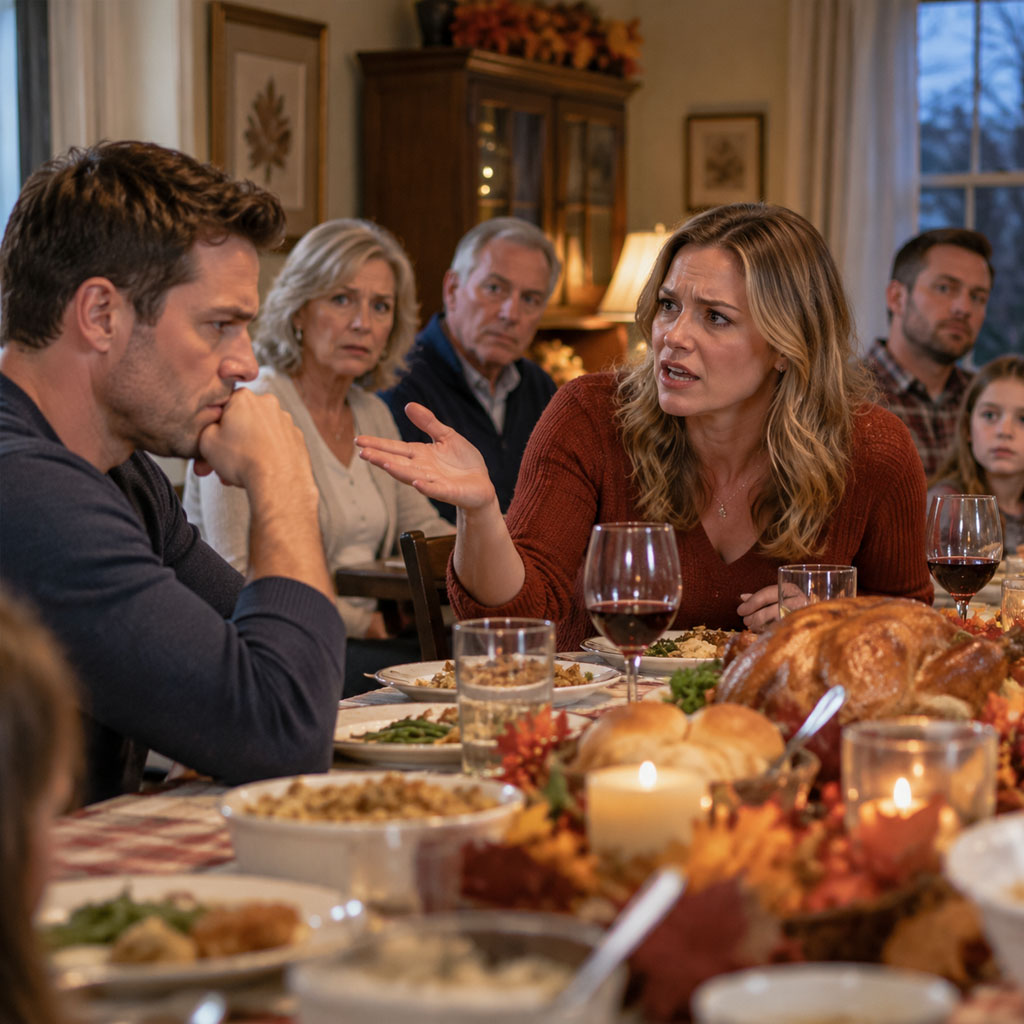
Chapter 2
Nobody answered.
My mother looked at my father, then back at me.
“What do you mean?”
“I mean the homeowners insurance payment. The one that’s been coming out of my account every month.”
My father shifted in his chair.
“Dave, that’s not something we need to discuss at dinner.”
“Interesting. You had no problem discussing my bank account at dinner.”
Melissa rolled her eyes.
“Here we go. He’s going to make himself a hero because he helped out a little.”
“A little?”
I pulled out my phone and opened my banking records.
“One hundred eighty-nine dollars a month. For five years. It started when Dad lost his job at 57 and called me because you were worried about losing the house.”
My mother went pale.
I continued.
“That’s over $11,000 just for the insurance. I’ve also covered utility bills when things got tight. Another few thousand dollars there.”
My father opened his mouth.
I didn’t give him a chance.
“And Melissa, remember last March when your bank account was overdrawn and you thought Todd’s car was about to be repossessed? That was $4,200.”
Her expression changed.
“That was a loan.”
“Was it? Because I haven’t seen a dollar.”
She looked down.
“And the $3,700 for Todd’s dental emergency the December before that? That was me too. Your insurance had lapsed.”
Todd finally turned away from the television.
“What does that have to do with anything?”
I looked at him.
“Quite a lot, actually.”
I unlocked another page on my phone.
“In the last eight months alone, I’ve sent Melissa more than $6,300 for the kids’ expenses. Soccer, school supplies, medical bills, transportation, and everything else that apparently becomes an emergency whenever your money runs out.”
Melissa’s face tightened.
I continued.
“And while I’m helping pay for your children’s necessities, you’re spending half the household income on hobbies.”
Todd sat up straighter.
“Watch what you’re saying.”
“Why? Is it inaccurate?”
He stared at me.
I knew about his expensive equipment, his drone racing investment, and the various projects he’d abandoned after spending thousands of dollars.
I hadn’t said anything before because I didn’t want the children caught in the middle.
But apparently, silence had made everyone believe I was stupid.
Todd’s face turned red.
Melissa looked genuinely surprised.
“Wait. You told me Mom and Dad were helping with most of those expenses.”
Todd looked at her.
For the first time that evening, the two of them seemed to be having a conversation without words.
Apparently, he’d been telling her one thing while telling me another.
I leaned back.
“None of you ever asked how I was doing after Jennifer left. Not one person asked whether I could afford the legal bills, whether I was sleeping, or whether I was okay after losing the house we’d bought for our children.”
My voice became tighter.
“I spent three years trying to become a father. Three years of treatments and appointments. Then my marriage collapsed, and I was left paying off the debt from a future that never happened.”
Aunt Patty reached across the table and gently touched my arm.
“Oh, Dave. We didn’t know.”
I looked at her.
“That’s exactly the problem. Nobody bothered to know.”
My brother Mike suddenly became interested in his mashed potatoes.
“Come on, Dave,” he muttered. “I’m sure Melissa didn’t mean it like that.”
I turned toward him.
“Don’t. You’ve never had my back, Mike. Don’t start pretending now.”
Then I looked at my sister.
“You want automatic payments? Here’s my answer. No.”
She shook her head.
“You’re being ridiculous.”
“Actually, I’m being very clear. I have a life, Melissa. I have bills, debts, goals, and things I want to do. Having no children doesn’t mean I have no responsibilities.”
My father raised his voice.
“You’re overreacting. We’re family.”
I almost smiled.
“Tell me one time in the last four years that any of you called me because you wanted to know how I was doing. Just one.”
Silence.
Not a single person answered.
I stood up.
“So yes, I have an $18,000 bonus. And no, you aren’t getting any of it. Neither is anybody else at this table.”
My mother started using the calm voice she’d relied on since I was a teenager.
“Dave, please. Let’s not ruin Thanksgiving.”
I picked up my jacket.
“You already did that.”
Melissa suddenly stood, knocking her wineglass sideways.
“What about the kids? They were excited to see you!”
I looked toward the kitchen, where the children were eating at their own little table.
I’d brought gifts for all three of them. Video games for Aiden and Emma, and a stuffed animal Lily had wanted when we’d gone shopping together months earlier.
“I bought them presents. They’re in my car. I’ll leave them on the porch.”
Then I walked out.
My mother called after me. My father ordered me to come back. Melissa accused me of abandoning everybody.
I kept walking.
I placed the gifts neatly on the porch, got into my car, and started the three-hour drive back to Seattle.
For the first hour, I was furious.
I turned up Metallica and let the music drown out the arguments still playing in my head.
By the time I reached my condo around 1 a.m., the anger had settled into something colder.
Clarity.
I opened my laptop.
As a project manager, I document everything. It was a habit I’d developed at work, but I’d also kept records of the money I’d lent my family.
Every transfer. Every bill. Every written promise to repay me.
I had records showing that Melissa had borrowed more than $42,000 over the previous three years. My parents had received nearly $30,000 in loans and financial assistance.
Almost none of it had been repaid.
I stared at the numbers for a long time.
Then I started making changes.
First, I called my bank and moved my money into new accounts at another institution.
Next, I went through every automatic payment.
The $247 monthly utility payment to my parents’ house? Canceled.
The family phone plan, covering six lines for $112 a month? Canceled.
My parents’ homeowners insurance? Canceled.
The $300 automatic transfer to Melissa on the fifteenth of every month? Canceled.
When I finished, I’d eliminated more than $1,100 in monthly financial support.
And that didn’t include the random emergencies.
I printed my records and contacted my attorney. Together, we prepared a formal letter explaining that I was forgiving the outstanding family loans but terminating all future financial assistance.
I wasn’t going to spend the next ten years chasing relatives through court.
I simply wanted my money, my time, and my life back.
Then I noticed something on my desk.
A brochure from a motorcycle dealership.
I’d wanted a Ducati for years. Every time I got close to buying one, someone in my family needed money.
I picked up my phone and added a reminder to visit the dealership the following week.
For once, I was going to spend money on something I wanted.
The next morning, my phone began buzzing.
Mom: Dave, there’s something wrong with the internet and the utility payment.
Dad: Son, did you change the insurance payment?
Melissa: What the hell? My phone isn’t working!
I didn’t respond.
For the first time in years, I went to work without wondering whose financial emergency I was going to solve during lunch.
Three days later, someone started pounding on my condo door.
“Dave! Open this door!”
I recognized Melissa’s voice immediately.
I opened it.
She stood in the hallway wearing an old Oregon Ducks sweatshirt, her hair messy and her eyes red.
“How could you do this to us?”
I stepped aside, and she marched into my living room.
“Emma’s school called because her lunch account is empty. The internet’s been shut off. Todd’s car got repossessed this morning!”
I folded my arms.
“That sounds difficult.”
She stared at me.
“Difficult? We can’t pay everything!”
“Then you and Todd need to figure out your finances.”
She looked around my condo, her eyes settling on the new television I’d bought with part of my bonus.
“So you can spend thousands on yourself, but your family gets nothing?”
I actually laughed.
“Yes, Melissa. That’s how spending your own money works.”
She started crying.
“The kids need clothes. Mom and Dad are panicking about the insurance. Please, Dave. We’re family.”
I walked into my office and returned with an envelope.
“Here’s something for you.”
She opened it.
Inside were the legal letter, copies of the transfers, and a detailed record of every loan she’d received from me.
She flipped through the pages, growing quieter with each one.
“What is this?”
“Your independence package.”
Her eyes filled again.
“You can’t do this.”
“I already did.”
“But we’re your family!”
I held the front door open.
“You’re people who share my DNA. That’s not the same as people who care about me.”
She stood there for several seconds, clutching the envelope.
Then she stormed out, slamming the door hard enough to rattle the pictures on my wall.
I locked the deadbolt.
For the first time in years, my home felt peaceful.
Chapter 3
I knew Melissa wouldn’t be the last person to show up demanding an explanation.
My parents had spent years treating my financial help as part of their household budget. They weren’t going to accept its disappearance quietly.
So I made a few more changes.
I changed my phone number, personal email, and social media privacy settings. I upgraded the security system in my building, changed the locks, and asked the front desk not to admit anyone claiming to be a relative without my permission.
I blocked everybody except Aunt Patty.
I wasn’t hiding from them. I was protecting my peace.
Then I took a week off work.
On the first day, I visited the Ducati dealership.
I’d been eyeing a matte-black Ducati Sport Classic, and the moment I saw it in person, I knew I’d found the bike I wanted.
It cost $16,000.
I paid cash.
The salesman looked almost offended by how quickly I completed the paperwork.
The first ride was incredible.
I took the motorcycle out on the mountain roads beyond Seattle, following the curves and listening to the engine beneath me. There was no phone buzzing with requests, no one asking me to cover an overdue bill, and no reason to hurry home.
I stopped at an overlook as the sun began to set.
The city lights slowly appeared below me.
For the first time since my divorce, I felt as though my life belonged to me.
When I returned to work, I was more focused than I’d been in years.
I wasn’t checking my phone every twenty minutes. I wasn’t taking calls during meetings to discuss somebody else’s overdraft fees. I wasn’t spending my evenings reviewing family bills.
I could finally concentrate on the work I was actually paid to do.
Three months later, I was promoted to senior program manager with a 30% salary increase.
My boss congratulated me after I successfully delivered another troubled project ahead of schedule.
“Whatever changed in your personal life, keep doing it,” he said.
I laughed.
“I think I finally learned how to manage my priorities.”
I bought myself a limited-edition mechanical watch, renovated my condo, and invested the money I’d previously been giving away.
I replaced the kitchen cabinets, installed black granite countertops, upgraded the appliances, and put in beautiful hardwood floors.
My office became the room I’d always wanted, complete with dual ultrawide monitors and a comfortable chair that cost more than I once thought reasonable.
I bought a Peloton, joined a kickboxing gym, and started hiking on weekends.
I also made friends.
Real friends.
People who invited me to dinner because they enjoyed my company, not because they needed me to cover the bill.
One Saturday, I ran into my neighbor Ryan in the garage. He was an architect who also rode motorcycles.
We started talking about the Ducati, and within twenty minutes, we were planning a weekend ride with a group of other riders.
It felt strangely refreshing to spend time with people whose conversations didn’t revolve around financial emergencies.
Aunt Patty remained my only connection to the old family circle.
We spoke about once a month.
My parents had eventually moved out of their house and into a smaller apartment because they couldn’t maintain the expenses without my help.
Melissa and Todd were fighting constantly.
“Todd’s spending hasn’t changed,” Patty told me one afternoon. “And Melissa keeps asking where all the money went.”
I shook my head.
“She should probably ask her husband.”
“I think she’s finally starting to understand how much you’ve been covering.”
I was quiet.
The children still crossed my mind sometimes.
Aiden, Emma, and Lily weren’t responsible for their parents’ decisions. They hadn’t asked to be born into a household where every unexpected expense became a family crisis.
“Are the kids okay?” I asked.
“They’re fine, sweetheart. Melissa’s had to get creative with budgeting. They don’t have every expensive gadget anymore, but they’re eating, they’re going to school, and they’re doing all right.”
That helped.
I didn’t want those children to suffer.
But I also understood that sending Melissa money would reopen the same door I’d spent months trying to close.
And I knew exactly where that would lead.
About six months after Thanksgiving, I met someone.
Her name was Elise. She was originally from the Czech Republic and worked as a pediatric surgeon.
We met at my kickboxing gym.
The first thing I noticed was her determination. She could hit a heavy bag with perfect technique, and she didn’t seem remotely interested in impressing anybody.
After class, I noticed her struggling with her gym bag while checking her phone.
“Need a hand?”
She looked at me.
“I can manage my own bag. But you can buy me a protein shake if you want.”
I laughed.
“Fair enough.”
We started talking.
There was something different about her. She was direct, independent, and comfortable saying exactly what she thought.
We started dating, and after a few months, I told her about my divorce and the situation with my family.
We were making dinner at my condo when I finally explained everything.
She listened without interrupting.
When I finished, she set down the knife she’d been using to chop vegetables.
“Dave, that’s not love. That’s exploitation.”
I looked at her.
“Sometimes I still feel guilty.”
“Of course you do. They trained you to feel responsible for everything.”
That sentence stayed with me.
Elise had her own career, her own money, and her own life. She didn’t expect me to pay for her groceries or solve her problems. When we went out, we split expenses naturally. When we eventually decided to move in together, we sat down and agreed on a fair arrangement for the household bills.
It was the simplest thing in the world.
And somehow, it felt revolutionary.
We had morning workouts, weekend motorcycle rides, quiet evenings cooking together, and conversations that didn’t end with someone asking for money.
Elise rode a Triumph Street Triple, and she handled it beautifully.
A year after we met, we decided to build a life together.
Then Aunt Patty called with some news.
“Melissa found your Instagram.”
I sighed.
“How?”
“She searched around. She saw the pictures of your condo and the motorcycle. She knows you’re doing well.”
Two days later, emails began arriving at my work address.
My mother wrote that she missed me and wanted me to come home for Christmas.
My father said the family wasn’t the same without me.
Melissa’s message was longer.
She wrote that the children asked about Uncle Dave and didn’t understand why he had disappeared.
I read them all.
I didn’t reply.
Their sudden interest in me was remarkably well-timed.
For two years, they hadn’t cared whether I was alive or dead. But now that my financial situation had improved, they suddenly remembered how important family was.
A week later, they took things further.
I was sitting in a meeting when my assistant sent me a message.
“Your parents and sister are in the lobby. They say it’s urgent. Should I send them up?”
I stared at the screen.
Then I typed:
“Absolutely not. Please tell them I’m unavailable.”
They refused to leave.
Security eventually escorted them out, and I left through a rear entrance to avoid another confrontation.
That evening, I told Elise what had happened.
She listened while holding my hand.
“They’re desperate,” she said. “They lost their safety net, and they don’t know how to accept it.”
“I just want them to leave me alone.”
“Then stop living as though you owe them an explanation.”
She was right.
The next day, I posted a picture of Elise and me standing beside our motorcycles in the mountains.
We looked happy.
Because we were.
I didn’t write anything about my family or the past. I simply shared a photograph of the life I’d built.
A few months later, I proposed to Elise on a cliff overlooking the Pacific during a quiet weekend getaway.
There were no photographers, no expensive decorations, and no audience.
Just the two of us.
She said yes.
We eventually bought a beautiful house in a quiet neighborhood. It had modern architecture, enormous windows, a home office, and a backyard that opened onto a green ravine.
For the first time, I had the home I’d always wanted without the financial anxiety I’d once associated with owning one.
I had savings.
I had security.
And I had someone beside me who loved me without expecting me to rescue her.
Then Easter arrived.
Chapter 4
Elise and I decided to host a barbecue for friends.
I’d gotten into smoking meat as a hobby, and that morning I was working on a brisket in the backyard.
Ryan and his wife were there, along with a few coworkers and friends from the kickboxing gym.
The yard was full of conversation, laughter, and the smell of barbecue.
Nobody was asking me to pay their bills.
Nobody was keeping track of what I earned.
People were simply happy to be there.
I was standing beside the smoker when the doorbell rang.
Elise went to answer it.
A moment later, she returned with a concerned expression.
“Dave, your family is here.”
I put down the tongs.
“Which family?”
She gave me a look.
“Your parents. Melissa too.”
I walked through the house and looked outside.
There they were.
My father stood at the front of the porch, looking older and grayer than I remembered. My mother had tears in her eyes. Melissa stood beside them, wearing the same expression I’d seen countless times before: a mixture of entitlement and desperation.
“Surprise!” my mother said.
I stared at them.
“How did you get my address?”
My father looked uncomfortable.
“Your aunt. We begged her to tell us. We said it was an emergency.”
I felt a little disappointed that Patty had given in, but I understood how difficult it must have been to hear them pleading.
I stepped outside and closed the door behind me.
Through the windows, I could see our friends talking in the backyard. Ryan was standing beside the grill, and Elise was watching me through the glass.
I checked my watch.
“You have two minutes.”
My father cleared his throat.
“Son, we’ve been doing a lot of thinking. We know we took you for granted. We want to make things right.”
My mother stepped forward.
“We miss you so much. The family isn’t whole without you.”
I looked at Melissa.
“Where’s Todd?”
She looked away.
“We’re separated.”
I nodded.
I wasn’t surprised.
Then I heard a car door slam.
A familiar voice followed.
“Well, look who’s home.”
Todd walked toward the porch wearing a faded sports jacket. He looked older, heavier, and considerably less confident than the man who’d spent Thanksgiving ignoring his children while demanding my money.
I gave him a flat smile.
“Well, if it isn’t Mr. Full-Time Hobby.”
His expression hardened.
“Very funny.”
“Thanks. I’ve had practice.”
He stepped closer.
“Dave, you think you’re something special now? You just abandoned your family and left everybody to fend for themselves.”
I actually laughed.
“Abandoned? Todd, remind me how many times Melissa called me because your paycheck disappeared or one of your passion projects went over budget.”
He folded his arms.
“That’s between me and my wife.”
“Interesting. Because for years, it was apparently between me and my bank account.”
He looked toward Melissa.
She said nothing.
I continued.
“How did that drone racing investment work out, by the way?”
His jaw tightened.
“You don’t know anything about what I’ve been through.”
“I know plenty. I know about the money I sent for your dental emergency. I know about the school expenses, the car payments, and the thousands of dollars your wife needed because you couldn’t keep your spending under control.”
He started to speak.
I raised my hand.
“No. You’re not going to turn this into a story about how unfairly you’ve been treated.”
I looked him directly in the eyes.
“You spent ten years teaching your children that being loud was the same as being right. You treated your wife like a financial manager, and you treated me like a backup credit card.”
Todd’s face turned red.
Melissa finally spoke.
“Dave, please. We didn’t come here to fight.”
I turned toward her.
“Then why did you come?”
She swallowed.
“I know I made mistakes. But we’re blood. You can’t just throw that away.”
“The kids miss you.”
I looked at her for a long moment.
I believed her about the children.
I knew they probably did miss me. I remembered Aiden showing me his school projects, Emma talking endlessly about dance class, and Lily asking me to help build her Lego sets.
I missed those moments too.
But I also remembered how easily my sister had used their needs to manipulate me.
“Melissa, I haven’t forgotten the kids. I haven’t forgotten any of them.”
“Then why won’t you help?”
I leaned against the porch railing.
“Because helping you has never actually helped them. It has helped you avoid dealing with your responsibilities.”
She looked hurt.
My father stepped in.
“Dave, we’re trying to bring the family back together.”
I shook my head.
“Where was this family when Jennifer left? Where were you when I lost the house? Where were you when I was paying off years of fertility treatments and trying to figure out how to rebuild my life?”
My mother began crying.
“We didn’t know how much you were hurting.”
“You never asked.”
I let the words sit between us.
“For two years, nobody called to see whether I was okay. Nobody asked if I needed help. Nobody invited me over just to spend time together.”
I looked at Melissa.
“But the moment I had a bonus, suddenly I was expected to fund your children’s future.”
She shook her head.
“That’s not fair.”
“No, Melissa. It wasn’t fair when you demanded automatic payments. It wasn’t fair when you treated my lack of children like proof that my money belonged to you.”
My father tried again.
“We’re your parents.”
“And I was your son when you needed me to pay your bills. But apparently, I wasn’t your son when I needed somebody to ask whether I was surviving.”
Through the window, I caught Elise’s eye.
She looked concerned but didn’t move.
I gave her a small nod.
I was okay.
I turned back to the people on my porch.
“Here’s what I don’t understand. I have a career I built myself. I have a woman who loves me. I have friends who show up because they want to spend time with me.”
My mother wiped her cheeks.
“We can change. We can make things right.”
I wanted to believe her.
A younger version of me would have accepted that sentence immediately. He would have opened his wallet, offered another chance, and convinced himself that this time would be different.
But I wasn’t that man anymore.
I had learned that apologies without changed behavior were just another way of asking for more time.
Melissa suddenly lost her composure.
“So that’s it? You’re going to leave us struggling while you sit in that beautiful house living like a king?”
There it was.
The real reason they’d come.
Not to apologize.
Not to reconnect.
Not to ask how I was doing.
They wanted something.
I smiled, but there was no warmth in it.
“You didn’t want me when I was struggling. You wanted what I could give you. Now that I won’t give it, you’re standing on my porch telling me I’m selfish.”
“That’s not true,” she said.
“Then tell me what you want besides money.”
She didn’t answer.
Todd shifted his weight.
My father looked down.
My mother continued crying.
I felt strangely calm.
For years, I’d imagined that if I ever confronted them, I’d be furious. I’d have a thousand things to say, and every sentence would be sharper than the one before it.
Instead, I felt tired.
Not angry.
Just finished.
My father reached toward me.
“Please, son. Don’t turn your back on your family.”
He grabbed my arm.
I gently pulled away.
“Elise is my family. The people inside that house are my family. They show up when it matters.”
I looked at my parents, then my sister.
“You’re people I used to know.”
My mother’s face crumpled.
Melissa looked at me as though she couldn’t understand how I’d become capable of saying no.
I opened the door.
“Take care of yourselves.”
Then I went inside.
I locked the door behind me.
For several seconds, I stood in the hallway listening to the voices outside. Nobody was shouting anymore. They seemed to be running out of arguments.
Elise approached and wrapped her arms around me.
“You okay?”
I held her close.
“Better than okay.”
She kissed my cheek.
“Then come back outside. Ryan’s been guarding your brisket like it’s a national treasure.”
I laughed.
And just like that, I returned to the backyard.
The food was ready, our friends were talking, and somebody had turned up the music.
I picked up the tongs and checked the meat.
Through the kitchen window, I could see my parents, Melissa, and Todd still standing on the porch.
They eventually walked away.
They looked back once, perhaps expecting me to change my mind.
I didn’t.
Their car pulled away, and the driveway became empty again.
That evening, Elise and I cleaned up together.
She put the leftover food away while I washed the utensils.
“Any regrets?” she asked.
I thought about it.
I thought about the Thanksgiving dinner, the phone calls, the money, the years of trying to be the dependable one.
I thought about the house I’d lost, the marriage that had ended, and the family I’d spent so much time trying to impress.
Then I looked around our kitchen.
Our home.
Our life.
“No,” I said. “Not one.”
She smiled.
We finished cleaning and went upstairs.
The next morning, I woke up early and walked into the garage.
My Ducati was parked beside Elise’s Triumph.
She appeared a few minutes later, holding her helmet.
“Ready?”
“Always.”
We rode up the coast, following the road as it curved along the water. The morning air was cool, and the sunlight reflected off the Pacific.
There was nowhere we had to be.
Nobody waiting for a transfer.
No emergency phone calls.
No guilt.
Just the road ahead and the woman I loved riding beside me.
I used to believe family meant never saying no. I thought being a good brother meant sacrificing whatever I had whenever somebody asked.
I was wrong.
Being generous is a choice. Being responsible for other adults is not an obligation. And loving children doesn’t mean allowing their parents to use them as a reason to control your life.
I still hoped Aiden, Emma, and Lily would grow up knowing they were loved.
I hoped their parents would become better at managing their responsibilities.
But I no longer believed it was my job to make everybody else’s life work while mine fell apart.
The people who truly cared about me didn’t need my bank balance.
They needed my time, my laughter, and my presence.
And those were things I was finally able to give without resentment.
Some people believe blood automatically makes a family.
I learned something different.
Family is built through behavior. Through respect. Through showing up when someone has nothing to offer you.
The best revenge wasn’t buying an expensive motorcycle, renovating my home, or earning a bigger salary.
It was waking up every morning without feeling responsible for people who had never taken responsibility for me.
I hadn’t lost my family that Thanksgiving.
I’d finally stopped losing myself trying to keep them happy.
And that was worth more than every dollar I’d ever sent them.
THE END.
⚠️ All characters and events are fictional. Do not imitate or apply them in real life. 😌😌😌


