
Chapter 2
Brittany hung up before I could ask another question.
I sat on the edge of my bed with the phone still against my ear, replaying those five words.
Your mother told me it was.
At first, I assumed Brittany meant Mom had been careless with language. My mother had spent ten years calling the place “Mother’s house,” as if that somehow overruled the deed, Nana’s will, and a court judgment.
But two days later, I discovered carelessness had nothing to do with it.
My grandmother’s next-door neighbor, Mrs. Callahan, called me while I was teaching.
“Jackson,” she said, “I don’t mean to interfere, but there’s a dumpster in your driveway.”
“What?”
“And some men appear to be removing your kitchen.”
I left school as soon as the final bell rang.
A huge construction dumpster sat in the driveway. Inside it were broken drywall, flooring, and the white cabinet doors Nana had installed in the seventies. One of them still had a yellow rectangle above the stove where Nana used to tape her grocery list.
I stood on the sidewalk staring at pieces of my childhood buried under renovation debris.
A building permit was taped inside the window.
Owner: Brittany Hurst.
I called the city.
The woman in the building department checked the property records and became very quiet.
“Mr. Hurst, are you authorizing this renovation?”
“No.”
“Did you sign anything authorizing Ms. Hurst to act as owner?”
“No.”
She asked me to email proof of ownership.
By four that afternoon, an orange stop-work notice was attached to my front door.
Two nights later, Cameron showed up at my apartment.
He stormed inside holding a copy of the notice.
“You shut down our kitchen renovation?”
“Our?”
“Do you know what we’ve spent?”
“No.”
“Forty thousand dollars.”
I stared at him.
“You spent forty thousand dollars renovating my kitchen?”
His face tightened.
“Mom and Dad loaned us the money.”
“Why?”
“Because it’s an investment.”
“In what?”
“The house.”
I waited.
Cameron threw up his hands. “Come on, Jackson. You know Brittany got the house in the divorce.”
“No, she didn’t.”
He stared at me.
“Mom said she did.”
I went to the drawer where I kept important papers and pulled out the divorce judgment.
“Read paragraph seven.”
Cameron grabbed the document.
I watched his expression change.
“The residence is the non-marital property of petitioner,” he read. Then he looked up. “Petitioner means you?”
“Yes.”
He continued.
“Respondent is granted exclusive possession…”
“Possession,” I said. “Not ownership.”
His eyes moved farther down the page.
Then he found the clause about cohabitation.
He read it twice.
Finally, he sat down.
The anger drained out of him so quickly it was almost frightening.
“She told me it was hers.”
“Who?”
“Brittany.”
“And Mom?”
He looked sick.
“Mom said the same thing. She said you let Brittany have it because of Grace.”
“I let Grace remain there temporarily.”
Cameron covered his face.
“I spent Mom and Dad’s retirement money.”
“You spent some of it.”
“Forty grand, Jackson.”
Then he told me something else.
He had quit his job.
Mom had encouraged him to start a small contracting business from the garage, he explained. No rent, a house, Brittany receiving support from me—it was, according to Mom, the perfect opportunity for Cameron to finally build a stable life.
I stared at my brother.
“Tell me how you and Brittany started.”
He looked embarrassed.
“Mom sent me over to fix the porch steps after the divorce.”
That much I knew.
“She kept asking me to help Brittany with things. The fence. The garage door. Little stuff. Then Brittany started feeding me dinner. We talked.”
Cameron rubbed his hands together.
“She didn’t treat me like everybody else does.”
“How does everybody treat you?”
“Like I’m about to ask for money.”
“You usually are.”
He laughed sadly.
“Yeah.”
Mom had encouraged every step, he said. She praised how good Cameron was with Grace. She suggested he stay overnight rather than drive home late. She helped choose the jewelry store where he bought the engagement ring.
She even paid half.
“Did Mom ever tell you about Nana’s will?” I asked.
“No.”
“Did she ever tell you the house was mine?”
“No.”
“What did she say?”
Cameron thought.
“She said it was a shame the house hadn’t stayed where it belonged.”
“Meaning?”
“In the family.”
I stared at him.
“We are the family, Cam.”
He looked at me as if the thought had genuinely never occurred to him.
A few days later, I went to my parents’ house.
Mom was in the kitchen wiping an already spotless counter. Dad stood in the doorway between the kitchen and family room, saying nothing as usual.
“Cam told me about the forty thousand dollars,” I said.
My mother kept wiping.
“He’s an adult.”
“You told him he was getting a house.”
She finally turned around.
For the first time, she told me what Nana’s will had done to her.
“You know what it was like sitting in that lawyer’s office?” she asked. “Hearing my mother give her house to my son?”
“She gave it to me because I cared for her.”
“You think I don’t know that?”
“You barely visited.”
Her expression hardened.
“You got the sweet old woman with her china stories. You didn’t grow up with her. You didn’t hear what she said to me when I was fifteen. You didn’t spend your childhood being told you weren’t enough.”
I didn’t know those things.
For a moment, compassion cracked through my anger.
Then she said, “That house should have been mine.”
“It wasn’t.”
“It was my mother’s.”
“And she chose.”
“She chose wrong.”
Dad stared at the floor.
Mom’s voice shook.
“You walked in with your pills and bedpans and your good intentions, and suddenly everything belonged to you.”
That hurt more than I expected.
Then I said something I regretted almost immediately.
“She asked for you every night.”
Mom froze.
“Every night,” I continued. “For two years. She asked whether you were coming tomorrow. I kept telling her you were busy.”
My mother’s face went white.
“You weren’t busy,” I said. “You just didn’t come.”
She whispered, “Get out.”
So I did.
I sat in my car afterward shaking, knowing what I said was true and also knowing truth can still be used cruelly.
I wished Nana were alive to tell me which kind of truth that had been.
Chapter 3
December became a month of lawyers, evidence, and careful silence.
Brittany’s attorney argued that Cameron had merely stayed at the house occasionally. An engagement, he claimed, represented an intention to marry someday, not proof that two people were already living together.
Lorraine smiled when she read that argument.
“Cam’s apartment lease ended September thirtieth,” she said. “He changed his official address three days later.”
“So?”
“So people can call something a sleepover. Government records tend to be less sentimental.”
She also gave me advice I hated.
“Keep paying support.”
“He’s living with my ex-wife in my house.”
“And the current order says you pay until a judge terminates it.”
“That’s insane.”
“It’s procedure. You want to win cleanly? Follow every order while asking the court to enforce every order.”
So on December first, I sent another payment.
Then I spent Wednesdays making tacos with Grace in my apartment.
I never asked what happened at her mother’s house. I never spoke badly about Brittany, Cameron, or my mother.
One evening Grace put down her taco and asked, “Daddy, is Uncle Cam going to be my new daddy?”
I had been expecting the question.
I still wasn’t ready.
“You only have one daddy, bug. That’s me.”
She watched me carefully.
“Uncle Cam is your uncle. He loves you. The grown-ups are figuring some things out, but none of it is because of you.”
She thought for several seconds.
“Okay.”
Then she asked for more cheese.
That night, I contacted a child therapist.
Brittany agreed to attend the appointment.
The therapist spoke privately with Grace, then brought us into her office.
“She thinks there’s going to be a wedding,” the therapist said. “She’s worried she might have to move. But mostly, she’s afraid she did something wrong at the engagement party.”
Brittany started crying.
“What does she think she did?”
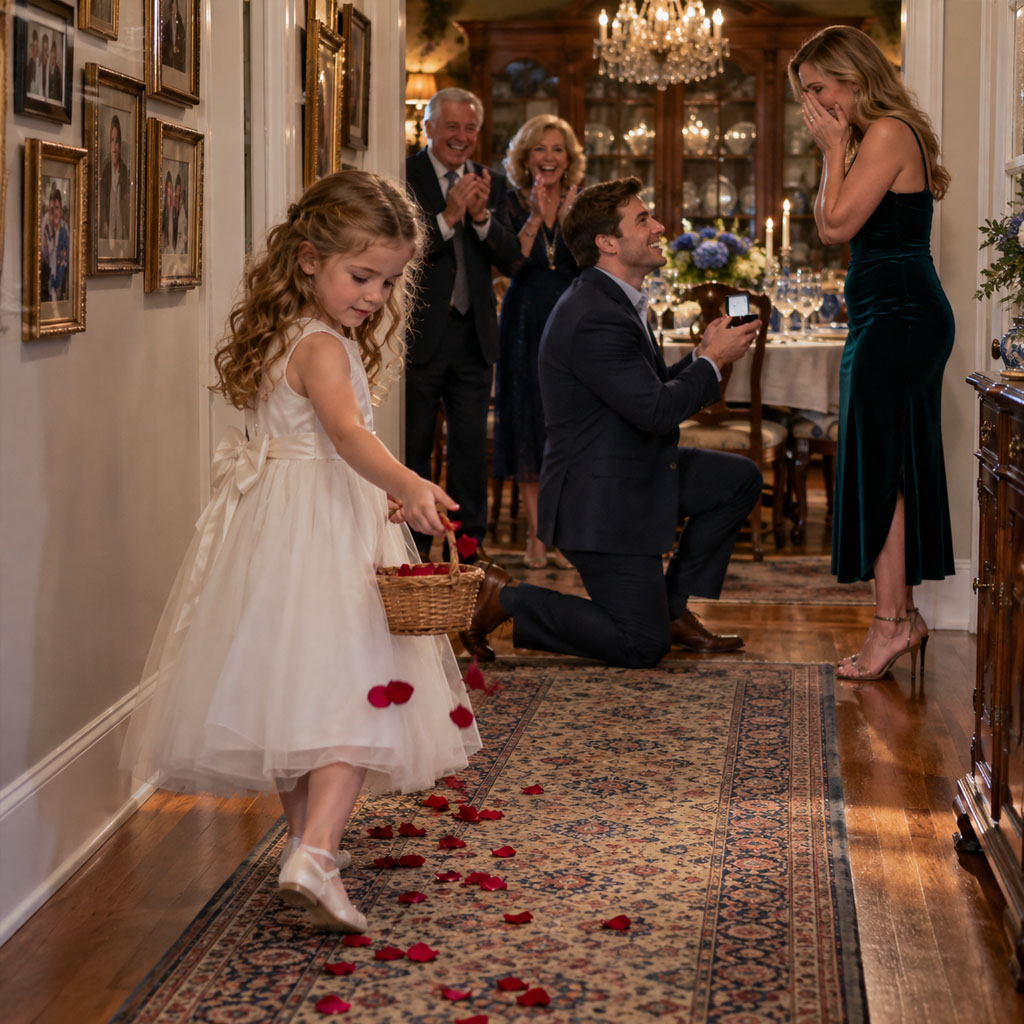
“She thinks throwing the flower petals upset her father.”
I stared at the fish tank in the corner because I couldn’t look at Brittany.
Outside afterward, she hugged her coat around herself.
“I didn’t think she understood.”
“She understands everything.”
Brittany nodded.
“I know that now.”
Christmas arrived with the kitchen in Nana’s house half demolished and the legal case unresolved.
Grace spent Christmas Eve with Brittany. I spent it alone in my apartment eating takeout and watching an old movie I should never have watched while feeling sorry for myself.
The next afternoon, Grace arrived carrying a drawing.
It showed her and me in front of Nana’s house. She had drawn the lilacs purple even though they only bloomed in spring.
Two days later, Mrs. Callahan called again.
“I saved something for you.”
At her house, she brought out an old white cabinet door.
The one from above Nana’s stove.
The yellow tape mark was still there.
Then she handed me Nana’s recipe box.
Inside were handwritten cards for spaghetti sauce, pierogi, orange cake, casseroles, and holiday cookies. In Nana’s handwriting, beside one cake recipe, she had written, Jackson likes extra frosting.
I sat at Mrs. Callahan’s kitchen table and cried.
She put one hand on my shoulder.
“Your grandmother told me something near the end,” she said. “She said, ‘The one who stayed gets to stay.’”
A week after New Year’s, Brittany was waiting beside my car after school.
She held out her phone.
“Read these.”
They were messages from my mother.
One had been sent only two months after the divorce.
You and Cam are good together. Don’t let anyone make you feel guilty.
Another read:
Once you two marry, the house stays in the family where it belongs.
Then:
Don’t mention the house to Jackson. He’ll make everything difficult.
And finally:
We should have the engagement party at the house. I’ll bring Mother’s china.
I handed the phone back.
Brittany looked smaller somehow.
“Your mother hated me for eight years,” she said. “Then suddenly she wanted lunches and shopping and family dinners.”
I said nothing.
“I thought she finally liked me.”
Her voice broke.
“She made me feel chosen.”
That sentence softened something in me.
Brittany had grown up being moved from apartment to apartment whenever rent increased. She had spent her life craving permanence. My mother had known exactly which promise would make her feel safe.
The house.
“She told me you’d given it to me because you felt guilty about the divorce,” Brittany continued. “She said the legal language didn’t matter because you’d never actually make Grace leave.”
“You signed the judgment.”
“I know.”
“Your lawyer explained it.”
“I know.”
“You still chose to believe Mom.”
“Yes.”
At least she didn’t lie.
Then she said, “Cam moved out.”
“When?”
“January second. He’s staying with a friend.”
I nodded.
“I’m still fighting you in court.”
“I figured.”
“My lawyer says I need to.”
“I understand.”
She put her phone away.
“But if they ask me what happened,” she said, “I’m telling the truth.”
That changed everything.
Chapter 4
The hearing took place on January twentieth.
My parents sat behind Brittany’s table. Cameron sat by himself near the aisle. He wore a button-down shirt that looked new.
Lorraine presented the divorce judgment, the Instagram engagement story, Cameron’s address change, the ended apartment lease, and the city’s stop-work order showing Brittany had applied for a construction permit as though she owned the property.
Then Cameron testified.
“Where were you living beginning October first?” Lorraine asked.
“With Brittany and Grace.”
“Did you contribute to household expenses?”
“Yes.”
“Were you living there as Brittany’s romantic partner?”
“Yes.”
“How much money did you invest in the house?”
He swallowed.
“About forty thousand dollars.”
“And why did you make that investment?”
Cameron looked toward our mother.
“Because I was told the house would be ours.”
My mother’s head moved almost imperceptibly.
No.
Cameron looked down.
“My parents loaned me the money.”
Brittany testified next.
Her attorney asked whether Cameron moved in intending to live with her as a committed partner.
“Yes,” she answered.
Her own lawyer looked as though he wished he could take the question back.
The judge ruled from the bench.
The evidence showed that Brittany and Cameron had begun living together as a couple months earlier. My support obligation ended as of the filing date, and later payments would be credited.
Then came the house.
Brittany’s temporary right to remain there was terminated.
She had sixty days to move.
The judge looked over her glasses toward my parents.
“I will add one observation,” she said. “Hosting an engagement celebration inside property that the court judgment clearly identifies as belonging to someone else suggests that several people involved would have benefited from reading the judgment more carefully.”
Nobody laughed.
In the hallway afterward, Cameron walked directly to Mom.
His voice was quiet.
“Did you know?”
Mom stiffened.
“Know what?”
“That it was Jackson’s house.”
She glanced at me.
“It was supposed to be mine.”
“That’s not what I asked.”
“It was my mother’s house.”
“Mom.”
Her voice rose.
“She gave it to him when it should have been mine. I was trying to put it back where it belonged. You were going to have it. You and Brittany. It would stay in the family.”
“You told me Brittany owned it.”
Mom reached toward him.
Cameron stepped away.
“You told me to quit my job.”
“I was trying to help you.”
“You spent Dad’s retirement money fixing a house you knew I’d never own.”
She reached again.
He backed away.
Then Cameron turned, pushed open the stairwell door, and walked down four flights rather than ride an elevator with her.
Dad stood beside Mom holding her coat.
He looked at me.
As usual, he said nothing.
That night Cameron called.
“I got a job.”
“Where?”
“A lumberyard. Contractor desk.”
“That sounds steady.”
“Yeah.”
He was quiet.
“I’m paying Mom and Dad back. Four hundred a month.”
“That’ll take a while.”
“I know.”
“It’s a start.”
Another pause.
Then he said, “I’m sorry I proposed to your wife in Nana’s hallway.”
“Ex-wife.”
He laughed.
So did I.
It was the first moment in months when I felt like I still had a brother.
A few weeks later, my father appeared at my apartment carrying a grocery bag.
Dad never visited without calling.
He took an old red coffee can from the bag.
Nana’s.
She had kept it on her kitchen windowsill for decades, filling it with spare change.
“I found it in our garage,” Dad said. “Your mother brought it home after the party.”
He sat on my couch without removing his coat.
“I told her not to have the party there.”
I waited.
“I said it once.”
“That sounds like you.”
He looked at me.
“I know.”
Then he said something I had waited my whole life to hear.
“I should have done more than say it once.”
Dad admitted he had spent decades avoiding confrontation with Mom. He disagreed quietly, then surrendered loudly through inaction.
“The forty thousand came from my retirement account,” he said. “I let her use it because arguing felt harder.”
He stared at his hands.
“I’m sixty-six. I’ll work two extra years because I didn’t want one difficult conversation.”
I didn’t know what to say.
Then Dad began crying.
Not dramatically.
Just tears slipping down the face of a man who had spent his entire life swallowing words.
“Your grandmother called me once near the end,” he said. “She asked me to bring your mother over. She said she didn’t have much time.”
I stopped breathing.
“I didn’t bring her.”
“Why?”
“Your mother refused. I told Nana she was sick.”
Dad wiped his face.
“I did what I always did. I chose the easier moment and left somebody else with the harder consequence.”
He stood to leave.
At the door, he turned.
“You did right by Nana.”
I couldn’t answer.
“You stayed when the rest of us didn’t,” he said. “Somebody in this family should have told you that years ago.”
After he left, I sat on the kitchen floor with Nana’s coffee can.
I poured the coins into my lap and counted them the way she used to let me when I was a boy.
Eleven dollars and forty cents.
I cried harder over that eleven dollars and forty cents than I had over the court case, the engagement, or the house.
Chapter 5
Brittany and Grace moved out one week before the deadline.
Brittany found a two-bedroom townhouse nearby so Grace could remain at the same school. I helped carry boxes because whatever Brittany had done wrong, she was still Grace’s mother, and Grace deserved adults who could stand in one room without making her choose sides.
When the moving truck was loaded, Brittany stood in Nana’s front hallway.
The old runner was still there.
She looked around.
“For what it’s worth,” she said, “I’m sorry.”
I waited.
“I’m sorry about the party. I’m sorry I let Grace be part of it. I’m sorry I let your mother convince me I had a right to this place.”
I nodded.
Then I said something I meant.
“You’re a good mother.”
Brittany’s eyes filled.
“I never thought you weren’t.”
She nodded once, walked outside, and drove away behind the moving truck.
I moved back into the house later that month.
The kitchen looked like a construction site. Bare studs lined one wall. The sink was gone. Electrical wires hung from openings where cabinets used to be.
I got the proper permits.
Then, on a Saturday morning, somebody knocked on the back door.
Cameron stood outside holding a cordless drill and a box of hinges.
“I get an employee discount,” he said.
I looked at the tools.
“Is that an apology?”
“No. The apology was on the phone.”
“So what’s this?”
“Cheap labor.”
I let him in.
We spent the weekend hanging cabinets.
I chose white doors with brass knobs, close to the ones Nana had owned. Over the stove, we installed one original door—the one Mrs. Callahan had pulled from the dumpster.
We left the yellow tape mark untouched.
It belonged there.
By Easter, the kitchen was usable again.
Grace came over at noon wearing yellow sneakers and carrying a chocolate rabbit that was already missing one ear.
I opened the dining-room cabinet and let her take down Nana’s Blue Willow plates.
“One at a time,” I warned.
“I know, Daddy.”
She carried each plate to the table with both hands.
When she placed the final one down, she stopped.
Her finger touched the little blue bridge painted across it.
“What’s this story?” she asked.
I sat beside her.
I told her about the picture on the china. About two people who loved each other and, according to the old legend, became birds so nobody could separate them.
Grace considered that.
“Is it a sad story?”
“A little.”
“Then why did Nana like it?”
I looked around the dining room.
Sunlight fell across the table where my mother had hosted an engagement party six months earlier. For weeks afterward, I had thought the worst thing they had done was celebrate inside my house without telling me.
But houses are only walls until people fill them with meaning.
My mother had wanted the house because she believed inheritance could repair what she had never received from her own mother.
Brittany had wanted it because she had spent childhood fearing the next move.
Cameron had believed it could finally make him successful.
Dad had allowed money to disappear into it because silence was easier than conflict.
And I had nearly turned it into a battlefield because I was so desperate to defend what Nana had left me.
But Nana hadn’t given me the house because she wanted me to win some future argument.
She gave it to me because I stayed.
That was different.
“Maybe she liked the story because people can go through something sad and still end up together somehow,” I told Grace.
Grace nodded as though that explanation was perfectly reasonable.
Then she asked, “Is Grandma coming?”
The question caught me off guard.
My mother and I had barely spoken since court.
“Not today.”
“Why?”
“Grown-up stuff.”
Grace frowned.
“I don’t like grown-up stuff.”
“Neither do I.”
She looked at the plate again.
Later that afternoon, Cameron came by with dessert. Dad came alone an hour after that. He stood awkwardly in the doorway until Grace grabbed his hand and pulled him toward the dining room.
Nobody mentioned Mom.
Not that day.
Healing, I learned, is rarely a dramatic event.
Sometimes it is two brothers hanging cabinets.
Sometimes it is an ex-husband carrying his ex-wife’s boxes.
Sometimes it is a father finally admitting that silence has consequences.
And sometimes healing is accepting that forgiveness and access are not the same thing.
My relationship with Cameron survived, though differently. He kept his lumberyard job. He began paying Dad back every month. His relationship with Brittany ended quietly after he moved out, which was probably inevitable once the fantasy of the house disappeared.
Brittany and I became better co-parents than spouses.
We stopped trying to win old arguments and focused on Grace.
My father started visiting without Mom occasionally, something he had never done before.
Mom remained the hardest part.
Months passed before she called me.
She didn’t apologize immediately.
Neither did I.
We talked about Grace. Then Dad. Then nothing important.
Finally she said, “I miss the house.”
I looked through the kitchen doorway at Nana’s old cabinet door.
“I know.”
“I spent my whole life thinking it should have been mine.”
“I know.”
“I still think part of me will always believe that.”
“Maybe.”
She was silent.
Then she said, “But believing something should have been mine didn’t give me the right to take it from you.”
That was the closest my mother could come.
For the moment, it was enough.
Grace turned eight the following winter.
For her birthday, she asked to have dinner at the house.
Brittany came.
Cameron came.
Dad came.
And, after a great deal of hesitation, Mom came too.
She stopped in the kitchen when she saw the restored cabinets.
Then she noticed the old door above the stove.
Her fingers touched the yellowed tape mark.
“She kept her grocery list there,” Mom said.
“I know.”
“She used to write things she already had just because she liked crossing them off.”
I smiled.
“That sounds like her.”
Mom laughed softly.
For a moment, she looked less like the woman who had manipulated half our family and more like somebody’s daughter remembering her mother.
We ate birthday cake on Nana’s china.
Nobody talked about the engagement party.
Nobody needed to.
After dinner, Grace stood between Cameron and me while we cleared plates.
She held one plate carefully and traced the little blue bridge with her finger.
“Daddy told me the story,” she announced.
Mom looked at me.
“Did he?”
“Yep. It’s sad, but it ends okay.”
My mother’s eyes stayed on mine.
“Yes,” she said quietly. “Some stories do.”
That evening, after everyone left, I stood alone in the hallway where Grace had scattered rose petals months earlier.
The house was quiet again.
But it no longer felt like evidence.
It felt like home.
I used to believe Nana left me that house because I had earned it by staying when everyone else left.
I don’t think that anymore.
People are complicated. Love is complicated. Families can hurt one another without being monsters, and good intentions can become excuses for terrible choices.
Nana knew that better than I did.
Maybe the house wasn’t a reward.
Maybe it was a responsibility.
A place where Grace could grow up knowing that love should never require pretending betrayal didn’t happen, but it also shouldn’t require carrying anger forever.
The house stayed mine.
That mattered.
But in the end, something else mattered more.
My daughter could walk down that hallway without ever knowing she had once been used as a flower girl in the middle of a family betrayal.
To Grace, it was simply the hallway to the dining room.
And that was exactly how I wanted it.
THE END.
⚠️ All characters and events are fictional. Do not imitate or apply them in real life. 😌😌😌


