
Chapter 2
The wedding planner left first.
She gathered her equipment, apologized several times, and hurried toward her van before the argument became worse.
Ethan stayed.
“Maybe everybody should calm down,” he said. “We could discuss what renovations make sense.”
“No renovations make sense,” I replied. “This isn’t your property.”
Chloe started crying.
Not quiet tears. Loud, wounded sobs.
“You’re ruining my wedding.”
“I offered you this place for free.”
“And now you’re taking it away because I had ideas?”
“You were discussing demolition without asking me.”
She called Mom.
Our mother lived more than an hour away. Somehow she arrived in less than fifty minutes.
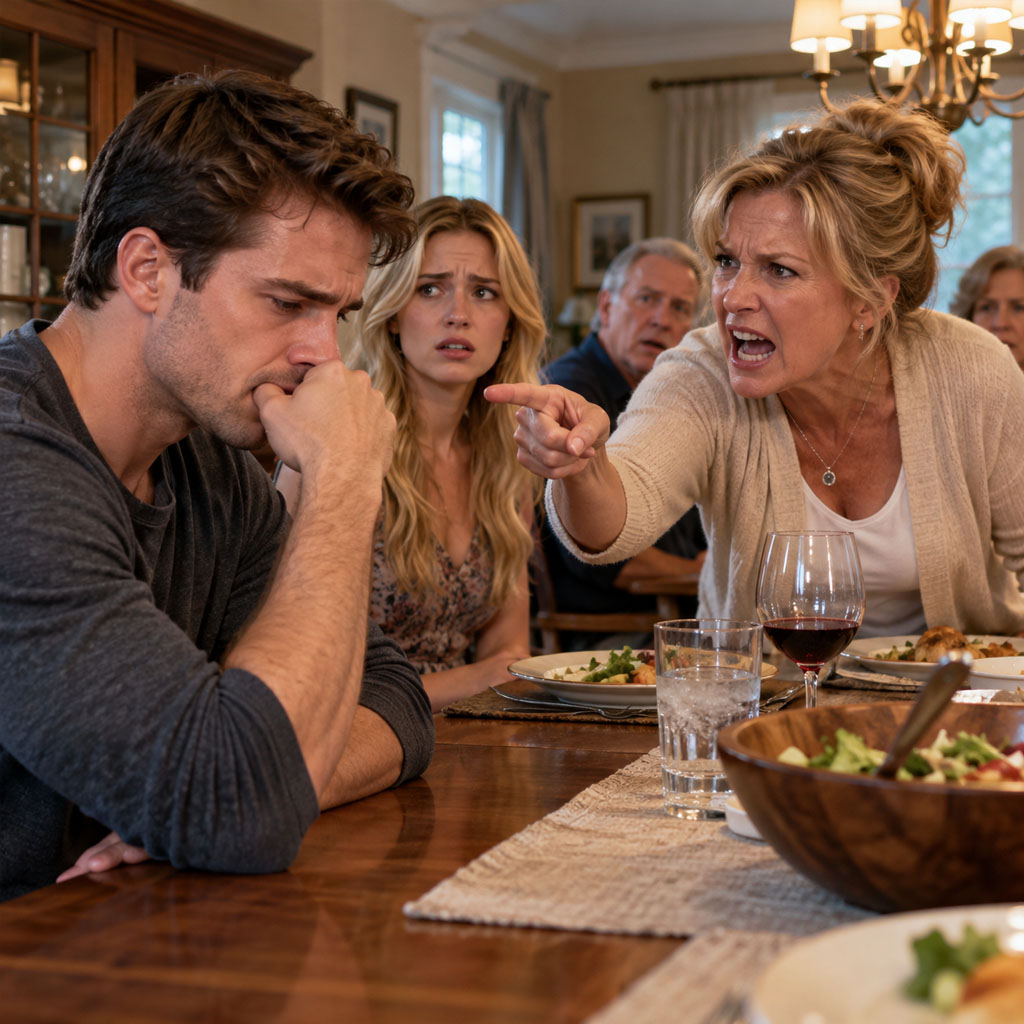
She marched inside already angry.
“How dare you humiliate your sister?”
“Mom, you weren’t here.”
“I know exactly what happened.”
That sentence summed up my childhood better than she realized.
She accused me of manipulating Grandpa. Chloe claimed I had isolated him during his final years. Mom said his judgment had been impaired.
That accusation infuriated me.
Grandpa had anticipated it. Before signing his will, he had undergone medical and cognitive evaluations specifically because he knew Mom might challenge him.
Then Brenda turned toward Maya.
“And you,” she said. “I suppose you’re enjoying all of this.”
Maya froze.
Mom continued. “You married a successful contractor and now you’ve got a million-dollar vacation home. Worked out nicely.”
“Stop.”
The room fell silent.
Maya had grown up in foster care. She had worked multiple jobs to put herself through nursing school. When we married, she was the one who suggested a prenuptial agreement because she never wanted anyone accusing her of chasing my business.
“You will not speak to my wife that way.”
Mom pointed at me.
“Then sign half the house over to Chloe.”
“No.”
“Half, Liam.”
“No.”
“If you don’t, you are dead to this family.”
There it was.
The threat that was supposed to frighten me into surrendering the last thing Grandpa had entrusted to me.
Instead, it clarified everything.
“I guess losing some greedy relatives won’t hurt.”
Mom went pale.
I opened the door.
“Leave.”
Chloe said I couldn’t throw her off her own inheritance.
I told her the sheriff could explain the deed if she wanted.
They left.
Before they reached the highway, Chloe filmed herself crying in Ethan’s car and posted the video online.
By evening, relatives I hadn’t spoken to in years were calling me heartless. Chloe portrayed herself as a grieving granddaughter whose wealthy older brother had stolen the family estate and ruined her wedding.
Maya and I spent the rest of the weekend repairing the dock.
At sunset, I stood in Grandpa’s living room and stared at an old photograph of him holding a string of fish beside that very lake.
“I’m sorry,” I whispered.
I didn’t know whether I was apologizing for the fighting or for finally understanding how badly he had misjudged—or perhaps correctly judged—our family.
When we returned home, I revoked Chloe’s permission to use the house.
I changed every lock and installed security cameras after discovering she had made a copy of a spare key years earlier.
My closest friend, an attorney, gave me one piece of advice.
“Document everything.”
So I did.
Every text.
Every threat.
Every social-media post.
Three weeks passed quietly.
Then a certified letter arrived at my office.
Brenda and Chloe were demanding mediation over what they called the “fraudulent and inequitable distribution” of Grandpa’s estate.
Their lawyer claimed Grandpa had suffered cognitive decline and that I had exercised undue influence over him.
I forwarded it to the estate lawyer who prepared the will.
He called me almost immediately.
“Liam, Arthur knew exactly what your mother might try.”
Grandpa’s estate file contained far more than I realized.
There was an independent medical evaluation confirming his competence. Signed statements from his physician and accountant. A recorded video of Grandpa explaining his decisions in his own words.
“He built a fortress around that will,” the lawyer said.
I should have felt relieved.
Instead, I felt tired.
Two days later, Chloe arrived at my construction office with Ethan and another attorney.
She wore no makeup, an oversized sweater, and an expression of carefully arranged misery.
Her lawyer handed me a document.
Their new demand was no longer $450,000.
It was $695,000.
Half the lake-house value. Compensation for emotional distress. Reimbursement for lost wedding expenses. Her student debt.
I stared at the total.
Then I laughed.
I truly couldn’t help it.
Chloe immediately began crying.
Her attorney leaned across my desk.
“Mr. Harrington, a public dispute could be extremely damaging to someone who depends on reputation for commercial contracts.”
My laughter stopped.
“Are you threatening my business?”
“I’m explaining reality.”
I stood and opened the office door.
“Reality is that you’re leaving.”
Chloe walked past me and whispered, “You’re going to regret this.”
That evening, I learned what she meant.
She launched an online fundraiser claiming I had manipulated our dying grandfather and stolen nearly a million dollars of family property.
She omitted the $95,000 she had inherited.
She omitted Grandpa’s medical evaluations.
She omitted my offers to help her.
She described herself as an indebted artist fighting a wealthy contractor for justice.
Donations poured in.
Then came the social-media campaign.
Mom posted long messages portraying Grandpa as mentally confused and me as controlling. Chloe shared childhood photographs of herself sitting on his lap.
A small regional news site published her version.
Then my company started receiving fake one-star reviews.
People who had never hired us accused me of theft and elder abuse.
The attack became personal when someone distributed printed copies of Chloe’s fundraiser at Maya’s hospital.
Maya called me from work crying.
One colleague had actually asked whether she felt guilty benefiting from “stolen family money.”
That was the moment my grief hardened into resolve.
They had come after my wife.
I was done protecting them from consequences.
That Friday, Maya and I drove back to the lake.
As our headlights swept across the front lawn, I hit the brakes.
A professional real-estate sign stood beside the driveway.
FOR SALE.
There was an unfamiliar SUV near the porch.
I ran inside.
A real-estate agent was showing the kitchen to an older couple.
“What are you doing in my house?”
The agent looked startled.
“Showing the property.”
“On whose authority?”
“Chloe Harrington. She said the estate was still being settled and she had authority from the family.”
I pulled up the county ownership records.
The agent’s expression changed from confusion to horror.
Within minutes, everyone was gone.
That night, I sat with Maya on the dock.
“I can’t keep playing defense,” I said.
“No,” she answered quietly. “You can’t.”
I went into the attic looking for old property plans.
Behind a stack of insulation, I found a heavy cardboard box.
Inside were dozens of spiral-bound journals.
Grandpa’s handwriting covered every page.
He had kept diaries for forty years.
I started reading.
And somewhere around midnight, I realized Grandpa had left me something far more powerful than a house.
He had left a record.
Chapter 3
The journals broke my heart.
Grandpa had written about Chloe repeatedly.
Not with anger.
With disappointment.
August 14, 2018.
Sent Chloe $1,000 for her birthday. Check cleared this afternoon. No call. Hope she’s doing all right.
July 4, 2020.
Invited Chloe to the lake. Told her I’ve been feeling poorly and could use company. She said she had summer classes. Liam later showed me a photograph she posted from a party in the Hamptons. I wish she had simply told me the truth.
October 12, 2021.
Chloe says she cannot afford textbooks. Sent $800. Brenda mentioned two days later that Chloe bought an expensive handbag. I need to stop confusing assistance with love.
Then I found an entry written shortly before Grandpa finalized his estate.
Met with the lawyer today. He asked again whether I’m certain about the lake house. I am. Chloe does not love that place. She loves what she thinks it can buy. Liam sees a home where Chloe sees a price. I hope someday she understands that this decision is not punishment.
I sat in the attic staring at those words.
Maya climbed the stairs.
“What did you find?”
“The truth.”
The next morning, I hired a litigation attorney.
We sent formal cease-and-desist notices to Mom and Chloe demanding an end to false statements, interference with my business, harassment of Maya, and attempts to represent themselves as owners of my property.
We demanded the fundraiser be removed and donors refunded.
Chloe responded by going live online.
She cried to thousands of viewers and claimed I was using money and lawyers to silence a struggling woman.
The story spread farther.
That turned out to be her biggest mistake.
My attorney had warned them that if they continued making public accusations, we would respond with evidence.
They continued.
So we responded.
Carefully.
Lawfully.
We released Grandpa’s will, his explanation of the inheritance, and his medical competency records. We released the probate accounting showing exactly what Chloe received.
Most important was Grandpa’s recorded statement.
He sat in his attorney’s office wearing his familiar red flannel shirt.
His voice was strong.
“I’m leaving the lake property to Liam because he understands what it represents. He worked beside me there and helped maintain it for years. Chloe is receiving money because I believe money is more useful to the life she has chosen. This is my decision. Nobody pressured me.”
Watching him on that recording made my throat close.
For months, people had argued over what Grandpa “would have wanted.”
Now he was telling them.
The fundraiser collapsed quickly.
Donors demanded refunds.
Several relatives called me.
“I’m sorry,” one aunt said. “We should’ve asked questions.”
Another admitted, “Your mother gave us a completely different story.”
Then additional evidence emerged during the legal dispute.
Messages between Chloe and a friend showed that the public pressure had been deliberate.
In one conversation, she wrote that if she made Maya’s life difficult enough at the hospital, I would eventually pay just to make the harassment stop.
In another, she joked about using fundraiser money toward a luxury car.
I read the messages twice.
Then I closed the file.
Maya found me sitting in the kitchen.
“You okay?”
“No.”
She took the chair beside me.
“That’s allowed.”
“I keep thinking about when Chloe was eight. She used to follow me around carrying this ridiculous purple backpack. If she fell off her bike, she’d call for me before she called Mom.”
Maya took my hand.
“You loved your sister.”
“I still do.”
“That doesn’t mean you have to let her hurt you.”
A month later, Mom formally challenged Grandpa’s will.
The case went to probate court.
Her attorney argued Grandpa had been mentally impaired and that I had exploited my access to him.
Our attorney presented his treating physician.
Grandpa had been mentally competent.
His accountant testified.
Grandpa had discussed tax consequences and estate strategy in detail.
Then the courtroom lights dimmed.
Grandpa appeared on a large screen.
I had seen the recording before.
Mom and Chloe apparently had not.
Grandpa looked directly into the camera.
“I know somebody may claim Liam talked me into this,” he said. “He didn’t. In fact, he never asked me for this house. I’m giving it to him because he showed me, year after year, that he values the place for what it is.”
He paused.
“I love both my grandchildren. Love does not require pretending they have made the same choices or built the same relationship with me.”
Chloe lowered her eyes.
Mom stared straight ahead.
Grandpa continued.
“The lake house should stay with someone who will preserve it, not sell it the moment a better opportunity comes along.”
When the video ended, the room was silent.
The judge upheld the will completely.
She also ruled that the challenge lacked credible support and ordered Mom and Chloe to cover substantial legal costs associated with their unsuccessful case.
Outside the courtroom, Chloe passed me without looking at me.
Mom stopped.
For one second, I thought she might finally say something different.
Instead she whispered, “I hope that house was worth your family.”
I looked at her.
“This was never about a house.”
She walked away.
Chapter 4
Two weeks after the trial, Ethan called.
He asked to meet at a quiet bar halfway between our homes.
When I arrived, he already had a beer in front of him.
His engagement ring was gone from his plans, though obviously it had never been on his finger.
“I left Chloe,” he said.
I didn’t know what to say.
He rubbed both hands over his face.
“I kept defending her because I thought she was overwhelmed. Grief, money, the wedding—I kept making excuses.”
“What changed?”
“I found out the crying act at your office was rehearsed.”
I frowned.
“What?”
“She practiced it in the bathroom mirror that morning. I heard her. She didn’t know I was home.”
He gave a bitter laugh.
“I convinced myself she was just trying to look vulnerable for the lawyer. Then I saw those messages about Maya. That was it.”
He told me Chloe had already spent nearly all the cash Grandpa left her.
There were luxury purchases, an expensive vehicle lease, vacations, and unpaid bills. She had sold Grandpa’s vintage watches for far less than their appraised value because she wanted money immediately.
“She kept saying once she got your house money, everything would be fine,” Ethan said. “Then I realized there was never going to be enough.”
I stared at my glass.
He continued.
“Even if you handed her a million dollars tomorrow, she’d find a reason she deserved two.”
I felt no satisfaction.
That surprised me.
Months earlier, I might have imagined this moment as vindication.
Instead, Chloe’s collapse only made me sad.
She had received more money from Grandpa than many people see in years of work.
She had received kindness.
She had received opportunities to remain part of the lake house without owning it.
None of it had been enough because the one thing she wanted was the right to say something belonging to me should also belong to her.
Eventually, I stopped checking what she and Mom said online.
Some relatives still believed them.
Most didn’t.
It no longer mattered.
Dad had stood beside me from the beginning. He and Mom had divorced years earlier, and he understood better than anyone how exhausting her demands could become.
One afternoon he called and asked, “You heading to Maine this weekend?”
“Yeah.”
“Catch one for Arthur.”
“I’ll try.”
That was Dad’s way.
No speeches.
No philosophy.
Just show up.
Maya and I spent the spring repairing the lake house properly.
We replaced damaged cedar on the dock and repaired the porch. We updated the kitchen without destroying Grandpa’s design. I restored one of the workbenches in his old shed and hung his hand plane above it.
On the final evening of our last repair trip, Maya and I sat at the end of the dock.
The lake was so calm it looked like glass.
She leaned against my shoulder.
“I have something to tell you.”
Something about her voice made me turn.
She smiled.
“I’m twelve weeks pregnant.”
For several seconds, I forgot how to speak.
“You’re serious?”
She laughed through tears.
“I’m serious.”
I wrapped my arms around her.
The house glowed behind us as the sun slipped through the trees.
“A boy or girl?”
“We don’t know yet.”
But weeks later, we did.
A boy.
We decided to name him Arthur.
The following summer, I stood on that same dock with one hand resting against Maya’s back while she carried our son.
The lake house didn’t feel like an inheritance anymore.
It felt like a bridge.
Grandpa had once taken my small hand and showed me how to hold a fishing rod. Someday I would do the same with Arthur.
That was what Grandpa had understood.
Money measures price.
It does not measure value.
The house had a price.
The land had a price.
Even Grandpa’s watches had a price.
But you cannot put an appraisal on a morning spent rebuilding a dock with someone you love. You cannot calculate the market value of a scar in the floorboards where your grandfather dropped a hammer and laughed until he had tears in his eyes.
You cannot divide memories into equal shares.
For months, I mourned the loss of my mother and sister.
Eventually, I realized I was mourning the family I wished we had been, not the one we actually were.
Real family had been standing beside me all along.
Maya, who never asked me to surrender my integrity just to make life easier.
Dad, who supported me when supporting me was unpopular.
Grandpa, who knew people might twist his wishes after he was gone and took the trouble to leave the truth behind.
And now Arthur.
One evening, while packing away tools, I found Grandpa’s old fishing cap hanging on a hook in the shed.
I carried it down to the water.
The sun was sinking beyond the pines.
For a moment, I could almost hear his voice.
Measure twice.
Cut once.
Do the job right even when nobody is watching.
I smiled.
“You knew, didn’t you, old man?”
The lake gave me no answer.
It didn’t need to.
Grandpa had known that inheritance could reveal things people preferred to hide. He knew generosity without judgment could become entitlement. Most of all, he knew preserving a family does not mean surrendering every boundary whenever someone threatens to leave.
Sometimes the people who say, “Give me what I want or you’ll lose me,” have already decided that what you own matters more to them than who you are.
Mom told me I was dead to the family unless I surrendered half the house.
For months, that sentence hurt.
Now I understand it differently.
She thought belonging was something she could use as leverage.
Grandpa taught me that real belonging works the opposite way.
It is built slowly.
With time.
With loyalty.
With truth.
With people who keep showing up even when there is nothing to gain.
I looked back toward the porch.
Maya stood there holding our son, rocking him gently while the evening light fell around them.
That was my family.
That was my inheritance.
The lake house was simply where I finally learned the difference.
THE END.
⚠️ All characters and events are fictional. Do not imitate or apply them in real life. 😌😌😌


