
Chapter 2
I drove home through a cold October rain with both hands steady on the steering wheel.
That steadiness scared me more than tears would have.
I had always imagined betrayal would feel like fire. Instead, it felt like someone had quietly removed gravity from the world.
Nothing seemed anchored.
When I entered the house, I went directly upstairs to Sophie’s room.
She was asleep under a quilt my mother had made, one arm wrapped around a stuffed rabbit she had owned since she was 3. Her night-light threw small stars onto the ceiling.
I stood there for several minutes.
Then I packed.
Clothes. Medication. School things. Her favorite books. The stuffed rabbit. The jar labeled Beach Trip because she would ask for it if she noticed it was missing.
I packed my own essentials afterward.
Sophie stirred when I lifted her.
“Mommy?”
“I’ve got you.”
“Where are we going?”
“Grandma and Grandpa’s.”
“Tonight?”
“Yes.”
She settled against my shoulder.
“Is Daddy coming?”
That was the first moment I nearly broke.
“No, sweetheart. Not tonight.”
My parents lived 30 minutes away in a brick colonial where Lauren and I had grown up. Dad opened the door in pajama pants and an old Virginia Tech sweatshirt.
“Caroline?”
Mom appeared behind him.
One look at my face ended the questions.
“I need Sophie to stay here tonight.”
Mom touched my arm.
“What happened?”
“Evan and Lauren are having an affair.”
Dad went completely still.
Mom whispered, “No.”
“For about a year.”
She covered her mouth.
I carried Sophie upstairs, put her in my old bedroom, kissed her forehead, and came back down.
Mom was crying.
Dad looked furious.
“Where are they?”
“At a restaurant.”
“I’ll go get Lauren.”
“No.”
“Caroline—”
“No. I’m handling it.”
Mom shook her head.
“Your sister wouldn’t do this.”
“She already did.”
“Maybe there’s some explanation.”
“A year-long explanation?”
Mom winced.
I immediately regretted the sharpness, but not the truth.
Dad put his hand on my shoulder.
“Stay here.”
“I can’t.”
“Why not?”
Because the affair was only part of the problem.
Three months earlier, I had noticed irregular transfers from one of the firm’s development accounts. Nothing enormous at first. Fifty thousand here. Eighty thousand there.
The transactions had been coded as consulting expenses.
I asked our controller about them.
She told me Evan had approved them.
That should have reassured me.
Instead, it bothered me.
So I quietly hired a forensic accountant.
What she found changed everything.
Over roughly 18 months, Evan had been moving company money through a series of consulting entities. Some of it eventually landed in an account tied to a company Lauren had quietly registered.
The total exceeded $1.6 million.
I had known about the missing money before I knew about the affair.
My attorney advised me to say nothing.
We documented everything.
Account transfers.
Approval records.
Corporate cards.
Emails.
Lease guarantees.
A set of design files downloaded from my firm’s private server.
Evan and Lauren were not merely planning a new life.
They were preparing a competing design-development business using my money, my clients, and several proprietary projects they apparently intended to present as their own.
The affair gave me pain.
The financial records gave me leverage.
That night, I told my parents none of this.
Not yet.
“I have business matters to handle,” I said. “Please keep Sophie here.”
Mom took my hands.
“Honey, don’t do anything permanent while you’re angry.”
I looked at her.
“I’m not angry enough to be careless.”
Then I left.
By the time I reached the house, Evan still wasn’t home.
I went into my office, opened my laptop, and reviewed the documents my attorney had prepared.
At 11:52 p.m., the first company restriction went into effect.
Evan’s authority over corporate accounts was suspended pending an internal fraud investigation.
Corporate credit cards were frozen.
The firm’s bank received formal notice regarding unauthorized transfers.
Access to our client-management system was revoked.
At 12:06, our technology administrator disabled Evan’s company credentials.
At 12:18, Lauren’s corporate-backed apartment lease was flagged for review because the deposit and several payments had been traced to disputed business funds.
I did not empty accounts.
I did not take money that wasn’t mine.
I did exactly what my attorneys and financial advisers had recommended to preserve evidence and protect the company until a court could sort out the rest.
At 12:47, the front door opened.
Evan came in quickly.
“Caroline?”
I remained in the living room.
He walked in holding his phone.
“What did you do?”
“Be specific.”
“My cards are suspended. I can’t get into the company system. The bank says my authority is under review.”
“I know.”
His face changed.
“You did this?”
“Yes.”
“Because of the affair?”
“No.”
That stopped him.
I placed a folder on the coffee table.
“Because of this.”
He opened it.
The first page contained a summary of the questionable transfers.
His face went pale.
He flipped to the second page.
Then the third.
“Where did you get this?”
“Company records.”
“This isn’t what it looks like.”
“You transferred more than $1.6 million through entities tied to Lauren.”
“It was investment capital.”
“Without board approval.”
“We were restructuring.”
“You were funding a competing company.”
He stared at me.
I continued.
“You downloaded designs from three active projects. You exported portions of our client database. You paid toward Lauren’s apartment using funds routed from corporate accounts.”
His mouth opened.
Nothing came out.
His phone began ringing.
Lauren.
He ignored it.
It rang again.
“Answer her.”
He looked at me.
“Why?”
“She’s your partner.”
He answered.
Lauren’s panicked voice carried through the quiet room.
“Evan, what’s happening? My card isn’t working and the building manager says there’s some problem with the lease.”
He closed his eyes.
“I’ll call you back.”
“No, don’t—”
He ended the call.
Then he turned on me.
“You’re trying to destroy us.”
I stared at him.
“No.”
“You froze everything.”
“I protected my company.”
“Caroline, please. We can work this out.”
“Which part?”
He dragged a hand over his face.
“We made mistakes.”
“An affair is a mistake if you need that word.”
I pointed toward the folder.
“This is something else.”
“Think about Sophie.”
My entire body went cold.
“Do not use our daughter as a shield.”
“I’m not.”
“You just did.”
“I’m saying she needs both parents.”
“She does. She also needs parents who obey court orders, financial laws, and basic decency.”
He stared at me.
For years, I had watched Evan charm clients who entered meetings determined to say no. He could make uncertainty sound like confidence and selfishness sound like strategy.
That night, the charm had nowhere to go.
“I want you out of the house,” I said.
“You can’t throw me out.”
“My attorney filed for temporary exclusive use based on the financial allegations and the domestic situation. Until the court rules, you can stay at a hotel.”
His eyes widened.
“You planned this.”
“I prepared.”
“How long have you known?”
“About the money? Three months.”
“The affair?”
“Tonight.”
He actually looked relieved.
That hurt more than it should have.
“So this isn’t all because of Lauren.”
“No, Evan.”
I stood.
“The affair broke our marriage. The money exposed who you were while I still believed in it.”
Chapter 3
By noon the next day, the quiet private betrayal had become a legal crisis.
My firm’s board called an emergency meeting. Our attorneys presented the financial records, and Evan was placed on administrative leave pending the investigation. The bank maintained restrictions on disputed accounts while auditors traced every transfer.
Nobody was dragged away in handcuffs.
Nobody’s life vanished with the push of a button.
Real consequences are usually slower than that.
They arrive in letters.
Court notices.
Meetings.
Statements.
Questions asked by people who no longer trust your answers.
Evan moved into a furnished apartment.
Lauren went to our parents.
That was where the next betrayal began.
Mom called me two days later.
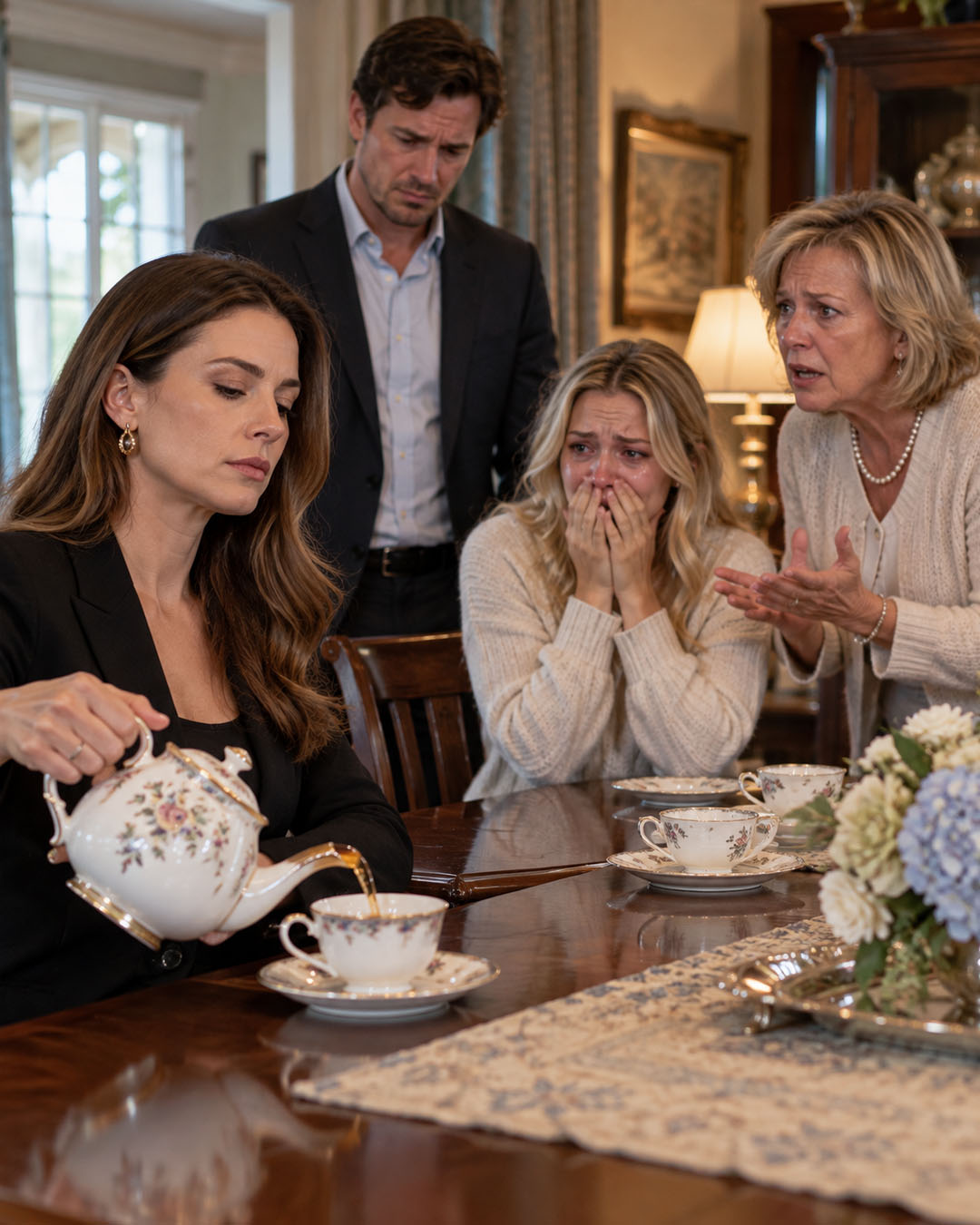
“Caroline, we need to talk about your sister.”
I was in my office reviewing project schedules.
“What about her?”
“She’s devastated.”
“So am I.”
“I know.”
“Do you?”
Mom sighed.
“She made a terrible mistake.”
“A year isn’t a mistake, Mom.”
“You know what I mean.”
“Yes. I know exactly what you mean.”
“She has nowhere to go.”
“She can get an apartment.”
“She doesn’t have money.”
“She’s 37.”
“Caroline.”
There was that tone.
The one from childhood.
You’re older.
You’re stronger.
You should understand.
Lauren had been protected by those words for most of her life.
Mom continued.
“She’s your sister.”
“And Evan is my husband.”
“Was.”
I closed my eyes.
Mom realized what she had said.
“I’m sorry.”
“No, you aren’t.”
“That’s unfair.”
“What do you want from me?”
She hesitated.
“I want you to think about forgiveness.”
I almost laughed.
“For whose benefit?”
“For everyone’s.”
“There is no everyone anymore.”
“She’s family.”
“So am I.”
Silence.
Then Mom said something I would remember for years.
“You can’t throw away a sister because of one terrible chapter.”
I stared out the window.
“She slept with my husband for a year and helped him take money from my company.”
“She says the business part was Evan’s idea.”
“Of course she does.”
“Maybe it was.”
“Do you hear yourself?”
“Caroline, I’m trying to keep this family from being destroyed.”
“No. You’re trying to make the person who was hurt responsible for repairing it.”
Mom began crying.
That once would have ended the conversation.
I would have comforted her.
I didn’t.
“I need distance,” I said.
“From Lauren?”
“From anyone who expects me to forgive on command.”
I hung up.
Dad called that evening.
He was gentler.
“I don’t agree with what your mother said.”
“Thank you.”
“But…”
There it was.
“But what?”
“Your mother’s scared. She thinks if you cut Lauren off, we’ll never have a family Christmas again.”
I laughed bitterly.
“Dad, Lauren slept with my husband. Christmas arrangements are not my priority.”
“I know.”
“No, you know the sentence. I’m not sure either of you understands what it means.”
He was quiet.
Then he asked, “What do you need?”
That was the right question.
I nearly cried.
“I need somebody to stop asking me to take care of Lauren.”
“All right.”
“And I need you to keep Sophie away from the details.”
“Of course.”
The divorce became ugly without becoming theatrical.
Evan initially denied wrongdoing with the company. Then the audit uncovered enough documentation that his attorney changed strategy.
There were negotiations.
Asset disputes.
Custody discussions.
The court eventually approved a parenting arrangement that allowed Sophie meaningful time with her father under terms both sides could live with. I never tried to take him away from her.
He had betrayed me.
Sophie had not.
I refused to use our daughter to punish him.
That mattered more to me than revenge.
The business dispute was harder.
Several questionable transfers were recovered. Insurance covered part of the loss. Evan resigned permanently from the firm as part of a broader settlement while civil and financial matters continued through appropriate channels.
Lauren’s hoped-for company collapsed before it opened.
The investors she believed she had lined up disappeared once they learned the designs and funding were disputed. The luxury apartment she had rented became impossible to maintain without money she had expected would continue flowing.
She moved in with my parents.
Mom called twice more asking whether I would speak to her.
I refused.
Then Lauren called from Dad’s number because I had blocked hers.
I almost hung up.
“Please,” she said.
Her voice sounded smaller than I remembered.
“What?”
“I need to explain.”
“You had a year.”
“I know.”
“No, Lauren. You had a lifetime.”
She began crying.
“I never meant for this to happen.”
I looked around my temporary apartment, where Sophie’s crayons covered the kitchen table and half our belongings were still in boxes.
“You made hundreds of decisions for this to happen.”
“Evan told me your marriage was already over.”
“You lived twenty yards from my house.”
She said nothing.
“You watched us eat breakfast together.”
“I know.”
“You watched him kiss me goodbye.”
“I know.”
“You came to Sophie’s birthday party.”
“I know.”
“You helped her make a card for our anniversary.”
Lauren sobbed.
“Please stop.”
“No.”
My voice remained calm.
“You asked for an explanation. This is mine. You didn’t fall into something. You participated in it while standing close enough to see exactly who it would hurt.”
She struggled to speak.
“I love him.”
That sentence finally removed the last bit of softness I had left.
“Then build a life with him.”
“He won’t answer my calls.”
I almost laughed.
“What?”
“He says everything became too complicated.”
Of course.
Once the money disappeared, apparently so did destiny.
Lauren cried harder.
“I lost everything.”
“No.”
She went quiet.
“You lost things you thought belonged to you.”
“Caroline—”
“My husband. My money. My connections. My forgiveness. None of those were yours to assume.”
Then I ended the call.
Chapter 4
The divorce became final the following spring.
By then, Sophie and I had moved into a smaller house in a quiet neighborhood with mature oak trees and children who rode bicycles in the street after school. It was not as impressive as the house I had shared with Evan.
I loved it more.
Sophie chose a yellow bedroom.
She arranged her stone jars on a white shelf.
The first night we slept there, she climbed into my bed around midnight.
“Mom?”
“Yes?”
“Are we staying here?”
“Yes.”
“For real?”
“For real.”
She thought about that.
“Can I paint stars on my wall?”
“We’ll see.”
“That means no.”
“It means your mother just moved an entire house and would like 48 hours before discussing paint.”
She giggled.
Then she curled against me and went to sleep.
For the first time in months, I did too.
My parents continued pushing for reconciliation with Lauren.
Not constantly.
That would have been easier to reject.
Instead, they used birthdays.
Holidays.
Small opportunities.
Mom would say, “Your sister misses Sophie.”
Dad would say, “Lauren’s really trying.”
Mom once suggested we all meet for brunch.
I declined.
“You have to forgive eventually,” she said.
“No.”
“Caroline.”
“I may forgive someday for my own peace. That doesn’t mean I have to restore the relationship.”
“She’s your sister.”
“And I’m her sister.”
Mom looked away.
That distinction mattered.
For most of my life, our family had treated the word sister as an obligation placed mainly on me.
I was older.
I was successful.
I was stable.
Therefore I should give more, absorb more, and forgive faster.
After the affair, I stopped accepting that arrangement.
I took Sophie and built a life that did not require me to constantly recover from people I loved.
There were lonely moments.
Of course there were.
Some evenings, after Sophie was asleep, I sat on the back porch remembering my marriage before I knew the truth.
Not the affair.
The good years.
The cheap dinners.
The hospital room when Sophie was born.
Evan dancing with her in the kitchen while pancakes burned.
Those memories were harder than the bad ones because they forced me to accept something complicated.
A person can betray you terribly without making every previous moment false.
Some of our happiness had been real.
It simply hadn’t survived who he became.
That realization helped me stop trying to rewrite my own past.
I didn’t need to hate every year to justify leaving the final one.
Sophie continued seeing her father.
At first, she asked whether he would come home again.
“No,” I told her gently.
“Why?”
“Because sometimes grown-ups decide they can be better parents living in different houses.”
She frowned.
“Did Daddy do something bad?”
I chose my words carefully.
“Daddy and I made some grown-up decisions that changed our marriage.”
That answer was incomplete.
It was also appropriate for a 7-year-old.
Children do not need to carry adult betrayals.
Evan eventually apologized.
Not at mediation.
Not in court.
Not when consequences first arrived.
Almost a year later.
We were standing in the parking lot outside Sophie’s school after a holiday concert. Parents were carrying folded chairs and paper snowflakes to their cars.
He walked beside me.
“Caroline.”
I stopped.
“I owe you something.”
“If this is about money, call my attorney.”
“It’s not.”
He looked older.
Not ruined.
Just reduced somehow.
More ordinary.
“I’m sorry.”
I said nothing.
“For all of it.”
He swallowed.
“I told myself our marriage was already broken because I needed that to be true.”
I watched him carefully.
“I blamed your work. Your hours. Everything except the fact that I wanted what I wanted and didn’t want to think of myself as the kind of man who would betray his wife.”
“That sounds accurate.”
He gave a sad laugh.
“I deserved that.”
“I wasn’t trying to hurt you.”
“I know.”
That was one of the strangest things about healing.
Eventually, you can tell the truth without needing it to wound.
“What happened with Lauren?” I asked.
His expression tightened.
“It ended.”
“I gathered that.”
“We weren’t good together without…”
He stopped.
“Without my life holding you together?”
He looked embarrassed.
“Yes.”
I nodded.
“At least you learned something.”
He looked toward the school.
“You really are okay, aren’t you?”
I thought about my house.
My daughter.
My company.
The quiet mornings.
The absence of suspicion.
“Yes.”
For the first time, I meant it completely.
“I am.”
Chapter 5
Two years after the affair, my mother turned 70.
Dad planned a dinner at their house and invited everyone.
Including Lauren.
For weeks, Mom said nothing about whether I would come.
That was progress.
She had finally learned invitations were not commands.
I wanted Sophie to celebrate her grandmother, so I went.
Lauren arrived before us.
I had not seen her in more than a year.
She looked different.
Her hair was shorter. She wore simple clothes. No expensive bag. No dramatic entrance.
When Sophie saw her, she hesitated.
Then Lauren crouched.
“Hi, sweetheart.”
Sophie looked at me.
I nodded slightly.
She hugged her aunt.
Watching it hurt.
But not in the way I expected.
I realized I did not want Sophie to inherit my anger.
Lauren had betrayed me.
That did not automatically make her incapable of loving a child.
Adults could carry boundaries that children did not need to understand yet.
Dinner was polite.
Dad talked about retirement.
Mom showed everybody photographs from a garden club trip.
Sophie described a science project involving bean plants.
Lauren barely spoke.
After dessert, I stepped onto the back porch for air.
A minute later, the door opened.
Lauren came outside.
“I won’t stay if you want me to go.”
“It’s Mom’s birthday.”
“I mean out here.”
I looked at her.
“You can stay.”
She sat at the far end of the porch.
For a while, we listened to crickets.
Then she spoke.
“I owe you an apology that doesn’t ask for anything.”
I said nothing.
She continued.
“I used to think saying sorry meant people had to give you a path back.”
I looked toward the yard.
“It doesn’t.”
“I know.”
Her voice trembled.
“I was jealous of you.”
That surprised me.
“Of me?”
“Always.”
I almost laughed.
“You were the one Mom protected.”
“I know.”
“Then what exactly did I have that you wanted?”
“Everything I couldn’t build.”
She looked down at her hands.
“You finished things. School. Work. Your company. Your marriage, I thought. You walked into rooms and people listened.”
She swallowed.
“I walked into rooms wondering whether somebody would rescue me if I messed up.”
“That wasn’t my fault.”
“I know.”
“Neither was your life.”
“I know that too.”
She wiped her eyes.
“Evan made me feel like I had something you didn’t.”
There it was.
Not love.
Competition.
At least at the beginning.
“He chose me,” she whispered. “And I hated myself for how much that mattered.”
I felt something old and heavy move inside me.
Not disappear.
Move.
“He didn’t choose you,” I said.
Lauren looked at me.
“He chose himself.”
Tears slid down her face.
“You did too.”
“That’s the difference.”
She nodded.
“I’m not asking you to trust me.”
“Good.”
“I’m not asking us to be sisters again the way we were.”
“We can’t.”
“I know.”
She took a breath.
“I just wanted you to hear me say that I knew what I was doing was wrong. Maybe not every minute. I lied to myself plenty. But underneath all of it, I knew.”
That was the apology I had needed.
Not “it happened.”
Not “we fell in love.”
Not “your marriage had problems.”
I knew.
Three honest words.
I looked at her.
“Thank you.”
She began crying harder.
I didn’t hug her.
I didn’t need to.
Forgiveness, I had learned, is not always an embrace.
Sometimes it is simply putting down the weapon you no longer want to carry while leaving the door closed.
Mom found us a few minutes later.
Her eyes moved nervously between us.
“Everything okay?”
Lauren wiped her face.
“Yes.”
Mom looked at me.
I nodded.
“Yes.”
Relief flooded her expression.
Then she made the mistake she had been making all our lives.
“Oh, thank God. Maybe now we can finally put all of this behind us.”
I smiled gently.
“No, Mom.”
Her face fell.
“We’re not pretending it didn’t happen.”
“I didn’t mean—”
“I know what you meant.”
I took her hand.
“But peace isn’t the same as pretending.”
Mom looked toward Lauren.
Lauren surprised me.
“She’s right.”
Mom blinked.
Lauren continued.
“You kept asking Caroline to forgive me because you wanted the family back.”
Her voice shook.
“But she wasn’t the one who broke it.”
Mom sat down slowly.
For perhaps the first time, my younger sister defended me when it cost her something.
Mom’s eyes filled.
“I thought I was helping.”
“I know,” I said.
“I couldn’t stand the idea of losing one of my daughters.”
“So you asked one daughter to carry what the other one had done.”
She flinched.
Dad appeared in the doorway but wisely remained silent.
Mom looked at me.
“I’m sorry.”
This time, there was no “but.”
No request.
No condition.
Just the apology.
I squeezed her hand.
“I know.”
That night, Sophie fell asleep in the car on the way home.
She was 9 now, long-legged and suddenly too big for the booster seat she had once complained about. At a red light, I glanced at her in the rearview mirror.
I thought about the night I had carried her sleeping body out of my old house.
Back then, I believed I was fleeing disaster.
I understand it differently now.
I was carrying the only part of my old life that still deserved to come with me.
The divorce did not destroy me.
My sister did not destroy me.
My parents’ pressure did not destroy me.
What nearly destroyed me was the belief that being a good wife, daughter, mother, or sister required me to accept whatever people I loved chose to do.
It doesn’t.
Love can forgive without forgetting.
Love can wish someone well from a distance.
Love can say, “I understand why you did it,” without saying, “You may do it to me again.”
And sometimes the healthiest thing you can do for your child is show her that walking away from betrayal is not bitterness.
It is self-respect.
When we got home, Sophie woke as I opened her car door.
“Did I miss the whole ride?”
“Pretty much.”
She stretched.
“Did you and Aunt Lauren make up?”
Children always ask the question adults spend hours avoiding.
I thought for a moment.
“We talked.”
“Are you friends again?”
“Not exactly.”
She frowned.
“Then what are you?”
I smiled.
“We’re two people trying to be kinder than we used to be.”
She considered that.
“Is that enough?”
I looked at my daughter.
At our small house with the porch light glowing.
At the life I had built after everything I once believed permanent fell apart.
“For tonight,” I said, “it’s plenty.”
She slipped her hand into mine.
We walked inside together.
I never went back to the marriage.
I never went back to being the sister who rescued Lauren from every consequence.
I never went back to believing peace required my silence.
I simply kept moving forward with my daughter beside me, not because I had forgotten what happened, but because I finally understood that looking back and going back were two very different things.
THE END.
⚠️ All characters and events are fictional. Do not imitate or apply them in real life. 😌😌😌


