
Chapter 2
For several seconds, I could hear nothing except the hum of the fluorescent lights. I had spent years believing that the worst thing a person could do was abandon someone who loved them. Now I was learning that some people could look directly into your eyes, promise you a future, and quietly calculate how much your life was worth.
Agent Martinez gave me time to breathe before continuing.
“The original plan involved an accident during your honeymoon,” she explained. “Richard intended to collect the life insurance money and inherit your assets. When the timing changed, he shifted to the smuggling scheme. If you were arrested, your finances could be tied up in legal proceedings, and he could still benefit from the arrangements you signed.”
“Why did the timing change?”
“Your upcoming medical appointment. We believe he was concerned that a doctor might identify something that would complicate the insurance claim. He accelerated the operation rather than wait.”
I thought of the annual physical I had scheduled for the following week. Richard had been unusually interested in whether I had made the appointment, asking twice if I had confirmed the date.
I had thought he was being considerate.
Instead, he had been watching the clock.
Agent Martinez explained that I was not under arrest and that the authorities had deliberately intervened before I could board the international flight. They needed my testimony to establish how Richard operated and to identify everyone involved.
I agreed to cooperate before she had finished asking.
Then I requested one thing.
“I want to see them.”
Twenty minutes later, I stood behind a two-way mirror overlooking an interview room. Richard paced beneath the harsh lights, his handsome face twisted with irritation. Jake sat in a chair with his head in his hands, looking more like a frightened child than a grown man.
“Where is Linda?” Richard demanded. “She has no idea what’s happening. This is a misunderstanding.”
Even now, he was trying to control the story.
Jake finally lifted his head. “She’s going to hate me forever.”
Richard stopped pacing. “You need to calm down. We agreed you would keep your mouth shut.”
I turned toward Agent Martinez.
“How many other women?”
“Three previous wives are connected to the same pattern. We’re investigating additional cases, including several suspicious deaths.”
The agent handed me a folder. Inside were photographs of three women who looked remarkably like me: ordinary, middle-aged women with kind eyes and the comfortable appearance of people who had worked hard for the lives they built.
Margaret Stevens, fifty-eight, had married Richard in Atlantic City. During their honeymoon, she was caught transporting illegal substances and sentenced to fifteen years in prison.
Patricia Williams, fifty-five, had been arrested under similar circumstances after marrying him in Las Vegas. She had died in prison the previous year after complications from diabetes.
The third woman, Carol Thompson, sixty-two, had become suspicious before her trip and refused to carry anything she hadn’t personally packed. When authorities discovered contraband in Richard’s luggage instead, she cooperated with investigators. By then, however, Richard had drained her retirement accounts and taken out loans against her house.
She had spent six months without a home before her daughter took her in.
I stared at their photographs until the tears blurred the faces.
“Patricia could have been me.”
“Yes,” Agent Martinez said quietly. “And if we hadn’t intervened, you might have become another person in Richard’s pattern.”
I wiped my eyes. Then I straightened in my chair.
“Tell me what you need from me.”
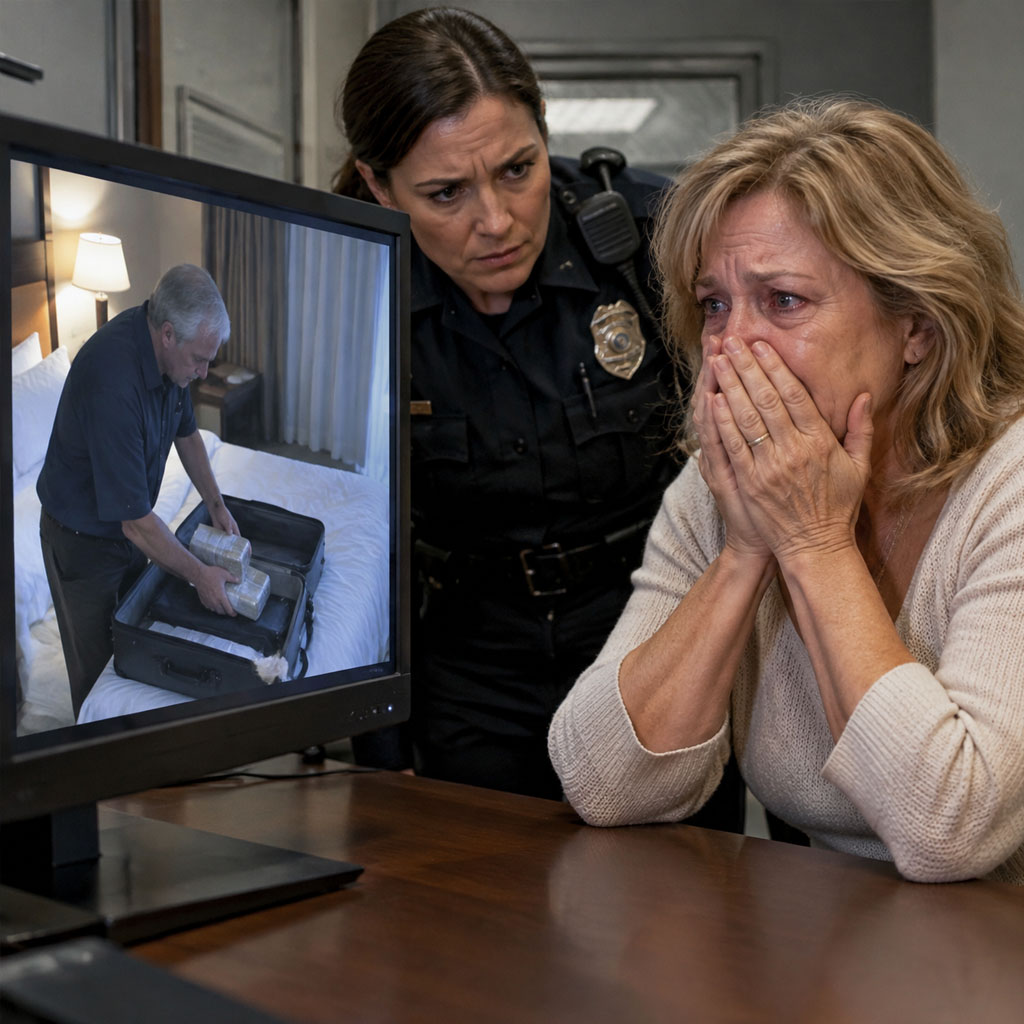
The following morning, I met Assistant District Attorney Sarah Chen, who was coordinating the prosecution. She showed me surveillance photographs of Richard meeting my son at a downtown bar months before our first date.
The footage confirmed what I had already begun to suspect. Jake had not merely tolerated my relationship with Richard. He had helped arrange it.
“He provided information about your routine, your financial situation, and your emotional history,” Sarah explained. “Richard knew when you visited the coffee shop, what books you liked, and how long you’d been alone.”
My son had turned my ordinary life into a map for someone who wanted to destroy it.
Sarah told me that Richard had promised Jake $15,000 for personal information and another $50,000 for helping with the operation. The money was supposed to come from the proceeds of the scheme and the financial arrangements Richard had persuaded me to make.
“Your son is facing serious charges,” she said. “He may try to argue that Richard misled him or that he never understood how dangerous the plan was. You’ll need to decide whether you’re prepared to testify against both men.”
I thought about the little boy who used to bring me dandelions from the yard and leave them in a glass beside my bed. I remembered the nights I had stayed awake worrying about his future, the tuition bills I had paid, and the times I had emptied my savings to help him start over.
Then I remembered his face in the security footage.
“Yes,” I said. “I’ll tell the truth.”
Still, I needed to hear the truth from Jake himself.
At the jail, we sat on opposite sides of thick glass, speaking through a telephone that made his voice sound distant and hollow. He couldn’t look at me.
“Mom, I’m sorry,” he said. “I never wanted things to go this far.”
“How far did you want them to go, Jake?”
He swallowed hard. He explained that Richard had first approached him at a bar, claiming he was interested in me and wanted advice about how to make me happy. At first, Jake said, it had seemed harmless. Then Richard offered him money for details about my finances, and Jake convinced himself that no real harm would come from answering questions.
“When did you realize something was wrong?” I asked.
“When he started asking about your insurance and your doctor appointments.”
“And you still helped him?”
Jake began to cry. “He told me you’d probably get probation if anything happened. He said it would be a temporary mess, and afterward we’d all have money.”
I leaned closer to the glass.
“Your mother was worth fifty thousand dollars to you?”
“No. That’s not what you were worth.”
“Then why did you sell me for that amount?”
He had no answer.
I told him about Margaret, Patricia, and Carol. I watched the color leave his face as he learned that Richard had done this before and that one woman had died in prison.
“I didn’t know about the other wives,” he whispered. “I swear I didn’t know.”
“Maybe you didn’t know everything,” I replied. “But you knew enough to stop. You knew enough to ask questions. You knew enough to remember that I was your mother.”
He pressed his palm against the glass.
“Are you going to testify against me?”
“I’m going to tell the truth about what you did. What happens after that is your responsibility.”
I paused, struggling to hold my voice steady.
“I love you, Jake. I always will. But loving you doesn’t mean protecting you from the consequences of your choices. The relationship we had before this happened is gone, and I don’t know whether we can ever build another one.”
He called my name as I stood to leave.
I didn’t turn around.
Outside, the morning air was cold, but for the first time since the airport, I could breathe without feeling as though someone had a hand around my heart. I had lost my marriage before it had truly begun, and I had lost the trust I had placed in my only child.
But I was alive.
And I was no longer willing to sacrifice myself to save people who had decided my life was expendable.
Chapter 3
Three weeks into the investigation, Sarah Chen arrived at my temporary apartment carrying a box of files so heavy she had to set it down with both hands.
“We found Richard’s operation headquarters,” she said. “And Linda, this is much bigger than one man and his accomplices.”
The warehouse in Newark contained detailed records on more than fifty women. Some were wives, some were widows who had recently received inheritances, and others were divorced women rebuilding their lives. Each file contained financial information, family histories, personal routines, and notes about emotional vulnerabilities.
My own file was three inches thick.
Sarah opened it to a page covered in Richard’s handwriting. One sentence had been underlined twice: “Responds to intellectual flattery and traditional romance. Son is financially desperate and emotionally dependent. Ideal leverage.”
I felt sick, but something else happened, too. Seeing my life reduced to a cold business calculation helped me understand that my loneliness had not made me foolish or deserving of what happened. Richard and his associates had deliberately exploited the ordinary human desire to be loved.
“What does this column mean?” I asked, pointing to a chart marked Timeline to Extraction.
Sarah hesitated.
“The original plan was to establish trust, gain financial access, and then arrange your death in a way that appeared accidental. The airport operation was a backup plan. Richard believed a criminal conviction would also separate you from your assets and leave him in a position to benefit.”
I stared at the chart. It was as though someone had prepared a schedule for erasing me from the world.
“How many women died?”
“We have confirmed seven deaths associated with the wider operation, though some cases are still being investigated. There may be more.”
Seven women. Seven lives that had once contained birthdays, family dinners, ordinary worries, and plans for tomorrow.
Then my phone rang.
The caller introduced herself as Helen Rogers, Margaret Stevens’s sister. She had seen the news about Richard’s arrest and wanted to know whether my case could help free Margaret, who had spent three years in prison for a crime she had not committed.
Helen described her sister as a generous woman who had believed Richard’s attention was a second chance at happiness. Margaret had maintained her innocence throughout the trial, but the evidence against her had seemed overwhelming.
“She’s been struggling,” Helen said, her voice breaking. “She keeps saying nobody will ever believe her. If you can help us, please don’t let her disappear in there.”
I looked at Sarah, who had already begun taking notes.
“Tell me everything,” I said. “We’ll see what we can do.”
Over the following months, I helped investigators reconstruct Richard’s methods. I provided documents, answered questions about our marriage, and described every conversation in which he had asked about money, insurance, or my family. Each memory was painful, but the work gave my grief somewhere useful to go.
Ten months after the airport arrest, I sat in a federal courtroom wearing a navy suit and faced the man I had once promised to love for the rest of my life.
Richard looked smaller without his expensive clothes and confident smile. His attorney tried to convince the jury that I had been desperate for companionship and had willingly entered a financial arrangement with him.
“Mrs. Morrison,” she asked, “isn’t it true that you were eager to marry my client and voluntarily changed your beneficiary designations?”
“I was eager to believe I had found someone who cared about me,” I replied. “I changed those documents because I trusted him. That trust was the very thing he intended to exploit.”
The attorney pressed me about the relationship, suggesting that I had mistaken an ordinary financial disagreement for a criminal conspiracy.
I looked directly at her.
“Your client didn’t simply persuade me to change my will. He arranged for illegal substances to be hidden in my suitcase while I was in the shower. He planned to let me take the blame, and the evidence shows he had another plan for my death if that one failed. That isn’t a disagreement about money. It’s a calculated attempt to destroy another human being.”
The courtroom fell silent.
The prosecution presented financial records, surveillance footage, and the files recovered from the warehouse. Witnesses described similar schemes involving Richard’s previous wives, while investigators explained how he used marriage and family connections to make his victims appear responsible for crimes they had never committed.
Then Jake took the stand.
I had known he would testify, but seeing him walk toward the witness box nearly undid me. He looked pale and thinner than I remembered, his suit hanging loosely from his shoulders.
He admitted that Richard had paid him for information about me and promised him $50,000 for his assistance. He also acknowledged that he had ignored warning signs because he wanted the money.
“Did you know Mr. Callaway intended to harm your mother?” the prosecutor asked.
Jake looked at me.
“I knew something was wrong,” he said. “I knew he was asking questions no one should have been asking about her. I let myself believe his explanations because I wanted the money more than I wanted to face what I was helping him do.”
His voice cracked.
“I told myself she would be fine. I told myself it was just a scheme and she wouldn’t really get hurt. But I never made sure that was true. I just kept taking the money.”
It was the first honest thing I had heard him say in months.
Richard’s attorney attempted to portray Jake as the mastermind, but the records showed that Richard had recruited him, manipulated him, and directed the operation. That did not excuse Jake’s choices, but it made the division of responsibility clear.
During a recess, Jake approached me in the courthouse hallway.
“Mom, I know I don’t deserve forgiveness,” he said. “But when I saw those files, I realized I helped plan your murder. I can’t change that. I can only admit it and try to understand how I became someone who could do something like that.”
I studied his face, searching for the little boy I remembered.
“I hope you do the work, Jake,” I told him. “But forgiveness isn’t something you can demand because you’re sorry. It has to come after honesty, accountability, and change. I can’t promise what our relationship will become.”
He nodded, tears gathering in his eyes.
“I understand.”
For once, I believed he might.
The jury deliberated for less than four hours before returning a guilty verdict on all major counts, including conspiracy, fraud, and trafficking-related offenses. The judge scheduled sentencing for the following month and condemned Richard’s calculated exploitation of marriage, family, and trust.
Outside the courthouse, reporters crowded around me.
“How do you feel about the verdict?” one asked.
“Relieved,” I answered. “But I also feel sad that so many women had to suffer before the full pattern was recognized. Richard’s conviction matters, but it doesn’t undo the years taken from Margaret, the losses Carol endured, or the lives that cannot be restored.”
Another reporter asked what I intended to do next.
I looked toward the courthouse doors, where Sarah was speaking with Helen.
“I’m going to help other women recognize these schemes before they lose everything. People need to understand that love should never require secrecy about money, rushed changes to legal documents, or the surrender of your independence.”
I had entered that courtroom as a woman whose confidence in herself had been shattered. I walked out knowing that what had happened to me was not the end of my story.
It was the beginning of a different one.
Chapter 4
Richard’s conviction should have been the end of it, but three weeks before his sentencing, Sarah called at six in the morning.
“We found his partners,” she said. “And one of them is someone you’ve met.”
An hour later, I sat in her office staring at a photograph of Dr. Anthony Martindale, the insurance agent who had helped Richard and me update our policies.
I remembered him as a pleasant, professional man who had patiently explained beneficiary designations and reassured me that planning for the future was a sign of responsible adulthood.
“He’s been working with Richard for more than five years,” Sarah explained. “He identified potential targets, facilitated insurance arrangements, and helped move money through the network.”
She showed me photographs linking Martindale to cases involving Margaret and Patricia. Another image showed him meeting Jake two months before Richard had approached me.
My son hadn’t simply wandered into a bad arrangement. He had been drawn into a professional network that assessed people like me as financial opportunities.
The investigation identified at least eight people involved in different parts of the operation, including financial advisers, lawyers, private investigators, and a retired law enforcement officer. Some had gathered personal information, others had arranged financial documents, and still others had helped disguise suspicious deaths as accidents.
Even a probate judge had been implicated in efforts to influence estate proceedings.
“How did you find all this?” I asked.
“An anonymous tip led us to a storage unit. Inside were financial records, planning documents, and recordings of meetings. Someone decided they couldn’t keep living with what they’d helped create.”
Sarah opened an encrypted video file. The recording showed Richard seated around a conference table with several associates, including Martindale and Jake.
Richard’s voice was unmistakable.
“Linda Morrison is isolated, financially stable, and emotionally vulnerable after her husband’s death. Her son is desperate enough to help, and she trusts authority figures. She’s an ideal target.”
I felt a familiar coldness settle in my chest.
Then Jake’s voice came through the recording.
“She’s already updating her will. The new insurance arrangements take effect next month.”
For a moment, I couldn’t move.
My son had been giving them updates on my life while I sat at home believing he was happy that I had found love.
But the most disturbing revelation came next. Richard explained that another criminal group had also been interested in me, hoping to exploit me through a slower romance scam. His associates wanted to act first because they believed their plan would produce a larger return.
I had not been unlucky enough to meet one dangerous man. I had become the subject of a competition between people who saw my life as a prize.
Sarah’s phone rang before she could say anything else. The caller’s voice had been electronically disguised.
“I was part of Richard’s operation,” the person said. “I helped target women, and I’m sorry. My daughter is getting married next month. Yesterday, I realized someone could do to her what we did to you. I can’t live with that anymore.”
The caller revealed that additional evidence was hidden in other storage units and warned that three women were currently being targeted by the network.
Sarah began coordinating with federal investigators, and I agreed to help wherever my experience could be useful. The next weeks were filled with interviews, document reviews, and careful efforts to identify potential victims without putting them at further risk.
The additional evidence led to the arrest of Richard’s associates. Martindale’s financial records connected him to multiple fraudulent policies, while the recordings exposed the network’s planning and its efforts to influence legal proceedings.
The anonymous informant turned out to be Martindale’s former assistant, who had spent years helping prepare paperwork without understanding the full purpose of the operation. Once she recognized what was happening, she had secretly preserved records and eventually contacted investigators.
Her evidence helped authorities identify the three women who were still being targeted. Investigators intervened before the schemes could progress, and the women received help reviewing their finances, securing their personal information, and separating themselves from the people exploiting them.
For the first time, I understood the difference between surviving a crime and helping prevent one.
I could not bring Patricia back. I could not give Margaret three years of her life or return Carol’s lost home. But I could help ensure that the next woman had someone to call before her entire world collapsed.
Richard was eventually sentenced to four consecutive life terms. Martindale and the other members of the network faced convictions and lengthy prison sentences, while the evidence against the corrupt probate judge led to a twenty-year sentence.
Jake cooperated fully with the prosecution and received a reduced sentence of three years in federal prison, followed by five years of supervised release. His cooperation helped establish the network’s structure, but it did not erase his role in targeting me.
Margaret’s conviction was overturned after the new evidence exposed the scheme that had sent her to prison. She was released, although the years of incarceration had left lasting effects on her health.
When Helen called to tell me, I sat down at my kitchen table and cried. It was not the clean, uncomplicated happiness of a story in which justice restores everything. Margaret had lost years she would never recover, and freedom did not instantly repair the damage.
Still, she was home.
And she knew someone believed her.
Chapter 5
Six months later, I stood in a hotel ballroom facing two hundred people gathered for the first national conference on predatory relationship fraud. Federal agents, prosecutors, social workers, financial professionals, and survivors had come from across the country to discuss how these schemes worked and how to stop them.
I had helped organize the event, but when I stepped toward the microphone, my hands trembled.
“Eighteen months ago, I was a school librarian who believed the most dangerous thing in my life was an overdue book,” I began. “I had lost my first husband, raised my son, and worked hard to build a quiet, comfortable life. I thought I understood people. I thought I knew the difference between kindness and manipulation.”
The room grew silent.
“I was wrong about some things, but not because I was foolish to want companionship. I was targeted because a group of people understood that loneliness, family loyalty, and trust could be used against me. They studied my habits, recruited someone I loved, and planned to take my money, my freedom, and potentially my life.”
I showed the audience examples of the warning signs we had documented: unusually rapid romantic commitments, pressure to change wills or beneficiaries, persistent questions about insurance, and attempts to isolate someone from family members or friends who raised concerns.
I also emphasized that financial abuse did not always begin with strangers. Sometimes a trusted relative provided the information that made the exploitation possible. Sometimes a professional who was supposed to offer protection was the person opening the door.
“My son participated in what happened to me,” I said. “He was also manipulated by someone who knew exactly how to appeal to his desperation. Those facts can both be true. Understanding why someone makes a terrible choice does not mean pretending the choice caused no harm.”
I explained that Jake was serving his sentence and participating in counseling to understand his decisions. We spoke occasionally through supervised conversations, but I had made no promises about reconciliation.
“I still love him,” I told the audience. “But love does not require me to pretend that trust has been restored. If we ever build a relationship again, it will have to be based on accountability and changed behavior, not guilt or obligation.”
After the presentation, a young woman approached me with tears in her eyes. Her seventy-eight-year-old grandmother had recently begun dating a man she met through church. He was already asking questions about her will and life insurance, and he had encouraged her to stop listening to family members who were concerned.
We sat together for twenty minutes while I helped her identify the warning signs. I gave her Sarah’s contact information and explained how to report her concerns without confronting the man alone.
“We’re going to help you,” I said.
The relief on her face reminded me why I had agreed to stand in front of that ballroom. My story had begun with a whispered warning at an airport. Perhaps someone else’s story could change because I had learned what that warning meant.
That evening, I returned to my two-bedroom apartment, a place I had purchased after reaching a settlement with the insurance company whose agent had participated in the scheme. It was modest, bright, and entirely mine. I had chosen the furniture myself, hung my favorite paintings on the walls, and placed a comfortable reading chair beside the window.
I no longer saved the good things for a special occasion.
My phone rang, and Carol Thompson’s name appeared on the screen.
“I got the job,” she announced before I could say hello. “The North Carolina Attorney General’s Office hired me as a victim advocate. I’ll be helping older adults who have been targeted by financial criminals.”
I smiled.
“I knew you would find a way to do something meaningful with what happened.”
Carol laughed, and the sound carried a warmth that had gradually returned over the past several months. She had lost her home and much of her savings, but she had rebuilt her life with the help of her daughter and the friends she had made during the investigation.
“It’s terrifying to start over at sixty-three,” she admitted. “But I finally know I can survive things I never imagined facing. I don’t want what happened to me to be the only thing that defines me.”
“It won’t be,” I told her.
Helen had started a nonprofit in Michigan to support families affected by wrongful convictions and crimes involving trusted relatives. Margaret was working with a legal aid organization to help other women challenge convictions based on fraudulent schemes.
We had become a strange kind of family, brought together not by blood or marriage, but by the knowledge that we had survived something that could have destroyed us. We didn’t tell one another that everything happened for a reason. Some things were simply terrible, and pretending otherwise would have been an insult to the people who suffered.
Instead, we listened. We showed up. We helped each other find the next step when the road ahead seemed impossible.
A few days later, Sarah sent me the final update on the network prosecutions. All eight major defendants had been convicted, and the anonymous informant had been relocated for her safety. Investigators were continuing to review suspicious cases connected to the network, but the people who had once operated with confidence were now facing the consequences of their actions.
I read the message twice before closing my phone.
Then I sat by the window with a glass of wine and thought about the woman I had been in the coffee shop eighteen months earlier. She had been reading Agatha Christie, hoping for a pleasant conversation, unaware that someone had studied her routine and prepared a charming opening line.
I wished I could go back and warn her, but I knew that a warning alone would not have been enough. Richard had not fooled me because I was incapable of thinking for myself. He had fooled me because he had practiced deception, because he had recruited my son, and because he knew how to make ordinary hopes feel like evidence of a perfect match.
I had learned to be more careful, but I refused to become a person who believed that every kind word concealed a threat. Trust, I understood now, did not have to be blind. It could grow slowly, supported by consistent actions, honest conversations, and respect for boundaries.
As for Jake, I did not know whether we would ever recover what we had lost. I hoped he would use his time in prison to become someone who understood the value of other people’s lives. I hoped he would learn to take responsibility without making excuses, and that one day he might earn the chance to sit across from me at a table without either of us needing to hide the truth.
But I would not put my life on hold waiting for that day.
Richard had wanted me to believe that my value depended on whether a man chose me. Jake had helped him make me believe that my own child valued me only for what I could provide. Their betrayal had nearly cost me everything, but it had not taken away my right to decide what came next.
The following morning, I made coffee, opened my laptop, and began preparing another presentation. There were more women to reach, more families to help, and more people who needed to understand that financial predators often wear familiar faces.
I thought about the airport, the security office, and the agent who had leaned toward me and whispered those unforgettable words.
“Pretend I’m arresting you.”
At the time, I had believed my life was ending. Instead, that moment had given me the chance to see the truth before it was too late.
I had lost a husband I never truly knew and a version of my son I could no longer trust. I had lost the comforting belief that loving someone guaranteed they would love me in return. But I had kept my life, my independence, and the ability to choose what kind of person I wanted to become.
And I had discovered something worth carrying into whatever years remained to me: being betrayed does not make you foolish for having loved, and surviving betrayal does not require you to forgive before you are ready.
Sometimes, the bravest thing a person can do is stop protecting the people who hurt them and start protecting the life they still have.
I turned to a blank page and began writing.
For the first time in a long while, I wasn’t trying to solve a mystery someone else had created for me. I was deciding how my own story would continue.
THE END.
⚠️ All characters and events are fictional. Do not imitate or apply them in real life. 😌😌😌


