
Chapter 2
My father looked at me as if I’d spoken a language he didn’t recognize. Mom stood beside him, clutching her purse with both hands, while Meredith stared at me with an expression that was half disbelief and half outrage. They had come expecting an argument about money, and perhaps a little lecture about family loyalty, but they hadn’t expected me to mention the year I’d stopped showing my sister my stories.
“You’re making this into something it isn’t,” Meredith said. “I was trying to help you. You know that.”
“You called my book garbage in front of everyone at Mom’s table. Then you emailed my agent and told her you were my editor.”
“I was networking,” she snapped. “That’s how publishing works. You wouldn’t know.”
Dad stepped forward. “Now, hold on. Your sister’s the one who got you interested in writing in the first place. She won prizes when you were still a kid. You ought to help her out.”
I looked at him for a long moment. He had spent three years accepting my money for his truck without asking whether I could afford it, and he’d never once asked what it cost me to keep helping. He had also sat at our family table while Meredith mocked my work, then told me she knew more about writing than I did.
“I don’t need to help her get an agent,” I said. “I don’t need to pay her loan, and I don’t need to pay for your truck. You all made your choices on Saturday. I’m making mine now.”
Mom began crying softly, looking toward Dad to see whether he would comfort her. Meredith crossed her arms and accused me of financial abuse, claiming I couldn’t make people depend on me and then withdraw the money when my feelings got hurt.
“I didn’t make you depend on me,” I said. “I helped because I thought we were family. You’re responsible for your loan, and Dad’s responsible for his truck. That’s not punishment. That’s life.”
“You’re really going to do this over one party?” Meredith asked.
“It wasn’t one party. It was a long time.”
Mom reached for my arm, but I stepped back. I wasn’t trying to hurt them, and I wasn’t interested in screaming or making threats. I simply walked to the front door, opened it, and held it while they gathered their things.
On the porch, Meredith put her sunglasses back on. “You know what your problem is, Dev? You always take everything so personally.”
“I was eleven,” I said.
Then I closed the door.
I didn’t understand why those words had come out so sharply until four days later, when a storm rolled across southern Missouri and the electric cooperative sent crews out to repair downed lines. I worked thirty-one hours over two days, climbing poles and replacing damaged equipment while the rest of the world tried to get its lights back on. Somewhere around hour twenty, my foreman, Arch, asked whether I’d heard that my parents had gone to the lake instead of my birthday.
“Yeah,” I said.
“Huh,” he replied, and handed me another bottle of water.
That was all he said, and somehow it meant more than all the explanations my family had offered.
When the storm work finally ended, I went back to Nadine’s Cafe. Aaron was waiting at our usual table with two coffees and a stack of library books. She didn’t ask me to explain what had happened with my family. She simply sat beside me while I opened my laptop and began working on my second novel.
I had learned that writing was the one part of my life I could control. I could choose the words, decide where a sentence ended, and make a character stand up for himself even when the people around him wanted him to stay quiet. I couldn’t force my parents to respect me, but I could stop handing them the power to decide whether my work mattered.
A week later, I booked the Elks Lodge for another party, this time on August twenty-ninth. I invited the people who had shown up for me in small, ordinary ways: Arch and the linemen from our crew, their wives, Nadine, Twyla from the bookstore, Roy from the lodge, Aaron’s parents, and a few retired workers who had written me letters after reading my novel.
I ordered barbecue for sixty people, and the woman at the restaurant laughed when she saw my name on the order. “Back again? Bigger crowd this time?”
“That’s the plan,” I said.
Aaron had another idea. She was building a display for local authors at the county library and wanted something from my childhood to show where my writing had begun. I told her I had a few old notebooks somewhere, and that Sunday, I finally opened the boxes my mother had dropped off in my garage years earlier when she turned my childhood bedroom into a sewing room.
The first box held Little League trophies and report cards. The second contained old drawings, a comic about a dog who became a police officer, and several spiral notebooks with bent covers and pages yellowed at the edges. I smiled when I found The Talking Tractor, the story Meredith had dismissed when I was eight.
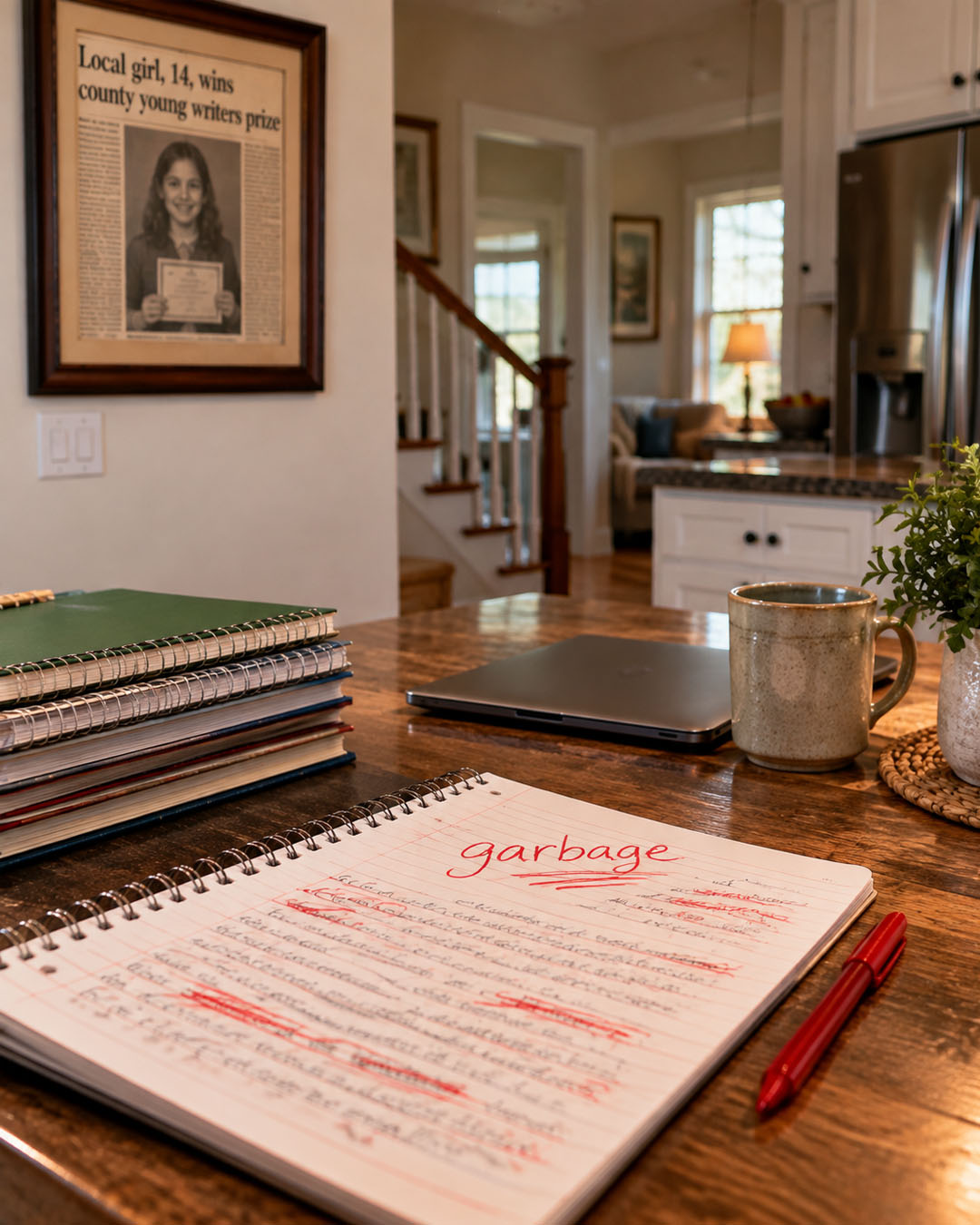
At the bottom of the pile was the green notebook. I knew it by the curled corner of its cover, and I remembered the night I’d finished it by flashlight, convinced that I’d written something special. I opened it and saw the word GARBAGE in red ink across the first page, pressed so hard it had cut through to the next sheet.
I began turning the pages. Every few paragraphs, Meredith had crossed out one of my sentences and written a replacement in the margin. There were arrows showing where passages should move, notes about making the scene sadder, and entire paragraphs rewritten in her handwriting. At the end, she’d crossed out my final sentence and written a different one beneath it.
I sat at my kitchen table for nearly an hour, looking at the small, uneven handwriting I’d used as a child. It was strange to see how hard I’d tried to make each word fit, how carefully I’d described the rain and the mud and the fear of losing a dog I loved. I had forgotten how much of myself I’d put into that story.
On Monday morning, I took the notebooks to the county library and gave Aaron the green one along with the others. I didn’t explain what I had found, because I wasn’t sure yet what it meant. I wanted to see whether she would notice the same things I was beginning to suspect.
Two hours later, she called me during my lunch break.
“Devon, I have a question,” she said. “Your sister won the county young writers contest when she was fourteen, right?”
“That’s what the clipping in Mom’s hallway says.”
“The library kept an anthology of the winners. We have all of them in the local history room.” She paused, and when she spoke again, her voice had changed. “I think you need to come down here and look at something.”
I drove to the library after my shift, still wearing my work boots. Aaron had placed two items on the large oak table in the local history room: a thin paperback anthology and my green spiral notebook. The book was open to page twelve, where a story titled “The Storm” appeared beneath Meredith’s name.
I read the first paragraph, then looked down at my notebook. The boy’s grandfather’s beagle had gotten loose during a thunderstorm, and the boy had gone out into the rain to find him. The dog’s name had changed from Rufus to Buster, but the sentences were mine, and so were the descriptions of the rain, the muddy road, and the fear that the dog might never come home.
Aaron had gone through both versions with a pencil, marking each place where Meredith had changed my words. There were forty-one changes in all, and every one appeared in the published story. The final sentence in the anthology was the one Meredith had written in the margin of my notebook, replacing the ending I’d created when I was eleven.
I looked at the red ink across the first page, then at the prize-winning story on the table. My sister had kept my notebook for four days, called it garbage, and returned it to me covered in corrections. In the same spring, she’d submitted it as her own work and won a county writing prize that convinced our family she was the gifted one.
“She didn’t just borrow your idea,” Aaron said quietly. “She took your story, changed a few things, and submitted it.”
I sat down because my legs had begun to feel unsteady. For eighteen years, my family had praised Meredith’s talent while I stood beside them pretending it didn’t bother me. She had laughed at my stories because she knew exactly what they were worth, and she’d spent years making sure I never discovered it.
The newspaper clipping in my mother’s hallway had never been a harmless family memento. It was proof of the moment my sister’s lie became part of our family’s history.
Chapter 3
I checked the anthology out of the library, and Aaron stamped the card herself. She didn’t tell me what to do next, and I was grateful for that because I didn’t know yet whether I wanted to confront Meredith, show the evidence to my parents, or simply put the notebook back in the box and walk away.
For five days, the book rode beneath the seat of my truck. Every time I climbed into the cab, I could see the corner of its cover, and every time I saw it, I remembered being eleven years old and standing in my sister’s doorway with the green notebook held against my chest. I’d believed her when she told me my writing was bad because I thought she knew more than I did. I had never considered that she might have been trying to keep me from discovering how good it was.
Aaron finally asked what I wanted to accomplish. We were sitting at Nadine’s one morning, and I’d been staring at the same paragraph on my laptop for nearly twenty minutes. She put her coffee down and waited until I looked at her.
“You don’t owe her a public humiliation,” she said. “But you don’t owe her silence, either. Decide what you want to say, and say it for yourself, not because you want her to suffer.”
I knew she was right. I didn’t want to destroy my sister’s life or turn my own success into a family spectacle. I wanted the truth to exist outside my head, where it could no longer be dismissed as a misunderstanding or a childhood grievance. And I wanted to stop carrying the shame of a story I had written with love, as if I’d done something wrong by believing in it.
I decided to bring the notebook to my second birthday party. I would put it on a table beside my published novel, not as a trap, but as a piece of my history. Anyone who wanted to read it could, and anyone who asked about the red ink would get an honest answer.
The night before the party, I laid the notebook beside the anthology on my kitchen table. Aaron helped me make a small card for the display that read, “Where It Started.” We included The Talking Tractor, my old comic about the dog who became a police officer, and a few other stories I’d written as a boy. The green notebook sat in the middle, open to the first page.
I didn’t tell my parents about the display. They hadn’t called since the visit, and I hadn’t reached out to them. I knew they might not come, but I wasn’t going to let their absence decide whether the evening mattered. This time, I had invited people who wanted to be there, and I trusted them to make the night what it was supposed to be.
On Saturday, August twenty-ninth, the hall was full by six o’clock. Arch and the crew arrived in clean shirts, which I had rarely seen them wear outside a wedding, and their wives brought desserts. Nadine came with two pies, Twyla brought a new sign for the entrance, and Roy wore a tie and insisted that someone take his photograph beside the buffet.
Aaron had arranged the old notebooks near the door, and people stopped to read them as they came in. Nadine laughed at the red pen marks in the green notebook, then grew quiet when she read the word GARBAGE across the top. One of Arch’s coworkers asked who would write that on a child’s story, and I told him the truth.
“Somebody who knew it was good.”
Around seven fifteen, Roy came over with an odd expression on his face. He glanced toward the entrance and lowered his voice.
“Your folks are here.”
My father stood just inside the door wearing the same tie he’d complained about before the first party. Mom held a gift bag in one hand, and Meredith stood behind them in a nice dress, scanning the room as if she were looking for a place to hide. I later learned that two of Dad’s lodge buddies had asked him at a bar why he’d missed his own son’s birthday celebration at the lodge. Apparently, my mother had decided it was better to show up than to let the town keep talking.
I walked over to greet them. Mom held out the gift bag and said, “Happy birthday, honey. We wanted to come.”
“You weren’t invited this time,” I said.
Her face tightened. “Well, I’m your mother.”
“You were invited last time.”
She looked away, and Meredith wandered toward the display table. I watched her pick up the green notebook, read the word written across the first page, and go completely still. The color drained from her face so quickly that I wondered whether she might be sick.
“Mer,” I said, keeping my voice calm, “can I talk to you for a minute? Both of you, too. Let’s go into the kitchen.”
The Elks Lodge kitchen was long and narrow, with a steel counter down the middle and a dishwasher humming in the corner. Aaron came with me because I’d asked her to, and she stood by the door while my parents and sister gathered around the counter. I went out to my truck and returned with the anthology, placing it open to page twelve beside the green notebook.
Dad frowned. “What’s this about?”
“Mom, you remember that newspaper clipping in the hallway, the one about Meredith winning the county young writers prize?”
“Of course I do,” she said.
“That’s the story she won with. And this is the notebook I wrote it in when I was eleven.”
I pointed to the first page, where my sister had written GARBAGE in red ink. Then I showed them the published story, the forty-one changes Aaron had marked, and the matching passages that appeared in both versions. I explained that Meredith had kept the notebook for four days, returned it covered in corrections, and submitted the revised story as her own work.
Nobody spoke. The dishwasher hummed, and somewhere in the hall I heard people laughing over a story Arch was telling. Mom picked up the anthology and read the first paragraph, then took the green notebook and studied my childhood handwriting. She set both items down very carefully, as though they might break.
“Meredith,” she whispered, “is this true?”
My sister’s face was pale, but she lifted her chin. “He was eleven. He wasn’t going to do anything with it.”
That was her entire defense. She didn’t say the story was hers, or that I was mistaken, or that the matching passages were a coincidence. She simply argued that because I had been a child, my work didn’t count.
For the first time in my life, I felt something inside me stand up straight. I had spent years trying to make my sister understand that I could write, too, and I finally realized that I no longer needed her permission.
“I was eleven,” I said. “You were right about that. I gave you the best thing I’d ever written because you were my big sister, and I thought you knew about books. You wrote garbage across it, laughed at me, and then took it to the library and won a prize with it.”
“That’s not what happened,” Meredith said, but her voice had lost its confidence.
“Then tell us what happened. Tell us why every sentence in that story matches the notebook, including the lines you crossed out and replaced. Tell us why the ending you wrote in the margin is the ending in the anthology.”
She looked toward Dad, waiting for him to step in as he always had. He stared at the notebook instead.
“You won a prize with that,” he said slowly. “We put it in the paper.”
“Yes, Dad. We did.”
Mom covered her mouth with one hand. I couldn’t tell whether she wanted to cry or whether she was finally beginning to understand how much the clipping had meant to me. For eighteen years, she’d walked past it without ever asking what had happened to the boy whose story had disappeared.
“Meredith,” I continued, “you have two degrees in English. You teach college students how to write an argument, and you teach them not to turn in somebody else’s work. I’ve seen your syllabus. You know exactly what plagiarism means.”
My sister began crying. “You don’t understand what it was like. I was fourteen. I was trying to prove I could do something.”
“So was I,” I replied. “I was eleven, and I wanted my sister to tell me I was good at something.”
She wiped her face and said I had humiliated her. I told her I hadn’t written anything on the notebook that wasn’t already there, and I hadn’t changed a word of the story she’d submitted. I had simply brought the truth into the room, and for once I wasn’t going to apologize for it.
Then I looked at my father. “You told me to help Meredith because she got me interested in writing. But she didn’t help me become a writer. She taught me to hide my work from her. It took sixteen years for someone else to convince me that my stories were worth reading.”
I nodded toward Aaron, who stood quietly by the door.
“This is Aaron. She read my novel before anybody else did. She helped me find an agent, and she believed in me when I was still afraid to show my work to anyone. Mom, she wrote you a card for my first party. She was going to give it to you that night.”
Mom looked at Aaron as if she were seeing her for the first time. Aaron gave her a small, polite nod but said nothing. She had no interest in turning the moment into a victory, and I loved her for that.
I picked up the green notebook and turned back to Meredith. “You wanted me to give you Margo’s number and recommend your book. But you already contacted her, and she already said no. I’m not going to ask her to reconsider, and I’m not going to pretend you edited my novel when you didn’t.”
Meredith’s eyes filled with tears. “I hope you’re happy. You’ve humiliated me.”
“No,” I said. “I’ve just been reading. Everybody always said you were the writer in this family. Turns out you were right. You just needed me to write it first.”
I took the notebook and left the anthology on the counter because it belonged to the library. Then I walked back into the hall, where Nadine was cutting pie and Twyla was trying to persuade Arch to dance. Aaron caught up with me, took my hand, and stood beside me without saying anything.
My family left five minutes later. Roy told me afterward that Mom had left the gift bag on the table near the entrance. I never opened it, and I never asked what was inside.
For the first time in my life, I didn’t feel the need to chase them down the driveway and explain myself.
Chapter 4
The weeks that followed were quieter than I expected. I had imagined that exposing Meredith’s lie would lead to shouting phone calls, angry messages from relatives, or some grand effort by my parents to convince me that I had misunderstood what happened. Instead, there was mostly silence, broken by the occasional cousin who asked what had gone on in the kitchen at the Elks Lodge.
I didn’t post photographs of the notebook or write about my sister online. I didn’t send the story to the newspaper or contact the college where she taught. The people who had been there knew what they’d seen, and I didn’t need to turn my family into public entertainment to make the truth real.
Word traveled anyway. Joplin isn’t a large town when it comes to stories like this, especially when the people involved have lived there for decades. Roy had been outside the kitchen, Arch’s wife had stood in the doorway, and several of my coworkers had seen the green notebook on the display table. I never told anyone what to say, but I stopped correcting people when they called me a writer.
My father began paying his own truck payment. He had been working fewer hours at the terminal, but he picked up additional shifts and adjusted his spending. When I finally learned that he had been able to cover the payment all along, I felt more sadness than anger. I’d been helping him because I believed he needed me, and he’d accepted the money without ever asking whether I was putting my own plans aside to provide it.
Meredith began paying her student loan herself. To make ends meet, she took a second job on Saturdays at Twyla’s bookstore on Main Street. I heard about it from Twyla, who said my sister was good at alphabetizing and keeping the shelves tidy. She also said Meredith had to restock my novel every Saturday morning before she could work on anything else.
I didn’t ask Twyla to do that. It was her store, and she could run it as she pleased, but the thought of Meredith quietly arranging copies of the book she’d once called garbage made me smile in spite of myself. I didn’t need her to praise my work, and I didn’t need her to apologize before I could keep writing.
My mother took the newspaper clipping down from the hallway. One of my cousins sent me a photograph showing the bare nail and the lighter square of paint where the frame had hung. I stared at it for a long time, wondering whether Mom had finally understood what the clipping had cost me, or whether she had simply decided she didn’t want to be reminded of the argument.
She hasn’t called me since the party. I haven’t called her, either, and I’ve made peace with that. Some relationships can be repaired with an honest conversation and a willingness to change, but others require distance before either person can see what has happened clearly. I don’t know which kind ours will be, and I no longer feel obligated to decide that for everyone.
Aaron and I are still together. She continues to work at the library, and I continue to climb poles for the electric cooperative. On mornings when the weather is clear, we sit at Nadine’s with our coffee and watch the town wake up through the front window. I write while she reads, and sometimes she leans over to ask why I’ve chosen one word instead of another.
She never takes my pages away with a red pen. She asks questions, listens to my answers, and lets me decide whether I want to change anything. That small difference has taught me more about editing than all the years I spent trying to please my sister.
I still think about the boy who wrote the story about the talking tractor. He was so proud of his little notebook that he carried it into his sister’s room expecting her to be impressed. When she laughed, he believed her because he thought older people knew things children didn’t, and because he wanted her approval more than he wanted to trust himself.
I wish I could go back and tell him that tractors don’t need mouths to make a good story, that the people who work with their hands have lives worth writing about, and that a child’s imagination isn’t worthless just because an older sibling says it is. But I can’t go back, and I can’t give that boy the years he spent hiding his work.
What I can do is keep writing. I can show my stories to people who read them with care, and I can refuse to let anyone convince me that the ability to create belongs only to people with the right degree or the right reputation. A book doesn’t become good because a publisher prints it, and it doesn’t become bad because someone in your family refuses to understand it.
A few months after the second party, I turned in the manuscript for my second novel. I had been working on it every morning at Nadine’s, and Margo called the next day to say she loved the ending. I felt the same quiet excitement I’d felt when Aaron first told me she couldn’t put my first book down, except this time I didn’t need to wonder whether I deserved it.
When I reached the acknowledgments page, I thanked Aaron for reading the early drafts, Arch for keeping me grounded, and Nadine, Twyla, and Roy for making room for me when my own family didn’t. Then, at the very end, I wrote one more line.
“And to my sister, who read my work first in 2008.”
Margo called the next morning. She laughed for nearly a minute, then said, “Keep it.”
I did.
Chapter 5
These days, I still arrive at Nadine’s around five thirty in the morning. The coffee is strong, the cinnamon rolls are still too big for one person, and the little table by the window has become my favorite place in the world to work. Aaron usually comes in at six oh three, carrying her library bag and wearing the same thoughtful expression she had the morning she first asked what I was writing.
She sits beside me now instead of across from me, and sometimes she reads over my shoulder while I work. We don’t talk much until the first cup of coffee is gone, but the quiet between us has never felt like the silence at my family’s dinner table. It is the kind of silence that gives a person room to think.
Last week, I printed out the first chapter of my third novel and left it on Aaron’s side of the table while I went to the counter for more coffee. When I returned, a yellow sticky note was attached to the first page. Two words were written on it in her careful handwriting.
NOT GARBAGE.
I stood there holding the pages, and for a moment I was eleven years old again, sitting on my bed with the green notebook in my lap. I could almost feel the old sting of the red ink, the shame of believing that my work was worthless, and the loneliness of keeping every story to myself because I was afraid someone would laugh.
Then I looked at Aaron, who was watching me with a small smile, and the memory loosened its hold on me. I put the sticky note in my wallet, sat down, and opened my laptop. Outside the window, a delivery truck pulled up to the curb, and the first customers of the morning began filing into the cafe.
I wrote the next sentence.
I don’t know whether my family will ever understand what happened, and I don’t know whether Meredith will ever admit that she stole a story from an eleven-year-old boy who trusted her. I know that my father still pays his own bills, my sister still works at the bookstore, and my mother has left the hallway wall bare where the framed clipping used to hang. Those are the facts, and I have stopped trying to turn them into a happier story than they are.
But I also know that I have a life filled with people who value the work I do, both on the power lines and on the page. I have a woman who reads my drafts, friends who show up when they say they will, and a growing stack of books that began with a boy who refused to stop writing even after someone he loved told him to quit.
My sister once believed that being the writer in our family meant she had the right to decide who else could write. She was wrong, and I no longer need her to admit it for me to know the truth. The red pen that followed me through childhood has finally lost its power.
I used to think that success meant proving my family wrong. Now I understand that it means building a life where their approval is no longer the measure of my worth. I can wish my sister well without giving her my agent’s number, and I can love my parents without paying for every decision they make.
The green notebook is back in my desk drawer, not hidden away as something shameful, but kept as a reminder of where I began. Sometimes I open it and read the story about Rufus, the beagle who ran into the storm. The sentences are awkward in places, and the ending is a little too sentimental, but there is a kind of courage in those pages that I hope I never lose.
An eleven-year-old boy wrote them because he loved a dog, loved his grandfather, and believed that people who loved each other should come looking when someone was lost. He didn’t know anything about literary agents or bestseller lists, and he certainly didn’t know that his own sister would one day use his words to win a prize.
He only knew that he had a story to tell.
That’s still enough for me.
THE END.
⚠️ All characters and events are fictional. Do not imitate or apply them in real life. 😌😌😌


