Chapter 2
I turned the phone toward the kitchen table and began reading the records aloud. At 3:42 a.m., someone had attempted a purchase at a children’s boutique in Oakwood Mall. At 4:11, three airline tickets had been booked for a 10:35 departure that morning, and at 4:37, a luggage purchase had been completed. The resort reservation followed nineteen minutes later, complete with a deposit and the names of Marissa’s children.
Her face changed when I mentioned the airline booking. The tickets had been issued using her legal name and the children’s dates of birth, details that could hardly have been guessed by a stranger. George still tried to dismiss the evidence, insisting that somebody could have obtained the information and framed his daughter, but even he sounded less certain than before.
“That’s a pretty elaborate conspiracy before sunrise,” I said.
Marissa glanced at her father, then at Daniel. I watched her consider several possibilities before she finally straightened her shoulders and decided that outrage might serve her better than denial.
“Fine,” she said. “I took it. But I was going to put the money back.”
Ellen covered her mouth. Daniel looked as though the floor had shifted beneath him, while George stared at his daughter in disbelief that quickly turned into anger directed at me.
“Marissa!” he barked.
She lifted her chin. “What? She has money. The bank will reverse the charges, and she’ll get it back. My kids needed this trip, and I knew she’d be reimbursed eventually.”
“You stole my card while I was sleeping,” I replied. “You don’t get to decide that someone else’s money is available just because you think they’ll recover it.”
“We’re going to be family,” she snapped. “You’re marrying Daniel. You weren’t even using the card.”
I glanced at Daniel. He looked ashamed, but he didn’t look away from his sister.
“Tell me you didn’t do this,” he said.
Marissa’s expression softened immediately. “Danny, don’t start. I made a mistake, that’s all.”
“A mistake is buying the wrong size shoes,” I said. “Taking someone’s card, using their identity, and charging thousands of dollars is a choice.”
George stepped between us, his voice rising. “You love making everything sound criminal. You write dramatic stories for a living, and now you’re treating your future sister-in-law like some dangerous stranger.”
“That is literally my profession,” I replied. “I follow evidence.”
For three years, I had watched Daniel’s family excuse Marissa’s behavior. When she lost a job after falsifying a mileage reimbursement, George insisted her employer had treated her unfairly. When she failed to repay the $3,200 Daniel had lent her for rent, Ellen explained that Marissa was emotionally overwhelmed. Once, she had taken an expensive cashmere coat from my apartment without asking because she needed something nice for a date, and George told Daniel to stop keeping score.
Daniel had begun recognizing the pattern, but old family habits were difficult to break. His father believed that the person who complained was often the real problem, while Marissa had learned that tears and indignation could turn nearly any confrontation into a discussion of how badly she was being treated.
“I’m calling the police,” I said.
Ellen hurried around the island. “Please don’t do that in front of the children.”
Marissa turned on me. “Are you really that heartless? You’re going to ruin my life over money you can afford to lose?”
“You didn’t know whether I could afford to lose it,” I said. “And even if I could, it wouldn’t make it yours.”
She opened her mouth, then looked at Daniel. “Say something. Tell her she’s overreacting.”
Daniel’s face tightened. “No. She’s not.”
George pointed a finger at him. “Think carefully before you take sides here.”
“I am thinking carefully,” Daniel answered. “She went into our room in the middle of the night and took something that wasn’t hers. What exactly am I supposed to defend?”
Marissa’s eyes filled with tears, but her expression hardened when the tears failed to change his mind. She stepped toward me and grabbed my arm.
“Don’t do this,” she whispered.
Daniel immediately removed her hand. “Don’t touch her.”
For the first time that morning, Marissa looked genuinely startled. Her brother had spent most of his life trying to keep the peace, and she was accustomed to him giving in when their father raised his voice. She had not expected him to draw a line in front of everyone.
“You think you’re better than me,” she said, glaring at me. “You think because you have a career and write articles, you can judge everyone.”
“No,” I replied. “I observed you. There’s a difference.”
I walked outside and called the bank first, locking the card and confirming the transaction sequence. Then I contacted the local police department and explained what had happened, giving the dispatcher the purchase times and the information already provided by the fraud-monitoring service. My hands began shaking only after I ended the call, when the cold morning air reached my bare arms and the reality of the situation finally settled over me.
Daniel came outside and sat beside me on the porch steps. For a while, he said nothing, staring at the driveway as if he were trying to find the right words among the cracks in the pavement.
“I’m sorry,” he finally said.
“This isn’t your fault.”
He gave a humorless laugh. “It feels pretty inherited.”
When I looked at him, he rubbed his jaw and told me something he had never shared before. When he was ten, Marissa had taken money from the envelope containing his confirmation gifts and blamed a cousin. Daniel had known she was lying, but their father accused him of imagining things and told him to stop making trouble.
“I kept thinking she’d grow out of it,” he admitted. “I thought if I loved her enough, maybe she’d become the sister I wanted.”
I placed my hand over his. I understood that kind of hope, the desperate belief that one more act of patience might finally change someone who had learned to benefit from your patience. Daniel wasn’t weak for wanting his family to be better than it was, but he could no longer make his future depend on that wish.
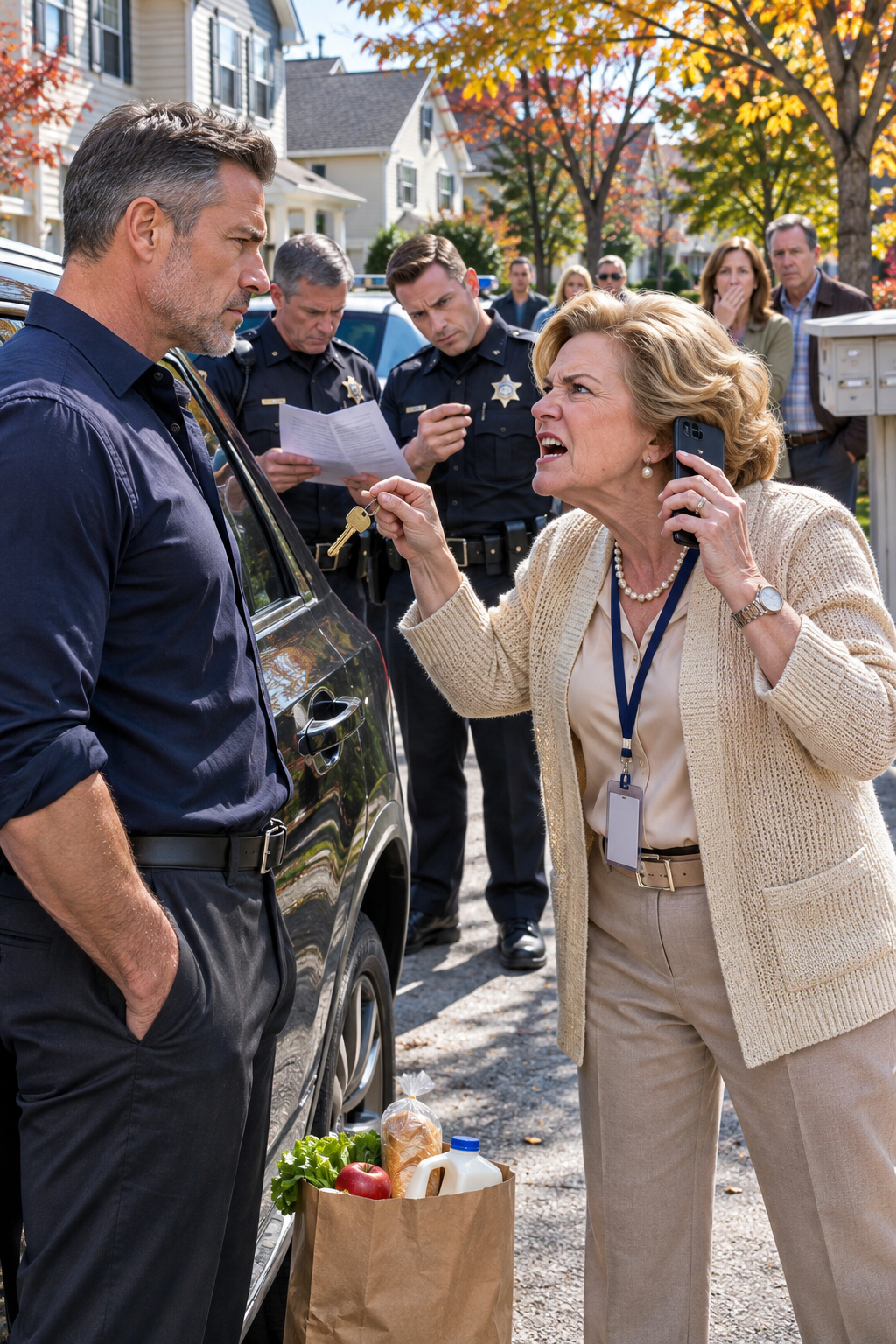
An officer arrived about thirty minutes later, followed by a second officer who spoke with the family while I provided my statement. George tried to dominate the conversation, explaining that this was a private family misunderstanding and that involving law enforcement would cause unnecessary embarrassment. The older officer politely asked him to let me finish speaking.
Marissa offered three different explanations in less than fifteen minutes. First, she said she had borrowed the card because she assumed Daniel had permission to use my belongings. Then she claimed she had found it on a hallway table. Finally, she suggested she had mistaken it for one of Daniel’s cards, although his name was nowhere on it.
The officers documented the statements, reviewed the available records, and contacted the merchants. Because the charges still required further confirmation and Marissa had not yet boarded the flight, she wasn’t arrested that morning. They explained that the investigation would continue after the bank and businesses supplied their records.
When they asked whether I wanted to proceed with a formal report, the kitchen became painfully quiet. Ellen was crying, Marissa looked at me as though I held the future of her entire family in my hands, and George gave me one last warning.
“Leanna, be reasonable.”
That word decided it for me. In their family, being reasonable had always meant absorbing the damage, paying the bill, and keeping quiet so that the person responsible wouldn’t have to feel uncomfortable.
“No,” I said. “I want the report filed.”
Marissa let out a sharp, disbelieving breath. “You’re doing this to punish me.”
“I’m doing it because you stole from me. What happens next depends on what the evidence shows.”
Within an hour, the airline had frozen the reservation, the resort had canceled the booking, and the merchants had begun their own fraud reviews. One store called the officer to confirm that its surveillance footage had been preserved. I didn’t need to argue with George anymore. The facts were finally speaking for themselves.
By noon, Daniel and I had packed our bags. Ellen followed me upstairs and watched as I zipped my suitcase, twisting her hands together.
“I know you hate me right now,” she said.
“I don’t hate you.”
“George doesn’t understand how these things work. He just wants to protect his daughter.”
I looked at her. “He understands more than he admits. He just chooses her anyway.”
Ellen flinched, and for a moment I thought she might argue. Instead, she lowered her eyes and whispered that she should have said something years ago, back when Marissa first began crossing boundaries and everyone else learned to look away.
“Yes,” I told her gently. “You should have.”
George stayed downstairs, slamming cabinets as though he were the injured party. Marissa eventually emerged from the bathroom, her eyes red, and accused Daniel of choosing a stranger over his own blood. He stood in the hallway with his suitcase in one hand and answered without raising his voice.
“No, Marissa. I chose reality over your lies.”
I loved him fiercely in that moment, not because he had taken my side, but because he had finally stopped pretending that silence was the same as loyalty.
Chapter 3
The drive home was quiet, but it wasn’t the uncomfortable silence of two people who no longer knew what to say to each other. It was the silence that follows a frightening discovery, when you are still trying to understand how something you believed was safe could have changed so quickly.
Halfway back to the city, Daniel asked whether I wanted to postpone the wedding. He kept his eyes on the road, but his hands tightened around the steering wheel as he spoke. He wanted to marry me, he said, yet he understood that his family had shown me what our life could become if he continued allowing them to cross boundaries without consequences.
“Is that what you want?” I asked.
“No,” he said. “I want to marry you. But I don’t want you to spend the rest of your life fighting my family because I won’t stand up to them.”
That answer mattered more to me than any promise that everything would somehow work out. I told him I wasn’t ready to make a decision about the wedding, but I was willing to keep talking as long as we were honest with each other. For the first time since the incident, I felt that we were dealing with the problem together instead of trying to protect one another from its existence.
The intimacy of the theft troubled me more than I expected. Someone had entered the room where I slept, opened my bag, and taken something valuable while I was unable to protect it. I kept remembering the sound of the zipper and the fact that I had asked whether everything was all right without receiving an answer. For several nights afterward, I woke at the slightest noise and checked that the door was locked.
The bank moved quickly because the card’s enhanced monitoring service had flagged the unusual spending pattern. The transactions were frozen while the merchants reviewed their records, and I was told that my liability was protected pending the investigation. The airline also confirmed that the booking had involved traveler information connected to Marissa and her children.
At 8:12 that evening, George called. Daniel sat beside me on the couch while I put the phone on speaker, knowing that whatever happened next needed to be heard by both of us.
“You got what you wanted,” George said without greeting us.
“No,” I replied. “I got documentation.”
He accused me of terrifying the children, embarrassing the family, and making a private problem into a public spectacle. I reminded him that I had tried to address the issue directly in his kitchen, and he had told me that his daughter would never steal from me before he knew what had happened.
“She’s under pressure,” he insisted. “She’s a single mother trying to give her children something good.”
“She’s an adult who made a choice,” I answered. “Being under pressure doesn’t give anyone permission to use somebody else’s money.”
George’s voice grew colder. “Family survives by protecting each other. We don’t drag our own through the mud for outsiders.”
I looked at Daniel. There it was again, the same old division between the people who were allowed to make mistakes and the people expected to absorb them. George didn’t consider me part of the family when my needs conflicted with Marissa’s wishes, and I wasn’t going to spend the rest of my life auditioning for a place at his table.
“If protecting your family means sacrificing me,” I said, “then I will never fit into the family you’re describing.”
Daniel leaned toward the phone. “Then she won’t be around you.”
George went silent before demanding to know whether Daniel was seriously choosing a woman over his parents and sister. Daniel’s answer came without hesitation.
“Leanna is my future. Right now, you’re just blood.”
He ended the call and sat back, looking both relieved and frightened by what he had said. Then he covered his face with his hands and let out a short, disbelieving laugh.
“Well,” he said, “that bridge is ash.”
I leaned against his shoulder. “Good bridges don’t burn that fast.”
The following week was difficult. Marissa sent messages from new phone numbers after I blocked the first ones, accusing me of ruining her children’s vacation and claiming that I was a cold, selfish woman who cared more about money than family. When she began making cruel assumptions about my ability to have children, I understood that she was searching for whatever might hurt me most, whether it had any basis in reality or not.
I saved every message and forwarded the records to the investigator. George sent Daniel a spreadsheet listing the financial help his parents had given him when he was younger, as if raising a child were a loan that accrued interest. Ellen left long voicemails about healing, forgiveness, and the danger of holding grudges.
Daniel didn’t answer most of them. Instead, he returned to therapy, something he had tried briefly in college before George dismissed it as paying a stranger to insult your parents. This time, he attended every appointment and began to understand how much of his life had been shaped by the need to prevent his father’s anger.
At work, my editor, Sonia, took one look at me and asked who she needed to ruin. The question made me laugh, which nearly turned into tears, and I finally told her the basic facts. Sonia listened without interrupting, then handed me a cup of coffee and said something I needed to hear.
“You never confuse discomfort with doubt, Leanna. Don’t start now.”
She was right. I was embarrassed, exhausted, and heartbroken for Daniel, but I had no doubt about what had happened. The evidence was there, and I wasn’t going to apologize for refusing to pretend otherwise.
Three weeks later, the bank permanently reversed the charges, and the merchants cooperated with the investigation. The prosecutor’s office reviewed the records and offered Marissa a plea arrangement involving restitution, financial fraud education, and a misdemeanor resolution rather than pursuing more serious charges. The agreement required her to acknowledge what she had done and repay the money, and the legal process moved forward according to its own timetable.
George called Daniel in a rage, claiming that I had destroyed his daughter’s future. Daniel listened for a moment before answering.
“No, Dad. She made those choices herself.”
Then he ended the call. He no longer tried to convince his father to understand, and that was a significant change in a man who had spent years believing that the right explanation could make unreasonable people behave reasonably.
One evening, while we ate takeout at our kitchen table, Daniel put down his chopsticks and looked at me thoughtfully.
“I always thought loyalty meant enduring the damage and staying anyway,” he said. “Now I think love without boundaries is just consent to being used.”
I reached across the table and took his hand. It wasn’t a perfect answer, and it didn’t erase the years of hurt he carried, but it was an honest one. For the first time, I could picture our marriage without imagining that I would have to fight his family alone.
We postponed the wedding. I didn’t want George walking around the reception pretending to bless our marriage while resenting me for refusing to protect Marissa from the consequences of her actions. Daniel agreed, and together we decided that any future ceremony would be built around the people who genuinely supported us.
He told his father that neither he nor Marissa would be invited unless they could respect our boundaries. George called it an ultimatum, and Ellen cried when she realized her husband expected everyone else to fall in line behind him. For a while, she continued defending his position, hoping that time would make us change our minds.
Then, several weeks later, she moved into her sister’s condominium for a while. She didn’t make a dramatic announcement or ask me to praise her courage. She simply admitted that she couldn’t keep pretending that the family’s problems would disappear if everyone stopped talking about them.
I was sorry for her, but I understood that the decision had to be hers. I had learned the hard way that nobody could make another person face the truth before they were ready.
Chapter 4
Six months after that Saturday morning, Daniel and I were married in a small downtown garden ceremony with forty-two guests. We chose an October afternoon when the weather was mild, the trees had begun turning gold, and the sunlight filtered through the branches in soft, shifting patterns.
There were no dramatic speeches, no carefully staged family reconciliations, and no one waiting to see whether I would be willing to forgive someone before the cake was cut. Sonia cried harder than my maid of honor, and Daniel’s hands trembled slightly when he placed the ring on my finger. When our photographer captured me laughing during the vows, my head tipped back and my hand covered my mouth, I barely recognized the woman in the picture.
I looked safe. That mattered more to me than the dress, the flowers, or the ring.
Ellen attended alone and sat in the second row. Before the ceremony, she approached me with tears in her eyes and apologized for the morning in her kitchen. She admitted that she had known for years that Marissa was allowed to get away with things that would never have been tolerated from anyone else, and she had remained quiet because challenging George always seemed harder than asking someone else to endure the consequences.
“I should have protected you,” she whispered.
“Yes,” I replied, holding her hand for a moment. “You should have.”
She nodded, accepting the answer without asking me to make her feel better. Then she hugged me and wished us a happy marriage, and I believed she meant it. George and Marissa did not attend, and although their absence left a space in the room, it didn’t diminish the day.
Almost a year after the theft, I received an email from Marissa’s former husband, Nate, who was the father of her children. We had met only twice, and our conversations had been brief and polite, but he had been following the financial case while updating custody arrangements. He wanted me to know that the documentation had helped the court take some of his earlier concerns more seriously.
There had been other incidents, other financial disputes, and other occasions when Marissa had persuaded people that an obvious pattern was merely a series of misunderstandings. Nate explained that the records from my case had given him a way to describe those concerns without relying on accusations alone.
At the end of his message, he wrote one sentence that I read three times.
“You weren’t cruel. You were the first person who stopped helping her hide from consequences.”
I sat quietly at my desk, thinking about how many families survive by assigning one person to absorb the damage. That person is expected to pay the bill, soothe the angry relative, excuse the lie, and remain gracious when everyone else has moved on. Sometimes it’s a daughter or a son, sometimes it’s a spouse, and sometimes it’s the person who marries into a family and is told that proving love means accepting whatever happens.
For a long time, I had believed that being generous meant never making someone uncomfortable. I thought love required me to keep the peace, even when the price of that peace was my own dignity. The morning Marissa took my card, I finally understood that I had confused kindness with surrender.
I still feel sorry for her children. They deserved a vacation that wasn’t built on someone else’s money, and they deserved adults who could admit when they were wrong without making them feel responsible for the fallout. I hope Marissa learns to become that kind of parent, though I no longer consider it my job to help her get there.
I also feel compassion for Daniel, who spent so much of his childhood believing that the right combination of patience and loyalty could make his family behave differently. He has learned to say no without delivering a speech, and he no longer treats every disagreement as a crisis he must resolve. Our marriage isn’t perfect, but we can talk honestly about uncomfortable things, and neither of us expects the other to sacrifice peace of mind to keep a relative happy.
The money eventually returned to my account, but the experience changed the way I think about security. I had once believed that security meant strong passwords, encrypted files, and careful financial planning. Those things still matter, but I understand now that personal security also means trusting yourself when something feels wrong and refusing to let someone else’s confidence replace your own judgment.
I don’t regret filing the report. I regret that Marissa chose to steal from me, and I regret that George tried so hard to convince everyone that the real offense was my refusal to remain silent. But I don’t regret allowing the evidence to speak, because the truth would have remained the truth whether the family approved of it or not.
Sometimes people ask whether I would handle the morning differently if I could go back. I would certainly sleep with my purse somewhere safer, and I would establish clearer boundaries with Daniel’s family much earlier. But when it came to the report, I would make the same decision.
The card Marissa used had been a backup card, one equipped with monitoring tools I had never expected to need in my own home. The charges were reversed, and the investigation followed its course. Yet the most important thing that happened that morning had nothing to do with the bank balance.
I stopped allowing other people to tell me what I had seen.
I stopped treating someone’s anger as proof that I had done something wrong. I stopped confusing family loyalty with the obligation to conceal another person’s choices. And I learned that refusing to participate in a lie is not the same as trying to hurt the person who told it.
Daniel and I have built a quieter life since then. We host friends for dinner, take long walks on Sunday afternoons, and make plans based on what we want rather than what will keep everyone else from getting upset. Ellen visits occasionally, and although our relationship remains cautious, it has become more honest than it was before.
George has not apologized, and Marissa has not contacted me directly in months. I no longer wait for either of them to acknowledge what happened before allowing myself to move forward. Some people may eventually understand the harm they caused, while others will spend their lives explaining why the consequences were unfair.
That choice belongs to them.
My own choice was made at 6:17 on a Saturday morning, in a house where I had expected to be welcomed as family. I could have accepted George’s demand to keep the matter private, allowed Marissa to blame the bank, and spent the rest of my life wondering what else I would be expected to overlook. Instead, I trusted the evidence, told the truth, and let the consequences unfold.
I learned that love doesn’t require silence when someone violates your trust. It doesn’t demand that you sacrifice your savings, your safety, or your dignity to prove that you belong. And it certainly doesn’t mean allowing someone to take what is yours simply because they share a last name with the person you love.
The morning my fiancé’s sister stole my credit card, I discovered something about her. But I discovered something about myself, too.
I could be kind without being compliant. I could love Daniel without accepting every condition his family tried to impose. And I could draw a boundary without apologizing for the fact that someone else didn’t like where it stood.
The bank returned my money. The wedding went ahead when we were ready. And the life I built afterward was mine to protect.
The card was only a piece of plastic, but the boundary I drew that morning was real.
And unlike those charges, it was never going to be reversed.
THE END.
⚠️ All characters and events are fictional. Do not imitate or apply them in real life. 😌😌😌