
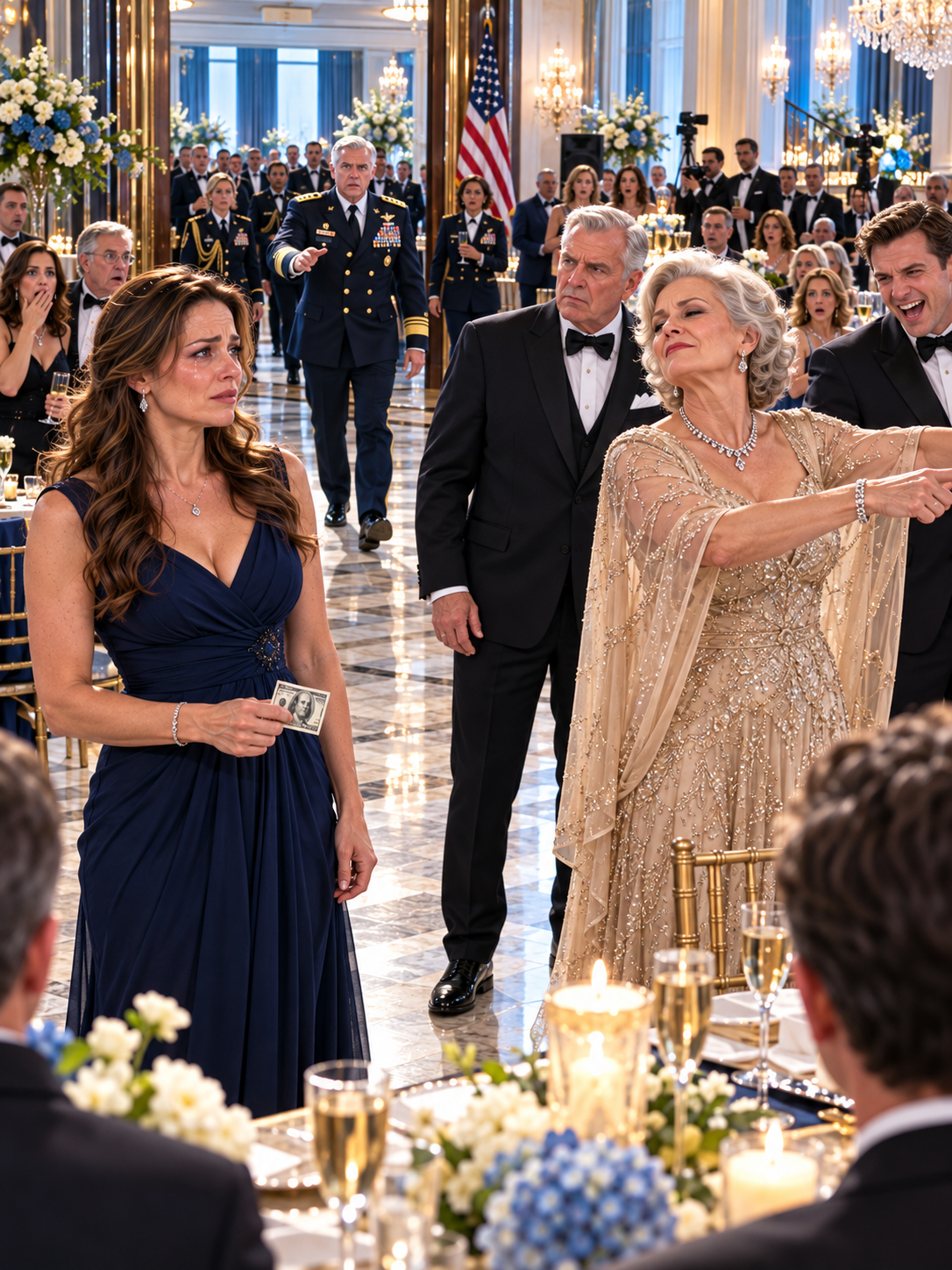
My parents thought I was the embarrassing daughter who worked an ordinary government desk job, so at their lavish anniversary gala, my mother shoved $100 into my hand and ordered me to wait outside before the family photographs. My younger brother laughed while investors watched me like I was hired help. Then the ballroom doors opened, a four-star general walked straight toward me, and one word changed every face in the room: “Colonel.” What my family learned afterward was far worse than my rank.
### Part 1
The hundred-dollar bill was so new that the edge scratched my thumb when my mother shoved it into my palm. “Go wait outside by the service gate,” Diane Hart whispered through a smile meant for the photographer twenty feet away. “Please, Evelyn. Just tonight. Your clothes are going to ruin the family portrait.”
Behind her, the ballroom of the Halston Estate glittered under three crystal chandeliers, each one scattering white light across champagne glasses and polished marble. My younger brother, Nolan, stood beside our father in a custom black tuxedo, one hand tucked casually into his pocket while he watched me with the expression people usually reserved for a stain on a tablecloth. “Take the money,” he said. “Get yourself dinner somewhere decent.”
I looked down at my gray jacket, which had a loose thread near the left cuff and a faint crease from being folded inside a garment bag. It wasn’t fashionable, but it was clean, and the shoes I wore had carried me through airports, command centers, and more sleepless nights than Nolan had spent working in the previous year. “You invited me,” I said quietly.
Dad adjusted his silver tie without looking at me. “Your mother invited you because she wanted the whole family here. That doesn’t mean you need to be in every picture.” He finally met my eyes and added, “Don’t turn this into one of your little pride things.”
That sentence took me back thirty minutes, to when I’d entered the ballroom and watched him greet guests beneath a banner celebrating his and Mom’s fortieth wedding anniversary. People I recognized from finance magazines and local charity boards shook his hand like Gregory Hart had built an empire with his bare hands. Almost nobody knew that the estate they were admiring had survived the previous decade because an anonymous investment structure had quietly kept the mortgage current.
Nobody knew where the money had come from because I had wanted it that way. Years earlier, while my career sent me farther from home, I had arranged for a financial manager to invest most of what I saved and direct a portion toward family support without attaching my name. I thought anonymity would protect my relationships from becoming transactional.
Instead, it had allowed my parents to invent a completely different story. In their version, Dad’s “business instincts” had rescued the estate, Nolan’s brilliance had attracted mysterious private capital to his software company, and I was the disappointing older daughter who had never done much with her life. They believed I worked administrative support for the government because that was the simple explanation I’d given when my assignments became sensitive.
I had watched Nolan hold court near an ice sculpture earlier that evening, explaining his company’s expansion plan to three potential investors. He spoke loudly enough for half the ballroom to hear him, describing himself as a “self-made founder” while rotating a champagne flute between two manicured fingers. When he noticed me near the wall, he smiled and said, “My sister Evelyn. Government paperwork. Somebody has to keep the stapler industry alive.”
The men around him laughed politely. I didn’t correct him, because I had spent years believing that dignity didn’t require an audience, but Uncle Calvin decided my silence was permission. He walked over with a glass of bourbon and inspected my shoes. “If things are tight,” he said, “Nolan probably needs someone doing data entry.”
Three guests nearby pretended not to listen. Dad joined us before I answered and sighed as though my existence required tremendous patience. “Evelyn’s never been ambitious like Nolan,” he said. “We stopped pushing years ago.”
My fingers tightened around the cold glass of water I was holding. I remembered twelve-hour flights in body armor, emergency logistics calls at three in the morning, casualty evacuation routes redrawn under impossible deadlines, and a sandstorm that once buried half our communications equipment before breakfast. None of that mattered in this room because I’d never packaged it into something my family could brag about.
Then Mom announced that the photographer was ready. She gathered Nolan, Dad, Uncle Calvin, and several relatives around the staircase while I moved naturally toward them. Her face changed before I’d taken three steps.
That was when she intercepted me beside a white floral arrangement, pressed the hundred into my hand, and gave me her final instruction. “Don’t make me ask twice,” she said. “The photos are important, and Nolan has investors here.”
I flattened the bill against my palm. “So do you want your daughter here, or do you want a picture that makes you look important?”
Her smile disappeared. “Why must everything with you be so difficult?”
Nolan laughed under his breath. “Because she thinks being miserable makes her deep.” He nodded toward the side doors. “Come on, Ev. Take the hundred. I’ll add another fifty if you don’t sulk.”
Something in me went quiet. I had spent years imagining that one day they would recognize loyalty without needing to understand where the mortgage payments came from or why Nolan’s payroll never bounced during his worst quarters. Standing beneath those chandeliers, I finally understood that the recognition I’d been waiting for wasn’t coming.
I placed the bill on a marble console table beside the flowers. Mom immediately snatched it up and pushed it back against my chest. “Don’t embarrass me,” she hissed.
Before I could answer, a deep mechanical sound rolled through the foyer. The ballroom’s oak doors opened, letting in a blade of cold night air along with four uniformed figures. Conversations softened as people turned toward the entrance.
The man walking in front wore four stars on his shoulders.
I knew General Marcus Whitaker instantly. We’d spent the previous nine months working the same strategic readiness program, and if he was here rather than waiting at the airfield, something had changed. Two security officers and his senior aide followed him across the marble while guests instinctively moved out of the way.
Mom lowered the hundred-dollar bill. Nolan’s smile faded as General Whitaker walked past him without a glance.
I straightened automatically and raised my hand.
“Good evening, sir.”
The general stopped directly in front of me and returned my salute with perfect precision.
“Colonel Hart,” he said. “Our departure window moved up. The aircraft is ready.”
Behind me, something made of crystal hit the floor.
And for the first time all evening, nobody was looking at me like I didn’t belong.
### Part 2
The silence lasted maybe three seconds, but it felt much longer. I lowered my salute, and General Whitaker gave me the small nod he used when there were details we couldn’t discuss in public. His aide stepped forward with a sealed folder and said, “Ma’am, command wants the revised briefing package before wheels up.”
Nolan stared at me as though I’d suddenly started speaking another language. “Colonel?” he said.
Mom’s mouth opened, but nothing came out. Dad looked from my face to the general’s uniform, studying the stars as if he suspected they might be costume jewelry. Around us, the guests who had spent the evening politely ignoring me began whispering.
General Whitaker glanced at my family, then at the hundred-dollar bill still clenched in Mom’s hand. He didn’t ask about it. That was one of the things I respected about him: he never demanded explanations when observation was enough.
“I need five minutes, sir,” I said.
“You have three.”
“That’s generous.”
The corner of his mouth moved almost imperceptibly. He turned toward the entrance with his detail, leaving behind the kind of silence powerful people create without trying.
Mom recovered first. She stepped toward me with a bright, desperate smile I had seen her use on donors and country club committee members. “Evelyn, sweetheart, why didn’t you tell us?”
The word sweetheart sounded foreign coming from her. Less than a minute earlier, she’d been worried my jacket would contaminate the family photograph. Now her jeweled hand reached for my arm as though she needed physical proof that I belonged to her.
I stepped back.
She missed me and nearly bumped the floral planter. “Don’t be ridiculous,” she whispered. “We’re your parents.”
“You remembered that quickly.”
Dad’s face tightened. “There’s no need for sarcasm. Obviously there has been some misunderstanding.”
I looked at him. “Which part?”
“The way we’ve perceived your career.”
“No.” I shook my head once. “You understood exactly what you believed about my career, and you decided that made me worth less.”
Nolan finally put his champagne down. “Okay, everybody needs to relax. So you got promoted and kept it private. Good for you. Nobody was trying to insult you.”
I almost laughed. “You offered me fifty dollars to disappear.”
“That was a joke.”
“Was Mom joking too?”
He glanced toward the investors behind him. That told me everything. Even now, he wasn’t thinking about me; he was calculating how this looked.
Mom slipped the hundred-dollar bill onto the console table as if abandoning evidence. “You should stay for the photograph,” she said. “Actually, wait. We can move Nolan over and put you in the center.”
I looked at the staircase where they’d planned to preserve their perfect family forever. “I don’t want the center.”
Dad lowered his voice. “Evelyn, don’t punish your mother because she didn’t understand.”
I thought about the word punish. For my entire childhood, any refusal to cooperate had been labeled cruelty, selfishness, or ingratitude. When I was seventeen, Mom took most of the money from my summer job because Nolan wanted a used convertible; when I objected, Dad told me I was “creating conflict over money.”
“I have orders to move,” I said.
Mom’s expression sharpened. “Orders can wait three minutes.”
“No, Mom. They can’t.”
I walked toward the exit. Nobody blocked me, although Uncle Calvin suddenly found the floor fascinating.
As I passed Nolan’s investors, one of them—a gray-haired woman named Sabrina Cole—gave me a thoughtful look. “Colonel Hart,” she said carefully, “have we met before?”
“Not formally.”
She frowned, searching her memory. I knew exactly why. Sabrina sat on the advisory committee of a defense logistics technology fund, and two years earlier she’d attended a restricted industry briefing where I’d spoken behind a secure videoconference wall without family names displayed.
Recognition flickered across her face.
I kept moving.
Outside, the autumn air hit my cheeks cold and clean. The transport vehicle idled beneath the porte cochere with its headlights washing over wet pavement. I climbed into the rear seat, shut the door, and felt the ballroom disappear behind armored glass.
General Whitaker sat across from me instead of taking the front. He waited until we rolled through the gates before asking, “Do I want to know what the hundred dollars was about?”
“No, sir.”
“Good.”
His answer surprised a laugh out of me. It was the first real one I’d managed all night.
He leaned back and loosened the top of his collar. “I’ve commanded people for thirty-four years, Evelyn. I’ve learned that there are families you inherit and families you build.” His eyes shifted toward the dark road outside. “Don’t confuse the first kind with the second.”
I looked down at my hands. The skin across my knuckles was dry from too many flights and too much industrial soap. Those hands had signed movement orders for thousands of troops, rerouted relief equipment after hurricanes, and once spent fourteen straight hours rebuilding a deployment schedule after a runway closure stranded six aircraft.
At home, they were apparently the hands of a failed secretary.
My phone began vibrating inside my bag before we reached the highway. First Mom, then Dad, then Nolan, then Mom again. By the time we arrived at the secure air terminal, I had seventeen missed calls.
I turned the phone face down.
Our briefing lasted through midnight. The issue that had moved our departure window was exactly the kind of problem that leaves no room for emotional distraction: an overseas logistics chain had lost access to a major transportation hub, and hundreds of people were waiting on decisions my team needed to make.
For six hours, I forgot the ballroom.
Then at 5:42 the next morning, while coffee burned on a warmer beside me, I received a message from Julian Mercer.
Julian managed the private investment structure I’d created after my third deployment. He was careful enough that even my family had never connected me to the capital keeping Nolan’s company alive.
His message contained only seven words.
We need to discuss your family’s accounts immediately.
I called him from the secure hallway.
“What happened?” I asked.
Julian was silent for a moment. “Before I tell you, I need you to understand something. The gala wasn’t the problem.”
A chill moved through me.
“What was?”
He exhaled slowly.
“Evelyn, somebody in your family has been signing your name.”
### Part 3
I stared through the narrow hallway window at a runway turning pale beneath the first light of morning. Somewhere beyond the glass, ground crews were guiding a cargo aircraft toward its parking position, their illuminated wands cutting bright red arcs through the gray air. “Start from the beginning,” I told Julian.
Three years earlier, before a long overseas assignment, I’d given my father a limited authorization allowing him to handle two mundane matters connected to an old family insurance policy and a storage unit. The document had expired after ninety days. According to Julian, copies of that authorization had later appeared in loan applications tied to the Hart estate and Nolan’s company.
“They didn’t use the original document,” Julian said. “They used it as a template.”
I leaned against the concrete wall. “How much?”
“We’re still determining exposure.”
“Julian.”
He knew my tone. “Approximately eight million dollars in obligations, guarantees, and credit facilities were represented as having indirect support from assets connected to your investment structure.”
For several seconds, the only sound I heard was ventilation moving above me. I’d anonymously supported my parents because I chose to, and I’d let Julian invest in Nolan’s company because he once showed promise before ego replaced discipline. But I had never authorized them to use my identity as collateral.
“Freeze every discretionary payment,” I said.
“Already initiated.”
“Mortgage support?”
“Suspended pending review.”
“Nolan’s emergency capital line?”
“Suspended.”
Julian paused. “Evelyn, once this happens, they’ll notice quickly.”
“That’s the point.”
By noon, my phone had become a vibrating brick. Dad left six voicemails asking why “some investment people” were suddenly refusing calls, Nolan sent thirteen messages ranging from fake concern to outright accusation, and Mom wrote that the family needed to meet before “outsiders created confusion.” Nobody mentioned the signature issue.
That told me they already knew.
I waited until evening to listen to one of Dad’s messages. “Evelyn, whatever you think is happening, there are explanations,” he said in the calm paternal voice he used when he wanted obedience to sound reasonable. “You’re upset because of last night, but financial decisions shouldn’t be made emotionally.”
Financial decisions.
Not forgery. Not deception. Not an apology for throwing me out of a photograph.
The next morning Mom called while I sat alone in a temporary office with a cup of bitter coffee and a stack of transportation reports. Against my better judgment, I answered.
“Finally,” she said. “Your father and I have been worried sick.”
“About me?”
“Of course about you.”
“Then tell me how you knew the investment payments had stopped.”
Silence.
It lasted long enough that I heard her refrigerator humming in the background.
“Evelyn,” she said eventually, “come home tomorrow night. We can talk like a family. Nolan has agreed to give you the seat at the head of the table.”
I closed my eyes. “You think this is about a chair?”
“Don’t twist my words.”
“Mom, did Dad use an expired authorization with my signature on financial documents?”
Another silence.
“That is complicated.”
“No. It’s yes or no.”
“Your father was protecting the family.”
I felt something inside me finally separate from the old version of myself. For years, I had believed there must be a combination of patience, sacrifice, generosity, and silence that would eventually make my parents love me without conditions. Hearing her call forged documents protection killed that belief more efficiently than any insult could have.
“The financial support is over,” I said.
Her voice immediately hardened. “Don’t be childish.”
“I’m not.”
“You can’t just shut everything off because your feelings got hurt at a party.”
“My feelings aren’t relevant.”
“Then what is?”
“The fact that you used me.”
She laughed once, sharp and humorless. “We gave you a home for eighteen years.”
“And I’ve spent the last ten financing yours.”
Silence returned, but this time it felt different. I could almost hear her calculating.
“What did you just say?”
I looked at the coffee stain near the edge of my desk. “You heard me.”
“You?”
“Yes.”
“The anonymous investment account?”
“Yes.”
“Nolan’s funding?”
“Yes.”
Her breathing changed.
I continued before she could recover. “The emergency capital, the mortgage support, Uncle Calvin’s loan restructuring, the tax reserve Dad thought came from his investment adviser. All of it passed through structures funded by me.”
For once in my life, my mother had nothing to say.
Then she whispered, “You should have told us.”
I almost admired the speed with which she found a way to make it my fault.
“No,” I said. “You should have treated me like your daughter when you thought I had nothing.”
“Evelyn, listen—”
“The trust support is closed.”
I ended the call.
My hands shook afterward, not from doubt but from the strange physical aftermath of doing something I’d trained myself not to do for decades: refusing to rescue them.
Julian called two hours later. The first consequences were already appearing. Nolan’s company had relied heavily on a revolving credit line that only existed because lenders believed a private backer would continue absorbing losses, and once that assurance disappeared, the bank’s risk department moved quickly.
“His board has scheduled an emergency meeting,” Julian said. “Tomorrow morning.”
“Don’t interfere.”
“I wasn’t planning to.”
“Let the company stand on its own numbers.”
There was a short pause. “You realize what those numbers look like.”
“Yes.”
Nolan had always told everyone his company was one good quarter away from explosive growth. I knew the truth because Julian sent me reports every month. Revenue was real, but expenses were reckless, leadership turnover was constant, and Nolan had repeatedly used new funding to hide old mistakes.
For years, my money had delayed the lesson.
Now the lesson was arriving.
That night, just before I left the office, Julian sent me another scanned document. It was a loan guarantee dated eighteen months earlier.
At the bottom was my name.
Evelyn Grace Hart.
The signature looked almost perfect.
But the witness line made my stomach turn.
Diane Hart.
My mother hadn’t merely known.
She had signed beside it.
### Part 4
The emergency board meeting started at nine the next morning. I wasn’t there, and I didn’t call anyone who was. Julian’s office simply had legitimate access to the investor side of the company, so by lunchtime he sent me a factual summary stripped of commentary.
Nolan lasted twenty-seven minutes before the first director asked him to explain why operating costs had increased by forty percent while recurring revenue barely moved. He blamed expansion, then market conditions, then a former chief financial officer. When they asked how he intended to replace the withdrawn private capital, he reportedly said, “The funding isn’t actually gone. It’s a family misunderstanding.”
That sentence ended him.
The board recessed for fifteen minutes and came back with a motion removing him from day-to-day control pending a financial audit. They didn’t fire him because I asked them to; they did it because for the first time they were forced to evaluate the company without assuming someone invisible would keep paying for every mistake.
At 12:43, Nolan called me.
I answered because I wanted to hear which version of reality he’d chosen.
“What did you do?” he demanded.
“Good afternoon to you too.”
“Don’t play games with me.”
I pushed my lunch aside. “Your board reviewed your company.”
“My company was fine until you pulled the financing.”
“Then it wasn’t fine.”
“You sabotaged me.”
“I stopped subsidizing you.”
His breathing crackled through the speaker. “You never told me it was your money.”
“Would you have treated me differently?”
“That isn’t the point.”
“It is exactly the point.”
He started pacing; I could hear his shoes hitting a hard floor. “You let me build a company around capital you could yank whenever you got emotional.”
“No. Your board approved investment terms that clearly allowed the private fund to stop future rounds. You built a lifestyle around money you never controlled.”
He went quiet.
I opened the scanned loan guarantee on my computer. “Did you know Dad was using my signature?”
Another pause.
Too long.
“Nolan.”
“I knew he was handling some paperwork.”
“That’s not what I asked.”
“Look, things got complicated.”
I laughed softly, because apparently complicated was the family word for illegal.
“He said you’d agree if you understood the stakes,” Nolan continued. “You were overseas. Nobody could reach you. We had payroll.”
“You sent me six birthday messages that year asking when I was coming home.”
“That wasn’t business.”
“No. It was access.”
He lowered his voice. “I was trying to save what we had.”
“You were trying to save what I had.”
Nolan exploded. He called me selfish, vindictive, bitter, jealous of his success, and finally ungrateful. I let him finish.
Then I asked, “Do you remember offering me fifty dollars to leave the gala?”
Silence.
“Your success looked very impressive that night,” I said. “You should be able to maintain it without me.”
I disconnected.
For the rest of that week, consequences arrived in unremarkable envelopes and ordinary phone calls. The country club suspended my parents after annual fees failed, two luxury vehicle leases went into default, and the bank reviewing the estate mortgage requested documentation Dad couldn’t provide.
None of those things made me happy.
That surprised me.
For years, I’d imagined anger as something hot and explosive, but mine felt like cold weather after a storm. I didn’t want them destroyed; I simply no longer felt responsible for protecting them from the life they’d actually built.
General Whitaker found me alone in the cafeteria late one evening, eating soup that had probably been sitting under a heat lamp since lunch. He set down his tray across from me. “You look like someone arguing with herself.”
“My family may lose their house.”
“Is it their house?”
I hesitated.
Technically, that question had become complicated.
Years earlier, when my parents faced foreclosure after Dad’s failed business venture, Julian’s investment company had purchased the distressed note through an affiliated entity. My parents remained in the home and made only a small portion of the actual monthly payment while the fund absorbed the rest.
“They think it is,” I said.
Whitaker broke a piece of bread. “That wasn’t what I asked.”
I looked at him.
He shrugged. “Logistics. Ownership matters.”
The next afternoon, Julian confirmed what I already suspected. Because of the forged guarantees and representations, the estate’s financing had become part of a broader fraud review, and the entity managing my investments had every legal right to stop concessions and pursue ordinary remedies.
“There’s more,” he said.
I rubbed my forehead. “There always is.”
“Our auditors found payments from Nolan’s company to your parents.”
“That doesn’t surprise me.”
“These might.”
He sent the ledger.
For three years, Nolan had been transferring company money to Dad under vague consulting agreements. Dad then used portions of those funds to maintain the estate, purchase club memberships, and pay personal expenses.
The money had originated from investment capital.
My investment capital.
It had moved in a circle: from me to Nolan, from Nolan to Dad, and from Dad into the performance of wealth they used to humiliate me.
I stared at the figures until they blurred.
Then one entry caught my eye.
Forty-eight thousand dollars.
Memo: Gala event and family image consultation.
I clicked the invoice attached to it.
The anniversary party where they had handed me a hundred dollars to disappear had been paid for, indirectly, with my money.
I leaned back in my chair and started laughing.
Not because it was funny.
Because there are moments when betrayal becomes so absurd that your body has no other language.
### Part 5
Two weeks after the gala, the first story appeared online. The headline described me as a “powerful military daughter who financially abandoned aging parents after family dispute,” and the article included a photograph of Mom looking exhausted outside a grocery store. Whoever had arranged it understood exactly which buttons to press.
By lunch, two more outlets had repeated the claim. Neither mentioned forged signatures, diverted company funds, or the fact that I’d spent years supporting everyone involved.
My public affairs office called.
I explained the situation without dramatizing it, disclosed the financial relationship, and provided the legal review already underway. The officer on the other end listened, asked three careful questions, and said, “Do not engage personally. Let counsel handle anything involving private finances.”
That suited me.
Mom apparently expected panic.
She texted at 3:17.
You can end all of this by acting like a daughter.
I read the sentence twice.
Then I deleted it.
Julian had predicted a reputational attack from the moment we discovered the false guarantees. What my parents didn’t know was that he’d spent the previous two weeks collecting documents, verifying timestamps, and securing permission to release limited financial evidence if necessary.
“They’re offering us a settlement,” he told me that evening.
“What settlement?”
“Restore financial support, allow Nolan access to emergency capital, and they stop talking to the press.”
I stared at him through the encrypted video call. “They actually put that in writing?”
“They did.”
“Save everything.”
“I already did.”
Three days later, Julian held a press briefing at his firm’s downtown office. I didn’t attend. I sat in a windowless planning room at work reviewing cargo projections while a television in the corner carried a muted live feed.
Julian stepped to the podium with no theatrics. He explained that his firm represented private investment entities that had supported businesses and real estate connected to my family for years, and that funding had been suspended after irregular documents were discovered.
Then he showed the numbers.
He didn’t reveal classified compensation or details of my work. He simply presented verified records showing that the supposedly abandoned Hart family had received millions in direct and indirect support over a decade.
A reporter asked why the support stopped.
Julian displayed copies of the disputed guarantees with identifying information appropriately redacted.
Another reporter asked whether the gala incident had caused the cutoff.
Julian paused.
“The gala caused Colonel Hart to stop ignoring a pattern,” he said. “The financial review caused the cutoff.”
That distinction mattered.
Then came the piece my parents hadn’t expected.
The Halston Estate had security cameras in its main ballroom and foyer. Because the private investment entity had paid the final event invoice through an account under investigation, counsel had legally obtained relevant footage during discovery connected to the financial dispute.
The clip was short.
Mom pressing the hundred-dollar bill into my hand.
Dad telling me not to make a scene.
Nolan offering another fifty.
Me asking whether they wanted a daughter or a photograph.
There was no dramatic music.
No narration.
Just their own voices.
By the time I finished work that evening, the story had changed completely. Reporters who had initially framed me as a cold daughter were now asking why a family living on secret support had publicly ridiculed the person financing them.
I didn’t feel vindicated.
I felt tired.
When I walked to my car, a woman in civilian clothes was waiting near the security checkpoint. For a second I didn’t recognize her.
It was Mom.
Her expensive styling was gone, and she wore a plain navy coat over clothes I’d never seen before. She looked smaller without the architecture of diamonds, hair appointments, and social performance surrounding her.
“Evelyn,” she said.
Security personnel looked toward me.
“It’s okay,” I told them. “Give us a minute.”
Mom stepped closer. “How could you let them show that video?”
I almost couldn’t believe the question.
“How could you do what was on the video?”
Her face tightened. “I made a mistake.”
“That wasn’t one mistake.”
“You’ve humiliated us nationally.”
“You hired people to attack my reputation.”
“We were desperate.”
“So was I, plenty of times.”
She shook her head. “This isn’t who you are.”
That old sentence again—the version of me she preferred was always the one who paid, absorbed, forgave, and stayed quiet.
“Who am I?” I asked.
“You’re my daughter.”
“Only when it benefits you.”
Her eyes filled with tears. “Your father barely sleeps. Nolan has lost control of the company. We’re going to lose the house.”
I waited.
The apology never came.
No “I’m sorry I treated you like dirt.”
No “I’m sorry we signed your name.”
No “I’m sorry we took your sacrifice and turned it into proof of our superiority.”
Just consequences.
“Mom,” I said, “what exactly do you miss about me?”
She opened her mouth.
Nothing came out.
I nodded slowly.
“That is what I thought.”
I turned toward the gate.
She grabbed my sleeve. “Please.”
I looked down at her hand until she let go.
“The financial investigation continues,” I said. “Julian will communicate through counsel.”
“What about us?”
“There hasn’t been an us for a long time.”
I walked away.
That night, Julian called with news that should have felt like closure but didn’t.
The forensic review was complete.
My father hadn’t created the false signatures.
Nolan had.
And Mom had witnessed every one of them.
### Part 6
Nolan denied it until Julian’s attorneys showed him the metadata. The forged documents had been created on a laptop registered to his company, edited under his personal account, and emailed to Dad from Nolan’s own address before being printed. Faced with evidence, he changed his story from “I didn’t do it” to “I thought Evelyn would approve.”
The distinction mattered to him.
It did not matter to me.
Dad claimed he believed the paperwork was legitimate. Mom admitted she knew I hadn’t signed it but insisted they were under pressure and planned to “fix everything” before I ever noticed.
What struck me most was how ordinary their explanations sounded.
Nobody had woken up one morning and announced, “Let’s betray Evelyn.” They had simply made a hundred small decisions in which my rights mattered less than their comfort, until forgery became just another administrative shortcut.
The civil case moved faster than I expected. Nolan’s board negotiated a restructuring that removed him as chief executive, preserved jobs for employees who had nothing to do with his decisions, and sold several unnecessary assets.
I supported that outcome.
Hundreds of people worked there.
They didn’t deserve unemployment because my brother needed consequences.
Nolan kept a minority interest but no control. For the first time since his twenties, his income depended on actual performance rather than money arriving from an unnamed source.
The estate was different.
Once the financial concessions ended, my parents couldn’t carry the payments, taxes, maintenance, and obligations attached to the property. Their attorneys tried to negotiate, but every proposal required the investment entity to absorb another loss.
Julian asked me one question.
“Do you want to subsidize them again?”
“No.”
He nodded.
That was the entire decision.
Six months after the gala, a court finalized the foreclosure process.
I told myself I wouldn’t go.
Then, on the morning the sheriff’s office supervised the final handover, I drove there anyway.
The estate looked smaller than I remembered. Without professional landscaping, leaves collected along the stone borders and several hedges had grown uneven. The fountain near the circular drive was dry.
I parked across the street.
Dad stood near the front steps beside six cardboard boxes. Nolan leaned against an old sedan with his arms folded.
Mom saw me first.
Even through the windshield, I watched recognition transform her posture. She walked quickly toward my SUV, then faster, until she was almost running.
I lowered the window.
“Evelyn.”
Her voice cracked.
“I didn’t know whether you’d come.”
“I wasn’t planning to.”
She rested both hands on the window frame. “Please don’t do this.”
“It’s already done.”
“Your father doesn’t have anywhere appropriate to go.”
“You have a rental.”
Her expression twisted. “A two-bedroom apartment.”
I looked past her toward the house.
My parents had raised two children in a three-bedroom ranch house before Dad’s early business success. Somehow a two-bedroom apartment had now become an unbearable tragedy.
“You’ll be safe,” I said.
“Safe?” She stared at me. “Is that the standard now?”
“It was apparently enough for me.”
Her face changed.
For one second, I thought she finally understood.
Then she said, “If you restore even part of the trust, we can start rebuilding.”
There it was.
I almost smiled.
Not from cruelty.
From clarity.
“Mom, you don’t want me back.”
“Of course I do.”
“You want access back.”
“How can you say that?”
“Because you haven’t asked me one question about my life since the gala.”
She froze.
“You don’t know where I was stationed last year,” I continued. “You don’t know what my job actually involves. You don’t know whether I’ve been sleeping, whether I’m seeing anyone, whether I have friends, whether I want children, whether I hate olives. You know my rank and my money.”
Tears filled her eyes.
“I love you.”
“I believe you love whatever version of me keeps you comfortable.”
She shook her head violently. “That isn’t fair.”
“No. It isn’t.”
Dad finally approached, walking more slowly than I remembered.
“Evelyn,” he said. “Enough.”
Even now, he used that tone.
I looked at him.
He stopped three feet away.
“We made mistakes.”
“Yes.”
“We’re still your parents.”
“Yes.”
“You can’t erase blood.”
“I don’t need to.”
He frowned.
“I can remember exactly who you are,” I said, “and still choose not to build my life around you.”
Nolan pushed away from the sedan. “You’re enjoying this.”
I looked at him.
“No.”
He laughed bitterly. “Come on. You sit there in your expensive SUV while we lose everything.”
“My vehicle belongs to the government fleet.”
That shut him up for a second.
I continued, “And I don’t enjoy seeing you fail. I just refuse to keep paying so you never have to learn.”
His jaw tightened.
“You think you’re better than us because some general saluted you?”
“No.”
I thought about the gala.
“You thought you were better than me before anyone saluted me.”
Nobody spoke.
A sheriff’s deputy stepped outside the estate and called Dad’s name.
The handover was ready.
Mom started crying.
I felt sadness then, real sadness, but it wasn’t the old panic that used to make me fix everything. It was the sadness you feel standing beside a burned house after the fire is already out.
“I hope you build something better from here,” I said.
Mom grabbed the window frame again.
“Evelyn, please.”
I met her eyes.
“I forgive myself for staying this long.”
Then I raised the window and drove away.
### Part 7
I didn’t hear directly from my family for almost three months. Their attorneys communicated with Julian about the remaining civil issues, but the calls, threats, emotional voicemails, and surprise visits stopped. Silence, which once would have terrified me, began to feel like space.
I moved into a townhouse near the base.
It wasn’t luxurious.
The kitchen cabinets were slightly crooked, the upstairs floor creaked near the laundry closet, and the woman next door owned a terrier that barked at delivery trucks as though national security depended on it.
I loved it.
For the first time, everything inside my home had been chosen for me instead of purchased to earn someone’s approval.
I bought a heavy blue coffee mug from a local pottery shop because it fit my hand well. I put photographs of my unit on the bookshelf.
There were no formal family portraits.
One Saturday morning, General Whitaker helped me carry a secondhand dining table through the front door because he happened to be nearby after a veterans’ charity event. Watching a four-star general argue with a narrow hallway and an oak table would have terrified half the Pentagon.
“Rotate it,” I said.
“I am rotating it.”
“Sir, you’re rotating the wrong end.”
He glared at me.
“I can court-martial you in your own foyer.”
“No, sir.”
“You’re smiling.”
“No, sir.”
We eventually got the table inside.
That evening, five people from my team ate pizza around it while the neighbor’s dog barked at absolutely nothing. Nobody cared what my furniture cost or whether my jacket photographed well.
I caught myself laughing so hard that my stomach hurt.
That was when I understood what General Whitaker had meant in the transport after the gala.
Family could be built.
The final civil hearing happened in early spring.
I attended because my testimony was required.
Mom sat behind the opposing counsel in a plain gray suit, Dad beside her, and Nolan two seats farther down.
He looked older.
Not ruined.
Just ordinary.
The case ended with negotiated restitution, the surrender of claims against several assets, and strict separation between my finances and theirs. No dramatic prison sentence appeared, and I didn’t want one.
I wanted legal boundaries.
I got them.
Afterward, Dad waited for me outside the courthouse.
“Can we talk?”
I almost kept walking.
Then I stopped.
He shoved his hands into the pockets of his coat.
“I’ve been thinking about what you said.”
“Which part?”
“About knowing your rank but not knowing you.”
Traffic hissed across wet pavement behind us.
I waited.
“I don’t know how to fix that,” he said.
The sentence was more honest than anything I’d heard from him since the gala.
“You may not be able to.”
His face tightened with pain, but he nodded.
“I suppose I deserve that.”
“This isn’t about what you deserve.”
“What is it about?”
“What I need.”
He looked toward the courthouse doors where Mom and Nolan were still inside.
“Your mother wants us to try family counseling.”
I almost smiled.
“Why?”
“To repair things.”
“I don’t want to repair them.”
His eyes returned to mine.
“That sounds final.”
“It is.”
“But you said this isn’t about punishment.”
“It isn’t.”
“Then why not give us a chance?”
Because chances had been my family’s favorite currency. They spent mine endlessly because they never believed the account could close.
“I gave you years,” I said. “You’re thinking about the last six months. I’m thinking about the last twenty.”
Dad swallowed.
“What if we change?”
“I hope you do.”
“And if we do?”
“Then your lives get better.”
He stared at me.
“You still wouldn’t come back?”
“No.”
The word hurt him.
I saw that.
I also knew pain wasn’t the same thing as injustice.
Dad slowly nodded.
“For what it’s worth,” he said, “I am sorry.”
I studied his face.
Maybe he meant it.
Maybe losing everything had finally forced him to examine what he’d become.
“I believe you,” I said.
Hope flashed across his expression.
I didn’t let it become a misunderstanding.
“But I’m not rebuilding the relationship.”
His shoulders dropped.
I continued, “Forgiveness doesn’t require access.”
He looked down.
“I didn’t know that.”
“Neither did I.”
We stood there another second.
Then I walked away.
In the parking garage, Nolan was waiting near my car.
Of course he was.
“You always get the last word,” he said.
“I didn’t know we were keeping score.”
“You destroyed my career.”
“You were removed because your board reviewed your decisions.”
“You pulled the capital.”
“Yes.”
“So don’t pretend you’re innocent.”
I set my briefcase on the passenger seat.
“I never said I was innocent. I said I was done financing you.”
He moved closer.
“You know what I hate?”
“I have a list of possibilities.”
His mouth twitched despite himself.
For one strange moment, we looked like siblings again.
Then he said, “I hate that you could have told me years ago.”
“Would you have respected me?”
He looked away.
There was my answer.
“Nolan,” I said, “you don’t have to like me. You don’t have to forgive me. You just have to build your next life without using mine.”
I got into the car.
He stepped back.
This time, he didn’t ask for money.
### Part 8
One year after the gala, I stood inside a bright ceremonial hall in Washington with sunlight pouring through tall windows. My dress uniform felt unusually heavy across my shoulders, partly because of the decorations already pinned there and partly because I finally understood what they represented.
Not status.
Not family prestige.
Work.
General Whitaker stood in front of me holding a small presentation case. Around us were officers, civilians, planners, logisticians, analysts, and enlisted personnel I’d worked beside during some of the hardest assignments of my career.
No chandeliers.
No investors.
No ice sculptures.
I preferred it that way.
The citation summarized years of service in polished official language: strategic readiness, overseas operations, emergency planning, sustained leadership.
It couldn’t describe the smell of overheated electronics inside a temporary command post or the sound of rain hammering a metal roof while a team worked through the night.
It couldn’t describe fear.
But the people in the room understood anyway.
General Whitaker pinned the medal to my uniform.
Quiet applause filled the hall.
As he stepped back, he lowered his voice.
“Still think you were the disappointment?”
I looked at him.
“That is dangerously close to an emotional question, sir.”
“Answer it, Colonel.”
“No, sir.”
“Good.”
He offered his hand.
I shook it.
After the ceremony, I checked my phone.
There was one message from Dad.
Congratulations. I saw the announcement. I won’t ask you to call. I hope you’re well.
Months earlier, that message would have pulled me into an hour of analysis.
Was he changing?
Was he manipulating me?
Did I owe him something?
Now I simply read it.
Then I typed back.
Thank you. I hope you’re well too.
Nothing more.
Mom had stopped contacting me altogether after I made my boundary clear.
Julian occasionally updated me when something legally relevant occurred. My parents had settled into a modest apartment, Dad had taken consulting work for a regional business, and Mom had started part-time administrative work at a nonprofit.
They were surviving.
That mattered to me.
Their survival simply wasn’t my responsibility anymore.
Nolan’s life changed most visibly.
Without the title he had wrapped around his identity, he spent months bitter and unemployed before accepting an operations role at a much smaller technology company. The position came with no executive office, no company driver, and nobody pretending his ideas were brilliant because they wanted access to private capital.
According to the only update I ever requested, he was doing adequately.
That was enough.
I didn’t need him humiliated.
I needed him independent.
Uncle Calvin eventually sent me a four-paragraph apology after publicly distancing himself from my parents during the financial collapse.
I read the first paragraph.
Then I deleted it.
Some people mistake consequences for personal growth.
I no longer felt obligated to investigate the difference.
The strangest change was how rarely I thought about the gala.
For months afterward, I had replayed the image of Mom pushing that crisp hundred-dollar bill into my chest.
Eventually the memory lost its sharpness.
It became one scene among thousands.
More important memories replaced it.
My team laughing around the crooked dining table.
A junior officer calling me at midnight because she needed career advice.
General Whitaker losing an argument with my hallway furniture.
The neighbor’s ridiculous terrier finally deciding I belonged on the street.
Life expanded once I stopped spending so much energy managing people committed to misunderstanding me.
A few weeks after the ceremony, I returned home on a clear Saturday afternoon and found an envelope in my mailbox.
No return address.
Inside was a single hundred-dollar bill.
For half a second, my chest tightened.
Then I found the note.
Evelyn,
I kept the one from the gala for months. I told myself I was keeping it because I regretted that night. The truth is, I kept it because I was waiting for a moment when returning it might reopen the door.
You told me forgiveness doesn’t require access.
I understand now.
I am sorry.
Mom.
I stood beside the mailbox while wind pushed dry leaves across the sidewalk.
There were a dozen ways I could have interpreted the gesture.
Manipulation.
Growth.
Desperation.
Regret.
Maybe it contained pieces of all four.
I carried the envelope inside.
For twenty minutes, I sat at my kitchen table looking at that bill.
The old Evelyn would have called immediately.
She would have worried that silence was cruel.
She would have searched for the perfect response that acknowledged Mom’s regret without causing pain.
I didn’t do any of those things.
I placed the note in a drawer.
Then I took the hundred dollars to the veterans’ community center near the base and donated it anonymously to their emergency grocery fund.
The receptionist smiled.
“Would you like a receipt?”
“No, thank you.”
Walking back to my car, I realized that was the first hundred dollars connected to my family that had ever felt clean.
That evening, several friends came over for dinner.
The house smelled like garlic, roasted chicken, and the apple pie someone had brought from a bakery because none of us trusted ourselves to make one.
General Whitaker wasn’t there.
He had promised his wife he’d stop treating every subordinate’s home like an extension of headquarters.
Around eight, somebody asked why one of my framed photographs showed me standing beside an aircraft in a terrible rainstorm.
I told the story.
Not the classified part.
Just enough to make everyone laugh.
Nobody asked what the mission had paid.
Nobody asked how much my house cost.
Nobody asked whether my rank could help their business.
They wanted to know whether I’d really slipped in the mud and landed on my radio.
I had.
It had been spectacular.
Later, after everyone left, I turned off the kitchen lights and stood for a moment in the quiet living room.
I thought about Dad’s apology outside the courthouse.
Mom’s returned hundred.
Nolan starting over without me.
I hoped they became better people.
I genuinely did.
But hope was no longer a chain tying me to them.
I could wish them well from a distance.
That was the part nobody had taught me growing up.
Walking away didn’t require hatred.
Boundaries didn’t require revenge.
And forgiveness, when I chose to offer it, didn’t mean handing someone the keys to my life again.
The gala had once felt like the night my family finally saw who I was.
I understood now that it was the night I finally saw them.
Their treatment of me before General Whitaker arrived had been the truth.
Everything after the salute was negotiation.
I didn’t need to hate them for it.
I simply needed to believe what they had shown me.
The next morning, I dressed before sunrise and drove toward the base.
The sky over the highway slowly shifted from charcoal to pale blue, and my coffee steamed in the cup holder beside me.
At the main gate, the young security officer checked my identification and handed it back.
“Morning, Colonel.”
“Morning.”
I drove inside.
No chandeliers waited for me.
No family photographer needed me to fit an image.
No one was offering me money to disappear.
Ahead, the operations building caught the first clean light of morning, its windows glowing against the sky.
I parked, picked up my briefcase, and walked toward the doors.
For most of my life, I had believed belonging was something other people had to grant me.
I had been wrong.
I already belonged to myself.
And this time, nobody was getting that back.
THE END!
Disclaimer: Our stories are inspired by real-life events but are carefully rewritten for entertainment. Any resemblance to actual people or situations is purely coincidental.


