
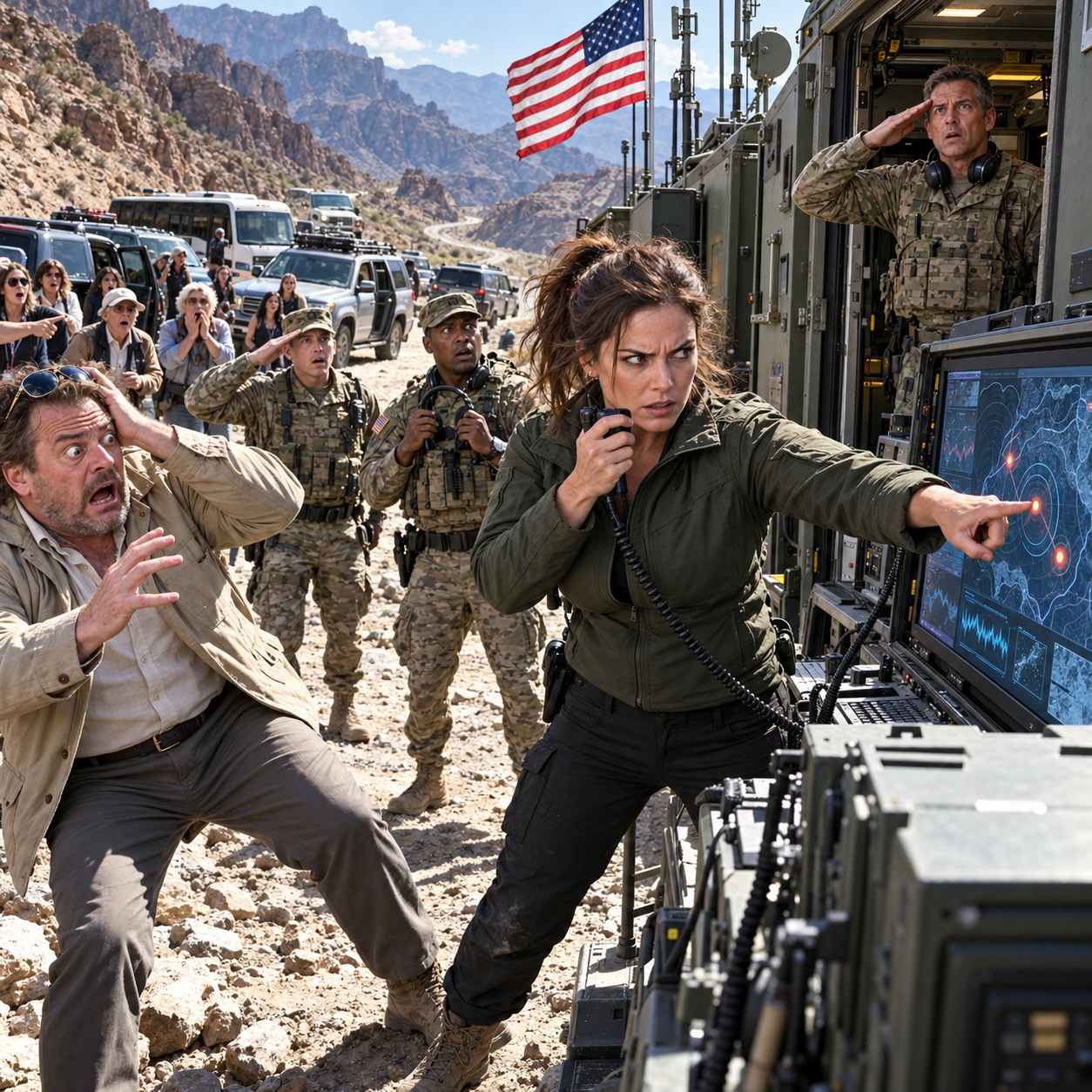
When Our Tour Convoy Lost Radar In The Dead Zone, He Shoved Me Aside: “She Gets Lost In Malls. Don’t Listen To Her!” I Overrode The Tactical Frequency And Gave Three Encrypted Coordinates. The National Guard Operator Froze, Standing Straight At Attention: “Ghost Tracker… You’re Alive?”
When Graham Vale laughed at me for trying to read a map, six frightened strangers laughed nervously along with him. Twenty minutes later, our van was wrecked on a frozen mountain road, and nobody was laughing anymore. I could have told them who I used to be, but keeping everyone alive mattered more than defending my pride. Six weeks after the National Guard brought us home, an investigator showed me a safety report bearing my signature. I had never signed it.
## Part 1: The Road We Should Never Have Taken
The first thing I noticed that Thursday morning was the ice forming on the inside of the equipment shed windows. It was October 15, and the Bitterroot Mountains were already wearing a fresh dusting of snow above the timberline. At five-thirty, the staging yard behind Blackpine Backcountry smelled of diesel exhaust, wet pine needles, and burnt coffee. I stood beside our passenger van with a clipboard tucked beneath my arm, watching the temperature drop another three degrees while the forecast on my phone refreshed.
My name is Laurel Kessler. I was thirty-seven years old, recently divorced, and employed as a logistics coordinator for a wilderness tour company outside Hamilton, Montana. According to my employee profile, I organized supplies, managed reservations, inspected equipment, and made sure tourists remembered to bring appropriate footwear. It was a deliberately ordinary description of a deliberately ordinary life, which was exactly what I had wanted when I moved to Montana eighteen months earlier.
Before that, I had spent eleven years in the Army, including eight as a warrant officer specializing in geospatial intelligence and tactical navigation. I knew how to interpret terrain from satellite imagery, identify safe movement corridors, and coordinate transportation through areas where ordinary maps became dangerously incomplete. I had helped plan evacuation routes during overseas operations and worked with National Guard units during domestic emergencies. None of that appeared on the Blackpine website, because I had asked the owner to leave my military background out of my public biography.
I had not left the service because I stopped loving the work. I left because I had grown tired of knowing exactly how many things could go wrong when somebody made an avoidable decision. My former husband, Daniel, once told me that even during dinner I looked like I was evaluating evacuation routes. After our marriage quietly collapsed beneath years of distance and accumulated exhaustion, I wanted mornings that smelled like coffee instead of aviation fuel and evenings when nobody needed anything from me.
Blackpine had seemed perfect until Graham Vale became the company’s senior guide. Graham was forty-one, handsome in the carefully maintained way of men who photographed themselves frequently, and followed by nearly two hundred thousand people online. He wore expensive mountaineering equipment that never seemed to acquire scratches, spoke about survival as though he had invented it, and treated anyone without an audience as disposable. Around paying customers, he was charming; around employees, particularly women who questioned him, that charm disappeared.
“Morning, Professor,” he called as he crossed the yard carrying a stainless-steel travel mug. His nickname for me had started after I corrected an incorrect elevation on one of his promotional maps, and he always pronounced it like an accusation. “Please tell me the snack bags are ready. Last trip, somebody forgot the almond butter, and I had to listen to complaints for three hours.” I checked the inventory sheet before replying that the supplies were complete, because correcting his memory would only waste time.
What mattered more was the weather. The National Weather Service had issued a winter storm warning for the higher elevations, with rapid temperature drops, heavy snow, and wind strong enough to create dangerous drifting along exposed roads. Our advertised itinerary involved reaching an overlook called Eagle’s Window by way of Slate Cut, a narrow former logging route that climbed above six thousand feet. I had already prepared an alternate itinerary along the lower Mill Creek corridor, where the group could still enjoy a guided excursion without crossing unstable terrain.
“We need to change the route,” I told Graham, holding out the forecast. “The freezing level is falling much faster than predicted, and the pressure trend has been ugly since midnight. Mill Creek gives us two safe turnaround points and keeps us below the exposed ridge.” He glanced at the screen, then looked beyond me toward the company office, where our owner, Dean Halbrook, was watching through the glass.
Graham lowered his voice. “These people paid for Eagle’s Window. There’s a promotional partnership riding on this trip, Laurel, and Dean already approved everything. If you’re nervous, stay here and count granola bars.” I reminded him that approval did not change the mountain conditions, but he walked away before I finished speaking. Through the office window, I saw Dean lift his phone and turn his back to me.
That was my first indication that something about the expedition mattered more to them than the six customers arriving at seven. Their employer, Arden Systems, had purchased an expensive corporate retreat package, and the itinerary included professional photographs for a campaign announcing a partnership with Blackpine. Dean had spent most of the previous month talking about how the exposure could turn a struggling local business into a regional brand. I understood why the contract mattered, but I had never believed that a marketing obligation outweighed a safety assessment.
The guests arrived in a black rental SUV and a silver pickup truck. Nadia Price, the group’s operations director, introduced herself first, a brisk woman with close-cropped black hair who kept checking messages from her office. Behind her came four colleagues carrying matching overnight bags, followed by Arthur Bellamy, a sixty-four-year-old executive whose quiet humor immediately made him my favorite passenger. Arthur asked whether we were likely to see mountain goats, and I told him that wildlife was unpredictable but the lower valleys were beautiful even in bad weather.
I noticed Nadia looking at the dark clouds gathering above the mountains. “Is that storm going to be a problem?” she asked. Before I could answer, Graham appeared beside us and announced that mountain weather always looked worse from town than it actually was. He assured everyone that he had driven the route dozens of times, flashed his polished smile, and began loading their bags while his phone recorded a cheerful departure video.
Inside the van, I checked the passenger manifest and emergency equipment for the second time. The blankets, first-aid kits, spare batteries, thermal clothing, and water were present, but the company’s satellite emergency communicator was not seated properly in its charging cradle. Its charging indicator remained dark when I pushed it into place. Graham leaned through the driver’s doorway while I was examining it and said, “Stop treating this like a military inspection. We have a schedule.”
I told him I wanted five minutes to verify the communicator’s power supply. He took the device from my hands, pressed its button until the screen briefly illuminated, and declared the problem solved. As he returned it to the compartment, I noticed a thin orange strip of inspection tape hanging loose from the charging case. I had sealed that compartment myself the previous afternoon, and the tape had been intact when I left.
Dean emerged from his office carrying a clipboard and a printed route authorization. “We’re running behind,” he said, handing the document directly to Graham. When I asked whether he had approved my Mill Creek alternative, he gave me the tight smile he used whenever he wanted an argument to end without acknowledging it. “Graham’s the senior guide. You’ve given your recommendation, Laurel, and now he gets to make the call.”
I looked down at the paperwork he had left on the passenger seat. A line near the bottom read, “Pre-departure safety verification completed,” followed by a handwritten initial beside my name. The handwriting was unfamiliar, but before I could inspect it, Graham snatched the folder away and tossed it into the driver’s storage pocket. “Everybody aboard,” he announced, and the guests began climbing in.
I had a choice to make. I could refuse to accompany them and let Graham drive six unfamiliar tourists into worsening weather without anyone else who understood the terrain, or I could go and continue arguing for a safe turnaround. I climbed into the front passenger seat with my personal topographic map folded inside my jacket. As we pulled out of the yard, I sent Dean one final message documenting my recommendation to use the lower route.
He never replied.
Three hours later, when the first ice pellets began striking our windshield, Graham took a turn that wasn’t on the approved passenger itinerary. I recognized the road immediately, and the realization made my stomach tighten: someone had changed our destination before we ever left the office.
## Part 2: The Wrong Turn
Slate Cut was not technically a trail anymore. Decades earlier, logging crews had carved it into the mountainside to reach timber stands beyond Eagle’s Window, but erosion and seasonal closures had gradually reduced it to a narrow service road used mainly by maintenance vehicles. The route had no guardrails, several sharp switchbacks, and an exposed section where runoff crossed the road through a shallow drainage channel. It was precisely the kind of place where an early freeze could turn a manageable drive into an emergency.
By ten-thirty, the rain had become sleet. The windshield wipers slapped against the glass while Graham leaned forward over the steering wheel, trying to see through a dirty white curtain of precipitation. His expensive sunglasses rested uselessly on top of his head, and the confidence in his voice had started giving way to irritation. Every few minutes, he glanced at the dashboard navigation screen as though staring harder might improve its accuracy.
“How much farther?” Nadia asked from behind me. She was holding her phone against the window, searching for reception, while one of her colleagues tried to lighten the mood by joking about the company’s travel insurance. Nobody laughed for long. Arthur sat near the rear, quietly rubbing his hands together despite the warm air coming from the vents.
“We should turn back at the next wide spot,” I said. “The road is icing underneath the tires, and we still have time to return before the drainage fills with runoff.” Graham shook his head without looking at me and said the overlook was less than twenty minutes away. I knew that was optimistic under ideal conditions and dangerously unrealistic under the ones we were experiencing.
He had been filming short promotional clips whenever the road straightened, talking about perseverance and the excitement of challenging conditions. I had asked him twice to put the phone away, and twice he had accused me of making the passengers nervous. Now, with the wind pushing the van sideways, he stopped recording and wedged his phone into the cup holder. The shift from performance to genuine concentration was so sudden that I knew he was frightened.
The navigation screen blinked at eleven-oh-seven. First the route line disappeared, then the display froze on a pale grid, and finally the entire screen went black except for a spinning loading symbol. Graham tapped it repeatedly before muttering about the satellite connection, apparently forgetting that our location should have remained visible if his map data had been stored properly. I reached into my jacket and unfolded the laminated topographic map across my knees.
The contour lines were tightly packed around us, showing a steep slope on the uphill side of the road and a drainage channel dropping away below. I compared the last visible intersection with the terrain outside, identified a distinctive granite outcrop, and placed our approximate position just northwest of a sharp bend. Ahead, the road crossed an unstable section of cut bank before curving toward the old Eagle’s Window turnout.
“Graham, stop the van,” I said, holding the map where he could see it. “We’re approaching the washout channel, and the roadbed is narrowing. There’s a rock shelf behind us where you can turn around.” He glanced at the paper and snorted, although his fingers were gripping the steering wheel hard enough to whiten his knuckles.
“Oh, here we go,” he announced to the passengers. “Laurel thinks she’s going to save us with a paper map.” He turned his head just long enough to give me a condescending smile and added, “She can’t even read a map. Last week she got lost trying to find the grocery store.”
One of the younger executives let out an uncertain laugh, more from discomfort than amusement. Graham took the sound as encouragement, reached over, and snatched the map from my hands. “Seriously, folks, this is why I handle the actual guiding. Some people belong behind a desk.” He dropped the folded sheet onto the floor beside the center console, then pressed the accelerator.
I felt the road change beneath us before I saw the danger. The tires stopped making their steady gravel crunch and began producing a slick, hollow sound against water-covered stone. Beyond the windshield, a strip of brown runoff crossed the road at an angle, carrying small branches and bits of ice. I grabbed the dashboard handle and told him to brake gently, but the front wheels were already sliding.
The van lurched sideways with a violent metallic bang. My shoulder slammed against the seat belt as the right front tire dropped into a washed-out depression and the entire chassis tilted toward the downhill edge. Someone screamed behind us, followed by the unmistakable sound of luggage crashing from an overhead rack. Graham jerked the steering wheel in the opposite direction, which accomplished nothing except making the front suspension strike the rocks again.
When we stopped moving, the engine was still running, but the passenger side was leaning sharply toward the ditch. A fine cloud of dust floated from the ceiling upholstery, mingling with the smell of hot rubber and overheated machinery. Through the windshield, I could see the narrow strip of road disappearing beneath fresh sleet, while loose stones rolled into the drainage below.
“Everybody stay seated,” I said, turning around. “Check yourselves for injuries, but don’t release your seat belts until I tell you it’s safe.” Nadia immediately repeated the instruction to her colleagues, and I was grateful that at least one other person in the van understood the importance of keeping people calm. Arthur held his left wrist against his chest and said he had struck it against the seat frame.
Graham barely heard us. He shifted into reverse and stamped on the accelerator, sending the rear tires spinning against the ice. The van rocked backward and slammed down harder onto the front suspension. I shouted for him to stop, but he tried once more before a sharp metallic crack came from beneath the hood.
The steering wheel shifted unnaturally in his hands. He stared at it as though it had betrayed him, then turned the ignition off and on twice while the dashboard filled with warning lights. The engine failed to restart on his final attempt. Outside, wind-driven sleet swept across the road, and a fresh trickle of muddy water ran beneath the disabled front tire.
I climbed carefully across the cabin and began checking the passengers. Arthur had a painful wrist and a rapidly swelling bruise, but no obvious deformity; the other five reported minor bumps and soreness without signs of serious injury. I had them remain belted while I examined the van’s position and confirmed that no one was trapped. From the passenger-side window, the ditch appeared deeper than it had from my seat, and water was already pooling around the damaged wheel.
Graham pulled out his phone and raised it toward the windshield. “No signal,” he said, tapping the screen. “It’ll come back. We’re just in a dead zone.” He opened the emergency compartment, grabbed the satellite communicator, and pressed the power button several times. The screen flashed once, showed an almost-empty battery indicator, and shut down.
“Use the charger,” I told him. He pulled out the cable, then froze when he discovered that the charging adapter was missing from the case. I remembered the broken inspection tape, and a cold feeling spread through my chest that had nothing to do with the weather. Graham checked the compartment again, pushing aside spare fuses and instruction cards, but the adapter was gone.
The cabin grew quiet as everyone watched him search. Outside, the sleet thickened into snow, and the temperature display dropped below freezing. Graham finally looked up at me with an expression I had never seen on his face before: genuine uncertainty stripped of every trace of performance. “Laurel,” he asked, “what are we supposed to do?”
Before I answered, a deep rumbling sound rolled through the drainage beneath us. Looking through the passenger window, I saw the bank of wet gravel supporting our damaged front wheel begin to crumble.
## Part 3: The Voice on the Radio
The sound of gravel shifting beneath the van brought me back to a feeling I hadn’t experienced in years: that narrow, crystalline moment when fear became less important than the next correct decision. I told Nadia to move the passengers toward the uphill doors, keeping their movements slow enough that the damaged vehicle would not rock. Graham started arguing that everyone should remain inside until a tow truck arrived. I looked directly at him and said, “There is no tow truck coming up this road tonight unless we tell someone exactly where we are, and that bank isn’t going to hold much longer.”
He opened his mouth, then closed it. The passengers began moving, carrying blankets, water, and the emergency bags I passed toward the rear. I helped Arthur out last, supporting his injured arm while Nadia guided him toward a shallow recess beneath a granite outcrop roughly thirty yards uphill. The rock blocked most of the wind, and the surrounding ground appeared solid rather than waterlogged.
I counted everyone twice before returning to the van with Nadia waiting near the uphill door. There were eight of us in total: six guests, Graham, and me. Nobody was missing, nobody had become separated, and we had enough thermal supplies to stabilize the group for several hours if we managed them carefully. What we did not have was a functioning satellite communicator, reliable cellular coverage, or a vehicle that could carry us back down the mountain.
I knew there was one more option. During my first week at Blackpine, I had inspected the company’s installed communications equipment and discovered an auxiliary VHF transceiver connected to a separate battery. It was intended for communication with local emergency responders when the commercial cellular network was unavailable, although none of the company’s guides seemed comfortable using it. I had checked the antenna and power connections during routine maintenance, partly out of habit and partly because unreliable communications had always bothered me.
I opened the driver’s-side access panel and found the radio exactly where I remembered it. The auxiliary battery indicator showed a usable charge, and when I switched on the unit, a soft burst of static emerged from the speaker. The company had programmed several authorized regional emergency channels into the device, including the shared interoperability channel used by local search-and-rescue teams during major incidents. I selected that channel and listened carefully before transmitting.
Graham climbed halfway back into the van, glaring at the radio. “What are you doing? You don’t have authorization to start calling government agencies whenever something goes wrong.” I told him this was a genuine emergency and that coordinating with responders was exactly what the installed equipment was designed to do. He accused me of exaggerating the situation, even while loose stones continued slipping away beneath the vehicle.
I pressed the microphone button. “Emergency traffic, emergency traffic. This is Laurel Kessler with Blackpine Backcountry, requesting immediate search-and-rescue assistance. We have eight people at a disabled vehicle on Slate Cut above the Bitterroot Valley, severe winter weather, one injured passenger, and unstable road conditions.” I released the button, waited through several seconds of static, and repeated the message with our estimated location.
A voice finally answered through the speaker, clipped and professional. “Blackpine station, this is regional emergency coordination. We copy eight persons, disabled transport, possible injury. Can you provide an accurate grid location?” I unfolded my map across the steering wheel, checked the position against the surrounding landmarks, and gave the military grid reference I had calculated, along with the elevation and a description of the drainage.
There was a brief pause while someone confirmed the coordinates. Then the operator returned and said that the Montana National Guard had been activated to support regional emergency operations during the storm. Their aviation and communications personnel were assisting civilian rescue coordinators, and someone from the Guard’s operations desk wanted to speak directly with the caller. I acknowledged the transfer, grateful that our request had reached people with the necessary equipment and regional knowledge.
“Blackpine station, this is Major Imani Torres with the Guard emergency operations liaison team,” said a woman’s voice. “Your grid places you near a drainage crossing that was marked unstable on our updated terrain assessment. Who calculated that position?” I recognized the voice instantly, although I had not heard it in almost four years. For a moment, the inside of the van seemed to disappear, replaced by the remembered hum of a crowded operations center during a flood evacuation.
“Major Torres, this is Laurel Kessler,” I replied. “Formerly Switchback, geospatial operations. The grid is mine, and I’m confident in the location.” Silence filled the channel long enough for me to hear the sleet scratching against the windshield. Then her voice returned, quieter and unmistakably changed.
“Switchback?” she said. “Laurel, is that really you?”
Graham turned toward me so abruptly that his shoulder struck the doorframe. Nadia, who had been standing just outside, leaned closer when she heard the voice coming through the speaker. I kept my eyes on the terrain map and answered that it was me, and that I had seven other people depending on our getting the next part right.
Imani had been a captain when we worked together during a major flood response in Idaho. Our team had coordinated evacuation routes after bridges washed out and entire communities lost access to their normal roads, and somebody had started calling me Switchback because I kept finding workable routes through terrain everyone else had written off. The nickname stayed with me through several assignments, even though it never appeared on my official paperwork.
During one particularly difficult evacuation, Imani and I had spent nearly nineteen hours coordinating the movement of stranded families while the floodwater continued rising. We had argued over bridge capacities, helicopter availability, fuel reserves, and the safest place to establish a temporary shelter. Our decisions had mattered, but they were never the work of one person acting alone. I trusted Imani because she understood that competence included listening when someone else knew more.
“All right, Switchback,” she said, returning to her professional tone. “We’re opening a coordinated response with the county search-and-rescue team. Ground vehicles are moving toward your access road, but the lower crossing may be blocked by falling timber. We have a Guard helicopter available for reconnaissance if the weather gives us a safe window, and I want you to identify a stable collection point away from the vehicle.”
I described the granite outcrop and the nearby open rock shelf. She asked about wind, visibility, obstacles, patient condition, and whether we had any means of marking our location without starting a fire. I answered each question from observation, carefully distinguishing what I could verify from what I was estimating. Beside me, Graham stood motionless, his expression changing from resentment to confusion and then something close to disbelief.
When the exchange ended, he finally found his voice. “What does she mean, Switchback? How do you know a National Guard major?” Nadia stepped into the doorway before I could answer and said, “Graham, Arthur’s getting colder, and the others need you to carry supplies. Whatever you’re worried about can wait.”
It was the first time I had seen anyone interrupt Graham without immediately apologizing. He stared at her, then at me, but ultimately grabbed two emergency bags and trudged toward the others. I checked the radio’s battery again, secured the microphone where it would remain accessible, and pulled the printed route authorization from the driver’s storage pocket. The paper was damp, but the ink remained legible.
Our company had filed an itinerary for Mill Creek, the lower route I had recommended. Someone had then added a handwritten instruction authorizing Slate Cut as an alternate access road, with the change supposedly reviewed by the logistics coordinator. My initials appeared beside the amendment, although I had never seen it before that morning. More disturbing was the date written next to them: October 13, when I had been in Spokane visiting my sister.
I slipped the document into a waterproof pouch without announcing what I had found. Outside, Graham was arguing with a passenger about where to put the emergency bags, and the snow was beginning to accumulate against the van’s uphill tires. I was no longer wondering whether he had made one reckless decision. I was wondering who had helped him make it before the trip even began.
Then the van shifted again. Its damaged front corner dropped several inches, the metal frame scraped against the rock, and a fresh fracture opened across the muddy roadbed. Through the radio, I heard Imani calling for an updated situation report, but I was already moving toward the passengers.
## Part 4: The Mountain Doesn’t Care Who’s in Charge
I reached the granite outcrop as another section of the road collapsed into the drainage. The van rocked forward, then settled at a steeper angle, its front bumper buried against a broken shelf of stone. A grinding noise rose through the snow, followed by the dull thud of earth and gravel striking the ravine below. I had spent enough time studying landslides to understand that the first movement rarely guaranteed the last.
“Everybody, we’re moving farther uphill,” I announced. “Stay together, take only what you can carry safely, and follow the exposed rock rather than the loose gravel.” Nadia began pairing people before I finished speaking, while Graham insisted that the group would freeze if we abandoned the shelter beside the van. I explained that the rock recess had been a temporary collection point, not a place to wait beneath an unstable cut slope.
Arthur was having difficulty keeping his footing. His injured wrist had swollen visibly, and although he remained alert and able to answer questions, his shivering had become persistent and his movements noticeably slower. I placed him between Nadia and another passenger, a broad-shouldered engineer named Lucas Wynn, and asked them to support him without putting pressure on the injured arm. We adjusted everyone’s outer layers and used the remaining dry blankets to protect Arthur from wind exposure.
The stable shelf lay another sixty yards uphill. It was not comfortable, but the bedrock was solid, the approach was free of overhanging trees, and a natural depression offered partial shelter from the wind. Beyond it, the mountains vanished into a wall of shifting white, making distances difficult to judge. I kept everyone moving at a measured pace, counting them repeatedly and watching for any sign that the cold was beginning to affect their judgment.
Halfway there, Graham stopped. He announced that he needed to return to the van for his phone and camera case, which he had apparently left near the driver’s seat. I told him we were not risking another person to retrieve personal equipment from an unstable vehicle. He responded that the camera contained important company footage and that Dean would hold him responsible if it was damaged.
“Then Dean can discuss it with the mountain,” Nadia said, her voice shaking with cold and anger. “Arthur can barely walk, and you want us to wait for your camera?”
Graham looked at the other passengers, searching for support, but nobody offered any. He took two steps toward the van anyway, then stopped when another rumble echoed from the drainage. I positioned myself between him and the failing road and told him that he could help us carry Arthur’s spare clothing or remain where he was until the rescue team arrived. After several seconds, he followed us, but the resentment on his face had become almost as visible as his fear.
When we reached the shelf, I reorganized the group into a sheltered cluster, with backpacks beneath their feet to reduce contact with the frozen ground. We passed out the remaining hand warmers, opened food that could be eaten without removing gloves, and distributed small amounts of water. I asked the passengers to watch one another for confusion, unusual drowsiness, or worsening shivering, and I assigned Lucas to keep talking with Arthur.
Graham sat several feet away, staring at the wrecked van through the snow. I could have enjoyed his humiliation, especially after weeks of insults, but I had no interest in making him suffer for an audience. I was angry with him, and that anger was becoming sharper as the seriousness of our situation unfolded. Still, every minute I spent punishing him would have been a minute stolen from the six people who had trusted our company to bring them home.
I returned to the van only long enough to retrieve the portable emergency radio kit and an additional battery, using the stable uphill approach and keeping Nadia in sight. The installed transceiver had served its purpose, but the vehicle could no longer be trusted as a communications station. Once I had established contact from the shelf, I reported our new position to Imani and explained the condition of the road.
“Ground team is approaching from the south, but we’ve got a problem,” she told me. “A tree fall has blocked the primary access route, and the county crew is bringing tracked equipment from a secondary approach. We also have an aviation crew evaluating conditions, but they cannot commit to a landing in this visibility.” I thanked her for the update and asked her to prioritize medical assessment for Arthur as soon as responders reached us.
There was no magical promise of a helicopter arriving in forty minutes. The storm was larger than our little disaster, stretching across several counties and forcing emergency crews to make decisions about people they couldn’t yet see. Imani could provide coordination, equipment, and experienced personnel, but she could not make the wind stop blowing. Hearing her explain those limitations made me trust the response more, not less.
A gust tore across the rock shelf and lifted one edge of our emergency tarp. Graham lunged forward to grab it, nearly losing his footing on the icy stone, and Lucas caught his jacket before he slipped. For a moment, we were all tangled together, fighting the wind while trying to keep the shelter anchored. It took three of us working in coordination to secure the tarp behind a pair of heavy rocks.
When we finally settled, Graham spoke quietly enough that only I could hear. “I didn’t know the road would be this bad.” I looked at the snow collecting along the seam of his expensive jacket and reminded him that I had told him exactly what the forecast meant before we departed. He rubbed his hands together and said, “Dean made it sound like the whole contract depended on reaching that overlook.”
I asked what he meant. He hesitated, glanced at Nadia, and admitted that the corporate retreat was only part of the arrangement. Blackpine was negotiating a regional marketing deal with an outdoor equipment company, and Graham had promised to deliver footage of a guided expedition reaching Eagle’s Window despite the threatening weather. According to him, Dean had encouraged the plan because dramatic footage would attract attention.
“That’s why we couldn’t turn around?” I asked. “Because you needed a video?”
He shook his head and insisted that it wasn’t that simple. The company had already invested money in a promotional launch, and Dean had suggested that losing the contract might force him to reduce staff. Graham said he felt responsible for protecting the business, as though that explained why six customers had been driven into a worsening storm. I asked whether protecting the business was also why the emergency communicator had been removed from its charger.
For the first time since the crash, he looked genuinely startled. “I didn’t take the adapter,” he said. “Dean borrowed the charging pack yesterday because his office generator wasn’t working. He told me he’d put everything back before we left.” I remembered the broken inspection tape and the casual way Dean had dismissed my request for another equipment check. Something Graham had just told me didn’t fit the version of events our employer would eventually present.
Before I could ask more, Arthur began responding slowly to Lucas’s questions. His shivering had changed, and his eyelids were drooping despite Nadia’s efforts to keep him engaged. I knelt beside him, checked his breathing and responsiveness, and helped the others improve his insulation while minimizing unnecessary movement. He gave me a weak smile and whispered, “Laurel, I think I picked the wrong vacation.”
“You picked the right people to sit beside,” I told him, glancing toward Nadia and Lucas. “We’re going to keep you warm, and we’re going to keep talking until help reaches us.” I radioed an urgent update about his condition, and Imani confirmed that the responding medical team had been informed. We continued watching him closely, hoping the coordinated rescue would reach us before his condition deteriorated further.
The minutes stretched until I stopped looking at my watch. Then a low mechanical thudding emerged somewhere beyond the ridge, nearly swallowed by the wind. Graham stood so quickly that he stumbled, while the other passengers stared into the snow as the sound grew louder.
A bright searchlight swept across the upper slope, illuminating the frost on the rocks around us. Through the radio, Imani said, “Switchback, we’ve located your group. Do not approach the aircraft. We’re using your position to guide the ground team in.”
For the first time that afternoon, I allowed myself to believe we might all get home. Then the helicopter’s light moved toward the ravine, and in its beam I saw the road below us break apart completely.
## Part 5: The Man Who Wanted to Control the Story
The road disappeared in stages. First the outer edge crumbled into the drainage, then the section supporting the van gave way with a deep, tearing sound that carried through the wind. Our damaged vehicle slid several feet, struck a boulder, and rolled onto its side against the lower slope. I heard Nadia gasp behind me, and for one terrible second I imagined what would have happened if we had remained inside.
Graham sank onto a rock and covered his face with both hands. Nobody spoke to him. We were too busy helping Arthur stay warm and watching the helicopter’s searchlight sweep back across the ridge, illuminating the fresh scar where the road had been. The aircraft could not safely land, but its crew had confirmed our location and identified a secondary approach that remained accessible to ground rescuers.
“Switchback, we’ve got county search and rescue coming up the southern service track,” Imani reported. “They’re using a tracked rescue vehicle with medical personnel aboard. Estimated arrival twenty-five to thirty minutes if the route stays open.” I acknowledged the message, checked our supplies, and returned to Arthur, whose eyes were open again. He squeezed Nadia’s hand when she asked whether he could hear her, and that small movement felt more reassuring than anything I had heard all afternoon.
The rescue vehicle arrived forty-one minutes later. We saw its amber lights first, blinking through the trees far below, then heard the laboring engine as it climbed the old service track toward our position. A search-and-rescue team in heavy winter gear approached on foot, carrying medical equipment, warm blankets, and a portable stretcher. Their leader, Captain Elise Moreno, introduced herself quickly and asked for a patient report.
I gave her a concise summary of everyone’s condition, the crash, the road collapse, our communications attempts, and the sheltering measures we had taken. Her team immediately began assessing Arthur while another responder checked the remaining passengers for cold-related injuries and signs of shock. I stepped out of their way because the most useful thing I could do was provide accurate information and let the medical personnel do their jobs.
Graham apparently saw things differently. As soon as Elise finished speaking with Arthur, he approached her with his shoulders squared and his familiar professional smile struggling to return. “I’m Graham Vale, the lead expedition guide,” he announced. “I kept everyone together through a pretty challenging situation. We had a mechanical failure, but I maintained control until your team arrived.”
Elise looked toward the wrecked van, then at the torn section of road below us. “We can discuss the sequence of events after everyone is safe,” she replied. “Right now, I’d appreciate it if you’d help my crew carry the remaining equipment.” Graham appeared offended by the suggestion, but there was nobody left willing to treat his objections as important.
Getting everyone down the mountain took almost two hours. Arthur traveled first with the medical team, secured and insulated against the cold while the vehicle moved cautiously along the service track. The rest of us followed in groups, accompanied by rescuers who knew the alternative route and kept us informed about the changing weather. The National Guard helicopter remained in the area long enough to assist with reconnaissance before conditions forced it to return to its assigned base.
By the time we reached the emergency staging area, darkness had settled over the valley. The air smelled of wet snow, diesel engines, and coffee brewing inside a temporary operations trailer. Paramedics transferred Arthur to an ambulance, while county deputies took preliminary statements from everyone who had been aboard the van. Nadia asked if she could ride with Arthur, and when the medic agreed, she climbed in without bothering to retrieve her suitcase.
I sat on a folding chair beneath a harsh fluorescent light, filling out an incident report with hands that had finally started shaking. During the emergency, I had been focused on tasks, people, and terrain. Now that there was nothing left to organize, the images kept returning: Graham grabbing my map, the wheels sliding, Arthur struggling to remain alert, and the road collapsing into the darkness. I pressed my palms against my knees until the shaking slowed.
Dean Halbrook arrived shortly after eight, wearing a spotless insulated jacket and carrying his phone in one hand. His eyes moved across the room before settling on Graham, who was speaking quietly with a deputy. Dean hurried toward him, listened for several seconds, then turned in my direction with an expression that was supposed to communicate concern. “Laurel, thank God everyone’s alive,” he said. “I’ve been dealing with calls from the clients, the insurance company, and our partners. We need to make sure we understand exactly what happened before people start drawing conclusions.”
I told him the road had failed after Graham disregarded repeated warnings and refused to turn around. Dean’s smile tightened, and he responded that difficult mountain conditions sometimes forced experienced guides to make judgment calls. He asked whether I had properly inspected the emergency equipment and suggested that the communications failure might have delayed the rescue unnecessarily. When I reminded him that the communicator’s charging adapter had been missing, his eyes flickered toward Graham.
“Equipment issues need to be reviewed internally,” Dean said. “You know how damaging public misunderstandings can be for a small company.” He reached toward the waterproof pouch containing the route authorization and added that he should probably collect company paperwork before it became misplaced. I stepped aside, kept the pouch in my hand, and said I would provide it directly to the investigators responsible for documenting the incident.
His expression changed. The friendliness vanished so completely that I wondered how many employees had seen the same look before me. “I’ve supported you since you came here, Laurel,” he said quietly. “Don’t make this more complicated than it needs to be.”
Before I could respond, Lucas approached holding his phone. He explained that he had been recording a short video of the mountain road before the crash, initially planning to send it to his wife. His recording included Graham taking the map from me, mocking my navigation, and continuing toward the damaged crossing after I specifically warned him to stop. Lucas had also captured the first moments of the slide before dropping the phone.
“I thought somebody should know this exists,” he told me. Dean immediately asked to see the footage, but Lucas declined and said he had already provided a copy to the investigating deputy. He looked uncomfortable as he spoke, like a man who had never expected an ordinary corporate retreat to leave him choosing between conflicting accounts of a serious accident. I thanked him for preserving what he had seen.
Dean walked away without another word. Twenty minutes later, Graham left the staging area through a side entrance, avoiding the passengers who had been sitting near the heater. I watched him disappear into the parking lot and felt no satisfaction. I had wanted him to listen before people were hurt, not to become embarrassed after the consequences were impossible to deny.
The following morning, I drove to the hospital after being cleared by the responding medical team. Arthur had suffered a fractured wrist and significant cold exposure, but the doctors expected him to recover. When I entered his room, he was sitting upright with a blanket across his knees and a breakfast tray he seemed determined to ignore. He looked at me for a long moment before saying, “I keep thinking about the part where you told us to move uphill.”
I pulled a chair beside his bed and asked how he was feeling. Arthur said his wrist hurt, his pride was bruised, and he would be perfectly content to spend the rest of his vacations somewhere with elevators. Then his expression became serious. “If we’d stayed beside that van because Graham told us to, we’d have been sitting underneath the road when it came down.”
I nodded, but I didn’t know what to say. There was a peculiar weight to hearing someone describe a life-threatening decision after the danger had passed. People often remembered an emergency as one dramatic moment, but what changed the outcome was usually a series of smaller choices made while nobody knew how the situation would end.
That afternoon, I received a call from Imani. She had reviewed the preliminary rescue summary and wanted to make sure I was doing all right, which was exactly the kind of question she had always asked after a difficult operation. We talked about Arthur, the responders, and the route I had used to establish our position. Before hanging up, she said, “You know, Laurel, you didn’t stop being good at this just because you stopped wearing the uniform.”
I thought about that sentence for the rest of the day. I had moved to Montana because I wanted to escape the consequences of other people’s dangerous decisions. Instead, I had worked for a company where my warnings were treated as annoyances and my qualifications as something Graham could mock. I had mistaken avoiding conflict for finding peace, and the distinction was becoming painfully clear.
Two days later, Dean emailed the entire staff a statement describing the accident as an unavoidable weather-related incident. The message praised Graham’s leadership, said all required equipment inspections had been completed, and thanked everyone for their professionalism. Attached was a scanned copy of a pre-departure safety checklist carrying my initials beside the communicator inspection.
I forwarded the message to the investigator assigned to the incident and explained that I had not initialed the checklist. Then I contacted Blackpine’s former operations assistant, a woman named Tessa Rowan, who had left the company six months earlier after what Dean described as a disagreement over scheduling. She replied almost immediately, asking me to call her rather than discuss the matter by email.
When I called, she didn’t sound surprised about the missing charger or the false paperwork. She asked me one question before I had finished explaining the accident: “Laurel, did Dean tell you the company had never had a serious safety problem before?”
I said yes.
Tessa went quiet, then answered, “That’s what he told the last woman who tried to stop one of Graham’s trips, too.”
## Part 6: The Signature That Exposed Everything
Six weeks after the rescue, I walked into a conference room at the Bitterroot National Forest administrative office carrying a folder thick enough to make my shoulder ache. The room smelled of old coffee and copier toner, and outside the windows, snow covered the same mountains that had nearly taken eight lives. Across the table sat a federal permit specialist, a county investigator, and a representative from the company handling Blackpine’s insurance claim. Their purpose was straightforward: establish what had happened, determine which operating conditions had been violated, and decide whether Blackpine could continue conducting commercial trips on the affected public lands.
The investigator, Rebecca Sutter, began by showing me a complete copy of the pre-departure safety verification. Unlike the abbreviated form I had seen in Graham’s folder, this version included my full name, a signature resembling mine, and a certification that I had personally inspected the emergency communications equipment on October 13. The document also stated that I had reviewed the high-elevation route and found it appropriate for the expected conditions.
I stared at the signature for several seconds. It looked convincing from a distance, but the final stroke of my last name curved in a way I never wrote it. More importantly, I had spent October 13 in Spokane, Washington, helping my sister move into a new apartment. I provided the investigator with the hotel receipt, travel records, photographs, and messages that established where I had been.
Rebecca placed another document beside the first. It was an electronic audit report showing when Blackpine’s trip records had been created, accessed, and modified. The supposedly completed safety verification had been entered into the system after I left for Spokane, and its route approval section had been edited again shortly before our departure. Both changes had been made through Dean’s administrative account.
I felt a wave of anger so intense that I had to set my water glass down. For weeks, I had known somebody was lying, but the evidence in front of me showed something more deliberate than an impulsive attempt to save face after the accident. Dean had attached my professional credibility to a decision I opposed, then expected me to accept responsibility if anything went wrong.
Tessa’s account explained why. During the previous winter, she had documented repeated problems with Blackpine’s emergency equipment, including expired supplies, incomplete inspections, and guides leaving without required communications backups. After she reported the problems, Dean reduced her responsibilities and instructed her to stop making written recommendations without his approval. She eventually resigned after discovering that one of her reports had been altered to remove a warning about a vehicle that later became stranded during a winter excursion.
That earlier incident had ended without serious injuries, but passengers had waited several hours for assistance after their guide’s emergency communicator failed. Dean had described the event to employees as an unfortunate mechanical inconvenience and told Tessa that negative paperwork would make insurance renewal more expensive. She kept copies of her original inspection notes, partly because she feared being blamed and partly because she knew the same pattern would eventually endanger someone else.
Rebecca had also received records from Blackpine’s office administrator, Mina Solis. Mina was the person who normally organized the trip documentation, and she had preserved copies of several messages after becoming concerned about changes Dean asked her to make. One message instructed her to use the existing inspection template so that departures could be processed without waiting for another equipment review. Another told her not to circulate my written recommendation about the weather to the corporate clients.
Those records established something I had not understood on the morning of the trip. Dean had been told by the local Forest Service office that the high-elevation access road was unsuitable for commercial travel under the forecast conditions. Rather than accept the lower route, he treated that guidance as an obstacle to fulfilling the promotional agreement. The modified paperwork was intended to make the dangerous choice appear routine and properly approved.
Graham had not been deceived about the weather, either. His own messages showed that he received both the forecast and my suggested alternate itinerary before departure. He had replied that the overlook footage was essential and that he would take responsibility for reaching it. Later, during his interview with investigators, he described the van’s slide as an unforeseeable loss of traction, but Lucas’s video demonstrated that he had continued driving after being warned about the precise section that failed.
The missing charging adapter had a less dramatic explanation than I initially feared, but it was no less negligent. Dean had borrowed the emergency communicator’s portable charging equipment for a demonstration at the company office and failed to return it to the expedition kit. Rather than delay departure for a proper inspection, he allowed the checklist to indicate that everything was complete. The emergency backup failed at exactly the moment it was supposed to justify its existence.
I was asked to describe the events from the beginning, and I did so without raising my voice. I explained the weather warning, my alternate route recommendation, the unfamiliar initials on the authorization, the damaged road, Graham’s refusal to stop, the loss of communications, and the decisions that followed. I did not embellish his insults or minimize the contributions of the passengers and rescuers. Every important statement I made could be checked against documents, photographs, radio recordings, or the accounts of people who had been present.
When Rebecca asked whether I believed the incident had been preventable, I answered yes. We could have postponed the trip, taken the lower route, stopped at a safe turnaround point, or at the very least verified the emergency equipment before leaving town. The weather was not responsible for Graham refusing to brake when I warned him about the crossing. The mountain had created the hazard, but the people running Blackpine had knowingly removed too many ways to avoid it.
Dean’s attorney submitted a written statement emphasizing the company’s financial difficulties and the extraordinary weather conditions. Graham argued that he had relied on the company’s approved paperwork and that his decisions were consistent with his training. Neither explanation addressed the repeated warnings, missing equipment, altered records, or the opportunities to turn back. The investigation did not depend on anyone admitting wrongdoing, because the records documented the decisions that had placed us there.
In the weeks that followed, the consequences arrived without the dramatic courtroom confrontation Graham probably would have preferred. Blackpine’s authorization to operate the affected commercial excursions was suspended pending corrective action, and the federal land-management review identified serious problems with its safety procedures and reporting practices. The promotional partnership was canceled, the affected customers received refunds and compensation through negotiated claims, and Dean’s insurance difficulties forced him to suspend most of the company’s operations.
Graham was terminated as the senior guide. He continued posting outdoor photographs for a while, occasionally telling his followers that the incident had been exaggerated by people who didn’t understand mountain conditions. Those posts became considerably less frequent after the investigation’s findings and the passengers’ accounts became public. He never contacted me with an apology, which spared me the trouble of explaining that one would not undo what he had chosen to do.
Dean called twice after the review. On the first occasion, he suggested that we meet privately to clear up our differences, as though falsified safety records and a dangerous expedition could be reduced to a misunderstanding between coworkers. On the second, he said the company had been his life’s work and asked whether I understood how many families depended on the jobs it provided. I told him that those families had also depended on him to run a company that didn’t place its employees and customers in preventable danger.
He said, “I thought you’d understand what I was trying to protect.”
“I understand exactly what you were protecting,” I replied. “That’s why I won’t help you hide it.”
I ended the call and blocked his number. There was no emotional speech, no invitation to rebuild our professional relationship, and no satisfying confession. Dean knew what he had done, and the consequences were unfolding through the very records he had manipulated. I did not need him to agree with my version of the truth.
I also declined the offer from the company’s remaining investors to become an interim safety director. They promised me authority to rewrite the procedures, hire qualified personnel, and rebuild Blackpine’s reputation. Under different circumstances, the position might have appealed to me, but I was not interested in becoming the public reassurance campaign for a business that had spent years ignoring its own employees. I told them they needed an independent safety review, not a familiar face standing in front of a repaired logo.
Instead, I accepted a position working with a regional wilderness preparedness and search-and-rescue training program. My new job involved teaching volunteers and beginning field personnel how to navigate with topographic maps, recognize dangerous terrain, prepare redundant communication plans, and make responsible decisions before an emergency developed. The pay was modest compared with the opportunities I had once pursued, but the work was meaningful in a way I hadn’t expected to find again.
Imani visited during one of my first training weekends. She arrived wearing ordinary hiking clothes, brought coffee for the instructors, and spent an afternoon watching students practice locating themselves on paper maps beneath the trees. At lunch, she told me she had been proud of how I handled the rescue, but even more pleased that I had stayed involved long enough to prevent similar failures elsewhere.
I admitted that for a while I had worried my decision to leave the military meant I had abandoned something important. She shook her head and reminded me that service was not defined by a uniform or the number of people who knew your name. “You wanted a quieter life,” she said. “That doesn’t mean you have to pretend you know less than you do.”
Arthur recovered well enough to return to work, although he told me his wrist still complained whenever the weather turned cold. He sent a photograph of himself standing on a paved overlook with Nadia and Lucas several months after the accident. Beneath it, he wrote, “Beautiful view. Excellent road. No celebrity guides.”
I laughed when I read the message. Arthur had become one of those unexpected friends who entered your life during a terrible afternoon and remained after the immediate danger was forgotten. Every holiday, he sent photographs from another carefully planned trip, usually including a joke about how many maps he had packed.
The following spring, I led a navigation class at a forest trailhead north of Hamilton. The morning was clear and cold, with sunlight moving slowly across the granite peaks and the smell of damp earth rising from the thawing ground. Twelve students stood around a picnic table while I spread out a topographic map and handed each of them a compass.
One young woman near the end of the table studied the closely spaced contour lines and frowned. “I’m terrible with maps,” she admitted. “I’ve always been afraid I’m going to get something wrong.”
I remembered the passengers sitting behind me while Graham laughed, the sound of tires losing traction, and the cold certainty that we were headed toward a place we shouldn’t have been. I also remembered Nadia carrying supplies without being asked, Lucas supporting Arthur, Imani answering the radio, and the rescue crew climbing through the snow to bring us home. None of us had survived because one person wanted to look impressive.
“Then you’re in the right place,” I told the student. “Nobody starts out knowing how to read every line. The important thing is learning to notice what the terrain is telling you, and being willing to change your plans when the evidence says you should.”
She smiled, adjusted her compass, and bent over the map again. Around us, the other students began comparing bearings and identifying landmarks, arguing cheerfully about which trail offered the safest route back to the parking area. I watched them work for a moment before stepping forward to help.
I still keep the map Graham threw onto the floor of the van. Its corners are permanently bent, and a faint brown stain marks the place where melting snow soaked into the paper. I could have replaced it a hundred times, but I never wanted to forget what that afternoon taught me.
For years, I had believed that keeping quiet was the best way to leave my old life behind. I had allowed Graham to question my intelligence, dismiss my warnings, and reduce me to a convenient target because I thought standing up for myself would only create more conflict. What I finally understood was that silence becomes dangerous when it allows someone else’s carelessness to put people at risk.
Graham had laughed because he believed authority came from being the loudest person in the vehicle. Dean had falsified records because he believed paperwork could protect him from the consequences of his choices. Neither of them understood that the mountain was indifferent to their explanations.
I folded the worn map, placed it back in my field jacket, and joined the students as they started down the trail. The sun was climbing above the ridgeline, the weather was holding steady, and everyone knew where we were going.
For the first time in a long while, I felt entirely at peace. Not because someone had finally recognized what I was capable of, but because I no longer needed to hide it—or prove it to anyone who refused to listen.
THE END!
Disclaimer: Our stories are inspired by real-life events but are carefully rewritten for entertainment. Any resemblance to actual people or situations is purely coincidental.


