
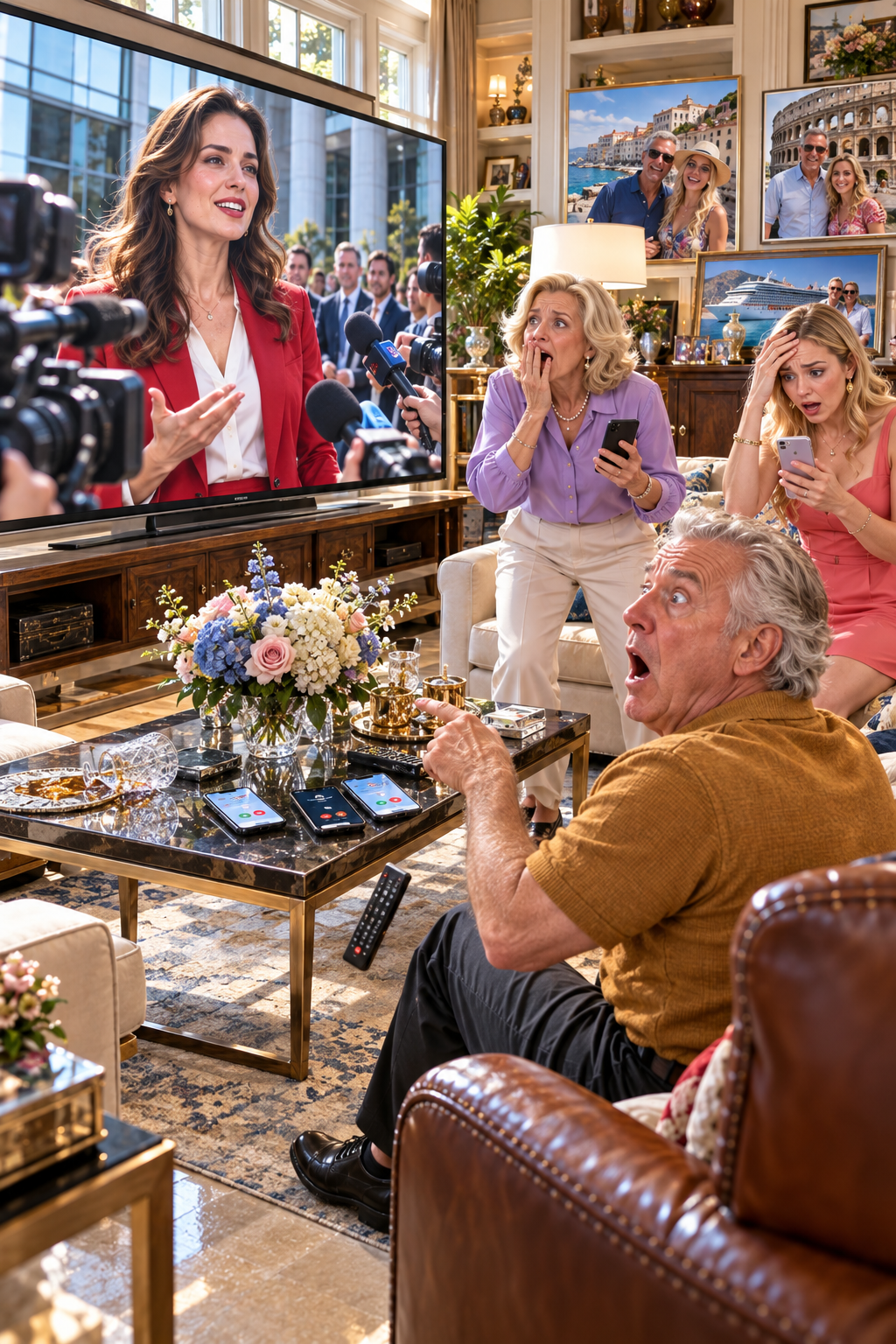
Every Holiday, My Parents Found An Excuse To Leave Me Home While They Spoiled My Sister. The Last Time, I Packed My Bags And Disappeared Across The Country. No Goodbye. No Address. Six Years Later, Dad Saw My Name On The News. My Phone Suddenly Exploded With 99 Missed Calls.
For years, my parents took my younger sister on beautiful holiday vacations while finding a different reason to leave me behind. The last Christmas, my father handed me the house keys instead of a boarding pass, and my mother didn’t even look embarrassed. I smiled, wished them a safe flight, and disappeared before they returned. Six years later, my artwork appeared on national television, and my father called ninety-nine times. Then a stranger sent me an old travel document with my name crossed out.
Part 1
The last Christmas I spent waiting for my family happened in a kitchen that smelled like cinnamon rolls and freshly brewed coffee. My father stood beside the refrigerator, checking three boarding passes on his phone, while my younger sister, Briar, sat at the counter comparing ski jackets. Mom was wrapping a cashmere scarf she’d bought for Briar to wear in Colorado. I had been awake since six, making breakfast for people who were preparing to leave without me.
“Are you sure there isn’t another seat?” I asked, keeping my voice casual as Dad zipped his carry-on. He barely glanced up. “Maren, we’ve been through this. Booking another flight this late would cost a fortune, and the suite only has two beds.” Briar looked at me over her coffee. “Besides, you don’t even like skiing.”
I’d mentioned wanting to learn twice that month, once during dinner and again when Mom showed me photographs of the resort. Neither conversation had apparently survived in anyone else’s memory. Mom tucked the scarf into a gift bag and said, “Someone needs to check on the house anyway. The furnace has been acting strange, and I’d rather not ask the neighbors.” She spoke as though giving me responsibility was a thoughtful alternative to including me.
I was thirty years old, working as a junior designer at a marketing agency outside Dayton, Ohio. I paid my own bills, lived in a small apartment, and had never asked my parents to finance my adult life. But somehow, every holiday invitation came with an explanation for why I didn’t belong on the itinerary. At twenty-seven, Briar still received trips, expensive gifts, and help with the lifestyle content business she’d been trying to build since college.
Christmas in Vermont had been too expensive for four. Thanksgiving in Manhattan had been arranged around Briar’s promotional event, so there hadn’t been enough notice for me to take time off. The previous summer, my parents had spent a week at a lakeside resort while I watered Mom’s plants. When they returned, Briar complained that a boat tour had been canceled by rain, and Mom reassured her with a bracelet from a jewelry store I’d never been able to afford.
The peculiar cruelty wasn’t that they forgot me completely. They always brought something home: a refrigerator magnet, a box of chocolates, a sweatshirt from an airport gift shop. Mom would hand it over and say, “See? We thought about you.” Then she’d spend an hour showing me photographs of the experiences they hadn’t thought to share.
That morning, Dad checked his watch and told everyone to hurry. I carried their extra suitcase to the car, standing in the driveway while cold wind pushed through my sweater. Briar was already inside, filming a cheerful departure video. Dad pressed the house keys into my palm and said, “You understand, don’t you? You’ve always been easier about these things.”
I looked toward Mom, hoping she might say something different. Instead, she straightened Briar’s collar through the open car door and reminded her to take photographs with the mountains behind her. When she finally turned to me, she smiled. “We’ll celebrate when we get back, sweetheart.”
“Have a safe trip,” I said.
I watched their car disappear at the intersection, then went inside and stood beside the Christmas tree. Four stockings hung from the mantel, but the family photograph displayed above them showed only three people standing in front of last year’s hotel fireplace. I had taken that picture after Mom handed me her phone at dinner. They’d used it for their holiday card.
I didn’t cry that morning. I opened my laptop, bought a one-way ticket to California, and called a former coworker named Leah Mendoza, who had offered me her couch months earlier when she’d heard about an opening at her company. She was surprised by how quickly I wanted to move. “Are you sure?” she asked. “Because I can pick you up at the airport, but my apartment is tiny.”
“That’s fine,” I told her. “I don’t have much.”
Over the next twelve hours, I packed two suitcases, canceled my lease, and arranged to finish my remaining assignments remotely while transitioning out of my job. I’d already been interviewing with the California company, but until then, I’d been afraid to make the move. Suddenly, uncertainty seemed less frightening than another year of pretending I was comfortable being forgotten.
I left the house keys on the kitchen counter beside a short note saying the furnace was working and the plants had been watered. I didn’t leave an address. I didn’t tell my parents about the job opportunity, and I didn’t leave a message for Briar.
By sunrise, I was on a flight heading west.
The first few months in Oakland were difficult in ordinary, unromantic ways. My new salary barely covered rent after I moved into a studio apartment above a laundromat. My car needed repairs I couldn’t afford, my secondhand laptop overheated, and I sometimes ate cereal for dinner while sitting on the floor. Still, nobody called me difficult for wanting something, and nobody expected gratitude for an invitation that never arrived.
I worked at a small branding studio, where I gradually learned that my opinions could matter without someone comparing them to Briar’s. I became a senior designer, then a creative director, taking independent commissions on weekends. Whenever I could, I made artwork from materials other people overlooked: discarded invitations, old photographs, unused place cards, and scraps of travel brochures.
My first exhibition took place in a narrow neighborhood gallery where the heater rattled whenever someone opened the front door. The show attracted fewer than fifty people, but a woman stood crying in front of a collage I’d made from an empty dining chair and torn Christmas cards. She told me it reminded her of growing up in a house where everyone noticed her chores but nobody noticed her absence.
That conversation changed the direction of my work.
Six years after leaving Ohio, I opened a much larger exhibition called The Fourth Place. Its centerpiece was a holiday dining table prepared for four, except the fourth chair faced a blank wall, separated from the others by several feet. Three elegant boarding passes rested beneath glass; where the fourth should have been, I’d placed an empty sleeve.
A video from opening night spread online, and a national morning program invited me to discuss the collection. I talked about invisible family roles, ordinary exclusions, and the way children can grow into adults who apologize for needing room.
The interview aired on a Tuesday.
By lunchtime, my phone showed ninety-nine missed calls, most from numbers with my old Ohio area code. I almost ignored them until I listened to Dad’s longest voicemail.
“Maren, your mother is getting questions, and Briar’s business is involved now. We need you to call before people start looking into those old trips.”
I replayed the final sentence twice.
He hadn’t asked whether I was happy, healthy, or even safe after six years. He was worried about someone looking into the vacations.
And for the first time, I wondered whether those missing invitations had involved more than favoritism.
Part 2
The first message I opened came from Mom. It said she’d seen my interview, that I looked beautiful, and that she hoped I was doing well. For approximately three seconds, I thought the years apart might have changed her. Then I scrolled down to the next message: “Your sister is extremely upset about what people are assuming. Please don’t embarrass the family over something that happened so long ago.”
I was sitting in my studio office when I read it. Outside, delivery trucks rattled over the uneven pavement, and someone downstairs was arguing about a parking space. My gallery director, Simone Rojas, had called earlier to congratulate me on the interview. I’d been planning to enjoy the morning by buying a decent coffee and taking the afternoon off.
Instead, I opened Briar’s social media account for the first time in years.
Her latest post showed her standing in front of a luxury hotel, wearing sunglasses that probably cost more than my first month’s rent in California. Beneath the photograph, she’d written that success should never require turning private family memories into a distorted public narrative. She didn’t mention me by name, but the comments were already connecting her post to my interview.
Briar had nearly half a million followers, many of whom knew her parents from years of cheerful holiday content. Her account had grown from personal travel photographs into a full-time business involving hotel partnerships, destination campaigns, and sponsored travel guides. I’d occasionally seen her work appear in magazines, although I’d learned to scroll past before the familiar disappointment settled in.
Her newest followers apparently knew something I hadn’t considered. They’d been watching a family of three for years, and some were asking where the older daughter had been.
At two that afternoon, Mom called again. This time I answered, sitting beside the studio window with a notebook in front of me. “Maren,” she said, sounding breathless with relief. “Thank goodness. We were starting to think something had happened to you.”
“Something did happen,” I replied. “Six years ago.”
She went quiet, then said, “We were worried when you left, but you made it clear you didn’t want contact.” I remembered the two phone calls she’d made during my first month in California, both asking whether I’d returned the spare garage remote. After that, she’d sent occasional holiday greetings without asking where I lived or how I was supporting myself.
“Why are you calling now?” I asked.
“We saw the interview. Your father and I are proud of what you’ve accomplished, but people are interpreting your artwork in a very personal way.” She hesitated before continuing. “Briar had a partnership review this morning. One of the companies asked whether the stories she tells about our family are accurate.”
“What stories?”
“You know how social media works. People are making connections that aren’t necessarily fair.” She lowered her voice. “We thought maybe you could post something explaining that your childhood wasn’t unhappy.”
I stared at the traffic beyond the window. “I’m thirty-six years old, Mom. The interview wasn’t about my childhood. It was about the holidays you kept leaving me out of when I was an adult.”
“That’s an exaggeration.”
“Is it?”
“We included you plenty of times.”
“Then why don’t you send me photographs from those trips?”
Her breathing changed. She told me memory wasn’t perfect, that traveling together hadn’t always been practical, and that Briar’s work created opportunities they couldn’t turn down. When I asked why those opportunities had never included buying one extra seat, she said I was making everything sound calculated.
Dad took the phone before I could answer. “We made the choices we thought were best,” he announced. “Your sister was trying to establish a career. We were helping her get started.”
“So you repeatedly left me home.”
“You were independent. You had your own life.”
“And she didn’t?”
“That’s not what I said.”
He sounded exactly as he had in our old kitchen, annoyed that an explanation he considered reasonable wasn’t being accepted immediately. Then he said the real reason for the call: Briar needed me to issue a public statement confirming that she’d never intentionally excluded me from family events.
I almost laughed. “I haven’t accused Briar of anything publicly.”
“People know you’re sisters.”
“Because she posted about my interview.”
Dad told me I was splitting hairs, while Mom said something indistinct in the background. I asked whether they remembered leaving me to check the furnace while they flew to Colorado. Dad said that particular trip had been unusually expensive. When I asked what hotel they’d stayed in, he couldn’t remember the name.
After ending the call, I opened a folder I’d maintained since my first year in therapy. My therapist had suggested writing down specific memories whenever I began questioning whether my disappointment was reasonable. I’d saved emails and photographs because the contradictions disturbed me more than the vacations themselves.
There was the Thanksgiving message saying four flights were too costly, followed by an Instagram photograph of Briar receiving an expensive watch. Another email described a New Year’s reservation that couldn’t be changed, although I later discovered they’d extended their stay by three nights. The final Christmas message was especially clear: “Maren can handle the house. She’s always been good about these things.”
I sent copies to Simone, not because I wanted them published, but because the gallery needed to understand what might happen next. She read them quietly before calling me. “Are you planning to respond to your sister?”
“Not unless she makes a direct claim.”
“Then keep everything backed up,” Simone advised. “You have an exhibition to run, and you don’t owe strangers a family trial.”
The following morning, Briar posted a video claiming that someone close to her was manufacturing a painful childhood for attention. She said I’d frequently declined vacations because I disliked travel and preferred spending holidays alone. By evening, screenshots of her statements appeared beside photographs of my artwork.
Mom called twice, asking me not to react. Dad sent a text saying he’d discuss everything privately if I stopped encouraging speculation. I answered that I would meet them once, in a public place, provided they brought the old holiday albums and were prepared to discuss specific dates.
Before they responded, an unfamiliar email arrived at my gallery address.
The sender was a woman named Carmen Pike, who said she’d coordinated promotional travel for Briar’s earliest partnerships. She apologized for contacting me out of nowhere and explained that she recognized one of the Christmas photographs circulating online.
Her final paragraph made my stomach tighten.
“I don’t know what your parents told you about those holidays,” she wrote, “but several trips were covered by commercial agreements. I still have the original guest requests, including one with your name on it. Were you ever told that your seat had already been approved?”
Part 3
I read Carmen’s email three times before replying. My first instinct was that someone had invented a story to attract attention, but she’d included a reference number and the name of a travel company I recognized from Briar’s old posts. I asked whether we could speak privately. She agreed to call after work.
Carmen sounded about my age, with the careful manner of someone who disliked becoming involved in other people’s arguments. She explained that she’d worked for a boutique travel marketing agency coordinating accommodation, transportation, and guest lists for promotional campaigns. Briar had been one of their smaller content partners six years earlier, before her audience grew large enough to attract national hotel chains.
“The Colorado Christmas trip was supposed to include four family members,” Carmen told me. “We approved that number in the preliminary budget. I remember because there was a last-minute request to change the arrangement.”
I stood beside my kitchen counter, gripping the phone. “What arrangement?”
“Your parents asked us to move the value of the fourth travel package into additional production expenses for Briar. They wanted a photographer for two days and a better suite for filming.” Carmen paused. “We asked for confirmation that the fourth guest wasn’t coming.”
“And what did they say?”
“That you’d declined.”
I looked at the blank wall above my kitchen table. My parents had told me the flight was too expensive, the room was too small, and someone needed to watch the furnace. Yet they’d apparently been offered the opportunity to include me without paying for everything themselves.
Carmen sent the first page of an old planning email while we were still talking. It contained four guest names, including mine, with a line drawn through the fourth entry in the revised version. Beneath the change was a note from the account coordinator: “Family confirms Maren will remain home by preference. Reallocate approved amount to production.”
“Why are you telling me this?” I asked.
“Because your sister’s company contacted some former partners yesterday, asking for confirmation that you didn’t want to travel with them,” Carmen replied. “I wasn’t comfortable signing off on something I couldn’t verify.”
After the call, I sat motionless until the refrigerator motor switched on. For years, I’d believed my parents were choosing convenience and favoritism over me. I hadn’t imagined they were sometimes converting the cost of including me into something more useful for Briar’s career.
Saturday morning, I arrived at a café in Berkeley twenty minutes early. I’d chosen a table near the front windows, where sunlight fell across scratched wood and pedestrians passed carrying grocery bags. I brought copies of the holiday messages, Carmen’s planning document, and a small notebook containing questions I wanted answered.
Mom and Dad entered together, looking older than the last time I’d seen them. Mom’s hair was shorter, and Dad had developed a slight stoop. Seeing them in person stirred an unexpected tenderness, the familiar recognition of people who’d once taught me to ride a bicycle and stayed awake when I had a fever.
Mom reached toward me, then stopped when I didn’t stand to embrace her. “You look well,” she said softly.
“I am.”
Dad placed a heavy shopping bag on the table. Inside were three old photo albums, their plastic covers scratched and cloudy. “Your mother insisted we bring these,” he said. “I don’t know what you’re hoping to prove.”
“I want us to agree on what happened before we talk about what you want me to say publicly.”
Mom opened the first album herself. The pages contained Christmas mornings, mountain cabins, Thanksgiving restaurant dinners, and smiling photographs of Briar. Several images were ones I’d taken before the family left or after they returned. I pointed to a photograph from Colorado and asked whether either parent remembered why I wasn’t there.
“You were working,” Dad answered.
I showed him an email confirming that I’d requested the entire Christmas week off. He frowned and suggested I might have changed my schedule afterward. When I showed him the message where I’d asked to join them, Mom stared at the table.
We continued through the albums, one holiday after another. The reasons shifted with every photograph: my schedule, the cost, the reservation, Briar’s obligations, my supposed dislike of crowds. I didn’t raise my voice or ask them to account for every birthday and family dinner. I wanted them to examine the pattern rather than escape into the details of individual excuses.
Finally, Dad said, “Your sister needed that time with us. We were supporting her career.”
“By telling me there wasn’t money for another plane ticket?”
“There wasn’t unlimited money, Maren.”
I slid Carmen’s document across the table.
Dad read the first page, and the muscles around his mouth tightened. Mom’s face drained of color as she recognized the company letterhead. Neither asked where I’d obtained it.
“That was a business arrangement,” Dad said at last. “You wouldn’t have enjoyed being photographed all day.”
“You never asked me.”
“We knew how you felt about Briar’s online work.”
“I didn’t like being treated as her unpaid assistant,” I answered. “That doesn’t mean I wanted to spend Christmas alone.”
Mom folded her hands tightly. “The photographer was important. Her first campaign hadn’t performed well, and the agency offered us flexibility with the budget.”
I waited for her to finish, but she stopped there.
“So when you told me that four flights were too expensive, you already knew a fourth seat had been offered.”
Dad looked at Mom, then back at me. “It wasn’t that straightforward.”
“It seems pretty straightforward from where I was sitting that Christmas.”
He leaned closer, lowering his voice. “Do you have any idea how difficult those early years were for Briar? She’d borrowed money, lost clients, and moved back home. We were afraid her business would fail.”
“And I was working two jobs,” I said. “Did you know that?”
Mom’s eyes filled, but Dad said nothing. I remembered coming home exhausted after weekend shifts, only to be told how fortunate I was to have stable employment. My independence had become a convenient reason not to ask what it cost me.
I closed the album and told them I wouldn’t publish Carmen’s document or involve the gallery in a public dispute if Briar withdrew her false statements. She didn’t have to endorse my artwork or apologize on camera. She simply needed to stop telling people I’d refused invitations that were never genuinely offered.
“She won’t like being told what to do,” Mom whispered.
“Neither did I.”
Dad asked whether I intended to make them pay for every mistake forever. I told him I was asking them to stop repeating the mistakes now. He seemed offended that the difference mattered.
As I stood to leave, Mom caught my attention with a question that sounded almost frightened. “Maren, has Carmen shown you the photographs from that Christmas campaign?”
“Only the itinerary.”
Mom looked toward Dad. He stared down at the table, his expression suddenly guarded.
“Then there’s something else,” she said. “Something I should have told you years ago.”
Part 4
Mom sent me the photographs that evening. They were from the Colorado campaign, taken during a dinner arranged inside a private dining room decorated with pine garlands and white candles. In the first photograph, four chairs surrounded a beautifully set table, with one place card still blank. In the next, the fourth chair had been moved against the wall, leaving three seats beneath the photographer’s lights.
The third photograph showed my parents and Briar raising champagne glasses, smiling toward the camera. Behind them, partially visible in the reflection of a window, the unused chair stood beside a rack of lighting equipment. It was such a small detail that I might have overlooked it if Mom hadn’t specifically told me to look.
An email attached to the photographs explained what had happened. The photographer had originally prepared the room for four because the preliminary guest list contained four names. After the booking changed, Briar requested a composition centered on what her campaign described as “our family’s holiday tradition.” The photographer had simply removed the extra chair.
I sat at my kitchen table, looking at the photograph until the light outside faded. Years earlier, I’d created artwork showing a chair separated from a family gathering because that was how exclusion had felt. I hadn’t known that somewhere in a hotel archive, almost the same scene had actually been arranged.
Mom called an hour later. “I should have stopped it,” she said before I could speak.
“Why didn’t you?”
“Your sister was finally getting opportunities. Your father said we needed to make the most of them, and I kept telling myself we’d take you somewhere another time.” Her voice trembled. “After a while, it became easier to believe you weren’t interested.”
“You knew I was interested.”
“I knew you asked to come that Christmas.”
That admission hurt more than any argument we’d had at the café. For years, my parents had insisted their choices were misunderstandings or unavoidable expenses. Now Mom was admitting she’d recognized my disappointment while deciding that Briar’s opportunities mattered more.
I asked whether Briar knew the fourth guest had been removed from the booking. Mom said Briar had signed the final production plan, but they’d told her I was comfortable staying home. I didn’t believe that completely absolved my sister. She’d watched me ask about trips, seen me excluded repeatedly, and accepted the benefits without questioning the explanations.
Before ending the call, Mom asked whether I could forgive her. I looked at the dark screen of my laptop, where three smiling people were frozen in a photograph. “I appreciate you telling me,” I said. “But I’m not ready to give you something just because telling the truth was uncomfortable.”
The following morning, Briar uploaded a new video.
She appeared without makeup, sitting on her living room sofa, speaking slowly about family relationships and the pressure of public scrutiny. She claimed I’d always been invited to participate in their vacations but had turned them down because I disliked traveling. Then she added something new: she said she’d personally asked me to join the Colorado Christmas trip and that I’d refused.
I remembered her sitting at our kitchen counter, comparing ski jackets while Dad handed me the house keys. She hadn’t asked me anything. In fact, she’d laughed when I suggested I could sleep on the resort sofa.
Simone called before the video had been online an hour. “She’s made a specific claim now,” she said. “You can correct it without turning your exhibition into an argument.”
I spent the afternoon preparing a short statement with the help of a professional adviser who reviewed the language for privacy concerns. I explained that my work drew from experiences of exclusion and that I’d never publicly identified my relatives. Because claims were now circulating that I’d voluntarily refused family holiday invitations, I was correcting that particular account.
I attached three dated messages with addresses and unrelated details concealed. One showed me asking Briar whether the Colorado reservation could accommodate another guest. Her answer read, “I already finalized the content schedule, and changing everything now would be a nightmare.” Another showed Mom explaining that adding me would complicate the arrangements. The third was Dad’s message telling me I’d always been easier about these things.
I didn’t publish Carmen’s document or the behind-the-scenes photographs. Those records answered questions I needed answered, but they also involved people and agreements unrelated to the public claims. The private truth had been painful enough without making every detail available to strangers.
Within a day, Briar deleted her video. The original post disappeared shortly afterward, although copies continued circulating. A resort group suspended an upcoming collaboration while reviewing statements in her promotional materials, and another company postponed a campaign she was supposed to launch the following month.
Dad called, furious. “Your sister’s losing contracts because of this.”
“She made public claims that weren’t true,” I answered. “I gave her a chance to correct them privately.”
“She didn’t know about all those old arrangements.”
“Then she shouldn’t have insisted she knew exactly what happened.”
He accused me of enjoying the attention, although I hadn’t accepted a single interview about my family since the original broadcast. I was spending my days preparing artwork, answering gallery emails, and trying to keep strangers from contacting my relatives directly.
“I’m not asking anyone to punish Briar,” I told him. “But I’m not going to protect her business by agreeing to a story that isn’t true.”
Dad fell silent. When he finally spoke, his voice was quieter. “We should have handled things differently.”
“Yes,” I said. “You should have.”
That evening, Simone told me a museum-affiliated foundation had expressed interest in purchasing the centerpiece of The Fourth Place for a traveling exhibition. It was the first conversation I’d had all week that concerned my work rather than my family’s reaction to it. I stayed late in the gallery, inspecting the glass over the three boarding passes and adjusting a label that had come loose.
As I was preparing to leave, another message arrived from Briar. It contained no apology, only one sentence: “I need to know whether Mom told you about the money Dad took out of your college fund.”
I stared at the screen, trying to understand what she meant.
Until that moment, I hadn’t known there was any college money left to take.
Part 5
I called Briar immediately, something I hadn’t done in six years. She answered on the fourth ring, sounding tired rather than angry. In the background, I heard running water and the clatter of dishes, ordinary sounds that felt strange coming from someone whose life I’d mostly seen through carefully edited photographs.
“What college fund?” I asked.
Briar hesitated. “Mom found an envelope from Grandma Eileen when she was going through the Christmas albums. Dad told her not to mention it, but they’ve been arguing ever since you met them.”
I remembered Grandma Eileen giving me a small leather sketchbook when I was twenty-four. She’d told me she believed I would eventually create something of my own, even if everyone else thought design was an impractical career. She died the following winter, and I’d always assumed the sketchbook was the last gift she’d intended for me.
Briar explained that Grandma had also left eighteen thousand dollars for my education or future creative work. The money had been deposited into an account my parents managed, along with other family savings. Years later, when Briar needed financing for her first serious travel campaign, Dad authorized using it to cover production costs and outstanding business expenses.
“Did you know it was supposed to be mine?” I asked.
“Not when he offered the money,” Briar replied. “He said it was family savings. Mom only told me where it came from after everything happened this week.”
“Why are you telling me now?”
“Because they’ve been making it sound like I forced them to choose me over you. I didn’t know about that money, Maren. I knew they helped with my business, but I didn’t know what they’d given up to do it.”
I believed she hadn’t known the source of the funds. I also remembered every holiday when she’d accepted my exclusion without complaint, every joke about how I preferred staying home, and the video she’d posted insisting I was dishonest. Learning that my parents had misled her didn’t erase the choices she’d made with the information she had.
“Thank you for telling me,” I said. “But you still told people I turned down invitations that you knew I wanted.”
She didn’t argue. “I know.”
After we hung up, I emailed Mom asking for a copy of Grandma’s letter and records showing how the money had been handled. She sent them three days later, along with a handwritten apology. Grandma’s original note contained a sentence that made me put the paper down: “Maren has always been so careful not to ask for anything that I’m afraid she’ll forget she deserves help, too.”
I’d spent years taking extra assignments and saving for equipment because I believed creating an independent career was entirely my responsibility. Meanwhile, the money Grandma had specifically intended to support that ambition had been redirected toward Briar’s work. My parents had transformed my willingness to manage without help into permission to give that help elsewhere.
Dad called after I requested the financial records. He admitted authorizing the transfer but insisted that Briar’s business had seemed more urgent at the time. When I asked why he’d never told me about Grandma’s gift, he said he knew I’d disapprove of the decision. It was the first time he’d admitted that he hadn’t simply misunderstood what I wanted.
I told him I would be obtaining professional advice about the money and wanted everything documented. He sounded surprised that I wasn’t interested in resolving it privately with a family promise. “I can make things right,” he said.
“You can repay what was meant for me,” I answered. “That’s one responsibility. It doesn’t settle everything else.”
Over the following weeks, the gallery became my refuge again. Simone and I arranged lighting, finalized labels, and prepared the collection for its opening reception. The foundation confirmed its intention to acquire the centerpiece, subject to its final inspection, and I spent an afternoon carefully documenting every material in the installation.
My parents asked whether they could attend opening night. I told them the gallery was open to the public and that they were welcome to buy admission like anyone else, but I wouldn’t participate in family photographs or interviews about reconciliation. Mom agreed immediately. Dad responded with a single word: “Understood.”
They arrived forty minutes after the doors opened.
I noticed them while speaking to a museum curator near the entrance. Mom wore a navy coat I’d seen in photographs for years, and Dad stood beside her looking uncomfortable in the crowded room. Neither approached me, and for a while they walked through the exhibition without speaking.
The main installation occupied an entire wall. Three embossed boarding passes hung beneath glass, with an empty fourth sleeve positioned beside them. Below the arrangement were four sentences drawn from the messages I’d received over the years: “She’s independent. She understands. She’s easier. She’ll get over it.”
I joined my parents after they’d spent several minutes looking at the work. Mom turned toward me with tears in her eyes, but she didn’t reach for my hand. Dad was staring at the empty sleeve.
“That’s what we did,” Mom whispered. “We treated you like you were already gone.”
“You kept making decisions without me,” I answered. “Eventually, I stopped asking.”
Dad cleared his throat. “I thought we were helping the daughter who needed us most.”
“You were helping the daughter whose needs were easiest for you to see.”
He looked down at the floor. For once, he didn’t offer an explanation, and the silence felt different from the ones I’d grown up with. It didn’t ask me to fix the discomfort for him.
Near the end of the evening, Simone approached to confirm the foundation had approved the acquisition. The centerpiece would become part of a traveling collection about identity and belonging. Mom overheard and smiled faintly.
“Your grandmother would have loved this,” she said.
I thought about the letter she’d hidden from me, the money that had disappeared, and the artist I’d become without the help Grandma had tried to provide. “I think she would have,” I replied.
Mom asked whether she and Dad could visit for Thanksgiving. I told her I was hosting dinner for friends and that my plans were already settled. When she asked whether there might be room for two more, I answered without hesitation.
“No. This year, I’m spending the holiday with the people who were here before anyone knew my name.”
Mom swallowed and nodded. Dad looked toward the entrance, then back at the artwork. Neither tried to change my mind.
After they left, Simone handed me a glass of sparkling water and asked whether I was all right. I looked around the crowded gallery, at the people discussing my work and the friends who had helped me prepare every piece. For the first time in years, my parents had attended an important event in my life without becoming the center of it.
“Yes,” I told her. “I really am.”
Part 6
Thanksgiving arrived with rain against my apartment windows and the smell of rosemary drifting through the kitchen. By eleven, I had three dishes in the oven, flour on my sweater, and a text from Leah warning that she’d forgotten to buy the cranberry sauce. I told her nobody would notice. She replied that she was bringing two bottles of sparkling cider as compensation.
I had invited ten people, including coworkers, artists, two neighbors, and a friend who had recently moved to California. Some knew the full story of my family, while others knew only that I didn’t usually travel for holidays. Nobody had asked me to explain or justify the invitations. They’d simply accepted them.
Around two, Leah arrived carrying a crooked pumpkin pie and a paper bag full of groceries. She surveyed my dining table, where I’d arranged mismatched plates around a centerpiece of eucalyptus branches. “You know what I like about your house?” she asked. “You actually expect people to show up.”
I laughed, but the remark stayed with me as the afternoon unfolded. Friends crowded into the kitchen, argued affectionately about music, and brought extra chairs from the living room. Someone spilled cider on a napkin, and another guest burned the dinner rolls. Nothing was perfect, but nobody had to earn the right to be included.
My phone buzzed shortly before we sat down.
Mom had sent a simple message: “I hope you have a wonderful Thanksgiving. We love you, and we understand you have your own plans.”
There was no photograph of a family dinner, no reminder that an empty seat waited in Ohio, and no request for a call. I answered that I was having a good day and wished them the same. It was the first holiday message from my mother that didn’t make me feel responsible for her disappointment.
An hour later, Briar texted.
“I saw the gallery photographs. The exhibition looks beautiful.”
“Thank you,” I replied.
She waited several minutes before sending another message. “I owe you an apology that has nothing to do with my contracts.”
I stepped onto the balcony, where the rain had softened into mist. Briar wrote that she’d been reviewing old messages and photographs after the companies she worked with requested corrections to some of her promotional material. She’d realized how often she’d repeated our parents’ explanations without asking me whether they were true.
“I liked being the one they chose,” she admitted. “I told myself you didn’t care because admitting you did would have meant admitting I benefited from you being left behind.”
I read those words twice.
For years, I’d imagined an apology from Briar arriving with excuses about our parents, her age, or the pressures of her career. Instead, she’d acknowledged something that had always been obvious to me but apparently difficult for her to say. She had enjoyed the attention, the trips, and the feeling of being important enough for everyone else to rearrange their lives.
“I appreciate you saying that,” I wrote. “But I don’t want to pretend we’re suddenly close.”
“I understand.”
We exchanged a few more messages before I returned to dinner. I didn’t invite her to visit or promise we’d spend Christmas together. Her apology mattered, but it wasn’t a replacement for the years she’d spent defending a situation that hurt me.
During dinner, Leah raised her glass and thanked everyone for showing up, including the neighbor who’d arrived late after working a hospital shift. We passed dishes around the table while rain tapped softly against the windows. I looked at the extra chair we’d pulled in for him and realized nobody had questioned whether making room was inconvenient.
In December, Dad emailed me instead of calling repeatedly. He attached an accounting prepared with help from a financial professional, showing how Grandma’s money had been used. He acknowledged that it had been intended for me and proposed repaying the amount, with an additional sum to recognize the years I’d been without it.
I reviewed the documentation with my own adviser before agreeing to the arrangement. Dad completed the repayment over the following months, without attaching conditions or asking me to visit. I used some of the money toward educational debt and set the rest aside for future creative projects. It couldn’t give me the opportunities I’d missed, but I was no longer willing to call a wrong decision irreversible simply because correcting it was inconvenient.
His final email contained something more personal.
“I went through fourteen major holiday trips over the years,” he wrote. “You were missing from nine. I used to remember only the five when we were all together, because that allowed me to think we were fair. I understand now how much I chose not to see.”
He also admitted he’d begun checking with Mom before making decisions that affected other people. It sounded like a small change, almost embarrassingly ordinary, but I understood what it had cost him to recognize the habit.
I thanked him for the accounting and for acknowledging the truth. I didn’t tell him everything was forgiven, and I didn’t offer to come home. When he wrote back, he said he understood.
By spring, The Fourth Place had traveled to two additional cities. At each opening, people lingered in front of the three boarding passes and the empty sleeve. Some recognized themselves in the person who’d been left out; others told me they’d been the family member who never questioned why someone was missing.
One woman approached me after a panel discussion in Chicago. She told me her brother had spent years declining family gatherings, or so she’d believed, until she discovered their parents hadn’t been informing him of the dates. She’d called him after seeing my exhibition, and they were slowly rebuilding a relationship without their parents managing the conversation.
Stories like hers reminded me that the artwork had become larger than my particular experiences. I hadn’t created it to punish my family. I’d created it because I wanted people to notice the empty places they’d learned to ignore.
Briar eventually corrected the misleading holiday descriptions on her public accounts. Some partnerships resumed, while others didn’t. She began doing more work independently, and although we exchanged occasional messages, I never became part of her content or agreed to participate in interviews about our relationship.
Mom sent birthday cards and sometimes asked about upcoming exhibitions. Dad occasionally mailed articles he thought I’d enjoy. Their contact became less frequent but more respectful, and I no longer experienced every message as a demand for something.
The following Thanksgiving, Mom asked whether I’d consider visiting Ohio. I told her I already had plans with friends. She answered, “I hope you have a lovely time,” and left it there.
A year after the ninety-nine missed calls, the same morning program invited me back to discuss the traveling exhibition. The host showed a photograph of the installation and asked whether all the attention had changed my relationship with my family.
“It changed what we’re willing to acknowledge,” I answered.
“Has it brought you closer together?”
I thought about Mom’s letters, Dad’s repayment, and Briar’s apology. Each represented an effort I wouldn’t have believed possible when I left Ohio. But none had made me want to return to the position I’d occupied for most of my life.
“Not in the traditional sense,” I said. “We have a more honest relationship now, but honesty doesn’t automatically restore closeness.”
The host asked whether I considered the ending sad.
“I think it would be sadder if I spent the rest of my life pretending everything was fine just because they finally acknowledged it wasn’t.”
After the interview, I returned to Oakland and went grocery shopping. I stopped at the neighborhood market for fresh bread, picked up flowers from a sidewalk vendor, and bought an extra set of dinner plates because Leah had invited two friends to our next gathering. It was a completely ordinary afternoon, and I found myself enjoying how little of it required thinking about my family.
That evening, I received a photograph from Mom. She’d found an old Christmas album and added a picture of me standing beside my installation at its first exhibition. Beneath it, she’d written, “We should have made room for you long before the world did.”
I kept the photograph. I didn’t call to thank her immediately, and I didn’t mistake the gesture for a promise that everything could be restored.
Years earlier, I’d stood in my parents’ driveway watching three people leave for a vacation I’d begged to join. I remembered the weight of the house keys in my palm, the cold air against my face, and the practiced smile I’d given them because I didn’t know how else to make leaving easier.
I no longer had to make my disappointment convenient for anyone.
My family had finally learned that I was someone they could lose, but by then, I’d learned something more important. I could love parts of my history without returning to the life those people had chosen for me.
At my next holiday dinner, we used every chair around the table. When one guest arrived unexpectedly with a friend, I opened the closet, brought out another chair, and made room between Leah and the window.
It took less than a minute.
For six years before I left home, I’d been made to believe that including one more person was an impossible complication. Now I knew how simple it could be when someone actually wanted you there.
And when I finally sat down among the people I’d chosen, I didn’t look toward the door to see who was leaving without me.
THE END!
Disclaimer: Our stories are inspired by real-life events but are carefully rewritten for entertainment. Any resemblance to actual people or situations is purely coincidental.


