
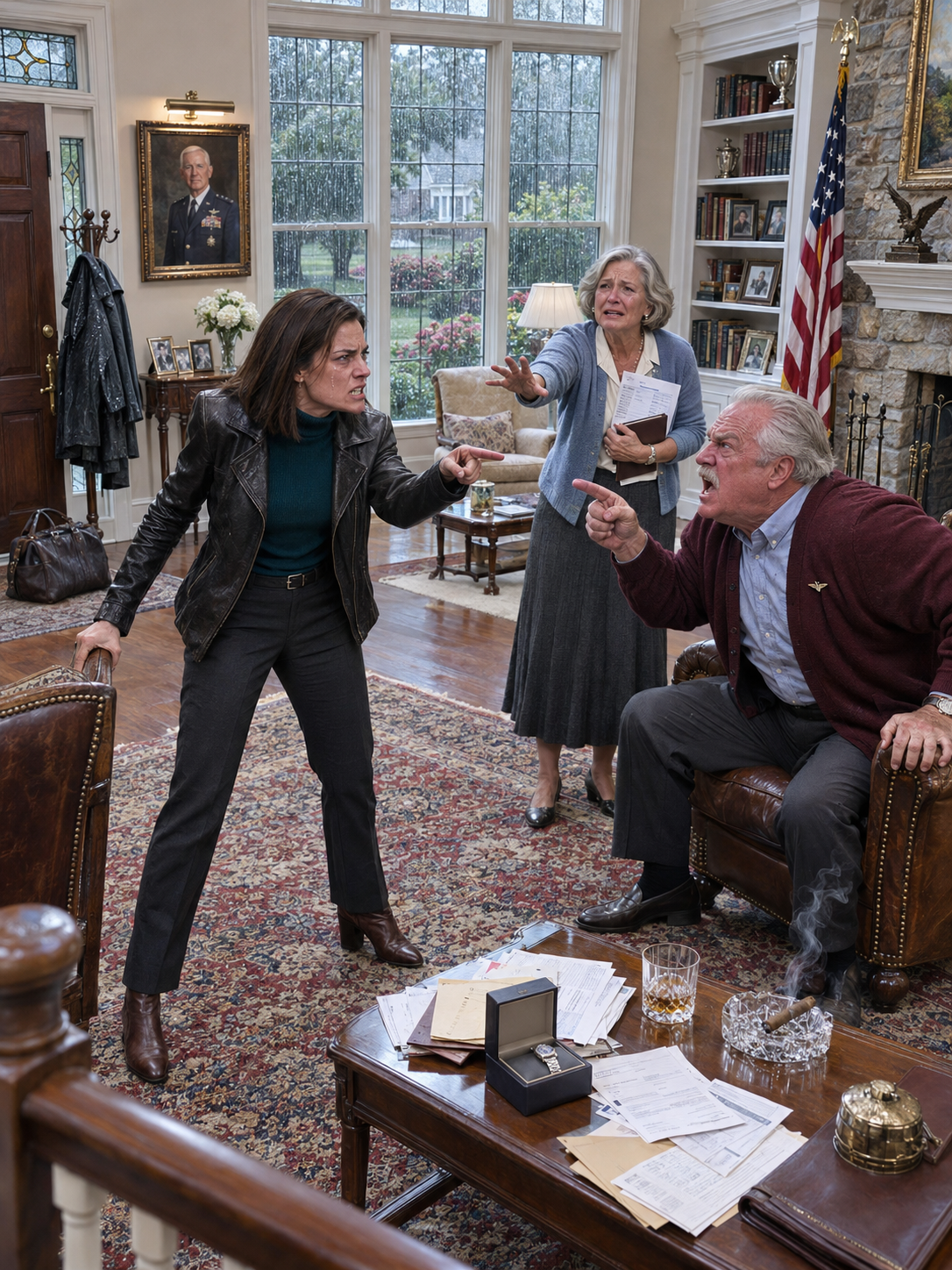
I drove four hours through a Virginia rainstorm because my mother sounded strange on the phone, only to find a retired Air Force colonel sitting in my late father’s chair, smoking in her house and judging me before I had removed my coat. He called me aimless, mocked my Navy career, spent my mother’s money, and insisted rank made him the authority in every room. For three days, I let him believe I was nobody. Then he crossed one line too many.
### Part 1
The first thing I tasted when I stepped into my mother’s house was menthol smoke. It hung beneath the ceiling fan in a pale gray layer, mixed with Old Spice, bourbon, and the damp wool smell coming off my rain jacket after four hours on I-64. My mother had hated cigarette smoke for as long as I could remember, yet a half-finished cigarette rested in a ceramic saucer on my father’s old coffee table.
The man occupying my father’s recliner did not stand when I entered. His polished brown shoes were planted on the coffee table, one ankle crossed over the other, while a college football game shouted from the television loud enough to make the picture frames tremble. He looked me over from wet hair to plain black travel shoes and said, “You must be Caroline.”
“Audrey,” I corrected. “Audrey Mercer.”
He smiled as though getting my name wrong had somehow been my mistake. “Right. Audrey. Your mother told me you were coming.”
My mother appeared from the kitchen carrying a dish towel she kept twisting between her fingers. Elaine Mercer looked smaller than she had six months earlier, though nothing about her actual height had changed. She hugged me quickly, and when I asked if everything was okay, her eyes slid toward the man in the recliner before she said, “Of course it is.”
That was when he finally introduced himself. “Grant Maddox. Colonel, United States Air Force, retired. Twenty-six years.” He said each piece like a medal being placed on a table, then added, “Your mother tells me you did some time in the Navy.”
Some time.
I set my leather travel bag beside the hall cabinet. Inside were two uniforms, a laptop, several classified-work reminders I would never open in that house, and a small velvet case I had carried because I was expected at a formal command event later that week. Grant saw an unremarkable black bag and returned his attention to football.
“I’m still serving,” I said.
“What do you do?”
“A little of everything.”
He laughed. “That usually means staff work.”
I heard my mother inhale softly from beside me. I could have corrected him in three sentences, but twenty-five years in uniform had taught me that correcting someone too early sometimes cost you information. So I only smiled, picked up my bag, and asked my mother which room she wanted me to use.
My hometown was Millhaven, Kentucky, a place small enough that people still identified houses by the families who had owned them twenty years earlier. We had one grocery store, a Baptist church with a cracked bell, a diner where the coffee tasted burned by eight in the morning, and a high school roof that leaked every spring. I grew up two streets from Main Street believing that success was something other families celebrated.
When I was eleven, I won the county science fair with a homemade water-filtration system built from gravel, charcoal, sand, and equipment my science teacher let me borrow. I carried the blue ribbon home and placed it beside my father’s dinner plate. He moved it to reach the salt and spent the meal talking about my older brother Owen scoring two touchdowns the previous Friday.
At sixteen, I brought home a report card with five A’s and one B. My father tapped the B with his index finger and said, “This is the one we need to discuss.” That was how praise worked in our house: five good things could be erased by one imperfect thing before dessert.
The Naval Academy acceptance envelope arrived when I was seventeen. I tore it open beside the mailbox, read the first sentence three times, then ran into the kitchen so quickly the screen door slammed behind me. My father read half the page, folded it once, and said, “Somebody’s got big ideas.”
My mother said nothing until the night before I left. She came into my bedroom holding an old shoebox filled with camp postcards, elementary-school photographs, pressed flowers, and every ridiculous letter I had ever written her. Sitting beside me on the bed, she said, “I kept these because sometimes I needed proof that there was a bigger version of you waiting to get out of this town.”
She never drove to Annapolis. Neither did my father. A card arrived three days after induction, stained along one corner by rain, with six words in my mother’s handwriting: I know you can do this.
For years, I treated those six words like emergency rations.
Dinner on my first night back felt painfully familiar. Grant dominated the conversation while my mother served chicken casserole, interrupting her twice to complain that she had used too little salt and once to ask why she had bought the “cheap” green beans. Whenever she reached for anything, she glanced toward him first.
He asked what kind of ships I had served on. I mentioned carriers and joint operations without giving him the career summary he clearly expected me to provide for inspection. When I referred to coordinating operations during a severe Pacific storm years earlier, he waved his fork dismissively.
“Logistics,” he said. “Traffic control with uniforms.”
“Sometimes.”
“Real command is different.”
I looked across the table. “I imagine it is.”
His expression brightened because he thought I had agreed with him.
My mother’s fork stopped halfway to her mouth.
After dinner, Grant poured bourbon without offering anyone else a drink. He launched into a twenty-minute story about Cold War alert exercises that had apparently grown more dangerous in his memory than in recorded history. I listened, asked two questions, and watched him become more comfortable every time I refused to compete.
Eventually he leaned back and said, “Elaine worries about you, you know.”
My mother looked up sharply. “Grant.”
“What?” He shrugged. “She does. Woman your age, bouncing around from assignment to assignment. No husband. No permanent home. At some point you have to stop drifting and build something.”
I almost laughed.
Instead, I looked at my mother. Her face had gone pale.
“What exactly did Mom tell you about my work?” I asked.
Grant answered for her. “Enough. Career Navy. Administrative side, mostly. Still moving every few years. Sounds exhausting.”
My mother opened her mouth, but I gave her the smallest shake of my head. “That’s one description.”
He raised his glass toward me. “You seem smart. You’ll figure out your direction eventually.”
At forty-nine years old, after more than two decades of service, I was being offered career counseling by a man wearing socks with tiny golf clubs on them.
But it was not his arrogance that bothered me.
It was my mother’s silence.
At two in the morning, I woke thirsty and walked downstairs. A lamp glowed in the kitchen, and I heard paper sliding across the granite island. When I stepped around the doorway, Grant was sitting alone with my mother’s bank statements spread in front of him and a calculator in his hand.
He covered the pages immediately.
“You always go through other people’s finances at two in the morning?” I asked.
His eyes narrowed. “Your mother asked me to manage some things.”
From behind me came the faint creak of a floorboard.
My mother was standing halfway down the stairs.
She wasn’t looking at Grant.
She was looking at the papers beneath his hand, and for the first time since I arrived, I saw something stronger than embarrassment in her face.
I saw fear.
### Part 2
Grant gathered the bank statements too quickly, shoving them into a blue folder as if speed could erase what I had already seen. “Elaine gets overwhelmed by finances,” he said. “I handle the complicated things.” My mother remained on the stairs, one hand gripping the railing hard enough that her knuckles had turned white.
“Do you?” I asked.
He leaned back in the kitchen chair. “Is there some reason you’re interrogating me in my own home?”
The phrase landed exactly where he intended it to. My mother flinched before I did.
“This is Mom’s house,” I said.
“Our home,” he corrected.
I looked at my mother. She lowered her eyes.
There are moments in command when the worst thing you can do is react to the first piece of information. You wait, not because you are uncertain, but because incomplete information invites bad decisions. So I got a glass of water, wished them both good night, and returned upstairs while Grant watched me with the satisfied expression of a man who thought I had retreated.
At breakfast, he acted as though nothing had happened. He fried eggs, left grease across the stovetop, and complained that my mother had bought the wrong coffee. Then he announced that he needed to run errands and asked her for “the card.”
My mother took a debit card from her wallet.
I saw hesitation before she handed it over.
“How much are you spending?” I asked.
Grant slipped the card into his pocket. “None of your concern.”
“Grant,” Mom murmured.
He kissed the top of her head as though rewarding a compliant child. “I’ll bring it back.”
The front door closed behind him, and we heard his truck start in the driveway. It was a new dark-blue pickup with chrome trim, oversized tires, and temporary dealer plates that had been replaced recently enough for me to remember noticing them through the rain.
I waited until the engine disappeared down the street. “Mom, why does he have your debit card?”
She began wiping a counter that was already clean. “His pension paperwork got complicated.”
“How complicated?”
“He had some trouble moving accounts after he relocated.”
I let three seconds pass. “How long ago did he relocate?”
She rubbed the same spot harder. “About four months.”
That answer bothered me more than I showed. Military retirement pay did not simply vanish for months because someone moved across state lines, and a retired colonel had spent enough years dealing with bureaucracy to know how to resolve an account problem. Even if his explanation was technically possible, his behavior was wrong.
I asked whether he contributed to household expenses. She said he did “when he could.” I asked whether his name was on the deed. She said no. I asked whether they had combined accounts, and that was when she stopped cleaning.
“Why are you doing this?”
“Because you sounded scared on the phone last week.”
“I was tired.”
“You called me at 1:20 in the morning and asked whether I remembered where Dad kept the property documents.”
Her face tightened.
She had apparently forgotten saying that.
Mom turned toward the window. “Grant wants us to be organized before the wedding.”
Wedding.
That was new.
“When?”
“We haven’t set a date.”
“How long have you been engaged?”
She looked at me then. “Three weeks.”
I had spoken to her twice in those three weeks.
She had never mentioned it.
Before I could ask anything else, Grant’s truck returned. My mother reacted to the sound before the vehicle even reached the driveway, moving quickly to gather the breakfast plates as though she had been caught doing something wrong. That reaction told me more than any answer she had given.
Grant came through the door carrying an expensive power-tool set and two shopping bags. “Sale,” he announced.
My mother glanced at the boxes. “Grant, we talked about—”
“It was forty percent off.”
“You said you were getting groceries.”
“I did.”
He placed one bag on the counter. Inside were coffee, chips, bacon, and a bottle of bourbon.
No milk. No vegetables. Nothing my mother had written on the small list beside the refrigerator.
That afternoon, I offered to drive Mom to the pharmacy and grocery store. Grant volunteered to come. When I said I wanted time alone with her, he smiled without humor and asked, “Why? Planning an intervention?”
“Do I need one?”
He stared at me long enough for the joke to die.
Mom quickly said we could all go later.
We never did.
Around five, while taking kitchen trash outside, I noticed a crumpled dealership receipt wedged beneath a paper towel. I unfolded it because the amount visible through the crease was large enough to catch my eye.
Monthly payment: $872.
Purchaser: Elaine Mercer.
Vehicle: 2026 Ford F-150.
I read it twice.
The truck Grant called his was financed in my mother’s name.
When I brought the receipt inside, she closed her eyes.
Grant had gone to shower. Water thudded through the pipes upstairs while I placed the paper on the table between us.
“Did you buy him that truck?”
“He needed transportation.”
“That isn’t what I asked.”
Her voice dropped. “The dealership wouldn’t approve him alone.”
“Why?”
“He said there was an error on his credit report.”
“Did you verify that?”
She looked toward the stairs.
That was answer enough.
My mother had inherited the house outright when my father died. She had savings, a modest pension, and years of careful habits. She clipped grocery coupons even when she didn’t need to and once drove back twelve miles because a cashier had accidentally given her ten dollars too much change.
Now she was making an $872 truck payment for a man who complained about the coffee she bought.
“How much else?” I asked.
“Audrey.”
“How much?”
“I don’t know.”
The shower stopped.
Mom grabbed my wrist. “Please don’t confront him.”
There was urgency in her voice that had nothing to do with protecting Grant’s feelings.
“What happens when someone confronts him?”
“Nothing.”
“Mom.”
“Nothing physical.”
The qualification chilled me.
Footsteps sounded upstairs.
She leaned closer. “He gets loud. He tells me I’m confused. Then eventually I start wondering whether I am.”
I covered her hand with mine.
“You’re not confused.”
Tears appeared in her eyes, but she blinked them back before Grant entered the room.
He noticed the receipt immediately.
His face changed.
Not dramatically. That was what made it worse. The easy charm disappeared, leaving something cold and calculating underneath.
“You digging through our trash now?” he asked.
“I was taking it outside.”
“That paper has nothing to do with you.”
“It has Mom’s name on it.”
He walked toward me, close enough that bourbon and toothpaste mixed unpleasantly on his breath. “You show up after being gone for years and suddenly you’re an expert on our life.”
“I didn’t say that.”
“No, you just walk around judging everything.”
My mother stood between us. “Grant, stop.”
He looked past her at my leather bag near the wall.
Then, smiling directly at me, he kicked it hard enough to send it sliding across the hardwood.
My mother gasped.
Grant stepped backward, deliberately caught his heel against the leg of a chair, and went down with a crash.
For one second, nobody moved.
Then he grabbed his hip and shouted, “What the hell did you do?”
I stared at him.
My mother stared at him.
And Grant stared back at us, already building the lie before he had even finished falling.
### Part 3
Grant’s performance became more convincing once he had an audience. He groaned loudly, accused me of leaving my bag where someone could trip, and insisted I had refused to move it after being warned. None of those things had happened, but he delivered each sentence with the confidence of a man accustomed to winning through volume.
My mother rushed for ice. Grant rejected it, then accepted it five minutes later after realizing that injured men should probably appear interested in treatment. He limped dramatically until he forgot which leg was supposed to hurt and switched sides near the hallway.
I said nothing.
That irritated him more than an argument would have.
“An apology would be appropriate,” he said.
I looked at the chair he had deliberately hooked with his heel, then at my bag nearly ten feet away. “For what?”
“You’re really going to do this?”
Mom returned holding a dish towel wrapped around an ice pack. “Audrey, please.”
Her voice broke on the final word.
She was not asking because she believed him.
She was asking because she knew what the rest of the evening would become if I refused.
I understood then how much of her life had been reorganized around preventing Grant’s reactions. She anticipated his moods the way sailors watch weather systems—not because storms are reasonable, but because failing to prepare for one does not stop it from arriving.
“I’m sorry your evening became unpleasant,” I said.
Grant accepted that as victory.
Later, Mom came to my room. She closed the door gently behind her and sat on the edge of the guest bed.
“I hate that I asked you to do that.”
“I know.”
“He wasn’t always like this.”
That sentence has probably kept more bad relationships alive than love ever has.
She told me they had met at a veterans’ charity luncheon eight months earlier. Grant had been charming, attentive, full of stories about duty and sacrifice. He fixed a broken porch railing without being asked, drove her to medical appointments, and called every evening precisely at seven.
After moving in, the rhythm changed. First he criticized how she spent money. Then he insisted he should handle repairs, accounts, insurance paperwork, and anything else he described as “complicated.” He disliked several of her friends and always had a reason they were supposedly taking advantage of her.
“Why didn’t you tell me?”
She gave me a tired smile. “You command people for a living, sweetheart. I was embarrassed that I couldn’t command my own kitchen.”
My throat tightened.
She still believed I held a senior Navy position, but years earlier I had stopped explaining every promotion because talking about my career with family had always felt like asking permission to be proud. She knew I worked at high levels and traveled constantly. She did not know exactly how high I had gone.
Neither did Grant.
“Mom, manipulation isn’t something you defeat by outranking it.”
She laughed once, sadly. “He would disagree.”
That night, I opened my laptop and helped her pull a credit report. We sat shoulder to shoulder at the small desk while rain tapped against the windows.
Three accounts immediately stood out.
One was the truck.
Another was a home-improvement credit line opened two months earlier.
The third was a personal loan for $34,000.
My mother stopped breathing for a second.
“I didn’t sign that.”
I turned toward her. “Are you certain?”
“Yes.”
The loan had been issued electronically.
The money was mostly gone.
I closed the laptop before fear could turn her into a spectator of her own life. “Tomorrow we contact the bank, freeze your credit, and speak to an attorney.”
“He’ll know.”
“Eventually.”
“What if he gets angry?”
“Then he gets angry somewhere else.”
She looked toward the closed bedroom door.
“I’m not sure I can make him leave.”
“I am.”
She studied my face. “That sounded very Navy.”
“It probably was.”
The following morning, Grant left early for what he called a retirees’ breakfast. My mother and I drove forty minutes to meet a banking officer in person. We took copies of identification, account statements, and the loan documents.
The banker, a woman named Denise, listened without interrupting. She froze several transfers, flagged the disputed loan, and recommended an immediate identity-theft report because the electronic signature and originating device required investigation.
Mom looked sick.
“I don’t want him arrested,” she whispered once we were back in the parking lot.
“This isn’t about punishment yet. It’s about protecting you.”
“But what if there’s an explanation?”
“There may be.”
I did not tell her what I believed.
Not yet.
We spent the afternoon with an attorney. By four o’clock, my mother had changed the passwords on her major accounts, placed credit freezes, and signed paperwork revoking any informal financial authorization Grant might claim she had given him.
For the first time all day, her shoulders lowered.
Then her phone rang.
Grant.
She stared at his name until the call stopped.
Ten seconds later, he called again.
Then again.
On the fourth call, she answered.
“Where are you?”
His voice was loud enough that I heard every word from the driver’s seat.
“Out.”
“With Audrey?”
“Yes.”
“What have you done?”
Mom looked at me.
I shook my head slightly.
She said, “We’ll talk at home.”
“You froze the card.”
Silence.
That confirmed the bank had already blocked whatever he had tried to purchase.
Grant’s voice changed. “Elaine, listen to me. Your daughter is putting things in your head. She doesn’t understand our arrangement.”
My mother’s fingers tightened around the phone.
“She understands enough.”
I turned to look at her.
Grant went silent.
It was the first time I had heard her openly oppose him.
Then he said, quietly, “You need to come home without her.”
Mom disconnected the call.
Her hands were shaking, but her voice was not.
“No.”
I started the car.
For almost an hour, neither of us spoke. We stopped for groceries, bought everything on her list, and even stood in the bakery aisle debating whether we needed a chocolate cake.
We bought it.
When we reached the house, Grant’s truck was gone.
Inside, nothing looked disturbed.
Then Mom walked into the bedroom and screamed my name.
I reached her in seconds.
Her jewelry box was open.
The small fireproof safe beneath her closet shelf had been dragged onto the carpet.
And the folder containing the deed to her house was missing.
### Part 4
The missing deed did not mean Grant owned anything. A property deed is not a bearer bond, and stealing paper does not magically transfer a house, but that distinction offered my mother very little comfort while she stood in her bedroom staring at the empty space in her safe. To her, the missing folder meant Grant had been planning something while sleeping beside her.
We called the attorney first. Then we contacted local police and documented what was gone.
Along with the property records, Mom noticed several pieces of identification paperwork missing from a folder she rarely opened. Her Social Security card was still there, but copies of tax returns, an old passport, and insurance documents were gone.
The officer taking the report asked whether Grant had access to the house.
“He lives here,” Mom said.
“Did,” I corrected.
She looked at me.
Then she nodded. “Did.”
That single syllable cost her more than anything else she said that afternoon.
We arranged for a locksmith before sunset.
Grant did not return that night. Instead, he sent my mother a stream of messages, beginning with concern, moving into accusation, then switching to apology. By midnight, he was claiming the missing documents had been moved “for safekeeping” because Audrey was “creating instability.”
My name appeared fourteen times.
He had decided I was the enemy because blaming me allowed him to keep pretending Mom had no agency of her own.
The next morning, I found her sitting in my father’s old chair with untouched coffee cooling between her hands. The room smelled different without Grant’s cigarettes. I could finally detect the lavender sachets she still kept in a side cabinet.
“He says you’ll leave,” she said.
“I will eventually.”
Her eyes lifted.
“I have a job, Mom. I can’t stay forever. But leaving for work and abandoning you are not the same thing.”
“He says you people become like that.”
“What people?”
“Career officers. He says the service teaches you that relationships are temporary.”
I sat across from her. “Grant says many things that benefit Grant.”
That earned a faint smile.
I had a formal event in Norfolk scheduled for Friday evening. My office had already rearranged enough around my emergency trip home, and I could not disappear indefinitely without creating questions I did not want reaching my mother.
I told her I would need to attend.
“What kind of event?”
“Change-of-command related.”
“Will you wear your uniform?”
“Yes.”
Her expression softened. “I always liked you in dress whites.”
“You haven’t seen me in them for years.”
“That doesn’t mean I stopped liking them.”
I almost told her then.
Instead, I decided I wanted her to hear it properly, not during a crisis while discussing stolen documents and frozen bank accounts.
The following afternoon, Mom went to her volunteer shift at a military veterans’ resource center near Virginia Beach. She had been working there twice a week for three years, helping older veterans schedule transportation and navigate benefit paperwork. I drove her because she did not want to be alone in the parking lot.
Grant knew her schedule.
I should have anticipated what came next.
At 1:17 p.m., while I was answering emails in a nearby coffee shop, Mom texted a single sentence.
Grant is here.
I was standing before I finished reading it.
By the time I reached the federal complex, two security officers were already near the entrance. Grant stood inside the lobby wearing retired-service identification around his neck and an old Air Force service coat over civilian trousers.
He had brought flowers.
Of course he had.
A dozen supermarket roses drooped in plastic wrapping while he loudly explained to anyone listening that his fiancée had been “taken advantage of by an unstable daughter.” Several elderly veterans sat nearby, trapped in the performance.
Mom stood behind the reception desk.
Her face was colorless.
Grant saw me enter and pointed. “There she is.”
Every head turned.
He marched toward me. “You’re done.”
“No.”
“You have interfered in a private relationship, frozen accounts you don’t own, and isolated Elaine from me.”
“Mom froze her own accounts.”
“She doesn’t understand finances.”
From behind the desk, my mother said, “I understand them better every day.”
Grant ignored her.
That told me everything.
He turned toward a security officer. “I’m Colonel Grant Maddox, retired Air Force. I want this woman removed.”
The officer said, “Sir, lower your voice.”
Grant straightened. “Did you hear me?”
“Yes, sir. I also heard you being told twice not to approach the reception area.”
“I have every right to speak to my fiancée.”
Mom’s voice came from behind him.
“I’m not your fiancée anymore.”
The lobby went silent.
Grant turned slowly.
My mother stepped out from behind the desk. She was wearing her volunteer badge and a pale-blue cardigan, with one silver strand of hair falling loose beside her cheek.
“We are finished,” she said. “Do not come back to my house. Do not use my cards. Do not contact my friends. My attorney will arrange for you to collect whatever property is actually yours.”
Grant stared at her as if a lamp had started talking.
Then he looked at me.
“You did this.”
“No,” I said. “She did.”
His face reddened.
“You’ve filled her head with garbage because you’re jealous she has somebody. You roll into town once every few years with your little Navy job and suddenly think you’re in command.”
One security officer stepped closer. “Sir, that’s enough.”
Grant turned on him. “Don’t tell me what’s enough. I wore eagles before you were out of grade school.”
The officer did not react.
Grant slapped his retired ID card against his chest. “Colonel. O-six.”
I saw several veterans exchange looks.
Rank impresses people far less when you have to announce it repeatedly.
“Sir,” the security officer said, “you need to leave voluntarily or you’ll be escorted out.”
Grant gave a humorless laugh. “You have no idea who you’re speaking to.”
A familiar voice behind me answered.
“I do.”
I turned.
Rear Admiral Daniel Shaw, an old colleague and the installation’s senior Navy representative for the joint command that hosted the center, had entered with two members of his staff after receiving word about the disturbance. I had texted him only to ask whether local security was available because Grant was creating a scene on federal property.
Dan saw me.
His entire posture changed.
Grant noticed.
Dan walked directly toward us, stopped two paces away, and snapped a salute.
“Admiral Mercer.”
The room seemed to contract around those two words.
I returned the salute automatically.
Behind Grant, one of the older veterans whispered, “Well, damn.”
Grant did not move.
His eyes went from Dan’s uniform to my face and back again.
“You’re an admiral?” he said.
I met his stare.
“Yes.”
And judging by the way the blood drained from his face, Grant Maddox had just realized the woman he had spent days calling directionless had never been the junior person in the room.
### Part 5
People imagine revelations as satisfying. In movies, the arrogant man discovers who you are, music swells, everybody watches him collapse, and years of disrespect suddenly feel repaid. Real life is quieter and less convenient.
Grant simply stared at me.
The roses sagged in his hand.
Rear Admiral Shaw looked from him to the security officers and asked, “Is the situation under control?”
“Yes, Admiral,” one officer said. “We’re asking the gentleman to leave.”
Grant found his voice. “This is ridiculous.”
Dan’s expression remained professionally empty. “Then leaving should be easy.”
“I’m retired Air Force.”
“I heard.”
“I served twenty-six years.”
“That also appears to have been mentioned several times.”
One elderly veteran coughed into his fist to hide a laugh.
Grant glared at me. “You set this up.”
“No.”
“You called him.”
“I asked whether security was available because you were confronting my mother at her workplace.”
“You knew he’d come down here and put on a show.”
Dan said calmly, “Colonel, nobody required assistance making this a show.”
Grant’s jaw tightened.
The security officers moved toward him. When he refused their first direction, they informed him that remaining after being ordered to leave could result in detention for trespassing and disorderly conduct.
That finally moved him.
He thrust the flowers onto a side table hard enough to scatter several petals. “You think stars make you something?”
I said nothing.
“You think because she has two stars, she’s better than everyone?” he demanded, looking toward my mother as though recruiting her for his humiliation.
Mom surprised both of us.
“No,” she said. “But she never needed them to make me afraid.”
Grant’s face changed.
That sentence hurt him.
He left under escort, shoulders rigid, still talking as the automatic doors closed behind him.
I did not feel victorious.
I felt tired.
After the lobby settled, Dan approached my mother and introduced himself. She shook his hand politely, then looked at me with an expression I could not immediately read.
“Two stars?” she asked.
“Mom—”
“Two?”
“Yes.”
“How long?”
“Four months.”
Her mouth fell open slightly.
“You were promoted four months ago?”
“Yes.”
“And you didn’t tell me?”
“I was going to.”
“When?”
“Friday.”
“Why Friday?”
“There’s a formal event.”
She stared at me another few seconds.
Then she laughed.
Not politely. Not delicately. She laughed until tears filled her eyes and she had to sit in one of the lobby chairs.
I crouched beside her. “Are you okay?”
“No.” She wiped her cheeks. “I’m furious with you.”
“Fair.”
“And proud of you.”
That one hurt more than I expected.
I looked down at the floor.
She touched the side of my face. “Audrey, look at me.”
I did.
“I’m sorry I made you believe achievements had to be hidden to make everyone else comfortable.”
For a moment I was seventeen again, standing in our kitchen with an academy acceptance letter folded in my father’s hand.
The difference was that this time my mother finished the sentence.
We drove home with the windows cracked because the rain had finally stopped. Pine trees blurred past beneath a bright, washed-blue sky while Mom asked questions about the promotion.
I told her the ceremony had been small because operational commitments had scattered half the people I cared about. I told her how strange it felt the first time a captain older than me called me Admiral without hesitation. I told her I still occasionally looked over my shoulder when someone said it.
“What did your father always say?” she asked.
I smiled without humor. “‘Somebody’s got big ideas.’”
She looked out the window.
“He was wrong about many things.”
“He wasn’t entirely wrong. I did have big ideas.”
That made her smile.
At home, the locksmith had already replaced the exterior locks. Mom stood in the doorway turning the new key back and forth, testing it several times.
“He’ll be angry.”
“Yes.”
“I keep thinking I should warn him.”
“About being unable to enter a house that isn’t his?”
“I know how it sounds.”
“I know how fear works.”
That evening, we ate leftover chocolate cake before dinner.
At seven, Grant began calling.
Mom silenced her phone.
At seven-fifteen, he emailed.
At seven-thirty, he called from a different number.
By eight, a mutual acquaintance had messaged Mom saying Grant claimed I was abusing my “military influence” to steal her house and isolate her.
Mom read it twice.
Then she deleted it.
“Progress,” I said.
“Don’t patronize me, Admiral.”
I laughed so hard I nearly spilled my coffee.
At ten, I went downstairs to answer an urgent message from my office. The kitchen was dark except for the laptop screen.
Mom was asleep.
The house finally felt still.
Then headlights swept across the windows.
A truck door slammed.
Grant’s key scraped against the new lock.
Once.
Twice.
Then the front door shook violently.
“Elaine!”
I closed my laptop.
He pounded again.
“Elaine, open this door!”
My mother appeared at the top of the stairs in her robe, frozen.
Grant shouted my name next.
“Admiral!”
He dragged the word into an insult.
“You want to pull rank? Come out here!”
I walked toward the door but did not open it.
“You need to leave,” I said through the wood.
“This is my house!”
“No, it isn’t.”
“I live here!”
“You were formally notified today that Mom ended the relationship. Arrangements will be made for your property.”
He kicked the lower part of the door.
Mom flinched behind me.
I dialed 911.
Grant heard me speaking to the dispatcher and changed immediately.
His voice dropped.
“Elaine, honey, I’m sorry. Open the door. Audrey has turned this into something it isn’t.”
My mother descended the stairs.
I held up one hand, but she kept walking.
She stopped beside me.
“Grant,” she said through the door.
Instant softness entered his voice. “Elaine. Thank God. Just open up.”
“No.”
Silence.
“I said I’m sorry.”
“No.”
“You’re emotional.”
“No.”
“You don’t mean this.”
My mother closed her eyes.
Then she said the sentence that ended whatever power he still imagined he had.
“I would rather be alone for the rest of my life than spend another day feeling small in my own kitchen.”
The porch went quiet.
Police arrived seven minutes later.
Grant drove away before they reached the street.
The following morning, however, our attorney called with news that made changing the locks feel almost meaningless.
Someone had filed paperwork at the county clerk’s office connected to my mother’s property.
And Grant’s name was on it.
### Part 6
The filing turned out not to be a valid transfer of ownership. Grant had attempted to record documents suggesting he held a financial interest in the house because of supposed improvements and money he claimed to have invested. Our attorney described the paperwork as legally weak but strategically ugly.
“He may be trying to create confusion,” she explained. “Sometimes the threat of a dispute is the point.”
My mother sat across from her in a conference room smelling faintly of printer toner and peppermint tea. “Can he take my house?”
“Not based on what I’m looking at.”
Mom breathed again.
The attorney pointed to two signatures.
“More importantly, Elaine, did you sign either of these?”
“No.”
I studied her face.
She did not hesitate this time.
The attorney nodded. “Then we document everything and let the appropriate authorities determine what happened.”
Over the next two weeks, my mother’s life became paperwork. She signed affidavits, disputed accounts, replaced identification documents, changed beneficiaries, canceled authorized users, and learned more about credit reporting than she had ever wanted to know.
Grant alternated tactics.
Some days he threatened lawsuits.
Other days he apologized.
Once he mailed a six-page handwritten letter explaining that stress from retirement had made him “overprotective,” while somehow spending four of those pages describing all the things my mother had supposedly done wrong.
She read two pages and threw it away.
“I used to think long letters meant somebody cared deeply,” she told me.
“Sometimes they just mean someone had too much ink.”
She smiled. “That sounded like your father.”
“I’m sorry.”
“No. He could be funny.”
That became part of our repair work too: learning we did not have to rewrite my father as entirely good or entirely terrible. He had loved us, provided for us, and still made his daughter feel invisible. He had given my brother effortless approval and made me earn scraps of it.
Both things could be true.
My brother Owen called after hearing from a cousin that Grant was gone. We had not spoken in nearly a year.
“What happened?” he asked.
“Mom ended the engagement.”
“I heard you had him escorted off a military installation.”
“Security escorted him out after he caused a disturbance.”
“So you did use your rank.”
There it was.
The old family instinct.
If something uncomfortable happened, somehow I had probably been too much.
“I didn’t need rank to call security.”
“He says you humiliated him.”
“He humiliated himself.”
Owen exhaled. “Audrey, I’m not defending him.”
“You’re about to.”
“I’m saying maybe everyone could cool down.”
“Our mother discovered accounts she didn’t authorize.”
Silence.
“What?”
“He financed his truck in her name. There’s a disputed personal loan. Property paperwork appeared with signatures she says aren’t hers.”
Another silence.
This one was different.
“I didn’t know.”
“No.”
“Why didn’t Mom tell me?”
I almost laughed.
“Maybe for the same reason she didn’t tell me until I drove four hours to see it.”
He came to Virginia three days later.
For the first time since childhood, I watched my brother enter our mother’s kitchen and truly see what had happened there. He saw the stack of fraud paperwork, the locksmith invoice, the certified letters from attorneys, and the bare rectangle on the wall where Grant had removed a framed squadron photograph after police supervised him collecting his property.
Owen sat down slowly.
“I should’ve been here.”
Mom looked at him. “Yes.”
His face tightened.
I loved her for not comforting him.
He turned toward me. “I should’ve been there for you too, when we were kids.”
I said nothing.
“I knew Dad treated you differently.”
“Yes.”
“I thought staying quiet meant I wasn’t participating.”
“It didn’t.”
“I know.”
He apologized without asking me to rescue him from the apology.
That mattered.
I did not forgive twenty years in a single afternoon, and he did not ask me to. He simply started showing up.
A week later, I attended the formal command event in Norfolk.
Mom came with Owen.
For the first time in my career, both of them sat in the audience.
I wore dress whites.
Two silver stars rested on each shoulder.
The room was filled with people who knew exactly what they meant and, more importantly, knew the years behind them.
During the reception, Mom stood near a window watching sailors approach me with reports, questions, jokes, and quiet words about old deployments. Nobody treated me as important because I demanded it.
They simply knew me.
A chief petty officer with thirty years of service shook my hand and told Mom, “Your daughter once kept my entire group sane during the worst weather I’ve ever seen.”
Mom glanced at me.
“The typhoon?”
I groaned. “Please don’t encourage him.”
The chief grinned. “Oh, ma’am, I have stories.”
She listened to all of them.
Driving home that night, she was quiet for nearly twenty minutes.
Finally she said, “Your father should have seen that.”
I looked out the passenger window.
“Yes.”
“I wish he had.”
“So do I.”
That was all.
I did not need to pretend the wish meant forgiveness.
The criminal investigation involving Grant moved slowly, as investigations do. We learned that several signatures on financial documents were under review and that the missing property papers had eventually been recovered from a storage box among his belongings.
Then the investigator called me with a question I had not expected.
“Do you know a woman named Patricia Cole?”
“No.”
“She lives in North Carolina.”
“What does she have to do with Grant?”
There was a pause.
“We’re still determining that.”
I looked across the kitchen at my mother, who was repainting an old wooden chair beside the window.
The investigator continued.
“But Mrs. Cole says Colonel Maddox was engaged to her three years ago.”
My grip tightened around the phone.
“And she says the relationship ended after money disappeared.”
### Part 7
Patricia Cole did not become part of our lives in any dramatic way. There was no secret meeting in a dark restaurant, no instant friendship built from shared damage, and no cinematic exchange of evidence across a polished table. Investigators spoke with her, our attorney confirmed enough details to advise caution, and my mother eventually received permission to contact her.
They talked once.
For forty-three minutes.
I was in the backyard replacing a rusted hinge on the shed door when Mom stepped outside afterward. She carried two glasses of iced tea and lowered herself into the patio chair beside me.
“Well?” I asked.
“She liked gardening.”
“Patricia?”
Mom nodded. “Roses mostly.”
I waited.
“She met Grant at a military charity event.”
Exactly where Mom had.
“He moved quickly?”
“Very.”
“Financial trouble?”
She nodded again.
There was no satisfaction in discovering the pattern.
Only grief.
Predators rarely make victims feel unique in retrospect. Their methods are often painfully repetitive, which means the affection you thought belonged specifically to you turns out to have been a script practiced elsewhere.
Mom stared into her tea. “She thought she was stupid too.”
“You weren’t.”
“Neither was she.”
“No.”
“She said that was the hardest part to understand.”
“What?”
“That being intelligent didn’t protect her.”
I set the screwdriver down.
“Manipulation works because it uses normal human things against you. Trust. Hope. Embarrassment. Wanting companionship. None of those are stupidity.”
Mom looked at me sideways. “Did the Navy teach you that?”
“No. You did.”
She smiled faintly.
By early winter, the financial damage had become clearer. Some disputed charges were reversed. The truck was repossessed after ownership and financing issues were resolved through attorneys and the lender. The questionable property filing was withdrawn while authorities continued reviewing the signatures involved.
Grant no longer contacted Mom directly because a protective order barred him from doing so.
We heard occasional updates through lawyers.
I stopped asking for details I did not need.
My deployment schedule intensified, and I returned to work full time. For the first month after leaving Mom’s house, I called every night even when that meant stepping away from meetings at inconvenient hours.
Then something changed.
She began missing my calls.
The first time, I panicked.
She returned it forty minutes later laughing. “I was at painting class.”
“Painting?”
“Landscapes.”
“You hate painting.”
“I hated painting with your father because he corrected everything I did.”
I sat down in my cabin.
“That is an important distinction.”
The next missed call happened because she was at dinner with two women from the veterans’ center.
Then a weekend antique market.
Then a road trip through the Blue Ridge Mountains.
Eventually I realized the best evidence of her recovery was becoming harder to reach.
Six months after Grant left, she called me through a secured satellite connection while my ship was operating far from home. The signal had a slight delay, making both of us accidentally interrupt each other.
“I cut my hair,” she announced.
“How short?”
“Short enough that the salon lady asked three times whether I was sure.”
“You’re dangerous.”
“I also painted the living room.”
“What color?”
“Blue.”
“Specific.”
“Harbor blue.”
I laughed. “Of course.”
She turned the phone camera briefly, though the connection pixelated the image into blocks. I could still tell the cold gray Grant had chosen was gone.
Mom had painted the room herself.
She had also moved my father’s recliner beside the window instead of facing the television.
“I can see the maple tree now,” she said.
That sentence stayed with me.
Sometimes freedom is nothing more dramatic than turning a chair.
Before ending the call, she mentioned that Grant had apparently tried contacting another widow in Florida after the protective order went into effect. Whatever happened afterward resulted in another legal warning.
“Are you surprised?” I asked.
“No.”
“Angry?”
“Not really.”
That surprised me.
She considered it. “I think anger requires me to keep giving him space in my day.”
I leaned back against the bulkhead.
“That might be the healthiest thing anyone in this family has ever said.”
“Don’t tell your brother.”
Owen and I were speaking more regularly by then. He had not transformed into a different person, nor had I suddenly forgotten decades of resentment.
We simply stopped pretending history could be fixed by pretending it had not happened.
One evening, he called while I was working through briefing papers.
“Do you remember your science-fair ribbon?” he asked.
“Yes.”
“I found it.”
I stopped reading.
“Where?”
“Dad’s garage. There’s a box with your name on it.”
My heart did something strange.
Owen continued. “There are newspaper clippings too. Academy stuff. Promotions. Some articles.”
“That doesn’t sound like Dad.”
“I know.”
“Did Mom make the box?”
“No idea.”
A week later, he mailed it to her house for safekeeping.
Months passed before I could return.
When I finally did, the maple tree had turned orange.
Mom placed the box on the kitchen table.
Inside was my blue science-fair ribbon.
The gold letters were faded.
Underneath were newspaper clippings, academy photographs, commissioning announcements, and copies of articles mentioning units I had commanded.
At the bottom was a sealed envelope.
My name was written across it in my mother’s handwriting.
“What’s this?”
She frowned.
“I don’t know.”
“You wrote it.”
“I write many things.”
The paper had yellowed slightly at the corners.
The postmark area was blank.
Mom sat down beside me while I opened it.
The first line was dated one week after my father’s funeral.
Audrey, I have spent my whole marriage being proud of you quietly, and I am beginning to understand that quiet pride may have hurt you almost as much as his silence did.
I stopped reading.
Mom covered her mouth.
She remembered the letter now.
She had written it.
But she had never sent it.
### Part 8
I read the letter slowly.
My mother had written four pages after my father’s funeral and hidden them inside a book when grief made mailing them feel impossible. She wrote that she had watched me spend childhood bringing achievements to a table where praise was rationed according to rules I had never created.
She admitted something I had never expected to hear.
She had been afraid of challenging my father.
Not afraid that he would hit her.
Afraid that he would withdraw affection, sulk for days, turn every disagreement into proof that she was disloyal, and make the house so emotionally exhausting that surrender felt easier than resistance.
Grant had not created that reflex.
He had recognized it.
“I’m sorry,” Mom said when I finished.
I folded the pages carefully.
“For the letter?”
“For not sending it. For all the times I watched and told myself keeping peace was helping.”
I looked around the kitchen.
The walls had fresh paint. The bank statements no longer sat hidden beneath someone else’s hand. A ridiculous ceramic bowl Owen had given her held bright yellow lemons in the center of the table.
“Do you know what I learned about peace?” I asked.
“What?”
“Sometimes people call something peaceful because only one person is allowed to make noise.”
She nodded slowly.
“I think I knew that by the time I wrote the letter.”
“You weren’t ready to act on it.”
“No.”
“You are now.”
That mattered more to me than an apology repeated forever.
My father’s box presented another problem.
The clippings suggested he had followed my career more closely than he ever admitted. My first instinct was anger.
Why save evidence of pride and refuse to express it?
Why keep my academy photograph in a box if saying “I’m proud of you” had been too difficult?
For years, part of me had wanted to discover that my father secretly understood me. Now that evidence sat in my hands, I realized secret pride was not the same thing as given love.
He may have admired me.
He also made me feel small.
Both were true.
I did not turn the box into a late reconciliation with a dead man who could no longer answer questions.
I simply kept the ribbon.
The rest stayed with Mom.
Grant eventually pleaded guilty to charges related to financial fraud involving documents connected to my mother. Other allegations were resolved separately, and I deliberately learned only enough to know she was protected and restitution procedures had begun.
I never attended a hearing.
Neither did she after her testimony was no longer needed.
When someone asked if she wanted an apology from him, she said, “No. I wanted my life back. Those are different things.”
That became the sentence I remembered.
My own career continued.
The stars stopped feeling new.
Eventually I could hear “Admiral Mercer” without instinctively believing someone meant another person.
I commanded large organizations, briefed rooms filled with people whose names appeared in newspapers, and made decisions affecting thousands of sailors.
Yet the moment that stayed clearest from that year happened in my mother’s kitchen.
I was home for a short visit before another long stretch at sea. She had ordered pizza, opened the windows because the weather was warm, and spread travel brochures across the counter.
“Savannah,” she said. “Or Santa Fe.”
“Those are completely different.”
“That’s why choosing is interesting.”
“You’re asking my opinion?”
“No.”
I laughed.
She pointed at me with a slice of pizza. “I’m informing you that I am considering both.”
“That sounds healthy.”
“I thought so.”
Owen arrived an hour later carrying beer and a pie. We ate until too late, argued over music, and never once mentioned Grant.
That absence was not avoidance.
It was victory of a different kind.
He had finally become irrelevant.
Before bed, Mom stopped me near the stairs.
“You know something funny?”
“What?”
“When Grant first met you, he told me later that he felt sorry for you.”
I raised an eyebrow.
“He said you seemed directionless.”
“I remember.”
“He thought the way you dressed meant you weren’t successful.”
“I was wearing a rain jacket.”
“He considered himself very perceptive.”
“That was his first mistake.”
Mom smiled.
“He said women who accomplish something always make sure people know.”
I thought about the velvet case that had sat unnoticed inside my leather bag.
Two stars.
A rank Grant worshipped because he believed hierarchy made people worthy.
He had spent three days ordering me around, correcting my posture, explaining leadership, dismissing naval operations as traffic control, and treating my silence as proof of inferiority.
When he finally learned my rank, he believed that was the moment he discovered who I was.
He was wrong.
My rank explained my job.
It did not explain me.
The Navy had taught me to make decisions under pressure, but rank itself had never made me brave. I had learned endurance long before Annapolis, sitting at childhood dinner tables where I understood that nobody was coming to defend my ambitions.
The service simply gave that endurance somewhere useful to go.
Years earlier, during a violent Pacific storm, thousands of sailors had depended on my staff and me to remain calm while an entire carrier group moved through seas high enough to bury the horizon. A chief who had served under commanders far more decorated than I was at the time approached me afterward.
“Ma’am,” he said, “you get quieter when things get worse.”
I had taken it as a compliment.
Now I understood why.
As a child, silence had been survival.
As an officer, I learned to turn it into discipline.
But silence only becomes strength when you choose it.
The silence my mother had lived in was different. Hers had been purchased with pieces of herself.
The day she ended that bargain mattered more to me than the afternoon Grant saw two stars on my shoulders.
A year after everything happened, I visited home again.
The house smelled like coffee, lemon cleaner, and whatever experimental bread Mom had burned in the oven.
No smoke.
No bourbon.
No Old Spice.
Her landscape paintings covered one wall. Most were mediocre, and one mountain looked suspiciously like a blue potato.
I told her so.
She threatened to disinherit me.
“From what?”
“My excellent paintings.”
“Then I withdraw the criticism immediately.”
We carried coffee onto the porch.
A car moved slowly past the maple trees.
Somewhere down the street, someone was mowing a lawn.
Mom leaned back in her chair and said, “You know, I used to think being alone was the worst thing that could happen to me.”
“And now?”
“The worst thing is disappearing while somebody sits beside you.”
I looked at her.
She was seventy-one, sunburned from a weekend gardening, wearing paint-spattered jeans, planning a trip to New Mexico with friends she had once allowed Grant to push away.
She did not look lonely.
She looked present.
My phone buzzed with a message from my staff.
I glanced at it and stood.
“Duty?”
“Always.”
Mom hugged me at the porch steps.
“Be careful.”
“I will.”
“And Audrey?”
I turned.
She smiled.
“I’m proud of you.”
No stars.
No ceremony.
No audience.
Just my mother standing in bright afternoon light outside the house where both of us had once learned to make ourselves smaller.
For most of my life, I had believed respect came when you finally accomplished enough that nobody could dismiss you.
I know better now.
People determined to diminish you can look directly at everything you have built and still refuse to see it.
You do not defeat them by becoming more impressive.
You defeat them by refusing to let their blindness become your mirror.
Grant Maddox had called me directionless because I did not announce myself loudly enough for him.
Then he learned I was a rear admiral.
But the stars were never the lesson.
The lesson was that by the time he saw them, I no longer needed him to understand what they meant.
THE END!
Disclaimer: Our stories are inspired by real-life events but are carefully rewritten for entertainment. Any resemblance to actual people or situations is purely coincidental.


