
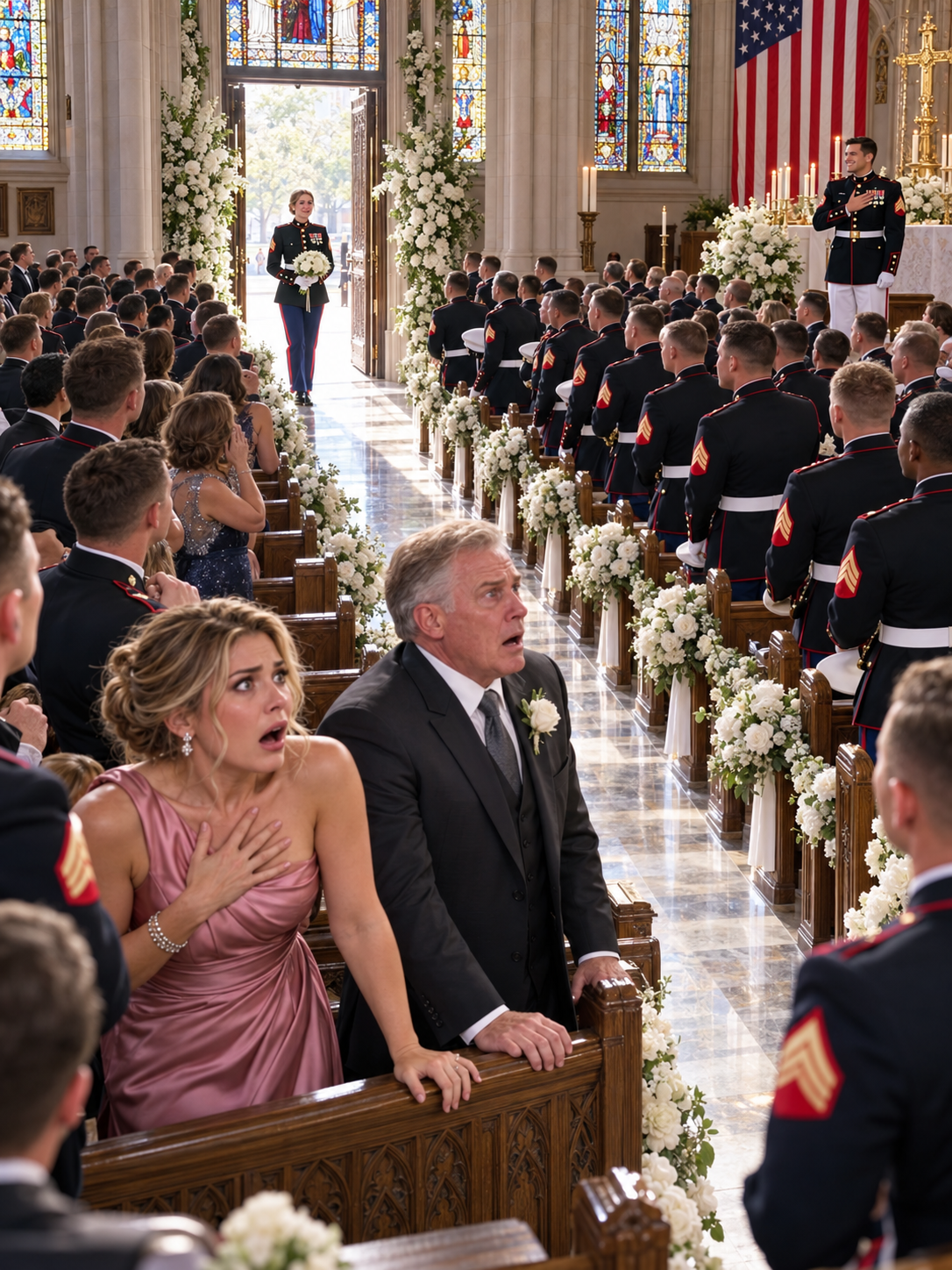
On the morning I was supposed to marry the man I loved, my sister looked at my Marine dress blues and told me I was embarrassing our family because I had never learned how to “be a real woman.” My father backed her before I had even left the bridal room. I almost let thirty years of their voices ruin the happiest day of my life—until the chapel doors opened, hundreds of Marines stood at once, and my sister finally saw the life she had spent years mocking.
### Part 1
“You’re actually wearing that?”
My sister Camille stood in the doorway of the bridal preparation room with one manicured hand still resting on the brass handle, staring at me as though I had shown up to my own wedding in muddy work boots. I had been alone for exactly twelve peaceful minutes, adjusting the collar of my Marine Corps dress blues beneath the cool white lights, and Camille had managed to poison the room before taking three steps inside. Her pale green dress was flawless, her hair looked professionally arranged down to the last strand, and the smile on her face was the same polished smile she had used for most of our lives whenever she wanted cruelty to sound like concern.
Her eyes moved from the rows of ribbons on my chest to the four silver stars on my shoulders, then finally to my face in the mirror. “Rachel, there are almost two hundred civilian guests out there, Dad invited people from his firm, and half the room already thinks this is going to be some kind of military spectacle,” she said, lowering her voice as if sparing me public humiliation. “Can’t you put on the white dress we brought as a backup and just be a woman for one day?”
For a second, I heard nothing except the faint hum of the air-conditioning and the distant scrape of chairs being moved somewhere beyond the chapel walls. Twenty-eight years in the Marine Corps had taught me how to keep my expression controlled while people tried to provoke me, but Camille had spent a lifetime studying exactly where to aim. “I know what I’m wearing,” I said, meeting her eyes through the mirror.
She gave a little laugh. “That’s the problem.”
Then she left.
The door clicked shut instead of slamming, which somehow made it worse, and I stood there staring at my reflection while memories arrived without invitation. I was fifty-two years old, a general, a combat veteran, the creator of a military support program serving tens of thousands of people, and yet one sentence from my sister had managed to turn me back into the nine-year-old girl sitting on her bedroom floor with a broken model airplane in her hands. Camille had always possessed that talent.
When I was nine, I spent nearly a month building a scale model of an F-14 Tomcat for a school aviation project, carefully painting the fuselage at our dining room table after everyone went to bed. The night before I was supposed to present it, Camille reached across my desk, knocked it to the floor, and snapped one wing clean off. She cried before I did, and by the time our mother entered the room, Camille was the one being comforted while I sat silently among pieces of plastic wondering how I had somehow become cruel for looking angry.
By high school, she no longer needed accidents. When I made varsity cross-country earlier than anyone expected, Camille waited until dinner and said, “I’m glad Rachel found something she can do without needing social skills,” and my parents laughed just enough to bury the achievement. Ten minutes later they were discussing Camille’s debate tournament, and I learned another useful lesson: in our family, anything I accomplished could be made small if she found the right sentence.
But what she did during my senior year was different.
I had secretly applied to the Marine Corps Platoon Leaders Class because I already knew what my parents would say. My father, Graham Mercer, was a senior partner at a defense consulting firm in McLean, Virginia, which meant he enjoyed telling people at cocktail parties that he “worked closely with the military” while treating my desire to actually serve as some embarrassing adolescent fixation. My mother worried the Corps would make me unfeminine; Camille simply thought I would fail.
When my acceptance letter arrived while our parents were away at a conference, Camille took it from the mailbox and hid it.
I did not discover the truth for six weeks.
When I finally contacted the recruiter and learned that paperwork had been mailed long before, I searched the house until I found the envelope pushed behind old photo albums in the back of a cabinet. I walked into Camille’s room holding it with both hands, furious enough that I could hear my heartbeat in my ears, while she calmly painted her nails at her vanity. “You took this.”
She never denied it. “I was protecting you,” she said.
“From what?”
“From humiliating yourself.”
That was the moment something inside me changed permanently. I understood that Camille did not hate me; hatred would almost have been easier because hatred acknowledges the other person as real. She had simply created a smaller version of me in her head, a timid younger sister who required her judgment, and every time reality contradicted that version, Camille tried to force me back inside it.
I reapplied the next cycle without telling anyone.
I was accepted.
On a hot Tuesday morning in June, I commissioned as a second lieutenant in the United States Marine Corps, and not one member of my family attended because I never told them when the ceremony was happening. I stood afterward beneath a hard blue sky while new officers hugged parents, girlfriends, brothers, and grandparents, and I remember thinking I should have felt lonely. Instead I felt something I had never felt in my parents’ house.
Free.
My phone buzzed on the bridal vanity, pulling me back to the present.
Dad.
Camille tells me you still refuse to reconsider the uniform. This is the last time I’m asking. Please don’t make today harder than it needs to be.
I read it twice, then placed the phone facedown beside my gloves. My father had called the previous night, supposedly to wish me well, but had spent fifteen minutes explaining how wearing four stars to my wedding might seem “self-important” to clients and acquaintances who were attending. He suggested I listen to Camille because, as he put it, “She understands presentation.”
I had commanded Marines in places where mistakes killed people.
I had testified before congressional committees.
I had made decisions while exhausted, bleeding, terrified, and responsible for people young enough to be my children.
Yet apparently my family still believed the most important thing about me was whether I made their dinner guests comfortable.
I reached for my white dress cover and settled it carefully onto my head. The woman in the mirror no longer looked like the girl whose airplane had been broken or the teenager whose acceptance letter had disappeared; she looked like someone who had spent almost three decades learning that other people’s discomfort was not evidence that she was doing something wrong. I was about to marry a man who had never once asked me to become smaller so he could feel larger.
Then someone knocked.
“Come in.”
The door opened, and retired Gunnery Sergeant Mateo Reyes stepped inside wearing immaculate dress blues. He had more gray in his hair than when we had first served together, but the steady expression had not changed, and behind him stood Major Elise Warren, Captain Jonah Pike, and several Marines I recognized from different chapters of my career. “Ma’am,” Reyes said, and something about his voice immediately told me there was more happening outside than anyone had bothered to mention.
I glanced past his shoulder.
The vestibule was crowded with midnight blue, scarlet, white covers, medals, and familiar faces stretching farther than I could see.
“How many people are out there?” I asked.
Reyes smiled.
“More than your sister planned for.”
And for the first time that morning, I forgot all about Camille.
### Part 2
I met Mateo Reyes sixteen years before my wedding in a place where the air always smelled like dust, diesel fuel, and burned trash.
Afghanistan had a way of stripping every decorative idea a person held about leadership down to the bone. My Marines did not care where I had gone to college, whether my father owned an expensive house in Virginia, or whether I could give a beautiful speech; they cared whether I knew my job when something went wrong. Most of them were barely old enough to rent a car back home, yet they carried responsibilities that would have crushed many people twice their age.
Reyes was a gunnery sergeant then, and he did not trust me immediately.
I respected him for that.
Trust in a combat unit is too expensive to give away because somebody has rank sewn onto a collar. I had earned pieces of it years earlier during an exercise in the Mojave when a vehicle died in a dry wash and a training scenario turned chaotic, and I took over communications long enough to reorganize the convoy before our notional enemy closed the route. The battalion commander gave me six words afterward—“Good call last night, Captain Mercer”—and I lived on those six words for months.
Afghanistan was different.
One October night, our unit moved through a compound outside a district center when part of a mud-brick structure collapsed during an operation, trapping four Marines beneath unstable debris. There were indications of another danger somewhere under the rubble, which meant every instinct screaming at us to rush forward had to be controlled. Reyes was already at the opening when I arrived, keeping younger Marines back while trying to organize the extraction.
He needed more hands and fewer opinions.
So I took over the outer cordon and communications while he managed the breach, then moved in when the rescue team needed another person. Dust filled my mouth until I could taste grit between my teeth, my shoulder slammed against broken masonry hard enough to leave me numb, and somewhere inside the wreckage a young lance corporal kept asking whether his leg was still there. We spent thirty-seven minutes bringing them out.
All four survived.
When the last Marine reached open air, Reyes turned toward me in the darkness. His face was gray with dust, his eyes red, and for several seconds he only stared. Then he nodded once and said, “Oorah, Captain.”
That was it.
But I knew what he meant.
Years later, after promotions carried me farther from field commands and deeper into offices, budgets, and political meetings, that night remained one of the standards I used to judge every decision I made. Leadership was not the speech after the danger ended. Leadership was deciding who you were while the building was still coming down.
My family never understood that distinction.
Dad attended business dinners with generals and admirals and could explain procurement policy to anyone within listening distance, but he missed nearly every promotion ceremony I had. When I became a colonel, he sent flowers to the wrong office. When I received my first star, Camille posted a photograph of herself online congratulating “my tough little sister” and used the announcement to write three paragraphs about how worried she had always been that military life would make me emotionally unavailable.
The higher I rose, the smaller they tried to describe me.
Oddly, that became less painful once I met Evan Cole.
Evan worked as a civilian data systems analyst supporting the Department of Defense, and the first time we met, he spent twenty minutes asking whether my veteran support pilot was collecting the wrong metrics. He never mentioned my rank, never told me serving under a female general must be “interesting,” and never seemed remotely impressed by people whose biographies impressed everyone else. He wanted to know whether the system worked.
I liked him immediately.
I had begun that program because of Staff Sergeant Nolan Price.
Nolan had deployed four times before leaving active service, and when I met him at a diner near the Navy Yard, his coffee sat untouched while his hands moved constantly around the paper cup. He told me he had been passed from office to office, given appointments weeks away, and made to repeat the most painful parts of his life to strangers who seemed more interested in completing forms than understanding him. I listened for almost three hours.
Seven months later, Nolan died.
His mother mailed me a copy of part of the note he left behind, and one sentence stayed with me: General Mercer was the only person who sat down and never looked at the clock.
I read those words alone at two in the morning.
Then I got angry.
Not the hot anger Camille had been able to provoke when we were young, but the cold kind that can become useful if you know where to put it. I built what became Project Haven, beginning with donated office space, my own money, several veteran counselors, and enough bureaucratic stubbornness to make half the Pentagon hate seeing my name on meeting agendas. We created confidential support lines, peer networks, embedded specialists, and ways for veterans to reach human beings before despair became an emergency.
Within four years, Project Haven had federal funding and tens of thousands of people using its services.
That was when Evan and I began working late together.
He found problems in my data system that no one else had noticed, and I discovered he always brought two coffees to meetings even though I had never told him how I took mine. We dated quietly because neither of us wanted our relationship becoming office entertainment, and he proposed on a Thursday night in our Arlington kitchen while pasta water boiled over behind him. There was flour on his sleeve because he had attempted homemade bread and failed spectacularly.
“I think we should get married,” he said.
I laughed. “Is that the proposal?”
“I had a longer version.”
“What happened to it?”
“I forgot it when you walked in.”
So I kissed him and said yes.
Camille learned about our engagement three days later and posted a long message online about how happy she was that her “commanding, fiercely independent little sister” had finally allowed herself to experience softness. She wrote that she hoped I would give myself permission to be “a bride rather than a general” on the wedding day. The wording sounded supportive unless you knew her.
Thousands of strangers apparently thought they did.
Comments appeared calling me masculine, cold, intimidating, and obsessed with rank. I refused to argue with people who had never met me; instead, I posted one photograph of my pressed dress blues hanging on the closet door. Underneath, I wrote: This is what I am wearing.
Something unexpected happened.
Female service members began posting wedding photographs in their uniforms. Husbands posted pictures of wives who served, mothers shared daughters in dress blues and service uniforms, and veterans I had never met wrote about refusing to treat their careers as something they needed to hide in order to look feminine. Within forty-eight hours, Camille’s original post had been buried beneath a movement she had accidentally created.
The veterans gave it a name.
Iron Bride.
I never asked them to come to my wedding.
I barely realized how many had seen the invitation that circulated privately afterward.
So when I stepped from the preparation room and saw Marines filling the vestibule, my first reaction was confusion. Men and women I had served with twenty years apart stood shoulder to shoulder, some active duty, some retired, some wearing uniforms and others wearing dark suits with miniature medals pinned carefully to their lapels. Through the chapel doors, I could see even more.
I turned toward Reyes.
“You organized this?”
“No, ma’am.”
“Then who did?”
He looked toward the sanctuary.
“You did.”
The words stopped me.
Through the open doors, I saw Camille seated in the front pew beside Dad.
Her face had gone completely still.
And when I finally looked beyond her, I understood why.
There were Marines everywhere.
### Part 3
The chapel could not hold all of them.
They filled the pews behind our invited guests, stood along the walls, crowded the rear vestibule, and continued through the open doors onto the steps outside. Dress blues created a deep midnight pattern beneath the white chapel walls, broken by scarlet trim, medals, ribbons, and the bright reflections from polished buttons. I recognized people from Camp Pendleton, Quantico, Afghanistan, the Pentagon, and Project Haven.
Some had driven through the night.
Some had flown across the country.
One retired master sergeant had come from Arizona with his wife because, as I learned later, I had written a letter to his daughter after she was injured years earlier and he had never forgotten it. A corporal from my final command stood beside a major I had once disciplined severely, both of them smiling at me as if no contradiction existed.
Then Reyes leaned closer.
“Four hundred sixty-three, ma’am.”
I looked at him. “What?”
“Four hundred sixty-three Marines.”
My throat tightened so quickly I could not answer.
At the altar, Evan stood beside the chaplain wearing the charcoal suit we had chosen together on a rainy Saturday in Georgetown. He looked from the crowd to me, his eyes already shining, and gave the smallest shrug as if to say, I didn’t know either. That made me laugh, and once I laughed, the tears came.
Camille was watching.
For years she had treated my career as a strange obsession that required explaining, softening, or apologizing for. Dad had always acted as though uniforms were respectable when worn by people he could invite to corporate dinners but embarrassing when worn by his daughter at family events. Now both of them were sitting inside physical evidence that an entire life existed beyond the version of me they had agreed to believe.
I took one step toward the aisle.
A voice rang from the rear of the chapel.
“GENERAL ON DECK!”
I recognized Major Warren before the echo had finished bouncing from the stone.
The sound that followed still comes back to me in dreams.
Four hundred sixty-three Marines rose almost as one.
Shoes struck the floor, bodies straightened, shoulders squared, and then hundreds of hands lifted in salute with such precision that the motion seemed to move through the chapel like a single wave. Outside the open doors, the Marines on the steps did the same.
No music played.
Nobody spoke.
I had been saluted thousands of times.
I had walked into command centers, ceremonies, briefings, formations, and official events where courtesy required exactly that gesture. But no regulation required anyone to spend their own money traveling to my wedding, and no order had placed those people in that chapel. They were there because they had decided to be there.
I pressed my lips together and tried to breathe.
Then I saw Dad.
He was not looking at me.
He was looking around the room, slowly, as though trying to calculate something that could not fit into numbers.
Camille looked smaller than I had ever seen her.
Not physically.
The difference was harder to describe.
For most of our lives, she had walked into every room already certain she understood everyone’s place inside it. She knew who mattered, who was impressive, who was awkward, who needed advice, who belonged in the center, and who should be moved toward the edge. Now she sat motionless while 463 people contradicted the story she had been telling about me since childhood.
I returned the salute.
Hundreds of hands lowered.
Then I started walking.
The aisle seemed impossibly long, and every few steps I recognized another face. Sergeant Major Lewis, who had argued with me so fiercely during a reorganization that we once cleared an entire conference room; Captain Monroe, who had been a frightened second lieutenant the first time I met her; retired Lance Corporal Santos, one of the four Marines pulled from the rubble years earlier.
Santos caught my eye.
He touched two fingers to his heart.
That nearly broke me.
By the time I reached Evan, I was crying openly, which would have delighted Camille if the circumstances had been different because she had spent half my childhood accusing me of being emotionally defective. Evan took my hands, looked directly into my face, and whispered, “You look exactly right.”
Not beautiful.
Not feminine.
Not impressive.
Exactly right.
That mattered more.
Our vows were the same ones we had written at our kitchen table with two mugs of coffee going cold between us. We promised honesty without cruelty, loyalty without possession, and patience when either of us came home carrying something the other person could not fix. Evan promised to be my most reliable ally in every campaign life gave us, and I promised never to mistake independence for having to carry everything alone.
When the chaplain pronounced us married, applause exploded through the chapel.
I kissed my husband while several Marines whistled loudly enough to scandalize the older relatives in the front rows. Even the chaplain laughed. For the first time that morning, I stopped wondering what Camille thought.
Outside, a group of officers formed a saber arch.
Sunlight flashed along the blades as Evan and I stepped beneath them, and the September air smelled faintly of cut grass and jet fuel from the nearby airfield. Cameras clicked, Marines shouted congratulations, and someone behind me yelled that Evan had better understand the chain of command at home.
He called back, “I was briefed!”
That got the biggest laugh of the afternoon.
The reception was held in a large event space on the installation, with long tables instead of delicate rented furniture and enough food to feed what had suddenly become a much larger gathering than expected. People rotated through stories from different eras of my career, and I learned that half the moments they remembered were moments I had forgotten.
A young sergeant named Lily Chen approached while I was holding a plate I had not managed to eat from for twenty minutes. She told me that two years earlier she had considered leaving the Corps because she was exhausted from feeling as though every mistake confirmed somebody else’s opinion about women in her field. “You came to our unit and said, ‘You are not required to be perfect to justify being here,’” she told me. “I wrote it inside my notebook.”
I did not remember saying it.
She did.
That realization followed me throughout the room.
People carry pieces of us we never know we gave them.
Reyes delivered the final formal toast before dinner.
He told the story of the collapsed building without turning it into mythology, which was exactly like him. He talked about fear, confusion, young Marines doing their jobs, and a captain who had enough sense to listen when her gunnery sergeant told her what he needed. Then he lifted his glass toward me.
“She never asked whether the Marines under her were worth going back for,” he said. “So none of us had to ask whether she was worth showing up for today.”
I could not answer that.
Evan squeezed my hand beneath the table.
Across the room, Dad stared into his drink.
Camille did not touch hers.
Hours later, as the noise softened and guests began drifting outside, I stepped toward an open hangar door for a minute of cool air. I had barely reached the threshold when I heard Camille’s heels approaching behind me. The runway lights blinked beyond the darkness, and for several seconds neither of us spoke.
Then my sister said something I had never heard from her before.
“I think I was wrong.”
I turned around.
And for once, Camille was not smiling.
### Part 4
Camille stood with both arms folded tightly across her waist, but the gesture did not look defensive so much as uncertain.
“I didn’t know,” she said.
“Didn’t know what?”
She glanced toward the reception behind us, where Marines were laughing, clearing plates, and telling stories as Evan helped an elderly retired colonel locate his coat. “That it was like this.”
I waited.
“That they felt that way about you.”
There it was.
Not an apology.
Not yet.
Still, it was closer to honesty than anything she had given me in decades.
“You thought they were pretending?” I asked.
Camille winced. “I thought rank made people act a certain way around you.”
“Rank does.”
She looked confused.
“But rank didn’t bring them here.”
Her eyes dropped.
For once, I did not rescue her from the silence.
That was another habit our family had taught me to break.
Whenever Camille crossed a line, somebody else rushed to make the aftermath comfortable for her. Mom explained her intentions, Dad told me to stop holding grudges, and I was expected to accept the smallest gesture because preserving family peace was apparently the responsibility of the person who had been hurt.
Camille rubbed her thumb across one fingernail. “Dad told me I embarrassed him today.”
I nearly laughed.
“He said I should have kept my mouth shut this morning,” she continued. “And for the first time, I thought maybe he was right.”
“That’s not why you were wrong.”
Her head lifted.
“You weren’t wrong because Dad disliked the result,” I said. “You were wrong when you hid my acceptance letter. You were wrong every time you turned an accomplishment into a joke. You were wrong this morning before a single Marine stood up.”
Camille’s eyes filled, and I felt the old reflex asking me to soften.
I ignored it.
“I thought I was protecting you back then,” she whispered.
“No. You were protecting the version of me that made you comfortable.”
She flinched.
I had imagined conversations like that before, usually while angry, and in those imaginary versions I delivered some devastating speech that left her speechless. Reality felt quieter. There was no rush of victory, only the exhaustion of finally saying something I should not have needed thirty years to explain.
Camille looked back toward the room.
“They didn’t stand because of the stars, did they?”
“No.”
“Why did they stand?”
I thought about Santos beneath the rubble, Nolan’s note, Lily Chen’s notebook, Reyes coming to the bridal room, and hundreds of people spending money and time simply to be present.
“They stood for what those stars are supposed to mean when you earn them correctly.”
She nodded.
“I’m sorry, Rachel.”
The words were so unexpected that I studied her face, searching for the performance I had learned to detect as a child. Maybe part of it was performance; Camille had practiced presentation for most of her life, and nobody becomes emotionally honest in one evening. But beneath the polished expression I saw something real enough to acknowledge.
“Thank you for saying it.”
She waited.
I knew what she wanted.
Forgiveness had always been treated in our family as a door that automatically reopened the house behind it.
I was done with that definition.
“I believe you regret what happened today,” I said. “But I’m not going to pretend today erased everything before it.”
Her lips parted.
“We can be civil,” I continued. “We can see whether something different is possible eventually. But you don’t get the old access to my life just because you finally understand that I had value all along.”
She cried then.
Quietly.
I did not hug her.
That may sound cruel to people who believe every family story requires reconciliation, but I had spent too much of my life confusing compassion with surrender. Camille was allowed to feel grief for the relationship she had damaged. I was not obligated to remove the consequence so she would stop feeling it.
She left a few minutes later.
Evan found me still standing near the door.
“How are you doing?” he asked.
“Strange.”
“Good strange or bad strange?”
“I thought this would feel like winning.”
He leaned against the metal frame beside me. “You didn’t win.”
I looked at him.
“You finally stopped fighting for their permission.”
That sentence followed me longer than anything else said at the wedding.
My father did not apologize that night.
He came to our table once before leaving, kissed my cheek stiffly, shook Evan’s hand, and said the ceremony had been “quite something.” I smiled because I understood him well enough to know that his entire belief system had been hit by a truck and he was trying to describe the license plate.
Our marriage began without the dramatic family reconciliation relatives apparently expected.
Camille and I spoke occasionally.
I stopped answering her calls whenever conversations turned toward her feelings about my boundaries. She invited us to holidays, and sometimes we attended; other times Evan and I stayed home, cooked too much food, and watched terrible action movies while our phones remained in another room.
It was peaceful.
Project Haven grew.
Federal funding expanded, military branches adopted versions of our peer-support network, and allied nations sent teams to study the model. I traveled constantly for several years, meeting counselors, veteran groups, commanders, spouses, and people who pointed out flaws in our system with the confidence of those living inside the problems.
I learned to listen before defending what I had built.
That became one of the most important lessons of my later career.
When I testified before the Senate Armed Services Committee, Nolan Price’s mother sat in the gallery wearing a dark blue jacket and holding one of her son’s old unit pins between two fingers. I spoke his name publicly because I did not want our success to turn him into an anonymous statistic. My voice nearly broke once, but I kept going.
Afterward, his mother hugged me in the hallway.
“He would have been proud,” she whispered.
“I wish he were here to criticize it,” I answered.
She laughed through tears.
“That sounds like him.”
Dad watched the hearing on television.
I knew because he texted me afterward.
Powerful testimony. Proud of you.
I stared at those four words for a long time.
Once, I would have saved them.
Instead I replied, Thank you.
Nothing more.
Years passed, and the stars on my shoulders began feeling heavier in ways rank never had before. Younger officers came into meetings with ideas I had not considered, and I started recognizing the danger every senior leader faces: confusing experience with ownership. I knew eventually I would need to leave before the organization became something I refused to let other people inherit.
My retirement date was set for April.
A week before the ceremony, Camille called.
“I want to come,” she said.
“You’re invited.”
“And Dad?”
“He’s invited too.”
She hesitated.
“Are you ever going to forgive us?”
I looked through my office window at the evening light over Washington.
“I already stopped carrying the anger every day.”
“That’s not what I asked.”
“I know.”
Silence.
Then I told her the truth.
“Forgiveness and restoration are not the same thing.”
She did not argue.
And when we hung up, I realized that was the first real evidence she might finally be changing.
### Part 5
I retired on a clear Thursday afternoon in April.
The ceremony took place at Marine Barracks Washington, where red brick, white trim, polished brass, and generations of history surrounded the parade deck. Evan sat in the first row, older than the man who had proposed with pasta boiling over behind him, with more gray in his hair and exactly the same calm eyes.
Reyes attended.
So did Camille.
Dad came too.
When I stepped to the podium, I looked across faces from almost every era of my career and realized retirement ceremonies are strange things because they attempt to compress a lifetime into speeches and plaques. Twenty-eight years becomes a paragraph about assignments. Fear becomes a medal citation.
People become names on a program.
So I ignored most of the prepared remarks.
I talked about people instead.
I talked about young Marines who had taught me that competence could come from someone nineteen years old and terrified. I talked about senior enlisted leaders who corrected me when I was wrong, officers who challenged me when I grew too certain, military spouses who carried burdens no performance report ever measured, and veterans who trusted Project Haven with stories they had barely told themselves.
Then I spoke about Nolan.
“A program does not save people,” I said. “People save people. Programs only decide whether those people can reach each other in time.”
The parade deck was absolutely quiet.
I looked toward his mother.
She nodded.
When the ceremony ended, there were photographs, handshakes, gifts, jokes, and far too many people telling me they expected me to relax in retirement. I informed each of them that Evan had already prepared a list of household repairs he had delayed for years because, in his words, he refused to compete with national defense priorities. That got several laughs.
Camille approached me after the crowd began thinning.
She hugged me gently.
I let her.
That did not mean the past had disappeared.
It meant I no longer needed every boundary to feel like a weapon.
“I’m proud of you,” she said.
“Thank you.”
She drew back and smiled sadly. “I should have said that decades ago.”
“Yes.”
She laughed once through her nose.
“You really aren’t going to make this easier for me, are you?”
“No.”
“Fair.”
That was probably the healthiest conversation we had ever had.
She walked toward the parking area, and my father remained behind.
Dad had aged dramatically during the final years of my service. The powerful executive who once filled rooms with his voice now moved more carefully, his shoulders slightly rounded beneath an expensive jacket. For a while, he only stood beside me watching Marines carry chairs from the parade deck.
Then he said, “I failed you.”
I turned toward him.
The old Dad would have begun with explanations.
I was busy.
Your mother worried.
Camille was persuasive.
I didn’t understand.
Instead he simply repeated it.
“I failed you.”
I waited.
“I thought because I understood the business around the military, I understood your life,” he continued. “I didn’t. Worse than that, I decided I didn’t need to.”
His eyes were wet.
“I missed things I can’t get back.”
“Yes.”
“I was ashamed at your wedding.”
That surprised me.
“Of me?”
“Of myself.”
For years I had imagined wanting those words.
When they finally came, they did not repair the missed promotions, the empty chairs, or the message telling me to change clothes on my wedding morning. But neither did they mean nothing.
“I believe you’re sorry,” I said.
He nodded.
“I am.”
“I’m glad you finally see it.”
He stepped forward uncertainly.
I allowed him to hug me.
It was awkward, short, and sincere.
When we separated, I did not tell him everything was forgiven. I did not promise to become the daughter he suddenly wished he had known better. Some losses remain losses even when everyone finally tells the truth about them.
He seemed to understand.
As he walked away, a young Marine captain approached from the opposite direction.
She was sharp-eyed, perfectly composed, and familiar in a way I could not immediately place. Her name tape read REYES.
“General Mercer?”
I smiled.
“Not for much longer.”
She grinned. “Captain Sofia Reyes, ma’am.”
Then I understood.
“Mateo’s daughter.”
“Yes, ma’am.”
The last time I had seen her, she had been a skinny teenager sitting at a backyard barbecue complaining that her father refused to let her borrow his truck.
Now she stood in front of me wearing captain’s bars.
“My dad told me the Afghanistan story when I was little,” she said. “About the building.”
I glanced toward Reyes across the courtyard.
He was pretending not to watch us.
“I’m sure he exaggerated.”
“He said you would say that.”
That made me laugh.
Sofia grew serious.
“He told me you went inside because you wouldn’t ask Marines to take a risk you weren’t willing to share. I joined because I wanted to know whether I could become that kind of officer.”
Something tightened behind my ribs.
“Your father was the reason those Marines got out.”
“I know.”
She looked down for half a second, then back at me.
“But you were part of the reason he came home believing leadership could look like you.”
There are compliments that make you proud.
Others make you feel responsible.
That one did both.
Sofia told me she had chosen a demanding operational specialty despite several people suggesting a safer career path. She said she had spent years hearing polite versions of the same argument I had heard as a young woman—that certain environments were simply not designed for people like her.
“What did you tell them?” I asked.
Her smile reminded me of her father.
“That sounds like their problem.”
I laughed so loudly Reyes finally gave up pretending not to listen.
I shook Sofia’s hand.
“You’re going to be fine, Captain.”
“Thank you, ma’am.”
“No.”
I held her gaze.
“Make them thank you.”
She walked away smiling.
That evening, Evan had gone ahead to prepare dinner with friends while I drove home alone through Arlington in the last pale light of afternoon. My dress uniform hung in a garment bag behind the passenger seat, and for the first time in almost three decades, there was no next assignment waiting for me.
At a red light, I thought about my wedding.
I remembered Camille standing in the preparation-room doorway asking why I could not be a woman for one day.
I remembered Dad’s text.
I remembered 463 Marines rising.
For years, I had thought that moment was the perfect answer to everything my family had ever said about me. It was dramatic enough to feel like justice: my sister watching hundreds of Marines salute the woman she had spent a lifetime belittling.
But I eventually understood that the salute had never been the revenge.
Neither were the stars.
Neither was the successful program, the congressional testimony, the retirement ceremony, or my father finally admitting he had been wrong.
Those were only moments.
The real answer was the life between them.
It was reapplying after Camille hid my acceptance letter.
It was showing up early when people expected me to fail.
It was crawling into danger because four Marines were still inside.
It was sitting across from Nolan for three hours and refusing to look at the clock.
It was loving Evan without shrinking for him and being loved by someone who never confused strength with the absence of softness.
It was telling Camille that regret did not automatically buy access.
It was hearing my father apologize and realizing I no longer needed his pride to confirm my own.
And it was watching Captain Sofia Reyes walk across a parade deck toward a future she did not need anyone’s permission to claim.
The traffic light changed.
I drove on.
At home, Evan was standing in the driveway because he had apparently been watching for my car.
He opened my door before I could reach for the handle.
“Well?” he asked.
“Well what?”
“How does civilian life feel?”
I considered that.
“Ask me tomorrow.”
He took my hand.
Inside the house, people were laughing, someone had burned the bread, and the smell of garlic drifted through the open kitchen window.
Before following him inside, I looked once at the garment bag hanging behind my seat.
The stars on my shoulders had never made me enough.
Neither had the salute.
I had been enough before any of them.
It simply took me most of my life to stop asking other people to agree.
THE END!
Disclaimer: Our stories are inspired by real-life events but are carefully rewritten for entertainment. Any resemblance to actual people or situations is purely coincidental.

