
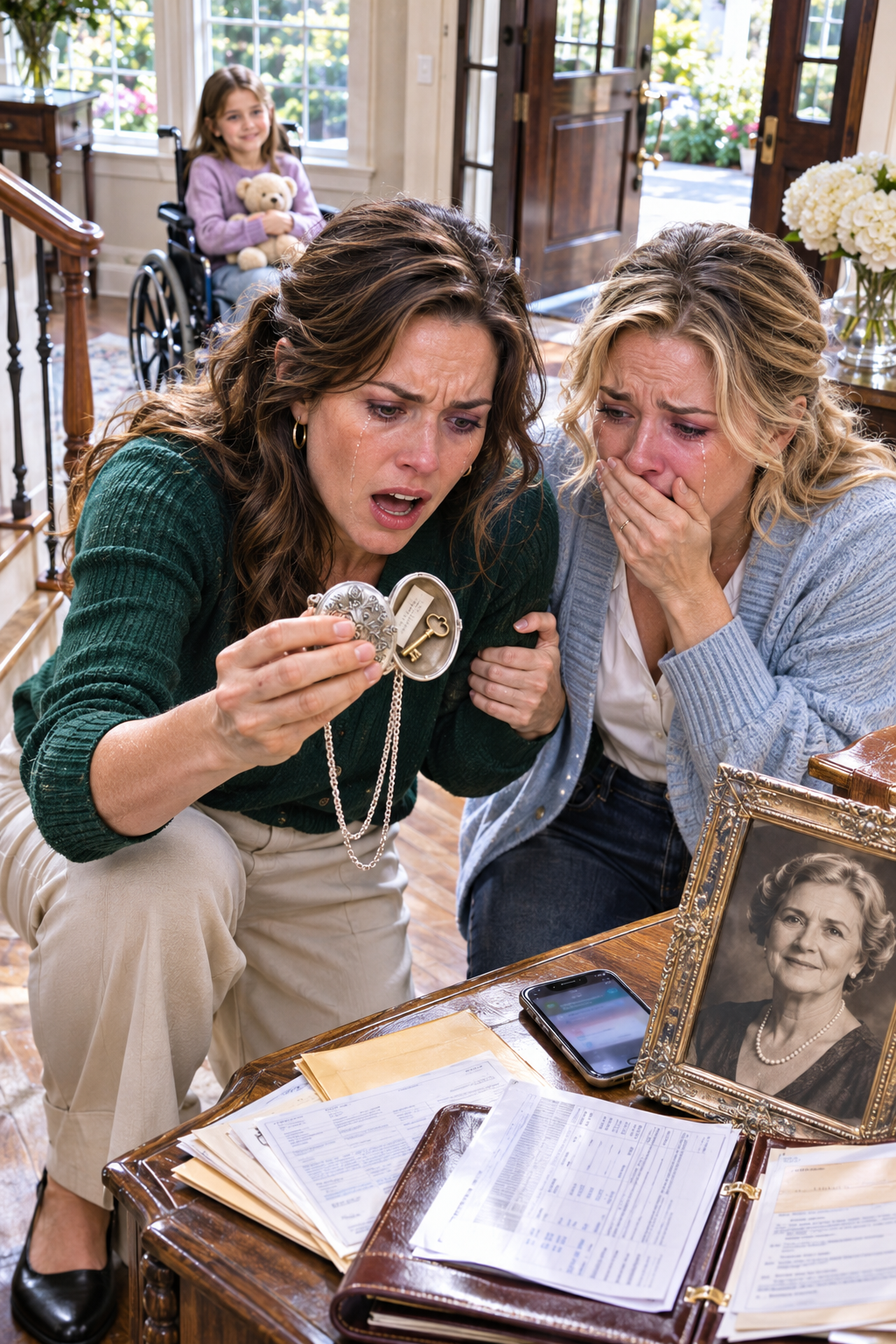
At 2:01 a.m., my sister collapsed at my door, eye swollen, ribs broken, her daughter Khloe waiting in a wheelchair. Before I called 911, Mom texted: “Don’t save that cripple. She made her choice.” Savannah’s husband had stolen money meant for Khloe’s care, and Mom had helped him. Then Khloe handed me Grandma’s silver locket. Hidden inside was a brass bank-box key and a note: “If she ever does to your girls what she did to mine, open Box 214.”
Part 1: One midnight escape exposes a family built on control
I was halfway through a warm beer and a crime-show rerun when somebody started pounding on my apartment door at 2:01 in the morning. It was not the polite knock of a neighbor or the impatient tap of someone who had forgotten a key; it was frantic, uneven, desperate, the sound of a person whose body had run out of options before her fear had. I muted the television and stood in the blue glow of the living room, listening as another blow rattled the frame. Then I heard my name. “Maddie. Please.” I knew the voice before my mind was willing to accept it. Savannah and I had once been inseparable, but adulthood, bad marriages, military assignments, and our mother’s endless talent for turning sisters into opposing witnesses had separated us for years. I crossed the room, looked through the peephole, and forgot every resentment I had ever rehearsed. Savannah was slumped against the wall with blond hair stuck to her face, one eye swollen, her jacket torn near the shoulder, while her daughter Khloe waited beside her in an aging wheelchair with duct tape wrapped around one footrest. Savannah tried to speak when I opened the door, but her knees buckled. I caught her before she hit the floor, dragged her inside, maneuvered Khloe’s chair through the narrow entrance, and locked the door behind us. “You’re safe,” I told them, even though I had no evidence yet that it was true.
Military police training does strange things to fear. Your emotions can be screaming while your hands become precise. I lowered Savannah onto the couch, checked her breathing, found the bruising spreading beneath her shirt, and noticed finger-shaped marks around her forearm. Khloe had not cried once. That frightened me more than tears would have. She sat near the coffee table clutching an old silver locket so tightly the chain had pressed red lines into her fingers. I recognized the engraved flower immediately. It had belonged to Grandma Eileen, who had died six years earlier, and I had not seen it since the funeral. Before I could ask why Khloe had it, my phone vibrated on the kitchen counter. Patricia Blake: Don’t save that cripple. She made her choice. I read the message twice because some cruelty is so cleanly written your brain tries to reject it as a mistake. Savannah whispered, “Don’t call Mom.” I turned the screen facedown. “Wasn’t planning to.” Then I opened my first-aid kit, took one look at Savannah’s ribs, and called 911. She tried to protest until I gave her the voice I used when frightened soldiers needed to understand the discussion had ended. When the dispatcher asked whether the suspected attacker might follow her, Khloe rolled her chair a few inches closer and whispered, “Grandma was there.” Savannah’s face changed. I crouched beside my niece. “Tonight?” She nodded. “Grandma told me not to talk about Kyle.”
At the emergency room, doctors confirmed two cracked ribs, a hairline fracture in Savannah’s right forearm, and bruising that did not match any innocent household accident. A patrol officer waited without pressing while Khloe sat beside me beneath a hospital blanket, still guarding the locket like it contained the only honest thing left in the world. Eventually Savannah gave me enough of the truth to make my anger turn cold. Her husband Kyle had been controlling the disability payments intended for Khloe’s care, funneling them through a household account that had somehow paid for his truck, a fishing trip, Patricia’s kitchen remodel, and other expenses that had nothing to do with their daughter. Patricia had backed him every time Savannah questioned it, insisting her daughter was bad with money and needed a man to manage things. That night Kyle had demanded Savannah sign transfer papers giving him broader control. She refused. He shoved her into the kitchen counter while Patricia sat nearby and treated the violence like an inconvenient argument. Khloe had watched enough to understand what the adults hoped she would later forget. “Grandma said I make everything worse,” she murmured. I told her she did not, but I could see from the way she studied my face that she had heard the opposite too many times to believe me immediately.
The lawyer who arrived before sunrise was Deborah Langley, a family-law attorney with a charcoal suit, exhausted eyes, and no interest in pretending monsters became less dangerous when they shared your last name. A friend from base had called a friend, and Deborah walked into Savannah’s hospital room already asking who controlled which accounts, whether Kyle had threatened custody, and where Savannah could safely go. Before she finished, a nurse delivered an envelope that had been left at reception. Deborah opened it and went completely still. Kyle had already filed for emergency custody of Khloe, claiming Savannah was unstable, financially irresponsible, and incapable of providing adequate care for a child with mobility needs. The supporting witness was Patricia. Our mother had signed a formal statement against her own daughter before the bruises on Savannah’s body had even finished darkening. I expected Savannah to cry. Instead she stared at the document with a terrible calm and said, “I told you. It’s worse than you think.” She was right. The abuse was not just physical. It had paperwork, bank accounts, witnesses, prepared language, and a mother standing behind it.
I slept forty-three minutes in a plastic hospital chair before an unknown number woke me. Kyle did not bother pretending. He told me Savannah was dramatic, warned me to stay in my lane, and said there were things involved that did not belong to me. When I told him Khloe was my family and therefore very much my business, he paused before saying, “Tell the kid to give it back.” Then he disconnected. I looked at Khloe’s fist and finally understood the locket mattered. Savannah remembered Patricia keeping it locked in her vanity after Grandma Eileen died, claiming it had been left specifically to her. When Khloe fell asleep, I examined the hinge and found a hidden plate. Inside was a folded scrap of paper wrapped around a tiny brass key stamped with the name First Lake Bank and the number 214. Grandma’s handwriting filled only two lines: For Maddie or Savannah. Not Patricia. If she ever does to your girls what she did to mine, open Box 214. Even Deborah lost her professional calm for half a second. Whatever our grandmother had feared, she had expected Patricia to lie about it after her death.
We took Savannah and Khloe to my apartment after discharge because imperfect safety was still better than returning them to Kyle. Deborah began preparing a protective order and response to the custody petition while I built a timeline from Savannah’s memories. What emerged was not one terrible night but a pattern stretching backward: doors slammed into Savannah, bruises explained away, money disappearing, Kyle calling Khloe expensive, Patricia insisting a good wife never embarrassed her husband. Eight months earlier, Savannah had supposedly fallen down Patricia’s staircase. I had been stationed in Texas at the time, and Patricia had called first, calmly telling me Savannah had been clumsy and dramatic. Now Khloe whispered, “He pushed.” Savannah stared at her daughter in horror. “Why didn’t you tell me?” Khloe lowered her eyes. “Grandma said if I lied nice enough, Mommy would stop crying.” Deborah began writing immediately. I could barely breathe. Patricia had not simply protected Kyle after the fact; she had taught a child how to preserve his version of reality.
At First Lake Bank, Box 214 opened the past. Inside were sealed letters, bank records, a yellow folder in Grandma Eileen’s handwriting labeled In case Patricia lies, and proof of an $82,000 inheritance Savannah had never received. Patricia had told us Grandma’s estate had been swallowed by medical and funeral debt. The records showed otherwise. Grandma had also left funds specifically intended for Khloe’s care because she did not trust Patricia to put a child’s needs ahead of her own control. My letter said I had never been cold, only careful because childhood had taught me to be. Savannah’s said she had never been weak, only trained to believe keeping the peace was her responsibility. Beneath them lay older evidence showing Patricia had taken money from Savannah long before Kyle entered the picture. On the drive home, Savannah held the folder against her chest and whispered, “She kept me dependent.” I nodded. “That was the point.” When we reached my building, a black SUV idled across the lot and disappeared as soon as I slowed. A handwritten note waited taped to my door: You should have listened to your mother. That was the moment I stopped thinking we were dealing with a chaotic family crisis. Somebody was executing a plan, and they had been practicing for years.
Part 2: Hidden records reveal Patricia helped manufacture Savannah’s helplessness
The next two days became an exhausting cycle of legal filings, police reports, benefit records, hospital documentation, and attempts to separate truth from stories Patricia had repeated so often they had begun appearing inside official files. Deborah secured a temporary protective order while Kyle and Patricia retaliated with anonymous neglect complaints. Police officers arrived at my apartment claiming someone had reported unsafe conditions for Khloe. They found clean counters, medication properly stored, food in the kitchen, batteries charging for the wheelchair, and a child who looked at one officer and said, “This is the safest place I’ve been in a long time.” Child services arrived next. Then another complaint. Then photographs supposedly proving Savannah had lived among mold, spoiled food, and dangerous clutter. Savannah took one look and said the rooms were not hers. Mrs. Allen, an older neighbor who had spent years watching Patricia’s house from across the property line, finally decided that minding her own business had become cowardice. Her doorbell camera showed Patricia entering Savannah’s former home after she fled, carrying garbage bags and bleach. Kyle arrived later with a box. They were not merely lying about conditions. They were staging them.
Khloe provided the next piece without understanding how devastating it was. Late one night she rolled into my kitchen wearing pajamas and told me Patricia had made her practice saying Savannah slept too much and forgot medication. Kyle had told her she was “getting good at helping.” I wrote the words exactly as she said them and sent them to Deborah. By morning the federal side of the case had begun opening wider. Staff Sergeant Hill called to say investigators were reviewing discrepancies in benefit records, and an investigator named Ramos later showed me forms carrying signatures Savannah had never written. Portal access connected to Patricia’s home had been used repeatedly to manage Khloe’s benefits. Kyle had submitted altered materials in his own disability claims. Photographs had been manipulated. Care-consent forms had been forged. The household account was no longer simply suspicious family bookkeeping; it was beginning to look like a deliberate financial scheme. When I returned home, Savannah was sitting rigidly on the couch because child services had come again after receiving another anonymous statement. “They asked Khloe whether I forget to feed her,” she said. There was a half-finished juice box and toast on the table beside crayons. Abuse has a way of invading the smallest ordinary things until breakfast itself feels like evidence.
Then Mrs. Allen offered to testify. She remembered Patricia collecting Savannah’s mail, Kyle ordering her around in the yard, and Patricia complaining in public that Khloe’s wheelchair and medical needs cost too much. Khloe’s physical therapist also had notes from appointments in which the child had asked whether “bad dads can take wheelchairs away” and whether grandmothers were allowed to tell mothers that disabled children were expensive. Deborah looked at the growing binders and told us the other side had finally made the mistake controlling people always make: they had assumed repetition would turn fiction into fact, but repetition also creates patterns. Every staged photograph, every anonymous call, every coached phrase, every altered form now pointed in the same direction. Savannah, meanwhile, had begun reading old medical intake records from injuries she once called accidents. One form said she had refused imaging after the staircase incident. “I didn’t refuse,” she said. “Mom told me the copay was too expensive and signed me out.” Again Patricia had positioned herself at the exact point where the official story was created.
The motive remained harder to understand until Patricia began leaving voicemails. She had stopped denying specific accusations and started speaking about Savannah as though my sister owed her something ancient. “You don’t know what she took from me,” she said in one message. Not money. Not Kyle. Not reputation. Savannah. Deborah and I returned to the old house under deputy supervision to retrieve belongings and documents. In Kyle’s filing cabinet we found a folder of old family papers containing a newspaper clipping about Patricia’s youth, a high-school yearbook, and an unsent letter from Grandma Eileen. One line froze me: Patricia, a husband is not a rescue plan. Stop punishing Savannah because James spoke to her with kindness you never earned. Savannah appeared in the doorway, read it, and finally told me something she had carried since she was fourteen. One evening our father had picked her up because Patricia had forgotten her after choir practice. He bought his hungry daughter dinner and made her laugh in the kitchen. Patricia, drunk and jealous, accused fourteen-year-old Savannah of flirting with her own father and deliberately stealing male attention. Savannah told Grandma Eileen, who confronted Patricia. From that day forward, affection toward Savannah became proof of manipulation in our mother’s mind.
It was so grotesque that part of me wanted another explanation, but once Savannah said it aloud, our childhood rearranged itself around the truth. Patricia had always called Savannah dramatic, seductive, weak, attention-hungry, incapable, ungrateful. She resented Dad’s patience with her. Years later, when Kyle appeared at church and described wanting a “steady” wife, Patricia pushed Savannah toward him and praised the way he kept her “grounded.” Grounded had sounded respectable then. Now it meant watched, dependent, corrected, and small. Kyle had often said, “Your mother warned me how you are,” not after arguments but before them. Patricia had not merely excused his behavior. She had supplied the script that made it feel justified. Savannah had spent years inside a marriage where her husband’s cruelty arrived already validated by the person who had trained her since childhood to distrust her own reactions.
A broken backup phone discovered beneath the porch steps gave us proof that Patricia’s planning had become more deliberate recently. Deleted search history included questions about proving a mother emotionally unstable in custody proceedings, freezing bank lockboxes after death, and removing grandchildren from a parent accused of lying. A draft text said, If Savannah had just stayed in her place none of this would have happened. Captain Reigns reviewed the growing file because Patricia had also complained that I had misused my military position to interfere in civilian finances. I had been careful to keep every search, request, and filing through civilian lawyers, law enforcement, and authorized channels. After reading the evidence, Reigns closed the complaint. “JAG’s done with you,” he said. “No misconduct.” Relief came unexpectedly on my drive home, when I realized Patricia had tried to threaten not just my family relationships but my career, and this time the official record had refused to become whatever story she wanted.
The first emergency hearing gave Savannah temporary physical custody and kept the protective order in place. Patricia arrived in pearls with the face she used at funerals, while Kyle wore a suit and tried to transform violence into an argument that had merely “gotten out of hand.” Mrs. Allen testified about the shouting, the financial control, the mail, and Patricia’s remarks about Khloe being expensive. Deborah walked Kyle through the bank transactions one by one. A fishing charter. Patricia’s kitchen remodel. A resort booking. Each paid from money supposedly managed for Khloe’s needs. “Family expenses,” Kyle insisted until Deborah asked him to show where the money had been repaid. He could not. The judge froze the disputed benefit accounts, denied Kyle’s request for immediate custody, and extended the protective order. It was only temporary, but when we stepped into the hallway Savannah leaned against the wall, trembling with the realization that for once an institution had heard her without Patricia translating.
The retaliation intensified anyway. More complaints arrived. An unfamiliar man called me and threatened my chain of command. Patricia left messages telling me I had always chosen the wrong people—our father, Savannah, anyone who refused her version of loyalty. Yet her language had changed. She did not sound confident anymore. She sounded cornered. Then federal investigators confirmed repeated portal logins from Patricia’s residence, forged signatures, benefit misuse, and falsified supporting documents connected to Kyle. Deborah discovered that Patricia had supplied language for the custody complaints and helped preserve the false staircase story. Even more importantly, investigators began questioning Kyle separately. Savannah understood before I did what pressure might accomplish. “He’ll turn on her,” she said one night. “Kyle never protects anyone once protecting them costs him something.” Three days before the final custody hearing, his attorney called Deborah asking for a “productive conversation.” The structure Patricia had spent years building was beginning to collapse because its two architects no longer trusted each other.
Part 3: Kyle turns on Patricia as the evidence reaches court
Kyle wanted leniency in exchange for information about Patricia. Savannah refused to bargain away consequences for what he had done, but his partial affidavit arrived anyway because federal investigators were already closing in and he apparently understood that silence would not save him. He admitted Patricia helped redirect Khloe’s benefits, coached him on language describing Savannah as emotionally unstable, altered medical forms, encouraged the staircase accident story, and pushed him to pursue custody after Savannah began resisting financial control. The ugliest line was attributed directly to Patricia: Savannah doesn’t deserve to raise the child she used to control her father. Even decades later, our mother was still punishing a grown woman for the fantasy she had invented around a fourteen-year-old girl. Kyle also wrote that Patricia repeatedly warned him, “If Savannah ever gets independent, you’ll lose your place in this house.” Suddenly every apparently separate act—the stolen inheritance, the benefits fraud, the medical paperwork, the custody case, the staged photographs, the marriage itself—formed one continuous system designed to make Savannah incapable of leaving without appearing unstable when she tried.
The final custody hearing took place on a gray Thursday beneath a sky heavy with rain. Local media had learned enough about veteran-benefit fraud and the family dispute to crowd the courthouse entrance, but Khloe stayed safely with Mrs. Allen. Savannah wore simple clothes and no longer carried her injured arm in a brace. That detail affected me more than I expected. The bruises had faded, bones were healing, and she had started moving like a woman whose body belonged to her again. Inside the courtroom, Patricia arrived in navy and pearls, holding herself with the rigid certainty of someone who believed respectable clothing could erase bank records. Kyle looked exhausted. Deborah did not perform. She built. Emergency-room reports established the violence. Photographs established the injuries. Bank statements traced Khloe’s money. Grandma Eileen’s documents established the hidden inheritance and Patricia’s motive. Doorbell footage showed the staging of false living conditions. Child-services logs established retaliatory reporting. Therapist notes supported Khloe’s disclosures. Federal correspondence confirmed an active fraud investigation. Kyle’s affidavit connected Patricia directly to the false narratives. By the time Deborah finished introducing the evidence, Patricia’s story no longer had enough empty space left to survive.
Then Patricia chose to testify. I should have known she would. She had spent her entire life believing language belonged to whoever used it most confidently. She folded her hands and told the judge, “I have only ever acted in my daughter and granddaughter’s best interests.” Deborah began with Khloe. Had Patricia instructed the child to tell adults Savannah forgot medication? Patricia said she had merely “reminded” Khloe that her mother was overwhelmed. Had she made anonymous reports to child services? She had been “concerned.” Had she withheld Savannah’s inheritance? She had been “managing family debt.” On whose authority? Patricia hesitated, then said, “Mine.” The judge stopped writing. Deborah placed Grandma Eileen’s notarized letter in front of her, the one explicitly warning that Patricia should never control money intended for Savannah or Khloe. Patricia dismissed her own dead mother as elderly and sentimental. Then Deborah asked whether Patricia had accused fourteen-year-old Savannah of trying to steal her husband. The courtroom changed. Even Patricia could not polish that question into something respectable. “That is private family pain,” she said finally. “It is relevant family motive,” Deborah answered.
When Savannah took the stand, I expected to hear the woman who had arrived at my apartment apologizing for bleeding on my couch. That woman was gone. Savannah did not exaggerate, excuse, or soften. She explained how Patricia had trained her to believe peace was her responsibility, how Kyle used that conditioning, how financial dependence made leaving feel impossible, and how every attempt to resist was later reframed as proof she was unstable. “My mother taught me that survival meant staying quiet and being grateful for whatever I was given,” she said. “Kyle learned to use that. He hurt me because he believed I would stay. She helped him because my dependence made her feel powerful. I am finished paying either one of them for permission to exist.” Her voice shook only once, when she spoke about Khloe. “My daughter will never grow up believing fear is respect or abuse is love.” Across the aisle, Kyle stared at the table. Patricia stared at Savannah with something colder than anger. She looked betrayed, as if her daughter’s ability to tell the truth were an act of aggression.
The judge ruled after a long silence. Savannah received full physical and legal custody. Kyle was denied unsupervised visitation, with any future contact subject to strict professional review. Patricia was restricted to supervised therapeutic contact only if Savannah herself requested it, which everyone in that room understood might mean never. Khloe’s care funds were ordered into an account solely controlled by Savannah. The protective order became permanent. Financial findings were referred directly to federal authorities. There was no cheering. Real victories rarely feel like the movies. Savannah simply closed her eyes and released a breath she seemed to have been holding since adolescence. Kyle sagged in his chair. Patricia remained perfectly upright, still trying to look like the ruling was temporary because reality had always bent eventually when she refused to acknowledge it.
We had almost reached the courthouse exit when federal agents stepped from a side hallway and called Kyle’s name. Fraud. False statements. Misappropriation of dependent funds. Additional allegations still under review. His attorney immediately began talking, but the agents were not there to negotiate in the corridor. As Kyle was led away, he looked over his shoulder at Patricia. Not at Savannah. Not at me. Patricia. The alliance between them ended in a single glance filled with blame. He had protected her only while protection benefited him. Patricia reached for my arm and asked, “After everything, you’d let them do this to me?” I looked at her hand until she removed it. “You did this to yourself.” Her face tightened. “I’m still your mother.” When I was younger, that sentence could end any argument because she treated motherhood like diplomatic immunity. That morning it sounded weak. “You’re the woman who taught me what I refuse to become,” I said, and walked away while she called my name behind me.
Federal investigators continued working after the custody ruling. Kyle’s exposure expanded to include false disability materials, forged documentation, misuse of funds, and intimidation. He eventually began negotiating a plea, while Patricia remained under investigation because she had spent decades making sure her actions appeared as decisions made by somebody else. Deborah warned us not to confuse a custody victory with the end of retaliation. She was right. Patricia mailed letters. Savannah returned them unopened. She called from unfamiliar numbers. We documented them. She tried sending messages through distant relatives who suddenly wanted to “help everyone heal.” Savannah blocked them. For the first time I watched my sister experience a different kind of strength—not fighting, not explaining, not winning arguments, but refusing to enter them. There was extraordinary power in watching a woman who had been forced to justify every emotion finally discover that “No” could be a complete sentence.
The hidden inheritance was recovered through the estate process and helped Savannah secure a modest accessible townhouse by the end of summer. It had two bedrooms, a ramp at the front, a patch of grass in back, and no history attached to the walls. The first afternoon I carried a box of silverware through the door, Khloe rolled ahead of me and announced, “This is the no-yelling house.” Savannah laughed from the kitchen, and I stopped for a second because I had forgotten what her real laugh sounded like. It did not end with an apology. Over the next several hours we unpacked dishes, medication supplies, school records, books, and the ordinary objects of a life that no longer required permission. Khloe arranged her books by color. Savannah stood in the pantry staring at shelves filled only with food she had bought herself. “No one is going to move things around to make me look messy,” she said. “Nope,” I answered. “No one gets my mail before me.” “Nope.” Her eyes filled. “No one tells Khloe what to practice saying.” I shook my head. Each sentence sounded like a small lock clicking open.
Part 4: A locked door becomes the beginning of their freedom
My reassignment arrived a month later. Training command meant fewer nights in the field and more time teaching young military police officers who still believed regulations alone could protect people from chaos. Captain Reigns approved it without ceremony, then told me I had survived a family disaster without dragging my uniform into places it did not belong. I understood the compliment. Patricia had tried to weaponize my career, my sense of duty, even my instinct to protect Savannah, but the discipline I once considered emotional distance had probably saved us. I had documented instead of retaliated. I had called civilian police instead of playing officer myself. I had brought Deborah in before making financial moves. I had let investigators handle evidence. For years Patricia had described me as cold because I refused to react the way she wanted. Grandma Eileen’s letter had given that trait another name: careful. On my first morning at the new post, I stood beside a wet parade field with coffee and a clipboard while recruits stumbled through formation, and for the first time in months I realized I was thinking about my own day instead of waiting for the next emergency.
Savannah’s recovery happened less cleanly. Safety did not erase memory. She still checked locks twice. Unexpected knocks made her shoulders rise. She sometimes woke convinced Kyle was in the hallway. But fear gradually stopped organizing every decision. She opened an account in her own name, learned every benefit schedule herself, met with financial counselors, chose Khloe’s therapists without asking Patricia whether they were too expensive, and began making ordinary mistakes without interpreting them as proof that somebody else should control her life. Khloe adjusted faster in some ways and slower in others. She loved the ramp because she could reach the front door without help. She hated raised voices on television. She became obsessed with the small tomato plant outside and called the corner beside it her safe spot. One evening Savannah sent me a photograph of her sitting there with the neighbor’s golden retriever, face tilted toward the sun. I saved it immediately. After everything adults had taught that child about danger, I wanted proof that she was also learning the shape of peace.
Kyle eventually accepted a federal plea involving fraud and restitution while separate family restrictions remained in place. Through his attorney he sent Savannah a letter asking for grace, healing, and the possibility of rebuilding some relationship later. Deborah read it in her office and gave a humorless laugh. Savannah did not. She turned the paper over, wrote one word, and handed it back. No. There was no speech about closure because she had finally understood closure did not require the person who hurt you to agree that the door should close. Patricia’s case moved more slowly, but her social world had already begun shrinking. Church acquaintances learned enough to stop treating her as the long-suffering grandmother. Financial investigators reviewed the accounts she had managed. Relatives who once repeated her version of Savannah began remembering details they had dismissed. Patricia responded the only way she knew how: she framed consequences as betrayal.
The week before Thanksgiving, Mrs. Allen called me from across Savannah’s street. Patricia was outside the townhouse carrying a pie and wearing a camel coat, standing on the porch like she could turn herself back into a mother through seasonal baked goods. Savannah had not opened the door. I arrived while Patricia was still demanding five minutes. “She’s my daughter,” she told me. “No,” I said. She blinked. “What do you mean, no?” I stepped between her and the doorway. “I mean being her mother does not give you access to her home.” Patricia’s jaw tightened. “She owes me a conversation.” “She owes you nothing.” For a second the polished performance disappeared and I saw raw rage. “She poisoned you against me.” I almost laughed because even after every document, every witness, every ruling, Patricia still could not imagine a world in which her own choices explained why people left. “You did that yourself.” Her hands shook around the pie box. “Someday you’ll understand what daughters take from mothers.” I looked at her, remembering fourteen-year-old Savannah being punished because our father bought her dinner, remembering stolen money, coached statements, bruises, forged forms, and a child told her medical needs made her expensive. “No,” I said. “Someday you may finally understand what mothers owe daughters.”
She walked away carrying the ruined pie, shoulders held stiff against the cold, and I did not feel triumphant. I felt finished. Inside, Khloe was wearing fleece pajamas and working on a lighthouse puzzle while Savannah stood near the window with wet eyes. “Did she leave?” she asked. “Yes.” Savannah hesitated. “Do you think she’ll come back?” I told her the truth. “Probably. Just not in a way that matters anymore.” That sentence became important over the following months. Patricia might send letters, appear at a relative’s gathering, leave a voicemail, tell another version of history to someone willing to listen. None of that required us to reopen the door. People often describe boundaries as something you announce once and then possess forever, but I learned they are closer to locks. You use them every time somebody tries the handle.
Thanksgiving was imperfect in all the right ways. Savannah worried she had overcooked the turkey. I bought rolls because neither of us trusted her bread experiment. Khloe insisted on saying grace and thanked “the people who help and the people who leave when they’re told,” which nearly made me choke on my water. After dinner I stood at the sink washing dishes while laughter drifted from the living room and wind touched the chimes outside. The townhouse smelled like rosemary, butter, dish soap, and the cinnamon candle Savannah loved. There were no legal folders on the table. No officers at the door. No medical forms waiting for signatures. No one monitoring whether Savannah laughed too loudly. Ordinary life had once seemed boring to me. That night it felt luxurious.
Driving home later, I sat in my truck beneath the apartment lights and remembered the first night clearly enough to feel the cold hallway air again. Savannah collapsing against me. Khloe gripping the locket. Patricia’s message glowing on the kitchen counter: Don’t save that cripple. I sometimes wondered what would have happened if I had obeyed the old family instinct and stayed out of it. There are endless phrases people use to make cowardice sound respectful: It’s between husband and wife. You don’t know the whole story. Family matters should stay private. Don’t make things worse. Patricia had depended on all of them. Kyle had depended on them too. Their system worked only while everybody near Savannah believed silence was more respectable than intervention.
People also talk about forgiveness as though it is the graduation ceremony of healing. I stopped believing that. Forgiveness can be meaningful when someone wants it, but no one should be forced to reopen access simply to prove they have moved on. Kyle wanted grace after consequences became real. Patricia wanted motherhood to erase accountability. Neither wanted reconciliation badly enough to become safe. Savannah did not owe them the performance of peace. Khloe did not owe them another opportunity to frighten her. And I did not owe my mother an unlocked door because we happened to share blood.
A week before Christmas, Khloe handed me a small present wrapped in crooked silver paper. Inside was a metal keychain shaped like a door. “It’s because you answer,” she said. I closed my fingers around it and had to turn away for a second before she noticed how hard the words had hit me. That night I hung the little door beside my keys at home. The apartment was quiet. No pounding against the frame. No unknown car waiting outside. No threatening note beneath the mat. Only the refrigerator humming, pipes shifting inside the wall, and laughter from another apartment somewhere down the hallway.
For years Patricia had taught us that family meant endurance. Grandma Eileen had tried too late to teach us something different. Savannah finally learned it herself, and so did I. Family was not the person demanding that you stay because leaving embarrassed them. It was not someone who controlled your money and called it help, rewrote your memories and called it concern, or demanded forgiveness and called it love. Family was the sister who reached your door when she had nowhere else to go. It was the child whose truth you believed before adults had a chance to edit it. It was the neighbor who stopped minding her own business when silence became complicity. It was the lawyer who documented everything, the investigators who followed the records, and the people who helped build a home where nobody had to rehearse what to say.
Most of all, family was knowing which doors to open and which ones deserved to remain locked.
Peace, I discovered, was much quieter than victory.
After everything we survived, quiet was exactly what we wanted.
THE END!
Disclaimer: Our stories are inspired by real-life events but are carefully rewritten for entertainment. Any resemblance to actual people or situations is purely coincidental.


