
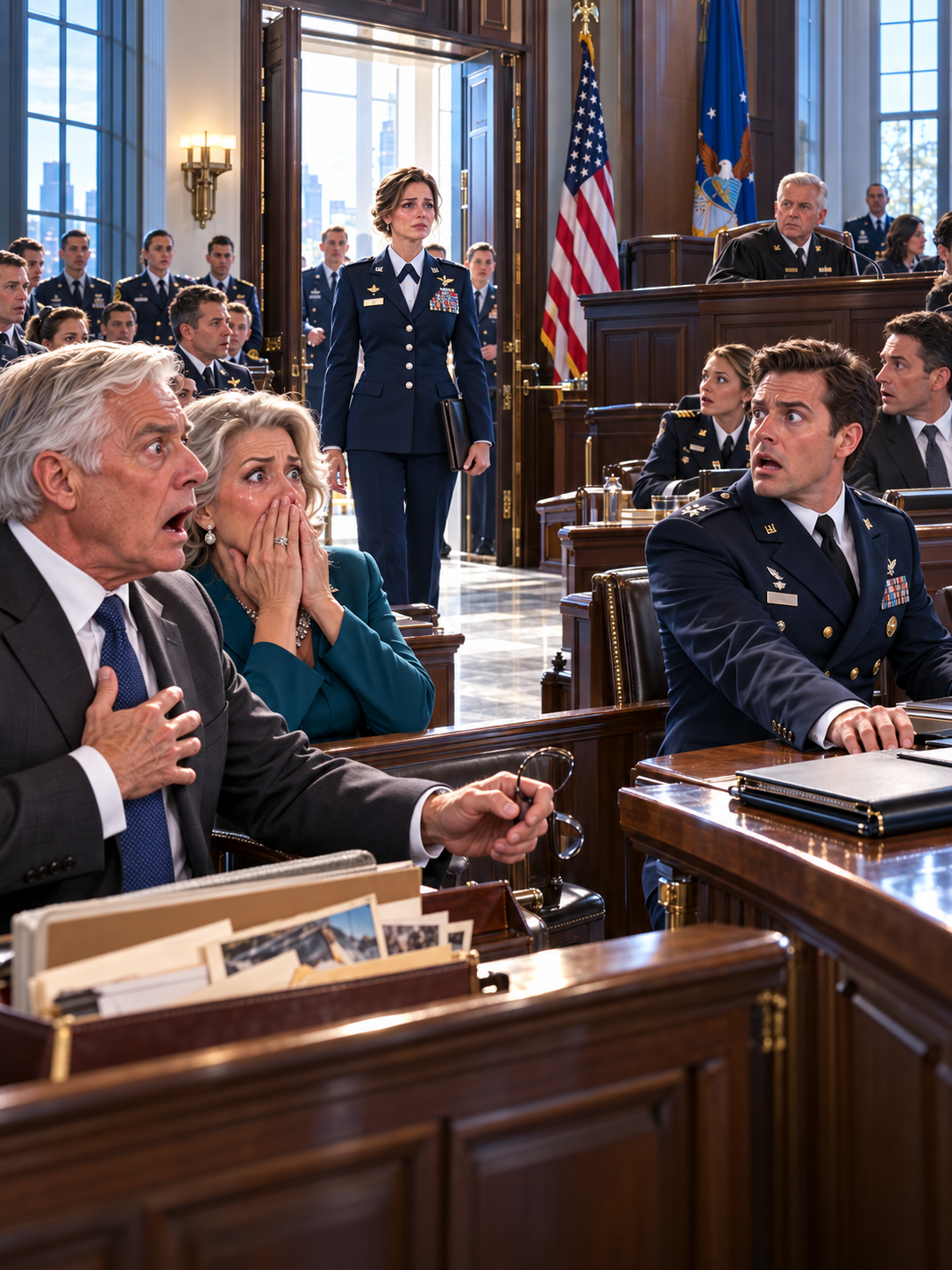
My father’s hands started shaking the moment I walked into my brother’s court-martial wearing fourteen years of Air Force service on my chest. My mother stared at my uniform like she had seen a ghost, because for more than a decade they had believed I failed training, lied about it, and disappeared in shame. I had mailed them proof, invitations, photographs, even my daughter’s birth announcement. They ignored every one. What they didn’t know was that the person who started the lie was sitting at the defense table.
### Part 1
The first thing I noticed when I entered the courtroom was my father’s right hand gripping the back of a wooden bench so hard that his knuckles turned white. He had aged since I last saw him, of course, but not enough to make him unfamiliar; the silver at his temples was new, the deep line between his eyebrows wasn’t, and neither was the habit of clenching his jaw whenever the world presented him with something he didn’t know how to control. His eyes traveled slowly from my face to the silver oak leaves on my shoulders, then to the ribbons on my chest, and finally to the nameplate above my right pocket.
My mother sat beside him with her purse balanced rigidly on her knees. Her mouth opened slightly when she saw me, but no sound came out, and for one strange second I remembered her standing beside my childhood bed every December, whispering that Santa wouldn’t come if I didn’t close my eyes. Fourteen years had passed since I had heard her voice in person, yet some memories ignored calendars.
Then I looked toward the defense table.
My older brother, Grant Mercer, had already seen me.
Something in his expression folded inward. He had always been handsome in the effortless way that made strangers remember him—broad shoulders, easy smile, the kind of face that looked natural in yearbook photographs—but that morning his skin was gray beneath the fluorescent lights, and the moment our eyes met, his shoulders sank. He stared down at the legal pad in front of him and pressed his lips together as if he already knew the uniform my parents were staring at was only the beginning.
I did not walk toward any of them.
I crossed to the row reserved for witnesses and legal personnel, placed my leather folder on the empty seat beside me, and exchanged a quiet greeting with the trial counsel. The American flag behind the military judge barely moved beneath the ventilation system, and somewhere near the back of the room an air conditioner clicked on with the same dull mechanical hum I had heard in a hundred government buildings.
Fourteen years.
That was how long it had taken the truth to put all four of us in the same room.
To understand why my parents looked at a forty-year-old Air Force major as if she had returned from the dead, you have to understand the place where we came from. I grew up outside Sheridan, Wyoming, where the mountains looked blue in the distance and winter mornings smelled like wood smoke, diesel fuel, and frozen dirt. My father, Thomas Mercer, managed the ranch-supply business his father had started, and my mother, Elaine, taught elementary school long enough to educate children whose parents had once sat in the same little desks.
We were not wealthy, but we were comfortable, respected, and painfully predictable. Dinner was at six, church potlucks happened twice a month, the American flag hung from our porch, and my father could tell you exactly which relative had served in Korea, Vietnam, or the Gulf without looking at the photographs in the hallway. Service meant something in our family.
So did reputation.
Grant was four years older than me and seemed born understanding how reputation worked. He was starting quarterback, ran track, dated the student council president, and could make my father laugh even after a twelve-hour workday. At the local diner, men slapped Grant on the shoulder and asked about football while I sat beside him drinking chocolate milk and wondering whether anyone knew I had won the county science competition two weeks earlier.
I never hated him for that. At least, I didn’t think I did.
Grant liked being seen, while I liked being prepared. I ran before sunrise because I enjoyed measuring distance, kept color-coded folders before anyone called that kind of thing productivity, and reread books until I understood why every chapter was where it was. When something frightened me, my instinct was not to retreat from it but to learn its rules.
At seventeen, I began researching the Air Force.
I didn’t want to leave Wyoming because I despised home. I wanted a life where preparation mattered more than charm, where standards were written down, and where being the quiet person in a room did not automatically mean being the least important person in it. By my senior year of college, I had decided to apply for Air Force Officer Training School.
I told my family during dinner one November evening.
My mother lowered her fork. “The Air Force?”
“Yes.”
“As an officer?”
“That’s the plan.”
My father studied me for several seconds while Grant leaned back in his chair. Dad finally nodded and said, “If you commit, Rachel, you finish.”
I remember smiling. “That’s what I intend to do.”
Grant gave a small laugh through his nose. “OTS isn’t a college seminar.”
“I know.”
“They send people home.”
“I know that too.”
He lifted his glass toward me. “Then good luck.”
The words were harmless enough, but the expression behind them stayed with me.
I left the following summer.
Officer training was uncomfortable, exhausting, humiliating in small deliberate ways, and more satisfying than anything I had done before. I learned quickly that competence under pressure looked less heroic than movies suggested; mostly it meant doing simple things correctly when you were hungry, tired, irritated, and being watched. I loved that clarity.
For the first several weeks, letters from home arrived regularly.
Mom wrote about her students, the neighbor’s new fence, and a deer eating her tomatoes. Dad wrote less often, but every envelope contained three or four carefully printed paragraphs ending with some variation of “Keep your head down and do the work.” Grant sent one postcard showing the Bighorn Mountains beneath an orange sunset.
“Hope you’re enjoying military paradise,” he wrote. “Try not to get yourself fired.”
I laughed when I read it.
Then, without warning, the letters stopped.
At first I blamed the mail. Then I blamed everyone being busy. After two weeks I called home during an authorized phone period and got no answer, then tried again the next weekend with the same result.
On the third Sunday, my mother finally picked up.
“Mom?”
There was a pause long enough that I checked the screen to make sure the call had connected.
“Rachel.”
Her voice sounded cautious, almost formal.
“Is everything okay?”
Another pause.
Then she asked, “Why didn’t you tell us?”
A cold pressure settled behind my ribs. “Tell you what?”
“That you left.”
I thought she meant the dormitory, the base, some training location she had misunderstood. “Left where?”
“Training.”
The hallway around me seemed to narrow.
“I’m still in training.”
My mother exhaled quietly.
“Grant said you washed out three weeks ago.”
I gripped the phone tighter. “What?”
“He said you were too embarrassed to tell us. He said you’d asked him not to make a big thing out of it.”
For several seconds, I couldn’t form a sentence.
“Mom, that is not true.”
“He said you didn’t want your father to know.”
“I am standing on an Air Force base right now.”
She went silent.
“I can give you the number for my training squadron,” I continued. “I can send you documentation. I can have someone confirm it.”
“Rachel…”
“Why would Grant tell you that?”
“That’s what your father asked.”
“No. I mean why would Grant tell you something that is completely false?”
Her answer came so softly I almost missed it.
“I don’t know why your brother would lie about something like that.”
That sentence frightened me more than anger would have.
Because underneath it was another sentence she had not spoken.
We believe him.
Before the call ended, my mother said my father was “very disappointed” and needed time. I stood alone afterward beneath the buzzing fluorescent light, listening to footsteps echo from somewhere farther down the corridor.
I told myself it was absurd.
I told myself truth had paperwork, records, phone numbers, witnesses, uniforms, orders.
I told myself I would go home after training, stand on my parents’ porch, and end the misunderstanding in five minutes.
I had no idea that the lie was already more useful to my family than the truth.
### Part 2
My first opportunity to return to Wyoming came the following February. I drove nearly seventeen hours in a used Honda whose heater worked only when it felt charitable, with my dress uniform hanging behind the driver’s seat and a folder of official documents tucked into my overnight bag. The farther north I drove, the more convinced I became that seeing me in person would settle everything.
Sheridan appeared beneath a pale winter sky exactly as I remembered it. Snow sat gray along the curbs, the old feed store sign creaked above Main Street, and the mountains rose beyond town like they had been waiting without me. When I turned onto my parents’ road, my stomach tightened so suddenly that I had to slow the car.
The flag was still hanging from the porch.
I parked beside the split-rail fence and sat there for nearly a minute before getting out.
I had changed into my uniform at a gas station forty miles outside town. It felt ridiculous now, almost theatrical, but I had wanted there to be no ambiguity when my father opened the door. I wanted him to see me and understand before I had to argue.
I knocked.
Footsteps crossed the living room.
My father opened the door only halfway.
For one second, his expression changed. His eyes moved over the uniform, the insignia, the nameplate, and I saw recognition trying to take hold. Then something harder replaced it.
“Rachel.”
“Hi, Dad.”
He did not invite me inside.
I swallowed. “I’m still in.”
His gaze dropped briefly toward my collar.
“Grant said they let you leave for medical reasons.”
“No.”
“He said you were having trouble accepting it.”
I actually laughed once because the alternative was shouting. “Dad, look at me.”
“I am looking.”
“No, you’re looking at the story Grant gave you. Look at me.”
His face tightened.
I pulled the folder from beneath my arm and opened it. “These are my orders. Here’s my military identification. Here are my training records. You can call the base yourself.”
He didn’t reach for any of it.
“Rachel, we don’t have to do this.”
My heartbeat became loud in my ears. “Do what?”
“Keep pretending.”
That word hit harder than I expected.
I stared at him, suddenly aware of cold air moving beneath the cuffs of my uniform trousers and the smell of my mother’s cinnamon candles drifting through the doorway. Somewhere inside the house, a television was playing quietly.
“Where’s Mom?”
“She’s here.”
“Can I speak to her?”
My father glanced behind himself.
That tiny movement answered me before he did.
“She doesn’t think this is a good idea.”
I stood on the porch holding proof of my own life while my mother stayed in the next room.
“Ask her to come to the door.”
“Rachel.”
“Please.”
His expression softened, which somehow made the situation worse. “When you’re ready to be honest about what happened, we’ll be here.”
I felt the last piece of hope inside me change shape.
Not disappear.
Change.
It became something colder and more useful.
“You’re not asking me to be honest,” I said. “You’re asking me to agree with you.”
My father looked away.
I closed the folder.
“All right.”
He seemed surprised. “All right?”
“I understand.”
I walked back to my car before he could decide whether to say anything else. He closed the door quietly behind me, and that soft click followed me all the way down the driveway.
I spent the night at a motel near the interstate. The room smelled faintly of bleach and old carpet, and an ice machine rattled outside my door every twenty minutes. I sat on the edge of the bed wearing the same uniform my father had dismissed as part of a lie and tried to understand how evidence could become irrelevant simply because someone had decided not to examine it.
I cried eventually.
Not dramatically.
I took off my shoes, set them neatly beside the bed, and cried with both hands covering my face because I didn’t know what else to do.
The next morning, I drove back to base.
I tried again twice that year. First I mailed a certified envelope containing copies of documents my father had refused to touch. It came back marked refused, the red postal sticker slanting across my own handwriting.
Then I called my mother’s longtime friend, Marjorie Lane.
She had known me since kindergarten. If anyone could walk into my parents’ kitchen without being treated like an intruder, it was Marjorie. I explained the situation carefully and asked for one thing.
“Tell them you spoke to me. Tell them I’m serving. They don’t even have to call.”
Two weeks later, Marjorie contacted me.
Her voice carried the strained kindness people use when they have bad news that technically belongs to someone else.
“I talked to your father.”
“And?”
“He said he appreciated my concern.”
I waited.
“He said this is a family matter.”
I closed my eyes.
“Did you tell him?”
“Yes.”
“Did he believe you?”
A pause.
“I think believing isn’t the problem.”
That sentence stayed with me.
I began examining the past with a different kind of attention. Grant had always enjoyed winning, but I remembered smaller things now: how irritated he became when my scholarship announcement made the local paper, how he left dinner early the night Dad spent twenty minutes asking about my Air Force application, how he jokingly called me “General Rachel” whenever our parents praised my planning.
Nothing had seemed dangerous at the time.
Jealousy rarely introduces itself as danger.
Sometimes it arrives disguised as a joke everybody forgets except the person making it.
I called Grant directly.
He answered on the fourth ring.
“Rachel?”
“Why did you tell them I washed out?”
Silence.
Then he said, “You should talk to Dad.”
“I did.”
“That didn’t go well?”
“You already know it didn’t.”
He sighed. “Look, maybe everybody needs some space.”
“Grant, answer the question.”
“I heard you were having problems.”
“From whom?”
Another silence.
“People talk.”
“Name one.”
“Why are you making this into some huge investigation?”
My hand tightened around the phone. “Because you told our parents I failed out of the Air Force while I was still in training.”
He said nothing.
“Tell them you were wrong.”
“I’ll talk to Dad.”
“Today.”
“I said I’ll handle it.”
He never did.
Three days later, my mother stopped answering my calls entirely.
That was the moment I finally understood I could spend years dragging proof to people who had already decided what counted as proof. My father’s pride had joined hands with Grant’s lie, and my mother had chosen the easier side of the argument because confronting either man would have required admitting what she had allowed.
So I stopped trying to convince them.
I did not stop caring.
That distinction mattered.
Every birthday and Christmas, I mailed a card. I used my real return address every time—Colorado, Texas, Virginia, wherever the Air Force sent me. I sent them because I wanted one clean fact left between us: I had never disappeared.
They had simply stopped looking.
Two years after that winter afternoon on my parents’ porch, I received a Christmas card from Marjorie. Beneath a photograph of her grandchildren, she had written one sentence by hand.
“Your mother asks about you when your father isn’t around.”
I stared at it for a long time.
Then I turned the card over and wrote down a question I would not fully understand until years later.
If my mother knew enough to ask, what else did she already know?
### Part 3
The Air Force has a way of making time measurable. Assignments, evaluations, exercises, promotions, relocations—years that might otherwise blur together become associated with buildings, units, weather, and the exact location of your desk when certain phone calls arrived. While my family preserved an imaginary version of my failure in Wyoming, my real life kept accumulating evidence.
My first operational assignment was in Colorado, where I worked in logistics readiness and learned how quickly one missing inspection, shipment, signature, or equipment record could become somebody else’s emergency. I liked the work because it rewarded the same part of me my family had always considered overly serious. Details mattered.
A supervisor named Colonel Dana Whitaker noticed that before I did.
During my second year, she returned one of my reports covered in notes. I assumed I had made a disaster of it until I saw that most of her comments were questions about whether I wanted greater responsibility.
“You catch inconsistencies,” she told me. “More important, you don’t panic when you find them.”
I smiled. “Is that rare?”
“Rarer than it should be.”
By the end of that assignment, I was leading projects involving equipment accountability and readiness reporting. I learned how to walk into a room full of people who outranked me, explain that their numbers did not match reality, and do it without turning the conversation into a contest of egos.
It was useful training for more than my career.
I met Noah Bennett during my fourth year of service.
He was a physician assistant assigned to the base clinic, originally from Tennessee, with an alarming devotion to gas-station coffee and a habit of listening all the way through a story before offering an opinion. We first spoke in the cafeteria after I complained to the cashier that the soup looked like it had developed independent political ambitions.
Noah, standing behind me, said, “Give it another hour and it may apply for command.”
I laughed harder than the joke deserved.
Lunch became another lunch, then dinner, then weekend hikes where he carried too much water and I carried too many contingency supplies. He was steady without being dull, kind without needing witnesses, and entirely uninterested in performing masculinity for other men.
On our third real date, I told him the shortened version of my family story.
“My brother told my parents I washed out of training,” I said. “They believed him. It’s complicated.”
Noah looked at me across the restaurant table.
“That sounds lonely.”
I had heard sympathy before. Advice too.
No one had ever named it that simply.
“It was.”
“Is,” he corrected gently.
I looked down at my water glass.
“Sometimes.”
He reached across the table but stopped before touching my hand, leaving the choice to me.
I closed the distance.
We married two years later in a small outdoor ceremony beneath a Colorado sky so blue it looked unreal. My commander attended, Marjorie flew in from Wyoming, and Noah’s parents drove from Tennessee carrying enough homemade food to feed three weddings.
I mailed invitations to my parents and Grant.
I knew better than to expect them, but hope is not rational simply because you recognize it.
The empty chairs did not ruin the day.
That mattered to me.
I married Noah beneath strings of white flowers while wind moved through the grass, and when he looked at me during our vows, there was no absence large enough to compete with what was actually present.
My parents missed it.
That was their decision.
Three years later, our daughter Chloe was born.
She arrived furious at the world, red-faced and loud, then became strangely dignified the moment the nurse wrapped her in a white blanket. Noah cried before I did.
“She has your eyebrows,” he whispered.
“She’s six minutes old.”
“I know what I’m seeing.”
I took a photograph the following morning and mailed a copy to Wyoming.
On the back I wrote, “You have a granddaughter. Her name is Chloe Bennett. She is healthy, she is beautiful, and we are doing well.”
I expected nothing.
Nothing came.
Still, every year I kept sending cards.
Sometimes I wondered whether they went straight into the trash. Sometimes I pictured Mom secretly opening them after Dad went to bed.
Marjorie never gave me direct information after that one Christmas note. She understood without being told that I did not want a spy inside my parents’ house.
My career advanced steadily.
Captain.
Flight commander.
A headquarters assignment.
Professional military education.
Deployments and exercises that taught me the difference between a procedure that looks efficient on paper and one that still works at two in the morning when equipment fails and everyone is tired.
I became particularly interested in inspection integrity because readiness numbers are useless when people treat paperwork as performance. A checked box does not make equipment safe. A signature does not make a test happen.
That principle became the center of several projects I led.
By my eleventh year in uniform, I was promoted to major.
The ceremony took place on a bright Wednesday morning. Noah stood beside me while Chloe, seven years old and wearing shiny shoes she had already complained about six times, sat in the front row.
When the new rank was pinned on, Chloe whispered loudly to the woman beside her, “That’s my mom.”
The room laughed.
I laughed too.
Later that afternoon, I sat outside our house with a cup of coffee cooling beside me while Chloe drew chalk planets on the sidewalk. For no particular reason, I thought about my father.
He would have understood the oak leaf.
He would have understood exactly what it meant.
For a few minutes I imagined mailing him a photograph.
Then I realized I no longer needed to.
I sent one to Marjorie instead.
Life settled into something I trusted. Noah and I argued occasionally about ordinary married things—laundry, schedules, whether he had actually heard me ask him to buy milk—but there was no emotional weather system I had to predict in order to feel safe. Chloe grew into a child who asked relentless questions and assumed, until proven otherwise, that adults were reasonable.
I envied her that.
Then, almost fourteen years after I left Wyoming, an email arrived from an Air Force legal office requesting my availability for consultation regarding an aircraft-support-equipment case.
At first, nothing about it seemed personal.
I had become one of several officers regularly consulted on logistics compliance issues, especially inspection documentation. I opened the attached summary while eating lunch at my desk.
The first page contained the accused service member’s name.
Technical Sergeant Grant Mercer.
I stopped chewing.
For several seconds I simply looked at the screen.
My brother had joined the Air Force.
No one had told me.
The file showed that he had enlisted years after our separation and built what initially looked like a respectable career. Strong early evaluations, technical qualifications, supervisory responsibilities.
Then the pattern changed.
Missed procedural requirements.
Resistance to external checks.
Incomplete records appearing complete after the fact.
The allegation that had triggered the investigation was worse.
Grant had certified mandatory inspections on aircraft ground-support equipment that investigators believed had never been performed.
I read the sentence twice.
Then a third time.
No one had been injured, but that fact brought no comfort. In logistics, you do not measure seriousness only by whether disaster happened. Sometimes the difference between “nothing happened” and “people died” is simply that nobody needed the failed equipment at the wrong moment.
I closed the document and called the legal office.
Before discussing anything substantive, I said, “You need to know the accused is my brother.”
The attorney on the line went quiet.
“You’re certain?”
“Yes.”
“We can use another consultant.”
“You probably should.”
I recused myself from anything involving the investigation or recommendation immediately.
I thought that ended my involvement.
It didn’t.
Two weeks later, the government requested me as an expert witness—not to investigate Grant, not to recommend punishment, but to explain Air Force inspection standards, documentation integrity, and the operational significance of falsely certified equipment checks. The defense was informed of our relationship and challenged my participation.
The military judge reviewed it.
My testimony would be allowed within strict limits.
That evening, I sat at our kitchen table while Chloe worked on math problems at the other end and Noah read the notice twice.
“Your parents could be there,” he said.
“I know.”
“How do you feel about that?”
I looked through the window at the dark outline of our backyard.
“I don’t know yet.”
The hearing date was six weeks away.
Three days before it, Marjorie called me for the first time in almost a year.
“Rachel,” she said, “your parents are driving to the base.”
I closed my eyes.
Then she added something that made the room suddenly feel very quiet.
“They still think you left the Air Force fourteen years ago.”
### Part 4
I spent the three days before Grant’s court-martial preparing for questions about inspection intervals, equipment documentation, supervisory responsibility, and readiness reporting. I did not prepare a speech for my parents.
That was deliberate.
Facts I could organize.
Fourteen years of abandonment did not fit neatly into a binder.
Noah came with me to the hotel near the base but would not be inside the courtroom during my testimony. Chloe stayed with one of our closest friends because I had no intention of introducing her to my parents in a military courthouse between recesses.
The night before the proceeding, Noah found me standing in front of the mirror checking my uniform.
“You’ve adjusted that ribbon rack four times.”
“It was crooked.”
“It wasn’t crooked the last three times.”
I met his eyes in the mirror.
He stepped closer. “You don’t have to prove anything tomorrow.”
“I know.”
“You keep saying that like a person who is absolutely planning to prove something tomorrow.”
I almost smiled.
Then I looked down at the uniform.
“I don’t want them thinking I wore this for them.”
“They won’t be able to know why you wore it.”
“I wear it because it’s my uniform.”
“Then that’s your answer.”
Noah had a talent for stripping drama away from things without minimizing them.
I slept badly.
At 4:47 the next morning, I gave up, showered, dressed, and stood by the hotel window watching maintenance trucks move through the parking lot beneath white security lights. I wondered whether Grant was awake.
I wondered whether he remembered that postcard.
Try not to get yourself fired.
The thought was crueler than I wanted to be, so I let it go.
By seven thirty, I was inside the courthouse meeting with trial counsel. The case was more extensive than the initial summary had suggested.
Grant had not falsified one inspection.
Investigators had identified a pattern across months.
He had supervised a team responsible for equipment checks and, when staffing shortages caused a backlog, had allowed records to show inspections completed before the physical work caught up. At first, his explanation appeared to have been that everything would be corrected quickly.
Then an audit approached.
Instead of reporting the backlog, he doubled down.
More signatures appeared.
More records showed work that had not occurred.
A piece of equipment later failed a routine functional test, exposing the discrepancy before it was used in an operation.
That failure was the loose thread.
Investigators pulled.
The whole thing unraveled.
“What’s his position?” I asked the attorney.
“He disputes intent on some entries. He acknowledges others.”
“So the argument is that he was trying to manage a backlog rather than deceive?”
“Essentially.”
I understood the logic.
I had seen versions of it throughout my career.
People rarely wake up intending to destroy themselves. They make one compromise to survive Tuesday, then another to protect the first one on Wednesday.
By Friday, honesty has become expensive.
That thought made me think of our family.
I hated the comparison.
The prosecution attorney must have noticed something in my face.
“You okay?”
“Yes.”
“If this becomes personal, tell me.”
“It became personal fourteen years ago. My job is making sure it doesn’t affect what I say in there.”
He nodded.
At eight fifteen, the courtroom clerk told us the doors were open.
I was scheduled to testify later, but I had permission to sit in a designated area until called because part of my role involved advising counsel on technical terminology outside the fact-finding portion. I entered carrying my folder against my left side.
That was when I saw my father.
His hands were shaking.
The memory stayed almost unnaturally clear afterward: the shine on the wooden bench, the faint smell of coffee, my mother’s gray wool coat folded beside her, Grant seated at the defense table with his attorney speaking quietly near his shoulder.
Dad saw me first.
His lips parted.
His hand tightened.
Mom followed his stare.
Her entire body went still.
I had imagined this moment once or twice during my twenties. In those imaginary versions, I always felt victorious.
I didn’t.
I felt tired.
Not weak.
Not frightened.
Just tired in the deep way you feel when something you carried for years finally becomes visible to the people who insisted it never existed.
Grant looked up last.
Our eyes met.
His face drained.
The military judge entered before anyone could speak.
Everyone rose.
The proceeding began.
I listened as charges were addressed and witnesses described how the discrepancies had been discovered. Grant’s section chief testified about staffing problems and pressure to maintain readiness numbers. A junior airman described raising concerns about inspections being entered before completion.
Grant’s attorney pushed back carefully.
Was the unit understaffed?
Yes.
Was Grant under pressure?
Yes.
Did equipment failure automatically mean the missing inspection caused the failure?
No.
Was there evidence Grant intended physical harm?
Absolutely not.
It was competent advocacy.
But the case was not about whether Grant wanted someone injured.
It was about whether he knowingly represented required work as completed when it wasn’t.
Near eleven, the prosecution called me.
I stood.
My father’s eyes followed me all the way to the witness stand.
After I was sworn in, trial counsel began with my qualifications.
“Please state your current rank.”
“Major.”
“Current assignment?”
I gave the unit and position.
“How long have you served on active duty?”
“Fourteen years.”
Somewhere behind the prosecution table, my mother made a tiny sound.
Not quite a gasp.
I continued looking forward.
Trial counsel walked through my logistics background, command responsibilities, inspection work, and my role in developing readiness-compliance guidance used across multiple units. Then he asked the question everyone in my family already knew would come.
“Major Bennett, are you related to the accused?”
“Yes.”
“How?”
“He is my older brother.”
“And have you had contact with him during your Air Force career?”
“No meaningful contact for approximately fourteen years.”
The defense attorney rose for cross-examination.
He was professional and direct.
“Major, given your history with my client, would you agree there may be personal feelings involved?”
“Yes.”
“Negative feelings?”
“There are unresolved family issues.”
“Would those issues affect your testimony?”
“No.”
“How can you be certain?”
I looked at him.
“Because the standard does not change based on who signed the form.”
For the first time that morning, Grant looked directly at me.
The attorney turned to another document.
“If a unit is severely understaffed, can inspections fall behind?”
“Yes.”
“Can supervisors face significant pressure to maintain readiness?”
“Yes.”
“So errors can happen?”
“Absolutely.”
He nodded as if he had reached the point he wanted.
I continued before he asked the next question.
“But an error and a false certification are not the same thing.”
The courtroom became very quiet.
He looked at me.
I explained the difference without anger. A missed inspection could be reported. A backlog could be documented. Equipment could be restricted until requirements were met.
What could not happen was converting work that had not occurred into paperwork saying it had.
When I stepped down nearly forty minutes later, I did not look at my parents.
The judge called a recess.
I gathered my folder and walked into the hallway, where sunlight from tall windows cut bright rectangles across the polished floor.
I had taken only six steps when I heard my mother behind me.
“Rachel.”
I stopped.
Her voice broke on my name.
I turned around.
My parents stood together near the courtroom doors, both looking at me as though they were seeing fourteen missing years arranged in human form.
My mother whispered, “You really stayed.”
“Yes.”
My father stared at the oak leaves on my shoulders.
Then he asked the question that told me more than any apology could have.
“What happened to the paperwork you said you sent us?”
I looked at him for several seconds.
“You tell me.”
And for the first time in fourteen years, my father had no story ready.
### Part 5
My mother moved first.
She stepped toward me, stopped, then seemed unsure whether she had the right to close the remaining distance. Her hands hovered near the strap of her purse, fingers opening and closing.
“You’ve been serving all this time?”
“Yes.”
“All fourteen years?”
“Yes.”
She looked at my uniform again.
“What rank did you say?”
“Major.”
Dad cleared his throat. “We heard.”
The old part of me wanted to say something sharp. The adult part understood that cruelty would feel satisfying for approximately three seconds and change nothing.
So I waited.
My father looked down the hallway.
“When you came home that winter…”
“I was an officer trainee.”
“You had papers.”
“Yes.”
“And the identification card.”
“Yes.”
He rubbed a hand across his mouth.
I recognized that gesture from childhood. He did it whenever he discovered he had made a mistake in the business and needed to calculate the cost.
This time the cost was fourteen years.
My mother’s eyes filled.
“Why didn’t you keep trying?”
The question surprised me so much that I stared at her.
“I did.”
“I mean after…”
“After Dad closed the door on me?”
Her face crumpled slightly.
I kept my voice low. “I mailed certified documents. Dad refused them. I asked Marjorie to speak to you. She did. I called Grant. I sent cards every year. I sent you my wedding invitation.”
Mom looked down.
“I sent you Chloe’s photograph the day after she was born.”
My father’s eyes snapped toward me.
“Chloe?”
“My daughter.”
He went pale.
My mother whispered, “We know her name.”
That stopped me.
“You know?”
She nodded.
“We got the picture.”
I looked at Dad.
He did not deny it.
A strange coldness moved through me.
“Then why did nobody answer?”
Mom began crying quietly.
Dad spoke.
“I thought…”
He stopped.
“What?”
His face tightened.
“I thought you were building some story to make us feel guilty.”
I actually stepped back.
“What story?”
“That you’d stayed in. That you had this whole life.”
I stared at him.
He must have heard how absurd it sounded because he closed his eyes briefly.
“Rachel, I know what it sounds like now.”
“No, Dad. I’m trying to understand what it sounded like then.”
He looked at me.
“The return addresses were military installations.”
“I know.”
“The wedding invitation named an Air Force chapel.”
“I know.”
“The photograph of my daughter had a hospital bracelet visible.”
His jaw flexed.
“I know.”
“Then at some point this stopped being about Grant’s lie.”
He said nothing.
“It became your lie.”
My mother covered her mouth.
Dad looked as though I had struck him, but I had only named the thing sitting between us.
Before he could answer, the courtroom doors opened.
Grant stepped into the hallway with his attorney several paces behind him. He saw us together and stopped.
My father turned.
“Grant.”
There was no affection in the way he said it.
No anger either.
Just weight.
Grant walked toward us slowly.
Dad waited until he was close.
“Why?”
Grant’s eyes moved to me.
Then to Mom.
“I don’t think this is the place.”
My father gave a short, humorless laugh. “You had fourteen years to choose a better place.”
Grant looked exhausted.
He rubbed the side of his neck.
He had done that since middle school whenever he was cornered by a truth he disliked.
“It started stupid.”
Nobody spoke.
Grant looked at the floor.
“When Rachel left, every Sunday dinner was about Rachel.”
I felt my stomach tighten.
He continued.
“What was she doing? Had she written? What would her job be? Dad told people at work. Mom told teachers. Everybody in town kept asking how she was doing.”
My mother shook her head.
“That doesn’t explain this.”
“I know.”
Grant looked at me.
“I was twenty-six, stuck in a job I hated, and suddenly my little sister was the interesting Mercer.”
There it was.
Small.
Embarrassing.
Human.
Nothing grand enough to justify the damage.
“So you told them I failed?” I asked.
“I said I’d heard you were struggling.”
“No. You told Mom I washed out.”
His face tightened.
“Yeah.”
“Why?”
“I wanted them to stop talking about you for five minutes.”
My father looked sick.
Grant went on before anyone interrupted.
“I thought you’d come home, show everyone the truth, and I’d say I misunderstood something. I figured it would last a couple weeks.”
I stared at him.
“Then I came home.”
“I know.”
“You watched Dad refuse to believe me.”
“Yes.”
“And you still said nothing.”
Grant looked away.
“I didn’t know how to undo it without admitting what I’d done.”
My mother let out a shaky breath.
“So you let us believe it for fourteen years?”
Grant’s head lifted.
“You let yourselves believe it.”
Dad took a step toward him.
I raised one hand.
“Don’t.”
My father stopped.
Not because I had authority over him.
Because my uniform made the gesture look like one.
Grant saw it too.
For a second, something bitter flickered across his face.
Then it vanished.
“You want to know the worst part?” he asked me.
“I’m not sure there’s a useful ranking system.”
“I joined because of you.”
That caught me off guard.
“What?”
He gave a hollow laugh. “After a few years, Dad stopped talking about how you’d failed and started talking about what you could’ve been. He’d say things like, ‘Rachel had the discipline for military life if she’d stuck with it.’”
I stared at my father.
His face turned gray.
Grant continued.
“I thought if I joined and actually made it, I’d finally own that part of the family story.”
The irony was so complete I almost couldn’t process it.
My brother had invented my failure because he resented my success, then enlisted to compete with the career he insisted I didn’t have.
My mother sat down hard on the hallway bench.
I looked at Grant.
“Did you ever check?”
“Check what?”
“Whether I was still serving.”
His silence answered.
“You knew.”
“I suspected.”
“When?”
He rubbed his neck again.
“After maybe a year.”
My chest tightened.
“How?”
“One of your cards mentioned Colorado. I looked up the base.”
I felt every muscle in my face go still.
“You saw my cards?”
“Sometimes.”
“Dad?”
My father looked at the floor.
“We kept them.”
The hallway seemed to lose sound.
“All of them?” I asked.
Mom nodded.
“Every one.”
I looked from her to Dad.
Fourteen years of birthdays, Christmases, promotions, wedding photographs, Chloe.
“You kept them.”
“Yes,” Dad said.
“And still chose not to call.”
His eyes met mine.
This time there was no pride left in them.
Only the exhausted expression of a man who had finally reached the end of every excuse he had built.
“If I admitted those cards were real,” he said, “I had to admit I’d been wrong from the beginning.”
My mother began crying harder.
Dad’s voice dropped.
“And every year I waited made admitting it worse.”
The courtroom clerk appeared in the doorway.
“Proceedings resume in five minutes.”
Grant’s attorney called his name.
My brother started to turn away.
“Grant.”
He looked back at me.
I had spent years wondering whether I would ever get the chance to ask him one question.
Now that I had it, the question had changed.
“Did you ever plan to tell them?”
He looked at me for a long moment.
“I kept waiting for a time when telling the truth wouldn’t cost me everything.”
The clerk called again.
Grant walked back toward the courtroom.
I watched him disappear through the doors and finally understood the connection between the lie that destroyed our family and the falsified inspections that had destroyed his career.
Every time the truth became expensive, my brother postponed paying for it.
Eventually the bill arrived anyway.
### Part 6
The court-martial resumed with Grant taking the stand during the defense case.
I had not expected that.
His attorney asked questions about staffing, workload, equipment shortages, and the pressure his section had been under during the months when the false inspection entries accumulated. Grant answered quietly and without the confidence I remembered from childhood.
Some of what he described was legitimate.
His shop had been understaffed.
A supervisor had pushed aggressively for readiness numbers.
People had been exhausted.
None of that changed what came next.
“Why did you certify the inspections?” his attorney asked.
Grant stared at his hands.
“At first, because I believed we’d finish them the next day.”
“And when you didn’t?”
“I thought we’d catch up.”
“Did you intend to place anyone in danger?”
“No.”
“Did you believe the equipment was unsafe?”
“No.”
The attorney paused.
“Then why continue making entries?”
Grant swallowed.
“Because once the first records were wrong, reporting the backlog meant reporting what I’d already done.”
The words landed heavily in the courtroom.
I saw my father lower his head.
Grant had just explained his military misconduct with almost the exact logic he had used for our family.
One lie became something he needed another lie to protect.
The prosecutor did not attack him on cross-examination. He didn’t need to.
“You knew the inspections had not occurred?”
“Yes.”
“You signed records indicating they had?”
“Yes.”
“You understood those records informed operational readiness decisions?”
“Yes.”
“And when the audit was announced, you corrected the records?”
Grant hesitated.
“No.”
“You made additional certifications?”
“Yes.”
The prosecutor sat down.
The facts were not dramatic.
They didn’t need to be.
By late afternoon, Grant was found guilty on the central charges involving false official statements and willful dereliction of duty.
The sentencing phase was harder to watch than I expected.
My parents submitted statements about his character. Former supervisors described the capable airman he had once been.
Then a young staff sergeant from Grant’s section spoke.
He said Grant had taught him almost everything he knew when he first arrived at the unit.
“He was good at this job,” the airman said. “That’s why none of us understood why he kept telling us to fix the paperwork later.”
That sentence affected Grant more than anything else.
His head bowed.
The final sentence included reduction in rank, confinement, and a punitive discharge that effectively ended the military career he had once imagined would restore his place in our father’s eyes. The exact legal consequences mattered, but what I remember most was Grant standing straight while they were announced.
He did not argue.
He did not look at me.
When the courtroom finally emptied, I walked outside into sharp afternoon sunlight.
Noah was waiting near my car.
I saw him before he saw me.
That gave me several seconds to watch the person who had spent more than a decade loving me without requiring me to prove I deserved it. Something inside my chest loosened.
He looked up.
“How bad?”
“Bad enough.”
He opened his arms.
I went into them.
For a while I said nothing.
Then I laughed once against his shoulder.
“My family kept every card.”
Noah leaned back.
“What?”
“Fourteen years of them.”
His expression changed slowly.
“And they still…”
“Yes.”
He inhaled through his nose.
Noah almost never spoke badly about my parents because I had never asked him to. That afternoon I watched him choose several sentences and reject each one.
Finally he said, “That’s difficult to defend.”
I laughed again.
“That’s your professional assessment?”
“I’m trying not to make your day worse.”
“You’re doing great.”
My parents found us before we reached the car.
Mom’s eyes were swollen.
Dad looked exhausted.
They stopped several feet away.
Mom looked at Noah.
“You must be Rachel’s husband.”
Noah glanced at me before answering.
“Yes. Noah Bennett.”
“I’m Elaine.”
“I know.”
Mom’s face tightened.
Of course he knew.
They were strangers to him only because they had chosen to be.
Dad extended his hand.
Noah shook it politely.
No warmth.
No hostility.
Just manners.
Then Dad looked at me.
“We’d like to talk.”
“I’ve talked enough today.”
Mom nodded quickly. “Of course.”
“We’re at the Hampton near the highway,” Dad said. “If you change your mind.”
“I won’t tonight.”
He accepted that.
That surprised me.
Mom reached into her purse and pulled out a small piece of paper.
“Our phone numbers are the same.”
I looked at it but did not take it.
“I know.”
Her hand dropped.
For a second I hated myself for the hurt on her face.
Then I remembered a hospital photograph of Chloe crossing half the country to people who had not even acknowledged receiving it.
Compassion did not require self-erasure.
I got into the car with Noah.
We drove several miles before he spoke.
“You okay?”
“No.”
“Good answer.”
I stared through the window.
“I thought seeing them understand would feel better.”
“Why?”
“Because for years I imagined this moment where truth finally arrived and everything clicked into place.”
“And?”
“It clicked.”
“But?”
I looked at him.
“It didn’t give me the years back.”
Noah reached over and rested his hand on my knee.
“No.”
That night my father called.
I almost ignored it.
Then I answered.
“Hello?”
His voice came quietly.
“Rachel.”
“Yes.”
“I owe you an apology.”
I stared at the hotel wall.
“That sentence is a start.”
He took a breath.
“I believed Grant because I trusted him. But that only explains the beginning.”
I said nothing.
“You came home. You showed me evidence. Marjorie talked to us. The cards kept coming. I knew the return addresses were real.”
I closed my eyes.
“At some point,” he continued, “I knew there was a very good chance I had been wrong.”
“A chance?”
He stopped.
Then corrected himself.
“I knew.”
There it was.
I opened my eyes.
“Thank you.”
“For what?”
“For finally saying the real thing.”
His voice broke slightly.
“I was ashamed.”
“You made me pay for your shame.”
“I know.”
“No, Dad. I don’t think you do yet.”
Silence.
I continued.
“You lost fourteen years with me. That was your consequence. But I lost parents. Noah got married without knowing his in-laws. Chloe has grandparents she’s never met. Your pride didn’t stay inside your house.”
“I know.”
“You keep saying that.”
He was silent.
Then he said something I had never heard from my father in my entire life.
“You’re right. I don’t know what it cost you.”
That was the first useful thing he said.
I sat on the edge of the bed.
“What do you want now?”
“To know my daughter.”
“You knew where I was.”
He didn’t answer.
“To know my granddaughter.”
That made my jaw tighten.
“You don’t get to skip over me to Chloe.”
“No.”
“If you ever meet her, it happens because Noah and I decide it is healthy for her.”
“I understand.”
“And meeting her does not mean we’re a family again.”
His breathing changed.
“I understand.”
I looked across the room at Noah, who was pretending not to listen.
“There will be no big reunion, Dad. No pretending these fourteen years were a misunderstanding. Grant lied. You and Mom chose that lie long after the evidence changed.”
“I know.”
This time the words sounded different.
Not defensive.
Not automatic.
Just tired.
Before we ended the call, my father said, “There’s something at home that belongs to you.”
“What?”
He paused.
“A box.”
I waited.
He did not explain.
“I want to bring it to you.”
I almost told him no.
Instead I said, “I’ll think about it.”
Six weeks later, my parents asked if they could drive to Colorado.
I gave them one weekend.
And three conditions.
They would stay at a hotel.
They would not ask Chloe to call them Grandma or Grandpa.
And nobody would use the word forgiveness.
### Part 7
My mother agreed to all three conditions immediately.
My father took several seconds longer.
That told me I had chosen the right conditions.
For the next month, they called once a week. I answered only when I wanted to, and if I was busy, I let the call go to voicemail instead of rearranging my life around the novelty of having parents again.
Our conversations were awkward.
Mom wanted to know everything at once.
“What grade is Chloe in?”
“Fourth.”
“Does she like school?”
“Mostly.”
“What does Noah’s family do at Christmas?”
“We usually alternate years.”
“What was your wedding like?”
That question hurt more than I expected.
“Beautiful.”
She became quiet.
“I’m sorry.”
“I know.”
I did not rescue her from the silence.
Dad asked about my career.
At first his questions irritated me because they carried the same focused interest I had wanted when I was twenty-three.
“What aircraft did your last unit support?”
“What does your current job involve?”
“How many people work under you?”
Eventually I told him, “You don’t need to interview me.”
“I’m trying to catch up.”
“You can’t.”
The words came out sharper than I intended.
He went silent.
I sighed.
“Dad, I’m not saying that to punish you. You cannot turn fourteen years into enough questions.”
“I know.”
“What you can do is know me now, if this continues.”
He absorbed that.
“All right.”
That became the shape of our new relationship.
Not restoration.
Introduction.
I also heard from Grant.
His first letter came two months after the court-martial.
I recognized the handwriting immediately.
For three days I left it unopened on my desk.
Finally Noah asked, “Are you planning to stare it into submission?”
“Possibly.”
“Let me know if it works. I have student loans.”
I opened it.
Grant did not ask for forgiveness.
I appreciated that.
He wrote about the court-martial, the humiliation of having his choices read aloud in formal language, and the strange relief of no longer managing multiple versions of himself.
One paragraph stayed with me.
“I spent most of my life thinking consequences were things other people gave you. Dad punished me. Coaches benched me. The Air Force reduced me. I’m starting to understand that most consequences are just the shape your own decisions eventually take.”
I read that sentence twice.
The old Grant would never have written it.
That did not mean I trusted the new one.
At the end he wrote, “You didn’t ruin my career. I did. I know people may say you testified against me because you hated me. You told the truth about standards. I’m the one who violated them.”
I folded the letter.
Noah looked at me.
“Well?”
“He appears to have encountered self-awareness.”
“Serious condition.”
“Potentially permanent.”
I almost smiled.
I did not write back.
Not then.
My parents arrived on a Friday afternoon in early October.
The day was cool and bright, with that clean Colorado light that makes every leaf look individually outlined. Noah was grilling chicken in the backyard because feeding people gave him something practical to do with his nerves.
Chloe had been told the truth in age-appropriate terms.
“My mom and dad made some bad choices a long time ago,” I explained. “We stopped talking. They want to meet us now.”
She considered that.
“Are they mean?”
“Not exactly.”
“Were they mean to you?”
Children have a brutal talent for reducing adult complexity.
“Yes.”
“Do you like them?”
“I don’t know yet.”
That answer satisfied her more than a fake one would have.
When my parents’ rental car pulled into the driveway, Chloe was practicing cartwheels on the lawn.
She completed one badly, rolled onto her shoulder, popped upright, and brushed grass from her jeans just as my mother stepped out of the car.
Mom froze.
Chloe froze too.
They stared at each other.
My father came around the vehicle holding a medium cardboard box.
For several seconds, nobody moved.
Then Chloe walked forward.
“Are you Rachel’s parents?”
Mom’s eyes immediately filled.
“Yes.”
Chloe pointed at herself.
“I’m Chloe.”
“I know.”
Chloe glanced back at me.
I gave a tiny nod.
Mom crouched slightly, though Chloe was old enough that it wasn’t necessary.
“It’s very nice to meet you.”
“You too.”
Then Chloe noticed the box.
“What’s that?”
Dad looked at me.
“Something that belongs to your mother.”
Chloe accepted this and immediately changed subjects.
“I found a caterpillar.”
My mother blinked.
“A caterpillar?”
“Yes. It might be dead, but Dad says not to assume.”
Noah called from the backyard, “I said it was resting.”
“It’s been resting for six hours.”
My father made a sound that might have been a laugh.
Chloe looked at Mom.
“Do you want to see it?”
Mom glanced at me.
I nodded once.
Chloe took her by the hand and led her toward the garden.
The sight hit me unexpectedly.
My mother walking beside my daughter.
Fourteen years late.
Dad remained near the car holding the box.
“She looks like you,” he said.
“People say that.”
“You used to walk everywhere like you had an appointment.”
I looked at him.
“That sounds like me.”
His mouth moved slightly.
Then he held out the box.
I took it.
It was heavier than I expected.
Inside were envelopes.
Hundreds of them.
Christmas cards.
Birthday cards.
Postcards.
Wedding invitations.
Photographs.
Every piece of mail I had sent to Wyoming.
The edges of some envelopes were soft and worn.
Several had been opened and resealed so many times that the glue no longer held.
I picked up one from my first Colorado assignment.
“You read these.”
Dad nodded.
“All of them.”
“When?”
“At first your mother did.”
“And you?”
He looked toward the backyard.
“Later.”
“How much later?”
“About three years after you left.”
I stared at him.
“So eleven years ago, you were reading letters from an Air Force base written by your daughter describing her Air Force job.”
“Yes.”
“And you still told yourself I wasn’t serving.”
He took a long breath.
“No.”
That answer surprised me.
“No?”
“I stopped believing that.”
My fingers tightened around the envelope.
“When?”
“Years ago.”
The lawn seemed suddenly too bright.
I set the box on the hood of the rental car.
“Then why didn’t you call?”
Dad looked at me.
“I had spent years telling your mother, Grant, Marjorie, everybody, that you were lying. Calling you meant admitting what I had done.”
“That’s the same explanation you already gave me.”
“I know.”
“Say the part you keep avoiding.”
His face changed.
“What part?”
“The part where protecting your pride mattered more than having a daughter.”
He closed his eyes.
When he opened them, he looked older.
“Yes.”
I waited.
He nodded slowly.
“Yes. It did.”
The sentence hurt.
I needed it anyway.
From the backyard, Chloe shouted, “Mom! It moved!”
My mother laughed and cried at the same time.
Dad glanced toward them.
“I don’t expect you to forgive me.”
“Good.”
His eyes returned to mine.
“I mean it.”
“So do I.”
We stood there beside the car.
For years I had imagined that if Dad ever admitted the truth, I would either scream at him or fall into his arms.
I did neither.
I felt sad.
And strangely free.
“I’m not going to spend the rest of my life punishing you,” I said.
Hope flashed across his face.
I raised a hand.
“That is not the same as forgiveness.”
The hope settled into something more realistic.
“I understand.”
“You and Mom can earn a place in our lives from this point forward. Small place. Slowly.”
He nodded.
“And if either of you ever rewrite what happened—if I hear that this was a misunderstanding, or that everybody made mistakes, or that I stayed away because I was stubborn—we’re done.”
“We won’t.”
“Dad.”
He stopped.
“You don’t know yet what you’ll do. That’s why trust takes time.”
He looked down.
“You’re right.”
For once, the words did not cost him fourteen years.
Only a few seconds.
That was progress.
But before the weekend ended, my mother told me something about Grant that made me realize the original lie had one final piece I had never known.
### Part 8
It happened Sunday morning while Noah made pancakes and Chloe argued that chocolate chips technically counted as a breakfast ingredient.
Dad had gone outside to take a phone call.
Mom and I were alone at the kitchen counter.
She was holding one of the old photographs from the box—the picture of me and Noah on our wedding day.
“I looked at this hundreds of times,” she said.
I said nothing.
Her thumb moved carefully along the edge.
“Your brother confessed something else after the court-martial.”
My stomach tightened.
“What?”
Mom stared at the photograph.
“The first time you called from training, before I finally answered, Grant had already talked to us several times.”
“I know that.”
“No. You don’t.”
She looked up.
“He told your father you might contact us pretending you were still on base.”
I frowned.
“Pretending how?”
“He said you were staying with another trainee who had access to base mail and phone numbers. He said you were embarrassed and might keep the story going for a while.”
For several seconds I could only stare at her.
“That doesn’t even make sense.”
“I know.”
“You could have called the base.”
“I know.”
“You could have looked up the number yourselves.”
“I know.”
I felt anger rise, but it was different now.
Older.
Less explosive.
“Why are you telling me this?”
“Because I spent fourteen years saying your father was the stubborn one.”
She folded the photograph into her palms without bending it.
“He was. But I hid behind that.”
I waited.
“I knew something was wrong almost immediately.”
That was the answer to the question I had written on the back of Marjorie’s Christmas card years earlier.
What did my mother know?
Enough.
“I recognized your voice on the phone,” she continued. “You sounded angry, not ashamed. You offered proof. You kept offering proof.”
“But you stayed in the other room when I came home.”
Her eyes filled.
“Yes.”
“Why?”
“Because your father had already committed himself to Grant’s story, and I was afraid if I challenged him, everything in the house would explode.”
I let out a slow breath.
“So you sacrificed me to keep the peace.”
She flinched.
“Yes.”
No defense.
No explanation.
Just yes.
That mattered more than she probably understood.
“I’m sorry,” she said. “Not because I was confused. Not because Grant lied. I’m sorry because I suspected you were telling the truth and chose comfort.”
I looked through the window.
Dad stood near the fence speaking quietly into his phone while Chloe practiced cartwheels several yards away.
“That’s worse than what I thought happened,” I said.
“I know.”
“But it’s the first apology you’ve given me that actually belongs to you.”
Mom began crying.
I did not hug her.
I stayed beside her.
Sometimes kindness is not the same thing as comfort.
Before my parents left that afternoon, Chloe allowed my mother to help braid her hair. Dad and Noah discussed grilling methods with the solemnity of arms-control negotiations.
From across the room, the scene looked almost normal.
I refused to mistake appearance for repair.
That had caused enough trouble in our family already.
At the front door, Mom hugged me after silently asking permission with her eyes.
I let her.
Dad did not try.
He simply said, “Thank you for letting us come.”
“You followed the rules.”
A small smile appeared.
“I can follow instructions occasionally.”
“Develop the habit.”
He laughed.
It was the first time I had heard my father laugh in fourteen years.
After they drove away, Chloe stood beside me on the porch.
“Are they my grandparents now?”
“They’ve always been your grandparents.”
“You know what I mean.”
I looked down at her.
“They’re people we’re getting to know.”
She considered this.
“Grandma cries a lot.”
I laughed.
“She’s had a complicated weekend.”
“Grandpa doesn’t talk much.”
“That part is normal.”
Chloe nodded.
“Can they come back?”
I looked toward the empty road.
“Maybe.”
That became the answer for most things involving my parents.
Maybe.
They returned three months later.
Then six months after that.
We spent one Christmas together, but they stayed at a hotel.
My mother learned not to ask for photographs of every milestone she had missed, because she eventually understood that memories are not museum exhibits she can tour after closing time.
My father stopped trying to learn my entire career in chronological order.
Instead, he began asking about whatever was happening now.
That difference mattered.
Grant and I did not reconcile in any traditional sense.
After his confinement ended, he moved to another state and found civilian work maintaining industrial equipment. He wrote several more letters.
Eventually, I answered one.
Three sentences.
“I received your letters. I believe you understand more now than you did before. I am not ready for a relationship with you, and I may never be.”
He replied once.
“I understand.”
He never pushed again.
That restraint was probably the kindest thing he had ever given me.
Nine months after the court-martial, I attended another promotion ceremony.
Not mine.
One of my captains was pinning on major, and I stood near the front with Noah and Chloe while her family cheered loudly enough to embarrass her.
Afterward, my phone vibrated.
A message from Dad.
“Your mother says today is the anniversary of your major promotion. We missed it then. We’re proud of you now. No reply needed.”
I read it twice.
Then I put the phone away.
I did not cry.
I did not feel healed.
Healing had never been one dramatic moment.
It was my husband making awful coffee in our kitchen.
It was Chloe leaving her backpack in the hallway despite being reminded six hundred times.
It was the people at work who knew exactly who I was without requiring evidence.
It was discovering that the life my parents refused to witness had still been fully real.
The following spring, I finally went through the cardboard box.
I sat on the living room floor while sunlight moved across the carpet and sorted fourteen years of my own handwriting.
Some cards made me laugh.
Some embarrassed me.
A few made me angry all over again.
Then I found the photograph I had mailed after Chloe’s birth.
On the back, in my younger handwriting, were the words:
“You have a granddaughter. Her name is Chloe. I am doing well. I hope you are too.”
I turned the photograph over.
Baby Chloe slept beneath a white blanket, completely unaware that the adults connected to her were already carrying histories she would someday ask about.
Noah sat down beside me.
“You okay?”
“Yeah.”
He looked at the piles of envelopes.
“That’s a lot of mail.”
“Fourteen years.”
He rested his shoulder against mine.
“Going to keep it?”
I thought about that.
Then I placed Chloe’s photograph back in the box.
“Yes.”
Not because the cards proved I had been right.
I no longer needed proof.
I kept them because they documented something more important.
I had reached toward my family long after they stopped reaching toward me.
When continuing to reach became unhealthy, I built a life anyway.
Their disbelief had not stopped my training.
Their absence had not stopped my marriage.
Their silence had not stopped me from becoming a mother.
Their pride had not stopped me from earning my rank.
The woman who walked into Grant’s court-martial wearing fourteen years of service was not there to shock her parents.
She existed because fourteen years earlier, a twenty-something officer trainee had stood outside a closed front door in Wyoming and made a decision.
I could spend my life begging people to believe me.
Or I could live so completely that their belief became irrelevant.
I chose the second.
My parents are part of my life now, but not in the way they once were and never again automatically. They do not receive trust because they are my parents; they receive whatever trust their current choices earn.
I have not forgiven Grant.
Maybe someday I will.
Maybe I won’t.
Forgiveness is not a debt I owe the person who harmed me, and reconciliation is not proof that I have healed.
What I have done is stop carrying him.
That is enough.
Sometimes Dad still looks at my uniform when he visits.
He tries not to make it obvious.
Once, while I was preparing for an official dinner, I caught him studying the ribbons above my pocket.
“What?” I asked.
He shook his head.
“Nothing.”
“Dad.”
He smiled sadly.
“I was just thinking about how much I missed.”
I adjusted my collar.
“A lot.”
“I know.”
There was a time when those words would have enraged me.
Now they were simply true.
I picked up my jacket.
From the hallway, Chloe shouted that Noah was ruining dinner.
Noah shouted back that heating frozen garlic bread did not constitute ruining anything.
Dad laughed.
I walked toward them.
I had spent years imagining that the greatest victory would be forcing my family to admit they were wrong.
It wasn’t.
The victory was realizing their mistake had never determined who I became.
They believed I washed out of the Air Force.
I became a major anyway.
They erased me from their version of the family.
I built one of my own.
And when the truth finally put us in the same room again, wearing silver oak leaves and fourteen years of service across my chest, I did not need revenge, applause, or even forgiveness.
I already had something better.
A life they could finally see.
And one I no longer needed them to validate.
THE END!
Disclaimer: Our stories are inspired by real-life events but are carefully rewritten for entertainment. Any resemblance to actual people or situations is purely coincidental.


