
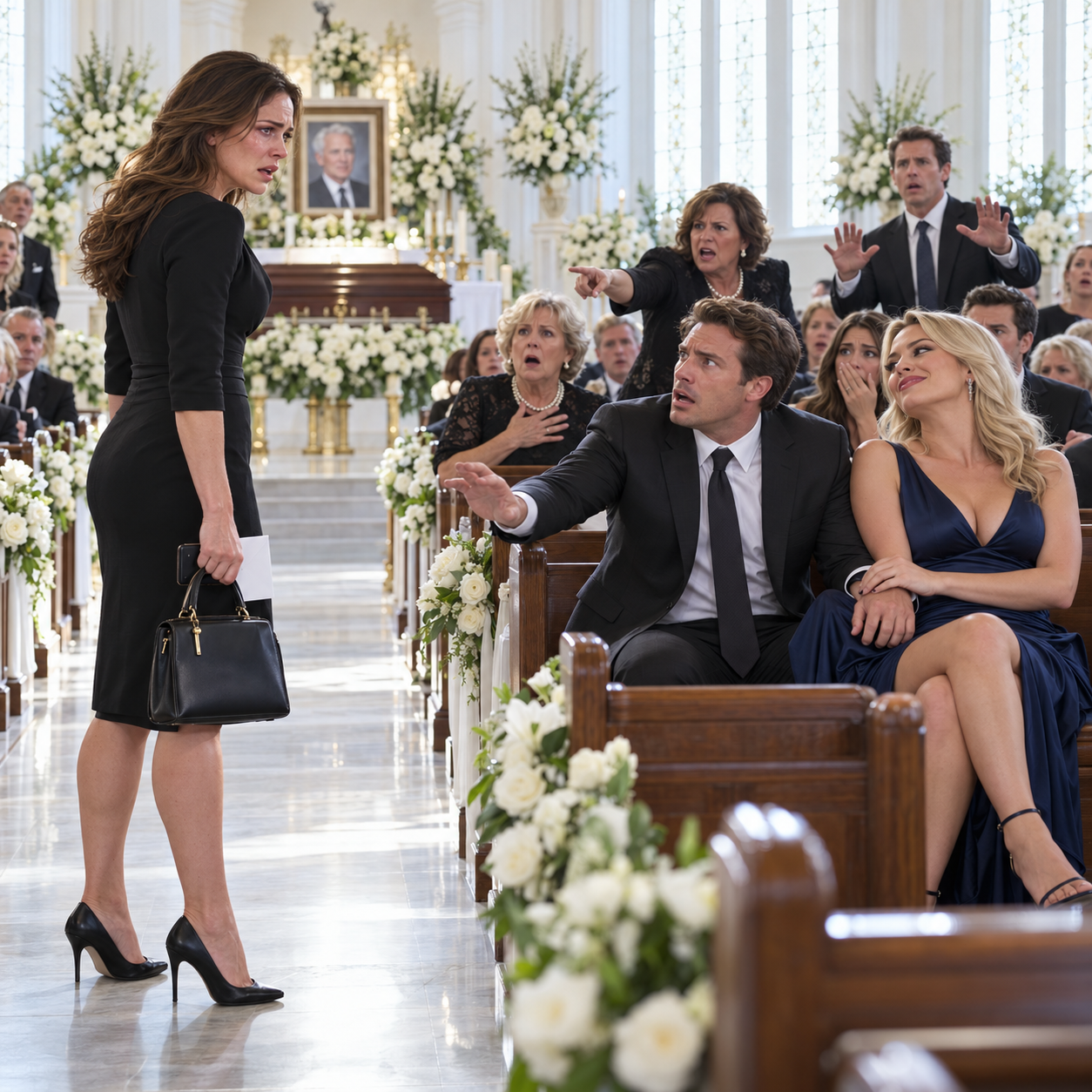
I thought the worst thing waiting for me at my father’s funeral would be the empty space where his voice used to be. Then I walked into the chapel and saw my husband’s mistress sitting in my family’s front row, wearing the midnight-blue Versace dress that had vanished from my closet three weeks earlier. She squeezed my husband’s hand and smiled. “I’m practically family now.” What neither of them knew was that my father had called me from hospice the night before he died—and he had already discovered everything.
### Part 1: My father’s funeral exposes the betrayal beside his coffin
The dress had been missing for twenty-three days. I knew because I had checked the date on my dry-cleaning receipt so many times that the numbers were practically burned into my memory. Midnight blue, fitted through the waist, with tiny crystals sewn around the neckline, it had been my father’s gift for my fortieth birthday. Thomas Bennett had never understood fashion, but he understood symbolism. The card tucked inside the box had said, Claire, every woman needs one piece of armor that looks like elegance. Wear this when someone underestimates you. After he died, I searched for that dress because I wanted to wear something he had chosen for me. When I couldn’t find it, I blamed grief, the cleaners, myself—everyone except my husband.
By ten that morning, the chapel smelled of lilies, furniture polish, candle wax, and coffee from the reception room downstairs. My father’s walnut casket rested beneath white roses while people from every corner of his life filled the pews: former clients, neighbors, sailing friends, retired judges, waitresses from the diner he had visited every Saturday for twenty years. My aunt Marjorie stood near the aisle greeting people with red-rimmed eyes and the terrifying efficiency she usually reserved for family holidays. I had barely stepped inside when I saw Evan in the front row. For one second, seeing my husband where he belonged steadied me. Then the woman beside him turned her head.
Lydia Shaw was wearing my dress.
I stopped so abruptly that the man behind me bumped my shoulder. The crystals caught the white light pouring through the high windows and scattered it across the pew. I knew the curve of that neckline. I knew the tiny repair beneath the left arm where I had snagged it at a charity dinner. I even knew the way the fabric folded near the hip when someone sat down. Lydia wore it as casually as if she had bought it herself, and one of her hands was threaded through Evan’s. They were not sitting near each other. They were holding hands at my father’s funeral.
I walked toward them before fear could turn into hesitation. “Where did you get that dress?” I asked. Evan looked up first, and the answer was already written across his face. His eyes widened, then slid toward the altar as though God might offer an emergency exit. Lydia, however, smiled. She worked in business development at Evan’s consulting company and had spent the last two years mastering the expression of a woman who considered every room an audition. “Claire,” she said softly. “I’m so sorry about your father.” I pointed at the dress. “Take it off the list of things you’re pretending not to understand.”
Evan stood halfway. “Claire, please. Not here.” Those three words rearranged fifteen years of marriage inside my head. Not here. Not I can explain. Not I had no idea. His concern wasn’t what he had done. It was where I had discovered it. Lydia glanced at him, apparently reading permission in his silence, and smoothed my father’s gift across her knees. “Evan gave it to me,” she said. “He said it had been sitting unused forever.” My stomach turned. “It was in my closet.” She tilted her head. “Then maybe you should ask your husband why he was giving away things you didn’t seem to appreciate.”
People nearby had stopped pretending not to listen. Aunt Marjorie appeared beside me so quickly I wondered whether rage had somehow transported her. Lydia saw her coming and lifted her chin. “I didn’t come here to create drama,” she said. “I came because Evan needed support. I’m practically family now.” A silence spread through the first three rows. Evan closed his eyes. Marjorie stared at Lydia with the frozen concentration of someone choosing between murder and manners. I simply looked at my husband. “How long?” He whispered my name. I repeated the question. Lydia answered for him. “Almost a year.”
A year explained Thanksgiving in Denver that had supposedly been a client emergency. It explained the hotel soap smell on his coat after “late strategy sessions,” his sudden protectiveness over his phone, his absence during my father’s worst week in the hospital. Dad had asked me twice whether Evan and I were all right. Both times I defended my husband. The second time, Dad stared at me for several long seconds and said, “Never protect a story harder than the person who gave it to you.” I had thought he was talking about marriage problems. Now I understood he had already been suspicious.
The organ began, forcing all of us into our seats. Lydia remained in the front row beside Evan while I sat directly behind them with Marjorie. During the service I barely heard the hymns. I watched Evan’s shoulders tighten whenever Lydia leaned toward him. I watched my dress glitter whenever she moved. Mostly, I remembered the phone call from my father two nights earlier. His voice had been weak but precise. “Claire, Leonard Hayes is bringing you an envelope tomorrow. Keep it with you. Don’t open it until he tells you.” When I asked why, Dad answered, “Because I finally confirmed what I hoped I was wrong about.”
When the pastor invited me to give the eulogy, I walked to the lectern carrying the envelope inside my folded pages. I told stories about Dad teaching me to sail, about him burning pancakes every Sunday because he refused to lower the heat, about the way he could hear dishonesty in someone’s voice before anyone else noticed. Then I saw Leonard Hayes, my father’s attorney and oldest friend, standing near the side aisle with a leather folder beneath his arm. He gave me one small nod.
I stopped reading my prepared speech. “My father called me two nights before he died,” I said. The chapel became perfectly still. “He told me he had discovered something about my marriage. Something he believed I deserved to know after the funeral, not before, because he wanted my last hours with him to belong to us.” Evan’s head lifted sharply. Lydia turned toward him. I reached inside my pages and touched the sealed envelope. “Dad also told me he had changed his estate plan after making that discovery.”
Evan went pale.
Leonard opened his folder.
And Lydia finally released my husband’s hand.
### Part 2: Dad’s private warning reveals a financial trap behind affair
Leonard did not read the entire will in the chapel. My father had been theatrical, but even he understood there were limits. Instead, Leonard explained that Thomas Bennett had left written instructions requesting that one particular section be read immediately after my eulogy if Evan attended the funeral. When Leonard said that, a strange sound came from somewhere behind me—half cough, half laugh. Evan stood. “This is completely inappropriate.” Aunt Marjorie folded her arms. “You brought your girlfriend to the man’s funeral wearing his daughter’s stolen dress. I wouldn’t make speeches about appropriateness.”
Leonard waited until Evan sat down before reading. “To my daughter, Claire Bennett Mercer, I leave my residence in Carmel, my investment trust, my ownership interest in Bennett Coastal Holdings, and the vessel North Star, all structured as her separate property and protected from any current or future marital claim.” I heard Lydia inhale. Evan stared at Leonard. What struck me wasn’t his grief or humiliation. It was recognition. He understood immediately what had been taken out of his reach.
Then Leonard continued. “To my son-in-law, Evan Mercer, I leave one dollar, along with the hope that he eventually learns the difference between building a life and attaching himself to one someone else built.” Someone behind us whispered, “My God.” Evan rose again, this time furious. Leonard lifted one hand. “There is one additional sentence.” He glanced directly at Lydia. “Any individual who has been led to believe Mr. Mercer personally owns the Bennett residence, the Carmel property, the family investment accounts, or the North Star has been misinformed.”
Lydia’s face changed so dramatically that my anger briefly gave way to curiosity. She turned toward Evan. “You said the house was yours.” He whispered, “Not now.” “You said you bought it.” “Lydia.” “You said Claire would get a settlement and we’d keep the house.” Three hundred people didn’t need a microphone to hear that. Evan grabbed her wrist, and she pulled away immediately. “Don’t touch me.” Then she looked at me, and for the first time all morning there was no triumph in her expression. Only the sick realization that she might have been lied to almost as thoroughly as I had.
I should have enjoyed it more. Instead, grief suddenly crushed everything else. My father was still dead. Nothing Leonard read could change that. I handed the microphone back to the pastor and walked outside before my knees betrayed me. The afternoon was offensively beautiful, bright California sun on pale stone, eucalyptus moving in the breeze, cars shining along the curb. Leonard found me sitting on the chapel steps ten minutes later. Without speaking, he handed me the envelope Dad had mentioned.
His handwriting appeared on the first page. Claire, if you’re reading this, then Leonard has probably annoyed several people on my behalf. Good. I laughed so suddenly that it turned into a sob. Dad continued: I hired an investigator because Evan began asking questions no loving husband should ask about a dying man’s assets. The affair was only what the investigator found first. There is more. Go to my study. Open the safe. Your birthday is still the combination, despite my repeated warnings that birthdays are terrible passwords.
I drove to Dad’s house instead of attending the reception. His study smelled exactly as it always had—cedar, leather, paper, and the faint salt carried inland from the coast. Behind a painting of his old sailboat sat the safe. Inside were four folders marked PERSONAL, FINANCIAL, PROPERTY, and EVAN. There was also a flash drive and a handwritten note: Start with the ugly one.
The EVAN folder contained photographs of him with Lydia, hotel records, restaurant receipts, and dates that turned betrayal into a calendar. One photograph had been taken the night Dad was transferred to hospice. Evan had told me he was trapped in a dinner with investors. The picture showed him kissing Lydia beside a hotel valet stand. Another showed her leaving my home carrying a navy garment bag while Evan held the front door for her.
The financial documents were worse. Evan had used our household accounts to pay for trips, jewelry, rent on an apartment I never knew existed, and dinners expensive enough to feed families for weeks. But that wasn’t what made my hands shake. Beneath those statements were copies of emails between Evan and a lender discussing “anticipated family liquidity after Thomas Bennett’s passing.” He had been exploring loans based on money he expected me to inherit.
Then I found drafts of medical authorization forms and notes about durable powers of attorney. Nothing appeared to have been filed, but someone had highlighted sections dealing with incapacity. A final email read, Once Thomas is gone, Claire will be overwhelmed for months. That gives us time to restructure.
The front door opened downstairs.
I heard Evan call my name.
I closed the folder but left it on Dad’s desk.
He appeared in the doorway several minutes later, tie loosened, funeral composure gone. His eyes landed on the papers immediately. “You opened the safe.”
“Dad told me to.”
He took a cautious step forward. “Claire, the funeral was a disaster. Lydia wasn’t supposed to say those things.”
I held up the photograph of him handing her my dress.
His face collapsed.
“Try again.”
He swallowed. “I made terrible choices.”
“You made organized choices.”
“It wasn’t supposed to happen like this.”
I tapped the email discussing my father’s death. “What was supposed to happen?”
Evan’s gaze sharpened. “You’re reading business correspondence without context.”
“Then give me context.”
He stared at the folder. “Your father controlled everything. He controlled you. He controlled our house, investments, opportunities. I was trying to make sure we weren’t financially trapped after he died.”
“We?”
He looked away.
That tiny movement answered more than words could.
My father had not discovered only an affair. He had discovered that my husband had begun planning for a version of my grief that made me easier to manipulate.
Then my phone buzzed.
An unknown number had sent one message.
Claire, this is Lydia. Evan lied to me about everything. I have something you need to hear.
### Part 3: The mistress brings evidence my husband never expected me to hear
I waited until the following morning to answer Lydia. Anger wanted me to meet her immediately. Experience told me that decisions made while shaking usually benefited whoever had caused the shaking. I spent the night at Dad’s Carmel cottage, a small white house above the ocean I hadn’t even known he had transferred into my name. I slept badly, woke before sunrise, and watched fog lift from the water while rereading Evan’s emails. By eight, grief had become something harder. At nine, I texted Lydia the name of a coffee shop near the marina.
She arrived without the dress, without makeup, and without the confidence she had carried into the chapel. She wore jeans, a dark sweater, and oversized sunglasses she removed only after sitting across from me. Her eyes were swollen. “I know you hate me,” she began. “Don’t make this about what I feel about you,” I said. “You contacted me because you have information. Give it to me.”
She placed a padded envelope on the table. “He told me your marriage was over eighteen months ago.” That number was six months longer than what she had announced at the funeral. When I pointed it out, she looked ashamed. “He told me never to admit the real date. He said it would make the divorce uglier.” She explained that Evan had described me as emotionally detached and financially dependent on my father. According to him, the house belonged to Evan, Dad had promised him a major stake in the family company, and I would eventually leave with enough money that everyone would be comfortable.
“Did that make sleeping with my husband easier?” I asked.
“No.” Her answer came quickly. “Believing him made it possible. That’s not the same as making it right.”
I didn’t forgive her for that sentence, but I respected its accuracy.
Inside the envelope were copies of texts, travel confirmations, receipts, and several messages where Evan complained about Dad. One read, Once the old man is gone, everything changes. Another said, Claire will be devastated. She won’t want to deal with legal details, which is actually helpful. I felt something cold move through my chest. Lydia watched me reading. “There’s more,” she said. “He started asking me to print documents at work because he didn’t want anything appearing on your home printer.”
She produced a flash drive. “Medical authorization forms. Trust summaries. Loan proposals. And this.” She placed her phone between us and played a voicemail. Evan’s voice came through clearly. “No, don’t push the lender yet. Thomas is still lucid. Once he’s gone, Claire will be too wrecked to question numbers for a while. I need everything ready before she starts listening to Leonard.”
The coffee shop seemed to disappear around me. Cups clinked. The espresso machine hissed. Someone laughed near the counter. Yet all I could hear was my husband calmly describing my future grief as an administrative opportunity.
Lydia wiped her eyes. “I thought he was talking about making the divorce easier. I didn’t understand what he was planning until yesterday.” I looked at her. “Why did you come to the funeral?” She swallowed. “Because he told me it was time to stop hiding. He said once your father was buried, everyone would finally understand your marriage was finished.” She looked down at her hands. “And because I wanted people to see me with him. I wanted you to see me.”
“At least that part’s honest.”
She nodded miserably.
“The dress?”
“He brought me to your house while you were at hospice. He opened your closet and pulled it out himself. He said you were donating designer clothes because you were ‘starting over.’ I thought he was giving me something you had already discarded.”
A memory came back with painful clarity: Dad in his hospice bed asking me why Evan had not visited in four days. I had defended him. Work is brutal right now, Dad. He squeezed my fingers and said nothing. He already knew.
I took the drive directly to Leonard.
By afternoon, a forensic accountant was involved. By evening, we understood enough to know Evan had not successfully taken control of anything, but he had prepared for the possibility. He had approached lenders using vague references to assets he expected to access through me. He had paid for much of his affair from joint funds. Most damaging, he had created business presentations implying that Bennett family capital stood behind one of his investment projects.
When I returned to the Carmel cottage that night, Evan was waiting beside his car.
“I told you not to contact me.”
“I’m trying to save our marriage.”
“Our marriage does not need saving. It needs an autopsy.”
His jaw tightened. “Lydia talked to you.”
“Yes.”
“She’s angry because I ended things.”
“She ended them after discovering you were broke without my family.”
His expression flickered. Apparently that detail still had power.
Then he tried the voice he had used throughout our marriage whenever he wanted me to doubt my own anger. Soft. Reasonable. Patient. “Claire, your father never respected me. Do you understand what fifteen years of that does to a man?”
I stared at him beneath the cottage porch light. Beyond him, waves struck the cliff in steady darkness. “My father distrusted you. There’s a difference.”
“He humiliated me.”
“You humiliated yourself.”
“I loved you.”
“Maybe you did. But apparently you loved access more.”
He stepped toward me. “We had real years together.”
That hurt because it was true. There had been Christmas mornings, road trips, nights painting rooms at midnight, hospital visits when my mother died, stupid jokes that belonged only to us. Betrayal did not erase those memories. It poisoned them.
“I know,” I said.
Hope appeared in his face.
I watched it for one second.
Then I said, “That’s why I’ll never forgive you.”
His shoulders dropped.
The next morning, Leonard called before sunrise.
Evan had retained counsel.
He was challenging Dad’s amended will, claiming my father had lacked capacity during his final week.
Leonard let me absorb that before adding, “Your father expected this.”
“How?”
“Because Thomas recorded something three days before he died.”
I sat down slowly.
“What did he record?”
Leonard’s answer made me close my eyes.
“Everything.”
### Part 4: My father’s final recording ends the marriage without forgiveness
Dad appeared on the conference-room television wearing a pale hospital gown and looking painfully thin. Seeing him alive again almost emptied my lungs. Then he looked directly into the camera and said, “My name is Thomas Bennett. It is April nineteenth, and I am recording this because my son-in-law possesses an unfortunate combination of ambition, entitlement, and confidence in his own intelligence.”
Even Leonard laughed.
Dad identified his doctors, the medications affecting him, the date, his location, and the precise changes he had ordered in his estate. He explained that he had received independently verified evidence of Evan’s affair and subsequent financial inquiries. He stated that no one had pressured him. “My daughter did not ask me to alter anything,” he said. “In fact, Claire spent an embarrassing amount of time defending her husband because loyalty is one of her strengths. Unfortunately, Evan appears to have mistaken that strength for blindness.”
Then his expression softened.
“Claire, if you ever see this, understand something. Protecting yourself is not cruelty. Closing a door after someone repeatedly walks through it with muddy shoes is not revenge. You are not obligated to keep loving someone merely because you once loved them well.”
I cried silently through the rest.
The probate hearing lasted less than a day.
Dad’s physician testified that he had been completely lucid when the documents were signed. His nurse confirmed that Evan had attempted to bring legal forms to hospice without my knowledge and had been turned away because Dad specifically prohibited him from handling financial paperwork. The investigator authenticated dates, photographs, and records. Leonard introduced the video.
Evan’s lawyer watched it once and requested a recess.
By mid-afternoon, the judge upheld the estate plan and warned that further unsupported challenges could expose Evan to sanctions. No cinematic shouting. No applause. Just a judge reading a ruling while fluorescent lights buzzed overhead and Evan stared at the table as the final door to my father’s money closed.
He caught me in the courthouse hallway afterward.
“I’m losing everything,” he said.
That sentence told me more than every apology he had attempted.
“No,” I replied. “You’re losing things that were never yours.”
His face tightened. “You know what I mean.”
“I do. That’s the problem.”
He rubbed both hands over his face. He looked older than he had six weeks earlier. His firm had begun investigating his expense reports after learning that several client dinners had actually been weekends with Lydia. The investment project tied to my family name had collapsed once Leonard formally notified the potential partners that Bennett money had never been committed. Lydia had resigned and moved out of state. Consequence had finally found him from several directions at once.
“We had fifteen years,” he said. “Does that mean nothing?”
“No.”
He looked surprised.
“It means a great deal,” I continued. “That’s why what you did was so destructive. If we had been strangers, you couldn’t have betrayed me.”
“Then maybe someday—”
“No.”
He stopped.
I had spent weeks wondering whether forgiveness was necessary for healing. People love telling betrayed women that holding anger keeps us tied to the people who hurt us. Maybe that is true for some people. It wasn’t true for me. I didn’t need to forgive Evan to stop carrying him. I simply needed to stop making his redemption part of my future.
“I don’t forgive you,” I said. “I’m not waiting for a better apology. I’m not leaving a door open because we once had good years. You knew my father was dying. You watched me drive to hospice every night. You let another woman into my closet. You used my grief in financial planning. There is no version of time that turns those choices into an accident.”
He whispered my name.
I walked away.
The divorce took another five months. Evan kept what was legally his, which turned out to be far less than Lydia had expected and far less than he had convinced himself he deserved. I sold our house because I no longer wanted to sleep in rooms that required me to forget things in order to feel comfortable. I kept the Carmel cottage and Dad’s sailboat, North Star.
The dress came back unexpectedly.
Lydia mailed it in a plain box with no return address. Inside was one note: I am sorry for my part in what happened. No excuses.
I stood in the cottage bedroom holding the midnight-blue fabric while afternoon sunlight flashed across the crystals. Physically, nothing was wrong with it. No tears. No stains. It looked exactly like the dress Dad had given me.
But it no longer felt like armor.
It felt like evidence.
I donated it to a women’s charity boutique in Monterey. The woman accepting donations held it up and gasped. “This is gorgeous. Are you sure?”
“Yes.”
Driving away, I expected regret.
Instead, I felt lighter.
With part of the money from selling the house, I created a scholarship in Dad’s name for women entering law school after experiencing major financial hardship. Aunt Marjorie cried when I told her, then immediately claimed she had dust in her eye despite sitting indoors.
I began spending more time on North Star. Dad had taught me to sail when I was nine, but I had rarely taken the boat out alone. The first few times, my hands shook while leaving the harbor. Eventually muscle memory replaced fear. I relearned how to read wind on the water, how to trust what I could observe instead of what someone told me.
One evening, nearly a year after Dad’s funeral, I sailed beyond the breakwater as the sun dropped toward the Pacific. A marina instructor named Jack had offered to come with me. He was kind, funny, and had never once asked whether I was “ready to date again.” I told him maybe another time.
That evening belonged to me and Dad.
I opened the final letter he had left in the cottage desk.
Pain is weather, sweetheart. It can ruin your afternoon, flood your street, even tear off your roof. But weather passes. Never confuse a storm with your address.
I read the line twice while the boat rose gently beneath me.
Behind me was the coastline, Evan, the funeral, the missing dress, the lawyers, the lies, and the version of myself who believed staying loyal meant staying available to people who betrayed me.
Ahead was open water.
I did not forgive my husband.
I did something better.
I stopped needing anything from him—including regret.
Then I turned North Star toward the horizon and let the wind take the sails.
THE END!
Disclaimer: Our stories are inspired by real-life events but are carefully rewritten for entertainment. Any resemblance to actual people or situations is purely coincidental.

