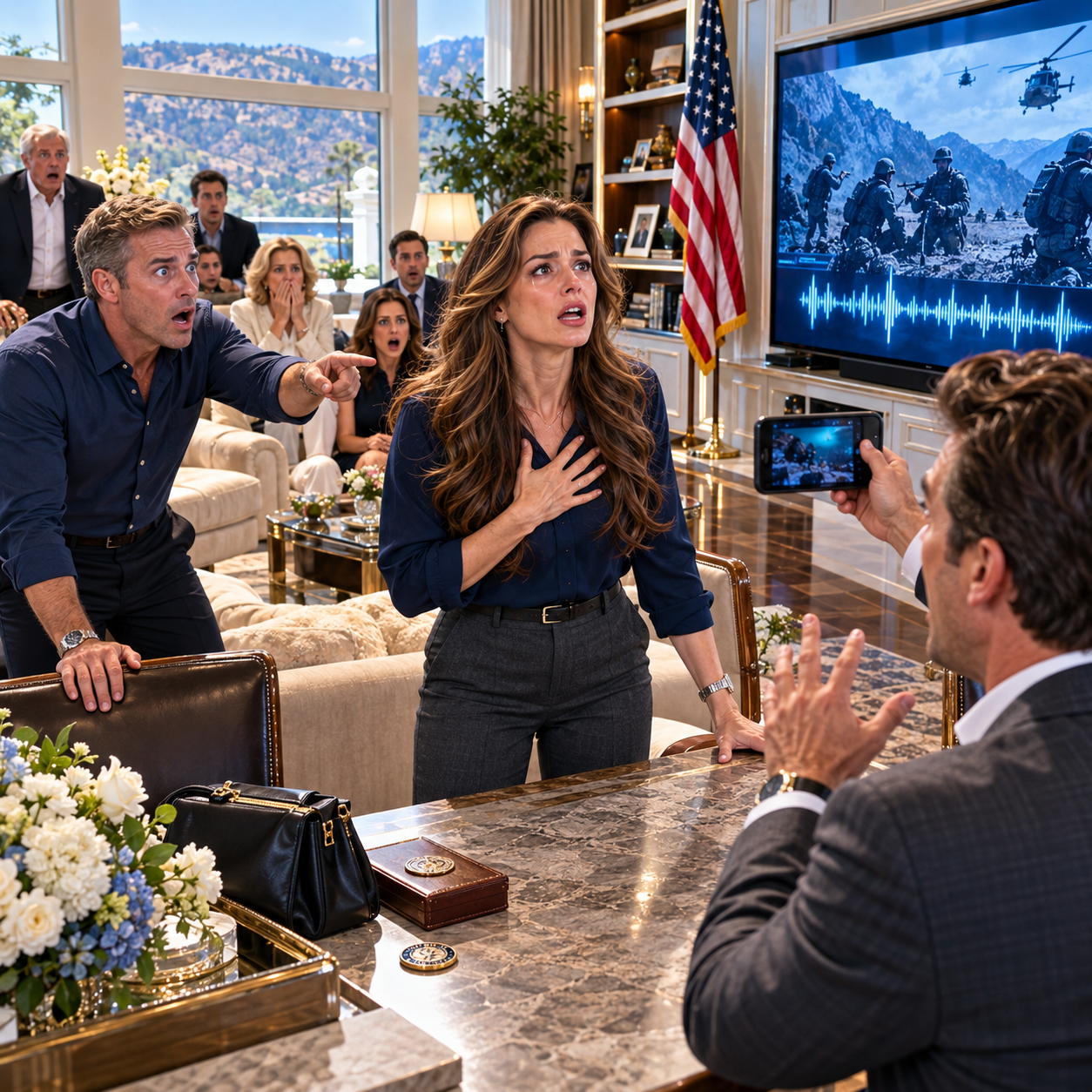
“Listen To What Real Combat Sounds Like,” My Ex Laughed, AirPlaying A Declassified Kunar Valley Recording. Explosions Filled The Room. Amid Radio Static, A Woman’s Voice Directed The Airstrikes. My Brother-In-Law Froze, Staring At My Lips As I Spoke Each Line Before The Tape Did: “Razor 41, Cleared Hot. Impact In… Two…”
At my ex-husband’s parents’ house, I watched him turn our divorce into entertainment. He played a declassified recording of an ambush to show his coworkers what “real operators” sounded like, then glanced at me when he said women like me stayed safely behind the action. His family laughed until I began speaking the commands before the recording did. I signed the papers anyway. Six days later, a stranger called about a missing sentence in that recording—and a document bearing my name.
## Part 1: The Voice in the Recording
The first thing I noticed when I walked into the Voss family home was that someone had moved the dining table to make room for extra chairs. I had driven three and a half hours to Charlottesville to sign the final separation agreement with my husband, Pierce, and I had expected twenty minutes of paperwork, perhaps an uncomfortable conversation, and a quiet drive home. Instead, his mother had prepared a formal dinner, complete with crystal glasses and candles that smelled aggressively of vanilla. Three men from Pierce’s defense technology firm were already sitting in the living room, looking as surprised to see me as I was to see them.
Pierce kissed his mother’s cheek and introduced me as though we were still a functioning couple. “This is Maren, my soon-to-be ex-wife,” he announced with a smile that made the word ex sound like a punch line. His mother, Lenora, gave me one of her practiced expressions of sympathy, while his father remained occupied with his newspaper. Only Pierce’s younger brother, Nolan, stood up, took my coat, and quietly asked whether I wanted something to drink.
I declined the wine and kept my leather document folder beside my chair. For two years, I had watched Pierce turn ordinary gatherings into performances designed to impress people who could advance his career, and I recognized the careful arrangement of tonight’s audience. His division director, Warren Kessler, was present, along with a senior engineer named Malcolm Price and Dorian Keene, a retired Air Force acquisition officer who now advised the company’s technical review board. Pierce was competing for leadership of a military communications program, and apparently his pending divorce had become another opportunity to demonstrate his importance. I understood that before the first course was cleared.
After dinner, Pierce connected his phone to the enormous television above the fireplace. “I’ve got something special,” he said, adjusting the sound system while his mother carried coffee into the living room. “A newly released combat recording from Afghanistan, the kind of material you don’t usually hear outside military circles.” He looked directly at me before adding, “It’s a good reminder that working around defense technology isn’t the same as understanding what happens when people actually depend on it.”
The recording began with radio interference, distant gunfire, and a man’s strained breathing. I recognized the quality of the transmission immediately, but recognition arrived in pieces rather than all at once: the compressed voices, the distinctive echoes bouncing between mountains, and the faint rushing sound of wind striking an exposed microphone. My fingers tightened around the folder on my lap. When someone mentioned a Ranger element moving through a valley in eastern Afghanistan, my stomach turned cold.
Seven years earlier, I had been there. I had served eight years in the Air Force, completed specialized combat-control training, and deployed three times with units operating in dangerous environments. My civilian job involved designing and evaluating avionics interfaces, but Pierce had always described my military experience as communications support, a convenient phrase that made me sound like someone who had maintained office equipment. I had corrected him early in our marriage, explaining that my work included directing aircraft and coordinating support for troops under fire. He had listened for perhaps thirty seconds before returning to a story about his own professional ambitions.
The controller’s voice emerged through the speaker, steady despite the urgency surrounding it. I recognized the cadence before I fully recognized the words, and suddenly I was back on a cold mountainside, kneeling beside a radio while frightened men shouted for help. A Ranger patrol had been ambushed near Narangal, and two soldiers were wounded before we understood how thoroughly the enemy had surrounded them. The next twenty-two minutes had demanded every ounce of concentration I possessed, because decisions made through that radio would determine whether those men survived.
Pierce interrupted the recording to explain something about operational psychology. “This is why actual field experience matters,” he told his colleagues, gesturing toward the television. “People who haven’t made these decisions under pressure don’t understand the requirements.” His mother nodded enthusiastically, and Warren asked a question about the communications equipment used during the engagement. Pierce answered with impressive confidence, repeating terminology I recognized from articles he had read and conversations he had overheard.
I stopped hearing him when the controller requested confirmation from the aircraft overhead. Without thinking, I whispered the next sentence a moment before it played. Nolan, sitting opposite me, lowered his coffee cup and stared at my mouth. I did it again several seconds later, this time remembering exactly where the original transmission had broken beneath a burst of interference.
“Maren,” Nolan said quietly, “how did you know what she was going to say?”
Pierce laughed without turning around. “She’s been listening to the recording, Nolan.”
“No,” his brother replied, leaning forward. “She said it before the recording.”
I looked at Nolan, then at the television, where the voice continued describing the situation unfolding below. For an instant, I considered staying silent, signing the documents, and leaving these people to their comfortable assumptions. Then Pierce smiled at me as though I were a child trying to participate in an adult conversation. I set my folder on the coffee table and said, “Because that’s my voice.”
The room seemed to lose its air. Pierce stared at me while Nolan reached for the remote and paused the recording, and Dorian Keene slowly straightened in his chair. I opened my folder to retrieve my service documentation, but something else caught my attention first: the presentation Pierce had minimized behind the audio player. On the screen was a communications diagram containing a sentence I had written years earlier in a private technical assessment, except someone had changed its meaning completely.
## Part 2: What He Had Taken
“That isn’t possible,” Pierce said, although he was looking at the screen rather than at me. His smile remained fixed for another second before disappearing, and I watched him search for an explanation that would allow the evening to continue as planned. Lenora gave an uncomfortable laugh and suggested that I must have heard a similar recording during my military career. Nolan didn’t look at either of them.
I retrieved a copy of my service record from the folder, where our attorneys had included it among the documents needed to address military retirement benefits. “November, seven years ago,” I said, placing the relevant page on the coffee table. “Kunar Province, Ranger element under fire, two aircraft supporting the evacuation. I was the combat controller assigned to coordinate the air support.” Dorian leaned forward to examine the document, then asked several careful questions about my training and operational responsibilities.
I answered without raising my voice. During my deployments, I had worked alongside teams operating in places where a missed transmission or misunderstood instruction could change someone’s life permanently. That night near Narangal, two wounded Rangers had been evacuated alive, something I remembered more clearly than any recognition I subsequently received. I had never considered those experiences suitable material for entertaining dinner guests.
Warren Kessler picked up the document after Dorian finished reading. His expression changed as he studied the qualifications and assignment history listed there, and Malcolm Price glanced toward Pierce with unmistakable concern. Pierce tried to recover by saying, “She handled the coordination side, which is obviously valuable, but that’s different from being part of the ground maneuver element.” Nolan turned toward him so sharply that the coffee table shook.
“She’s the voice you’re playing to impress everybody,” Nolan said. “You spent ten minutes explaining how important that person was, and now you’re trying to make her job sound insignificant.”
Pierce’s father finally folded his newspaper. Lenora began collecting empty cups even though several people were still drinking, moving around the room with the nervous efficiency she always displayed when someone challenged her son. Pierce ignored his brother and looked at me with an expression I recognized from our marriage. It was the expression he wore whenever he expected me to rescue him from the consequences of something he had said.
“Why didn’t you tell me?” he asked.
I stared at him, astonished that he could ask the question sincerely. There had been evenings when I tried to describe difficult assignments, only for him to interrupt with jokes about classified adventures or ask whether I had met anyone important. Once, when a former teammate called to thank me for helping bring his wounded friend home, Pierce complained that the conversation had interrupted dinner. I eventually stopped offering stories because I had grown tired of watching him turn my experiences into smaller versions of themselves.
“I did tell you,” I replied. “You just never listened long enough to understand.”
Dorian cleared his throat and asked whether we could speak privately about the presentation still visible on the television. He explained that Pierce’s team was developing a communications interface intended to help operators manage information during high-pressure missions. The slide behind the audio player, he said, had been presented internally as an example of operationally informed design. According to Pierce, its conclusions came from extensive personal exposure to special operations requirements.
I examined the diagram again. During an interoperability review eighteen months earlier, I had written a technical warning about automated systems treating repeated voice requests as unnecessary duplication. My original recommendation was that software should preserve repeated human communications until the receiving operator could confirm their meaning, particularly when interference made acknowledgments uncertain. The presentation on Pierce’s screen claimed almost the opposite: that intelligently filtering repeated transmissions would reduce confusion and improve operator efficiency.
“Where did you get this?” I asked.
Pierce reached for his phone. “It’s company material, Maren.”
“That sentence was taken from an assessment I wrote,” I said. “And somebody removed the condition that made the recommendation safe.”
Malcolm looked toward Warren, who asked Pierce whether he had retained the original source documentation. Pierce answered that he would locate it at work, suddenly sounding less like a project leader and more like an employee being questioned about an expense report. Dorian asked whether I would be willing to discuss the matter formally if the company requested it. I told him that any professional conversation would need to happen through the appropriate channels, with my employer’s approval.
I signed the separation agreement at the kitchen counter shortly afterward. Nolan brought me water, and Lenora stood near the refrigerator, watching without offering the apology I could see forming and disappearing behind her tight expression. Pierce waited until I had capped my pen before moving into the doorway. “If I’d understood your background, I could have introduced you to people who mattered,” he said.
“My service wasn’t something you were entitled to use,” I replied. “Neither was my work.”
I drove home with the radio switched off. Six days later, Dorian called my office and explained that an internal review had uncovered an unexpected discrepancy involving the combat recording and Pierce’s presentation. Someone had removed a sentence from the technical material associated with the recording, and the missing words changed the lesson the company was using to justify its design. Then he asked a question that made me sit down: “Maren, did you ever authorize Pierce to sign your name to an operational review?”
## Part 3: The Missing Warning
I spent the next morning staring at an email from Dorian that contained nothing more than a request for a confidential meeting. He had deliberately avoided attaching documents, explaining that the company needed to establish what information I could legally review before sharing its internal findings. I appreciated the caution, because I had spent enough years around sensitive information to understand that a legitimate concern did not give anyone permission to bypass procedures. Before answering, I contacted my employer’s legal department and asked for an attorney familiar with technical intellectual property and defense industry compliance.
The attorney, Celeste Rowan, listened without interrupting as I described the dinner, the recording, and the altered diagram. She asked whether my original assessment contained restricted technical information, and I explained that the excerpt Pierce had used came from an unclassified human-factors discussion I had prepared for a professional workshop. The underlying observations were mine, although my employer had subsequently incorporated some recommendations into its own research. Celeste requested the original document, its revision history, and every message I had exchanged with Pierce about it.
Finding those messages took less than an hour. Eighteen months earlier, Pierce had asked me to explain why military operators sometimes distrusted automated communication systems, claiming he wanted to understand my work better. I had been embarrassingly pleased by his sudden interest and sent him a short, sanitized explanation with a diagram illustrating the importance of preserving human acknowledgments. His reply contained only five words: “Perfect. This is really useful.”
At the time, I had mistaken those words for appreciation. Now I remembered how quickly his interest vanished whenever I tried to discuss anything unrelated to his upcoming presentation. He had never asked what inspired the recommendation or why I considered repeated communications essential under difficult conditions. He had simply taken the material and disappeared into his home office.
Three days later, Celeste accompanied me to a conference room at Dorian’s company, where a compliance officer named Inez Whitaker joined us. Inez explained that Pierce’s team had submitted an operational validation memorandum eight months earlier, presenting its software design as supported by an experienced former combat controller. The document included a description of my military background and identified me as an independent operational reviewer who had approved the interface’s proposed handling of repeated transmissions. At the bottom of the electronic form, beside the approval date, was my name.
“I never reviewed this system,” I said.
Inez nodded without appearing surprised. “That’s what we needed to establish.”
The document contained an electronic acknowledgment rather than a handwritten signature, but someone had still certified my participation without my permission. Worse, the supporting notes reproduced sections of my original assessment while removing several qualifications about operator control and uncertain acknowledgments. I stared at the familiar phrases, remembering the late evening when I had written them at our kitchen table while Pierce watched television. He had complained about the clicking of my keyboard, then borrowed my explanation as though it belonged to him.
Inez showed us a separate summary of an earlier field evaluation. The prototype interface had performed well during ordinary demonstrations, but several participants had reported that repeated requests were sometimes grouped together without clearly identifying whether a human operator had acknowledged them. The developers considered the behavior an efficiency feature, while two operational testers had described it as potentially confusing during high-pressure situations. The concerns remained documented, but the version Pierce had submitted for executive review classified them as resolved.
One tester’s name caught my attention immediately: Elias Velez.
I had known Elias as a Ranger sergeant during my second deployment. He was one of the two men wounded during the Narangal engagement, and he had sent me Christmas cards for three years afterward, usually containing photographs of his growing family. We had exchanged occasional messages since then, but I hadn’t realized he had participated in a military communications evaluation after leaving active service. Seeing his name on that report made the problem feel less like a dispute over professional credit and more like something capable of affecting people I knew.
I called Elias that evening. He answered from his garage in North Carolina, where a compressor hummed behind him and his youngest daughter was apparently searching for a missing bicycle helmet. When I mentioned the communications evaluation, his humor disappeared. “I told them the interface could make unanswered calls look finished,” he said, sounding irritated all over again.
He explained that the prototype had presented several repeated requests as one consolidated item during a controlled exercise. Nobody had been injured, but his team had needed to stop and clarify information that the display appeared to treat as already handled. He had written a detailed report because the problem reminded him of how easily uncertainty could spread during a real engagement. Months later, he received a notice indicating that the issue had been addressed, although nobody invited him to verify the correction.
That night, Celeste forwarded my formal statement to Inez with the supporting documents. I sat beside my apartment window, listening to rain against the glass, and remembered Pierce complaining that I worried too much about unusual situations. Near midnight, a reply arrived confirming that the company had reopened the field-test findings and suspended the disputed validation memorandum. Attached was the original evaluation timeline, showing that the warning had been discussed four months before Pierce classified it as resolved—and that Warren Kessler had attended the meeting.
## Part 4: The Cost of Silence
The review meeting took place the following Thursday in a windowless conference room outside Washington, D.C. Celeste sat beside me, with Inez and two independent technical reviewers across the table, while Dorian occupied a chair near the door. Warren arrived carrying a laptop and several carefully organized folders, followed by Pierce, who stopped walking when he saw me. For the first time since we separated, he appeared genuinely uncertain about how to behave in my presence.
Inez began by explaining that the company was reviewing the accuracy of its operational validation records and the handling of previously reported concerns. The purpose was not to evaluate my military career or assign personal blame for our marriage ending. She wanted to determine whether the system’s requirements had been supported by legitimate evidence and whether unresolved problems had been represented accurately. Pierce listened with his hands folded, occasionally glancing toward Warren.
The technical reviewers demonstrated the disputed interface using a controlled simulation with fictional information. In the first sequence, an operator sent a request, received acknowledgment, and watched the system update the display correctly. In the second, the simulated request was repeated because confirmation had not been received, but the interface grouped the transmissions into a single item that appeared routine. The reviewers explained that the behavior did not necessarily cause failure by itself, but it could conceal uncertainty from someone responsible for making a time-sensitive decision.
“That was precisely the distinction I wrote about,” I said.
Warren adjusted his glasses and argued that the design had been intended to reduce information overload, not suppress important communication. I agreed that reducing unnecessary clutter was a legitimate engineering goal, then pointed to the original wording from my assessment. It recommended preserving the operator’s ability to recognize and resolve unanswered requests, rather than allowing automation to treat repetition as confirmation. The distinction was not complicated, but it mattered enormously when communication was unreliable.
Pierce finally interrupted. “We’re talking about a presentation summary, not an actual deployed system. Nobody was harmed.”
Elias’s written evaluation lay on the table between us. He had described the problem in plain language, warning that operators might assume someone else had received information that remained unacknowledged. I looked at Pierce and remembered all the times he had dismissed my concerns as unnecessary pessimism. “Nobody being harmed during a test is a reason to fix the problem before deployment,” I said, “not a reason to erase the warning.”
Inez then asked Pierce to explain why my name appeared on the operational approval. He claimed he believed our earlier conversation and the document I had shared constituted permission to reference my expertise. When she asked whether I had been shown the final validation memorandum, he admitted I had not. Warren stared at the conference table as the compliance officer displayed an email in which Pierce described obtaining approval from his “household operational adviser.”
I recognized the date immediately. Pierce had sent that email on the morning of our second wedding anniversary, the same day he forgot our dinner reservation and told me he had been trapped at work. I had spent that evening eating reheated pasta while he sat upstairs answering messages. The memory hurt less than I expected, although the realization that he had been using my qualifications while dismissing them at home left me almost physically exhausted.
Dorian requested permission to play a longer authorized excerpt of the declassified recording. The company had used a shortened version in demonstrations, emphasizing the steady exchange between the controller and aircraft while removing the confusing interruptions that made the original situation difficult. In the restored segment, my younger voice repeatedly sought acknowledgment after a transmission failed to receive a clear response. When confirmation finally arrived, the relief in another soldier’s voice was audible even through the radio interference.
I remembered that moment vividly. We had been cold, exhausted, and working against uncertainty, and nobody involved had considered repeating a request a meaningless inconvenience. The lesson was not that people under pressure needed less information at any cost, but that they needed reliable ways to distinguish completed actions from unresolved ones. It was the lesson Pierce’s presentation had nearly erased.
Warren asked for a short recess, but Inez continued long enough to establish how the validation memorandum had been approved. Pierce’s electronic acknowledgment had been entered using credentials authorized for his project role, and the document identified me as an independent reviewer despite having no record of my participation. The company would investigate whether the approval violated its internal certification requirements. Before we left, Inez handed Celeste one more document: an earlier message Pierce had sent requesting permission to use my military credentials in promotional material, accompanied by a copy of my complete service summary.
The message was dated eleven months before our separation. Pierce had known exactly what I did in the military long before he played that recording at his parents’ house. He hadn’t misunderstood my career at all; he had chosen which version of it served him best.
## Part 5: What Remained
I didn’t confront Pierce in the parking lot after the meeting. He followed me toward the elevator, calling my name twice, but Celeste stepped aside only when I indicated that I was willing to hear him. He looked tired beneath the fluorescent lighting, with his tie loosened and the confidence that usually carried him through difficult conversations entirely absent. “I wasn’t trying to hurt anybody,” he said.
I believed that he hadn’t intended anyone to be injured. I also understood that he had repeatedly minimized warnings because acknowledging them would have delayed a project on which he had built his professional reputation. He had used my work without permission, certified my approval without asking, and publicly diminished the experience he had privately relied upon. None of those decisions required cruelty as their primary purpose to cause real harm.
“You knew what I did,” I said. “You had my record before that dinner.”
Pierce looked toward the elevator doors. “I knew the qualifications were significant, but I didn’t understand everything they meant.”
“You understood enough to put them in a document when you needed credibility,” I replied. “You just didn’t think they deserved respect when they belonged to me.”
He asked whether I would tell the investigators that he had acted without malicious intent. I explained that I had already provided an accurate statement, and I wouldn’t change it to protect him from facts he found inconvenient. When he reached for my arm, I moved away before his fingers touched my sleeve. I told him any further communication about the investigation or divorce would need to go through our attorneys.
The company’s review continued for several weeks. Its leadership withdrew the disputed operational validation, required independent testing of the interface’s treatment of unacknowledged transmissions, and corrected the source attribution in its technical records. The project itself was not canceled, because its underlying goals remained useful, but its readiness claims could no longer depend on incomplete evaluations. A later independent review confirmed that the specific behavior Elias had reported needed additional safeguards before the interface could advance.
Warren remained responsible for explaining why the earlier warnings had been classified as resolved. Pierce was removed from the defense communications program and reassigned to a commercial operations division while the company completed its employment review. I learned those details through formal correspondence and a brief message from Nolan, not through gossip. What happened afterward would be determined by the company’s procedures, and I felt no need to campaign for a more dramatic punishment.
Lenora called me near the end of November. She began by saying she was sorry the dinner had become uncomfortable, then suggested that Pierce’s humiliation had been punishment enough. I listened until she asked whether I could help restore the family’s relationship with him. “Your son embarrassed himself because he wanted an audience,” I told her. “What happened afterward came from decisions he made at work, long before that evening.”
She became quiet, then asked whether I could eventually forgive him. I told her that forgiveness wasn’t a family obligation and that my decision to end the marriage would not change. Whatever Pierce learned from the experience was his responsibility, not another task I needed to complete for him. We ended the call politely, and I didn’t invite further contact.
Nolan remained the only member of the family I occasionally heard from. He sent a short message after learning about the independent technical review, saying he was glad the problem would receive proper attention. I thanked him for noticing what everyone else had ignored during dinner. He replied that he had simply paid attention, a modest explanation that reminded me how much damage people could avoid by doing exactly that.
A few days before Christmas, Elias called with an update. His old military unit was organizing a reunion, and he wanted me to know that several men from the Narangal operation hoped I would attend. He also told me his daughter had recently discovered the Christmas cards he used to send and asked why he had saved copies of them. “I told her you helped me come home,” he said, his voice unexpectedly rough.
I looked at the small shadow box above my desk, where my combat controller insignia rested beside a folded note from that deployment. For years, I had kept those reminders out of sight because I didn’t want strangers demanding explanations or my husband turning them into stories about himself. But Elias’s call reminded me that protecting my privacy didn’t require pretending the experiences had never happened. I told him I would attend the reunion.
In January, Dorian contacted me through the appropriate professional channels about a possible independent advisory role. My employer approved a limited arrangement after reviewing potential conflicts, and I joined a human-factors working group focused on improving communication interfaces for people operating under pressure. The work involved difficult questions, careful testing, and disagreements that could not be settled through confident presentations alone. I liked that nobody expected me to provide dramatic war stories when a practical answer would do.
My divorce became final that spring. Pierce sent one last message acknowledging that he had treated my silence as permission to define me however he wanted, followed by an apology that seemed more thoughtful than anything he had said during our marriage. I read it once, then archived it without replying. Perhaps he meant every word, but sincerity arriving after consequences did not restore the trust he had spent years dismantling.
On my first morning with the working group, I entered a conference room where engineers were discussing how to make important information visible without overwhelming the people who needed it. Someone asked what operators should be able to do when a system appeared certain but the human situation remained unclear. I opened my notebook and began describing a cold night in Afghanistan, an unanswered transmission, and the importance of never mistaking silence for confirmation.
Nobody interrupted. Nobody asked whose reputation my experience might improve, and nobody needed to hear that I had once been married to Pierce Voss. They asked questions, challenged assumptions, and changed the design when the evidence warranted it.
That evening, I drove home beneath a pale spring sky with the windows cracked open and the radio switched off. I thought about the voice on that recording, the younger woman who had been frightened but steady, determined to bring everyone home despite everything she couldn’t control. She had never needed an audience or a husband’s approval to do her job, and neither did I.
The recording had not made me important, and Pierce’s humiliation had not made me successful. What mattered was that an unanswered warning had finally been heard, a preventable problem was being corrected, and I had reclaimed the ordinary freedom to live without someone continually making me smaller.
For the first time in years, the silence around me belonged entirely to me.
THE END!
Disclaimer: Our stories are inspired by real-life events but are carefully rewritten for entertainment. Any resemblance to actual people or situations is purely coincidental.