
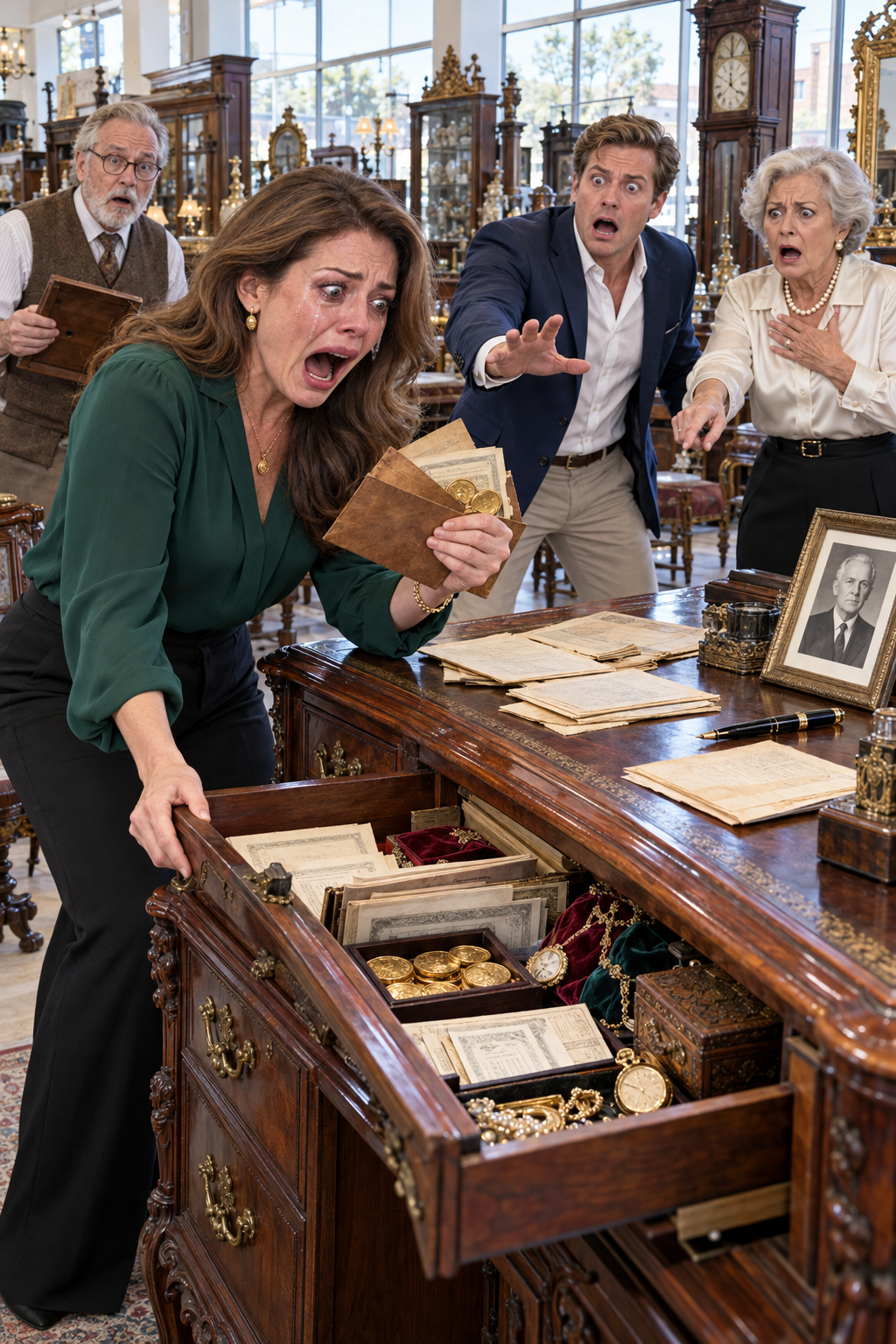
“I Sold Your Late Father’s Desk,” My Brother Smirked. I’d Warned Him Never To Touch That Item. I Traced The Desk To An Antique Shop—Then Discovered The Wealth Inside, Too. He Thought I’d Do Nothing. But He’d Forgotten One Thing. I Confronted Our Mother. Two Weeks Later, He Called Me, His Voice Shaking…
When I came home from a business trip, the antique desk my father had spent three winters restoring was gone, and my younger brother acted as though he’d done me a favor by selling it. My mother begged me not to make a scene, so I quietly tracked down the dealer and bought it back myself. Three days later, I discovered a hidden compartment my brother had never bothered to examine. Inside was an old envelope containing something far more troubling than forgotten family valuables.
## Part 1: The Empty Room
The first thing I noticed was the smell of fresh cardboard. My house usually smelled faintly of coffee, lemon furniture polish, and the lavender sachets I kept in the linen closet, but that Friday afternoon, the hallway smelled like a shipping warehouse. I rolled my suitcase past three unfamiliar boxes, reached the doorway of my study, and stopped so abruptly that the suitcase tipped against my ankle. My father’s mahogany desk was gone, leaving four pale rectangles on the hardwood floor where its heavy legs had protected the finish from twenty years of sunlight.
I stood there for nearly a minute, trying to convince myself that my brother had moved it somewhere safe. Then I saw the scratches across the floor, the missing brass desk lamp, and a stack of my father’s old notebooks piled carelessly beside a plastic storage bin. Someone had emptied the drawers, dragged that enormous piece of furniture through my house, and taken it away without telling me. The realization made my stomach tighten in a way that anger alone couldn’t explain.
My name is Maren Hartwell, I’m thirty-nine, and I work as an operations manager for a regional medical equipment company outside Asheville, North Carolina. My younger brother, Beck, was thirty-four and perpetually three months away from the business opportunity that would supposedly change his life. When he asked to use my spare bedroom while renovating his house, I agreed because he was family and because our mother had already been calling me about his financial difficulties. I had only one condition: he could use the spare bedroom, but nobody was to touch Dad’s desk in the adjoining study.
Dad, Silas Hartwell, had bought the desk at an estate auction when I was sixteen. It was an enormous nineteenth-century piece with carved drawer pulls, two heavy pedestals, and a writing surface covered in old scratches that Dad insisted were part of its character. He spent three winters restoring it in our garage, teaching me how to remove old varnish without destroying the wood underneath. When he died two years earlier, his will specifically left that desk to me, while the rest of his estate went to Mom.
I called Beck from the empty study, expecting confusion or at least an apology. He answered over loud music, said, “Hey, Mare, you’re back early,” and explained that he’d traded the desk to an antique dealer for a modern office setup. When I asked why he had taken something that belonged to me, he laughed and said, “It’s furniture, not a family member, and Dad would’ve wanted it put to practical use.” I stared at the empty floor and told him to send me the dealer’s name.
“Don’t turn this into one of your control issues,” he said, suddenly irritated. “I got two desks, four chairs, and storage cabinets out of that old thing, so technically I increased the value of what we had.” I reminded him that we’d agreed he wasn’t allowed to move it, and he answered that siblings shouldn’t need written contracts for every little decision. Then he said he was late for a meeting and hung up.
I found the dealer’s business card on my kitchen counter underneath a greasy takeout receipt. Sloane Antiques occupied a renovated brick storefront about twenty minutes away, with tall windows displaying grandfather clocks, silver serving trays, and old wooden cabinets. The owner, Vera Sloane, was a compact woman in her sixties who wore reading glasses on a chain and looked increasingly uncomfortable as I described the desk. She took me into a rear storage room, where my father’s work sat wrapped in moving blankets beside a loading dock.
Vera showed me the paperwork Beck had signed three days earlier. He had identified himself as the sole heir of Silas Hartwell and assured her that the furniture was his to trade, even though Dad’s will said otherwise. She had already arranged to ship the desk to a collector in Virginia on Monday, but she listened carefully when I explained what had happened. I returned with a copy of the will and the original auction receipt, and after reviewing both, she agreed to let me recover the desk for the $1,200 value she’d assigned to the trade.
It hurt to spend that money on something I already owned, but I wanted the desk safely back in my house before arguing about reimbursement. Vera arranged for her delivery crew to bring it the following morning, and she gave me copies of the transaction documents, including the form Beck had signed. As I was leaving, she mentioned something that seemed strange. “Your brother was unusually eager to get it out of the house,” she said. “He called twice to ask whether I’d arranged transportation.”
Saturday morning, I supervised the movers as they returned the desk to its original place, then spent hours sorting through the cardboard box Beck had left behind. My personal savings records were mixed with Dad’s handwritten ledgers, old photographs, and several folders containing receipts from the family property. While checking the lower left pedestal for damage, I felt a narrow wooden edge that didn’t match the opposite side. I pressed it gently, heard a small click, and watched a thin panel slide forward to reveal a compartment containing a faded blue envelope.
Dad’s handwriting appeared across the front, unmistakable even after two years.
“Before anyone sells the east meadow, read everything.”
Underneath those words was a date from the summer before he died, and beneath the envelope lay a folded property survey bearing the name of a company I had heard my brother mention just the previous week.
## Part 2: What My Father Left Behind
I carried the envelope to the kitchen table instead of opening it in the study. My hands smelled of old wood and dust, and I needed a clear surface where I could arrange anything delicate without damaging it. Inside were two original property deeds, several paper stock certificates, a survey marked with red pencil, and a letter written on the cream stationery Dad used for important family matters. I recognized his habit of underlining dates twice, but the first sentence made me stop reading.
“If Beck has started talking about selling access to the meadow again, do not assume he understands what he is promising.”
I read that sentence three times before continuing. Dad explained that he’d purchased an adjoining eight-acre parcel in 1998, years before a new highway made our family’s rural property attractive to developers. The meadow included a narrow stretch of creek, an old farm crossing, and the only practical route between a proposed development site and the county road. Dad had never considered it an investment to sell; he’d bought it to protect the house, orchard, and creek from becoming part of somebody else’s construction project.
The second deed confirmed that Dad owned the property separately from the house where Mom still lived. The stock certificates came from a regional utility company whose name had changed through several mergers, and Dad’s notes suggested they might still have considerable value. None of these assets had appeared on the estate inventory I remembered reviewing after his death. The thought bothered me because Dad had been meticulous about records, yet he’d hidden the most important ones inside furniture he knew would eventually leave his home.
I called Mom that evening, intending to ask whether she’d known about the meadow. She answered on the third ring, sounding tired, and asked whether Beck had finished moving his things into my spare room. When I told her about the desk, she sighed and said, “He shouldn’t have done that, sweetheart, but he’s under tremendous pressure right now.” I asked what kind of pressure would make him sell an inheritance that wasn’t his, and she fell silent.
“Mom, did Dad own eight acres behind the orchard?” I asked. She answered too quickly, insisting that the land had been worthless for years and that we shouldn’t reopen old family arguments. When I mentioned the name Greer Land Partners, I heard something strike the kitchen counter at her end of the call. She asked me where I’d seen that name, and her voice sounded nothing like the woman who had been defending Beck a moment earlier.
I told her I had found old papers in the desk but didn’t explain the hidden compartment. She begged me to leave the documents alone until we could talk, then said Beck had been trying to arrange a small business partnership with a land consultant named Russell Greer. According to Mom, the arrangement involved planning services for a future development, nothing more. But the survey in front of me showed a proposed access road cutting directly through Dad’s meadow and ending less than two hundred yards from her back porch.
On Monday morning, I took copies of the papers to Leah Serrano, the attorney who had handled Dad’s estate. She remembered our family and immediately recognized the significance of the documents, although she warned me that finding original deeds didn’t automatically establish who currently owned the assets. We would need updated title records, an accounting of the estate, and confirmation from the utility company’s transfer agent before making any decisions. She also wanted to know why the parcel had never been disclosed during the original estate proceedings.
Leah pulled Dad’s will from her records and pointed to the provision leaving his remaining assets to Mom. If the newly discovered property and shares were still legally part of his estate, they would need to be addressed through the appropriate court process, with Mom as the intended beneficiary. Beck had no present ownership interest in either asset, and his claim to the antique dealer was inconsistent with the written will. Leah recommended that I preserve every document and stop discussing the discovery with him until we understood what he’d been doing.
That afternoon, I checked the public property records and found a recently filed application requesting preliminary evaluation of a proposed access route. It listed Greer Land Partners as the applicant and described the route as crossing property controlled by the Hartwell family. The supporting correspondence included a statement from Beck identifying himself as the family’s representative for future negotiations. Although the application didn’t grant anyone access to the land, it was obvious that he had been making promises about property he didn’t control.
The next discovery came from a folder Dad had hidden behind the deeds. It contained copies of personal checks, bank transfers, and handwritten notes documenting money he and Mom had given Beck over nearly a decade. I recognized some of the occasions: a failed restaurant investment, an expensive certification program, and a landscaping venture that had closed after nine months. But one entry was recent enough to make my throat go dry.
Eight months before Dad died, he’d transferred $38,000 to cover a financial obligation Beck had promised to handle himself.
Beside the entry, Dad had written, “Della must not lose the house because he cannot accept an answer.”
That night, Mom called again, and this time she didn’t bother asking whether I was upset about the desk. She said Beck had scheduled a meeting with Russell Greer at her house for Thursday, and he wanted her to sign something before the weekend.
## Part 3: The Price of Keeping Quiet
I drove to Mom’s house Wednesday evening and found her sitting at the kitchen table with a stack of unpaid bills and an untouched cup of tea. The house looked exactly as it had when Dad was alive, from the crooked family photographs in the hallway to the green ceramic bowl he used for his car keys. Mom had always insisted that changing those things would feel like losing him twice, but she’d apparently been willing to discuss letting strangers build a road behind his orchard. When I placed the survey in front of her, she pressed both hands against her mouth.
“Beck told me the company would pay enough to clear what he owes,” she whispered. She explained that Greer Land Partners had offered Beck a consulting arrangement involving site preparation, equipment coordination, and introductions to neighboring property owners. Beck had assured her that the access agreement was temporary, that construction wouldn’t begin for years, and that no part of the family house was at risk. She had accepted his explanations because he kept telling her he would lose everything if the partnership collapsed.
I asked whether she’d read the agreement herself. She shook her head and admitted that Beck had already persuaded her to move $12,000 from her retirement savings into his business account three months earlier. He’d promised to return it when his first contract payment arrived, but that payment had apparently gone toward additional equipment and office furnishings. For the first time, I understood that Dad’s death hadn’t ended the pattern recorded in his ledgers; it had simply removed the person who occasionally said no.
“Why didn’t you tell me?” I asked. Mom stared at the tablecloth and said she hadn’t wanted me to think less of my brother, then admitted she was afraid I’d stop helping him altogether. The answer hurt more than I expected because it meant she’d been protecting Beck’s reputation at the expense of my ability to make informed decisions. I told her I loved her, but I would no longer participate in family arrangements built around information being deliberately withheld from me.
Thursday morning, I returned with Leah, who had agreed to attend the meeting at Mom’s invitation. Beck arrived fifteen minutes late in a fitted blazer, carrying a leather portfolio and talking cheerfully about how the project would finally put everyone ahead financially. Russell Greer followed him, a reserved man wearing work boots beneath pressed khakis, and spread several drawings across the dining table. Within minutes, he was describing a permanent access easement through the east meadow, not the temporary construction arrangement Beck had promised Mom.
I asked Russell who had authorized Beck to negotiate on the family’s behalf. He produced an email stating that Beck represented the Hartwell property interests and that Mom was prepared to consider a permanent easement after reviewing final compensation. Beck leaned toward me and muttered, “This is why I didn’t want you involved,” before Russell explained that he’d advanced Beck $16,000 for planning services connected to securing the proposed route. The written terms required Beck to account for certain expenses and return any unearned portion if his work couldn’t be completed.
Leah calmly explained that the ownership records were under review and that no authorized owner had agreed to the proposed access. She showed Russell the property documents and informed him that further discussions would need to go through the actual titleholder after the estate questions were resolved. Russell’s expression changed immediately, and he began gathering his drawings while asking Beck why he’d represented the situation differently. Beck insisted that everyone had understood the general plan, but Russell answered, “Understanding a plan isn’t the same as giving someone permission.”
After Russell left, Beck turned on me with a fury I’d rarely seen outside our childhood arguments. He accused me of sabotaging a legitimate opportunity because I couldn’t stand watching him become successful, then pointed toward Mom and demanded that she explain how much money the deal could have brought in. Mom quietly told him she hadn’t realized the proposed road would be permanent. Rather than apologize, Beck said she should have asked better questions before letting him spend months developing the project.
That was when I placed the antique dealer’s paperwork on the table. I showed him his declaration that he was Dad’s sole heir, followed by the will identifying me as the desk’s owner and my receipt for the $1,200 required to recover it. Beck stared at the documents, then dismissed the entire matter as a technical mistake because, according to him, the desk had been sitting unused for years. When I asked why he’d sold it after explicitly promising not to touch it, he couldn’t give me an answer beyond needing the furniture for his office.
Mom finally spoke with a steadiness I hadn’t heard from her since Dad’s funeral. “Beck, your father spent years paying for your mistakes, and I’ve been doing the same thing since he died,” she said. Beck looked genuinely astonished, as though the financial support he’d received had been an invisible family resource rather than money somebody had worked to earn. He stood, pushed his chair backward, and announced that we could all enjoy our precious furniture while he figured out how to survive.
Before he reached the door, I told him he had thirty days to remove everything belonging to him from my house, and that I expected repayment of the $1,200. He turned around and asked whether I was seriously choosing an old desk over my own brother. I answered, “I’m choosing not to let you decide what belongs to me,” and for once, Mom didn’t ask me to soften my words.
Beck left without another argument, but that evening, Leah called with a new concern. Russell had forwarded an additional document Beck had submitted during the preliminary negotiations, and it appeared to use information taken from Dad’s private financial ledgers. The desk hadn’t been the only thing he’d treated as his to use.
## Part 4: The Records He Thought Nobody Would Check
The document Russell sent was a financial summary listing the family home, orchard, and adjoining property as resources available to support the proposed development. Beck had included estimated values, details of Mom’s remaining mortgage, and historical income figures copied from Dad’s old notebooks. At the bottom, he’d described these figures as confidential family information provided with the owners’ knowledge. Mom had never seen the summary, and I certainly hadn’t authorized him to circulate anything belonging to me.
Leah explained that the document wasn’t itself a transfer of property, but it raised serious questions about the authority Beck had claimed. She advised Mom to respond in writing, correcting the record and making clear that Beck could not represent her in future negotiations without express permission. Russell acknowledged receiving the correction and agreed to suspend discussions while the ownership issues were resolved. Whatever business relationship he chose to maintain with Beck afterward would be between the two of them.
I spent the next weekend checking every folder Beck had handled while staying at my house. There were no missing bank statements or signs that he’d accessed my accounts, which was a relief, but he’d photocopied portions of Dad’s ledger without asking. Inside a drawer of the modern cabinet Beck had left behind, I found a draft proposal describing the family acreage as an ideal location for a private residential entrance. He’d been planning around the property long before he asked to store boxes in my spare room.
I remembered the conversation with uncomfortable clarity. Beck had stood in my kitchen drinking orange juice directly from the carton, complaining that his renovations were taking longer than expected and that he needed temporary storage. He’d promised the boxes would be gone in six weeks, thanked me for trusting him, and asked whether he could use my printer occasionally. What I’d considered an ordinary favor had given him regular access to Dad’s financial records, the desk, and a quiet workspace for developing his proposal.
When I confronted him by email, he admitted copying the figures but claimed he’d only been trying to produce accurate projections. He also suggested that Dad would have supported the project because it could have made the family financially secure. I reminded him that Dad had repeatedly declined development proposals while he was alive, and that the documents we’d discovered supported those decisions. Beck didn’t respond to that point; instead, he accused me of turning ordinary business preparation into a personal attack.
Meanwhile, Leah and a title researcher completed their initial review of the hidden deeds. The meadow had been purchased in Dad’s name and recorded properly, but the property had been overlooked during estate administration because nobody had identified it among the assets to be inventoried. The utility shares required separate verification, including tracing the company’s corporate changes and checking whether any proceeds had been transferred to unclaimed property accounts. Leah arranged to address the omitted assets through the appropriate estate procedures rather than simply treating the physical certificates as proof that someone could cash them in.
An independent appraisal later estimated the meadow’s market value at approximately $240,000, although selling it would have required finding a buyer and resolving the usual practical questions about access and land use. The remaining utility shares and related entitlements appeared to be worth roughly $70,000, pending final confirmation. Those figures were astonishing, but what stayed with me was the fact that Dad had protected the land for nearly three decades without ever treating it as an easy source of spending money. Beck had spent months trying to negotiate away access to something he didn’t even know Dad owned.
Mom and I met with Leah to discuss what should happen once the assets were legally accounted for. Under Dad’s will, Mom was the intended beneficiary of his remaining estate, so the decision about their future belonged to her after the required administration was completed. She chose to work toward placing the recovered property and investments into a trust for her own support, with herself managing it and me named to take over when she could no longer do so. Beck would receive no authority to borrow against those assets or use them for his businesses.
Two days later, Beck arrived at my house carrying a folder and asking whether we could settle things without lawyers. I let him into the living room but didn’t invite him into the study, and he immediately noticed the closed door. He explained that Russell wanted an accounting of the advance, that several expenses weren’t eligible under their agreement, and that he might have to sell his new equipment to cover the difference. For the first time, his financial problem had consequences that neither parent could quietly absorb.
“I can pay you back for the desk,” he said, “but I need some time.” I told him I would accept reasonable installments and that he could collect his belongings on Saturday when I was home. He looked relieved until I explained that those arrangements didn’t restore his permission to use my property, represent our family, or request financial assistance from me. “You’re acting like I stole something precious,” he said, and I answered that the value of an object had never been his decision to make.
Saturday afternoon, he arrived with a rented van and two friends. I watched from the porch while they carried out the boxes, filing cabinets, and chairs he’d been so pleased with, and I checked each room after they finished. Beck left the keys on my kitchen counter without saying goodbye. As the van pulled away, I realized I hadn’t heard him acknowledge a single consequence of his actions except the money they were going to cost him.
That evening, Mom came over carrying a small wooden box I’d seen in Dad’s workshop. Inside were the original brass drawer keys, several family photographs, and a note Dad had left for her about the desk. She handed me the note without speaking, and the final sentence explained why he’d insisted that I, rather than Beck, should inherit it.
“She understands that caring for something means thinking about who will have to live with your decisions after you’re gone.”
## Part 5: What Was Worth Keeping
I read Dad’s note three times before putting it back in the wooden box. The handwriting slanted slightly downward, the way it always had when he was tired, and there was a faint ring from a coffee cup near the corner. For a moment, I was angry with him too, because he’d recognized Beck’s habits without ever finding a way to stop the family from accommodating them. Then I remembered how often Dad had tried to warn us that helping someone and protecting them from consequences were not the same thing.
Mom sat beside me on the sofa and admitted that Dad had wanted to discuss the meadow and the family finances before his health deteriorated. She’d asked him to postpone the conversation because Beck was already struggling and she couldn’t bear another argument. After Dad died, she focused on keeping the house running and comforting Beck, telling herself there would eventually be a better time to address the money he’d received. Sitting there with his note in her hands, she finally acknowledged that avoiding the subject had allowed the same problems to continue.
Over the following months, the legal process moved forward slowly but steadily. The attorney completed the necessary estate filings, the title records confirmed Dad’s ownership of the meadow, and the utility company’s transfer agent verified the surviving stock interests. After the estate matters were resolved, Mom worked with Leah to establish her trust, keeping herself in control of her assets and naming me as successor trustee. She also updated her financial instructions to ensure that no family member could make commitments on her behalf without proper authorization.
Russell Greer eventually informed Mom that his company was exploring a different route for the proposed development. He had ended Beck’s consulting arrangement after reviewing the disputed representations, and Beck was responsible for resolving the remaining advance balance under their contract. I learned through Mom that my brother had sold most of his new office furniture and taken a regular job at a building supply company while negotiating repayment. The very furniture he’d traded Dad’s desk to obtain had become another expense he couldn’t justify keeping.
Beck began repaying me in installments, sometimes sending $100, sometimes $200, depending on the month. Every payment arrived with a short message, usually something like “Sent what I could,” and occasionally a complaint about how difficult everything had become. I kept a simple record of what he’d paid and what remained, answering only when a practical response was necessary. I no longer spent evenings explaining my feelings to someone who had repeatedly demonstrated that he understood my boundaries only when they interfered with his plans.
Mom changed more than I expected. She stopped transferring money whenever Beck called with an emergency, began reviewing her accounts with an independent financial adviser, and asked him to arrange a repayment plan for the $12,000 she’d given his business. Their conversations were difficult, and some ended with Beck accusing her of favoring me, but she didn’t retreat into apologies as she once would have. When she told me about those arguments, I listened without volunteering to fix them.
In early December, Mom invited both of us to dinner for her birthday. Beck arrived carrying flowers from the grocery store and looked noticeably thinner, with rough hands from his new job and dark circles beneath his eyes. He was polite through most of the meal, asking about my work and telling Mom that he’d found an affordable apartment closer to the building supply warehouse. For nearly an hour, we managed an ordinary family conversation, although none of us pretended that the previous months had been a misunderstanding.
After dinner, Beck followed me onto the porch while I was putting on my coat. He said he’d been thinking about Dad’s desk and admitted that he should have asked before taking it, but then added that he hadn’t realized the situation would become such a major family dispute. I told him the problem wasn’t that he’d underestimated the desk’s value; it was that he had considered my permission unnecessary. He looked away toward the driveway and said, “I guess we’re never going to get past this.”
“I don’t know what our relationship will look like in ten years,” I answered. “But I’m not going to pretend we’re fine just because you’re uncomfortable with what happened.” He nodded without meeting my eyes, then asked whether I thought Dad would have been disappointed in him. I told him that Dad had spent years hoping he’d learn to take responsibility, and that what he chose to do next mattered more than what either of us imagined Dad might say.
We hugged briefly before I left, but it wasn’t a reconciliation. I still loved the boy who had once followed me around our backyard carrying a toy toolbox, insisting that he wanted to build things just like Dad. I could remember that boy without trusting the adult he’d become, and I no longer believed that sharing childhood memories obligated me to overlook present behavior. We continued speaking occasionally, but I stopped giving him access to the parts of my life he’d treated carelessly.
By spring, the meadow had become something more meaningful to me than a valuable piece of land. Mom and I arranged a small conservation review and learned that the creek supported native plants and provided an important drainage area for neighboring properties. We decided against selling or developing it while Mom considered longer-term protections compatible with her trust and financial needs. On a Saturday morning, we walked the old fence line together, following a narrow path Dad had cleared years earlier, and Mom told me stories about the orchard that I’d never heard before.
The following afternoon, I finished cleaning Dad’s desk. I replaced a damaged drawer runner, polished the brass handles, and organized the remaining family records into labeled folders, with the important originals secured separately. The false panel still opened with a gentle push, but the compartment behind it was empty now, its contents properly documented and no longer dependent on somebody remembering where Dad had hidden them. I sat down in his old chair, opened my laptop, and got back to the ordinary work I’d neglected while managing the family’s problems.
Six months earlier, I’d returned from a business trip to find an empty space where my father’s desk belonged. Now it stood beneath the study window again, catching the afternoon light across the mahogany surface he’d worked so patiently to restore. Beck’s final repayment hadn’t arrived yet, and there were still uncomfortable conversations ahead, but I no longer needed either his money or his apology to feel that I’d recovered what mattered. I’d protected my home, helped Mom protect her future, and finally stopped accepting responsibility for decisions I hadn’t made.
Dad’s desk was never just valuable because of the documents hidden inside it. It was valuable because he’d taken something damaged and neglected, understood what could still be saved, and spent years caring for it properly.
I had once believed I needed to do the same thing for my brother, no matter how much it cost me.
Now I understood the difference.
A desk could be repaired without asking anything of the wood.
A relationship required two people willing to do the work.
And for the first time in my life, I was willing to leave that work unfinished rather than do it all myself.
THE END!
Disclaimer: Our stories are inspired by real-life events but are carefully rewritten for entertainment. Any resemblance to actual people or situations is purely coincidental.


