
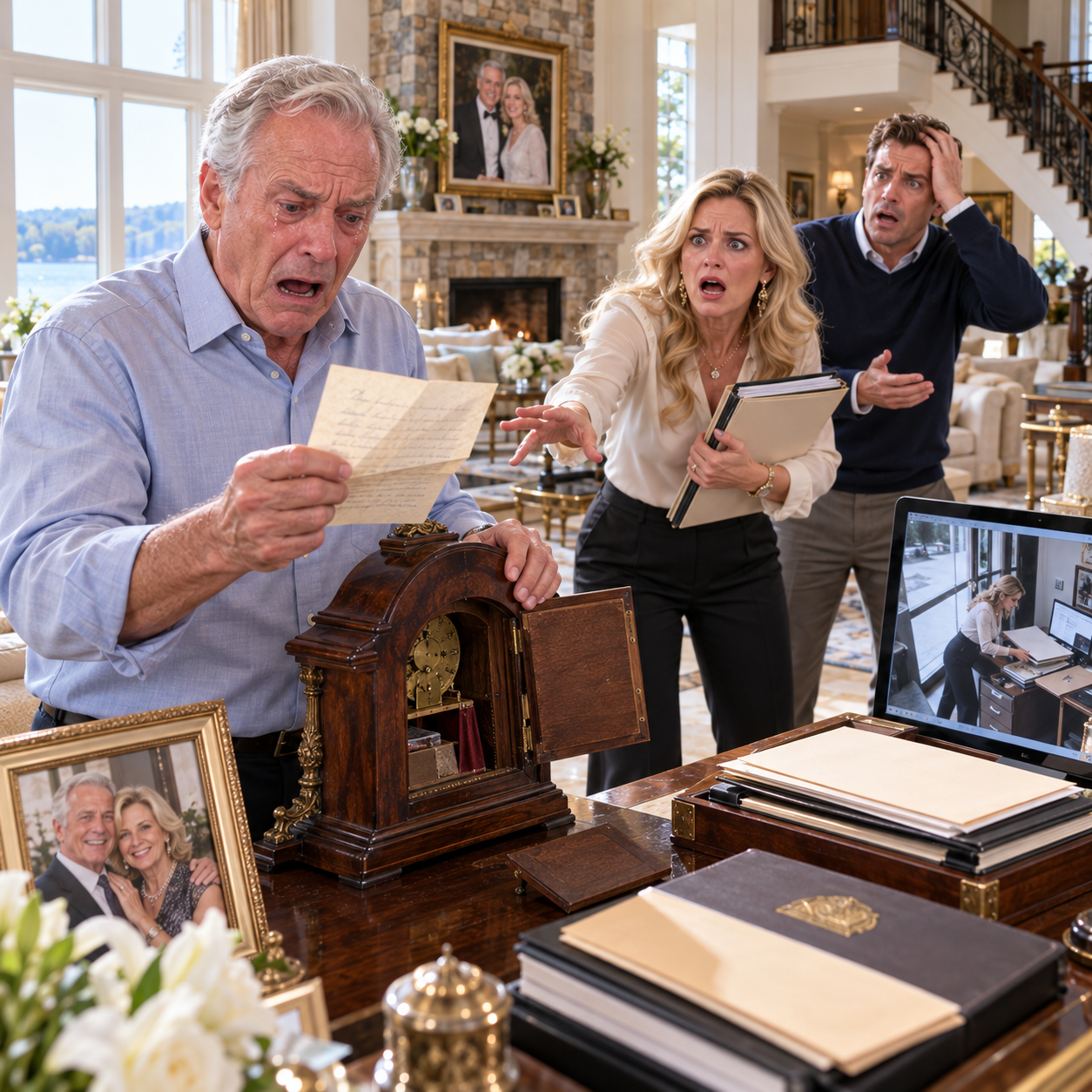
I yanked my late wife’s clock off the shelf after watching my daughter-in-law rifle through my insurance files on a hidden camera. Marissa had been meeting a property attorney and discussing my health like a deadline. My son called her loving. I pried open the clock’s back, found a false panel, and pulled out Helen’s handwriting. “If somebody starts turning Owen’s love into leverage, protect him.” My hands shook. My wife had been dead eight years—and she’d seen this coming.
### Part 1
People who walk into an old clock shop usually notice the silence first, but they are wrong about that. My shop has never been silent. It clicks, hums, settles, chimes, and breathes through hundreds of tiny mechanisms that never agree on the exact second, and after forty years behind the same walnut workbench, I can tell when something is wrong simply because one sound falls half a beat out of place.
My name is Walter Brennan, I am sixty-five years old, and I have owned Brennan Clock & Watch Repair in downtown Asheville, North Carolina, since I was twenty-seven. My late wife, Helen, kept the books, painted the gold lettering on the front window, remembered every customer’s birthday, and somehow tolerated the fact that I believed a perfectly organized drawer was one of civilization’s greatest achievements. She died eight years ago after a fast illness that gave us almost no time to understand what was happening, and for years afterward I kept finding pieces of her in stupid places: a grocery list behind the refrigerator, a scarf in the hall closet, her handwriting on an invoice she had corrected in red ink.
The one thing I never touched was a fruitwood bracket clock she restored during the last year of her life. Helen had never been much of a clockmaker, but one summer she suddenly insisted I teach her. She spent three weekends dismantling that old English movement, muttering at tiny screws and celebrating whenever she managed to reseat a spring without sending it across the room. When she finished, she placed the clock on the shelf above my bench and said, “This one stays here.”
I asked why.
She smiled. “You’ll understand when you need to.”
At the time I thought illness had made her sentimental. I kissed her forehead and left the clock exactly where she wanted it. For eight years it ticked above my head while I repaired other people’s family heirlooms and quietly tried not to think about mine.
Our only son, Owen, was thirty-five by then. He was a structural engineer, thoughtful and dependable, the sort of kid who had built bridges out of cereal boxes instead of forts. After Helen died, he came every Sunday morning with coffee and biscuits, and those quiet breakfasts probably saved me from becoming one of those widowers who slowly disappears inside his own routines.
Then he met Marissa Cole.
The first time Owen brought her into the shop, she wore a cream coat, pale pink nails, and perfume that smelled expensive enough to have a mortgage. She shook my hand warmly and said, “Walter, this place is incredible. Owen never told me the building itself was this beautiful.”
I remember that sentence because she noticed the building before she noticed the clocks.
Marissa worked in commercial redevelopment. She talked about “unlocking value,” “adaptive reuse,” and “underperforming properties” with the casual confidence of somebody describing weather. While Owen proudly showed her the workshop, I watched her eyes move from the front display cases to the register, then the staircase, the ceiling height, the rear entrance, and finally the framed deed hanging near my office.
She was not admiring the room. She was measuring it.
I told myself I was being unfair.
Owen loved her. That mattered more than my instincts.
They married the following September at a vineyard outside town. Owen cried when she came down the aisle, and I cried because Helen should have been sitting beside me making sarcastic comments about the flowers. Marissa looked radiant. Everybody toasted the future. For several months, I convinced myself the uneasy feeling I had carried since that first meeting was nothing more than an old man becoming suspicious of change.
Then Marissa began asking questions.
“Have you ever had the building appraised?”
“Do you have a retirement plan?”
“Would Owen inherit the business?”
“Have you considered selling while downtown values are high?”
Each question arrived wrapped in concern. She worried about the stairs. She worried about my blood pressure. She worried that I worked too much. She worried Owen would someday be overwhelmed by “estate complications.”
Owen had never worried about any of those things until she did.
The first real alarm came from my assistant, Ruth Delgado, who had worked with me for twelve years and possessed the useful habit of distrusting anyone who smiled too continuously.
One afternoon I returned from picking up replacement parts and found Ruth standing behind the counter with her arms crossed.
“Your daughter-in-law stopped by.”
“What did she want?”
“Said she needed the restroom.”
I looked toward the back hallway.
Ruth lowered her voice. “She spent ten minutes by your desk.”
Nothing appeared missing, but my insurance file sat slightly higher than usual and the second drawer did not close with its normal resistance. Small things mean nothing to most people. To a clockmaker, small things are where the truth usually lives.
I said nothing to Owen. Instead I bought a green notebook and began writing dates.
May 6. Marissa entered workshop while I was absent.
May 21. Asked Owen whether I had updated my will.
June 3. Asked me whether property could be transferred before retirement.
June 18. Owen canceled Sunday breakfast. Said Marissa wanted them to “focus on their own future.”
The notes bothered me because they formed a sequence: value, ownership, health, transfer, distance.
Then one Saturday, I arrived early at Owen’s house for a cookout and heard Marissa talking through the open kitchen window.
“I’m not being cruel,” she said to someone on the phone. “I’m being realistic. Walter is sixty-five, he has blood pressure issues, and eventually the property becomes Owen’s problem.”
I stopped with my hand on the side gate.
There was a pause.
“No, Owen isn’t ready to talk about selling. He gets sentimental because of his mother. But sentiment changes when responsibilities become real.”
I backed away before she could see me.
Owen stood in the backyard lighting charcoal, completely unaware that his wife was discussing my death like an inconvenient step in a development schedule.
That evening I called Calvin Price, a retired county investigator I knew through a customer.
“I need you to look into someone quietly,” I told him.
“Who?”
“My daughter-in-law.”
There was a silence before he answered.
“That’s usually not a sentence that ends well.”
“I know.”
Two weeks later, Calvin came to the shop after closing with photographs showing Marissa meeting repeatedly with a property attorney named Rebecca Sloan. Owen was never present.
Rebecca specialized in commercial transfers, estate disputes, and redevelopment deals.
“That doesn’t prove anything,” Calvin warned.
“No,” I said. “But it tells us what question to ask next.”
The very next afternoon Ruth called while I was repairing a grandfather clock at a customer’s home.
Her voice was barely above a whisper.
“Walter, she’s here again.”
“Marissa?”
“She said she needed the restroom. She’s in your office right now.”
I felt something inside me become perfectly still.
“Don’t confront her.”
“What should I do?”
“Nothing. Let her leave.”
I hung up, opened the security application Calvin had installed on my phone three days earlier, and watched the hidden workshop camera come alive.
There was Marissa.
She walked directly to my desk.
She opened the insurance drawer.
She photographed three pages.
Then she closed the drawer, turned toward my workbench, and slowly looked up at Helen’s bracket clock.
For almost thirty seconds she stood beneath it.
Then she reached up and lifted it from the shelf.
My hands went cold.
She turned the clock once, examined the bottom, and carefully replaced it.
She did not know what was inside.
The worse realization was that neither did I.
That night, after the shop was locked and the street outside had gone quiet, I stood beneath Helen’s clock and heard her voice from eight years earlier as clearly as if she were behind me.
“You’ll understand when you need to.”
For the first time since she died, I took the clock down.
And when I opened the back and noticed that the wood grain beneath the movement did not quite match, I realized my wife had left me something she had never intended anyone else to find.
### Part 2
The hidden panel released when I pressed two tiny brass clips against the inner rails. Helen had built it beautifully, so cleanly that even I had worked beneath it for eight years without noticing. Under the false floor lay a plastic sleeve containing a folded letter, several photocopied records, handwritten names, and an old county filing.
My fingers began shaking before I opened the letter because I recognized Helen’s handwriting immediately.
Walter, if you are reading this, then something has finally made you suspicious enough to look.
I sat down.
Helen explained that during the months before her death she had become uneasy about Marissa. Not because she disliked her, she wrote, but because she had spent thirty years balancing books and watching people negotiate, and she knew the difference between someone admiring what another person had built and someone studying how to acquire it.
She had quietly researched Marissa’s professional history.
Years earlier, Marissa had been connected to a redevelopment proposal involving an elderly widower’s property outside Hendersonville. Nothing criminal had been proven, but the man’s daughters had challenged the transaction after discovering private discussions about his assets and future incapacity. The dispute had settled quietly.
One of the names associated with that case was Rebecca Sloan.
The same attorney Marissa was meeting now.
Helen’s final paragraph hurt more than the rest.
You fix things after they break, Walter. That is what makes you good at your work. But this time, please do not wait for something to break. If somebody starts turning Owen’s love into leverage, protect him even if he is angry with you for doing it.
I read that sentence four times.
The next morning I took copies to my attorney, Martin Keene. He had handled Helen’s estate and mine for nearly twenty years, and when he finished reading, he removed his glasses and stared at the pages.
“This is not evidence of current wrongdoing,” he said.
“I know.”
“But it gives us a trail.”
Within forty-eight hours Martin had begun restructuring everything Marissa seemed interested in. My will was updated. The building was moved under a restricted family trust with independent oversight. No spouse of Owen’s could compel a sale, borrow against the property, or gain management authority through marriage. Any future transfer required independent counsel and preservation conditions protecting the shop.
I felt strange signing those papers. Relieved, yes, but also ashamed that my marriage, my son, and Helen’s memory had become clauses and signatures.
Calvin kept investigating.
What he found was worse.
Marissa had asked an acquaintance connected to an insurance contractor about my coverage and health-related records. We could not yet prove exactly what she had obtained, but an internal inquiry showed unauthorized activity connected to my policy number.
Meanwhile Owen became more distant.
“Dad, Marissa thinks you’re avoiding reality.”
“Dad, maybe keeping the shop exactly the same isn’t the same as honoring Mom.”
“Dad, wouldn’t it be easier if I understood your estate plan?”
None of those sentences sounded like Owen.
One evening he came to the shop after work and sat opposite me while I cleaned an antique pocket watch.
“Marissa thinks you don’t trust her,” he said.
I continued working. “Do you?”
He frowned. “That’s not what I asked.”
“No. It’s what matters.”
His shoulders tightened. “She’s my wife.”
“And I’m your father.”
“I know.”
“Then why does every conversation suddenly sound like somebody placed you between us?”
His face changed, because somewhere inside him he knew exactly what I meant.
“I’m tired of being in the middle.”
“You weren’t born there, Owen.”
He left angry.
I let him.
That was one of the hardest things I have ever done.
Two days later, the hidden camera caught Marissa entering the workshop again and photographing my private documents. This time the video was unmistakable. She checked property records, insurance paperwork, and a folder containing correspondence from Martin.
Afterward, Calvin recorded a legally obtained conversation outside the café where Marissa met Rebecca.
Marissa’s voice said, “If Walter doesn’t formalize anything soon, the cleanest path is through Owen later. He’s sentimental, but he can be persuaded if it’s framed as protection.”
Rebecca answered, “You need to stop talking about his father’s health like a timetable.”
Marissa laughed.
“You know what I mean.”
I listened once.
I did not need to listen twice.
I called Owen.
“We need dinner Thursday.”
He hesitated. “With Marissa?”
“Yes.”
“What’s this about?”
“The future of the shop.”
I heard him exhale.
“Finally.”
I almost told him everything then. Instead I said, “Bring her.”
Thursday evening we met at a downtown restaurant with city lights glowing beyond the windows. I arrived carrying Helen’s bracket clock wrapped in canvas. Marissa noticed it immediately.
“That’s beautiful,” she said. “Is that Helen’s?”
“Yes.”
Owen touched the fruitwood case gently when I placed it on the table.
“I remember this.”
“You remember the outside.”
His eyes met mine.
“What does that mean?”
I opened the back panel.
Marissa’s expression changed before I removed a single paper.
It lasted less than a second, but I saw it.
I placed Helen’s letter, Calvin’s photographs, the workshop stills, the property documents, and the insurance inquiry on the white tablecloth.
Marissa stared at them.
Owen stared at me.
“What is this?” he whispered.
“This,” I said, “is why I stopped answering questions about my estate.”
Marissa recovered first.
“Walter, whatever story you’ve constructed—”
“I have video of you photographing my private files.”
Owen turned toward her.
She went silent.
“I have records of your meetings with Rebecca Sloan. I have an internal inquiry connected to unauthorized access involving my insurance information. And I have a recording of you calling my son ‘persuadable’ while discussing how my property could eventually be transferred.”
Owen’s face lost all color.
“Tell me he’s lying,” he said.
Marissa looked at him.
Then at me.
Then at the documents.
“It isn’t what it looks like.”
Owen let out a strange hollow laugh.
“That sentence only works when nobody has pictures.”
She reached toward him. “Owen, I was protecting our future.”
He moved his hand away.
“From what?”
“From chaos. From your father refusing to plan. From an emotional attachment to a property that could determine our financial security.”
There it was.
Not Dad’s shop.
Not Mom’s legacy.
Property.
Security.
Asset.
I watched understanding move through my son like a slow fracture.
Then I unfolded Helen’s letter.
“Owen,” I said, “your mother saw the beginning of this before she died.”
His eyes filled.
Marissa’s expression hardened.
“You’re using a dead woman against me?”
“No,” I said quietly. “She protected us before either of us knew we needed protecting.”
Owen read the first page.
Then the second.
By the time he reached Helen’s final paragraph, his hands were shaking.
Marissa began speaking again, faster now, but he raised one hand.
“Stop.”
She actually stopped.
He looked at her with an expression I had never seen on my son before.
“What exactly were you waiting for to happen to my father?”
### Part 3
Marissa insisted she had never wanted anything to happen to me. She said she was only planning responsibly, only exploring possibilities, only trying to prevent Owen from inheriting a complicated business and an old downtown property without preparation. She used the words responsible, practical, future, protection, and stability so many times they stopped sounding like English.
Owen listened without interrupting.
Then he asked one simple question.
“Why didn’t you tell me?”
Marissa blinked.
“If all of this was for us,” he continued, “why didn’t I know about the lawyer, the property estimates, the insurance questions, or you going through Dad’s files?”
She looked toward me as if my presence were the problem.
“Because I knew you’d get emotional.”
Owen leaned back.
That was the moment something died.
Not loudly. No shouting. No broken glass. Just the look on my son’s face changing from hurt to clarity.
“You didn’t think I was your partner,” he said. “You thought I was another obstacle to manage.”
“That is not fair.”
“You called me persuadable.”
“That was taken out of context.”
“What context makes that better?”
She had no answer.
I told Marissa she was no longer permitted inside my shop, workshop, or office. Martin had already prepared written notice restricting her access to my business records, and all further questions regarding the property would go through counsel.
She stared at me.
“You had all of this ready.”
“Yes.”
“You planned this dinner.”
“Yes.”
“You humiliated me.”
“No. I documented you.”
That made her angry.
For the first time since I met her, the polished voice disappeared.
“You’re obsessed with that shop,” she snapped. “You’ve kept Owen orbiting your grief for years. You act like an aging storefront is sacred because your wife painted a sign.”
Owen stood up.
“Don’t talk about Mom.”
Marissa stared at him.
He removed his wedding ring.
Not dramatically. He simply slid it from his finger and placed it beside his untouched dinner.
“I’m not coming home with you.”
Her face went completely still.
“Owen.”
“No.”
“You’re throwing away our marriage because your father spied on me.”
“I’m ending it because the spying proved he needed to.”
She left alone.
Afterward Owen and I sat at that table until the restaurant was almost empty. I let him read parts of Helen’s letter, though I kept the private sections between my wife and me.
“I brought her into your life,” he said.
“She brought herself.”
“I defended her.”
“Yes.”
He flinched.
I hated hurting him, but I refused to soothe the truth until it became useless.
Then I added, “You missed things. That doesn’t mean you deserved what she did.”
He stared at the table for a long time.
At eleven forty-seven that night he called me.
“She packed before dinner.”
I sat upright in bed.
“What?”
“Half her clothes are gone. Passport gone. Jewelry gone.”
His voice sounded empty.
“And Dad?”
“Yes?”
“I found her files.”
He arrived at the shop after midnight carrying a banker’s box.
Inside were printed property assessments, emails with Rebecca Sloan, projected sale values, and a spreadsheet labeled Estate Transition Scenarios.
One column was marked Barriers.
Walter emotionally attached to shop.
Owen resistant because of mother.
Will/trust status unclear.
Monitor health changes.
I had spent months preparing myself for ugly evidence. Nothing prepared me for seeing my life reduced to spreadsheet rows.
Owen read the line about himself twice.
“She made me a barrier.”
“Yes.”
“And you were a health variable.”
I did not answer.
The next email was worse.
If Walter does not formalize within the next year, leverage after transfer may be stronger through Owen. He responds to fairness and protection language.
Owen folded the page once.
Then again.
“I keep wondering which parts of my marriage were real.”
I sat across from him.
“You may never know.”
“How do you live with that?”
“You stop trying to rescue every memory. Some were probably real because you were real in them. That is enough.”
His eyes finally filled.
“What do I do tomorrow?”
“You call a divorce attorney.”
He nodded.
No argument.
No hope that Marissa might explain it better in daylight.
The following morning she parked across from my shop for nearly an hour. Owen arrived while she was there. They spoke on the sidewalk for several minutes before he came inside and placed his wedding band in a small box on the counter.
“She says lawyers are making everything worse.”
“Of course.”
“She says I’ll regret destroying our marriage over a misunderstanding.”
I looked at him.
“Do you think it was a misunderstanding?”
“No.”
That mattered.
A week later Marissa came into the shop while Ruth was at lunch.
I was at my bench.
“You need to leave,” I said.
“I want ten minutes.”
“No.”
She remained in the doorway.
“You think I’m some monster.”
“I think you made spreadsheets about my death.”
Her composure finally cracked.
“You have no idea what it is like being the only adult in a family willing to plan realistically.”
“You keep saying realistically as if it means secretly.”
Her jaw tightened.
“Owen deserved a future outside this mausoleum.”
I stood up.
The room became very quiet except for the clocks.
“This shop gave your husband a childhood. His mother worked here. I built my life here. You saw square footage.”
“You could have created enormous value.”
“And there it is.”
She stopped.
“You never understood why Owen loved this place,” I said. “You only understood what it might sell for.”
She looked toward Helen’s clock.
Then back at me.
“I did love him.”
“Maybe you did. But you loved leverage more.”
She left without another word.
That evening Owen came by with takeout and sat at my workbench while I repaired an old regulator.
“I need you to know something,” he said.
“What?”
“I’m not going back.”
I put down my screwdriver.
He continued before I could answer.
“I don’t care if she apologizes, cries, blames stress, says she was protecting us, or says she has changed. Mistakes are things you regret after doing them. This was a system. She built a system.”
For months I had worried loneliness would pull him backward.
That sentence ended the worry.
The divorce papers were filed the following week.
Marissa requested mediation language leaving room for reconciliation after a cooling-off period.
Owen refused.
No reconciliation clause.
No future discussion.
No cracked door left waiting for nostalgia.
On Sunday morning he arrived at my house carrying coffee and biscuits, the same way he used to before Marissa slowly rearranged our lives.
We sat at Helen’s old kitchen table.
After breakfast he looked at me and said, “Will you teach me how Mom cleaned clock movements?”
I stared at him.
“You’re an engineer.”
“I know.”
“You’ll try to overpower the screws.”
“Probably.”
I smiled for the first time in what felt like months.
“Then we have a lot of work to do.”
### Part 4
Owen’s first lesson at the bench lasted nineteen minutes before he sent a tiny spring skittering across the work mat because he breathed too hard.
He looked horrified.
“Did I break it?”
“No.”
“Was it expensive?”
“No.”
“Then why are you looking at me like that?”
“Because your mother would have mocked you for a month.”
He laughed.
That was how we started rebuilding our Sundays.
Not with speeches about healing. With coffee, screwdrivers, dirty movements, and Owen slowly learning that clock repair rewards patience more than intelligence. He still worked as an engineer, but he came to the shop every Sunday and eventually several evenings a month. Ruth taught him customer service because, according to her, I had spent forty years becoming “technically excellent and socially questionable.”
“Hope first,” she told him. “Facts second.”
Owen actually wrote it down.
The divorce took several months.
Marissa fought about language more than money. She wanted documents describing the situation as a breakdown in communication. Owen refused. She wanted wording that left open the possibility of future reconciliation. He refused that too.
When the divorce became final, he called me from the courthouse.
“It’s done.”
“How do you feel?”
He was quiet for several seconds.
“Like opening a window after somebody burned something in the kitchen.”
I understood exactly.
We did not celebrate the end of his marriage. We marked the end of the danger.
Soon afterward I brought him to Martin’s office and showed him the trust documents protecting the shop. Owen would eventually have the opportunity to become steward of the property, but not automatic owner with unlimited authority. The building could not be sold impulsively. No spouse could control it through marriage. Preservation requirements protected the business Helen and I had built.
Owen read everything carefully.
“You didn’t just leave it to me.”
“No.”
He nodded slowly.
“I’m glad.”
That surprised me.
He looked at the documents again.
“If you had handed me everything right after the divorce, I’d never know whether I wanted it or just felt guilty.”
Helen would have liked that answer.
Over the next year Owen reduced his engineering schedule and spent more time at the shop. He learned inventory, vendors, customer intake, repair estimates, and the difficult art of telling somebody that Grandpa’s watch was worth fifty dollars and still worth saving because value and price are not the same thing.
One afternoon a woman brought in a box containing her late father’s watches. She looked overwhelmed. Her little daughter waited near the front window holding a stuffed fox.
Owen opened the box carefully.
“We can go through these one at a time,” he told her. “Some might be repairable, some might be better preserved as they are. You don’t have to decide anything today.”
Ruth looked at me over her glasses.
Hope first.
Then facts.
I pretended there was dust in my eye.
The following autumn, Owen asked if we could restore Helen’s faded gold lettering on the front sign.
My first reaction was immediate.
“No.”
He waited.
Then he said, “Not replace it. Preserve it.”
That changed everything.
We removed the old sign together and spent two days touching up the gold using photographs of Helen’s original work. Owen concentrated so hard his tongue pressed against his cheek exactly the way hers used to.
When we rehung it, evening light caught the letters and made them glow without making them look new.
Owen stepped onto the sidewalk.
“Well?”
I stood beside him, smelling damp leaves and distant woodsmoke.
“It looks like home.”
He nodded.
Marissa contacted us once after the divorce, through attorneys. Her message said she hoped “time would bring perspective” and that one day Owen might recognize the difference between poor judgment and bad intentions.
Owen did not answer.
Neither did I.
There was no reunion years later, no emotional coffee meeting, no holiday forgiveness, no sentimental scene where everybody admitted mistakes and hugged. Some betrayals happen once in anger. Others are researched, calculated, hidden, documented, and repeated. Forgiving those things is not the same as healing from them.
Owen healed by moving forward.
So did I.
Two years after everything happened, I was sixty-seven and using the blood pressure cuff Owen bought me despite complaining about it every time. He spent three days a week at the shop while maintaining enough engineering work to keep that part of himself alive. He had become good with basic movements, though he still rushed when excited.
A school librarian named Claire started appearing near closing time because her late father’s watch supposedly required “one more adjustment” every few weeks. Eventually the watch worked perfectly.
She kept coming.
Owen thought nobody noticed.
Everybody noticed.
I stayed out of it.
One lesson was enough.
Every Sunday morning I still arrive before him.
I unlock the front door while the street is quiet and the bakery down the block is beginning to send the smell of warm bread into the cold air. I switch on the workshop lamp, walk beneath the shelf, and take Helen’s bracket clock down.
Her letter remains inside the hidden compartment.
I have never moved it.
Some things belong exactly where the person who loved you intended them to wait.
I wind the movement until I feel the proper resistance, close the case, and return it to the shelf.
Tick.
Tick.
Tick.
For years I thought Helen had hidden evidence inside that clock.
I understand now that she hid something more important.
She hid permission for me to trust myself.
Marissa believed our legacy was real estate. She believed the building mattered because downtown property had become expensive and a family business was simply an asset waiting for the right transition.
She never understood what Helen understood from the beginning.
Legacy is not the building.
It is not the deed.
It is not the sale price, the trust documents, or even the clocks.
Legacy is knowing what deserves protection without turning that protection into control. It is teaching your son the difference between inheritance and stewardship. It is refusing to let guilt become love or greed disguise itself as concern.
Most of all, it is knowing when something cannot be repaired because repairing it would require pretending the damage never revealed the truth.
Around eight every Sunday morning, the front bell rings.
“Coffee’s here,” Owen calls.
I hear him moving through the front room while a hundred clocks continue their uneven conversation with time. Sunlight reaches Helen’s restored lettering on the window. The old bracket clock ticks over my shoulder.
And for the first time in years, nothing in the room sounds out of place.
THE END!
Disclaimer: Our stories are inspired by real-life events but are carefully rewritten for entertainment. Any resemblance to actual people or situations is purely coincidental.


