
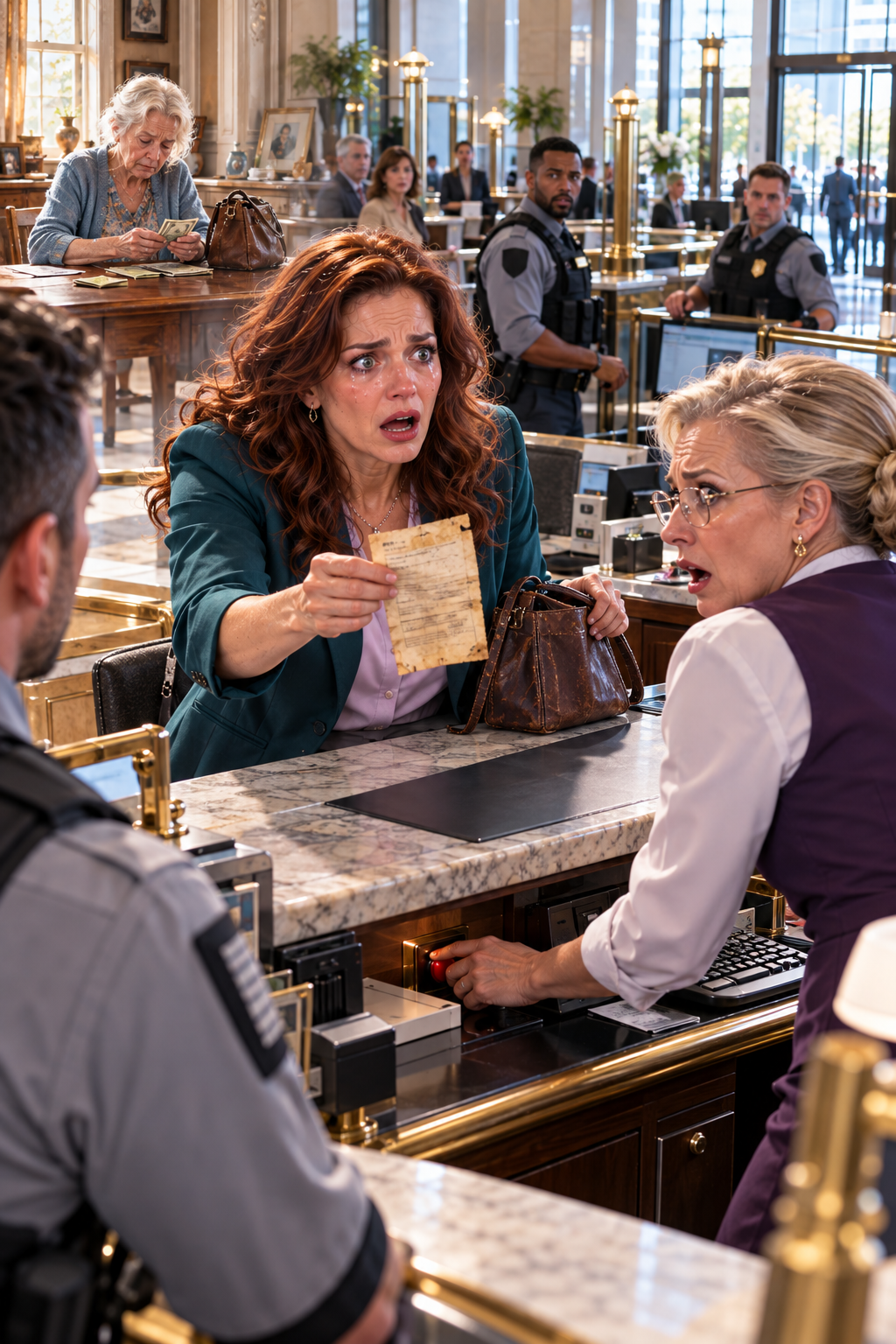
Going Through My Late Mother’s Purse, I Found An Old Bank Receipt. The Balance Was $67 Million. But She Always Said She Had $300 To Her Name. When I Showed It At The Bank, The Teller Turned Pale And Pressed The Alarm.
My mother spent thirty-eight years cleaning offices at night, wearing secondhand coats and pretending she didn’t need hearing aids. When my furnace broke, she told me she had only $300, and my brother said I should stop asking her for help. Three months after her funeral, I found a bank receipt showing $67 million hidden inside her purse. My brother went silent when I mentioned it. Two days later, a bank teller pressed a hidden alarm, and a detective showed me a document that changed everything.
Part 1
The first thing I noticed about my mother’s apartment after she died was how loud the refrigerator sounded. It had always rattled, but without her television playing old game shows or her slippers scraping across the kitchen linoleum, that little motor seemed to fill every room. I stood inside the doorway holding a cardboard box from the funeral home, looking at the folded dish towel hanging from her oven handle, and couldn’t bring myself to put anything away. My mother, Estelle Wren, had been dead for eleven weeks, and I was still expecting her to come out of the bathroom complaining that somebody had moved her reading glasses.
My name is Audra Wren, and I was fifty-four when all this happened. I drove a school bus in Duluth, Minnesota, on a route that started before sunrise and ended with forty-three children delivered to their front doors, whether they remembered to say goodbye or not. My daughter, Rosalie, was twenty-nine and worked as a nurse at a rehabilitation hospital, usually taking whichever shifts paid a little extra. Between the two of us, we understood overtime, frozen dinners, and the particular dread of hearing an unfamiliar noise coming from an old car.
My mother understood those things better than either of us. She had cleaned the offices of the Breakwater Building on Superior Street for thirty-eight years, beginning after my father was lost aboard a freight vessel on Lake Superior. He was thirty-one, she was thirty-two, and I was seven when two men in dark coats came to our door one November morning. My younger brother, Bram, was four and kept asking why the men wouldn’t take off their shoes.
The shipping company’s final payment barely covered the outstanding bills and a used Chevrolet. My mother worked nights because those were the hours she could get, and because the neighbor downstairs agreed to watch us until we were old enough to stay alone. She bought our winter boots a size too large and stuffed newspaper into the toes until we grew into them. When she developed trouble hearing in her sixties, she refused the hearing aids the specialist recommended, claiming the price was ridiculous for someone who lived alone.
I had believed every word she said about money. The previous February, my furnace failed during a week when the temperature didn’t rise above ten degrees, and I called her while standing in my kitchen wearing two sweatshirts. She listened while I explained the repair estimate, then said, “Honey, I’ve got about three hundred dollars until my next check, but you can have it.” I told her to keep it, borrowed the money elsewhere, and spent the next six months paying it back.
Rosalie had made similar sacrifices. She qualified for a university nursing program at eighteen, but the financial aid package left a gap I couldn’t cover, so she enrolled closer to home and worked nights while completing her education. It took seven years, and she graduated with $39,600 in student loans. At her pinning ceremony, my mother cried so hard she had to borrow a tissue from the woman beside her, then insisted on taking six photographs with an old digital camera.
Bram was different from us. He had moved to Arizona at twenty-five, sold recreational vehicles for a while, then drifted through a succession of jobs that always sounded more promising over the telephone than they turned out to be. He called our mother often when he needed something and rarely when he didn’t, but she loved him with the same fierce loyalty she gave everybody. Once, when I asked how much money she had sent him that year, she told me, “Audra, keeping score doesn’t make people love each other better.”
At her funeral in August, Bram cried openly while I felt too numb to cry at all. After the burial, he followed me into the parking lot and asked whether I’d collected her purse from the funeral director. I said I had, and he gripped my elbow harder than necessary. “Don’t throw it away,” he said. “Mom kept everything in that thing.”
That afternoon, another man approached me in the funeral home’s quiet vestibule. He was tall, carefully dressed, and carried a leather portfolio, with a heavy gold ring bearing the letter B on his right hand. He introduced himself as Cyrus Halden, an adviser representing people who had known my mother through her old workplace. He explained that she might have possessed some historical business documents, and his clients were prepared to offer $40,000 for their return.
I thought he had mistaken me for someone else. When I asked why old paperwork was worth so much, he smiled and said wealthy families sometimes attached unusual sentimental value to their histories. He gave me his card, expressed his condolences, and left before I could ask another question. By October, he’d called three times, and his offer had risen to $95,000.
I was thinking about those calls when I finally opened my mother’s purse that Saturday in November. It was brown leather, worn almost gray at the corners, with a broken clasp held shut by a blue rubber band. Inside were peppermint candies, grocery coupons, a bus transfer, a lipstick without its cap, and a small brass key bearing the stamped number 308. The lining had separated along one edge and been repaired with crooked black stitches, which bothered me because my mother could mend a coat so neatly that nobody could find the seam.
I turned the purse over in the afternoon light and examined the stitching. It looked rushed, and several threads had been pulled so tight that the fabric puckered around them. Using the tiny scissors from her sewing basket, I carefully opened the seam and felt something folded between the lining and the leather. It was a narrow strip of bank paper, creased twice and beginning to fade.
The heading read Iron Harbor Trust, Duluth, Minnesota, and the date was June 24. Below my mother’s name was an account number, followed by a balance of $67,284,519.06. I read the number three times before I could make myself count the digits properly. My mother, who once walked four miles through snow rather than pay for a taxi, had held an account worth more than sixty-seven million dollars.
On the back, in her familiar cramped handwriting, she had written a message.
“Audra, don’t sign anything from the man with the gold ring. Ask for Eamon Finch at the bank, and show him this. I’m sorry I couldn’t tell you sooner. I was going to explain everything on my birthday.”
Her birthday was September 2. She had died on August 19.
I sat in her recliner until the windows reflected the dark room behind me. Then I called Bram, intending to ask whether he knew anything about the money, but his voice changed the moment I mentioned a bank receipt. He said he was driving, asked me not to discuss it over the telephone, and ended the call before I could answer. I barely slept that night, and on Monday morning I took the receipt downtown.
The young teller at Iron Harbor Trust greeted me pleasantly and asked how she could help. When I explained that my mother had died and showed her the receipt, she typed the account number into her computer, read whatever appeared, and stopped moving. Her eyes flicked toward the doors, then returned to me as her hand disappeared beneath the counter. I heard a small click, and four minutes later two police officers entered the lobby and asked me to come with them.
Part 2
The conference room smelled of lemon furniture polish and coffee that had been sitting on a warmer too long. A policewoman took my identification and asked me to remain seated while someone from financial investigations came downstairs. Nobody handcuffed me, but when I asked whether I could leave, she said, “We’d really prefer you stayed until the detective arrives.” That was the first time I understood that the money in my mother’s account might be evidence of something serious.
Detective Petra Salcedo arrived carrying a thick folder and wearing a dark green jacket over an ordinary blouse. She was in her forties, with short black hair and a manner that suggested she had little patience for unnecessary drama. She asked how I’d discovered the receipt, whether anyone had offered me money for documents, and whether I knew an attorney named Milton Carrow. I told her about the purse, Cyrus Halden, and the offer that had almost tripled since the funeral.
She listened without interrupting, then opened her folder. Inside was a copy of a will dated August 6, thirteen days before my mother died, leaving her entire estate to the Breck Heart Initiative, a charitable organization based in Minneapolis. The document bore my mother’s signature, the signatures of two witnesses, and a notary seal belonging to Milton Carrow. Detective Salcedo placed a second sheet beside it and told me Carrow had died the previous year.
“Someone used the seal of a deceased notary to authenticate this document,” she said. “The foundation submitted it as part of an effort to obtain control of your mother’s accounts, and the bank reported the discrepancies.” When I told her I’d never heard of the foundation, she watched my face and asked whether my brother might have known about it. I remembered Bram refusing to discuss the receipt, and suddenly the room felt smaller.
My mother had left an old will in her kitchen drawer dividing whatever she owned between Bram and me. I explained that to the detective, who asked whether I knew of anything more recent. That reminded me of another card I’d found inside the purse, belonging to Daphne Kittredge, an elderly estate attorney who had once helped my mother settle my father’s affairs. On the back was an appointment date from July, and I asked permission to telephone her.
Daphne arrived with an umbrella, a battered briefcase, and the irritated expression of someone who had been interrupted while doing something important. She looked at the suspicious will, then removed a certified document from her own folder. My mother had signed it on July 11, leaving her estate equally to her children and appointing me executor. It included a handwritten statement that she had never agreed to transfer her property to a charitable foundation and feared someone might produce papers claiming otherwise.
“She came to me frightened,” Daphne explained, sitting beside me. “She said a businessman had visited her apartment and spoken as though her property already belonged to him.” The detective studied the documents, then asked why my mother hadn’t reported the encounter immediately. Daphne said she’d encouraged her to do exactly that, but Estelle wanted the legitimate will secured before taking another step.
A knock interrupted us. An elderly banker with silver hair and an untied scarf entered carrying a paper cup of water, and I recognized his name when Detective Salcedo introduced him. Eamon Finch had managed my mother’s account, and he told me he’d seen photographs of my school bus and Rosalie’s nursing graduation. He remembered my mother describing us with a pride so extravagant that I had to cover my mouth before I started crying.
Then Eamon explained where the money came from.
In 1982, my mother was cleaning a tiny rented office on the Breakwater Building’s sixth floor. Its occupant was Alden Breck, a young engineer developing an early portable system for detecting dangerous irregularities in a patient’s heartbeat. His wife had died unexpectedly two years earlier, and he had poured nearly everything he owned into the project. He slept under his desk, lived on vending-machine sandwiches, and sometimes worked so late that my mother had to ask him to lift his feet so she could mop.
She began bringing him soup twice a week. He taught her the names of the tools scattered across his desk, while she taught him how to make a meal last three days without tasting like leftovers. When a lender threatened to seize his equipment unless he repaid $6,000, she gave him the remaining money from my father’s death settlement. Alden refused to accept it as a gift, so his newly formed company issued her a three-percent ownership interest, recorded in its original shareholder ledger and later approved by its board.
My mother put the certificate away and returned to cleaning.
Breck Medical Instruments developed slowly, eventually supplying monitoring equipment to hospitals across the country. Alden died in 2010, and his son, Leland, assumed control. Earlier that year, a larger medical technology company had agreed to purchase Breck Medical Instruments for approximately $3.4 billion. During its due diligence, lawyers uncovered my mother’s original ownership interest in records that didn’t match the company’s newer shareholder books.
Eamon said the buyer required the ownership discrepancy to be resolved before closing. Independent examiners authenticated Alden’s signature, and the old board minutes confirmed the shares had been authorized. My mother received her share of the sale, and after estimated taxes and other adjustments, just over $67 million went into the account she opened with him in May. She had barely touched it.
I thought about all the winters she wore gloves inside her apartment and the afternoons Rosalie spent working at a nursing home instead of attending classes with her friends. “She had the money for three months,” I said, struggling to keep my voice steady. Eamon nodded and admitted he’d urged her to speak to her family, but she feared the dispute wasn’t over. “She kept saying there was something wrong with the old records,” he told me.
Detective Salcedo explained that the newest company ledgers had omitted my mother’s ownership for decades. If the omission was deliberate, Leland Breck had attempted to keep money that rightfully belonged to her, and the suspicious foundation was controlled by associates of his. Cyrus Halden worked for Leland as an outside adviser. The letter B on his ring suddenly made sense.
Daphne took me back to the bank the following morning to examine the safe-deposit box my mother had rented in June. The brass key from her purse opened box 308, which held the original share certificate, several old letters, and an envelope with my name written in blue ink. One letter from Alden thanked my mother for protecting his life’s work, and beneath his signature he’d added, “One hundred and twelve thermoses of soup, and I still owe you dinner.”
The letter addressed to me was much newer.
“Audra, I wanted to tell you and Rosalie everything at Brighton Beach on my birthday. I know what this money could have meant when you were younger, and I know it must hurt to learn about it now. I thought those shares were worthless for forty years, and when I finally understood, Leland Breck came to my kitchen demanding I give them to his foundation. He told me people like us couldn’t protect that kind of money, but I told him I’d protected two children on six dollars an hour.”
The rest of the letter described her visit to Daphne and begged me not to let anyone frighten me into signing away what Alden had given her. Beneath her signature was a final sentence, written so small I nearly missed it. “Ask Eamon about the distributions. I think they’ve been taking my money longer than anyone knows.”
Three days later, Detective Salcedo called me back to her office. She turned her computer toward me and displayed a surveillance photograph from a hotel restaurant near the Duluth waterfront. Cyrus Halden sat at a corner table with two coffee cups between him and another man, leaning forward in a conversation that looked private. The second man was my brother Bram, and according to the date stamped across the image, they had met six weeks after our mother’s death.
Part 3
I stared at the photograph until the restaurant’s patterned carpet became more familiar than my brother’s face. Bram was leaning toward Halden with his hands spread across the table, looking exactly as he did whenever he was trying to convince someone of something. Detective Salcedo asked whether I knew about the meeting, and I shook my head. She said it was evidence in an ongoing investigation and couldn’t tell me what the two men had discussed.
On my way home, I pulled into the parking lot of a closed grocery store and called Bram again. This time he answered, and I asked him directly whether he’d been meeting with people from Breck Medical Instruments. There was a long silence, followed by the sound of a vehicle passing close to his phone. “Audra, there are things I can’t explain right now,” he said, and when I asked whether he’d helped someone go after Mom’s money, he whispered, “I’m trying to put something right.”
I hung up before he could say anything else.
For most of my life, I’d been the person who corrected Bram’s mistakes. I paid his overdue electricity bill once when he was twenty-eight, drove through a snowstorm to collect him from an airport after a business arrangement fell apart, and listened to my mother defend him whenever he forgot her birthday. Now I wondered whether she had known something about him that I hadn’t. Worse, I wondered whether the fear in her final letter had anything to do with her own son.
Two days later, Cyrus Halden telephoned with what he called his client’s final proposal. He offered $250,000 in exchange for my mother’s company documents and my agreement not to challenge the foundation’s claim to her estate. His voice was reassuring, almost affectionate, as though he were helping a tired woman settle an irritating family matter. When I mentioned my lawyer, he warned that a prolonged legal dispute could exhaust my savings before the case reached a courtroom.
I told him I’d think about it and called Daphne immediately. She arranged a meeting with Detective Salcedo, who explained that Halden had been careful not to acknowledge any wrongdoing in his previous communications. His newest offer could give them an opportunity to understand whether he knowingly possessed a fabricated will and who had directed him to use it. They asked whether I would meet him in my kitchen while investigators monitored the conversation from nearby.
I spent Friday evening cleaning a house that was already clean. Rosalie had noticed I was distracted, but I had told her only that complicated paperwork was delaying the settlement of her grandmother’s estate. She came over after work with takeout from a Chinese restaurant, found me scrubbing the stove burners with an old toothbrush, and took the brush out of my hand. “Whatever this is, Mom, you don’t have to solve it by cleaning something,” she said.
I wanted desperately to tell her everything. Instead, I hugged her and asked whether she remembered Grandma’s chicken-and-wild-rice soup. She said she could still taste the pepper and see the little dent in the thermos lid. After she left, I sat at the kitchen table thinking that my mother’s kindness had traveled farther through our family than any amount of money ever could.
Halden arrived Saturday morning in a black sedan, wearing the same expensive coat he’d worn at the funeral. He carried a leather folder containing a cashier’s check for $250,000 and a document labeled Disclaimer and Release of Interest. The agreement required me to recognize the August will, surrender original records relating to Breck Medical Instruments, and abandon any competing claim to the bank account. He placed a polished silver pen beside the check and told me this would allow everyone to move forward.
I asked why my mother would leave her savings to strangers when she’d spent her life worrying about her children. Halden explained that Leland Breck had devoted decades to making his father’s company successful and believed the recently discovered shares represented a historical bookkeeping mistake. When I asked whether that gave him the right to claim my mother’s money, his patient expression thinned. “Your mother never contributed to the technology or managed the business,” he said. “She happened to be holding an old piece of paper.”
I told him my attorney believed the newer will had been manufactured. Halden leaned back and glanced toward the kitchen window before answering. “People outside the legal profession have a very romantic view of documents,” he said. “The important thing isn’t what somebody remembers signing, but what can be presented and defended.” I asked about Milton Carrow, and Halden’s fingers tightened around his coffee cup.
“That was an unfortunate detail,” he admitted. “The people preparing the paperwork should have checked the notary information more carefully.” He looked at me for several seconds, apparently deciding how much I understood. Then he said Leland had wanted the matter resolved before my mother’s death, but she had refused every arrangement presented to her.
“So this other will appeared afterward?” I asked.
Halden gave a small, impatient shrug. “Leland needed a document that would protect his father’s company, and someone supplied one. You’re not responsible for any of that, Audra, unless you insist on making it your problem.” He pushed the agreement closer and said, “Take the check. Your daughter could use it more than a lawyer could.”
I had been trying not to tremble, but hearing him discuss Rosalie made my anger break through the fear. I asked whether Leland had also decided that my mother didn’t deserve the annual payments from the company. Halden looked genuinely surprised, and then he smiled. “Your mother was more observant than we expected,” he said. “She started asking questions about those accounts after the acquisition, and that made everything considerably more difficult.”
Before he could say anything else, someone knocked sharply at the back door. Halden turned, expecting perhaps a neighbor, and instead saw Detective Salcedo enter with two officers. She identified herself, advised him that he was under arrest, and directed him to stand away from the table. His face reddened, but he made no attempt to argue.
Then Bram appeared behind the officers.
He looked thinner than he had at the funeral, with dark circles beneath his eyes. When he saw me, he stopped and lowered his head, and I understood that the photograph from the hotel had not told the entire story. Salcedo explained that my brother had been cooperating with investigators since September. The restaurant meeting had been recorded, and information Bram provided helped establish the connection between Halden and the fabricated will.
For a moment, relief nearly overwhelmed me. Then Bram asked whether we could speak privately, and the expression on his face warned me there was something worse coming. We sat at my kitchen table after the officers had taken Halden away, with two untouched cups of coffee between us.
“In July, a man from Breck’s company contacted me,” Bram began. “He said Mom had some investment paperwork they needed to review and that she wasn’t cooperating.” Bram had been behind on rent and had borrowed money from three different friends, so when the man offered him $4,000 for helping establish contact, he accepted. He provided her telephone number, confirmed when she was usually home, and told them she kept important papers in her purse.
I stared at him, remembering the crooked stitches in that purse. “You gave strangers information about her for four thousand dollars?”
“I didn’t know there were millions involved,” he said. “They told me it was an old stock dispute, and I thought she might have signed something she didn’t understand.” He rubbed his forehead and admitted he’d grown suspicious when our mother called him afterward, frightened by an encounter with Leland Breck. But instead of warning me, he avoided the subject because he didn’t want to admit what he’d done.
After she died, Halden contacted him again and offered considerably more money for access to her papers. Bram refused, then called the police and confessed to accepting the earlier payment. He’d been helping investigators ever since, partly because he was afraid that his own actions had put our mother in danger. I understood why he had concealed the investigation, but that didn’t erase what he’d done before it began.
“You could have told me you were worried about her,” I said. “You could have told Mom why those people knew so much about her.” Bram started apologizing, but I raised my hand. “You made her easier to reach, Bram, and you left her to handle them by herself.”
He began crying, quietly enough that I could hear the refrigerator running behind him. I didn’t comfort him. When he finally left, I looked at the money Halden had placed on my kitchen table, now sealed inside an evidence bag, and thought about how confidently he had assumed that everybody had a price.
The following Monday, Detective Salcedo told me Halden had agreed to provide information about Leland Breck. Investigators had obtained communications concerning the false will, along with records suggesting that company payments belonging to my mother had been redirected for years. One message, sent by Leland shortly after visiting her apartment, made me feel physically sick.
“She’s refusing to cooperate. Prepare the alternate paperwork. If she dies before this is settled, we need the foundation ready to claim everything.”
My mother had died less than six weeks later, and for the first time since the funeral, I was afraid to ask whether her death had really been natural.
Part 4
Detective Salcedo had already asked the medical examiner to review my mother’s death, but I spent the next two weeks waking at three in the morning and remembering every visit I’d made to her apartment that summer. There had been no obvious injuries, no signs of a struggle, and nothing unusual in the doctor’s report. A second review of her medical history supported the original conclusion that her heart had stopped naturally. Salcedo called me personally to explain the findings, then acknowledged that knowing the truth about her death wouldn’t make Leland’s behavior any easier to accept.
Leland Breck was arrested in December, shortly after leaving a fundraising luncheon at a hospital where his family had financed a new cardiac wing. Reporters photographed him walking toward an unmarked police vehicle, looking irritated rather than frightened. His attorneys immediately insisted that all his dealings with my mother had been legitimate business negotiations and that he knew nothing about any fabricated documents. For a few days, I allowed myself to believe the investigation had finally reached the people responsible.
Then Leland’s lawyers filed a separate civil action challenging my mother’s ownership of the company shares.
Their complaint claimed the certificate issued in 1982 had been unauthorized and that my mother had surrendered any remaining interest in 1999. Attached was a photocopy of a $500 check made payable to Estelle Wren, with “Full Repurchase of Shares” written on the memo line. The attorneys argued that even if Alden Breck had issued the certificate properly, the company had subsequently purchased it back. If a court accepted that argument, the money from the acquisition could become the subject of a much larger ownership dispute.
Daphne read the complaint in her office, which occupied the upper floor of an aging brick building above a tailor shop. When she reached the check, she put down her glasses and told me the original document would matter more than the company’s interpretation of it. I asked whether someone could sell shares without understanding their value, and she said people made unwise financial decisions every day. What she needed to establish was whether my mother had accepted the supposed transaction at all.
That evening, I searched every box from her apartment. I checked envelopes containing utility bills, jars of buttons, and an old recipe book with newspaper clippings tucked between the pages. At eleven, I remembered the metal coffee can she’d kept above her refrigerator, labeled EMERGENCIES in thick black marker. I’d put it in my basement because I couldn’t bear to throw away the last place she had kept her savings.
The can held eleven dollars, two expired grocery coupons, and a collection of folded papers tied together with kitchen string. At the bottom was an original company check dated April 1999, payable to Estelle Wren for $500. It had never been endorsed or deposited, and across the front, in my mother’s handwriting, were three words. “Not for sale.”
For several minutes, I simply held it under the basement light. I remembered the spring of 1999 because Bram had borrowed money from Mom to repair his truck, and she’d told me she couldn’t afford new shoes until the following month. Somebody had offered her money for those shares when five hundred dollars could have made a real difference. She had refused anyway, and I finally understood that she hadn’t forgotten Alden’s certificate nearly as completely as I once believed.
Daphne arranged for the original check to be examined and preserved. Meanwhile, investigators found Sybil Kroll, an eighty-eight-year-old former bookkeeper who had worked for Breck Medical Instruments from its earliest years. She lived in assisted housing outside Minneapolis and initially refused to discuss the company, explaining that she’d already spent too much of her life wishing she’d spoken up. When Daphne showed her the photocopy of the check, Sybil asked whether Estelle Wren was still alive.
At the hearing in February, Leland’s attorneys described my mother as a longtime cleaning employee who lacked experience in corporate finance. They suggested she had misunderstood the original arrangement and that the 1999 check demonstrated she had voluntarily relinquished her claim. I sat beside Daphne with my mother’s small rosary in my coat pocket, watching Leland study the proceedings as though he were evaluating a contract. He never looked at me until the original check was produced.
Daphne began with Alden’s signed certificate, the early shareholder ledger, and the minutes of a board meeting confirming that my mother’s three-percent interest had been properly approved. A document examiner explained that the signatures and paper records were consistent with the company’s surviving archives. Then Sybil Kroll testified that in 1999, shortly after Leland began overseeing the company’s finances, he had ordered staff to prepare small buyout checks for several early investors. He wanted those ownership interests removed from the books even though some recipients hadn’t agreed to sell.
“I told him the checks weren’t enough to transfer anybody’s shares,” Sybil said. “He told me the paperwork could be handled later.” When asked why she hadn’t challenged him further, she looked toward the judge and admitted that she’d been afraid of losing her job. She then explained that Alden frequently mentioned my mother at company gatherings, describing her soup and the money that had saved his first prototype. He had never treated her ownership interest as a misunderstanding.
Daphne submitted the uncashed check, and the judge examined my mother’s handwriting. Leland’s attorney argued that the company might have replaced the check or completed the transaction by another method. But the records offered no signed transfer agreement, no accepted payment, and no evidence that Estelle Wren had ever agreed to sell. The very document Leland relied upon had become evidence against him.
There was another problem, and it was much bigger than the check.
A forensic accountant working with the investigators had reconstructed the company’s dividend records using archived bank statements and accounting data. For more than twenty years, payments attributable to my mother’s three-percent interest had been diverted into accounts controlled by Leland. The missing distributions totaled approximately $4.1 million, before interest. When the accountant displayed the payment trail, I remembered the final line in my mother’s letter: “Ask Eamon about the distributions.”
I looked across the courtroom at the man who had dismissed her as a cleaning woman. He had inherited his father’s company, inherited the advantages of his father’s reputation, and apparently spent years collecting income that belonged to someone who still worked nights. My mother hadn’t been careless with money. She had been denied information that someone else was paid to keep accurate.
Leland’s lawyers requested a recess. When the hearing resumed, they announced that their client was withdrawing the claim that the shares had been repurchased in 1999. Daphne nevertheless asked the court to determine the validity of the original ownership interest and preserve the estate’s right to recover the missing payments. The judge permitted additional submissions, and the dispute finally ended with a written ruling confirming my mother’s shares, rejecting the alleged repurchase, and recognizing the July will as her authentic testament.
The August document was declared invalid. Subsequent proceedings established the estate’s right to recover the diverted distributions with applicable interest and costs. Leland’s attorneys settled those financial obligations while the criminal case continued. None of this required my mother to have understood corporate law; it required the company to honor records that its own founder had created.
Outside the courthouse, Daphne handed me a copy of the ruling and asked whether I wanted to speak to the reporters gathering beside the entrance. I told her I didn’t, because the person who deserved to explain the certificate had been buried six months earlier. She nodded and took my arm as we walked toward the parking garage. For the first time in weeks, I could imagine going home without checking my phone for news about the case.
But before we reached my car, Bram called. He said he’d heard about the ruling and wanted to know whether we could finally sit down together as a family. He’d received confirmation that the estate would eventually be divided according to Mom’s wishes, and he wanted me to know he’d never intended to keep the payment from Halden. I stopped beside my car and told him, “You didn’t protect her when she was alive, Bram, and money won’t change that.”
He began to explain himself again. I told him to keep whatever the law entitled him to, return the money he’d accepted from Leland’s people, and stop asking me to make him feel better about his choices. When I ended the call, I didn’t feel triumphant. I felt like someone who had finally put down a heavy box she’d been carrying for another person.
Part 5
Leland Breck pleaded guilty in the criminal case that spring after prosecutors presented the communications recovered from Halden and the financial records showing the diverted distributions. The court sentenced him to six years in prison for his role in the attempted diversion of my mother’s estate and related financial offenses. Halden received a shorter prison sentence after cooperating with investigators, while two former company employees who had witnessed the fabricated will received probation under their agreements with prosecutors. I attended Leland’s sentencing because I wanted to see the proceedings end, not because I expected to enjoy watching him lose his freedom.
Before the officers led him away, Leland removed the heavy gold ring from his finger and handed it to his attorney. I’d seen that ring in my mother’s last warning, on Halden’s hand, and in photographs of the company’s executives. It represented a family legacy that Leland had spent years trying to protect, even while disregarding the wishes and agreements of the man who created it. Watching him surrender it, I thought of my mother carrying Alden’s certificate in an ordinary purse while cleaning the same building where his company began.
I didn’t feel sorry for Leland, but I wasn’t particularly happy either. I wanted the years back when my mother lived with one working ear and told me she couldn’t afford to visit the dentist. I wanted Rosalie to have experienced college without working until midnight and falling asleep over her textbooks. None of those things could be returned by a judge.
Bram received his share of our mother’s estate under the terms of her will. I made no effort to challenge it, because my mother had made that decision while she was alive, and I wasn’t going to rewrite her last wishes because I disliked my brother’s behavior. He returned the $4,000 he’d accepted from Leland’s representative and later offered to contribute some of his inheritance to a memorial fund. I told him he was free to do that, but it would not purchase my forgiveness.
He called several more times before finally understanding that I meant what I said. I didn’t hate him, and I hoped he built a decent life with the opportunity he’d been given, but I no longer wanted the responsibility of helping him become that person. He had been old enough to recognize that selling information about our mother to strangers was wrong. His later cooperation with the police mattered, but it didn’t erase the choice that had frightened her in the final weeks of her life.
When the estate was finally distributed, I had enough money to leave my job, buy an enormous house, and never worry about another heating bill. Instead, I took three weeks off to settle the paperwork and decide what I wanted my life to look like. The first person I told the complete story was Rosalie. She came over after her hospital shift, still wearing her navy scrubs, and sat across from me while I laid the receipt, the photograph of the stock certificate, and her grandmother’s letter on the kitchen table.
She listened without speaking until I explained the three-percent ownership interest. Then she asked, “Grandma had all that money before she died?” I told her about the May deposit and how frightened Mom had been of Leland’s attempts to control it. Rosalie stared at the receipt, and tears began sliding down her cheeks. “I don’t care about being rich,” she said. “I just wish she’d told us she was scared.”
That was the part I couldn’t stop thinking about either. My mother had carried her worry alone because she believed protecting us meant keeping the danger away from us, and she died before she could discover that we would have faced it beside her. I was angry with her for not trusting us sooner, and I missed her so badly that the anger sometimes felt unbearable. Rosalie reached across the table and took my hand, and for once neither of us tried to explain away the other one’s feelings.
The following week, I paid off Rosalie’s remaining student loans. I showed her the confirmation rather than surprising her with a letter, because after everything we’d learned, I wanted money to become something we discussed openly. She sat down, checked the figures twice, and asked whether I was absolutely certain. When I said yes, she put her head on my shoulder and cried with the same exhausted relief I’d once seen on my mother’s face after paying the rent.
There was still one question I needed answered, so I visited Eamon Finch at Iron Harbor Trust. He remembered the morning my mother had requested the printed balance inquiry and said she’d insisted on having a paper copy even after he’d shown her the account on his computer. “She told me a screen could be changed or taken away,” he said. “She wanted something she could hold in her hands.”
Then he told me something I hadn’t known. That morning, my mother had taken a little sewing kit from her purse and carefully opened the lining with a letter opener he’d lent her. Her hands had been shaking, and she had pricked her finger twice while sewing the receipt inside. When Eamon offered to help, she refused and told him, “Audra will find it if she needs to. I taught her where to look.”
I had forgotten that lesson until he said those words. When I was little, Mom bought nearly everything we wore from thrift stores, and before we used a coat or a purse, she made us examine the seams and linings. Once, I found a five-dollar bill inside the sleeve of a winter coat, and she let me keep it on the condition that I check every pocket before throwing anything away. She’d remembered a childhood habit I hadn’t thought about in forty years and trusted it to carry a message after she was gone.
I thanked Eamon, walked out to my car, and sat behind the steering wheel with my mother’s purse in my lap. The black stitches were still there, uneven and crowded together, and I could picture her sitting in that bank office trying to thread the needle. She hadn’t been preparing a clever mystery for me to solve. She’d been a frightened woman making sure her daughter would have evidence if something happened before she could explain.
That afternoon, I made two decisions about the inheritance. The first was to establish a hearing assistance program for retired and working custodians, hospital cleaners, and other night-shift employees in northeastern Minnesota. I remembered how my mother used to turn her head toward her good ear while pretending she could hear perfectly, and I wanted other people to have a choice she hadn’t felt she could afford. The first woman approved for assistance was a sixty-seven-year-old cleaner who worked in the same Breakwater Building where my mother had spent most of her career.
The second decision required more planning. With Daphne’s help and Rosalie’s input, I created a scholarship endowment for children of night-shift workers who wanted to attend college, trade school, or professional training programs. We structured it to provide ongoing grants rather than spend the entire fund in a few years, with particular attention to students whose families earned too much for certain assistance programs but not enough to cover tuition comfortably. I called it the Night Lantern Scholarship because my mother used to leave a small light burning in the kitchen while we slept, and I wanted that image to mean something to families who worked when most of the city was dark.
Every student awarded a scholarship received a stainless steel thermos and a short letter explaining how a woman cleaning an office had helped an engineer build something that eventually saved lives. I didn’t include the exact size of her inheritance in the letter. The lesson wasn’t that generosity would always make someone wealthy; most generous people never receive anything close to what they give. I wanted students to understand that their parents’ work had dignity even when the world overlooked it.
As for me, I returned to driving my school bus. I reduced my schedule after the end of the school year, but I kept my familiar morning route because I liked the children, the predictable routine, and knowing whether the roads would be icy before most people finished breakfast. One little boy still greeted me with a new joke nearly every morning. I never told him anything about the bank, the court hearings, or the money.
On September 2, what would have been my mother’s next birthday, Rosalie and I drove to Brighton Beach with a thermos of chicken-and-wild-rice soup. We’d arranged for a simple wooden bench overlooking Lake Superior, and its small brass plaque carried my mother’s name and a sentence from Alden Breck’s old letter. We sat watching the waves break against the rocks while the wind moved through the trees behind us. Rosalie poured the soup into two cups, then asked whether Grandma would have liked everything we’d done.
“I think she’d have worried we were spending too much,” I said, and we laughed until our eyes filled with tears.
The lake looked exactly as it had when I was little, deep blue beneath the afternoon sky, with freighters moving slowly toward the harbor. I thought of my father somewhere beneath those waters, the husband whose small death benefit my mother had given to a struggling inventor. She could never have imagined what that decision would become, and even if the company had failed, I believe she would still have remembered the man who needed help. What made her extraordinary wasn’t the money that eventually arrived, but the fact that she’d never allowed somebody else to decide what her kindness was worth.
I keep her purse on a shelf above my kitchen table now. The broken clasp is still tied with its blue rubber band, and I haven’t repaired the crooked stitches because they are the last sewing she ever did. Sometimes, after a long day, I take it down and hold it exactly as she used to, both hands resting on the worn leather. I still wish she’d trusted me with the truth while we had time together, but I no longer believe the receipt was the most important thing she left behind.
My mother gave away six thousand dollars when she could barely afford groceries, refused five hundred dollars when it could have made her life easier, and finally left her children a fortune that somebody else had spent decades trying to claim. She couldn’t control what Bram did, what Leland wanted, or how long she would live, but she made one final decision that none of them could undo. She trusted her daughter to look beneath the surface, find what mattered, and finish the work she couldn’t.
And that is exactly what I did.
THE END!
Disclaimer: Our stories are inspired by real-life events but are carefully rewritten for entertainment. Any resemblance to actual people or situations is purely coincidental.


