
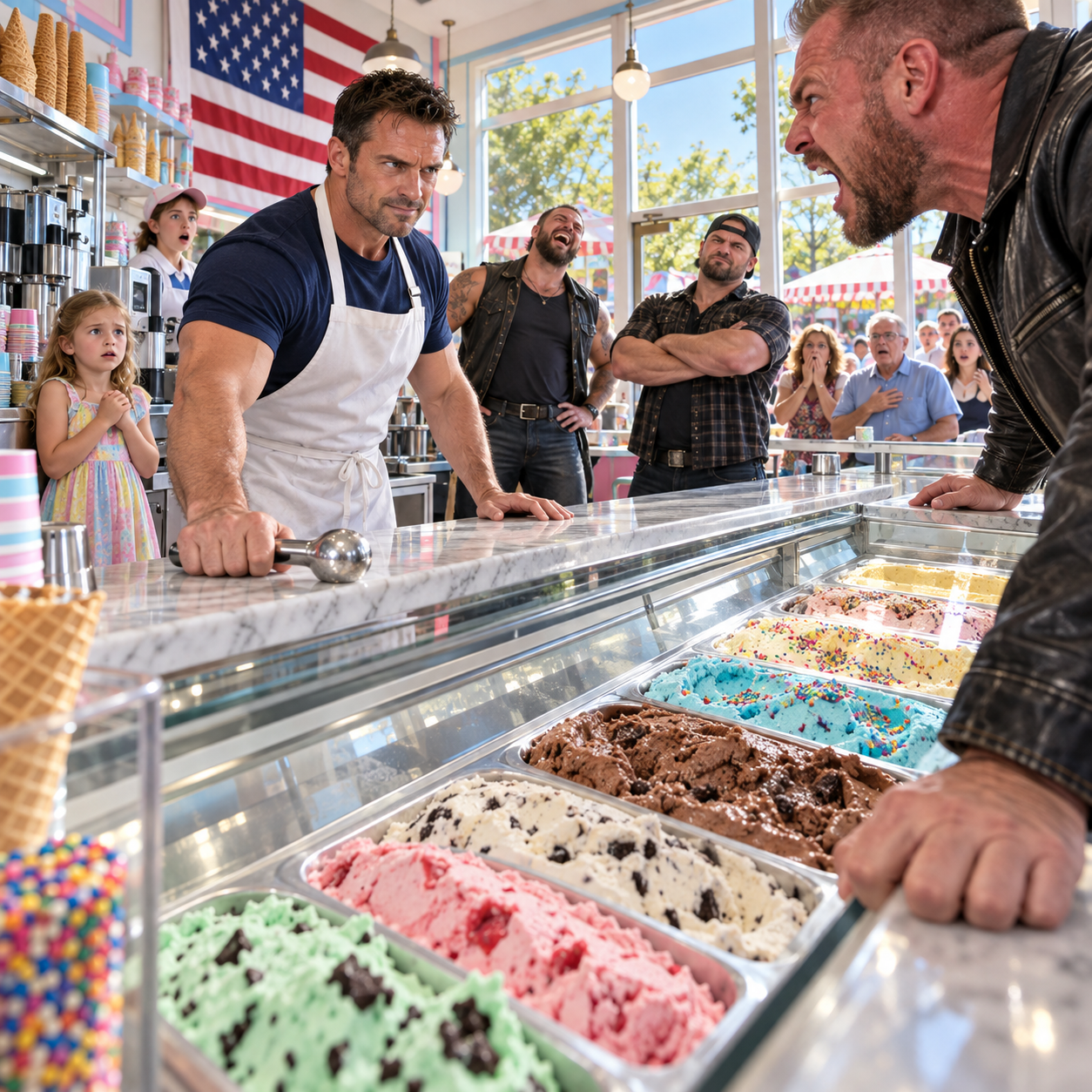
I Was A Former Secret Service Agent Who Protected Two Presidents. Now I Own An Ice Cream Shop. A Cartel Enforcer Walked In, Grabbed My 7-Year-Old Daughter By The Hair, And Put A Knife To Her Throat. “Empty The Register, Or She Gets A New Smile.” His Two Friends Laughed At The Door. I Smiled, Set Down The Scoop, And Said Gently, “Sweetheart, Close Your Eyes. Daddy’s Going To Make A Mess…”
The man holding a knife against my seven-year-old daughter expected me to beg. The two men near the door laughed, and the whole room seemed to wait for me to break with them. Instead, I told my daughter to close her eyes and used a game I had taught her years earlier. Two weeks later, after threats, ruined inventory, and a frightened young man appearing on my doorstep, I discovered something stranger than the attack itself: the laugh at the door had been a message nobody else had heard.
Part 1: The Quiet Life I Chose After Protecting Presidents
People in Red Mesa, Arizona, still tell the story wrong.
If you stop for gas and wander into Frank Bell’s barbershop, somebody will eventually tell you about the former Secret Service agent who fought off three cartel men inside an ice cream shop using a steel scoop. Depending on who is telling it, I broke six ribs, shattered a jaw, and threw one man through a plate-glass window while my daughter cheered from behind the counter. None of that happened, and the steel scoop never touched anybody.
My name is Ethan Mercer, and before I started worrying about waffle cones, freezer temperatures, and whether children wanted rainbow or chocolate sprinkles, I spent sixteen years with the United States Secret Service. For the last eight of those years, I worked presidential protection, close enough to two presidents to know what brand of cough drops one preferred and which one hated elevators. I never tell people which presidents, because once you leave that life, you either truly leave it or spend the rest of your years telling strangers what important rooms you once stood inside.
What the job gave me was less dramatic than people imagine. I was not a martial-arts genius, I did not carry secret gadgets, and I could not look at a stranger and magically know his intentions. What I learned was repetition: watch entrances, notice exits, track hands, remember which person in a crowd is behaving differently from everyone else, and never assume the loudest threat is the most dangerous one.
Faces are performances. Hands have work to do.
I left after my daughter Lily was born seven weeks early while I was flying over the Atlantic on an advance assignment. My wife, Sarah, was an emergency-room nurse, and she never once asked me to resign, which somehow made the decision harder. When I finally reached the hospital and saw Lily through the glass of the neonatal unit, smaller than my forearm and breathing with help, Sarah stood beside the incubator and rested one hand against my back.
“You came home,” she whispered.
That sentence stayed with me.
We moved to Sarah’s hometown of Red Mesa, a high-desert place in southern Arizona where six thousand people lived between dry hills that turned violet after sunset. Sarah took night shifts at Cochise Regional Medical Center, while I spent eight months fixing our roof, repainting bedrooms, replacing a fence, and discovering that a man accustomed to twelve-hour operational days can become deeply irritating when given nothing more urgent than a dripping faucet. I was forty-five and retired from the only profession I had ever truly understood.
Then I walked into a little ice cream shop called The Snowbird.
The Snowbird had been on Main Street since 1963. It had a marble counter scratched by generations of wedding rings, six chrome stools, four red vinyl booths, a brass bell over the door that gave an unhealthy little clang, and a freezer cabinet that hummed like an air conditioner in an old motel. Behind the register sat a handwritten sign: FOR SALE. ASK WALTER.
Walter Gaines was seventy-one, widowed, stubborn, and responsible for the best waffle cones in three counties. His knees hurt, his children lived in other states, and he had no intention of dying behind an ice cream counter simply because nobody else knew how much cinnamon belonged in the batter.
“You know anything about ice cream?” he asked when I told him I wanted to buy the place.
“No.”
“Business?”
“Not ice cream business.”
“Why do you want it?”
I looked around the shop. A teenage couple was sharing a milkshake, an elderly man was reading the paper over butter pecan, and a little boy at the counter had chocolate on both cheeks.
“Nobody looks disappointed when they see the ice cream man.”
Walter studied me, then sold me the store on one condition: he would continue coming in twice a week to make waffle cones because, in his words, “You’ll ruin them.”
That was three years ago.
By the summer everything happened, I could rebuild the batch freezer, roll a cone without burning my fingertips, recognize twenty-four flavors by smell, and remember most regular customers’ orders. I still could not temper chocolate properly. Walter considered this proof that government employment permanently damaged judgment.
Lily was seven by then, small for her age, dark-eyed like Sarah, with one missing front tooth and absolute authority over what she called the sprinkle department. Every Saturday she stood on a milk crate behind the counter wearing a Snowbird apron folded twice around her waist. She asked each customer, with the seriousness of a bank officer approving a mortgage, “Rainbow or chocolate?”
There was one thing I had taught Lily from my old life.
I called it the turtle game.
Whenever I said, calmly, “Sweetheart, close your eyes,” Lily was supposed to drop immediately, sit low, tuck her chin against her knees, wrap her arms around her legs, shut her eyes, and count slowly to thirty. She was never to stand up or look around until I touched her shoulder.
We practiced in our backyard. We practiced in grocery-store aisles. Once we practiced during the Fourth of July parade, and Lily dropped so quickly that the woman beside us nearly dropped her lemonade.
Sarah thought the game was strange.
“Children shouldn’t have to rehearse emergencies,” she told me.
“No,” I said. “They shouldn’t.”
But I kept practicing with Lily anyway.
The reason was simple. When something violent happens, most people lose their first few seconds trying to decide what is happening. Those seconds matter. A person already low, already still, already following a familiar instruction has a better chance than a person waiting for fear to explain itself.
At the time, I thought turtle was the last useful thing I would ever carry from my old career into my new one.
I was wrong.
Red Mesa had started changing before I bought The Snowbird, though newcomers like me noticed it later than people who had been born there. Main Street contained twenty-three storefronts, and during my second year five of them closed. A saddle shop disappeared first, then a Mexican bakery run by two sisters who had been there since the nineties, then a family-owned print shop.
In June, Delaney Hardware burned almost completely to the foundation at two in the morning.
The fire marshal blamed old wiring.
Nobody on Main Street believed him.
One Tuesday morning Walter was shaping warm waffle cones over wooden molds when he finally told me why.
“There’s a man named Grant Holloway,” he said. “Sooner or later, he visits everybody.”
“What does he sell?”
Walter looked at me.
“Fear.”
And before that week ended, Grant Holloway walked through my door.
Part 2: The Man Who Had Been Selling Fear for Years
Grant Holloway was thirty-nine, handsome in the carefully neglected way of men who want people to believe charm is accidental. He had sun-browned skin, expensive boots, very white teeth, and a laugh that seemed designed to make strangers feel they had known him for years. His father had once owned one of the largest rodeo stock operations in the county, but Grant inherited the company at twenty-seven and lost most of it before he turned thirty-five.
According to Walter, Grant blamed the economy, dishonest partners, banks, drought, regulations, and one ex-wife. According to everybody who had loaned him money, Grant Holloway had simply discovered that borrowing was easier than earning. After the rodeo business collapsed, he sold used trucks, brokered land he did not own, and eventually began introducing himself as a “security consultant.”
Every business on Main Street understood what security meant.
Grant charged between three hundred and twelve hundred dollars a month depending on what he thought the owner could pay. Nobody signed contracts. Nobody received invoices. Grant simply appeared every few weeks, collected cash, and reminded everyone that Red Mesa sat less than an hour from the Mexican border.
He never explicitly claimed to belong to a cartel.
He did something smarter.
He kept an old pickup with Sonora license plates behind his house. He let people see him eating lunch with men who crossed the border. He referred casually to “friends down south,” then allowed frightened people to construct the rest of the story themselves.
“What happens if somebody refuses?” I asked Walter.
He stopped rolling a cone.
“Harold Delaney refused.”
“The hardware store?”
Walter nodded.
“Twice.”
I looked toward the front window, where the empty blackened lot remained visible three storefronts away.
“And you paid him?”
Walter stared at the counter.
“For eighteen months.”
“You didn’t tell me before I bought this place.”
“I was afraid you wouldn’t buy it.”
I wanted to be angry, but Walter was seventy-one and had spent a year watching neighboring businesses close. Fear is easy to judge when you inherit it from somebody else. It is harder when the threatening man knows where your grandchildren go to school.
Grant arrived eight days later.
He came alone at two in the afternoon, ordered two scoops of Rocky Road, paid with a twenty, and told me to keep the change. Then he leaned his forearms on the marble and talked about Main Street as if he chaired a neighborhood association.
“We’re family around here,” he said. “Everybody watches out for everybody.”
“That’s nice.”
“Walter probably mentioned our arrangement.”
“He did.”
Grant smiled.
“Five hundred a month. Same schedule Walter had. No increase just because the ownership changed.”
“What exactly am I purchasing?”
“Peace of mind.”
“I already have insurance.”
He laughed.
“This is a different kind.”
I smiled back.
“I’ll pass.”
Grant’s head tilted half an inch.
“Pass?”
“I’m not interested.”
For a moment the pleasant expression remained fixed while something underneath it recalculated. Then he laughed again, patted the marble twice, and collected his ice cream.
“Everybody needs a little time to understand a new town.”
“I understand it pretty well.”
“We’ll talk again.”
The brass bell complained as he left.
The following Thursday, a nineteen-year-old named Caleb Brooks came in for his usual cup of butter pecan. Caleb worked at Mesa Tire and always had black grease around his fingernails no matter how hard he scrubbed. He bought one scoop every Thursday for his grandmother Evelyn, who had raised him after his mother disappeared from his life.
Caleb paid mostly in coins.
Lily liked him because he always asked how much money was in the tip jar.
That evening, while locking the front door, I saw Caleb sitting in the passenger seat of Grant Holloway’s black pickup.
A broad-shouldered man stood beside the driver’s door cleaning his fingernails with a folding knife.
That got my attention.
By Saturday, I knew his name was Ray Dobbs. He was thirty-two and had spent five years in state prison after an armed robbery outside Tucson. Since his release, he had worked for Grant without any job title anybody could identify.
Grant’s other regular companion was Mason Pike, a former high-school defensive lineman who was big, noisy, and still entered rooms shoulder-first.
Caleb did not fit.
A retired deputy named Earl Benton told me why over coffee.
“Evelyn Brooks is sick,” he said. “Kid drives her to treatment twice a week. Their truck died last winter. Couple weeks later Grant turns up with a Silverado.”
“Gift?”
Earl laughed without humor.
“Grant doesn’t give gifts.”
That night I told Sarah about the payments, the hardware fire, Grant, Ray, and Caleb.
She listened at our kitchen table in blue hospital scrubs while a cup of tea cooled untouched between her hands. When I finished, she asked the practical question.
“Do we pay?”
“No.”
Her jaw tightened.
“Ethan, Harold’s store burned.”
“If we pay once, we never stop.”
“If we don’t, what happens?”
“I talk to the sheriff.”
Sheriff Thomas Rourke was sixty-one and looked permanently short on sleep. He listened carefully and did not dismiss me, but he explained that intimidation was difficult to prosecute when every victim refused to describe being intimidated.
“Get me one shop owner willing to say Grant threatened them,” he said. “One statement with a name and a specific demand, and I’ll start building something.”
“Nobody will?”
Rourke shook his head.
“Not yet.”
Grant came back two Fridays later.
This time Lily was working the sprinkle station.
He stood near the register and watched her longer than a stranger should watch somebody else’s child.
“Cute kid,” he said.
I put down my scoop.
I did not rush. I walked around the end of the counter and positioned myself between Grant and Lily as naturally as I could.
“Say what you came to say.”
“Five hundred.”
“No.”
“Ethan, this isn’t personal.”
“It became personal when you looked at my daughter while discussing money.”
His smile narrowed.
“You think your old badge matters here?”
“I don’t have a badge anymore.”
“I’ve heard what you did.”
“Then you heard enough to know I spent years standing beside people who actually needed protection from serious threats.”
I watched his hands.
Both came off the counter.
“I’m not impressed by people who hint about imaginary friends,” I continued. “So take your five-hundred-dollar conversation somewhere else.”
His hands disappeared into his pockets.
He rocked backward half a step.
It was tiny, but I saw it.
Grant Holloway was not afraid of violence.
He was afraid of humiliation.
A man could threaten him, curse him, or refuse him, and he would grin. But smile at him as if the threat itself were ridiculous, and something nervous appeared in his body.
I stored that away without knowing why.
“Your decision,” Grant said lightly.
He walked out.
Walter emerged from the back room.
“You shouldn’t have embarrassed him.”
“I know.”
“He’ll send somebody else next time.”
“I know that too.”
That evening I installed another camera over the alley, changed the rear lock, checked our fire extinguishers, and went home.
After dinner I made Lily practice turtle again.
She laughed halfway through.
“Dad, I know how.”
“Show me.”
Sarah stood in the doorway, watching us with an expression I could not read.
The next afternoon was hot even by Arizona standards. Sarah was working a double shift, Walter had driven to Tucson to see his sister, and the Saturday rush disappeared shortly after four-thirty. Only one elderly couple remained, sharing a banana split in the front booth.
At 4:43, the bell over the door rang.
Ray Dobbs entered first.
Mason Pike followed him.
Caleb Brooks came in last with his eyes fixed on the floor.
Mason turned the sign from OPEN to CLOSED.
Ray walked toward the counter.
And before I had taken one full breath, his hand reached across the half door toward my daughter.
Part 3: The Afternoon a Knife Reached My Daughter
Ray moved with the confidence of a man who had terrified people before.
His left hand closed around Lily’s ponytail and pulled her backward off the milk crate. A container of rainbow sprinkles tipped over and scattered across the floor. Ray caught her against his chest, opened the black folding knife with his right hand, and pressed the side of the blade under her jaw.
Lily made a tiny choking sound.
Her eyes found mine.
“Empty the register,” Ray said. “Or she gets hurt.”
Near the door, Mason laughed.
It was immediate, booming and delighted.
Half a beat later, Caleb laughed too.
His was thin, wrong, and almost swallowed before it left his mouth.
I heard the difference.
More importantly, I saw the hands.
Ray’s left hand was twisted into Lily’s hair. His right held the knife flat against her skin rather than digging the edge inward. Mason’s arms hung loose, ready to move.
Caleb’s hands were buried so deeply in his pockets that his shoulders had risen toward his ears.
He was trying to keep them there.
I set my scoop on the marble.
“Okay,” I said.
Ray smiled.
I looked at Lily.
“Sweetheart, close your eyes.”
Her face changed.
She knew the game.
“Daddy’s going to make a mess.”
She dropped immediately.
Ray had expected a frightened child to pull upward against his grip. Instead Lily went completely limp, knees folding, chin dropping, arms locking around her legs. Her body weight yanked his left hand downward.
His balance followed.
The knife came away from her neck.
I was already moving.
There was a large glass container of rainbow sprinkles beside the topping rail. I knocked it sideways into Ray’s face.
The jar shattered against his forehead, releasing a ridiculous explosion of colored sugar.
Ray flinched.
Everybody flinches when something comes toward the eyes.
His knife hand rose instinctively.
I caught his wrist and drove it against the marble, then slammed the steel lid of the topping compartment onto the back of his hand.
Ray shouted.
The knife dropped.
It bounced once and disappeared into the dipper well where we rinsed scoops.
His other hand remained tangled in Lily’s hair.
I forced his wrist inward until his fingers opened, then pulled him forward through the half door. He hit the customer side of the counter chest-first, skidded through melted fudge and sprinkles, and landed hard.
I put one knee between his shoulder blades.
Mason charged from the door.
I did not stand.
I grabbed the swinging half door and shoved it outward just as he reached me.
The edge struck both of his shins.
His shoes hit the mixture of syrup and sprinkles on the tile, and a man weighing almost two hundred and eighty pounds discovered how little dignity remains after both feet leave the ground simultaneously.
He landed flat.
The air left him in one long animal noise.
I pulled off my apron and tied Ray’s wrists behind him, looping the strings around the steel foot rail at the bottom of the counter. Lily’s apron had fallen beside her milk crate. I used it to secure Mason while he was still attempting to convince his lungs to work.
Then I turned toward the door.
Caleb had not moved.
He stood where he had entered, pale enough to look sick, hands still buried in his pockets.
“Take them out slowly,” I said.
He obeyed.
Empty.
His fingers trembled.
“Booth three.”
He stared at me.
“Sit down. Hands flat on the table. Don’t move.”
Caleb walked to the third booth and sat.
I went behind the counter.
Lily was still curled on the floor.
She was whispering numbers.
“Twenty-seven… twenty-eight… twenty-nine… thirty.”
I touched her shoulder.
Before she opened her eyes, I lifted her and carried her into the back room, pressing her face into my neck.
She looked through the little service window at the wreckage.
Rainbow sugar covered half the floor. Fudge dripped from the cabinet. Ray was swearing into the tile. The milk crate lay upside down.
Lily stared.
“Dad.”
“What?”
“You made a huge mess.”
My laugh came out broken.
“I warned you.”
That was when my hands finally started shaking.
I held her until she complained that I was squeezing too tightly.
The elderly couple had called 911 from underneath their table. Deputy Luis Ortega arrived sixteen minutes later and stood in the doorway staring at two grown men tied up with ice cream aprons.
He looked at me.
Then Ray.
Then Mason.
Then the knife resting at the bottom of the dipper well.
Finally his eyes moved toward Caleb.
“What about him?”
Caleb stared at the tabletop.
I remembered the late laugh.
“He’s a customer.”
Ortega frowned.
“He came in with them.”
“He was sitting in booth three.”
The couple from Iowa had spent most of the incident beneath a table. They could confirm three men entered, but after that they had seen shoes, chair legs, and several ounces of hot fudge.
Ortega looked at me for a long time.
Then he wrote something in his notebook.
Caleb walked home.
Sarah arrived forty minutes later in her hospital scrubs.
She hugged Lily first, then me.
Sarah almost never displayed affection publicly, so when she locked both arms around me in the middle of the destroyed shop, I understood how frightened she had been.
She stepped back and examined the floor.
“Who cleans this?”
I looked at the sprinkles.
“I guess I do.”
Ray Dobbs and Mason Pike were booked that night on multiple charges, including aggravated assault and attempted armed robbery. Because Lily had been forcibly restrained, the case was more serious than Grant had probably expected.
At 9:18 that night, while I was mopping, the landline rang.
I answered.
Grant Holloway’s voice sounded almost cheerful.
“You made a mess.”
I said nothing.
“That’s the trouble with messes, Ethan. Somebody has to clean them.”
The line went dead.
On Monday, Ray Dobbs walked out of the county jail after someone posted a large cash bond.
Three days later, at the hour Caleb normally arrived, the bell rang and an elderly woman entered.
She was thin, silver-haired, leaning on a cane, with a hospital bracelet still around one wrist.
“Evelyn Brooks?”
“Yes.”
She ordered butter pecan.
When I handed her the cup, she counted several coins onto the marble and placed a folded piece of notebook paper beside them.
I opened it.
The message was written in block letters.
THANK YOU FOR BOOTH THREE.
THEY’RE GOING TO MAKE ME DO THE NEXT ONE.
PLEASE DON’T CALL.
THEY CHECK MY PHONE.
I read it twice.
Evelyn watched me.
“I don’t know what you saw in my grandson,” she said, “but he came home from your store, sat on my kitchen floor, and cried until dark.”
“What does Grant have on him?”
Her mouth tightened.
Then she told me.
Caleb’s old truck had died during the winter. Without transportation, Evelyn could not reach her kidney treatments twice a week. Grant appeared days later with a ten-year-old Silverado and told Caleb he could work off the price through simple errands.
Errands became deliveries.
Deliveries became collections.
Then Grant explained that the truck still legally belonged to him, that Evelyn’s transportation depended on Caleb being useful, and that people who became inconvenient sometimes vanished into desert country where nobody searched very hard.
“He told Caleb to laugh at you,” Evelyn said.
“What?”
“Grant teaches them that. He says when you frighten a man, laugh in his face and he’ll understand nobody is coming to help him.”
I thought about Caleb at the door.
Mason had laughed because he enjoyed what he saw.
Caleb had laughed because somebody had instructed him what frightened people were supposed to sound like.
“Mrs. Brooks,” I said, “tell Caleb something for me.”
She waited.
“Tell him the laugh is why he went home.”
Evelyn looked confused.
But she nodded.
The next morning, a woman entered The Snowbird at seven and ordered coffee ice cream, which should have been my first clue that she was not normal.
She displayed federal credentials.
“Special Agent Dana Reese,” she said. “FBI, Tucson.”
I looked at the badge.
Then at her.
“That was fast.”
“You tied a convicted felon to an ice cream counter with an apron.”
She tasted the coffee flavor.
“That gets paperwork noticed.”
Then Dana told me something that changed the shape of everything.
The FBI had already been investigating Grant Holloway for eight months.
They simply had not found anybody brave enough—or desperate enough—to help prove what he had built.
Part 4: The Late Laugh That Became Our First Real Witness
Dana Reese sat at the marble counter with a cup of coffee ice cream melting between us.
“Grant is extorting businesses engaged in interstate commerce,” she said. “That puts federal statutes in play. If I establish the pattern, he can spend a long time in prison.”
“The hardware fire?”
“We believe it was deliberate.”
“You can prove it?”
“No.”
“Ray?”
“Won’t talk.”
“Mason?”
“More frightened of Grant than prison.”
“And the business owners?”
Dana gave me a tired look.
“You already know.”
Nobody wanted to become the next burned building.
“What do you need?”
“Someone inside his operation.”
Neither of us said Caleb’s name.
Dana watched faces as well as I did.
“He’s nineteen,” I said.
“He entered your store with the man who put a knife on your daughter.”
“He kept his hands in his pockets.”
“That doesn’t make him innocent.”
“No.”
“He laughed.”
“Late.”
Dana stopped moving.
I continued.
“Mason laughed immediately. Caleb copied him after half a beat. Eyes down, shoulders high, hands locked where he couldn’t use them.”
“You decided all that in a few seconds?”
“I spent a career noticing the person in a crowd who didn’t match the crowd.”
“What if you’re wrong?”
“Then you investigate him like anybody else.”
Dana slid a business card toward me.
“If he calls, I’ll listen.”
Grant moved before Caleb did.
The following Saturday someone entered the alley behind The Snowbird and cut electrical power to our walk-in freezer at the junction box. Whoever did it knew exactly which line to disconnect and removed the cellular temperature alarm before leaving.
By Monday morning nearly nine thousand dollars of inventory had melted and partially refrozen.
Walter stood in the freezer doorway staring at ruined tubs of ice cream.
A summer’s worth of his caramel sauce sat separated into oily layers.
“Harold’s hardware store was hit on a Saturday,” he finally said.
I called Dana.
Agents inspected the junction box and found nothing usable.
Sheriff Rourke came personally.
“I’m sorry,” he said.
That evening Sarah sat on the edge of our bed with both hands folded tightly together.
“I want to take Lily to my sister’s house in Prescott.”
“Okay.”
“Don’t say okay like I told you I’m buying groceries.”
I sat beside her.
She looked at me, and tears filled her eyes.
“A man put a knife against her throat.”
“I know.”
“And you stood there smiling at him.”
“So Lily would see me smile.”
“I know why.”
Her voice broke.
“That’s what scares me, Ethan. I know why it worked.”
I did not answer.
Sarah wiped her face.
“I married you after you came home. I don’t want to spend the rest of our lives watching you become that man every time somebody threatens us.”
“I am that man.”
“No.”
She shook her head.
“That was your job. You’re her father now.”
I took her hand.
“If you want Prescott, I’ll drive you tomorrow. I’ll come every weekend.”
Sarah stared toward Lily’s room.
The next morning she changed her mind.
“Lily has a spelling test Friday,” she said while making coffee. “Grant Holloway is not making my daughter miss school.”
That was Sarah.
People later called me brave because they heard the story about the knife.
They never saw my wife pack Lily’s lunch the Monday after a stranger threatened our family.
Three evenings later, Grant entered alone.
He carried a green canvas bank bag.
The shop was empty.
He placed it on the counter and unzipped it.
Bundles of cash filled the bag.
“Fifty thousand.”
“For what?”
“Your freezer. Your trouble. And respect.”
I looked at him.
“My associates were impressed with what you did to Ray.”
“Your associates down south?”
Grant smiled.
“My people take notice of professionals.”
I watched his hands.
“Take the money,” he continued. “Then tell the county attorney you aren’t completely certain anymore. Maybe Ray had a knife, maybe he was joking, maybe you overreacted because of your background.”
“He held it against a child.”
“Nobody got cut.”
“No.”
“Exactly. So everybody walks away.”
I glanced at the money again.
Grant’s right thumb rubbed repeatedly along the side of his index finger.
A nervous habit.
“No.”
His smile remained.
“Fifty thousand dollars.”
“It belongs to everyone you’ve been collecting from.”
“That’s an accusation.”
“You owe half this county money, Grant. You’ve survived by making people afraid to ask for it back.”
His thumb moved faster.
I pushed the bag toward him.
“I’m not giving Ray back to you.”
His eyes hardened.
“And Caleb?”
“Especially not Caleb.”
For the first time, the smile disappeared.
“So you do like the boy.”
“He’s nineteen.”
“He’s mine.”
“People aren’t property.”
Grant zipped the bag.
“Next job is yours.”
“My store?”
“Maybe.”
“My house?”
“Maybe.”
He leaned closer.
“And Caleb is going to do it.”
Then he walked away.
Two days later an ambulance delivered Evelyn Brooks to Sarah’s emergency room.
She had a broken wrist and a deep cut above her eyebrow.
She told the staff she had fallen down the steps of her trailer.
When they were alone, Evelyn grabbed Sarah’s sleeve.
“It was the big one,” she whispered.
“Ray?”
“The one with the knife.”
Sarah called me.
I drove to Evelyn’s trailer that afternoon.
Caleb opened the door.
His face looked like he had not slept in days.
We sat at a small kitchen table beneath school photographs showing Caleb from kindergarten through graduation. A dialysis schedule hung from the refrigerator.
I waited.
Silence is uncomfortable for frightened people.
Caleb lasted almost two minutes.
“I didn’t know about Lily.”
“I know.”
“I swear.”
“I know.”
He stared at me.
“How?”
“The laugh.”
His face changed.
“You keep saying that.”
“You laughed late. Mason laughed because he thought it was funny. You laughed because somebody told you to.”
Caleb looked down.
“Grant says people break when you laugh.”
“And did I?”
“No.”
“That bothered him, didn’t it?”
Caleb nodded.
“He talked about you all week.”
“What does he want you to do?”
Caleb covered his face with both hands.
“Burn your house or the store. He hasn’t decided.”
I felt something inside me become very still.
“When?”
“Soon.”
“Did Grant order the hardware fire?”
“Ray did it. Grant drove.”
“You know that?”
“Mason bragged.”
“Why haven’t you told the police?”
Caleb looked almost offended by the question.
“Grant says he owns people in the sheriff’s department.”
“He doesn’t.”
“You don’t know that.”
“Yes, I do.”
I leaned forward.
“And I’m starting to think he doesn’t have cartel friends either.”
Caleb stared.
“Every time Grant talks about ‘people down south,’ his thumb rubs his index finger. It’s a self-comfort gesture. Powerful men don’t remind teenagers how powerful they are every five minutes. Frightened men do.”
I placed Dana Reese’s card on the table.
“I won’t make you call.”
Caleb picked it up.
“What happens if I do?”
“I’ll be there.”
“And Grandma?”
“She stays at my house until this is over.”
He swallowed hard.
“You’d do that?”
“My wife already made the guest room.”
I stood.
At the door, I looked back.
“Booth three is still there, Caleb.”
He did not smile.
But he kept the card.
Three nights later, from the landline in Evelyn’s hospital room, he called Dana Reese.
Part 5: The Frightened Kid Inside Grant Holloway’s Machine
Dana met us after closing in the back room of The Snowbird.
Walter had gone home, the blinds were drawn, and the freezer compressors produced the low steady hum I had learned to associate with safety. Caleb sat on a stack of unopened cone boxes while Dana explained exactly what cooperation would mean.
She did not dramatize it.
That mattered.
She told him he could refuse at any point, that nobody could promise perfect protection, and that Grant would become more dangerous if he suspected betrayal. Then she showed him a recording device small enough to disappear inside the bill of a baseball cap.
“You wear this only if you choose,” she said.
“What do you want me to get?”
“Grant giving orders. Payments. The hardware fire if possible. Threats.”
Caleb stared at the recorder.
“And the cartel?”
Dana glanced at me.
“I want him talking about his people down south.”
“Why?”
“Because if they exist, I want to know who they are. If they don’t, I want Grant admitting how he uses the story.”
Caleb rubbed his palms on his jeans.
“What if he checks me?”
“He checks your phone?”
“All the time.”
“The device isn’t in your phone.”
He looked at me.
I refused to make the choice easier.
“It’s yours,” I said. “Whatever you decide, Evelyn still stays with us.”
“My grandmother is going to drive your wife crazy.”
“Sarah runs an emergency department. Your grandmother doesn’t scare her.”
That earned the smallest smile.
Then Caleb took off his Mesa Tire cap.
He handed it to Dana.
For six days, Caleb drove for Grant while the recorder sat above his forehead.
During the day he visited businesses with Ray and Grant. At night he ate dinner at our house with Evelyn. Lily treated him as if nothing unusual were happening and repeatedly asked whether Mesa Tire had its own tip jar.
Grant talked constantly.
He described collections, threatened store owners, joked about Harold Delaney escaping his burning hardware store in a bathrobe, and referred to his cartel contacts often enough that Dana began calling them “the invisible board of directors.”
Caleb noticed something too.
“You were right about the thumb,” he told me Wednesday night.
“Every time?”
“Every time he mentions Mexico.”
On Thursday, Grant finally discussed The Snowbird.
Saturday.
Two in the morning.
Caleb was supposed to bring gasoline through the alley.
Ray would ignite it.
Grant would drive.
Dana listened to the recording twice.
“That’s enough.”
“Then arrest him.”
“I want him arriving with the fuel. We’ll have agents in the alley and another team across Main Street.”
Caleb exhaled.
“So Saturday ends it?”
“If everything goes right.”
Everything stopped going right on Friday afternoon.
At 4:52, while I was handing a mint-chip cone to a high-school student, my phone vibrated.
Unknown number.
Two words.
HE KNOWS.
Then another message.
TONIGHT.
I finished the sale.
I gave the girl her change.
“Have a good evening.”
She walked out.
I turned the sign to CLOSED.
Then I called Dana.
She was in Tucson, at least ninety minutes away.
“My team is positioned for tomorrow,” she said.
“He’s changed the schedule.”
“Where’s Caleb?”
“I don’t know.”
“Ethan, get your family somewhere secure.”
“Already doing it.”
I called Sarah.
She listened without interrupting, picked Lily up from the after-school program, and returned directly to the hospital. Security met them at the staff entrance.
Sarah never asked whether I was coming.
She knew the answer.
Later, when I told her how calmly she handled it, she said, “I am the charge nurse of an emergency department. Stop calling me a civilian.”
My next call was Sheriff Rourke.
“I think Grant has Caleb.”
A pause.
“What makes you think that?”
“He discovered Caleb has been staying at my house.”
“What’s tonight?”
“Grant burns the shop and makes Caleb the explanation.”
Rourke became quiet.
I continued.
“If investigators find the nineteen-year-old who rode with Ray during the knife incident dead inside my burned store, everybody believes Caleb retaliated against me.”
“Jesus.”
“Grant solves two problems.”
“Where do you want us?”
“The alley.”
“I’m not putting officers into your plan without federal backup.”
“Dana is driving.”
“That is not the same thing.”
“You asked for evidence.”
“I asked for a statement.”
“I’m offering the man himself.”
Rourke swore under his breath.
Finally he said, “Me and Ortega. Nobody else gets pulled off patrol until Reese arrives.”
“Come from the feed-store lot. No lights.”
“And you?”
“Inside.”
“No.”
“Sheriff—”
“You are not law enforcement.”
“I know the building.”
“So do firefighters. That doesn’t make them bait.”
“If Grant sees a cruiser before he enters, Caleb stays in his truck with Ray.”
Silence again.
“I hate this.”
“So do I.”
Rourke finally agreed to wait outside unless he saw immediate danger.
At ten, I turned off every light in The Snowbird except the small blue glow of the freezer thermometer.
I removed the large carbon-dioxide extinguisher from beside the batch freezer.
It weighed nearly twenty pounds.
Walter had purchased it years earlier after an electrical fire near the compressor.
I placed it beside booth three.
Then I sat in the dark.
I knew every sound in that building.
The freezer click.
The soda cooler vibration.
The slight knock in the ductwork when the air-conditioning shut off.
The brass bell moving when desert wind pressed against the front door.
For years I had waited in hotel corridors, parking garages, stairwells, backstage areas, and motorcade holding rooms. The skill was not staying alert.
The skill was remaining calm enough that alertness did not become imagination.
At 1:37 a.m., headlights crossed the alley wall.
An engine stopped.
Doors opened.
Something heavy scraped against metal.
Then I heard Grant’s voice.
The rear door began to move.
Someone worked a pry bar into the frame.
The door always stuck after opening three inches.
They struggled at exactly that point.
Then the frame cracked.
Ray entered first.
Flashlight in one hand.
Red gasoline can in the other.
Caleb came behind him.
His wrists were bound in front with plastic restraints.
His lower lip was split.
His cap was still on his head.
The recorder.
Grant entered last wearing leather gloves and carrying another fuel can.
Nobody looked toward booth three.
People tend to stare at the task they came to perform.
Grant placed the can beside the walk-in freezer.
The cap opened.
The smell of gasoline reached me seconds later.
“You know what’s funny, Caleb?” Grant said.
Caleb did not answer.
“I spent all afternoon wondering who you talked to. Police? A reporter? Our retired hero?”
He began pouring a line of gasoline across the floor.
“Then I realized it doesn’t matter.”
Ray laughed.
Grant continued.
“Tomorrow people hear you tried burning Ethan Mercer’s shop because he humiliated you. Poor troubled kid trapped inside before he could escape.”
Caleb’s voice shook.
“And Grandma?”
Grant paused.
“Your grandmother should learn to stay out of grown men’s business.”
From the darkness, my hands tightened around the extinguisher handle.
Caleb had already given the FBI evidence of extortion.
Now Grant was recording his own attempted murder plan.
Then Caleb asked the question Dana had wanted.
“What about your friends down south?”
Grant started laughing.
Not his polite laugh.
A genuine one.
“Oh, Caleb.”
He laughed harder.
“There are no friends down south.”
Ray looked at him.
Grant kept talking.
“I bought lunch for a guy named Hector twice in Nogales. That’s it. The Sonora truck? Auction in Benson. Nine hundred bucks.”
Caleb stared.
“That’s the cartel?”
“That’s all anybody needed to believe.”
Grant spread both arms.
“This entire town has been paying me because of a license plate and two lunches.”
For a moment nobody moved.
Then Grant reached inside his jacket.
He pulled out a brass lighter.
That was enough.
“Grant.”
Three heads snapped toward the darkness.
I stood from booth three.
The extinguisher was in my hands.
Ray’s flashlight found my face.
Grant froze.
I looked at the gasoline around his boots.
“You smell terrible.”
Part 6: Grant Finally Confessed to the Lie That Built His Power
Grant’s thumb rested against the lighter wheel.
His confidence vanished so quickly that it almost looked like anger.
“Don’t move.”
His voice had risen.
“I’ll light it.”
“No, you won’t.”
His eyes narrowed.
“You think I won’t?”
“I think you’ve spent years making other people do the dangerous part.”
Ray shifted beside him.
I kept my attention on Grant.
“You had Ray burn the hardware store. You had him attack Evelyn. You sent him after Lily.”
“Shut up.”
“You drive.”
“I said shut up.”
“You collect.”
Grant’s thumb rubbed the lighter.
“You laugh.”
His face changed.
“But you don’t light fires.”
Ray came at me.
The knife appeared from his pocket.
I pulled the extinguisher pin and squeezed.
Carbon dioxide exploded from the horn with a deafening roar.
A white freezing cloud filled the narrow room.
Ray took the blast across his face and upper body.
He screamed and threw both arms over his eyes.
I swept the horn toward Grant.
The cloud swallowed him.
He repeatedly struck the lighter wheel.
Nothing happened.
The extinguisher had displaced much of the oxygen immediately around him, and frost formed over his glove and lighter.
The important part was not the physics.
The important part was that Grant expected fire and got nothing.
For perhaps the first time in his adult life, his threat refused to perform.
I released the handle.
Visibility disappeared.
Ray was still yelling.
I knew the room better than they did.
I stepped toward his voice.
His knife struck the metal cone rack.
I caught his wrist against it, forced the arm downward, then swept one foot out from under him.
Gasoline had made the tile slick.
Ray went down.
I followed, drove my knee against his back, and forced the knife loose.
It slid beneath the walk-in freezer.
Then I reached through the fog and found Caleb by the collar.
I pulled him low against the wall.
“Booth three,” I whispered.
He coughed.
“What?”
“Same rule. Stay low.”
Grant ran.
He stumbled through the damaged rear door and into the alley.
He made six steps.
Patrol headlights came on.
Sheriff Rourke stepped from behind a dumpster beside the feed store with his weapon ready.
Deputy Ortega emerged on the opposite side.
“Grant,” Rourke called, sounding more tired than angry. “Get on your knees.”
Grant stood in the headlights holding the useless lighter.
Gasoline covered the lower half of his pants.
White frost clung to one glove.
“You don’t understand.”
Rourke did not move.
“On your knees.”
“I have people.”
“Sure.”
“People down south.”
Rourke gave him a long look.
“The back door was open the entire time.”
Grant’s face emptied.
“I heard your whole speech.”
The sheriff pointed toward the ground.
“Now get on your knees.”
Grant obeyed.
Dana Reese arrived thirty-four minutes later with two agents and an evidence technician.
By then Ray was handcuffed inside a patrol vehicle.
Grant sat in another.
Caleb and I were in booth three.
I had cut the restraints from his wrists using kitchen shears.
Every light in the shop was on.
Dana approached.
She looked at Caleb’s swollen lip.
Then at his crooked cap.
“Can I have that?”
Caleb removed it.
The technician opened a seam beneath the bill.
The recorder was still running.
We listened at the marble counter.
Grant’s voice filled the ruined shop.
“There are no friends down south.”
The technician marked the timestamp.
We listened to him describe framing Caleb.
We listened to him admit the Sonora pickup came from an auction.
We listened to him boast about the hardware fire.
Then came another part.
Grant laughed while talking about Mason Pike.
“Mason’s so stupid he thinks he’s my partner. I’ve been laughing at that ox since high school.”
Dana stopped playback.
“Play that again.”
The technician did.
I understood before she explained.
“Mason thinks Grant is getting him a lawyer,” she said.
“Probably.”
“How loyal do you think he feels after hearing this?”
The following morning Dana visited Mason in jail.
She did not threaten him.
She did not offer promises she could not legally make.
She placed a speaker on the interview-room table and played Grant’s recording.
Mason heard his best friend calling him stupid.
He heard Grant explain that Mason could take the blame for the knife incident.
He heard the laugh.
According to Dana, Mason sat silently for nearly a minute after the recording ended.
Then the biggest man in the room covered his face with both hands.
“Where do you want me to start?” he asked.
He started with the hardware store.
Then he described collections from businesses, the freezer sabotage, threats, vehicles, money, and every time Grant had ordered Ray to “send a message.”
Grant had built his entire system on the belief that humiliating people made them easier to control.
In the end, the person who destroyed him was the friend he had humiliated most.
The federal case expanded rapidly.
Mason’s testimony led investigators to bank deposits Grant could not explain.
A search warrant led to handwritten payment records hidden inside a tool chest.
The records contained store names, monthly amounts, missed payments, and crude notes describing consequences.
DELANEY—REFUSED TWICE.
SNOWBIRD—OLD FED. PROBLEM.
BROOKS KID—TRUCK.
The truck given to Caleb was still legally Grant’s.
Investigators also recovered photographs of Evelyn’s treatment schedule from Grant’s phone.
It was proof that he had not simply loaned Caleb transportation.
He had studied the exact dependency that allowed him to control the boy.
For years, the town had treated Grant Holloway as a man connected to something enormous and distant.
The investigation revealed something smaller and uglier.
Grant had no criminal empire behind him.
He had built a local machine out of debt, embarrassment, rumor, and the certainty that frightened people rarely compare notes.
One shopkeeper thought Grant had cartel backing.
Another believed the sheriff’s department was compromised.
A third believed Grant owned local judges.
None of it was true.
But because nobody spoke openly, each person’s private fear strengthened everybody else’s.
When the truth finally spread, the most common reaction was not relief.
It was shame.
Walter expressed it one morning while helping me remove gasoline-soaked flooring from the rear room.
“I paid him eighteen months.”
“You had a wife dying of cancer.”
“I still paid.”
“So did half the street.”
“That doesn’t make me feel better.”
I pulled another damaged tile loose.
“It should.”
“Why?”
“Because Grant’s business depended on making everybody believe they were the only coward.”
Walter stopped working.
I looked at him.
“You weren’t.”
For the first time since the attack, his shoulders relaxed.
The Snowbird stayed closed while the entire rear floor was removed.
Gasoline had soaked through the old tile into the subfloor.
My insurance company wanted reports.
Federal investigators wanted access.
Reporters wanted interviews.
I refused almost all of them.
Then a local television station ran a story about “the retired presidential protector who defeated a cartel extortion ring.”
I turned off the television halfway through.
Sarah laughed.
“Your face.”
“There was no cartel.”
“I know.”
“I didn’t defeat anything.”
“You froze a criminal with a fire extinguisher.”
“I didn’t freeze him.”
“Your version is going to lose.”
She was right.
But the court version mattered more.
And seven months later, Grant Holloway finally walked into a federal courtroom where nobody was afraid of his laugh.
Part 7: The Man Who Laughed at Everyone Heard Them Laugh Back
The federal trial lasted just under three weeks.
By then Grant faced charges related to extortion, conspiracy, arson, witness intimidation, and the attempt to frame Caleb through the destruction of The Snowbird. Ray Dobbs accepted a plea before trial and admitted his role in the hardware fire, Evelyn’s assault, the freezer sabotage, and the attack on Lily.
Mason also cooperated.
He testified for two days.
On the first morning he entered the courtroom wearing a suit that fit badly across his enormous shoulders. He looked nothing like the man who had laughed beside my door.
He looked tired.
The prosecutor asked why he had obeyed Grant for so long.
Mason stared at his hands.
“Because I thought he was the only person who respected me.”
Then the prosecutor played the recording.
Grant’s own laugh filled the courtroom.
Mason did not look at him.
Caleb testified the following day.
I loaned him one of my old suits.
The shoulders were too wide, the sleeves were slightly long, and Sarah had to pin the trousers temporarily because there had not been time for proper alterations.
Caleb’s voice shook during the first ten minutes.
Then the prosecutor asked about Evelyn.
He became steady.
He explained the truck, the errands, the collections, the threats, Ray, Grant’s instructions to laugh, and what happened inside my shop.
“Why did you laugh when Mr. Mercer’s daughter was threatened?”
The defense objected.
The judge allowed the question.
Caleb swallowed.
“Because Grant taught us that if somebody looked at us, we should laugh. He said it made them feel alone.”
“Did you find the situation funny?”
“No.”
“What were you feeling?”
“Like I was going to throw up.”
“What did Mr. Mercer do afterward?”
“He told the deputy I was a customer.”
“Were you?”
“No.”
Caleb looked toward me in the gallery.
“Not then.”
He faced the jury again.
“But he gave me a way to become one again.”
The courtroom went completely still.
On the final week, prosecutors played the entire recording from the night of the attempted fire.
The jury heard Grant admitting there was no cartel connection.
They heard him explain the Sonora license plate.
They heard him brag that the entire town had been paying “a license plate and two lunches.”
Two jurors laughed.
They tried not to.
It was small and surprised, the sound people make when a monster from childhood is revealed to be a coat hanging behind a bedroom door.
Grant heard it.
I watched his hands.
His right thumb immediately began rubbing his index finger.
The old motion.
Then other people in the courtroom recognized what the jury had recognized.
The terrifying network had never existed.
Grant had built his power from suggestion.
A truck.
A rumor.
A borrowed name.
A few well-placed lunches.
The judge quieted the courtroom.
But something had already happened.
Grant Holloway, the man who had built a career around laughing while other people were afraid, had finally become the person hearing laughter from the other side.
His face changed.
Only slightly.
I had spent enough years watching people under pressure to notice.
He understood.
The spell was gone.
The jury convicted him.
At sentencing, several Main Street business owners spoke.
Harold Delaney described standing barefoot in the road at two in the morning while his hardware store burned.
Walter described paying cash after his wife died because he could not bear losing the shop too.
Evelyn Brooks walked to the front of the courtroom using her cane.
She looked directly at Grant.
“You thought my grandson stayed because he was weak,” she said. “He stayed because he loved me. There is a difference.”
Grant received twenty-six years in federal prison.
The judge ordered restitution.
Authorities sold the black pickup, the Sonora-plated truck, Grant’s remaining property, and several assets investigators proved had been purchased using extortion money.
The victims did not recover everything.
But they recovered enough to matter.
Harold Delaney used his share to rebuild.
He poured a new concrete slab where the hardware store had stood.
Ray received eighteen years under his plea agreement.
Mason received six because of his cooperation.
I did not celebrate any of those numbers.
Prison sentences do not rewind children’s memories.
They do not remove the moment a knife touched skin.
They do not restore Walter’s lost money or give Harold back the years his business sat empty.
What mattered was that Grant’s system stopped.
Main Street stopped paying.
Nobody quietly placed envelopes under cash registers.
Nobody looked away when unfamiliar trucks parked outside stores.
Owners started calling each other.
That simple change did more than any arrest.
Fear survives isolation better than truth does.
The Snowbird remained closed for six weeks.
One Sunday morning I arrived expecting to continue repairs and found five people already inside.
Walter was there.
So was Harold Delaney.
The owner of the Copper Spur bar knelt near the freezer spreading mortar.
The woman who ran the tattoo shop was carrying tile.
The motel owner had brought tools.
“What are you doing?” I asked.
Harold looked up.
“Apparently none of us know how floors work.”
“I have contractors coming tomorrow.”
“No, you don’t.”
“Harold—”
“Your insurance is already paying enough people.”
Walter pointed a trowel at me.
“Stop talking and carry tile.”
Nobody had organized it officially.
People simply came.
By afternoon the new floor was finished badly enough that a professional would have complained and well enough that I never considered replacing it.
Everybody ordered one scoop before leaving.
Nobody allowed me to accept payment.
I returned their money.
They put it into Lily’s tip jar.
Evelyn eventually moved back to her trailer.
The county medical service handled most transportation to her treatments, but when scheduling failed, Caleb drove her.
His Silverado had been seized because it belonged to Grant.
So I sold him The Snowbird’s old delivery van for one dollar.
The van was white with a faded blue penguin painted on both sides.
Caleb hated it.
Evelyn loved it.
That settled the matter.
Caleb kept working at Mesa Tire.
On Tuesday and Friday mornings, he also started helping Walter make waffle cones.
Walter said the boy had excellent hands.
Then he would look at me pointedly and add that Caleb might learn to temper chocolate before I did.
Sarah enjoyed this more than necessary.
I also kept a promise I had made her after the attack.
The Snowbird began closing on Sundays.
At first I hated it.
Sunday had always been profitable, especially during soccer season.
But I stayed home.
I fixed the fence.
I cooked breakfast badly.
I attended Lily’s games.
At the first one, I caught myself scanning the parking lot, the bleachers, people’s waistbands, hands, bags, entrances, and exits.
Sarah touched my wrist.
“She’s number eight.”
“I know.”
“Watch number eight.”
So I did.
Not perfectly.
But more often.
Months passed before Lily mentioned Ray.
Children are strange that way.
They can carry enormous questions silently while adults convince themselves the question has disappeared.
One evening she was doing spelling homework at our kitchen table when she looked up.
“Dad?”
“Yeah?”
“Why did you let Caleb stay in booth three?”
I put down my coffee.
“What do you mean?”
“He came with the bad men.”
“Yes.”
“So how did you know he wasn’t like them?”
I thought about giving her an easy answer.
Children deserve simple truths when simple truths are enough.
This one was not.
“Because he laughed late.”
Lily frowned.
“That doesn’t make sense.”
“The big man laughed because he liked seeing somebody scared.”
“Mason?”
“Yes.”
“And Caleb laughed after him. But he was looking at the floor, and his hands were hidden. He wasn’t enjoying anything.”
I reached across the table and moved a strand of hair away from her face.
“He was copying what somebody told him to do.”
“So he was scared too?”
“Yes.”
Lily considered that.
Then she returned to her spelling words.
I thought the conversation was finished.
It wasn’t.
“What if you were wrong?”
I looked at her.
“Then I would have dealt with being wrong.”
She nodded as if that answer satisfied her.
It was the answer I kept thinking about too.
Part 8: Booth Three Became the Place Where Our Town Healed
By the following spring, Red Mesa had changed in small ways that never appeared in newspaper articles.
Harold Delaney reopened his hardware store.
The new building was smaller than the old one, but he painted the exterior the same faded green and rehung the original sign, even though smoke had darkened one corner.
The bakery that had closed did not return.
Neither did the saddle shop.
Some damage remains damage.
But several empty storefronts gained new tenants.
A young couple from Tucson opened a coffee shop.
A woman who had grown up in Red Mesa returned from Phoenix and opened an accounting office.
People started talking about Main Street as a place that might survive instead of a place waiting to disappear.
Caleb changed too.
Not dramatically.
Real people rarely transform in a montage.
He still startled when a black pickup slowed near him.
He still checked Evelyn’s locks twice before leaving at night.
For months he would not sit with his back toward a restaurant door.
But he laughed differently.
The first time I heard a genuine one, Walter had dropped an entire rack of waffle cones.
Caleb bent over the counter laughing so hard he could not speak.
I listened.
Right on time.
No hesitation.
Nobody directing it.
Just laughter.
Walter threw a dish towel at him.
In March, Walter announced that The Snowbird needed a new flavor.
“You’ve had twenty-four flavors since Kennedy was president,” I said.
“Exactly. Civilization is declining.”
“That argument makes no sense.”
“Neither does your chocolate.”
For one month, Walter, Caleb, and Lily experimented every Saturday morning.
Walter wanted butter pecan because it was the flavor Evelyn had ordered for years.
Caleb wanted Walter’s caramel ribbon.
Lily demanded rainbow sprinkles.
“Why?”
“Because the sprinkles saved us.”
Technically, the turtle game saved her.
The jar of sprinkles merely helped me take Ray’s eyes off the knife.
I started to explain this.
Sarah kicked my ankle beneath the table.
“Sprinkles saved us,” I agreed.
They built the flavor from all three.
Butter pecan.
Caramel ribbon.
Rainbow sprinkles scattered across the top.
“What do we call it?” Walter asked.
Lily did not hesitate.
“Booth Three.”
Nobody argued.
On the first warm Saturday in April, Lily wrote the name on the chalkboard above the dipping cabinet.
BOOTH THREE
Butter Pecan — Caramel Ribbon — Rainbow on Top
Ask for It by Name
She drew a crooked penguin beside it.
Caleb stood underneath the sign pretending not to be emotional.
Evelyn ordered the first scoop.
She paid in coins.
Some traditions should not be improved.
Around noon, Frank Bell from the barbershop walked in.
He looked at the menu.
“So this is the famous flavor?”
“No,” I said.
“The famous one has cartel blood in it.”
Caleb choked on a laugh.
Frank grinned.
“I heard you broke Ray’s arm with a scoop.”
“No.”
“Knocked out Mason?”
“No.”
“Threw somebody through a window?”
“No.”
“Then what did happen?”
“The scoop stayed on the counter.”
Frank looked disappointed.
“Terrible story.”
“Completely.”
He ordered Booth Three anyway.
The town will probably always tell its own version.
That is what towns do.
Somebody will say three cartel assassins entered The Snowbird.
Somebody else will say five.
Eventually I will be ninety years old in the story and fighting twelve men while holding a milkshake.
The truth is less heroic and more useful.
There was no cartel.
There was a frightened town and one man clever enough to realize fear does not need evidence if people are too isolated to compare what they know.
Grant understood humiliation.
He understood debt.
He understood how to choose people with vulnerable relatives, struggling businesses, old mistakes, or unpaid loans.
He understood that the threat people imagine can be larger than the threat standing in front of them.
What he misunderstood was loyalty.
Grant thought Caleb obeyed because Caleb was weak.
Caleb obeyed because Evelyn needed him.
Grant thought Mason stayed because Mason was stupid.
Mason stayed because he believed Grant was his friend.
Grant thought business owners paid because they respected him.
They paid because each believed everybody else knew something they did not.
The moment those assumptions were exposed, his whole structure collapsed.
Sometimes I think about the exact second everything changed.
People assume it was when Lily dropped.
Or when the sprinkle jar struck Ray.
Or when the fire extinguisher filled the back room with white gas.
Those moments mattered.
But the important moment happened earlier.
Mason laughed.
Then Caleb laughed half a beat later.
I heard two similar sounds carrying two completely different meanings.
One said, I enjoy your fear.
The other said, I am trapped here too.
That difference put Caleb in booth three instead of a patrol car.
Booth three gave him somewhere safe enough to think.
That gave Evelyn time to bring me his note.
The note connected us to Dana.
Dana gave Caleb a choice.
His choice produced the recording.
The recording exposed Grant.
Grant’s own cruelty turned Mason.
Mason exposed the rest.
Grant destroyed himself with the same behavior he had used to control everybody else.
People sometimes ask whether protecting presidents prepared me for any of this.
Yes and no.
My old job taught me to move quickly when danger became physical.
But anyone can learn emergency procedures.
The harder lesson was noticing people.
Crowds are not one thing.
Groups are not one mind.
The frightened young man standing beside a cruel man may not be cruel.
The silent shop owner handing over cash may not be cowardly.
The person who goes along today may be waiting for one believable way to stop tomorrow.
You have probably been in rooms where that difference mattered.
Maybe nobody had a knife.
Maybe it was an office where people laughed at a new employee.
A family dinner where everybody tolerated the same cruel joke.
A school hallway.
A group chat.
A meeting where one person was embarrassed and ten others laughed because everyone else did.
Listen carefully.
Sometimes one laugh arrives half a beat late.
Sometimes somebody looks down at the table while everyone else is looking at the victim.
Sometimes the person who appears to be standing with the crowd is actually searching for the nearest door.
You do not have to rescue everybody.
You probably cannot.
But sometimes showing one person where the door is changes more than you expect.
A year after the trial, I found Caleb repairing the hinge on booth three before opening.
The old red vinyl seat still had a crack running through one corner.
“Walter says we should reupholster these,” he said.
“He’s been saying that since I bought the place.”
“We could actually do it.”
“No.”
“Why not?”
I looked at the booth.
Because Lily had survived beside it.
Because Caleb had sat there shaking while I decided to trust what I had seen.
Because later he had sat there again after we cut the restraints from his wrists.
Because Dana had stood beside it while listening to the recording that ended Grant’s control of Main Street.
Because some worn things become valuable precisely because you can see what happened to them.
“Leave it,” I said.
Caleb tightened the screw.
“You getting sentimental?”
“Absolutely not.”
“You are.”
“Go make waffle batter.”
He laughed and disappeared into the back room.
Walter was already there complaining that Caleb used too much cinnamon.
Lily stood on her old milk crate even though she was now tall enough that she barely needed it.
Sarah sat in booth one after finishing a night shift, drinking coffee and pretending she was not falling asleep.
The brass bell over the door still rang badly.
The freezer still hummed.
The morning sun crossed the marble counter.
I picked up the same steel scoop that people in town insist I once used as a weapon.
It had a dent near the handle from years of being dropped.
Nothing dramatic.
Just a scoop.
A family entered.
Two parents.
A little boy.
A girl about Lily’s age.
They studied the flavors.
The boy pointed toward the bottom of the chalkboard.
“What’s Booth Three?”
Lily stepped forward before I could answer.
“It’s butter pecan with caramel and rainbow sprinkles.”
“Why is it called that?”
Lily looked at me.
I waited.
She smiled at the boy.
“Because something scary happened here once, and a bunch of people helped each other afterward.”
That was better than anything I would have said.
The boy considered the explanation.
“I want that.”
His sister nodded.
“Me too.”
I reached for two cups.
“Rainbow sprinkles?”
Lily looked offended.
“Dad.”
“Right.”
Some questions no longer needed asking.
Outside, Main Street was waking up.
Across the road, Harold lifted the metal gate over his rebuilt hardware store.
The coffee shop next door set two tables on the sidewalk.
Caleb’s ridiculous penguin van was parked at the curb.
Nobody was paying Grant Holloway.
Nobody was whispering about mysterious men from across the border.
Nobody was waiting for permission to stop being afraid.
I scooped the butter pecan.
Lily added caramel.
Then she covered both cups with rainbow sprinkles.
And in the booth against the wall, the cracked red seat of number three remained exactly where it had always been.
Not because that was where the worst thing happened.
Because it was where somebody who thought he had no choices discovered that he still had one.
And that, more than the knife, the presidents, the fire, or anything people in Red Mesa tell tourists, is the part of the story I hope they eventually get right.
THE END!
Disclaimer: Our stories are inspired by real-life events but are carefully rewritten for entertainment. Any resemblance to actual people or situations is purely coincidental.

