A week before her birthday, my daughter said the best gift would be if I just died…
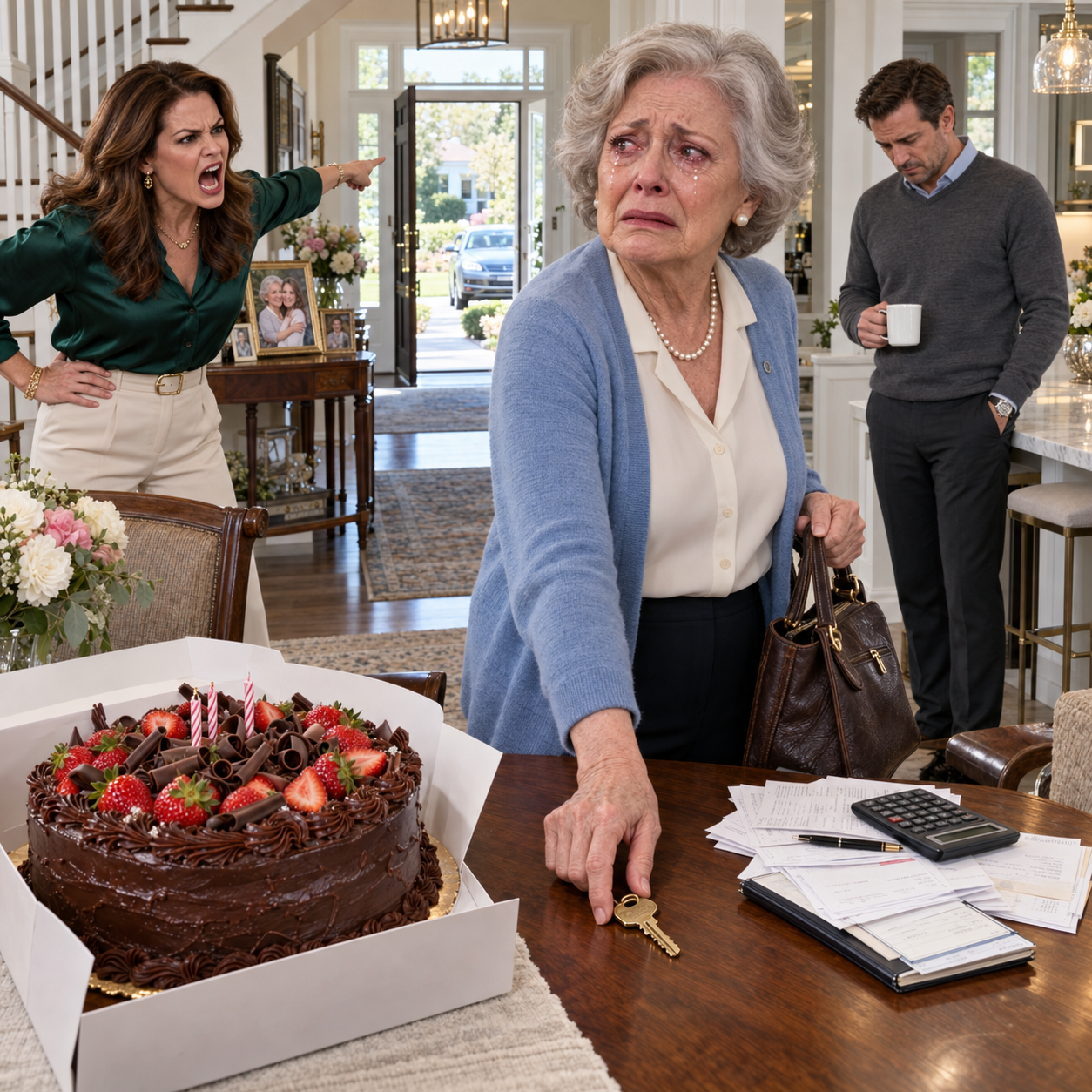
A week before my daughter’s forty-fifth birthday, I brought her favorite chocolate-strawberry cake, and she told me the best gift I could give her was to die. Her husband stood nearby and said nothing. I set the cake down, returned my brass key to their house, and left without arguing. Less than two weeks later, after I stopped paying their bills and sent a sealed envelope to her birthday table, my attorney called about a court filing Rebecca had made before our terrible afternoon.
### Part 1: One cruel birthday wish makes me question decades of sacrifice.
Rebecca had invited me over on the Wednesday before her birthday, saying the weekend would be “too busy for family obligations.” She later claimed I had barged in unannounced. I was seventy-two, a retired intensive-care nurse living fifteen minutes away in Columbus, Ohio, and I had spent the morning at Bellamy’s Bakery paying two hundred dollars for the cake she loved as a girl. I had also put a check for five hundred dollars in my purse. It was meant to help with the twins’ summer camp. I almost laughed, remembering how my late husband, Paul, used to say that Rebecca could talk me into buying snow tires in July. Paul had been gone fourteen years. Since then, I had been the person Rebecca called when a faucet broke, when a child needed pickup, when a bill came due, and rarely when she wanted to know how I was doing.
The warning signs had been there, and they were small enough that I kept finding reasons to excuse them. In March, Rebecca used the emergency key to my condo while I was at a dentist appointment and carried off Paul’s old record cabinet because it “made my living room look cluttered.” In April, she put the deposit for a family resort weekend on my credit card, then told me she assumed I would want to treat the children. In May, she pressed me to cancel a long-awaited appointment with an arthritis specialist because she and David needed a sitter. I canceled it, and she acted as though I had simply done what was expected. Lately she had become interested in my affairs. She asked whether I still owned a share of her house, photographed the labels on my prescription bottles “in case of an emergency,” and twice insisted I had forgotten conversations I could remember perfectly. Once, while helping set the table, I noticed an envelope from an elder-law office hidden beneath a stack of grocery coupons. Rebecca took it from me so quickly she knocked over a saltshaker. I assumed it concerned David’s father.
That Wednesday, David opened the door with a weary smile, and Rebecca appeared behind him in workout clothes. Their eleven-year-old twins, Lucy and Owen, were at school. “Oh, Mom,” she said, looking at the cake as though I had brought a leaking paint can. “I thought we agreed you’d stop making everything an occasion.” I reminded her that she had invited me. She waved me toward the dining room, where unpaid-looking envelopes sat beside a laptop. I asked if David had heard anything about the job interviews Rebecca said he had been attending since his latest layoff. He stared at her. Rebecca cut in with, “We’re handling it.” Then she said she knew what would make her birthday better. I offered the check for camp. She didn’t look at it. “You want to know the best present you could give me?” she asked. “If you just died. Then maybe I could finally breathe.” David looked down at the cake box. No one moved. When I asked if she understood what she had said, Rebecca replied that she was tired of my questions, my visits, and the way I acted as if my sacrifices entitled me to a place in her life. “I’m your mother,” I said. “I know,” she answered. “You never let me forget.”
Once, I would have cried until she comforted me and then paid for dinner. Instead I pushed the unopened cake toward her and took her house key off my ring. “You’re entitled to privacy,” I said. “You’re not entitled to speak to me that way.” David finally said, “Rebecca, come on,” but it sounded less like an objection than a request to keep the afternoon moving. At home I sat on the same faded sofa where I had held Rebecca through childhood fevers and looked at the camp check, still in my purse. I didn’t send it. The next morning I asked whether she had meant it. “I meant that I need you out of my life,” she replied. “Please don’t turn this into another guilt trip.” I hung up and cried hard enough to give myself a headache. Then I opened the file drawer where I kept forty years of pay stubs, receipts, and closing papers. I had worked nights, paid for her college changes, contributed to her wedding, and given $150,000 toward the purchase of the house. At Paul’s insistence, the closing attorney recorded me as a thirty-percent owner, not a donor. Rebecca and David owned the rest and were responsible for the mortgage. I had also covered eight months of mortgage payments during David’s earlier unemployment and had since been transferring nine hundred dollars a month into what Rebecca called the household emergency budget. That did not buy her affection. It was time I stopped trying.
On Friday, my bank removed Rebecca’s access to the reserve account I alone had funded. I canceled her authorized card, changed my passwords, and ended the monthly transfers. I paid every obligation I actually owed and touched nothing that belonged to Rebecca or David. My attorney, Miriam Ellis, reviewed the house deed and my estate plan, reminding me that a thirty-percent share was neither permission to evict my daughter nor a way to erase the mortgage. “You can stop volunteering to finance them,” she said. “You cannot solve twenty years of hurt with one lawsuit.” We prepared a new will and beneficiary designations, with separate protections for the twins. That afternoon David apologized for his silence but asked me to keep sending money until he settled at work. “Rebecca said you lost your job again,” I told him. He blinked. “Juliet, I started my new job in February. I’ve been making the mortgage payments myself since then.” He showed me the direct deposits on his phone. All those months I had been sending money for a crisis that no longer existed. When I asked him what Rebecca had done with it, he looked toward the window and said, “I think I finally know why she didn’t want me looking at her business accounts.”
### Part 2: Missing payments reveal a second betrayal hiding inside my family.
David returned the following morning with a folder from their dining-room desk. He had not stolen it or gone digging through Rebecca’s passwords; she had given him the folder months earlier when she asked him to help organize the expenses of her home-staging company, Juniper & Lace. Back then, he had believed her when she said the business was nearly profitable. Now he had matched its statements to the monthly amounts I had transferred. Rebecca had been using my so-called household support to keep up payments on equipment, storage space, and short-term business financing. The debts totaled more than seventy thousand dollars, and several payments were already overdue. David admitted he knew the business was struggling, but he had not understood its size. I asked why he had accepted my help without checking whether I could afford it. He rubbed his hands over his face. “Because it was easier not to ask,” he said. It was the first useful truth I had heard from anyone in that house.
That evening Rebecca called. She did not ask whether I was all right. “David says you’ve gone through our finances,” she began. “I went through mine,” I answered. She said she had intended to pay me back once a hotel decorating contract came through. When I reminded her that she had called the money mortgage help, she said there was no practical difference because every dollar kept their family going. Then came the accusation I recognized: if I loved the twins, I would not jeopardize their home over my wounded pride. I told her I would always care about Lucy and Owen, but their parents were responsible for the bills. “You used to say you’d do anything for me,” she said. “I did,” I replied. “That was my mistake. I should have taught both of us where my help ended.” For a few seconds I heard only her breathing. Then she said, “You’re getting forgetful, Mom. You really ought to talk to someone.” It was an odd thing to say in the middle of an argument about bank statements. I wrote it down after we hung up.
I did not decide to vanish overnight. Years earlier, I had clipped an article about a watercolor workshop in Santa Fe and slipped it into a cookbook, where it had stayed while Rebecca’s emergencies filled my calendar. Now I called the workshop, rented a small furnished casita for three months, and asked my neighbor Marlene to check on my condo. I arranged mail forwarding, gave Miriam my address, and told David directly that I was taking a trip and would remain reachable for genuine emergencies involving the children. I did not stage a death or ask anyone to lie about my whereabouts. On Rebecca’s birthday, while I waited at the airport, a courier delivered a sealed packet addressed to her. David later told me she opened it at the dining table, pushing aside the expensive decorations she had arranged for her party. Inside was a four-page letter, not a list of everything she owed me for being born. I wrote that I had canceled my voluntary transfers, revoked access to my accounts, and changed my estate instructions. I enclosed copies of the relevant account notices and a photograph of Lucy and Owen with Paul, taken on the last summer he was alive. At the bottom I added, “I am alive, safe, and choosing distance. Please do not tell the children otherwise.” David later said she laughed at the first page, thinking I was making a point. By the third she sat down, clutching the photograph, and began asking whether the transfers had truly stopped.
By the time I landed in New Mexico, Rebecca had called fourteen times. Her messages began with fury over the money and ended with a sudden tenderness I had wanted for years. “Mom, please. We can fix this. I didn’t mean what I said.” I listened once, then put my phone away. Outside the airport, the mountains rose violet above the evening traffic. I checked into a place with a blue door, a little courtyard, and a kitchen just big enough for one person to cook without apologizing for taking up space. The next morning I bought coffee, walked to the workshop, and introduced myself without adding that I was somebody’s mother. That should not have felt like an achievement, but it did. Two days later, David wrote to say Rebecca had shown him a draft loan application secured by their house. The lender had required my participation because my name appeared on the deed. I had never signed the application. David said she had described a form she wanted me to sign as a routine property-tax correction. I remembered the envelope under the coupons and felt my stomach tighten. Still, I thought the worst secret was the business debt.
On Monday, Miriam called about a notice from the county probate court that had been forwarded from my condo. A petition had been filed asking a judge to appoint a guardian for me. Its supporting statement claimed I was missing appointments, mishandling medication, making irrational financial gifts, and becoming unable to manage my property. There were descriptions of the very incidents Rebecca had engineered or exaggerated: the specialist appointment I had canceled to babysit, the money I had voluntarily given her, and my supposed confusion over conversations she denied having. No guardian had been appointed, and Miriam said the petition faced serious obstacles. But Rebecca had listed herself as the person best qualified to control both my personal decisions and my finances. In an attachment, she described plans to sell my condo, move me to supervised accommodation, and “stabilize family housing expenses” with the proceeds. I sat at the casita’s tiny kitchen table reading each page twice. The petition had been signed eleven days before Rebecca told me that my death would be the perfect birthday gift. She had been preparing to take control of my life while I was still paying for hers.
### Part 3: A failed guardianship scheme costs us our home and trust.
Six weeks later I flew to Columbus for the hearing, carrying a report from an independent physician who had assessed my memory, reviewed my medication, and documented my ability to make decisions. Miriam brought the report, my bank statements, and the actual dates of my appointments. We submitted my letter, travel bookings, and regular correspondence with Miriam. I wore an old navy jacket from my nursing days. Rebecca sat across the room with a lawyer and looked at me only once. She claimed my generosity showed declining judgment. Miriam did not pretend I had always made wise choices. She showed that making generous, even foolish, choices was not the same as being unable to choose. After reviewing the evidence, Rebecca’s attorney requested a recess. By afternoon Rebecca agreed to withdraw the petition. The judge dismissed it without appointing anyone. There was no courtroom applause. I walked out with legal control of my own life intact, which was more than enough.
Outside the courthouse, Rebecca asked for five minutes. She had dark circles under her eyes. “I was scared,” she said. “Juniper & Lace was supposed to be the thing that proved I could do something on my own. Every month it got worse, and David kept asking questions.” An adviser had mentioned guardianship when she complained about my financial decisions. When I asked why she had described me as incapable, she whispered, “Because I thought if I could handle the property, we could get through the year.” She had hoped to refinance their house using my ownership share and, if that failed, gain control over my condo. A court would never simply let her use my assets to cover her debts, but she convinced herself there was a way. Her property plan even proposed paying Rebecca a monthly “family management fee.” I finally understood the photographs of my medications, the borrowed emergency key, and the sudden claims that I was forgetful. What I had mistaken for nosiness had been an attempt to build a record against me. “And when you refused to sign?” I asked. She looked away. The birthday outburst was not rehearsed, but her resentment had grown for months. She wanted my checks, not my questions. “You wanted me gone,” I said. “Then you tried to tell a judge I wasn’t capable of deciding where to go.” Rebecca began crying. I believed she was frightened. I did not believe fear excused what she had done.
David and Rebecca had a harder year than either expected. Without my monthly transfers, Rebecca closed the staging studio and sold its equipment to satisfy part of the debt. Other cuts could not cover the business debts and mortgage. David asked whether I would buy their seventy-percent share or agree to sell the house. Miriam handled negotiations so I would not have to. We sold it seven months later, by agreement, before the missed payments became a foreclosure problem. After the mortgage and selling costs, my share of the proceeds was forty-three thousand dollars—far less than the $150,000 I had put into the house. Leaving had not made me rich. I had lost savings and years I could not recover. Rebecca and David rented a smaller place, and eventually David moved into an apartment nearby while they worked out their separation and parenting schedule. He said the guardianship petition had changed how he understood his marriage. Their losses brought me no pleasure. I was done hiding them.
There were consequences for me, too, beyond the money. I spent the first Christmas in Santa Fe missing two children who had never mistreated me. Sometimes I still reached for the phone. I also had to admit something embarrassing: I had raised her to expect a rescue and then resented her for expecting it. When Paul died, being indispensable to Rebecca had kept me from feeling alone. I solved problems she needed to face and tolerated rudeness because I feared saying no. That explained my choices without making hers acceptable. I saw a counselor to stop organizing my life around whether Rebecca might become kind. I kept my condo for the time being and arranged a longer lease on the casita. I painted desert doors, late-afternoon shadows, and once, without planning to, the old sofa in my Ohio living room. The watercolor was crooked, but I framed it anyway.
David made sure Lucy and Owen knew only what they needed to know: their grandmother was safe, she loved them, and the adults were sorting out difficult things that were not the children’s fault. We set up Sunday video calls during his parenting time. Later he brought them to Santa Fe. We visited a museum, made crooked pancakes, and never discussed their mother’s debts. Rebecca sent a letter through Miriam the following spring. She acknowledged the petition, the money, and her birthday words without asking for another check. I read it, then put it away. I wished her well through the attorney but did not reopen contact. I could accept that she might change and still decide that I would not be the person testing whether she had.
On my seventy-third birthday, the twins mailed a card with a drawing of a house under a bright New Mexico sky. Marlene visited for the weekend, and we bought a small chocolate cake with strawberries from a neighborhood bakery. It cost eighteen dollars. As I set it on my kitchen table, my new brass house key lay beside the plates. I thought of the key I had taken off my ring at Rebecca’s house, and of how long I had mistaken constant access for closeness. I still loved my daughter. I simply no longer believed that love required me to surrender my money, my judgment, or the right to close my own door. A home, like a relationship, is only safe when the people inside respect who holds the key.
THE END!
Disclaimer: Our stories are inspired by real-life events but are carefully rewritten for entertainment. Any resemblance to actual people or situations is purely coincidental.