
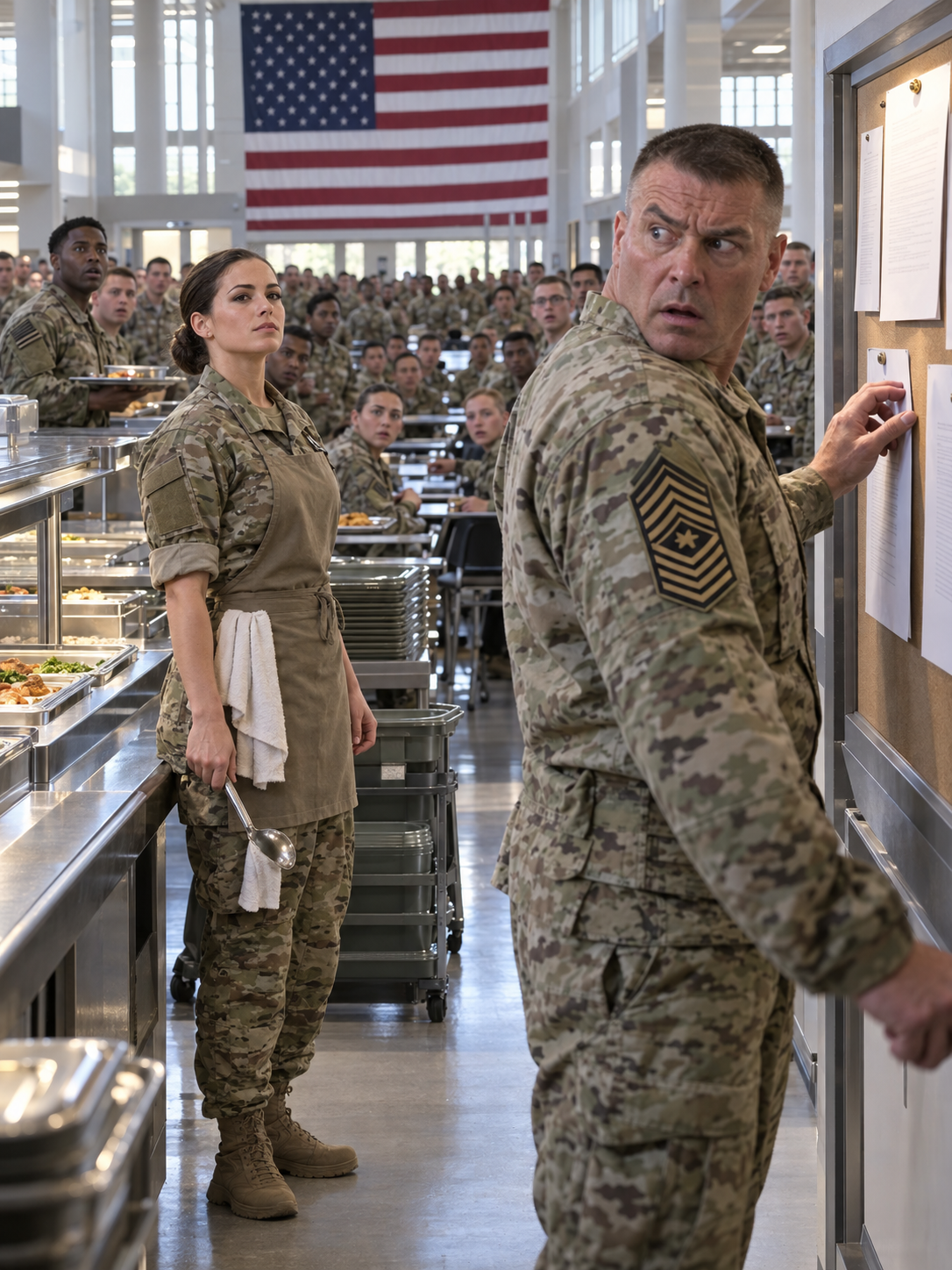
The sergeant major shoved a spoon into my hand and ordered me to earn my uniform while hundreds of soldiers laughed. I said, “Understood,” stepped behind the chow line, and served plate without revealing who I was. Then I cleared trays, wiped tables, and watched him keep smiling. Near the end of the night, command orders were pinned to the board. He walked over, read the name at the top, turned toward me—and suddenly, the entire hall went silent.
### Part 1
My name is Mara Ellison, I am forty-one years old, and I learned a long time ago that the Army notices the people at the front of a formation far more easily than it notices the people quietly keeping that formation alive.
I learned that lesson when I was twenty-five, on a resupply run through a valley that looked harmless on a map and felt anything but harmless from behind a windshield.
The road was burning.
That is still the first image that comes back whenever someone asks me what shaped the kind of officer I became, not the medals, not the promotions, not the command photographs, but a dark road split open by fire while a nineteen-year-old private gripped a steering wheel so tightly I could hear his knuckles knocking against the plastic.
We had eleven vehicles carrying fuel and supplies through terrain headquarters had confidently called secure. Somewhere ahead of us, the lead tanker suddenly vanished inside an eruption of orange light, and for one horrible second the entire column froze as though every driver had forgotten how engines worked.
I was a lieutenant riding in the third truck.
The private beside me looked young enough to still have his mother doing his laundry a year earlier.
“Ma’am,” he whispered, staring through the windshield. “Are we going to make it?”
Fear has a smell when you are trapped inside a vehicle with it. Sweat, hot plastic, fuel, wet canvas, and something metallic your body seems to invent when your nerves understand danger before your mind does.
I remember deliberately lowering my voice.
“We’re going to make it because you’re still driving,” I told him. “Keep your eyes on the truck ahead of you. That’s your whole world right now.”
He swallowed.
Then he drove.
We pushed the ruined tanker aside, kept the rest of the convoy moving, and dragged ten vehicles and every soldier back behind the wire before daylight. Somewhere between the screaming radios and the smoke smearing the night sky, I understood something no leadership course had ever explained properly.
Rank could tell you who was supposed to be in charge.
Pressure showed you who actually mattered.
Sometimes it was the lieutenant on the radio.
Sometimes it was the mechanic crawling underneath a disabled truck.
Sometimes it was a terrified nineteen-year-old who kept his foot on the accelerator because somebody needed him to.
And sometimes it was the person holding a ladle.
The morning after that convoy, I walked into the field dining tent filthy, exhausted, and still vibrating with leftover adrenaline. Behind the serving trays stood a stocky cook in his fifties who looked as though he had not slept all night.
He probably had not.
Hundreds of exhausted soldiers shuffled past him.
Officers took plates without looking up.
Sergeants grabbed coffee and moved on.
Nobody said his name.
Nobody thanked him.
He was treated like part of the equipment, no more human than the folding tables or the generator coughing outside.
I stopped.
“What’s your name, Sergeant?”
He blinked at me.
“Calvin Briggs, ma’am.”
“Thank you, Sergeant Briggs. This mattered today.”
The look on his face bothered me more than the burning road had.
He looked shocked.
Not pleased.
Not proud.
Shocked.
As though being seen had become so unusual that basic gratitude felt suspicious.
I made myself a promise in that tent.
I would never walk past the person holding the ladle.
Not the cook.
Not the mechanic with grease packed beneath his fingernails.
Not the fuel specialist who carried that permanent chemical smell in his uniform.
Not the supply clerk everyone treated like a machine that occasionally malfunctioned.
I kept that promise for the next sixteen years.
I made captain, then major, then lieutenant colonel. I commanded support soldiers, survived staff assignments, sat through endless briefings, learned how senior officers could argue over one spreadsheet cell for forty minutes, and watched each promotion pull me slightly farther away from the loading docks where the real pulse of the Army had always made the most sense to me.
Through all of it, I had one habit.
Whenever possible, I learned the name of the lowest-ranking person in the room before I worried about impressing the highest-ranking one.
Then came the phone call I had been waiting most of my career to receive.
I had been selected for battalion command.
A brigade support battalion.
Seven hundred soldiers.
Cooks, medics, mechanics, fuel handlers, drivers, supply specialists, recovery crews—the people who made it possible for everyone else to do their jobs.
It felt less like a promotion than coming home.
My change of command was scheduled for the following morning, but I arrived a day early without announcing myself.
I wanted to see the battalion before it knew I was watching.
That afternoon, rain fell in thin gray sheets over the post. I pulled a plain rainshell over my combat uniform, covering the rank on my chest, threw my bag over one shoulder, and walked from the gate instead of requesting a driver.
Nobody saluted.
Nobody stared.
Nobody cared.
Perfect.
Near the loading dock, I found a young specialist fighting with a pallet jack that had apparently decided retirement sounded better than another rainy afternoon.
“Headquarters?” I asked.
She pointed, then apparently decided pointing was not enough and walked halfway there with me.
Her name tape read RUIZ.
She talked the entire time.
The dining facility was holding a hail-and-farewell dinner that evening. Everyone was nervous about the incoming commander. The barracks still had hot-water problems. The motor pool was behind on one maintenance cycle.
Then she gave me the warning that would become funny only much later.
“You’ll be fine,” Specialist Kayla Ruiz said, smiling as rain ran off her cap. “Just don’t get on Sergeant Major Holloway’s bad side.”
“Good advice?”
“The best advice.”
I thanked her by name.
An hour later, I saw Command Sergeant Major Dean Holloway for the first time.
He was across the quad correcting a young soldier.
Holloway was around fifty, lean, straight-backed, immaculate, and so precise that even rain appeared reluctant to land on him incorrectly. Soldiers passing nearby instinctively gave him space.
“You want to wear that uniform?” I heard him say. “Then earn it every day. Nobody owes you respect because you managed to put it on.”
It was not terrible advice.
That mattered.
Dean Holloway was not a cartoon bully.
He was a highly respected senior enlisted leader who had helped drag a struggling battalion into shape through discipline, relentless standards, and thirty years of experience.
He also possessed one dangerous flaw.
He believed he could understand almost anyone within seconds.
Inside headquarters, I met the executive officer, Major Tessa Monroe.
She took one look at my wet jacket and bag and recognized me immediately.
“You’re early, ma’am.”
“I want tonight quiet.”
Her eyebrows moved slightly.
“You mean nobody knows you’re here?”
“I want to see the battalion before it sees me.”
She clearly thought this could become a terrible idea.
To her credit, she only said, “Understood.”
That evening I entered the dining facility through the rear doors.
The place was packed.
Hundreds of soldiers, spouses, laughter, chairs scraping tile, hot gravy, scorched coffee, damp uniforms, restless children, and the noisy warmth of a battalion gathering that everyone had complained about attending and then enjoyed once they arrived.
I stood near the serving line, rank still hidden under my rainshell.
For several minutes, nobody noticed me.
Then Dean Holloway did.
I watched his eyes settle on me.
I watched him decide.
Unknown face.
Combat uniform at a social function.
No visible rank.
Standing near a serving line already short on help.
In his mind, the entire equation took perhaps two seconds.
He walked directly toward me.
Several nearby soldiers noticed.
Holloway lifted a stainless-steel serving spoon from behind the counter and placed it into my hand.
“You want to wear the uniform?” he said loudly.
Conversations near us softened.
“Earn it.”
Then he nodded toward the food.
“Start with the chow line. When they’re done eating, start on the dishes.”
Someone laughed.
Then several people laughed.
Soon half the nearby tables were smiling.
I looked down at the serving spoon.
Across the room, Specialist Ruiz had gone completely still.
Her paper plate hovered near her chest.
She had walked me to headquarters.
She had probably seen Major Monroe’s reaction when I entered.
And now she was performing some increasingly terrifying mental arithmetic.
Holloway waited.
I could have opened my jacket.
I could have said my name.
I could have watched the laughter die immediately.
Instead, I looked him in the eye.
“Understood, Sergeant Major.”
Then I stepped behind the serving line.
I served my battalion dinner.
Plate after plate moved past me.
Some soldiers avoided eye contact.
Some smirked.
A few quietly thanked me.
Most had already accepted the story Holloway had created: I was some newly arrived officer or soldier who needed to be taught humility.
I gave them potatoes.
I gave them meat.
I gave them vegetables that appeared to have surrendered several hours earlier.
Then I cleared trays.
Then I wiped tables.
Staff Sergeant Noah Briggs, who actually ran the dining facility, kept watching me with growing suspicion.
I was too comfortable behind the line.
Too calm.
Too familiar with the rhythm of a field kitchen.
Most of all, I was not embarrassed.
I had carried worse things than dirty plates.
Near the end of the night, as I wiped down the final table, Sergeant First Class Aaron Beck entered carrying several pages from headquarters.
He walked to the bulletin board beside the door and pinned up the paperwork for the next morning’s change of command.
One sheet contained the assumption-of-command orders.
Dean Holloway wandered over and read them.
I watched his face.
His eyes moved downward.
Stopped.
Went back upward.
He read the name again.
Then he slowly turned toward me.
My wet dish rag was still in my hand.
The hall quieted piece by piece.
Holloway stared from the orders to my face.
“Ma’am,” he said.
And for the first time all evening, Command Sergeant Major Dean Holloway looked afraid.
### Part 2
“Ma’am, I didn’t know.”
The words sounded strangely small coming from him.
Dean Holloway had a voice built for parade fields, motor pools, and crowded formations, yet beneath that bulletin board it dropped almost to a whisper.
I folded the gray dish rag once.
Then again.
Nobody moved.
Three hundred people had suddenly become fascinated by the space between us.
I could feel them waiting for me to destroy him.
Part of me understood why.
Public humiliation creates a hunger for public revenge. People like symmetry. They want the bully embarrassed, the insult returned, the balance restored in front of the same witnesses who watched it become uneven.
I looked toward Staff Sergeant Briggs.
“Sergeant Briggs.”
He straightened.
“Ma’am?”
“You run a clean dining facility. Thank you.”
Then I looked across the room.
“Specialist Ruiz.”
She looked as though she wanted the floor to open underneath her.
“Thank you for walking me through the rain today.”
“Yes, ma’am.”
I picked up my bag.
Then I walked out.
That was all.
No speech.
No threat.
No dramatic revelation.
Just rain hitting my shoulders again as the dining facility doors closed behind me.
Later that night, Major Monroe came into the borrowed office where I was reviewing tomorrow’s ceremony.
She shut the door carefully.
“You could relieve him.”
“I know.”
“Tomorrow morning. Publicly. In front of the brigade.”
“I know.”
“Nobody would question you.”
I leaned back.
That was exactly what bothered me.
The easiest decision was sitting there waiting for me with every possible justification neatly attached to it.
Holloway had judged someone before knowing anything about her.
He had turned correction into performance.
He had humiliated a soldier because he believed the audience made the lesson stronger.
He deserved correction.
But did he deserve destruction?
“Tell me the truth about him,” I said.
Monroe sat down.
“He is the best command sergeant major I’ve ever served with.”
I waited.
“And?”
“And he is also the hardest human being I have ever served with.”
“That sounds more believable.”
“He rebuilt this battalion’s standards. Maintenance is better because of him. Convoy discipline is better because of him. Young NCOs know their jobs because of him.”
She paused.
“But?”
“He decides who people are immediately.”
There it was.
“If he decides correctly, he looks brilliant. If he decides wrong…”
“Tonight.”
“Tonight.”
I looked toward the rain-streaked window.
Monroe leaned forward.
“One other thing, ma’am.”
“What?”
“He’s not sleeping tonight.”
I almost smiled.
“I doubt many people are.”
“No. I mean he is going to punish himself worse than anything you could think up.”
After she left, Specialist Ruiz appeared at my door.
She looked miserable.
“Ma’am, I’m sorry.”
“For what?”
“For tonight. For everybody laughing. If we had known who you were—”
“That sentence is the problem.”
She stopped.
I pointed toward the chair.
“Sit.”
She sat.
“If everyone had known I was the incoming commander, would anyone have laughed?”
“No, ma’am.”
“Would Sergeant Major Holloway have handed me the ladle?”
“No.”
“Then rank would have protected me.”
She swallowed.
“The uniform should have been enough.”
I saw the realization hit her.
“You didn’t fail me today,” I said. “You met a stranger in the rain and helped her find headquarters. Remember that. Especially when you become the person someone else is nervous to approach.”
She nodded.
“Go get some sleep.”
When she left, I finally decided what I was going to do.
The next morning arrived bright and cold.
The rain had cleared, leaving the parade field wet beneath a hard blue sky.
Seven companies stood in formation.
Seven hundred soldiers.
At the front stood Dean Holloway.
He looked exactly like a man who had spent the entire night staring at a ceiling.
Our outgoing commander, Lieutenant Colonel Matthew Grant, passed the battalion colors to the brigade commander, Colonel Elaine Foster.
Colonel Foster turned.
Then she passed them to me.
The wooden staff settled into my palms.
Seven hundred soldiers saluted.
The sound of the formation moving together struck me in the chest.
That was the real revelation.
Not Holloway reading a sheet of paper.
Not whispers in the dining hall.
The Army itself had now said publicly what the room had learned privately.
The woman clearing their dinner plates twelve hours earlier was their commander.
Colonel Foster stepped to the microphone.
Her remarks were short.
Then she said something I have remembered ever since.
“A battalion usually learns what kind of commander it has during the first few weeks.”
She looked briefly toward me.
“This battalion apparently started early.”
A ripple moved through the formation.
They understood.
After the ceremony came the receiving line.
Holloway approached me.
He came to attention.
Saluted perfectly.
“Ma’am,” he said quietly, “I have no excuse.”
I returned the salute.
“Understood.”
“Whatever you decide, I’ll accept it.”
“We’ll talk this afternoon.”
For the first time in my life, I understood there are moments when leaving somebody uncertain for several additional hours can be professionally useful and personally satisfying at exactly the same time.
Later, I addressed the battalion.
I never mentioned the dining facility.
I told them about the burning road instead.
About the nineteen-year-old driver.
About the cook nobody saw.
About how wars depended on thousands of people who spent most of their careers being treated as background until everything suddenly stopped working without them.
Then I told them my standard.
“In this battalion, the person holding the ladle will not be invisible.”
No one moved.
“The private holding a wrench, the specialist operating a forklift, the cook behind a serving tray, the clerk behind a desk, the driver waiting in the rain—they are not furniture.”
I let the silence stretch.
“The uniform does not guarantee admiration. It does not guarantee promotion. It does not guarantee that anyone will think you are extraordinary.”
I looked over the formation.
“But it guarantees a minimum dignity from every leader in this battalion, beginning with me.”
Holloway stood in the front rank.
He knew exactly whom I was talking to.
So did hundreds of soldiers.
I never pointed at him.
I did not need to.
That afternoon, he entered my office.
He stood at attention.
“Close the door,” I said.
He did.
“Sit.”
He remained standing.
“Sergeant Major.”
He sat.
“I’m not relieving you.”
His eyes flickered upward.
For half a second relief almost appeared.
I removed it immediately.
“You’re staying because I believe you are extremely good at your job.”
“Yes, ma’am.”
“You are also staying because you are going to help me fix the exact thing you demonstrated last night.”
His jaw tightened.
“Yes, ma’am.”
“You’ve spent thirty years telling soldiers they must earn the uniform.”
“Yes.”
“Now you’re going to teach them the other half.”
He waited.
“They do not have to earn basic dignity.”
Something moved behind his eyes.
“You judged me because you believed I could do nothing to you.”
He looked down once, then forced his eyes back toward mine.
“Yes, ma’am.”
“That is the part I care about. Not that you insulted your commander.”
I leaned forward.
“I care that you thought the insult was safe because you believed I was nobody.”
That landed.
Hard.
He nodded.
I continued.
“I could relieve you today. You would leave embarrassed, angry at yourself, and probably spend the rest of your career remembering the lesson.”
“Yes, ma’am.”
“But that would teach one man.”
He looked at me.
“I want seven hundred people taught.”
For the first time since entering the room, his expression changed.
“You stay beside me. Publicly. You keep your authority. You enforce standards. You do your job.”
I paused.
“And every single day, you demonstrate that the lowest-ranking soldier in this battalion deserves to be seen.”
Holloway drew a slow breath.
“That’s the price?”
“That’s the price.”
He stood.
“Yes, ma’am.”
He reached the door.
“Sergeant Major.”
He turned.
“This is not forgiveness.”
His face went still.
“This is work.”
“Yes, ma’am.”
He left.
Within one week, I discovered just how much work it was going to become.
Because soldiers had watched their feared sergeant major make the biggest mistake of his career.
And some of them had decided that meant they no longer had to fear him at all.
### Part 3
The first sign came in the motor pool.
A young sergeant ignored one of Holloway’s corrections, then smirked when he thought the sergeant major had turned away.
Holloway saw it.
So did I.
The old version of Dean Holloway would have crossed that concrete like artillery fire.
Instead, he stopped.
That pause was tiny.
Almost invisible.
But I noticed it.
“Sergeant,” he called.
The young man turned.
Holloway corrected him firmly, professionally, and without turning the exchange into entertainment for everyone standing nearby.
Then he walked away.
The sergeant looked at me.
I looked back.
“Was the order unclear?”
His smirk disappeared.
“No, ma’am.”
“Then execute it.”
“Yes, ma’am.”
That moment mattered because I had realized something unpleasant.
I was going to have to defend Holloway’s authority.
The man who had embarrassed me publicly now needed me to publicly demonstrate that he still possessed my confidence.
Otherwise every soldier who disliked discipline would use our history as a doorway.
So I backed him whenever he was right.
Deliberately.
Visibly.
Then, in private, I corrected him whenever he slipped into the habits that had created our first night together.
One afternoon he came into my office irritated.
“Ma’am, I feel like I’m walking around with somebody checking every word I say.”
“You are.”
He stared.
“It’s you.”
His expression almost made me laugh.
“You wanted honesty, Sergeant Major.”
“I suppose I did.”
“Then here it is. Your standards are excellent. Your instincts are fast. Your patience is terrible.”
“Yes, ma’am.”
“You’ve spent decades believing speed of judgment proves experience.”
He folded his hands.
“Usually does.”
“Usually isn’t good enough anymore.”
That bothered him.
Good.
Change that feels comfortable is usually just agreement wearing different clothes.
For several weeks we existed in a strange balance.
In public, united.
In private, difficult.
Then the battalion went into the field.
It rained for two days.
Mud swallowed tires, soaked gloves, invaded boots, and turned every simple task into something requiring twice the energy.
By the second afternoon, one heavy vehicle buried itself nearly to the axles.
The recovery truck arrived late.
The convoy schedule collapsed.
Radio calls stacked over each other.
Young soldiers began looking around for somebody else to tell them they were not responsible for the problem.
I had seen that expression before.
Sixteen years earlier.
Inside a truck on a burning road.
Something in me became very calm.
I climbed down into the mud.
A young private named Jenna Lewis was standing beside the recovery equipment, eyes wide.
“You trained on this?”
“Yes, ma’am.”
“You know the procedure?”
“Yes.”
“Then I’m going to stand right here while you do it.”
She hesitated.
“What if I mess it up?”
“You probably will.”
Her eyes widened further.
I smiled.
“Then we correct it. That’s training.”
Around us, rain hammered against metal.
Holloway stood twenty yards away watching.
Private Lewis worked.
I kept my voice steady.
“Good. Check the connection.”
She checked it.
“Again.”
She checked again.
“Now move.”
The recovery began.
The vehicle groaned free of the mud.
For a few seconds, the entire group around us cheered.
Lewis looked as though she had personally moved a mountain.
I slapped the side of the truck.
“That’s your recovery now. Remember how it felt.”
“Yes, ma’am.”
We spent several more hours rebuilding the schedule.
I moved between crews, using names whenever I knew them and asking when I did not.
By evening, everyone was filthy.
Every vehicle was accounted for.
Nobody was injured.
The convoy was moving again.
I stood near the recovered truck watching gray evening settle across the training area.
Holloway walked over.
For a while he said nothing.
Then he stared at the vehicle and asked, “Why didn’t you relieve me?”
The question surprised me.
“You’ve been carrying that around for a month?”
“Yes, ma’am.”
“I thought maybe you’d eventually figure it out.”
“I haven’t.”
Rain dripped from the edge of his cover.
“You could have ended my career that morning. The brigade would have applauded you.”
“Probably.”
“Nobody would have blamed you.”
“No.”
“So why?”
I looked at him.
“Because I needed the best sergeant major in the brigade more than I needed the satisfaction of proving you were wrong about me.”
He looked away.
“And because I made a promise when I was twenty-five.”
“What promise?”
I told him about Calvin Briggs.
The cook in the tent.
The man no one saw.
“I promised myself I would never walk past the person holding the ladle.”
Holloway gave a short, humorless laugh.
“And then I handed you one.”
“Yes.”
“That must have felt almost designed.”
“It did.”
He stared into the mud.
“Relieving you would have allowed me to turn you into one bad night,” I said.
His head lifted.
“And that would have made me guilty of the same thing you did.”
For once, Dean Holloway had no response.
He walked away quieter than he had arrived.
After that field problem, something began changing.
Not dramatically.
Not all at once.
Holloway did not suddenly become gentle.
I would not have trusted such a transformation anyway.
Hard people do not become soft because somebody teaches them one memorable lesson.
What changed was smaller.
He learned to pause.
I would watch him cross the motor pool toward a young soldier who had made a mistake, then slow half a step before speaking.
Sometimes he still used the exact hard words he would always have used.
Sometimes he chose different ones.
The important part was that now he chose.
Specialist Ruiz became my unofficial measure.
When I first arrived, she stiffened whenever Holloway came near.
Most young soldiers did.
By winter, she did not.
One morning I watched him stop beside her at the loading dock.
“You’ve got that pallet wrong.”
Her shoulders tightened slightly.
Then Holloway pointed toward the weight distribution.
“See where it’s leaning?”
“Yes, Sergeant Major.”
“What happens if that shifts while you’re moving?”
She studied it.
“It could roll.”
“Exactly. Reset it. I’ll show you the faster method.”
He stayed.
He explained.
He did not humiliate her.
He did not draw an audience.
Then he made her repeat the process herself.
When he walked away, Ruiz noticed me standing nearby.
She smiled.
I smiled back.
That tiny exchange meant more to me than half the reports that crossed my desk.
By spring, Holloway implemented a new policy without asking me first.
Every soldier reporting to the battalion would be met personally by a first-line leader.
Every soldier would be greeted by name.
No initiations designed to embarrass them.
No “earning” basic human treatment.
When he briefed the new arrivals, he did something I never expected.
He told them about the dining hall.
“The last person I ordered to earn her uniform by serving chow,” he said, “became my commander the next morning.”
The room went silent.
Holloway looked at the terrified young soldiers seated in front of him.
“I want every one of you to learn from my mistake without paying what I paid to learn it.”
His face remained perfectly serious.
“Do not decide somebody’s worth before they open their mouth.”
Then he added, “And even after they open it, give yourself another second.”
Several soldiers laughed nervously.
Holloway did not.
“I mean that.”
From the back of the room, I watched the most feared man in my battalion use his own worst moment as training material.
That was when I first wondered whether keeping him had been more than the right personnel decision.
Maybe the serving spoon was becoming something larger than either of us.
And very soon, I would find out whether the mercy I had shown Holloway had accidentally taught my battalion the wrong lesson.
### Part 4
Mercy becomes dangerous when people mistake it for weakness.
That spring, one of our soldiers committed a serious act of misconduct.
It was not a misunderstanding.
Not an awkward joke.
Not an exhausted leader making one terrible judgment.
The soldier knowingly violated a major standard, hurt people who trusted him, and then attempted to hide what he had done.
Almost immediately, I could feel the battalion watching me.
My reputation had changed during the previous months.
People knew the story about Holloway.
Some had turned it into proof that I was patient.
Some had turned it into proof that I believed in second chances.
A few had apparently turned it into the assumption that Lieutenant Colonel Mara Ellison would forgive anything if you looked remorseful enough afterward.
Holloway came into my office carrying the investigation summary.
He placed it on my desk.
“This one’s different.”
“Yes.”
“No room for the dining-hall lesson here.”
“No.”
His eyes met mine.
“I wanted to hear you say it.”
I understood.
The soldier faced serious consequences.
Holloway and I handled the case firmly, carefully, and according to the facts.
Nobody cheered.
Nobody should have.
Leadership is not entertainment.
But the battalion noticed.
They understood that what I had given Holloway had never been softness.
It had been judgment.
He had made one terrible mistake rooted in a long-standing flaw, owned it immediately, accepted accountability, and then spent months changing his behavior.
That was different from deliberate harm.
Grace and accountability had to live in the same building.
Otherwise neither meant anything.
Late one night, after almost everyone had gone home, Holloway and I sat alone in the operations center.
The lights hummed overhead.
Cold coffee sat between us.
Both of us were too tired to maintain the polished roles of commander and command sergeant major.
He finally told me where some of his hardness had come from.
Funerals.
Deployments.
Soldiers he had trained and later buried.
Mistakes that could have been prevented if somebody had enforced a standard earlier.
“I started thinking hardness was the same thing as protection,” he said.
I listened.
“And then?”
“Eventually I couldn’t tell when I was correcting somebody for their sake and when I was doing it because being hard was the only way I remembered how to be.”
That was the most vulnerable thing I ever heard Dean Holloway say.
“You built armor,” I said.
“Yes.”
“Then forgot you were wearing it.”
He looked at me.
“That sounds about right.”
We never became friends in the ordinary sense.
We did not have backyard dinners.
We did not call each other on weekends to talk about life.
We became something more useful inside the Army.
A command team that trusted each other when things got heavy.
That kind of trust is built through repetition.
A thousand ordinary mornings.
A thousand decisions.
A thousand moments when one person could quietly undercut the other and chooses not to.
Our readiness improved.
Retention improved.
Morale improved.
Those statistics mattered.
What mattered more to me was harder to measure.
New privates walked into the battalion and people used their names.
Young soldiers asked questions without looking terrified.
NCOs corrected mistakes without automatically turning them into public spectacles.
Holloway remained demanding.
I wanted him demanding.
Standards save lives.
But fear stopped being the main tool by which those standards were delivered.
About eighteen months into my command, we hosted a large joint exercise.
Several outside units arrived.
One afternoon I was near the motor pool when I noticed a visiting senior enlisted leader speaking to one of my youngest mechanics.
The private was holding a wrench and answering questions.
The visitor barely looked at him.
“Move that.”
The private moved it.
“Get me somebody who actually knows this system.”
“Sergeant Major, I’m assigned—”
“I didn’t ask what you’re assigned to. Go find someone useful.”
The private’s face changed.
I felt the old heat rising in me.
Then I stopped.
I wanted to see what happened if I did nothing.
Holloway was across the motor pool.
He heard it.
He turned.
For a heartbeat, I saw the old Dean Holloway in his stride—the hard man who had once crossed a dining hall carrying a serving spoon toward someone he had already decided was worthless.
He walked between the visitor and the private.
Not aggressively.
Not apologetically.
Simply completely.
“In this battalion,” Holloway said, “we use people’s names.”
The visitor frowned.
“I was asking for an experienced mechanic.”
“You are speaking to one.”
The private looked stunned.
Holloway pointed toward his name tape.
“Private Harris.”
The visitor glanced down.
Holloway continued.
“There is a long story behind this rule, and unfortunately I am the fool in the story.”
The visiting sergeant major looked confused.
Holloway smiled slightly.
“The short version is that we don’t look through the person holding the wrench, the clipboard, or the ladle.”
He nodded toward Harris.
“He has a name.”
A long second passed.
Then the visitor looked at the private.
“Private Harris.”
“Yes, Sergeant Major.”
“Show me the fault you found.”
“Yes, Sergeant Major.”
Holloway walked away.
He never looked toward me.
He had no idea I had witnessed the exchange.
That was what made it perfect.
The standard no longer depended on me.
It existed when I was not speaking.
It existed when Holloway did not know I was watching.
That is the only test of culture that matters.
People can behave beautifully when the commander is standing ten feet away.
What they do when they believe nobody important can see them tells you what you actually built.
Standing at the edge of that motor pool, I realized the lesson had moved beyond me.
It now lived inside the man who had once demonstrated its opposite.
Soon afterward, the Army began doing what the Army always does.
Moving people.
My next assignment appeared.
Holloway was approaching retirement.
For the first time, I began seriously asking myself whether everything we had built would survive after both of us left.
Leaders like to imagine their influence lasts.
Reality is less sentimental.
Sometimes the moment the commander leaves, the old habits come rushing back through the door.
My answer came during Holloway’s retirement ceremony.
And before he stepped away from the Army for the last time, Dean Holloway decided to tell seven hundred soldiers exactly what I had done to him after the worst night of his career.
### Part 5
The retirement ceremony took place on the same parade field where I had assumed command two years earlier.
Autumn had returned.
The sky was hard and clean.
Families lined the edge of the field.
Soldiers stood in formation.
Holloway wore his uniform with the same obsessive precision he had worn it the first night I met him.
Only his face had changed.
Not physically, at least not much.
But the permanent edge around his eyes had softened.
Thirty years of service stood behind him.
Deployments.
Promotions.
Funerals.
Mistakes.
Thousands of soldiers.
A thousand mornings he probably could no longer distinguish from one another.
When the speeches ended, he stepped forward.
Someone had prepared a podium.
Holloway barely glanced at his notes.
“I had a safe speech prepared,” he began.
A few people laughed.
“My wife told me it was boring.”
More laughter.
“So I’m going to tell you the story I actually want you to remember.”
I already knew where he was going.
Two years earlier, the memory would have tightened something inside me.
Now I only listened.
“The best commander I ever served with arrived at this battalion one day early.”
He looked toward me.
“She did not tell us who she was.”
A ripple of amusement moved through older members of the unit.
Some had heard the story many times.
Newer soldiers leaned forward.
“I found her standing near a serving line wearing a wet uniform with her rank covered.”
He paused.
“And because I was absolutely certain that thirty years in the Army had made me capable of understanding any soldier in about three seconds, I understood her immediately.”
Laughter.
“I was completely wrong.”
More laughter.
“I handed her a serving spoon.”
Even soldiers who knew the story laughed again.
“I told her to earn her uniform.”
Holloway looked down briefly.
“She said, ‘Understood.’ Then she served dinner.”
The laughter faded.
“She served hundreds of people. Then she cleared tables. Then she washed and wiped everything we asked her to.”
He looked over the formation.
“And then somebody posted the assumption-of-command orders.”
Silence.
“The woman holding the dish rag was my incoming battalion commander.”
Several younger soldiers stared toward me.
Holloway continued.
“That should have been the worst moment of my career.”
He stopped.
“It wasn’t.”
That surprised even me.
“The worst moment came later when Lieutenant Colonel Ellison explained that what bothered her was not that I had insulted my commander.”
His voice slowed.
“What bothered her was that I believed I was insulting somebody who could do nothing about it.”
No one moved.
“That distinction has followed me every day since.”
Holloway rested both hands on the podium.
“She could have relieved me the next morning.”
He looked at me again.
“She didn’t.”
A long pause.
“She did something harder.”
His voice thickened slightly.
“She made me stay.”
A few soldiers smiled.
“She made me help build a battalion where nobody could do what I had done that night to somebody else.”
He drew a breath.
“She gave me back the same serving spoon, figuratively speaking, and told me to feed people better.”
The field was completely quiet.
“I have been trying to do that ever since.”
Then Holloway looked toward the youngest soldiers.
“If you remember one thing from me, remember this.”
His voice carried across the grass.
“The soldier you ignore today may command you tomorrow.”
He paused.
“Or save your life.”
Another pause.
“Or fix the truck that gets you home.”
His expression hardened, not with anger but conviction.
“Or cook your dinner.”
Then he said the line that mattered most.
“Or they may never do anything important for you at all.”
He looked over the formation.
“And they still deserve to be treated like a person.”
I had heard thousands of speeches during my career.
I remember very few.
I will remember that one until I die.
Afterward, families crowded around Holloway.
Soldiers shook his hand.
Young NCOs asked for photographs.
His wife cried.
Specialist Ruiz—Sergeant Ruiz by then—stood near the formation talking with several soldiers she now supervised.
I watched her laugh.
Two years earlier, she had been the frightened twenty-two-year-old pressing both hands over her mouth in a dining hall.
Now young soldiers approached her comfortably.
That mattered.
Eventually the field emptied.
I remained near the far edge after almost everyone had gone.
The battalion colors had been furled.
Cars pulled away.
Children called to parents.
The ordinary world returned.
I thought about the young lieutenant I had been.
The burning road.
The frightened driver.
The cook named Calvin Briggs.
A man who had looked shocked because someone bothered to learn his name.
I had made one quiet promise in a canvas tent.
Never walk past the person holding the ladle.
For sixteen years, I had assumed keeping that promise meant something small.
Thanking people.
Learning names.
Looking mechanics in the eye.
Listening to clerks.
Stopping at loading docks.
I had never imagined that promise would eventually collide with my own pride in a dining hall full of laughing soldiers.
I certainly never imagined Dean Holloway would become one of the people who carried it farther than I could.
That was the part I had misunderstood about leadership when I was young.
I thought leadership meant being the person who carried the lesson.
Later I learned the real goal was to give the lesson away.
If it dies when you leave, you built dependence.
If it survives without you, you built culture.
Several weeks after Holloway retired, my own change of command arrived.
I stood on the same wet field.
The same colors passed from my hands to the next commander.
The battalion saluted.
Then, just like that, it was no longer mine.
That hurts more than commanders like to admit.
For years you say “my battalion.”
My soldiers.
My motor pool.
My headquarters.
Then somebody reads an order aloud and everything you carried belongs to someone else.
Before leaving, I walked through the dining facility one final time.
Nobody knew I was doing anything sentimental.
That was intentional.
A young cook stood behind the line.
I had met him only twice.
“Specialist Carter.”
He looked up.
“Ma’am.”
“Food looks good.”
He laughed.
“You haven’t tasted it yet.”
“Fair point.”
He handed me a plate.
I took it.
Then he hesitated.
“Ma’am?”
“Yes?”
“Is that story about you and Sergeant Major Holloway actually true?”
I smiled.
“Which version?”
“The one where he made you serve chow because he didn’t know you were the commander.”
“Yes.”
Carter stared.
“And you really didn’t tell him?”
“No.”
“Why?”
That question had followed me for two years.
I finally had the simplest answer.
“Because I wanted to know how he treated people when he thought they couldn’t affect his career.”
Carter nodded slowly.
“And then you kept him.”
“I did.”
“Would you do it again?”
I looked around the dining facility.
Soldiers were eating.
Laughing.
A sergeant was helping a private clean something near the drink station.
Nobody looked afraid.
“Yes,” I said.
“I would.”
Not because Holloway deserved an easy ending.
He did not get one.
Staying was harder for him than leaving.
Every day he had to walk through the same battalion that knew exactly what he had done.
Every day he had to demonstrate he had learned something.
Every day he had to resist habits built across thirty years.
That was accountability.
Not revenge.
There is a difference.
I have met leaders who believed punishment proved strength.
Sometimes punishment is necessary.
I have ordered it myself.
But destruction is not automatically accountability, and mercy is not automatically weakness.
The difficult part of command is knowing which moment you are standing inside.
Dean Holloway had one terrible night.
He had a blind spot large enough to humiliate the wrong person in front of hundreds.
But when confronted with it, he did not lie.
He did not blame me.
He did not claim I had tricked him.
He did not complain that I should have revealed my rank.
He said, “I have no excuse.”
Then he spent two years proving those words meant something.
That mattered.
Years later, soldiers who had served in that battalion still contacted me occasionally.
Some remembered the ceremony.
Some remembered Holloway.
Some remembered the serving-spoon story.
One message came from Kayla Ruiz after she became a platoon sergeant.
She wrote only a few sentences.
Ma’am, a new soldier reported today looking terrified. I remembered that rainy afternoon when you asked me for directions. I walked him across the motor pool myself. I knew you’d appreciate that.
I stared at that message longer than I should admit.
There it was.
The promise moving again.
From a cook in a tent.
To a lieutenant.
From that lieutenant to a sergeant major.
From the sergeant major to a specialist.
From the specialist to a soldier I would never meet.
That is how leadership survives.
Not through speeches carved onto walls.
Not through evaluation reports.
Not through medals sitting inside shadow boxes.
Through behavior passed from one person to another until nobody remembers exactly where it began.
Rank tells you who to salute.
Orders tell you who commands.
Insignia tells you where someone sits inside an organization.
None of those things tell you who deserves to be seen.
That choice belongs to you.
Every ordinary day.
In the hallway.
At the loading dock.
Behind the maintenance bay.
Beside the fuel trucks.
Inside the dining facility.
Whenever somebody is standing off to the side with a wrench, a clipboard, a tray, or a serving spoon, doing the work everyone notices only when it stops getting done.
The night Dean Holloway handed me that ladle, he thought he was teaching an unknown soldier humility.
Instead, he accidentally handed me the clearest picture of my battalion I could possibly have received.
I saw who laughed.
I saw who looked away.
I saw who noticed.
I saw who helped.
And I saw the kind of leader my command sergeant major was when he believed power flowed only one direction.
I could have revealed myself immediately.
I could have watched his face collapse in front of everyone.
Maybe the room would have cheered.
Maybe people would have called it justice.
But I never needed Dean Holloway to lose in order for me to win.
I needed him to see.
Then I needed him to help everyone else see.
Two years later, on the final day he wore the uniform, he stood on that parade field and told hundreds of soldiers the lesson in his own words.
The person standing in front of you may someday command you.
They may someday save you.
They may someday become somebody important.
But none of those possibilities are the reason you should respect them.
The real reason is simpler.
They are already somebody.
And sometimes the person holding the ladle is quietly holding up the entire room.
THE END!
Disclaimer: Our stories are inspired by real-life events but are carefully rewritten for entertainment. Any resemblance to actual people or situations is purely coincidental.

