
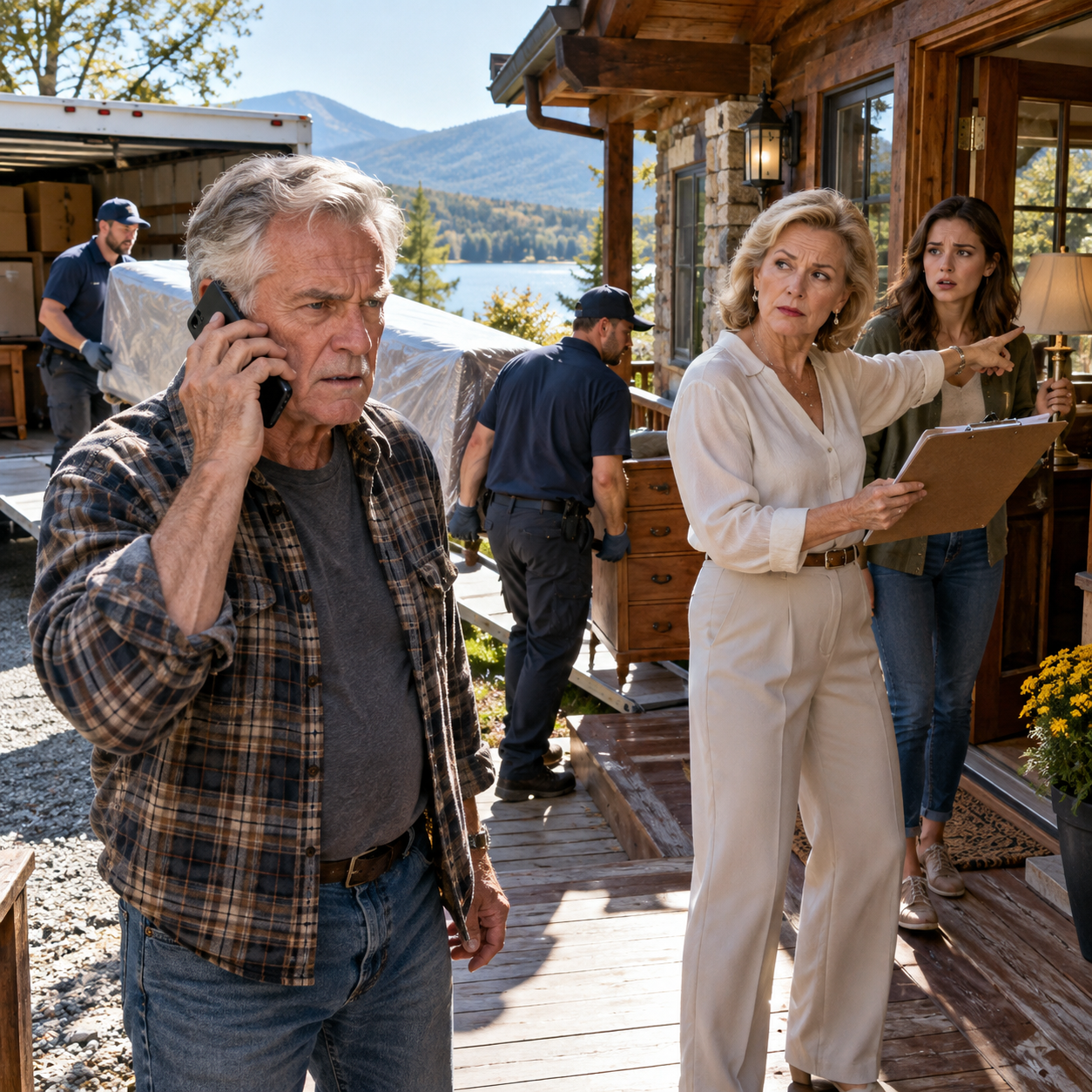
Part 2: The House Holds Evidence My Family Never Mentioned
I slept badly and woke before dawn.
The folder stayed on the kitchen table all night. I kept walking past it as though it belonged to someone else, then returning to read the same pages again.
There were forms for transferring money between accounts. Blank authorization documents. Notes about insurance policies. A page titled “timing” listed the anniversary of Nora’s death, my retirement date, and Daniel and Rachel’s wedding anniversary.
Nothing in the box was illegal by itself.
Together, the papers felt like somebody had measured me for a suit I had never agreed to wear.
At seven, I called Ray.
He came back with coffee and a legal pad.
When I showed him the files, he did not react dramatically. He simply took photographs and asked whether Carol had ever helped me with banking.
“No.”
“Rachel?”
“After Nora died. Online bills. Automatic payments. Things I didn’t want to think about.”
Ray looked at me.
“How much access?”
I hated the answer before I gave it.
“Probably more than I should’ve allowed.”
Ray rubbed one thumb along the edge of his coffee cup. “Yesterday I recognized Carol’s name because of an old report. Different county. Older widower. Similar family connection.”
“Was she charged?”
“No. The man backed away from the complaint.”
“Why?”
“His son begged him not to tear the family apart.”
I looked toward the lake.
That sentence sounded painfully familiar, even though no one in my family had said it yet.
After Ray left, I went back upstairs to restore Nora’s study. She had organized everything according to a logic only she understood. Pens in a chipped mug, stamps in a teacup, receipts inside old birthday-card envelopes.
While replacing a drawer, I noticed a slim notebook wedged behind it.
The cover was blue.
On the first page Nora had written my name.
Not a letter. Just my name, underlined once.
The earliest entry described an eleven-hundred-dollar electronic transfer she hadn’t recognized. She had called the bank because I never used online banking unless somebody stood beside me and walked me through it.
That somebody, toward the end of Nora’s illness, had often been Rachel.
Nora hadn’t accused her.
She had recorded dates.
Six weeks later, another transfer appeared.
Then another.
Nora had written:
Before I say anything to Daniel, I need facts. Suspicion can damage a family almost as effectively as theft.
I closed the notebook and sat at her desk.
That sentence sounded exactly like her. Even dying, Nora had been more concerned about damaging someone unfairly than about being proved right.
Daniel arrived shortly after noon.
He walked in without calling out, saw me at the kitchen table, and stopped when he noticed Ray’s card beside the file box.
“What’s going on?”
I pushed Carol’s folder toward him.
He read the page with my property values first.
“What is this?”
“Your mother-in-law’s homework.”
His face hardened. “Dad.”
“Keep reading.”
He did.
When he reached the note about me trusting family with paperwork, he lowered himself into a chair.
“Rachel said that?”
“It appears so.”
“You don’t know what this means.”
“No. That’s why you’re here.”
I placed Nora’s notebook beside him.
He recognized her handwriting immediately.
Daniel read for nearly half an hour. He turned every page slowly, sometimes going back to earlier entries. Near the end, he took off his glasses and rubbed both eyes.
“Mom knew?”
“She suspected.”
“Why didn’t she tell me?”
“Read the last paragraph again.”
He did.
Nora had written that Daniel deserved evidence, not fear, and that if Rachel was innocent, an accusation could poison his marriage permanently.
Daniel stared down at the page.
“She was protecting me.”
“She was trying to.”
He swallowed. “Dad, I swear to you, I never knew.”
“I believe you.”
His eyes lifted quickly.
That seemed to hurt him more than if I had accused him.
He leaned back and stared at the ceiling. “Rachel told me she was helping you because you were overwhelmed.”
“I was overwhelmed.”
He looked at the files.
“That doesn’t mean I was available for harvesting.”
Part 3: Nora’s Notebook Exposes a Quiet Financial Siege
Monday morning, my banker, Elaine Foster, met me before the branch officially opened.
I had known Elaine since she was a teller with braces and a college textbook under her counter. She now managed the branch and had the unnerving ability to remember every customer who had ever bounced a check.
She had already pulled three years of records.
“Martin,” she said, “I need you to look at these carefully.”
The highlighted transactions covered several pages.
Small transfers first.
Then larger ones.
Payments to accounts I did not recognize. Electronic withdrawals disguised among routine bills. Amounts just ordinary enough that a grieving widower scanning quarterly statements might assume they were insurance, taxes, contractors, or something his late wife used to manage.
The total was just over two hundred thousand dollars.
I removed my glasses.
“That’s not possible.”
Elaine folded her hands.
“Do you recognize any of these receiving accounts?”
“No.”
“Did you authorize Rachel to transfer money?”
“I authorized her to help pay bills.”
“That isn’t the same thing.”
No, it wasn’t.
Grief had made many distinctions feel unimportant at the time.
Nora had handled our household finances for thirty-nine years. After the funeral, passwords might as well have been written in another language. When Rachel offered to organize online payments, I had handed her a notebook containing information no cautious man should hand anybody.
Not because she demanded it.
Because I was tired.
By noon, the bank’s fraud department was involved. Ray joined us, and Elaine provided documentation showing logins, transfers, and destination accounts.
One receiving account was tied to a business associated with Carol.
Another had Rachel’s name attached.
Daniel came to the branch after I called.
He studied the printouts without speaking.
Finally he said, “Can you tell which one actually moved the money?”
Elaine answered carefully. “That will take investigation.”
Daniel nodded.
He did not defend Rachel.
He did not condemn her either.
He simply asked for copies and said, “I need to hear her tell me what happened.”
They spoke that evening at their house.
He told me about it the next day.
Rachel admitted she had given Carol access to some of my account information. At first, she said, Carol claimed she was helping consolidate expenses and locate forgotten subscriptions.
Then Carol started talking about “unused assets.”
Rachel knew money was being moved.
She claimed she believed Carol intended to repay it once a real-estate deal closed.
“Do you believe her?” I asked.
Daniel looked exhausted.
“I believe she kept choosing not to ask questions because the answers would have made her responsible.”
That sounded closer to the truth than anything else.
Rachel came to the cabin three days later.
She looked younger without makeup, and frightened in a way I had never seen before. She stood near the front door rather than sitting.
“I didn’t think it would go this far.”
I waited.
She glanced at Nora’s pictures above the fireplace.
“My parents were drowning financially. Dad had medical bills. Mom made some bad investments. She kept saying you had more money than you could ever use.”
“Did you agree?”
Rachel wiped her palms against her jeans.
“I told myself you wouldn’t be hurt by it.”
“And the cabin?”
“Mom needed somewhere to live.”
“Why were Nora’s belongings outside?”
Her mouth tightened.
“Mom said keeping everything exactly the same wasn’t healthy for you.”
I almost laughed.
Instead I asked, “And my wedding album?”
Rachel looked away.
“I didn’t know about that.”
Perhaps she didn’t.
By then, the distinction had become painfully small.
Before she left, she said, “Daniel won’t speak to me unless it’s about practical things.”
I looked at her.
“You came here for me to fix that?”
“No.”
Her eyes filled, but she held my gaze.
“I came because I wanted to tell you I’m cooperating.”
That mattered.
Not enough to erase anything.
But enough that I believed her.
Part 4: Truth Costs My Son His Marriage but Restores Our Family
The investigation lasted through the fall.
Carol’s previous dealings with the widower in Henderson County became relevant again once investigators compared methods. Rachel provided emails, text messages, and financial records rather than forcing authorities to obtain every piece the hard way.
Some of the money was recovered quickly because it remained in traceable accounts. Other funds had been spent or moved again. My attorney told me recovery would be slow and imperfect.
Oddly, the number stopped mattering as much once it had a name.
Loss.
Not mystery.
Not incompetence.
Not proof that age had made me foolish.
A loss caused by people who had mistaken my grief for permission.
There was one final thing Nora had left me.
Near the back of her notebook, I found the name of an attorney named Margaret Sloan.
I remembered Margaret vaguely from Nora’s garden club.
When I called, she said, “I’ve wondered when I’d hear your voice.”
Nora had met with her during treatment.
Without alarming me, she had tightened my estate documents, revoked old authorizations, and required in-person verification for major property transfers. She had also documented her concerns about unexplained financial activity.
“She was very specific,” Margaret told me. “She said you were carrying enough already.”
I turned toward the window.
“That sounds like her.”
“She also said you’d be angry she didn’t tell you.”
“That also sounds like her.”
Margaret laughed softly.
Then I did too.
It was the first time in months that remembering Nora hurt and comforted me in the same breath.
Daniel filed for divorce in November.
He never asked me whether he should.
One Saturday he came to the cabin carrying work gloves and a splitting maul. We spent the afternoon cutting firewood and replacing the porch boards I had originally driven up to repair.
Around four, he sat beside me on the steps.
“I keep thinking about Mom knowing.”
“Me too.”
“I wish she’d told me.”
“So do I.”
He picked at a splinter in the new board.
“But I understand why she didn’t.”
I nodded.
After a while, he said, “I should’ve paid more attention.”
“To what?”
“Rachel. The questions about your money. The way Carol talked about this place.”
I set down my coffee.
“Your mother spent her whole life trying to teach us the difference between trust and blindness.”
Daniel smiled faintly. “Did we learn it?”
“Eventually.”
Winter came early that year.
I changed every lock, every password, every account number. I hired someone to help with bookkeeping, and I made him explain every page to me instead of simply signing where he pointed.
The cabin remained mine.
More importantly, it became mine again.
Nora’s quilt returned to the upstairs bed. Her raincoat went back on its hook. Her ceramic bowl sat beside the door, containing three quarters, a Canadian dime, and a bent hairpin she had probably dropped there years before.
I kept her notebook in the study.
Not hidden.
Not displayed.
Just present.
In February, Daniel came for dinner. We made chili, burned the cornbread, and argued about whether Nora would have eaten it anyway.
“She would,” he said.
“She would’ve scraped off the bottom.”
“Then told us it added character.”
We both laughed.
Later, after Daniel drove home, I stepped onto the porch.
The lake was almost black beneath the winter sky. There were no moving trucks, no strangers carrying furniture, no one explaining what I supposedly needed for my own good.
The new porch boards were lighter than the old ones.
For a while they would look out of place.
Eventually weather would darken them until they belonged.
I understood something then that Nora had probably known long before I did.
Protecting a life you built does not mean refusing to let anything change.
It means deciding which changes are yours to make.
I locked the door behind me, slipped the key into my pocket, and went inside.
The End .
All characters and events in this story are fictional, created for storytelling and entertainment purposes. Thank you sincerely for reading. Your feedback and support are invaluable and motivate me to continue sharing more stories with you.
Story Title: I Drove Up To Fix My Late Wife’s Cabin… Only To Find My Daughter-In-Law’s Mother Already Moving In

