
## Part 2: The Wedding Photographs Exposed What My Parents Had Hidden
We left the hospital after midnight, carrying a plastic bag of Hazel’s belongings instead of our daughter. Her car seat remained strapped into the backseat, with the little yellow blanket she’d kicked onto the floor still lying beneath it. Halfway home, Daniel pulled into a gas station because his hands were shaking too badly to hold the steering wheel. Neither of us got out of the car.
At home, Hazel’s half-finished bottle stood on her dresser, and a single pink sock lay beside the changing mat. Her stuffed elephant leaned against the crib as though waiting for someone to come back. I sat on the nursery floor until sunrise, holding that sock against my chest while Daniel sat silently beside me. Every few minutes, my hand reached for my phone to check the baby monitor before I remembered there was nothing left to check.
Mom finally called Sunday morning. “We just got back to the hotel,” she announced, sounding exhausted. “Brooke cried during the speeches. It was such an emotional evening.” I closed my eyes and said, “Mom, my baby died,” but she only sighed and told me everyone was heartbroken.
When I asked why they had stayed for the cake, her voice sharpened. “What were we supposed to do, Leah? Walk out and make two hundred guests wonder what happened?” I told her I’d wanted her beside me when Hazel was dying, and she responded with a sentence I would never forget. “We have two daughters. Yesterday mattered to Brooke, too.”
I ended the call before she could say anything else.
Daniel spent Sunday calling the funeral home, answering questions from the hospital, and ordering food neither of us could swallow. That afternoon, my aunt Marlene called, crying so hard she could barely speak. “Sweetheart, why didn’t anyone tell me Hazel was that sick?” she asked, and I stared at the wall, confused. “Mom knew,” I replied. “She was at the wedding with you.”
There was a long silence before Marlene explained what she’d been told. Mom had said Hazel had a mild fever and that we were keeping her home out of caution. During dinner, she’d assured relatives the doctors expected Hazel to recover. When I told Marlene the exact time of Hazel’s death, she whispered, “I would have driven straight to that hospital if I’d known.”
Until then, I had believed my parents had simply chosen Brooke’s wedding over Hazel’s final hours. Now I understood they had prevented other people from choosing differently. Marlene arrived within an hour carrying groceries, tissues, and a small bag of Hazel’s favorite soft washcloths she’d bought weeks earlier. She didn’t offer explanations for my parents or ask me to forgive anyone; she simply took my hand and stayed.
Monday morning brought something worse.
My cousin Nina sent me a photograph posted from the wedding reception. Brooke stood beneath an enormous flower-covered arch, smiling between Mom and Dad, while a decorative sign overhead declared, “The Best Day of Our Lives.” The photograph had been taken at 7:46 Saturday evening, twenty-eight minutes after Hazel died. My parents knew she was gone when that picture was taken.
Nina had commented beneath the photograph, asking people to remember that the bride’s infant niece had died that same evening. Within hours, relatives and wedding guests began asking why they hadn’t been told. Some quietly removed their cheerful captions, while others sent messages offering condolences. Mom called Marlene in a fury, accusing her of spreading private family business.
“You told everyone the baby was getting better,” Marlene reminded her. Mom answered, “I wasn’t going to ruin Brooke’s reception.” When Marlene repeated those words to me, I finally understood what frightened my mother. It wasn’t that she’d made a terrible decision; it was that people had begun questioning it.
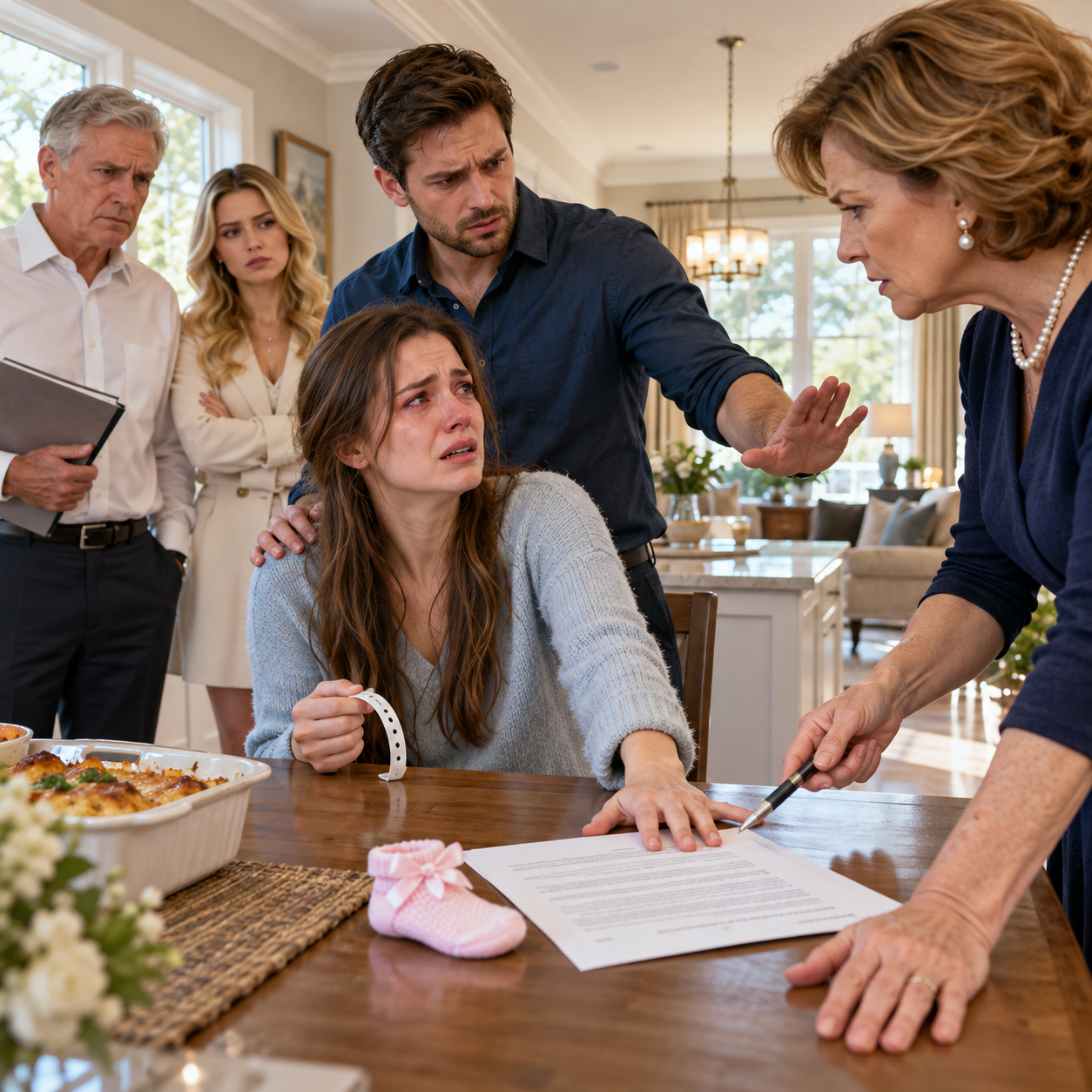
Tuesday morning, three days after Hazel died, my parents’ car pulled into our driveway.
Mom stepped out carrying a casserole dish, Dad held a folder, and Brooke followed them wearing the expensive cream-colored coat she’d purchased for her honeymoon. Daniel met them at the door and explained that I wasn’t ready for visitors. My father pushed past the conversation with a stern expression. “We need to clear something up as a family.”
I was sitting at the kitchen table, with Hazel’s hospital bracelet resting between my hands. Dad opened his folder and placed a typed statement in front of me. My mother’s handwriting appeared beneath the final paragraph, marking the space where I was supposed to sign. As I read the first sentence, the room seemed to tilt.
They weren’t there to comfort me.
They had come to make me lie.
## Part 3: My Parents Demanded A Lie That Protected My Sister’s Wedding
The statement claimed I had personally encouraged my parents to remain at Brooke’s wedding, assuring them that Hazel was receiving excellent care and that their presence wasn’t necessary. It said I understood their decision completely and wanted relatives to stop criticizing them. My father tapped the bottom of the page. “Sign it, Leah. People are saying terrible things about us.”
I looked at Mom, who had carefully placed her casserole beside the sink, as though bringing food excused everything else. “You want me to tell everyone I asked you to stay?” I whispered. She pulled out a chair and answered, “We just need people to understand that we’re not monsters.” When I asked whether she’d drafted the statement before checking how Daniel and I were surviving, she avoided my eyes.
Brooke stepped forward, twisting her wedding ring around her finger. “My new in-laws are calling Evan, and people are leaving horrible comments under our photographs,” she complained. “I can’t get my wedding day back, Leah. Can’t we have one nice thing in this family?” I watched her for a moment, wondering how someone could stand in a house filled with her dead niece’s belongings and worry about photographs.
“Did you know I called Mom before the ceremony?” I asked. Brooke nodded and said she’d heard Hazel was having complications. I asked when she learned Hazel had died, but before she answered, Mom interrupted. “This isn’t an interrogation, Leah. We’re all grieving differently.”
“Then tell me why you asked me not to tell the family until after the cake,” I said, holding up my phone. Mom’s expression hardened, and her answer came without hesitation. “Because nothing was going to bring Hazel back. There was no reason to take something beautiful away from Brooke, too.”
Daniel moved beside my chair, his face pale. “I think you should leave,” he said. Dad straightened and replied, “We’re her parents,” as though those words gave him permission to stay. Daniel opened the front door. “Then you should know when your daughter needs you to leave.”
I pushed the statement across the table. “I’m not signing a lie,” I told them, and Dad shook his head in disbelief. “After everything we’ve done for you, you’re going to let strangers attack us?” I pointed toward Hazel’s bracelet. “You were ninety minutes away. I asked you to come, and you stayed.”
“We had responsibilities at the wedding,” Dad answered.
“And I had a daughter.”
For the first time, nobody spoke. Then Brooke rolled her eyes and muttered, “You always know how to make everything about yourself.” Daniel held the door open until all three of them stepped onto the porch, and I stood motionless beside the kitchen table. Their untouched casserole remained beside the sink, and later that afternoon, I threw it away without lifting the lid.
That evening, a message arrived from Evan, Brooke’s new husband. We’d always gotten along, although we’d never been particularly close. “Leah, I’m sorry to contact you,” he wrote. “Can we speak for a moment?” I told him I couldn’t manage a phone conversation and asked him to text whatever he needed to say.
His response made me sit upright.
“Brooke told me Hazel was sick, but she said your parents had spoken with you and everything was stable. I only found out today that Hazel died during our reception. If I’d known how serious things were, I would have taken your parents to the hospital myself.”
I read his words aloud to Daniel, who sat beside me on the couch. Until that moment, we’d assumed Evan knew what had happened and had chosen to continue celebrating with everyone else. But he’d been deliberately kept in the dark, just like Aunt Marlene and the other wedding guests. I typed a brief thank-you, and Evan replied that there was something else I needed to see.
He attached several screenshots from a private group conversation involving Brooke, Mom, Dad, and two members of the wedding party. One bridesmaid had forwarded the exchange to Evan because she felt guilty about what she’d been asked to conceal. I opened the first screenshot and saw a message Brooke had sent at 6:16 p.m. “Please put your phones away for the ceremony. Leah knows today is important.”
Then I reached the messages from later that evening.
At 7:38 p.m., Mom had written, “Hazel passed. Don’t say anything to guests until the reception is over.”
Two minutes later, Brooke had replied, “Okay. Please don’t tell Evan yet. He’ll want to leave, and we haven’t done the first dance.”
I stared at those words until the letters blurred. Brooke hadn’t merely accepted our parents’ decision to stay at the wedding. She had known her niece was dead and deliberately hidden that truth from her own husband because she was afraid he would want to help us.
Daniel reached for my hand, but I couldn’t move. My sister had asked me to protect her wedding memories with a lie, when she herself had helped construct the lie that kept our family away. And now, for the first time since Hazel died, I knew exactly what I needed to do.
## Part 4: The Hidden Messages Revealed The Truth And Changed Everything
I wanted to call Brooke and demand an explanation, but I could already imagine her response. She would tell me I was too emotional, that I was ruining her marriage, and that nothing could change what happened. Instead, I opened our family group chat and wrote a message with shaking hands. “Hazel died Saturday at 7:18 p.m. We asked my parents to come to the hospital before she died, and they chose to stay at the wedding.”
I continued, explaining that I had never encouraged them to remain there and that they’d asked me to sign a statement claiming otherwise. I told everyone Daniel and I were planning a small memorial and needed privacy. Then I set the phone facedown and held my husband’s hand. I didn’t attach Evan’s screenshots or photographs of Hazel in the hospital because her final hours belonged to her, not to strangers looking for someone to blame.
The replies arrived anyway. Nina offered to organize flowers, an uncle promised to drive from Virginia, and two relatives apologized for believing Mom’s assurances that Hazel was improving. My parents sent dozens of texts over the following days, first accusing me of misunderstanding their intentions and then insisting they had been in shock. Dad finally wrote that I’d publicly humiliated them, while Brooke sent one bitter message: “I hope you feel better now that everyone hates my wedding.”
I deleted nothing, but I answered none of them.
On Thursday, Evan contacted me again. He said he’d confronted Brooke about the messages and that they had serious things to discuss. “I’m not asking you to take sides,” he wrote. “I just wanted you to know I never agreed to hide this.” I thanked him for telling me the truth and hoped he would understand what kind of marriage he had entered.
The following Saturday, we held Hazel’s memorial in a small garden behind our church. I’d asked Mom, Dad, and Brooke not to attend because I couldn’t bear another argument. Marlene arranged simple white flowers, Nina helped welcome guests, and neighbors brought food without expecting conversation. Monica, the nurse who’d stayed with us at the hospital, arrived briefly on her day off carrying Hazel’s memory box.
Inside were her tiny handprints and a lock of her soft hair. Daniel held the knitted blanket Monica had given us that terrible night, folding and unfolding one corner as people gathered beneath the garden trees. Friends, coworkers, relatives, and neighbors stood quietly around us, including people who’d met Hazel only once but remembered how she’d smiled whenever someone sang. For the first time since her death, I wasn’t surrounded by people asking me to explain myself.
Marlene spoke about Hazel’s beautiful eyes and the happiness she’d brought into our lives. I had written something to read, but when I stood and opened the folded page, my throat closed. Daniel gently took it from my hands and began speaking about Hazel’s tiny fingers, her dislike of bananas, and the delighted squeals she’d made whenever she heard crinkling paper. Then he looked at me and said, “Her life was short, but it was an entire life to us.”
I broke down against his shoulder, and he held me while the wind stirred the branches above us. Nobody asked us to be strong, nobody mentioned the wedding, and nobody tried to make our grief more convenient. We stood together until the last guest had gone, then carried Hazel’s memory box home. That evening, I placed her handprints beneath the paper stars above her crib.
Three weeks later, Dad appeared on our porch alone. He carried a small wooden elephant he’d been carving for Hazel, its ears carefully rounded and its surface sanded smooth. He placed it beside the door and looked at me with red-rimmed eyes. “Leah, I was wrong,” he said quietly. “You called, and I should have come. I don’t have an excuse.”
For several seconds, I couldn’t answer. I’d waited for those words while sitting beside Hazel’s hospital bed, while leaving the hospital without her, and while reading my parents’ request that I sign away the truth. Finally, I said, “Thank you for saying that, Dad. But I can’t be close to you right now.”
He nodded, left the elephant on the porch, and walked away without arguing. It was the first time since Hazel’s death that he’d accepted an answer from me without demanding something in return. I brought the little elephant inside and placed it on Hazel’s bookshelf, where her grandfather had once arranged her tiny storybooks. I still didn’t know whether I’d ever be ready to welcome him back.
Mom sent several letters explaining how impossible the choice had felt and how deeply she’d loved both her daughters. In her third letter, she finally wrote, “I should have come when you asked.” It was the apology I’d needed, but not a promise that she would change. I put the letter away, understanding that forgiveness, if it ever came, wouldn’t require me to pretend everything was normal again.
Brooke and I haven’t spoken since she stood in my kitchen and asked me to protect her wedding day. I don’t know what happened between her and Evan after he discovered those messages, and I’ve stopped trying to find out. Their marriage is theirs to face, just as my grief is mine to carry. I refuse to let Hazel’s memory become another argument about who deserves sympathy.
Some mornings, I make coffee while Daniel prepares breakfast, and we manage to laugh at something ordinary. Other mornings, a tiny sock appears in the laundry, and I sink onto the bedroom floor because I cannot imagine a lifetime without my daughter. We eventually put Hazel’s crib into storage, but I kept one of the paper stars hanging in our bedroom window. When sunlight passes through it, a small shadow moves across the wall, and I remember her reaching toward the stars with both hands.
I once believed loving my family meant making endless allowances for their mistakes, even when those mistakes broke my heart. Now I understand that love without truth can become another way of demanding silence. My parents were allowed to celebrate Brooke’s wedding, but they were never entitled to rewrite what happened while Hazel was dying. And my sister’s happiness was never worth more than my daughter’s life.
Three days after Hazel died, my family handed me a paper claiming they’d done nothing wrong. They wanted my signature so everyone would stop questioning them. But the truth was already written in the hospital records, the unanswered calls, and the messages they’d sent while my daughter took her final breaths.
I couldn’t change the night they chose not to come.
I could only refuse to let them change its story.
And each time I look at that paper star, I remember the only person whose memory I will spend the rest of my life protecting: my little Hazel, who deserved a family that came when she needed them.
THE END.
All characters and events in this story are fictional, created for storytelling and entertainment purposes. Thank you sincerely for reading. Your feedback and support are invaluable and motivate me to continue sharing more stories with you.


