
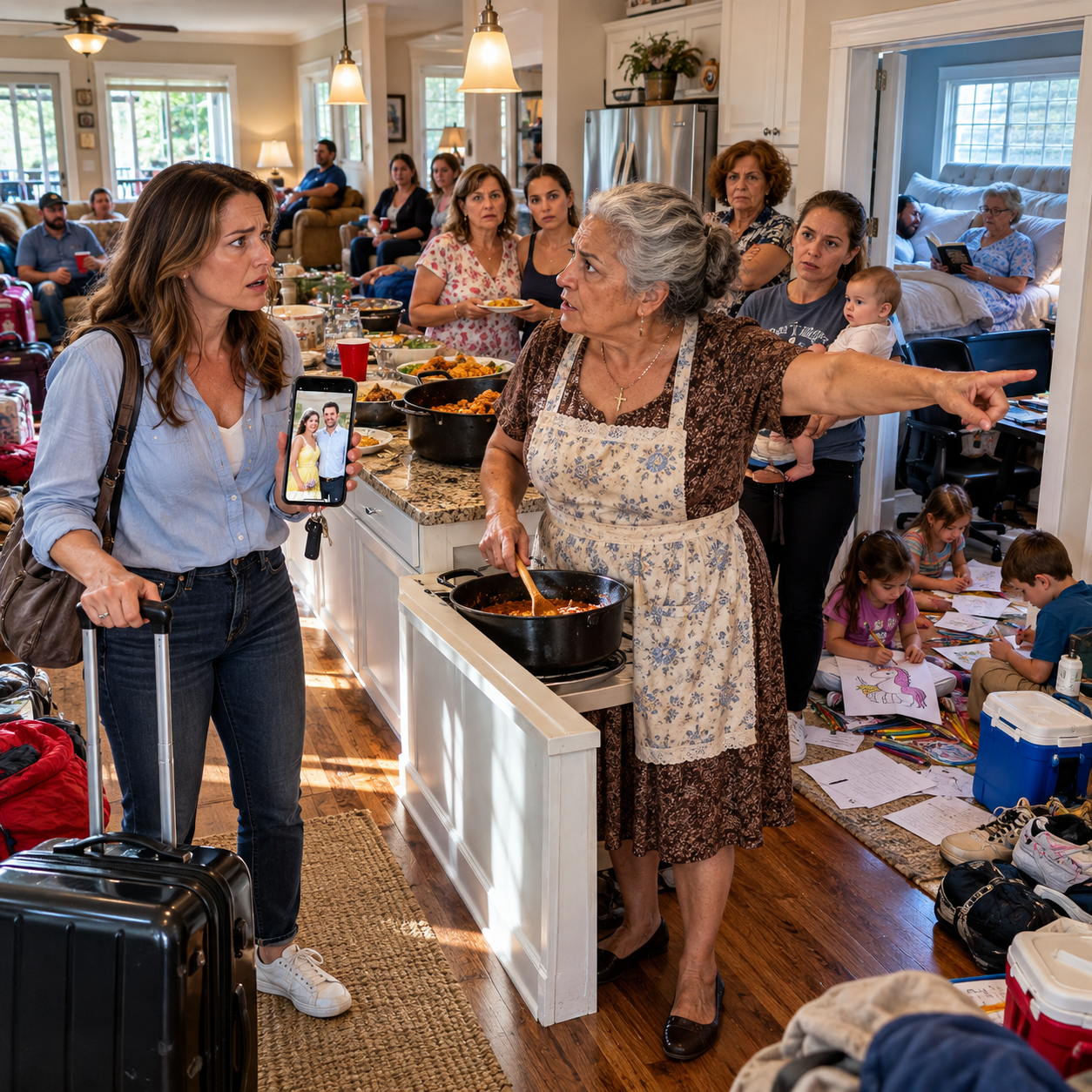
## Part 2: A Deed And Marriage Certificate Turn His Story Upside Down
I ended the call, watched the lights glowing through my windows, and sat behind the steering wheel until my hands stopped trembling. Then I checked my reflection, arranged my face into something resembling a polite smile, and walked back inside.
Jimmy’s mother was still stirring her pot.
“Leaving already, dear?”
“For a few days.”
“How thoughtful. We really do need the extra room.”
I collected some clothes and toiletries, drove to a hotel near the mall, and checked into a room that smelled of industrial detergent.
At nine-thirty that night, I called Polly Short, the attorney who’d handled my first divorce. I left a detailed message explaining what Jimmy had done. Then I opened my laptop and reported the exposure of my confidential claim files to my adjusting firm’s compliance officer.
Writing that email was harder than making either phone call. In eleven years, I’d never had a privacy incident. Now I was explaining that children had used confidential paperwork as coloring pages because my husband had handed our home over to strangers.
Polly called at seven the next morning.
“Tell me everything again,” she said. “Slowly this time.”
By eight-thirty, I was standing at the courthouse requesting a certified copy of our marriage certificate. The clerk recognized me.
“You wore yellow, didn’t you?”
“Yes, ma’am.”
She stamped the certificate, and I placed it beside a copy of my property deed.
At Polly’s office, I spread both documents across her desk.
“The house is your separate property,” she explained. “You owned it before the marriage. But Jimmy lives there, and you can’t simply deny him access to his residence without following the law.”
“What about his relatives?”
“That’s different. They’re guests, not tenants. We’ll formally revoke their permission to stay and give them a reasonable deadline. If they refuse, we’ll address it through the proper channels.”
Polly prepared a written notice requiring the visitors to leave by noon on Thursday, August 14. She also arranged for a sheriff’s deputy to be present while I delivered it.
Before serving the notice, I returned home to collect additional clothing.
The kitchen was still crowded. Jimmy’s mother barely acknowledged me as I passed. In the hallway, I reached onto the top shelf of the closet for my garment bag and knocked something loose.
A picture frame.
It was our wedding photograph, taken outside the courthouse. I was laughing in my yellow dress while Jimmy stood beside me with his arm around my waist.
I reached up again.
Four more frames were stacked beneath a blanket: our first Christmas, our anniversary dinner, a fishing trip to Grand Isle, and the afternoon Jimmy moved into my house.
Every photograph of us together had been removed from the walls.
I sat on the hallway floor holding them against my chest.
A shadow fell across the doorway.
Jimmy’s mother stood there with a dish towel in her hands.
“Jimmy told us you’ve had a difficult time since your divorce,” she said. “He warned us you might become emotional.”
She glanced at the photographs without recognizing what she was looking at.
“We’re trying to be patient with you, dear.”
I watched her return to the kitchen, then carried the photographs to my car.
The next morning, Deputy Billie Gibbs met me outside the house. She explained that she was there to prevent a confrontation, not to enforce an eviction that hadn’t occurred.
Jimmy’s mother came onto the porch wearing the same apron.
I handed her Polly’s notice.
She read it twice.
“This is my son’s house.”
“No, ma’am.”
I gave her the deed.
She studied my name, the purchase date, and the official recording information.
“He rents it to you,” she insisted.
I opened the folder again and handed her our certified marriage certificate.
“Jimmy doesn’t rent this house to me. He’s my husband. We married in March 2023.”
His mother’s fingers tightened around the paper.
Behind her, several relatives crowded into the doorway. A cousin holding a baby asked what was happening.
The elderly woman read Jimmy’s name again. Her eyes traveled to the wedding date.
“He’s been coming home for Christmas,” she whispered. “Every year.”
“Yes.”
“And telling me he lives alone.”
I didn’t answer.
She lowered herself onto the top porch step, still holding the certificate.
Deputy Gibbs addressed the family calmly, explaining the deadline and encouraging everyone to leave voluntarily.
Nobody argued.
For the first time since I’d arrived home, Jimmy’s mother looked directly at me without calling me the renter.
“Does my son know you’re doing this?”
“Yes, ma’am,” I said. “But he doesn’t know I’ve found the wedding pictures.”
## Part 3: His Father’s Boats Reveal The Price Of Our Secret Marriage
By Thursday morning, people were packing.
Children cried over a vacation cut short. Coolers were carried to trucks, sleeping bags rolled up, and someone dragged the fish fryer off my deck. Two deep tire ruts remained in the lawn where the Texas pickups had been parked.
I found Sheree in my bedroom stripping the sheets from my mattress. The woman who’d borrowed my nightgown had already left. The gown lay neatly folded on my dresser.
“I washed everything,” Sheree said. “At least let me do that.”
She sat on the edge of the mattress and looked at me for a long moment.
“There’s something about Jimmy you should understand.”
His father, she explained, had built a shrimping business in Port Arthur. Four boats, a dock, and an ice house had supported the Padilla family for decades. When he died, ownership passed to Jimmy’s mother.
“She’s always told the children they’ll inherit their shares if they honor the family.”
“What does that mean?”
Sheree folded a pillowcase carefully.
“Jimmy’s daddy promised him a boat called the Lady Padilla. His mother told him he’d lose it if he married a divorced woman.”
I looked toward the hallway where our wedding picture had hung.
“That’s why he never introduced me?”
“Partly.” She hesitated. “This summer, she started inviting a woman from church to family dinners. Thirty-eight, never married. Sat her right beside Jimmy twice.”
“Did he tell her he was married?”
Sheree shook her head.
“He let everybody believe he was available.”
Outside, one of the cousins was struggling to lift a bicycle into his pickup.
Sheree followed my gaze.
“We didn’t know about you, Amelia. Most of us didn’t even know your name.”
The last vehicles left shortly before noon.
Jimmy’s mother walked past me carrying a large aluminum cooking pot. She didn’t speak or turn around.
A cousin named Tommy was the final person out. He stopped at the porch steps and showed me his phone.
“I’m the one who took down your pictures,” he admitted. “Jimmy gave me a key last month.”
On his screen was a message Jimmy had sent before our departures.
Take the pictures in the hall and living room down before Mama gets there. Put them on the closet shelf. Don’t let her see.
Tommy rubbed his forehead.
“I thought it was some kind of surprise. I’m sorry.”
After his truck disappeared, I stood alone on my porch.
Jimmy hadn’t merely neglected to tell his family about me. He had arranged to erase me from my own house.
That evening, I pulled his clothes from our bedroom closet and stuffed them into heavy contractor bags. Work shirts, fishing hats, socks, boots—everything went into the garage.
I was careless with a small velvet box containing his father’s gold watch.
The following morning, I discovered its crystal had cracked.
I sat on the garage floor holding it. For all Jimmy had done, the man who’d once worn that watch had done nothing to deserve my anger. I returned it to its box and decided I would pay to repair it.
On Friday, a locksmith rekeyed the doors and changed the garage locks. Following Polly’s instructions, I placed a new house key in an envelope at her office, available for Jimmy to collect when he returned. His access to the residence remained available, but I wanted any contact documented.
That evening, I sat alone on the porch while rainwater dripped from the cypress trees.
I didn’t feel victorious. The house smelled of disinfectant, the refrigerator was full of unfamiliar leftovers, and the hallway walls bore pale rectangles where our photographs used to hang.
By Saturday night, I had forty-one missed calls.
Jimmy called nine times from the offshore platform. His mother called fourteen. Sheree called eleven, and the remaining calls came from relatives whose numbers I didn’t recognize.
Jimmy left six voicemails.
In one, he was furious I’d brought a deputy to the house. In another, he apologized and begged me to wait until he returned.
The fifth message was different.
“I was going to tell Mama at Christmas,” he said, his voice nearly lost beneath the platform machinery. “You don’t understand what those boats meant to Daddy. If she cuts me out, it’s like losing him all over again.”
He stopped, then spoke more softly.
“I thought I could have both. I thought she’d eventually soften, or I’d find a way to tell her.”
Another pause.
“I never thought you’d come home early.”
I saved that message.
It told me more about my marriage than all the apologies combined.
## Part 4: On My Porch He Finally Chooses The Truth Too Late
On Sunday, August 17, Jimmy’s offshore rotation ended.
His truck pulled into my driveway at twelve-forty that afternoon.
His mother was sitting in the passenger seat.
A gray Buick parked behind him, and I recognized Sheree at the wheel. She remained inside, watching as Jimmy climbed out of his truck.
He looked exhausted. His face was sunburned, his beard had grown unevenly, and his shoulders sagged beneath his work shirt.
His mother stepped onto the walkway, still wearing her Sunday church dress. A rosary was wrapped around her fingers.
I stayed on the porch swing.
She turned toward Jimmy.
“Mijo, is she your wife?”
He looked from his mother to me.
For several seconds, all I could hear was a lawn mower somewhere down the street and the frogs calling from the drainage ditch.
“Yes, Mama,” he finally said. “Amelia is my wife. We got married in 2023.”
His mother closed her eyes.
When she opened them, she studied him with an expression I couldn’t quite read.
Then she spoke quietly in Spanish.
I didn’t understand the words until Sheree translated them later.
“Then you’ve made your choice. You have no place on my dock.”
She turned away, walked to Sheree’s Buick, and climbed into the back seat.
Jimmy watched the car disappear around the corner.
Then he sat on the top porch step, exactly where his mother had sat holding our marriage certificate four days earlier.
“Daddy built that dock in 1986,” he said. “I used to sit on a bucket and watch him unload shrimp. He promised me the Lady Padilla would be mine someday.”
I listened.
“When Mama told me she’d cut me out if I married you, I thought she’d change her mind. Then we got married, and I kept putting off telling her. Every holiday made it harder.”
“You could have told me the truth.”
“I told you she was difficult.”
“That’s not the same thing, Jimmy.”
He rubbed both hands across his face.
“I was scared of losing everything Daddy worked for.”
“So you made sure I was the one who could lose everything.”
He turned toward me.
“That’s not fair.”
“You gave twenty-three people permission to stay in my house without asking. You had our wedding pictures hidden. You told your mother I was your renter, then convinced her I was emotionally unstable so she wouldn’t question me.”
He opened his mouth, then looked away.
“Do you know what hurts the most?” I asked. “You weren’t afraid I’d discover your family was staying here. You planned everything because you expected me not to.”
Jimmy’s shoulders began shaking.
I had loved this man through offshore storms, missed birthdays, lonely holidays, and the ordinary disappointments that come with sharing a life. I knew how to comfort him.
That afternoon, I couldn’t make myself do it.
After a while, I went inside and returned carrying the velvet box.
“I broke your father’s watch,” I said. “I was angry and careless. I’m sorry. I’ll pay to repair it.”
He opened the box and touched the cracked crystal with his thumb.
“Thank you for telling me.”
I nodded toward the driveway.
“Polly has your new house key. Your belongings are in the garage. Call her before you come for them.”
He looked at me.
“Are you asking for a divorce?”
“I’m asking you to understand that I’m not going to disappear again just so you can keep something.”
He stayed on the step a little longer. Then he walked to his truck.
I filed for divorce in September. Under Louisiana’s applicable separation requirement for our marriage without children, we needed to live separately for 180 days before the divorce could be finalized.
Jimmy moved into an apartment in Morgan City and continued working offshore.
He collected his belongings on a Tuesday with Deputy Gibbs present to keep the peace.
Before leaving, he stood at the bottom of my porch steps.
“For what it’s worth, Amelia, you were never just a renter to me.”
“I know,” I told him. “You knew exactly who I was. That’s why it hurt.”
In October, Sheree called.
Jimmy’s mother had revised her will. The Lady Padilla and the share of the family dock intended for Jimmy would now pass to a nephew in Port Arthur.
I didn’t celebrate hearing that. Jimmy had sacrificed our marriage trying to protect his inheritance, and in the end, he’d lost both.
My adjusting firm completed its investigation in September. Every confidential document was accounted for, and the review found no evidence that information had left my house. I received a written acknowledgment thanking me for reporting the incident promptly.
I returned to work, driving through Texas after a hailstorm and Mississippi after a tornado. There were roofs to inspect, estimates to finish, and people who needed someone to show up when they said they would.
Life didn’t suddenly become easy. Some evenings I still reached for my phone when something funny happened, forgetting for a moment that Jimmy was no longer the person I called.
But the house gradually began to feel like mine again.
One rainy afternoon, I finally sorted through the photographs Tommy had hidden in the hallway closet.
I couldn’t throw away our wedding picture. The woman in that yellow dress had been happy, and I wouldn’t punish her for believing in someone. I wrapped those photographs carefully and placed them in a box in the attic.
At the bottom of the stack, I discovered one more frame.
It wasn’t a picture of Jimmy and me.
It was a photograph from 2016, taken the day I bought the cottage. I was sitting on the front porch steps, sunburned and grinning, holding a single brass house key toward the camera.
I remembered that afternoon. My hair was a mess, my checking account was nearly empty, and there wasn’t a stick of furniture inside yet.
But I had stood in the doorway of that little house and promised myself I’d never again have to beg anyone to let me belong somewhere.
I carried the photograph downstairs and hung it beside the front door, exactly where our wedding portrait used to be.
Then I stepped onto the porch.
A light rain had begun tapping against the tin roof, and the bayou breeze carried the smell of wet grass through the neighborhood.
I didn’t know whether Jimmy would ever understand what he’d done. I didn’t know whether his mother would forgive him, or whether he would someday forgive himself.
Those weren’t things I could repair for him.
I only knew that when I turned my key in the front door that evening, I was walking into a home where nobody needed to hide my picture.
And that was enough.
The End .
All characters and events in this story are fictional, created for storytelling and entertainment purposes. Thank you sincerely for reading. Your feedback and support are invaluable and motivate me to continue sharing more stories with you.


