The steel blade sliced through the air toward my throat before anyone announced the drill had begun. I caught the handle without thinking, and three seconds later, the arrogant instructor was flat on his back beneath me. Then the commander burst through the hangar doors, saw what I was about to do, and screamed, “Abort the drill! Stand down right now!”
### Part 1: The arrogant instructor chose the wrong woman to humiliate.
My name is Emma Vance, and for six months, I had worked harder at being invisible than I ever had at being noticed. Eight years of high-tempo deployments across three continents had left me with fractured sleep, exhausted nerves, and a body that reacted to danger before my mind could identify it. I had requested a transfer to regional logistical oversight because I wanted something ordinary: generator manifests, supply requests, coffee that went cold while I answered emails, and evenings when nobody expected me to disappear into darkness. Unfortunately, the military had one rule that even a quiet desk assignment couldn’t erase: every active-duty specialist had to complete quarterly hand-to-hand recertification.
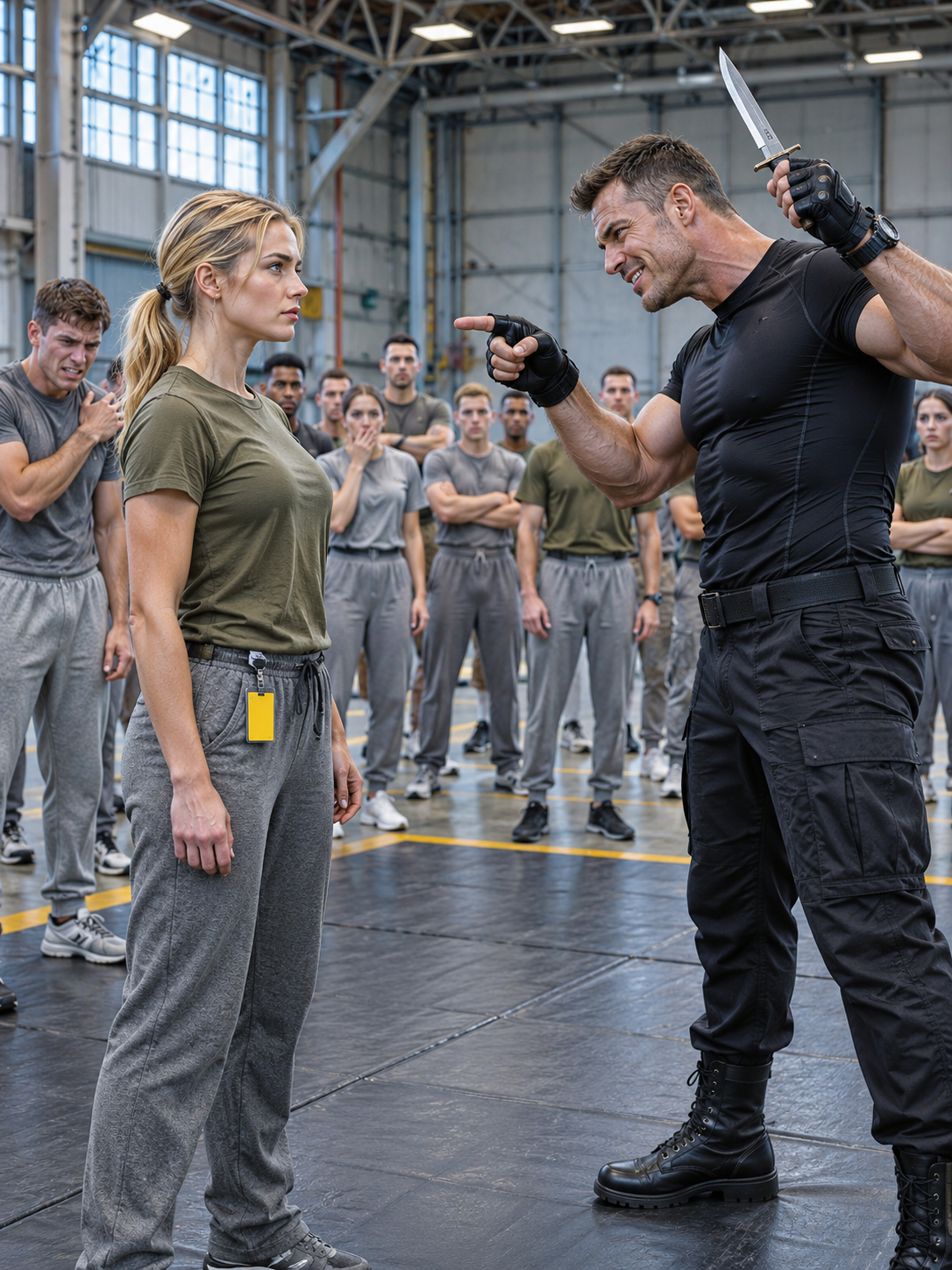
That was why I walked down the concrete stairwell into Hangar Bay 4 on a cold Tuesday morning, wearing faded gray training clothes and an old olive T-shirt without a single operational patch. The room smelled of rubber mats, damp concrete, and the faint electrical tang from overhead lights, while twenty clerks and junior officers waited beside three marked training areas. I had tied my blond hair into a loose ponytail, rolled my shoulders forward, and tucked my hands into my pockets, deliberately disguising the posture years of combat training had carved into me. At the registration desk, a corporal checked his clipboard and barely glanced up. “Emma Vance, logistics division,” he murmured, marking a box before pointing toward mat three, and I quietly thanked him before slipping into the back row.
Then Instructor Hayes entered the center circle, and I immediately understood why the others looked nervous. He was a private-sector contractor, not an active-duty soldier, but he strutted across the mats as though every person in that hangar existed to admire him. His fitted black compression shirt displayed his muscular arms, his fingerless gloves looked brand-new, and his polished boots struck the floor with theatrical precision. For fifteen minutes, he lectured us about weakness, cowardice, and the supposed stupidity of people who spent their careers behind computer screens. I watched his eyes move from face to face, searching for someone too intimidated to challenge him.
He found that person in Miller, a young supply specialist whose daily responsibilities involved cataloging medical crates. “Come here, Miller,” Hayes ordered, curling two gloved fingers, and the young man stepped forward with the uncertain expression of someone approaching a trap. Before Miller could properly position his feet, Hayes seized his wrist and hurled him onto the rubber mat with enough force to make several people flinch. Miller landed hard, gasped for air, and clutched his shoulder while Hayes stood over him with a satisfied grin. “Pathetic,” the instructor announced, refusing to help him up, “and that’s what happens when your entire career is spent hiding behind a computer.”
Nobody laughed, although Hayes clearly expected applause. Two trainees glanced toward Miller, but neither moved until he struggled upright on his own, his cheeks burning with embarrassment. I felt my jaw tighten because I recognized the expression on Hayes’s face: the pleasure of humiliating someone who couldn’t safely fight back. During my deployments, I had served beside supply specialists whose careful work kept entire teams alive, and watching this man reduce their value to a punch line made something cold settle in my chest. Still, I lowered my eyes and reminded myself that I had come to qualify, not to start a confrontation.
Unfortunately, Hayes noticed the one person who hadn’t reacted to his performance. His gaze traveled over my faded clothing, paused on the small yellow logistics tag clipped to my belt, and returned to my face with a slow, insulting smile. “You, the blonde in the back,” he called, pointing directly at me, “what’s your name?” I answered, “Vance,” and he beckoned me toward the center of the mat, telling the room that he wanted to see whether my hands could move as quickly as my spreadsheets. I stepped forward and stopped four paces away, keeping my breathing even while a few people exchanged uncomfortable looks.
“Don’t worry, Specialist Vance,” Hayes said, rolling his shoulders. “I won’t scuff those pretty boots.” He reached toward his tactical rig and unclipped a weighted carbon-steel training blade, its edges dull but its pointed tip and solid metal body perfectly capable of causing a serious injury. Standard range safety procedures required protective equipment, clear verbal boundaries, and rubber training weapons for reaction drills, requirements covered by the safety guidance we were supposed to follow. I looked at the blade, then at his face, and said quietly, “Instructor, are we using approved training equipment?”
His smile disappeared.
“Reaction time is everything,” he announced loudly enough for the entire group to hear, deliberately ignoring my question. “Some people freeze, some people run, and some people just pray the threat goes away.” He balanced the metal handle across his gloved fingers, then leaned closer as though sharing a private joke. “Let’s find out what a logistics girl does.”
I didn’t raise my hands or assume a fighting stance. I simply watched his right shoulder, the way I had been taught years before, while Miller stood near the wall rubbing his injured arm. Hayes mistook my stillness for defiance, and I saw his embarrassment turn into anger when I refused to give him the frightened reaction he wanted. He never called the drill to begin, never confirmed that I was ready, and never warned the trainees standing behind me.
He just snapped his wrist.
The metal blade left his hand and came spinning directly toward my throat.
### Part 2: A flying blade awakened instincts I desperately wanted buried.
For one impossible second, everything seemed to slow down. The fluorescent lights stretched into pale streaks above me, the sound of someone gasping faded into the distance, and I watched the steel rotate through the air with a terrible familiarity. My left foot shifted, my shoulders turned just enough to clear the blade’s path, and my hand closed around the handle before it passed my collarbone. I remember the cold weight against my palm, but I don’t remember deciding to catch it.
That was the frightening part.
My body had already committed to a response my conscious mind hadn’t authorized. I crossed the four paces separating us, caught Hayes off balance with my right forearm, and swept his foot from beneath him in one controlled motion. His boots left the mat, his expression shattered, and he landed flat on his back with a heavy thud that echoed through the hangar. Before he could recover, I had one knee planted against his chest and the flat of the dull training blade resting motionless beside his neck. Every instinct I had spent years sharpening told me what the next movement could accomplish, and every part of the woman I was trying to become begged me to stop.
Hayes stared up at me, his eyes enormous. The confidence that had filled his voice moments earlier was gone, replaced by a stunned awareness that he had challenged someone whose experience he couldn’t begin to understand. Around us, twenty people stood frozen, and even Miller seemed to forget the pain in his shoulder as he watched the instructor struggle to understand what had happened. I could hear the faint buzz of the lights, Hayes’s uneven breathing, and my own pulse beating in my ears.
Then the heavy doors at the far end of the hangar clanged open.
Commander Garrison stepped inside carrying a clipboard, conducting what should have been an ordinary inspection of the training facility. He took two steps, glanced toward mat three, and stopped so abruptly that the clipboard slipped against his forearm. I watched his eyes move from my locked posture to the blade and the exact position of my hands, and I saw recognition strike him before he even looked at my face. “ABORT THE DRILL!” he shouted, his voice tearing through the enormous room. “Stand down! Right now! Drop the weapon!”
His command reached something deeper than reflex. I exhaled, opened my fingers, and let the training blade fall onto the rubber mat with a sharp metallic clatter. Then I released Hayes, rose smoothly, stepped back three paces, and placed my hands behind my back in parade rest. The room remained silent except for Hayes scrambling upright, clutching his neck, and breathing like a man who had just escaped an accident he never imagined possible.
“Commander!” Hayes sputtered, pointing at me with a trembling hand. “She assaulted me! She broke every demonstration protocol we have!”
Garrison didn’t look at him immediately. His attention remained on me, and something passed between us that nobody else in the hangar could have understood: recognition, concern, and the unspoken knowledge that I had come dangerously close to reacting as though the training bay were somewhere else entirely. Finally, he turned toward Hayes. “You threw a metal weapon at an unprotected trainee,” he said, his voice suddenly quiet. “I suggest you think very carefully before you accuse anyone of breaking protocol.”
Hayes opened his mouth, but Garrison raised one hand. “My office. Now.”
Ten minutes later, I stood at attention before the commander’s heavy mahogany desk on the second floor of the administration building. The room smelled faintly of fresh coffee and printer toner, and a narrow window overlooked the airfield where maintenance crews moved quietly between parked aircraft. Hayes paced behind me, still wearing his immaculate gloves, while Garrison sat down without inviting either of us to speak.
“This is completely unacceptable,” Hayes burst out. “That woman used excessive force against a civilian contractor! Articles 91 and 92 of the Uniform Code of Military Justice address disobedience and failure to follow lawful orders. I want her disciplinary record reviewed immediately.”
Garrison opened a drawer in his desk. “You aren’t a military prosecutor, Mr. Hayes, and quoting regulations doesn’t give you the right to invent violations.” He unlocked a steel file box, removed a thick folder marked with a red classification tab, and laid it in front of him. “Before we discuss Specialist Vance’s actions, I have one question.”
Hayes folded his arms. “Fine.”
Garrison looked directly into his eyes.
“Did you throw a weighted combat blade at an unarmored soldier without warning?”
Hayes hesitated, and in that hesitation, I saw the first crack in the story he intended to tell.
### Part 3: A sealed personnel file reveals the truth about my past.
“It was an unannounced reaction assessment,” Hayes finally answered, lifting his chin. “A controlled sensory-shock exercise designed to evaluate baseline reflexes. She overreacted, and I shouldn’t be punished because she couldn’t handle the pressure.” He leaned against the edge of the desk as though the explanation settled everything, but Garrison’s expression remained unchanged. I stood motionless beside the window, watching the reflection of my own face in the glass and wishing the morning had never happened.
“Did she receive protective eye equipment?” Garrison asked.
“No, but—”
“Did you establish the boundaries of the exercise?”
“Commander, the entire purpose was to surprise—”
“Did you receive authorization to throw a metal blade at an unprotected participant?”
Hayes stopped speaking. Garrison folded his hands on the desk, allowing the silence to stretch until even the distant sound of aircraft engines seemed unusually loud. “Our installation safety requirements, including the standards incorporated into your contract, prohibit that kind of exercise,” he said. “A surprise does not excuse a violation, and a dull blade does not become harmless because you’ve decided to call it training.”
Hayes tried a different approach. “Commander, with respect, you’re taking the word of a logistics clerk over a professional combat instructor.” He pointed toward me without looking in my direction. “She obviously has some recreational martial arts experience, but she lost control in front of an entire class. You cannot have people like that reacting unpredictably around trained personnel.”
Garrison slowly opened the red folder.
He removed a laminated summary sheet and pushed it across the desk, positioning it beneath the bright pool of his reading lamp. “Read the rank, Mr. Hayes,” he instructed, and for the first time since entering the office, I saw genuine uncertainty move across the contractor’s face. Hayes bent forward, expecting some minor administrative discrepancy, but his eyes stopped on the first line.
“Master Sergeant Emma Vance,” he read.
Garrison waited.
Hayes continued down the page, his face losing color as he reached the instructor qualifications, operational commendations, and deployment history. The file identified me as a former senior combat recovery instructor attached to special reconnaissance operations, with years of experience training personnel in dangerous recovery scenarios. It documented eight years of forward deployments across three continents, followed by an administrative decompression transition and temporary consultation work in regional logistics. My plain clothes and yellow division tag hadn’t been disguises in an official sense; they simply reflected the quiet position I had requested while trying to rebuild an ordinary life.
“You called her a desk clerk,” Garrison said. “She chose a desk because she has already spent years doing work most people in this building will never be asked to do.”
Hayes swallowed. “I wasn’t informed.”
“Her background wasn’t necessary for you to follow basic safety rules.” Garrison tapped the report with one finger. “And the technique you witnessed wasn’t something she invented this morning. I recognized it because I’ve seen the advanced operational training associated with her previous assignments.”
My eyes remained forward, but my hands tightened behind my back. I had worked for months to make those records irrelevant to my daily life, and now they were spread across a desk because one arrogant man had needed an audience. I remembered nights when every unexpected sound demanded a decision, and I remembered the exhausting discipline required to leave those reactions behind when the danger ended. Hayes hadn’t merely embarrassed himself; he had dragged a part of my past into a room where it should never have been necessary.
“Master Sergeant Vance,” Garrison said, softening his voice, “look at me.”
I turned my head. “Yes, Commander.”
“Did you intend to injure Mr. Hayes?”
“No, sir.” I drew one steady breath before continuing. “He threw the blade without warning. My response was automatic, but I recognized the training environment and stopped before causing further harm.”
Garrison studied me for a moment. “That’s consistent with what I witnessed.”
Hayes made a frustrated sound, but Garrison had already turned toward his computer. “Base security has secured the surveillance recordings from Hangar Bay 4,” he said. “The footage will establish the sequence of events, and this incident will be referred for a formal safety and contract review.” He began typing, each keystroke sounding unnaturally loud in the quiet office, while Hayes stared at the red folder as though he might somehow erase what he had just read.
Then Garrison paused and looked at me again. “There is something else I need you to understand, Master Sergeant. This investigation isn’t only about what happened to you.”
I frowned. “Sir?”
He turned the monitor slightly toward us, displaying the opening moments of the recorded training session. On the screen, young Miller stepped into the circle, hesitant and unprepared, while Hayes advanced before the trainee had established his balance. The next moment showed Miller hitting the mat and Hayes standing over him, making no effort to help.
I felt my stomach tighten.
“Your encounter wasn’t the first safety concern recorded this morning,” Garrison said. “And I intend to account for every person placed at risk.”
For the first time since the blade had left Hayes’s hand, I felt something stronger than the desire to disappear.
I felt relieved that somebody had finally noticed Miller.
### Part 4: The evidence destroys his reputation and restores my peace.
Hayes stared at the surveillance recording as Garrison replayed the moments leading to the incident. The footage showed Miller being thrown before he was ready, my unanswered question about training equipment, and Hayes releasing the metal blade without announcing the start of an exercise. There was no hidden threat, no aggressive movement from me, and no reasonable basis for his accusation that I had attacked him without provocation. When Garrison froze the recording on the instant the blade left Hayes’s hand, the contractor finally looked away.
“You understand what this means for your contract,” Garrison said.
Hayes rubbed his forehead. “Commander, I’ve spent years building my reputation.”
“And these soldiers spent years earning the right to train without being recklessly endangered.” Garrison opened the incident-reporting system and began documenting the violations, including the failure to establish safe training boundaries, the unauthorized use of a metal projectile, and Miller’s earlier injury. Under the installation’s contractor safety provisions and applicable federal acquisition requirements, Hayes was immediately suspended pending review, his access credentials were frozen, and his company’s agreement was placed under formal examination. For the first time all morning, he had nothing to say.
Before Hayes left, Garrison asked whether I wanted to add anything to my statement. I looked toward the frozen image of Miller on the screen and realized that, for all his arrogance, Hayes still believed this was primarily a contest between himself and me. “Yes, sir,” I answered. “Specialist Miller should receive a medical assessment, and his account should be included without anyone pressuring him to minimize what happened.”
Garrison nodded. “Already arranged.”
That became the final revelation Hayes hadn’t anticipated. The case no longer rested simply on the identity of the woman he had underestimated; the recordings and witness accounts showed that he had created an unsafe environment for the entire class. Miller, who had barely dared to meet the instructor’s eyes that morning, provided his own account of the incident. His statement helped establish that the problem had begun long before Hayes threw the blade at me.
By the end of the week, the review findings had led to the termination of Hayes’s company’s evaluation contract with the base. The close-quarters recertification program was reassigned to active-duty noncommissioned officers, with stricter oversight and properly approved training equipment. Hayes’s swagger, his expensive gloves, and his threats about military discipline couldn’t protect him from the evidence. The same man who had demanded that I face punishment was forced to confront the consequences of his own decisions.
But my day in Garrison’s office had ended much more quietly.
After completing the initial incident paperwork, he reached for my quarterly qualification sheet and carefully filled in the proficiency blocks with top-tier marks. He signed the bottom, slid the clipboard toward me, and waited while I reviewed it. “You demonstrated something more important than speed today, Master Sergeant,” he said. “Catching that blade was instinct. Stopping yourself afterward was discipline.”
“Thank you, Commander,” I replied.
He held my gaze for a moment. “You requested a quieter assignment for a reason, Emma. One bad instructor doesn’t change that.”
I signed the document and stepped outside into the cool late-afternoon air, where the sky above the airfield had turned a soft, bruised purple. The autumn wind smelled of damp pine needles and distant jet exhaust, and for once, I let myself enjoy the ordinary sound of leaves scraping across the pavement. I walked the quarter-mile back to the logistics depot, passed the young clerks joking beside their supply crates, and returned to my small cubicle with its two dull monitors and stack of generator maintenance requests.
My black coffee had gone lukewarm. Nothing on my desk had changed.
I placed the signed qualification slip into the completed outbox, settled into my chair, and opened the next routine maintenance manifest. Down the hall, someone laughed at a terrible joke, a printer rattled, and the familiar rhythm of ordinary work resumed. I realized I was smiling, not because I had defeated Hayes, but because his humiliation had never been what I wanted.
I had spent years learning how to respond to threats, and even longer learning when not to. Hayes believed strength meant making people afraid, while Miller’s courage in speaking the truth reminded me that dignity often announces itself in much quieter ways. The commander had recognized my training, the evidence had protected the people who needed protecting, and I no longer had to prove anything to anyone.
I picked up my coffee, glanced at the paperwork waiting on my screen, and returned to the life I had deliberately chosen.
Because the greatest proof of strength wasn’t what I could do with a blade.
It was knowing I could put it down.
THE END.
All characters and events in this story are fictional, created for storytelling and entertainment purposes. Thank you sincerely for reading. Your feedback and support are invaluable and motivate me to continue sharing more stories with you.