
## Part 2: The Morning My Family Finally Revealed My Real Value
The pounding began shortly after seven the next morning, rattling my apartment door hard enough to make the picture frames tremble. Through the peephole, I saw Mom standing beside Grace, both wearing winter coats hastily pulled over their clothes, their faces flushed from the cold. I opened the door but didn’t step aside, and Mom immediately demanded, “What did you do to our accounts?” Grace held up her phone and added, “My car payment isn’t scheduled anymore, Adele, and Mom says the grocery card isn’t working.”
I leaned against the doorframe, listening to the accusations tumble over one another. “Merry Christmas to you, too,” I said, but Mom didn’t even acknowledge the greeting before accusing me of embarrassing the family. She insisted I hadn’t been excluded, that Christmas dinner had simply been smaller than usual, and that I was behaving like a child over something insignificant. “There was room for Karen, who you’ve known three months, but not for your own daughter,” I answered, and for the first time, Mom seemed irritated that I had remembered the details.
“Brent is becoming part of Grace’s future,” she said, crossing her arms as though that settled the matter. I asked what that made me, and she stared at me with the baffled expression of someone who had never expected her decisions to be questioned. “Adele, you’re forty-two, you have no husband or children, and you make excellent money,” she said. “Grace is building a life, and you have a responsibility to help this family because you have more than you need.”
Grace looked at the floor, and suddenly the entire morning became painfully clear. My mother wasn’t apologizing for leaving me without a seat; she was explaining why my life entitled everyone else to my money. “If I’m not important enough to eat Christmas dinner with you, why am I important enough to pay your bills?” I asked, watching Mom’s expression harden. She called me selfish, then cruel, then ungrateful, but I simply told her the payments were finished and that I wouldn’t discuss them again.
“You’ll regret turning your back on your family,” she warned as Grace started crying. I studied the woman who had once stayed beside my bed through a childhood fever and wondered when our relationship had become something I could apparently cancel with a bank transfer. “I’m not turning my back on anyone,” I said, opening the door wider so they could leave. “I’m just no longer paying people to keep me around.”
For the next several days, the family group chat filled with furious messages, wounded accusations, and reminders of sacrifices nobody could actually name. Dad called twice without leaving a voicemail, while Grace sent a photograph of her car payment notice with the words, “I hope you’re proud of yourself.” I muted the conversation and returned to work, trying to concentrate on ordinary responsibilities while every quiet moment brought back the image of my missing chair. What disturbed me most wasn’t their anger but the realization that none of them had asked why I’d been hurt.
On January third, a message arrived from Brent, the last person I expected to hear from. He wrote, “I don’t know whether I should send this, but you deserve to hear what happened after you left,” and attached an audio recording. I sat at my kitchen counter, pressed play, and heard the familiar clatter of Christmas dishes, followed by Uncle Neil asking how “the martyr” was doing. Mom laughed and said I was probably sulking because I’d been denied an audience, while Grace replied, “She’ll get over it; she always does.”
The recording continued, and each voice seemed to strike a different place inside me. Dad complained that at least they could enjoy a holiday without my lectures, and Karen said my constant gifts and attempts to help made everyone uncomfortable. Then Brent spoke, his voice uneasy beneath the laughter, asking whether anybody realized I might still have been close enough to hear them talking. The recording ended shortly afterward, leaving me staring at the phone while my coffee cooled untouched.
Brent sent another message explaining that he’d confronted Grace about the conversation and that she’d accused him of interfering in family business. He’d moved into my parents’ house after New Year’s, hoping to save money for the wedding, but admitted that living there had shown him things he couldn’t ignore. I thanked him without knowing what else to say, astonished that the man who had occupied my Christmas chair had become the only person willing to tell me the truth. For the first time, I understood that my relatives hadn’t merely taken my generosity for granted; they’d learned to resent the very person who provided it.
A week later, Mom appeared at my door again, this time with swollen eyes and trembling hands. She told me a small kitchen fire had damaged the cabinets, ruined several appliances, and left the house difficult to live in while the insurance company reviewed the claim. Everyone was safe, but the repair estimates were substantial, and she needed money immediately. When I asked whether she had come because she missed me or because something needed paying, she lowered her gaze and said, “Adele, this isn’t the time to keep score.”
## Part 3: The Burned Kitchen Exposed A Betrayal Far Worse Than Christmas
I followed Mom to the house that afternoon, my stomach tightening as I walked into the familiar kitchen and smelled smoke beneath the sharp scent of cleaning solution. Blackened cabinet doors leaned against the wall, a contractor’s paperwork covered the counter, and a stack of scorched recipe cards lay beside the sink. Grace stood near the refrigerator with her arms folded, watching me approach as though she’d already decided what I owed them. Mom explained that insurance would take time and that they needed help with temporary expenses, then looked expectantly at my purse.
I reached inside and removed a small white envelope, which made her shoulders relax with visible relief. She opened it immediately, discovered a fifty-dollar bill, and stared at me as though I’d handed her something insulting. “What is this supposed to be?” she demanded, holding the money between two fingers, while Grace shook her head in disbelief. “That’s what my place at Christmas dinner was worth,” I answered, although I knew the amount was symbolic and that the real debt between us could never be measured in dollars.
Mom accused me of using their misfortune to humiliate them, and for a moment I wondered whether coming had been a mistake. I looked at the ruined cupboards, remembered Dad teaching me to make pancakes at that stove, and felt genuine sorrow for what they’d lost. “I’m glad nobody was hurt,” I told her, “but being your daughter doesn’t mean I’m responsible for every emergency you have.” Grace stepped forward and said I was acting cold, so I met her eyes and reminded her that she’d called me cold when I stopped paying her heating bill, too.
I left the envelope beside the damaged recipe cards and walked out without another argument. At home, I made tea, sat beside the window, and watched snow drift past the streetlights while another message arrived from Dad asking me to remember that we were family. I wanted to answer that family was supposed to be the place where a person didn’t have to prove their worth, but I couldn’t find words that hadn’t already been ignored. I turned the phone over and tried to convince myself that the worst of it had passed.
The next morning, Brent knocked on my apartment door, looking exhausted and carrying a thick manila envelope. He told me he’d moved out of my parents’ house after another argument with Grace, then placed the envelope on my kitchen counter and asked me to sit down. Inside were credit card statements, account notices, and purchase receipts, all bearing my full name above an address I hadn’t used in years. “Your mother opened this account using your information,” he said quietly, “and there’s almost eight thousand dollars in charges.”
I flipped through the pages, recognizing expensive restaurants, hotel stays, online purchases, and a designer stroller from an upscale boutique. The account had been opened months earlier, and several charges carried dates when I’d been working overtime to cover the very expenses my family claimed they couldn’t manage. Brent explained that he’d found the statements while helping clear papers from the damaged kitchen and had questioned Grace about them. She told him my mother had arranged everything and that I would never report it because, as Grace put it, “Adele doesn’t do that to family.”
I gripped the edge of the counter, trying to understand how the woman who had taught me to return extra change at the grocery store could justify opening an account in her daughter’s name. Brent admitted he’d taken copies before leaving because he feared the documents would disappear if he challenged my mother directly. “I should have told you sooner about what your family was like,” he said, and I saw the shame in his expression when he mentioned the Christmas recording. I thanked him, watched him leave, and spread every statement across my desk until the room looked like the evidence wall of a detective’s office.
That afternoon, I called the bank’s fraud department and explained that I hadn’t opened or authorized the account. The representative walked me through the identity-theft process, advised me to preserve the statements, and helped me begin disputing the charges. I also contacted an attorney, who explained the importance of documenting everything and filing a formal report rather than relying on private promises. By evening, I had begun the unpleasant process of proving that the debt associated with my own name did not belong to me.
Grace called two days later, her voice tight with anger, and demanded that I stop making things worse. She said Mom had only borrowed against the account and intended to repay everything once their finances improved, although she couldn’t explain why nobody had asked my permission. When I told her the bank was investigating, she began crying and accused me of destroying our mother’s reputation. “You had months to tell me what happened,” I answered, “and you only called when someone started asking questions.”
Mom called the following morning, declaring, “We don’t call the police on family,” as if that principle erased what she’d done. I sat at my desk with the unauthorized statements in front of me and asked whether family was also supposed to use each other’s identities without permission. She had no answer, only another warning about the damage my actions might cause. After I filed the necessary report and investigators contacted Grace, the frantic calls stopped almost overnight, and the silence that followed was more unsettling than the arguments.
The investigation moved slowly through weeks of documentation, verification, and conversations with my attorney. I supplied proof of where I’d lived, copies of my identification, and records showing that I hadn’t benefited from the purchases, while the bank reviewed the account’s opening information and transactions. I had imagined that confronting a betrayal would produce some dramatic moment of victory, but most evenings I simply organized paperwork until my eyes ached. What kept me going was the knowledge that stopping now would teach my family the same lesson my silence had taught them for decades: that they could take from me without consequences.
Then, in early March, my attorney called with news that the bank had accepted my fraud claim and was completing the process of removing the debt from my name. I closed my eyes, feeling the first genuine relief I’d experienced since Christmas, but before I could fully absorb it, another notification appeared on my phone. It was a voicemail from Dad, the man who had watched me stand without a chair and had done nothing. His message began with an apology, but what he admitted next changed the way I remembered that Christmas night.
## Part 4: My Father’s Confession Finally Revealed The Truth About Christmas
I sat at the kitchen table with my phone pressed against my ear, listening to my father’s voice shake through the recording. “Adele, I know I haven’t been much of a father lately,” he began, pausing long enough for me to hear him breathing. He said the house had felt different since Christmas, that the arguments about money had exposed resentments nobody wanted to acknowledge, and that he’d spent weeks remembering the expression on my face when I entered the dining room. Then he said something I never expected: “Your mother didn’t forget your chair, sweetheart, and I knew that before you walked through the door.”
I stopped breathing for a moment as he explained that he’d watched Mom remove my place card while preparing the table. She’d told him there wasn’t enough room for everybody, that I would probably understand, and that Brent needed to feel welcomed into the family. When Dad suggested using a folding chair, she’d dismissed the idea, saying I was independent enough not to care about a single dinner. “I knew you would care,” he admitted, “but I said nothing because keeping the peace was easier than standing up for you.”
He continued speaking, his voice growing rougher with every confession. “We treated you like a safety net, Adele, and when you finally stepped away, the whole house started falling apart,” he said, explaining that they’d become so accustomed to my help that they no longer recognized it as generosity. Mom wasn’t ready to acknowledge the damage she’d caused, and Grace continued to blame everyone else for the consequences of her decisions. “I don’t expect you to come back or pay for anything,” Dad finished, “but if you ever want to talk to your old man again, I’d like that very much.”
When the message ended, I remained seated, staring at the phone while the refrigerator hummed behind me. For months, I’d wondered whether Christmas had been an oversight, a careless mistake made during a busy holiday, or a decision taken without considering my feelings. Dad had finally answered that question, and the answer hurt because it meant someone had recognized the injustice while it was happening and still allowed me to walk out alone. Yet his confession also gave me something I’d been denied since December: the truth without an invoice attached.
Later that week, my attorney confirmed that the disputed account had been closed, the fraudulent debt removed, and the related credit-report corrections completed. The bank sent a written acknowledgment of the resolution, and I filed the documents in a folder beside the old spreadsheet where I’d recorded years of family expenses. I opened the spreadsheet one final time, scrolled past payments for Grace’s apartment, the lake house repairs, groceries, utilities, and subscriptions, and calculated how much of my own security I’d sacrificed because I couldn’t bear to disappoint anyone. Then I closed the file and wrote three words in my notebook: The debt is paid.
Outside, March sunlight was dissolving the last dirty snowbanks along the sidewalk, and the city seemed to be emerging from a winter that had lasted much longer than three months. My apartment had grown quieter without the constant family emergencies, but the quiet no longer frightened me. I began noticing small pleasures I’d forgotten, like reading an entire book without checking my phone, buying groceries without calculating someone else’s expenses, and coming home from work without wondering which relative needed rescuing. The money I’d once sent away each month remained in my savings account, where I could finally use it to build a future that belonged to me.
One Sunday afternoon, I decided to call Dad, not because his confession erased what he’d allowed, but because I wanted to discover whether we could have a conversation without obligations attached. He answered on the second ring, and for several seconds neither of us spoke, until he quietly said, “Adele, it’s good to hear your voice.” I told him I appreciated the apology, but that we couldn’t return to the way things had been, and he said he understood. When he asked whether I’d come for dinner someday, I answered, “Maybe, Dad, but not until I know I’m invited because you want me there.”
He didn’t argue, bargain, or mention the money, and that alone made the conversation feel different. We talked about his recovering kitchen, the insurance repairs, and the old maple tree in the backyard, which had lost a large branch during a February storm. Before hanging up, he told me he’d kept the small wooden chair I used as a child, the one he’d built himself when I was five, and that he’d recently repaired its broken leg. I smiled despite myself, remembering how proud I’d been to have a chair that belonged entirely to me.
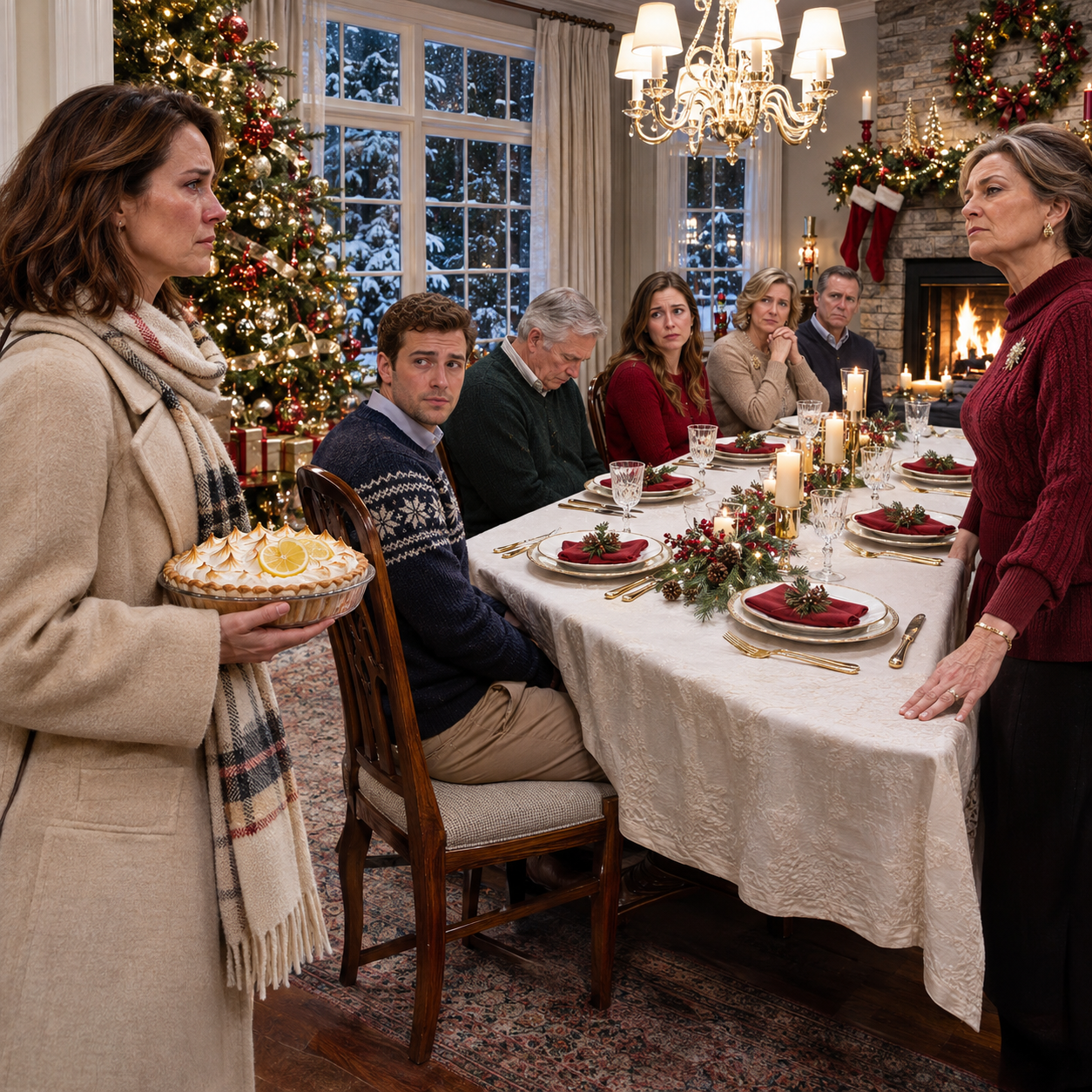
That evening, I opened my cupboard and took out the ceramic pie dish I’d finally washed after Christmas, its yellow flowers faded from years of baking. I remembered carrying it through my parents’ doorway, expecting the familiar warmth of a family gathering, only to discover there was room for my generosity but not for me. For a moment, I considered whether I would ever spend another Christmas in that dining room, but then I realized I no longer needed to decide. My place in the world didn’t depend on their seating arrangements, their apologies, or their willingness to acknowledge what I’d given.
I set the dish on the counter and began making a fresh lemon pie, this time simply because I wanted one. As I pressed the dough into its edges, I thought about Mom’s certainty that my life was somehow incomplete because I hadn’t married or raised children, and how many years I’d spent accepting that judgment without questioning it. My apartment was small, and there were no chandeliers or elegant Christmas decorations, but everything inside it represented choices I had made for myself. The family I’d tried so hard to please could no longer determine whether my life counted as a life worth celebrating.
When the pie came out of the oven, I carried a slice to the window and watched the last snow melt beneath the streetlights. I hadn’t received the Christmas apology I’d wanted from my mother, and I didn’t know whether Grace would ever understand what she’d helped destroy. But my father’s confession had finally broken the silence, the fraudulent account was gone, and the money I’d earned was mine to protect. I could leave room in my heart for forgiveness without reopening my bank account, and I could love my family without allowing them to decide my worth.
I had driven home for Christmas hoping to find my familiar seat at the family table, only to discover that the people sitting around it had forgotten what belonging was supposed to mean. The hardest lesson wasn’t learning that they could live without me; it was realizing I could live peacefully without their approval. As I took another bite of pie, my phone remained silent beside me, and for once, I didn’t feel compelled to fill that silence with an apology, a favor, or a promise. I finally understood that the most important place I’d ever needed to claim wasn’t a chair in my mother’s dining room, but a place in my own life.
THE END.
All characters and events in this story are fictional, created for storytelling and entertainment purposes. Thank you sincerely for reading. Your feedback and support are invaluable and motivate me to continue sharing more stories with you.

